

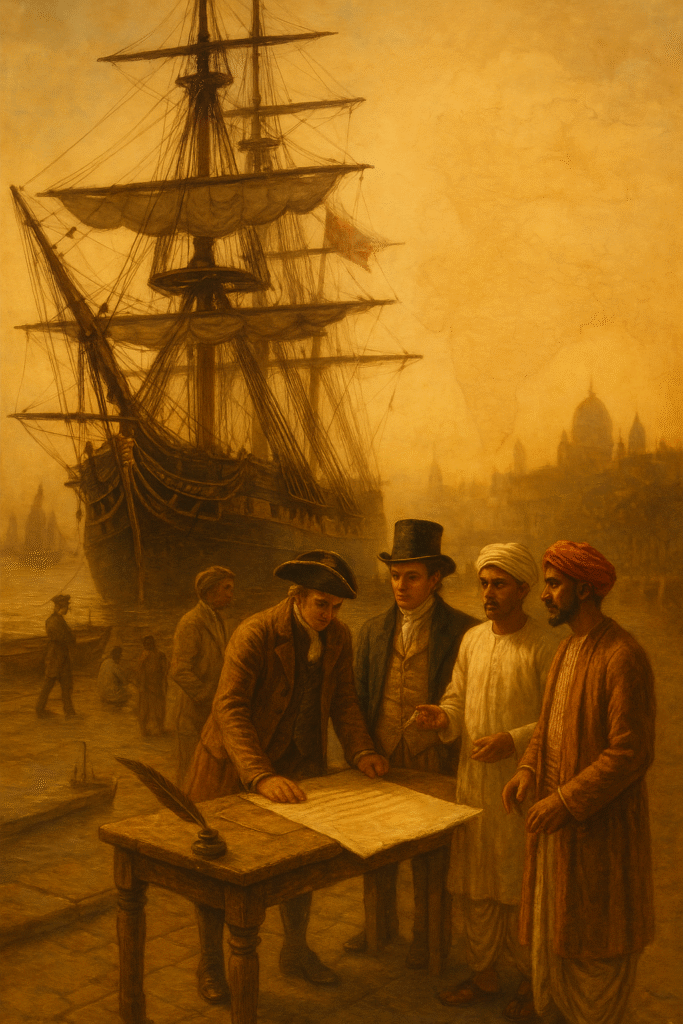

Charter Act 1813: The Beginning of a New Phase in British Indian Administration
Background: The Need for a New Review
By the early nineteenth century, circumstances in both India and Britain had changed dramatically. The East India Company’s charter, last renewed in 1793, was due for review after twenty years. Meanwhile, the Industrial Revolution in Britain was in full swing, and British manufacturers were eager to access India’s vast market. Thus, the Charter Act of 1813 emerged as a crucial legislative measure, redefining not only commercial boundaries but also the social, educational, and administrative framework of British India.
Main Provisions of the Act
The most significant feature of this Act was the end of the East India Company’s trade monopoly in India. For the first time, British merchants, other than the Company, were permitted to trade with India. However, the Company retained its monopoly over trade with China and in tea. This marked a clear shift — from a closed commercial empire to an open imperial economy. India was now formally integrated into the expanding network of British capitalism.
Another landmark provision was the authorization of Christian missionaries to enter India for the purpose of “moral and religious improvement.” While officially presented as a humanitarian initiative, it was, in practice, a tool of cultural influence. The missionaries established schools and churches, and their activities began to shape India’s educational and social fabric in subtle yet lasting ways.
Promotion of Education
For the first time in history, the British Parliament acknowledged its responsibility for the education of Indians. The Act earmarked an annual sum of ₹1,00,000 (one lakh rupees) “for the revival and promotion of literature and the encouragement of learning among the natives of India.”
Though the fund remained largely unused in the early years due to debates over the medium of instruction and purpose of education, it laid the foundation for a systematic English education policy in India. This decision later inspired the educational reforms of 1835 and the spread of Western knowledge systems.
The Act also introduced a measure of financial accountability. The Company’s revenues and expenditures were now to be reported to the British Parliament, creating a sense of administrative transparency — though primarily serving British interests.
Religious and Social Implications
The Charter Act of 1813 generated a heated debate in both India and Britain. Was the British presence in India purely commercial, or was it a civilizing mission? The entry of missionaries intensified the question. Many Indians viewed this as a threat to their religious and cultural autonomy, while reform-minded leaders saw an opportunity to engage with new ideas. Over time, English education and Western thought helped nurture a new educated Indian middle class — the very group that would later spearhead social reform and political awakening.
Economic Consequences
The Act opened Indian markets to British manufacturers, leading to a massive influx of British textiles. Local artisans and weavers, once thriving under indigenous industry, now faced economic decline. Indian handicrafts could not compete with the mechanized textile mills of Manchester. Thus, while the Act stimulated trade, it also marked the beginning of India’s deindustrialization under colonial rule — a shift from producer to consumer economy.
Political and Administrative Significance
The Charter Act of 1813 was more than a commercial statute; it was a constitutional milestone. It clearly defined the relationship between the British Parliament and the East India Company, asserting that political authority in India was derived from the Crown and Parliament, not the Company itself. This subtle but crucial change laid the groundwork for greater imperial control and future administrative reforms. The Acts of 1833 and 1853 would later continue this process of centralization.
A Symbolic Moment
Imagine Calcutta in 1814 — a classroom at Fort William College, where young Indian scholars are reading about European governance and law in English. Among them, a curious student wonders if one day Indians might write their own laws. That spark of thought — the idea of self-rule — was indirectly ignited by the educational and ideological changes set in motion by this very Act.
Conclusion
The Charter Act of 1813 was a watershed in the history of British India. It ended the Company’s trade monopoly, introduced state responsibility for education, encouraged missionary activity, and linked India more closely with Britain’s economic and political system. Though its immediate benefits were limited to British interests, the Act sowed the seeds of modern governance, intellectual awakening, and socio-political transformation. In essence, it marked the transition from a purely commercial empire to an empire with administrative and moral pretensions — a transformation that would shape India’s destiny for decades to come.

Charter Act 1833: The Road Toward Centralized Governance and Constitutional Reform
Background: A Turning Point in British Policy
Two decades after the Charter Act of 1813, the nature of British rule in India had transformed. The East India Company was no longer a purely commercial enterprise; it had become a governing authority responsible for the administration of a vast and diverse territory. The British Parliament realized that India could no longer be managed through fragmented presidencies and trade-driven governance. Thus, the Charter Act of 1833 was introduced — a landmark law that redefined India as a single administrative unit under centralized authority.
Main Provisions of the Act
The Charter Act 1833 completely abolished the commercial functions of the East India Company. From this point onward, the Company was to act solely as an administrative agent of the British Crown. Trade ceased to be its primary function, and governance became its main duty. This marked the official transition from a mercantile body to a political administration, establishing the foundation of the British colonial state in India.
The Act also declared that India was to be governed under the authority of the British Parliament, not merely under the Company’s discretion. It symbolized the assertion of imperial sovereignty and the beginning of formal colonial governance.
The Governor-General of India
The Act designated the Governor-General of Bengal as the Governor-General of India, giving him supreme authority over the entire country. Lord William Bentinck became the first Governor-General of India under this provision. This step unified the previously separate presidencies of Bengal, Bombay, and Madras under one central administration. It was a major step toward the political and bureaucratic unification of India.
Creation of the Legislative Council
One of the most important provisions of the Act was the establishment of a Legislative Council for the Governor-General. The Council consisted of the Governor-General and four other members, and it had the power to make laws for all British territories in India. This was the first time that India had a formal legislative body — a precursor to the future Indian Legislative Council and the concept of representative lawmaking. The centralization of legislative powers also meant that the local councils of Bombay and Madras lost their right to make independent laws.
The Move Toward a Uniform Legal System
The Act aimed to introduce a uniform legal system across India. To achieve this, it established the first Law Commission in 1834, with Lord Macaulay as its chairman. The Commission’s task was to codify and simplify Indian laws, ensuring consistency and equality before the law. The most significant outcome of this effort was the drafting of the Indian Penal Code (IPC), which was later enacted in 1860. Thus, the Charter Act 1833 was instrumental in shaping the foundations of India’s modern legal and judicial framework.
Economic and Social Impact
With the Company’s trade monopoly abolished, private British merchants and investors gained unrestricted access to Indian markets. India was transformed into a supplier of raw materials for British industries and a consumer of British manufactured goods. This marked the consolidation of economic imperialism — the subordination of India’s economy to serve Britain’s industrial interests. Traditional Indian industries and artisans suffered heavily, leading to widespread unemployment and economic dependency.

On the social front, the Act brought both hope and disappointment. For the first time, it declared that no person in India should be excluded from holding office on the grounds of religion, place of birth, descent, or color. In theory, this opened the door for educated Indians to join the administration. However, in practice, the British bureaucracy remained exclusive, and Indians continued to face discrimination. Yet, this declaration inspired a new generation of Indians to pursue education and public service, sowing the seeds of political awakening.
Centralization of Power
The Charter Act 1833 marked the complete centralization of administration in India. By transferring legislative powers solely to the Governor-General’s Council, the British ensured direct control from the center. This increased administrative efficiency, but it also weakened local representation and autonomy. The growing centralization alienated many Indians and contributed to political dissatisfaction, which would later find expression in the Revolt of 1857.
A Historical Moment
Imagine the year 1834 in Calcutta — the grand Government House illuminated as Lord William Bentinck and his advisors discuss the future of India. Should India remain a trading outpost or become a governed state? The decision to create a unified administrative structure under British Parliament was made that very year — a decision that would shape India’s destiny for more than a century.
Conclusion
The Charter Act of 1833 was a monumental step in the constitutional development of British India. It centralized power, introduced legislative and legal reforms, abolished the Company’s commercial privileges, and recognized the principle of equality in public service. At the same time, it entrenched British political control and expanded economic exploitation. Though many of its promises remained unfulfilled, the Act paved the way for future reforms, including the Charter Act of 1853, which would further evolve India’s administrative structure. In essence, the 1833 Act stands as a milestone in India’s long journey from commercial rule to structured colonial governance.

Charter Act 1853: Administrative Reform and the Move toward Modern Bureaucracy
Background: The Last of the Charter Acts
By the early 1850s the character of British rule in India had already shifted decisively from trade to administration. The East India Company was functioning largely as the executive arm of British policy rather than as a commercial cartel. The Charter Act of 1853 — the last of the periodic Charter Acts — arrived in this context with an aim to streamline governance, provide clearer legislative structures, and introduce principles of merit and accountability into the Indian service.
Main Provisions and Institutional Changes
One of the most consequential features of the 1853 Act was its reorganization of the Legislative Council. The Act enlarged the Governor-General’s Council and provided for a clearer separation between executive and legislative functions. Members appointed specifically for legislative duties were to consider laws and regulations, while administrative members focused on executive tasks. This division represented an early attempt to introduce a rudimentary separation of powers within colonial governance.
Another landmark provision was the explicit move toward open competitive recruitment for the civil service. The Act allowed appointments to the civil services to be made through competition — a principle that would later evolve into the formal Competitive Examination system associated with the Indian Civil Service (ICS). Although in practice early examinations were held in Britain, and entry barriers for Indians persisted, the principle of merit-based selection was established as official policy.
Legislative Representation and Composition
The 1853 Act also altered the composition of the legislative machinery by increasing the number of members and providing for representation from different provinces. While real political power remained firmly in British hands, the change created institutional space — however limited — for broader consultation on legal and administrative measures. These structural adjustments laid groundwork for later debates on representation and the expansion of legislative councils in subsequent acts.

Legal and Administrative Consequences
The Charter Act of 1853 reinforced earlier efforts to standardize laws and administrative procedure across British India. It encouraged the continued work of the Law Commission and supported codification projects that aimed at creating a uniform legal framework. The momentum generated by these legal reforms contributed to the later enactment of foundational codes such as the Indian Penal Code and procedural statutes.
Administratively, the Act emphasized efficiency and professionalization. By promoting recruitment on the basis of competence rather than patronage, the British aimed to create a stable, expert bureaucracy able to implement policy across a vast and culturally diverse territory.
Economic and Social Ripple Effects
The institutional reforms of 1853 had indirect economic and social consequences. Merit-based entry encouraged Indians (where opportunities allowed) to pursue Western education and professional training — a development that fed the growth of an educated middle class. This new class would later become crucial in articulating political demands and social reforms. At the same time, the continuing centralization of authority and the primacy of British interests meant that economic policies still prioritized imperial needs over indigenous development.
Limits and Criticisms
Despite its progressive rhetoric on merit and structure, the Charter Act of 1853 had significant limitations. Competitive exams were initially held in England, practical barriers limited Indian participation, and real policymaking remained concentrated among British officials. The reforms therefore strengthened the administrative machinery without substantially broadening political power or correcting the deep economic imbalances of colonial rule.
Moreover, some historians argue that the Act’s technical and institutional focus diverted attention from urgent socio-economic grievances in the countryside — grievances that would explode dramatically in the Revolt of 1857 a few years later.
An Imagined Scene
Picture a young Indian graduate in London in 1854 preparing for the new examinations, hopeful yet aware of the odds. He studies law, history and public administration, dreaming that merit might open the gates of official service. Across the Indian continent, rural cultivators and artisans confront crop failures, high taxes and market dislocation — realities that institutional reform alone cannot instantly cure.
Conclusion: Transition and Legacy
The Charter Act of 1853 occupies a pivotal place in India’s constitutional history. It did not dismantle colonial power; rather, it refined the instruments of governance — reorganizing legislative structures, endorsing competitive recruitment, and promoting legal codification. These changes moved British India toward a more centralized, bureaucratic state and planted seeds for modern administrative practices.
Ultimately, the Act’s legacy is double-edged: on one hand it advanced administrative professionalism and legal uniformity; on the other hand it masked persistent inequalities and political exclusions. Understanding the 1853 Act helps explain both the emergence of a professional civil service and the political tensions that culminated in the mid-19th century upheavals — events that would reshape colonial rule and India’s path toward self-rule.

