
Bureaucracy: Meaning, Characteristics, and My Learnings from the Administrative System
Bureaucracy is often misunderstood as slow or rigid, but through close observation of governance and public administration, I have learned that bureaucracy is the backbone of any organized system. It is an administrative structure designed to ensure order, fairness, and continuity in the functioning of a country, organization, or institution.
What Is Bureaucracy?
Bureaucracy is an administrative system that functions according to established rules and procedures to run governance and organizations smoothly. It consists of a well-organized structure of officials and employees who perform their duties based on clearly defined roles, responsibilities, and regulations.
Key Features of Bureaucracy
1. Formal Structure
Bureaucracy follows a defined hierarchy where rights, duties, and authority are clearly distributed at each level. This clarity prevents confusion and overlapping responsibilities.
2. Rule-Based Functioning
All tasks are performed according to predetermined rules and procedures. This ensures discipline, uniformity, and consistency in decision-making.
3. Specialization
Work is divided based on expertise and skills. This specialization improves efficiency and helps in making informed decisions.
4. Fairness and Impersonality
Decisions are taken based on facts and rules, not personal emotions or favoritism. This creates trust in the administrative system.
5. Written Documentation
Every action and decision is recorded in writing. Documentation ensures transparency, accountability, and future reference.
6. Emphasis on Public Service
The primary objective of bureaucracy is to serve the public and make governance effective at all levels.
Importance of Bureaucracy
- It acts as the backbone of governance and administration.
- It serves as a bridge between the government and the public.
- It helps in implementing policies and managing resources efficiently.
Criticism of Bureaucracy
1. Complex Procedures
Excessive rules and paperwork often lead to delays in decision-making and implementation.
2. Lack of Flexibility
Rigid rules sometimes make it difficult for bureaucracy to adapt to new ideas and changing situations.
3. Corruption
In some cases, misuse of power, red-tapism, and bribery reduce the effectiveness of bureaucracy.
From my learning, bureaucracy itself is not the problem; rather, the way it is used determines whether it becomes a tool for development or an obstacle.
How Bureaucracy Works: Step-by-Step
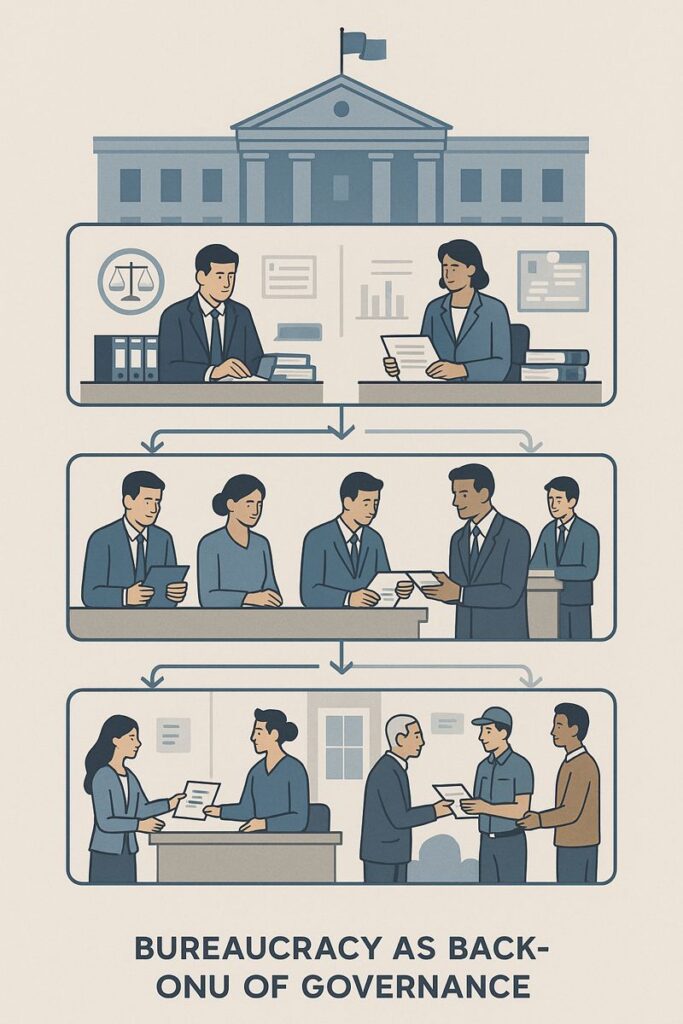
1. Hierarchy and Responsibilities
- Higher level: Policy formulation and major administrative decisions
- Middle level: Policy implementation and supervision
- Lower level: Ground-level execution of schemes and services
2. Rules and Procedures
Every decision and action follows established rules, ensuring fairness and transparency.
3. Written Documentation
Records of work and decisions act as evidence for accountability and future investigation.
4. Division of Work
Responsibilities are assigned according to skills and expertise, increasing productivity and quality of outcomes.
5. Decision-Making Process
Decisions are based on facts, data, and rules, eliminating personal bias.
6. Accountability
Each officer is accountable for specific duties, making responsibility clearly identifiable.
7. Public Interface
Bureaucracy interacts directly with citizens, addressing problems and delivering government schemes at the grassroots level.
Example: Implementation of a Government Scheme
Consider the implementation of a government scheme like Pradhan Mantri Awas Yojana:
- The government designs and announces the scheme.
- Senior officials prepare the policy framework.
- Middle-level officials monitor and coordinate implementation.
- Lower-level staff ensure benefits reach eligible citizens.
This example shows how bureaucracy transforms policy decisions into real-life outcomes.
Characteristics of Bureaucracy
Hierarchy
A clear chain of command simplifies coordination and control.
Rule-Based System
Uniform rules ensure discipline, equality, and transparency.
Division of Work
Task specialization enhances efficiency and expertise.
Formalization
Official communication follows formal procedures, maintaining professionalism.
Impersonality
Decisions are objective, avoiding personal bias or discrimination.
Written Records
Documentation strengthens accountability and transparency.
Specialization and Expertise
Recruitment and promotion are based on qualifications and merit.
Accountability
Every official is responsible for their assigned duties.
Stability
Permanent staff ensure continuity despite political changes.
Centralized Authority
Major decisions are taken at the top to maintain coordination.
Goal Orientation
All actions are directed toward achieving organizational or governmental goals.
Professionalism
Personal and official lives are kept separate to ensure integrity.
My Personal Learnings from Bureaucracy
Studying bureaucracy taught me that stability, patience, and structure are essential for long-term governance. While speed is important, fairness and accountability matter more. A system built on rules may seem slow, but it prevents chaos and arbitrary power.
Conclusion
Bureaucracy is an organized, rule-based, and professional administrative system that ensures continuity, fairness, and effective governance. Although rigid rules and complex procedures may sometimes slow progress, the right use of bureaucracy plays a crucial role in the development of society and the nation.
Related Article: Public Administration: Meaning, Scope, and Importance
Frequently Asked Questions (FAQs)
What is bureaucracy in simple words?
Bureaucracy is a system of administration where work is done according to rules, hierarchy, and written procedures to ensure fairness and efficiency.
Why is bureaucracy important?
It helps in implementing government policies, maintaining law and order, and ensuring continuity in governance.
What are the main characteristics of bureaucracy?
Hierarchy, rule-based functioning, specialization, written documentation, impersonality, and accountability are its main characteristics.
What are the disadvantages of bureaucracy?
Excessive rules, lack of flexibility, delays in decision-making, and corruption are some common criticisms.
Can bureaucracy support development?
Yes, when used efficiently and ethically, bureaucracy plays a vital role in national development and public welfare.
Importance of Bureaucracy
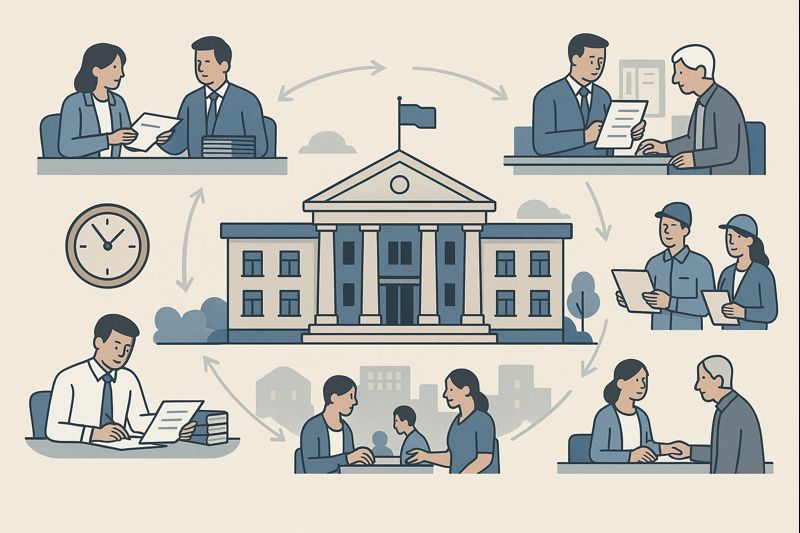
The importance of bureaucracy is highly significant due to its central role in governance and administration. Through my understanding of administrative systems, I have realized that bureaucracy is not merely a formal structure but a vital mechanism that ensures continuity, stability, and effective public service. It contributes to the smooth functioning and overall development of a country, organization, or institution.
Smooth Functioning of Governance and Administration
Bureaucracy makes governance effective through a well-organized administrative system. It ensures that government decisions are translated into action at the ground level. By coordinating between policymakers and citizens, bureaucracy creates a functional link between the government and the public.
Helpful in Policy Implementation
One of the most important roles of bureaucracy is implementing government policies and welfare schemes. Bureaucratic institutions ensure that policies reach the intended beneficiaries and are executed according to rules, objectives, and timelines.
Political Stability and Continuity
Bureaucracy continues to function even during political instability or changes in government. This administrative continuity maintains stability in the democratic system and ensures that public services are not disrupted.
Specialization and Administrative Efficiency
Division of work and specialization enhance efficiency within bureaucracy. Officials develop expertise in specific fields, enabling them to handle complex administrative problems and contribute effectively to policy formulation and implementation.
Maintenance of Law and Order
Bureaucracy functions strictly according to laws and rules, helping to establish discipline and justice in society. It plays a key role in maintaining law and order and preventing corruption, misuse of power, and administrative irregularities.
Transparency and Accountability
Written documentation and clearly defined responsibilities ensure transparency in bureaucratic functioning. Every officer is accountable for their duties, which increases public trust and confidence in the administrative system.
Social and Economic Development
Bureaucracy plays a crucial role in social and economic development by implementing schemes related to education, health, agriculture, employment, and infrastructure. It helps address the needs of weaker and marginalized sections of society and improves their living conditions.
Role in Emergency and Crisis Situations
During natural disasters, epidemics, or national emergencies, bureaucracy ensures smooth execution of relief, rescue, and rehabilitation operations. It supports the government in crisis management and coordination at multiple levels.
Protection of Democratic Values
Bureaucracy safeguards democratic values by ensuring that government actions are carried out within constitutional and legal frameworks. It helps maintain accountability and transparency, reinforcing public-oriented governance.
Promotion of National Integration
The uniform administrative structure of bureaucracy promotes national integration by ensuring similar standards of governance across different regions. It helps reduce regional, linguistic, caste, and religious disparities through impartial administration.
Summary
Bureaucracy is the backbone of governance and administration in any country. Acting as a bridge between the government and the public, it ensures effective policy implementation, administrative continuity, and public welfare. Through efficiency, transparency, and accountability, bureaucracy plays a vital role in maintaining social order, democratic values, and national development.
Related Reading: Meaning and Functions of Bureaucracy
Criticism of Bureaucracy
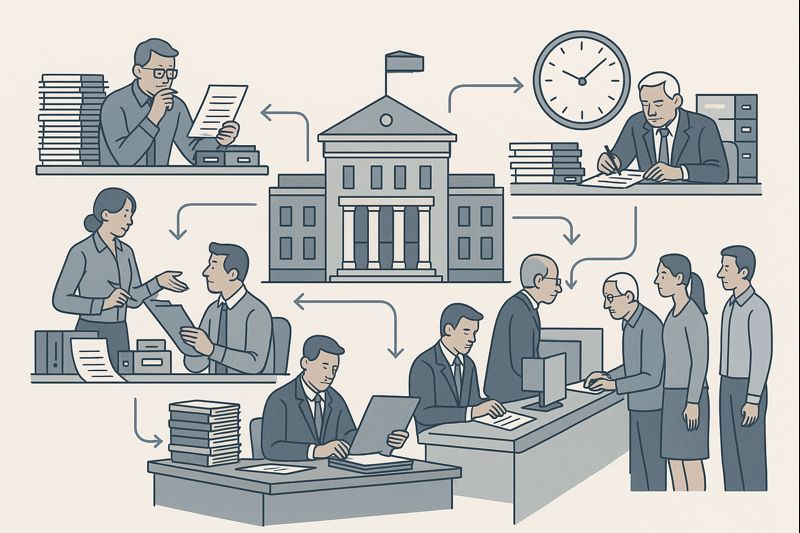
Despite its importance in governance and administration, bureaucracy is often criticized for its rigid structure, complex procedures, and limited adaptability. Through observation and study, it becomes clear that while bureaucracy ensures order and stability, certain structural weaknesses reduce its effectiveness and public trust. The major criticisms of bureaucracy are discussed below.
Red Tape
Bureaucracy is characterized by excessive rules, formalities, and procedural requirements. This red tape leads to delays in decision-making and makes administrative work complex and time-consuming, often slowing down development initiatives.
Lack of Flexibility
Bureaucratic functioning is strictly rule-based and formal. As a result, it struggles to respond quickly to changing circumstances or new challenges, limiting its ability to innovate or adapt.
Corruption
At certain levels, bureaucracy faces issues such as corruption, bribery, and misuse of power. These practices can lead to the exploitation of public resources and violation of citizens’ rights.
Lack of Public Connection
Bureaucratic officials often remain distant from the everyday problems of citizens. Weak communication with the public can make administration appear insensitive, unresponsive, and disconnected from ground realities.
Excessive Centralization
Decision-making authority in bureaucracy is usually concentrated at higher levels. This limits the ability of lower-level officials to address local issues efficiently and delays problem-solving at the grassroots level.
Inefficiency
Over-formalization and procedural complexity often reduce administrative efficiency. This inefficiency delays the implementation of government plans and public welfare policies.
Lack of Initiative and Creativity
Bureaucratic officials are expected to strictly follow rules and orders. This leaves little room for innovation, creativity, or independent thinking, discouraging proactive problem-solving.
Inertia and Resistance to Change
Bureaucracy tends to resist reforms and new approaches. Abandoning traditional methods and adopting modern practices often occurs slowly, affecting administrative modernization.
Insensitivity to Public Needs
Excessive focus on procedures sometimes overshadows the real needs of citizens. As a result, public grievances and complaints may not receive timely or effective solutions.
Concentration of Power
Power within bureaucracy is often concentrated in the hands of a few senior officials. This increases the risk of bias, favoritism, and discriminatory decision-making.
High Administrative Cost
The large size of the bureaucratic system and its complex procedures increase administrative expenditure. This places an additional financial burden on taxpayers.
Lack of Performance-Based Evaluation
Evaluation in bureaucracy is generally based on seniority and rule compliance rather than efficiency and performance. This reduces motivation among capable and hardworking employees and discourages excellence.
Summary
Due to its rigid, rule-bound, and hierarchical nature, bureaucracy often suffers from inefficiency, delay, and alienation from the public. Although it remains an essential administrative system, meaningful reforms are required to make bureaucracy more flexible, transparent, responsive, and people-oriented.
Related Reading: Importance of Bureaucracy
Conclusion of Bureaucracy
The conclusion of bureaucracy highlights that it is an organized, rule-based administrative system essential for the smooth functioning of governance and administration. Without bureaucracy, systematic development and effective functioning of any society or nation would not be possible. At the same time, bureaucracy has certain limitations and criticisms, which need continuous attention and reform.
Positive Aspects of Bureaucracy
Smooth Administration
Bureaucracy ensures organized and efficient governance by providing a stable administrative structure.
Law Compliance
It functions strictly according to rules and procedures, ensuring discipline, fairness, and uniformity in administration.
Long-Term Stability
Administrative work continues smoothly even during political instability, maintaining continuity in governance.
Specialization
Division of work and merit-based functioning increase productivity, efficiency, and quality of decision-making.
Accountability and Transparency
Written records of decisions and actions ensure accountability and transparency in public administration.
Challenges of Bureaucracy
Despite its strengths, bureaucracy faces several challenges that limit its effectiveness:
- Red Tape and Delay: Excessive procedures often lead to delays in decision-making.
- Distance from the Public: Bureaucratic officials sometimes ignore or fail to understand public needs.
- Corruption: Abuse of power and administrative irregularities are observed in some cases.
- Lack of Flexibility: Rigid rules make it difficult to adapt to changing circumstances.
Future Direction of Bureaucracy
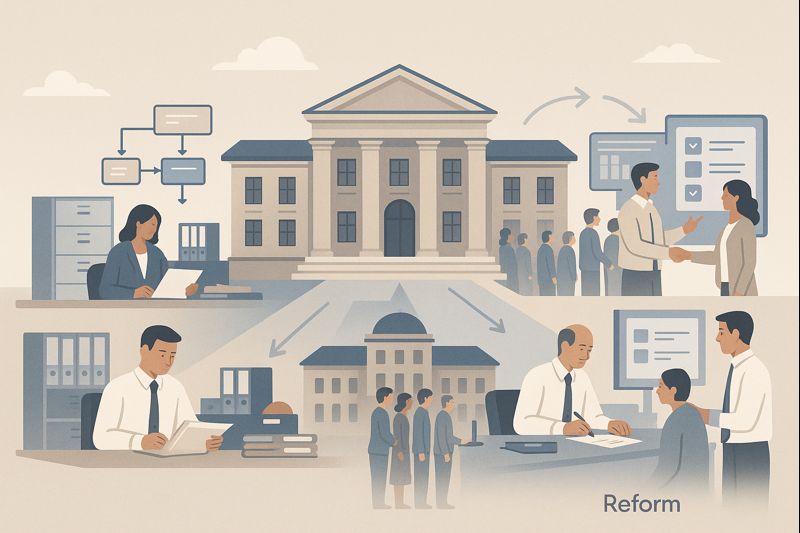
To remain relevant and effective, bureaucracy needs to become more flexible, people-centric, and transparent.
Digitalization and E-Governance
Administrative processes can be simplified and accelerated through digital technology and e-governance initiatives.
Administrative Reforms
Rules and procedures should be made more practical, simplified, and less complex to improve efficiency.
Public Connectedness
Officials must be sensitized to public needs and problems to ensure responsive and humane administration.
Control of Corruption
Strict monitoring, accountability mechanisms, and transparency can help prevent corruption and misuse of power.
Summary
Bureaucracy is the backbone of governance and administration. Without it, effective implementation of policies and schemes is not possible. However, continuous reforms and innovation are essential to overcome its limitations. An efficient, transparent, and public-oriented bureaucracy can play a decisive role in the sustainable development of society and the nation.
Reference
- Max Weber (1947), The Theory of Social and Economic Organization, Oxford University Press.
- Fadia, B. L. & Fadia, Kuldeep (2019), Public Administration: Administrative Theories and Concepts, Sahitya Bhawan.
- Prasad & Prasad (2018), Administrative Thinkers, Sterling Publishers.
- Indian Constitution – Articles related to Public Services (Articles 309–323).
- Second Administrative Reforms Commission (ARC), Government of India – Reports on Bureaucratic Reforms.
- UPSC General Studies Paper II – Governance, Constitution, Polity, Social Justice.
GOOD
Быстрый микрокредит онлайн – моментальное одобрение и удобное погашение
микрокредиты в Казахстане https://mikrokredityvsem.kz/ .
Выгодные займы онлайн с низкой процентной ставкой и гибкими условиями
займы онлайн https://news365.kz/ .
Простые и удобные микрокредиты – деньги на любые нужды
микрокредиты онлайн https://mikrokredityvsem.kz/ .
Клининг для тех, кто ценит время: Ваш дом сияет чистотой, пока вы занимаетесь важными делами
клининговая компания москва https://klining-v-moskve0.ru/ .
Клининг-компания Москвы №1: 12 лет опыта и цены ниже средних
клининг москва клининг москва .
Yeni başlayanlar üçün Pinco Casino – necə oynamaq və qazanmaq olar?
pinko kazino https://www.pincocasinogiris-az.com .
Авторазборка: проверенные запчасти по низким ценам
авторазбор https://www.avtorzborka3-moskva.ru .
The best free online rubber stamp generator – create unique stamps in just a few clicks
online stamp maker free https://make1-stamp-online.com .
Free rubber stamp maker – customize size, shape, and text instantly
stamp maker stamp maker .
Мощные светодиодные светильники для производственных помещений от производителя
прожекторные светодиодные лампы https://www.proizvodstvo-svetodiodnih-svetilnikov.ru .
Купи подписку на Spotify и забудь о рекламе в любимых треках
премиум подписка спотифай https://podpiska-spotify-1.ru .
Самые надежные камеры заднего вида с гарантией производителя
купить камеру заднего вида https://camera-zadnego-vida.ru/ .
Демонтаж и установка сантехники в СПб – актуальные цены от специалистов
прайс на сантехнические работы в спб http://www.remont-santehniki-price.ru .
Услуги сантехника в СПб – прайс на обслуживание инженерных систем
монтаж сантехники цена за работу http://santeh1-montazh-price.ru/ .
Большой выбор мебели для кафе и баров – от классики до современного дизайна
мебель для кафе на заказ https://www.mebel-dlya-kafe.ru .
Оформление технологической карты на погрузочно-разгрузочные работы с учетом требований заказчика
типовая технологическая карта проведение погрузочно разгрузочных работ с применением автопогрузчика http://www.tekhnologicheskie-karty.ru/ .
HM
Ok
Good