Key Members of the Constituent Assembly of India

Whenever I read about the Indian Constitution, one question always arises in my mind — who were the people behind this remarkable document, and under what circumstances did they create it? This curiosity led me to explore the lives, struggles, and vision of the key members of the Constituent Assembly of India.

The Constituent Assembly was not merely a political body; it was a historic platform where the future of a newly independent nation was carefully designed. India had just emerged from centuries of colonial rule, and the responsibility of shaping a democratic framework for such a diverse country rested on the shoulders of a few visionary leaders.

In this article, I am not only presenting historical facts, but also sharing my personal learning in the form of a story. You will discover how Dr. B. R. Ambedkar, Dr. Rajendra Prasad, Jawaharlal Nehru, Sardar Vallabhbhai Patel, and many others transformed their ideas into the world’s longest written constitution.

📘 Top Study Product
Study Product

High-Quality Study Material for Exam Preparation

⭐⭐⭐⭐☆ (4.6/5 Rated by Students)
  • ✔ Structured & syllabus-focused content
  • ✔ Clear explanations & easy revision
  • ✔ Trusted by competitive exam aspirants
  • ✔ Ideal for long study sessions
🛒 Check Price on Amazon

The journey of the Constituent Assembly teaches us that democracy is not built overnight. It is shaped through debates, disagreements, compromises, and above all, a deep commitment to justice, equality, and liberty. Every article of the Constitution reflects the dedication and sacrifices of its makers.

As you read further, you will not only gain knowledge about the key members of the Constituent Assembly, but you will also understand how their vision continues to guide modern India. This is not just a story of the past — it is a lesson for the present and a guide for the future.
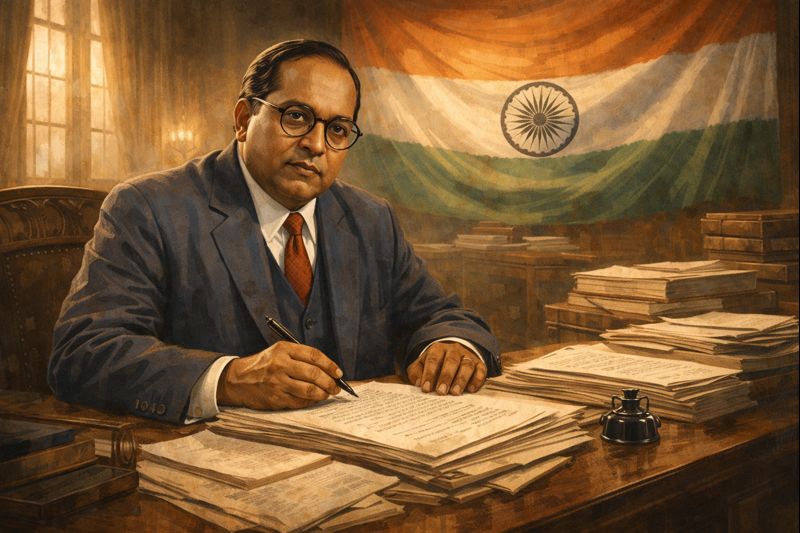
What Was the Constituent Assembly?

The Constituent Assembly was the historic institution responsible for laying the foundation of independent India’s future. Its primary task was to draft a permanent Constitution for the country, reflecting the aspirations, values, and diversity of the Indian people. It was not merely a legislative body, but a visionary forum where democracy, justice, equality, and liberty were carefully shaped by the Key Members of the Constituent Assembly of India.

When I first studied the Constituent Assembly in detail, I realized that it represented more than political decision-making. It symbolized India’s transition from colonial rule to self-governance, where Indians themselves would decide how their nation should be governed.

Formation of the Constituent Assembly

The Constituent Assembly was formed in 1946 under the Cabinet Mission Plan introduced by the British Government. Its objective was to allow Indian representatives to draft their own Constitution without external control. Initially, the Assembly consisted of 389 members, representing provinces, princely states, and major political groups.

After the partition of India in 1947, the members elected from areas that became Pakistan withdrew, reducing the total strength of the Indian Constituent Assembly to 299 members. These leaders later became known as the Key Members of the Constituent Assembly of India, who worked tirelessly for nearly three years to create the Constitution of India.

The Historic Story of the First Meeting

The first meeting of the Constituent Assembly was held on 9 December 1946 in New Delhi. The atmosphere on that day was filled with hope, responsibility, and a deep sense of historical importance. Every member present understood that they were participating in the creation of a nation.

Dr. Sachchidananda Sinha, the oldest member, was appointed as the temporary President of the Assembly. His opening address reminded the members that the decisions taken inside that hall would influence generations of Indians.

From that very day, the Constituent Assembly began a journey that transformed India into a sovereign, democratic, and republic nation — a journey whose impact is still visible in every article of the Indian Constitution.

📘 Top Study Product
Study Material

Premium Study Material for Competitive Exams

⭐⭐⭐⭐☆ (4.7/5 Student Rated)
  • ✔ Structured & syllabus-aligned content
  • ✔ Clear explanations & quick revision support
  • ✔ Trusted by serious aspirants
  • ✔ Ideal for long study sessions
🛒 Check Price on Amazon

Dr. B. R. Ambedkar: The Architect of the Constitution

For me, Dr. B. R. Ambedkar is not just a leader, but a living symbol of struggle, courage, and self-respect. Born into a society that subjected him to discrimination and humiliation, he transformed education into his strongest weapon. His life proves that determination can change even the harshest destiny.

Dr. Ambedkar did not limit himself to academic excellence alone; he dedicated his entire life to the cause of social justice. As one of the Key Members of the Constituent Assembly of India, his presence ensured that the Indian Constitution would stand firmly on the principles of equality, dignity, and human rights.

Ambedkar’s Struggle and Contribution

Dr. Ambedkar’s journey was filled with continuous struggle. From childhood discrimination to professional challenges, he faced every hardship with resilience. He studied at Columbia University and the London School of Economics, and returned to India with a clear vision of building a just society.

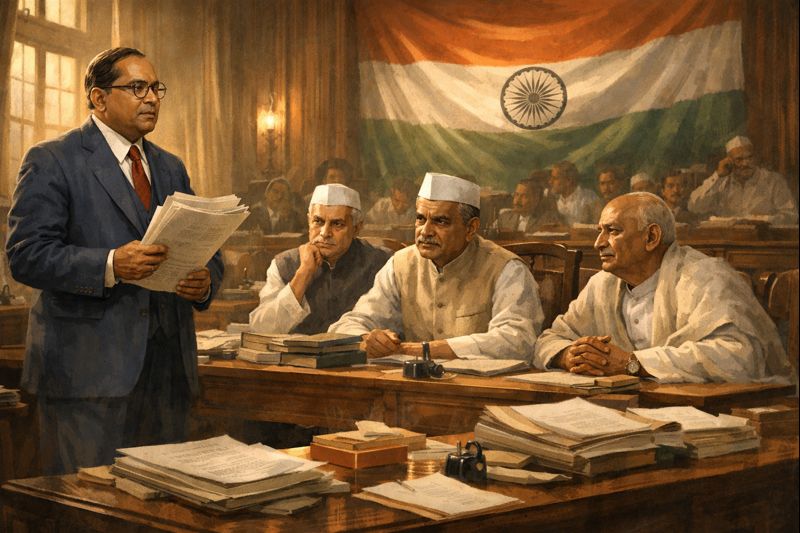
He was appointed as the Chairman of the Drafting Committee of the Constituent Assembly. In this role, he shaped each article of the Constitution in a way that protected the rights of the marginalized and ensured equal opportunities for all citizens. He firmly believed that political freedom has no meaning without social and economic equality.

Fundamental Rights in the Constitution

The Fundamental Rights drafted under Dr. Ambedkar’s guidance act as a shield for every Indian citizen today. These rights guarantee equality, freedom of speech and expression, religious liberty, protection from exploitation, and the right to constitutional remedies.

Whenever I read about Fundamental Rights, I realize that Dr. Ambedkar did not design the Constitution merely as a legal document, but as a moral promise to the people of India. He ensured that no citizen would ever be considered inferior in the eyes of law.

Dr. B. R. Ambedkar’s contribution teaches us that true nation-building is achieved not through power, but through justice, compassion, and equality.

Dr. Rajendra Prasad: President of the Constituent Assembly

Dr. Rajendra Prasad’s leadership was calm, dignified, and yet remarkably strong. As the first permanent President of the Constituent Assembly and one of the Key Members of the Constituent Assembly of India, he carried not only the responsibility of guiding discussions, but also the moral authority to protect democratic values. His presence ensured discipline, balance, and respect within the Assembly.

To me, Dr. Rajendra Prasad represents the idea that true leadership does not require loud speeches or domination. Instead, it grows from integrity, patience, and an unwavering commitment to fairness. He guided the Assembly with humility and wisdom during one of the most crucial phases of Indian history.

Leadership Style

Dr. Rajendra Prasad followed a truly democratic leadership style. He listened carefully to every member, regardless of political position or ideology. He believed that the Constitution belonged to the people of India, and therefore every opinion deserved respect and serious consideration.

During intense debates, when emotions often ran high, Dr. Rajendra Prasad maintained a calm and balanced atmosphere. With gentle words and firm principles, he encouraged dialogue instead of conflict, and cooperation instead of confrontation.

His leadership teaches us that democracy is strengthened not by authority alone, but by mutual respect, patience, and thoughtful discussion. This is why Dr. Rajendra Prasad is remembered as one of the most ideal and respected Presidents of the Constituent Assembly.

📘 Top Study Product
Study Material

High-Quality Study Material for Competitive Exams

⭐⭐⭐⭐☆ (4.6/5 Student Rated)
  • ✔ Structured & syllabus-focused content
  • ✔ Clear explanations & quick revision
  • ✔ Trusted by serious aspirants
  • ✔ Ideal for long study sessions
🛒 Check Price on Amazon

Role of Jawaharlal Nehru

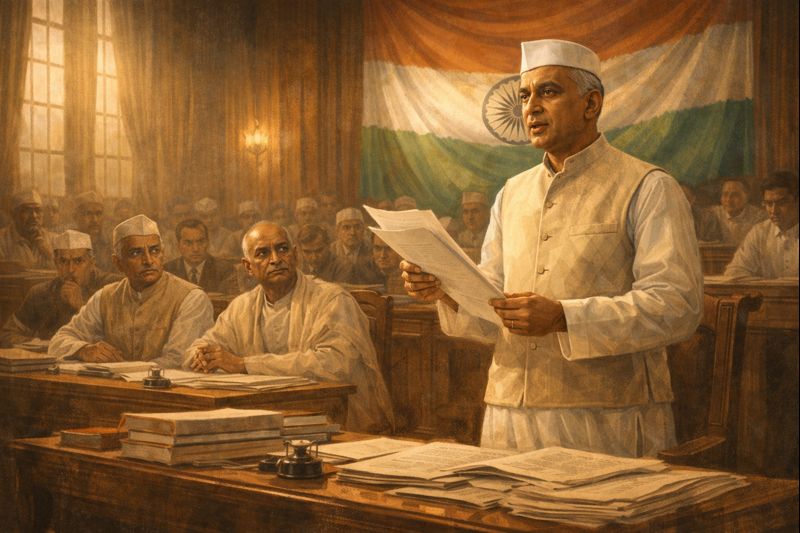
Jawaharlal Nehru’s vision was not limited to achieving political freedom; his true dream was to build a modern, scientific, and democratic India. He believed that independence would be meaningless unless it created opportunities, dignity, and equality for every citizen. In the Constituent Assembly, he emerged as a leader whose thoughts were far ahead of his time.

For me, Nehru represents the idea that leadership is not about power, but about shaping the future with wisdom and responsibility. His speeches in the Constituent Assembly reflected his deep faith in democracy, human rights, and social justice.

The Story of the Objectives Resolution

On 13 December 1946, Jawaharlal Nehru presented the historic Objectives Resolution in the Constituent Assembly. This resolution later became the philosophical foundation of the Indian Constitution. It declared India to be a sovereign, independent, democratic republic committed to justice, liberty, equality, and fraternity.

The Objectives Resolution was not merely a political statement; it was a moral promise to the people of India. The principles expressed in this resolution were later incorporated into the Preamble of the Constitution, making it the soul of the constitutional framework.

Whenever I read the Objectives Resolution, I realize that Nehru was not only addressing the leaders of his time, but also speaking to future generations. His words continue to guide India’s democratic journey even today.

Jawaharlal Nehru’s contribution reminds us that nation-building is not only about writing laws, but about creating a vision that inspires millions to believe in a better tomorrow.

Other Key Members

  • Sardar Vallabhbhai Patel — The architect of national integration, who united the princely states and strengthened India’s administrative unity.
  • Maulana Abul Kalam Azad — A strong supporter of education, culture, and secularism, who reinforced the values of tolerance and unity in the Constitution.
  • K. M. Munshi — A distinguished scholar who contributed clarity, balance, and cultural depth to the language of the Constitution.
  • H. C. Mukherjee — The Vice-President of the Constituent Assembly, who ensured democratic discipline and procedural harmony during the proceedings.

Each Member’s Unique Role

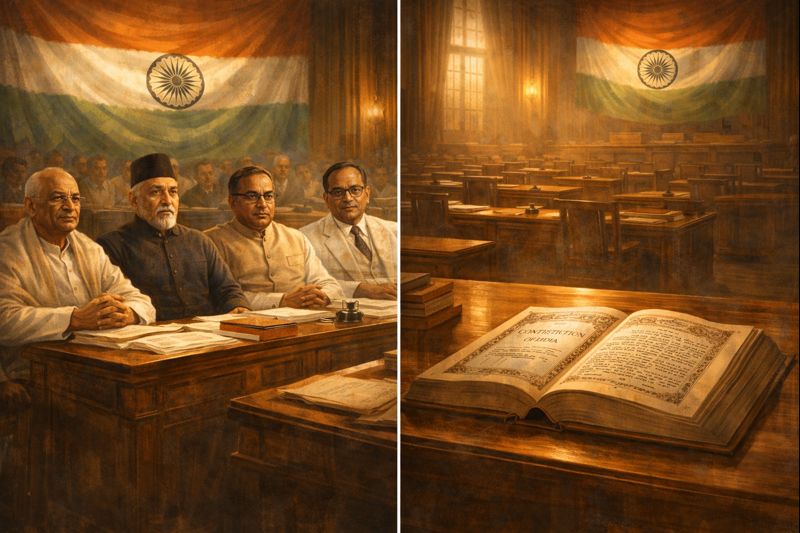
The Constitution was not the work of a single individual. It was the result of collective wisdom, diverse experiences, and shared responsibility shaped by the Key Members of the Constituent Assembly of India. Every member of the Constituent Assembly brought a unique perspective that enriched the final document.

Sardar Patel provided administrative strength, Maulana Azad offered moral and educational vision, K. M. Munshi shaped constitutional language with precision, and H. C. Mukherjee maintained institutional balance. Together, their combined efforts transformed the Constitution into a living document of unity and justice.

When I reflect on their contributions, I realize that great achievements are never created alone. The Indian Constitution stands as a powerful example of how collective effort can build the foundation of a nation.

📘 Top Study Product
Study Material

Premium Study Material for Competitive Exams

⭐⭐⭐⭐☆ (4.7/5 Student Rated)
  • ✔ Structured & syllabus-focused content
  • ✔ Clear explanations & smart revision
  • ✔ Trusted by aspirants nationwide
  • ✔ Ideal for long study sessions
🛒 Check Price on Amazon

My Learnings: Life Lessons from the Constituent Assembly

While studying the Key Members of the Constituent Assembly of India and their work, I learned that nation-building is not merely about writing laws, but about shaping values, responsibilities, and moral vision. These leaders never placed personal interests above national interest, and this is what made their contribution truly historic.

I also realized that the Key Members of the Constituent Assembly of India were not only politicians, but also teachers, philosophers, and guides who created a roadmap for future generations of India.

The Value of Democracy

The Constituent Assembly taught me that democracy is not only a system of governance, but a shared responsibility of every citizen. Every voice matters, even when it represents a minority or an unpopular opinion. Democracy becomes strong only when disagreement is respected.

Democracy gives us the right to question, to express, and to demand change — but it also gives us the duty to respect the Constitution and the rule of law. This balance is the true strength of a democratic society.

Whenever I read the debates of the Constituent Assembly, I understand that the freedoms we enjoy today were built on countless discussions, sacrifices, and visionary decisions.

These lessons from the Constituent Assembly remind me every day that being a responsible citizen is the greatest service to democracy.

Message for Today’s Youth

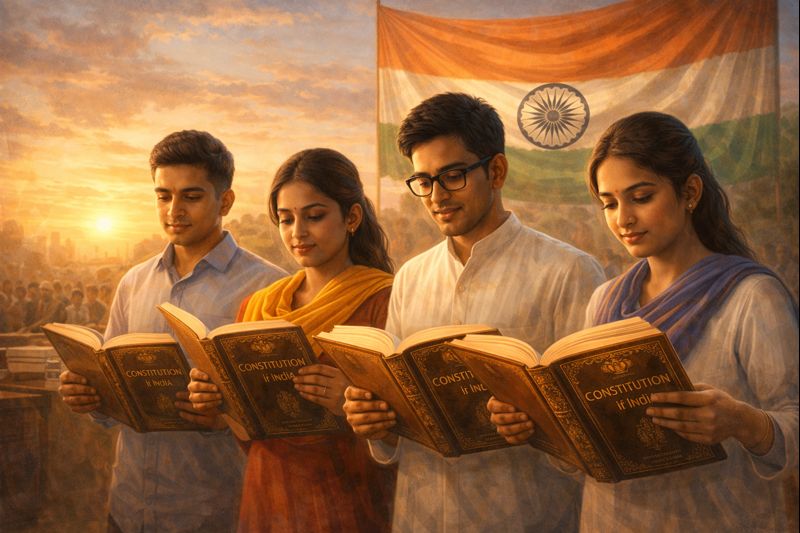
If today’s youth begin to understand the Constitution not merely as a textbook for examinations or a legal document, but as a guiding philosophy of life, the future of India can become even brighter. The Constitution does not only grant us rights; it also teaches us how to become responsible and conscious citizens.

The youth of today are rich in energy, knowledge, and technological skills. If they adopt the core values of the Constitution — justice, liberty, equality, and fraternity — they can bring meaningful change not only in their own lives, but also in society as a whole.

The members of the Constituent Assembly have left behind a path that inspires us to think beyond personal success and work for collective progress. Their vision reminds us that true development begins with awareness and responsibility.

In my view, democracy will become truly strong only when young citizens understand both their rights and their duties. When youth respect the Constitution, follow its principles, and protect its spirit, they become the strongest pillar of the nation.

My message to today’s youth is simple yet powerful — know your Constitution, respect your Constitution, and live by its values, because this is the first step toward true nation-building.

Conclusion

The Key Members of the Constituent Assembly of India are not merely figures of history; they are guiding lights for the present and the future of India. Their vision, struggles, and dedication continue to shape the democratic foundation of the nation.

Dr. B. R. Ambedkar’s commitment to equality, Dr. Rajendra Prasad’s balanced leadership, Jawaharlal Nehru’s visionary thinking, Sardar Patel’s spirit of unity, and the collective wisdom of all members together gifted India a Constitution that stands among the finest in the world.

Through this journey, I have realized that the Constitution is not just a collection of laws, but a living philosophy that inspires us to become better citizens every day.

If we can adopt even a small part of the values upheld by the Key Members of the Constituent Assembly of India, we can protect our rights with confidence and fulfill our duties with sincerity.

Ultimately, it can be said that the Key Members of the Constituent Assembly of India are not only heroes of the past, but true guides for generations yet to come.

The values upheld by the Key Members of the Constituent Assembly of India remain relevant even in modern times.

Frequently Asked Questions (FAQ)

What was the Constituent Assembly?

The Constituent Assembly was the body responsible for drafting the Constitution of India. The Key Members of the Constituent Assembly of India represented the will of the people in shaping the country’s democratic framework.

When was the Constituent Assembly formed?

The Constituent Assembly was formed in 1946 under the Cabinet Mission Plan.

How many members were there in the Constituent Assembly?

Initially, the Assembly had 389 members. After the partition of India, the number was reduced to 299 members who later became known as the Key Members of the Constituent Assembly of India.

What was Dr. B. R. Ambedkar’s role?

Dr. B. R. Ambedkar was the Chairman of the Drafting Committee and played the most important role in framing the Constitution, which is why he is known as the Architect of the Indian Constitution.

Who was the President of the Constituent Assembly?

Dr. Rajendra Prasad was the permanent President of the Constituent Assembly.

Who presented the Objectives Resolution?

The Objectives Resolution was presented by Jawaharlal Nehru on 13 December 1946 and later became the foundation of the Preamble of the Constitution.

When did the Constitution of India come into force?

The Constitution of India came into force on 26 January 1950.

What lessons do we learn from the Constituent Assembly?

The Constituent Assembly teaches us the values of democracy, equality, justice, tolerance, and collective responsibility.

References

  • Constitution of India – Government of India Publication
  • Constituent Assembly Debates
  • Speeches and Writings of Dr. B. R. Ambedkar
  • Jawaharlal Nehru – Objectives Resolution, 1946
  • Autobiography and Memoirs of Dr. Rajendra Prasad
  • Official Website of the Parliament of India
  • National Archives of India
  • NCERT History and Political Science Textbooks
  • Research Articles and Academic Journals on Indian Constitution
📘 Top Study Product
Study Material

High-Quality Study Material for Competitive Exams

⭐⭐⭐⭐☆ (4.7/5 Student Rated)
  • ✔ Structured & syllabus-aligned content
  • ✔ Clear explanations & quick revision support
  • ✔ Trusted by serious aspirants
  • ✔ Ideal for long study sessions
🛒 Check Price on Amazon

Leave a Comment

Your email address will not be published. Required fields are marked *

Scroll to Top