
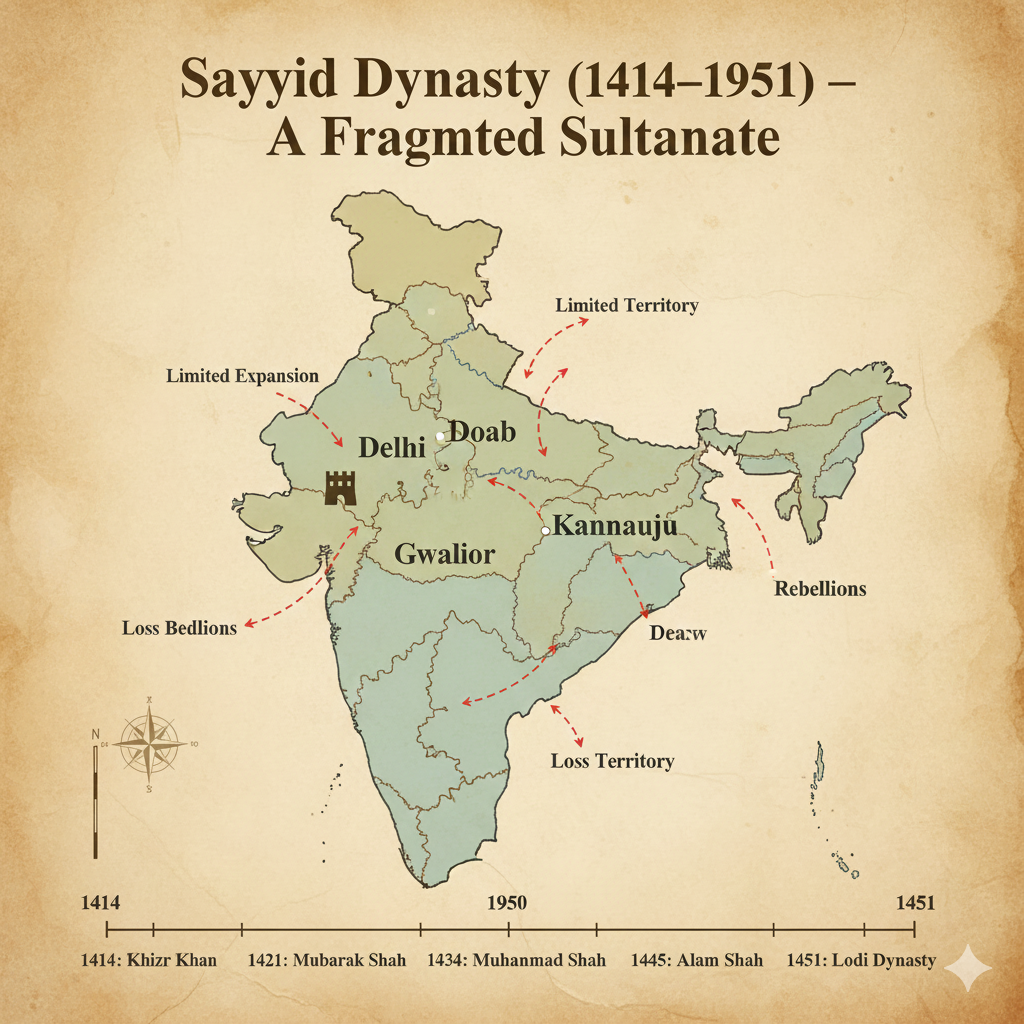
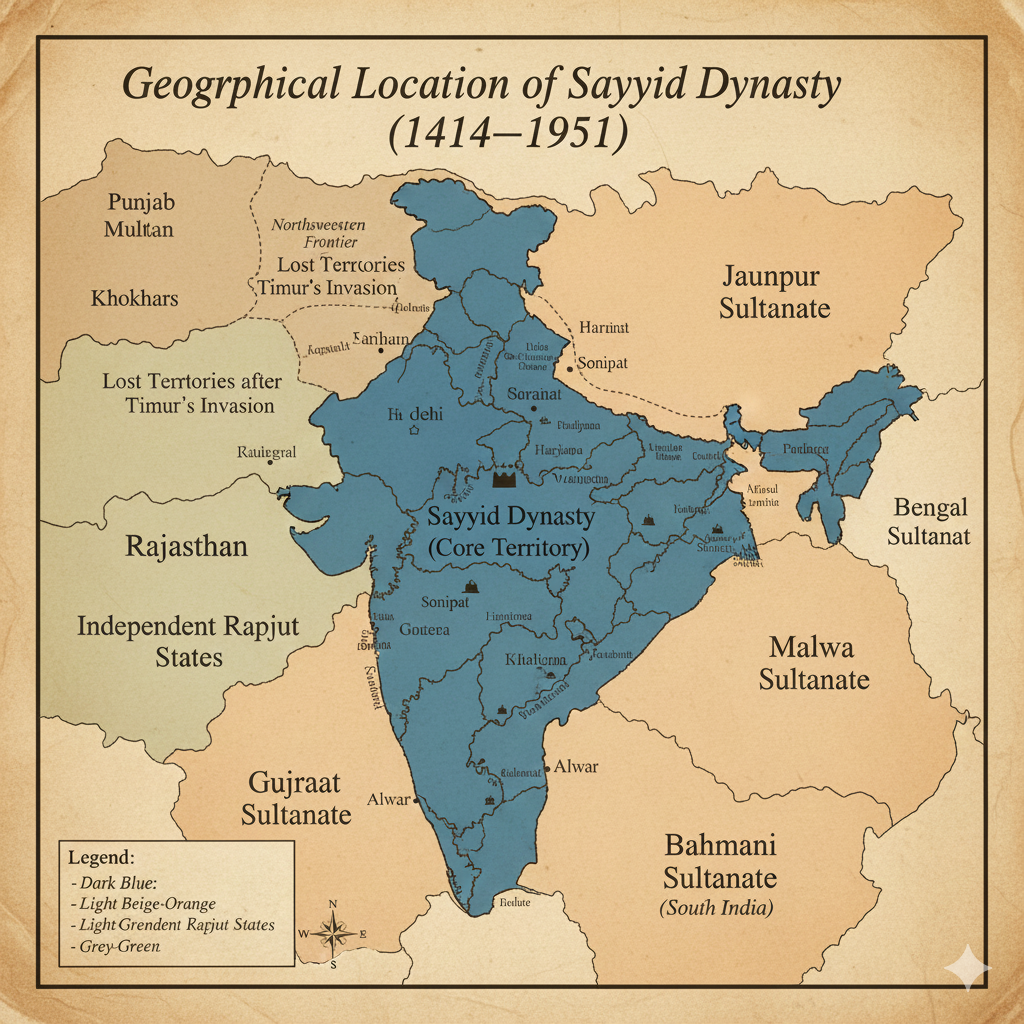
Geographical Location of Sayyid Dynasty (1414–1451)
Geographical Location of Sayyid Dynasty (1414–1451): Detailed Introduction
The Sayyid dynasty, the fourth ruling family of the Delhi Sultanate, governed a weakened and limited territory after Timur’s invasion. Their rule lasted for about 37 years, during which they maintained authority over Delhi and nearby regions. However, their geographical reach remained minimal, and they failed to reunify the vast empire once controlled by earlier sultanates.
Geographical Boundaries of the Sayyid Dynasty
1. Control of Limited Land Area
- The Sayyid dynasty’s rule was confined to Delhi, the Doab (Ganga–Yamuna region), and a few adjoining areas.
- Their influence extended slightly into Haryana, Alwar, and parts of western Uttar Pradesh.
- The region was economically and militarily weak, making it difficult to maintain stable authority.
2. Regional States That Became Independent
During the Sayyid rule, several major provinces of the Delhi Sultanate broke away and asserted independence:
- Jaunpur: Emerged as a powerful and independent sultanate in North India.
- Gujarat: Established itself as a strong and independent sultanate.
- Malwa: Became an autonomous state in Central India.
- Bengal: Did not recognize the authority of the Sayyid dynasty.
- South India: The Bahmani Sultanate rose as a dominant power, completely outside Delhi’s control.
These independent regional powers consistently challenged the Sayyid dynasty, reducing Delhi’s influence to a symbolic level.
3. Lack of Control Over the Northwest and Punjab Region
- Punjab and the northwestern regions, once key parts of the Delhi Sultanate, slipped out of control.
- Local groups such as the Khokhars dominated these areas.
- After Timur’s invasion, the Sultanate permanently lost its grip on these territories.
4. Separation of Rajasthan and Rajputana Region
- Rajput rulers strengthened their power in Rajasthan and surrounding regions.
- The Sayyid dynasty held no influence or authority in these territories.
Limitations of the Geographic Location: Reasons
1. Impact of Timur’s Invasion
Timur’s invasion in 1398 destroyed the administrative and political structure of the Delhi Sultanate. Following this devastation, the power of the Sultanate shrank to Delhi and nearby areas, leaving very little for the Sayyid rulers to control.
2. Weak Military and Administrative Power
The Sayyid dynasty had neither a strong army nor an effective administrative system. Their military weakness allowed provinces to revolt and declare independence, further shrinking their geographical reach.
3. Rise of Regional Sultanates
Independent sultanates such as Jaunpur, Gujarat, Bengal, and Malwa strengthened their rule and rejected Delhi’s authority. The Sayyid dynasty lacked the capability to reassert control over these emerging powers.
4. political instability
Internal rebellions, instability within the ruling family, and weak governance further restricted the boundaries of the Sultanate. Regional forces took advantage of this and gradually weakened Delhi’s influence.

⭐ Editor's Choice
Discover a highly rated product selected for its quality, functionality, and positive customer feedback.
View Details & Reviews →Influence of the Geographical Location
1. Economic Weakness
Due to their small territorial reach, the Sayyid rulers faced severe revenue shortages. Loss of trade routes, agricultural regions, and tax-paying provinces weakened the Sultanate economically.
2. Decline in Military Power
Limited resources meant the dynasty could not maintain a large or effective army. As their military power declined, neighbouring states increasingly challenged their authority.
3. Political Instability
Frequent rebellions and restricted territorial control weakened the dynasty’s political stability. Throughout their reign, Delhi’s influence remained largely nominal.
4. Cultural and Administrative Decline
With geographical boundaries shrinking, cultural, architectural, and administrative developments were also restricted to Delhi alone. No major cultural or architectural achievements emerged during this period.
Conclusion
The Sayyid dynasty governed only a small geographical area, primarily limited to Delhi and nearby regions. The rise of regional sultanates, the aftermath of Timur’s invasion, and administrative and military weaknesses prevented the dynasty from unifying or expanding the Sultanate. Their geographical limitations reflected their political and economic struggles, eventually leading to their decline in 1451 and paving the way for the rise of the Lodi dynasty.
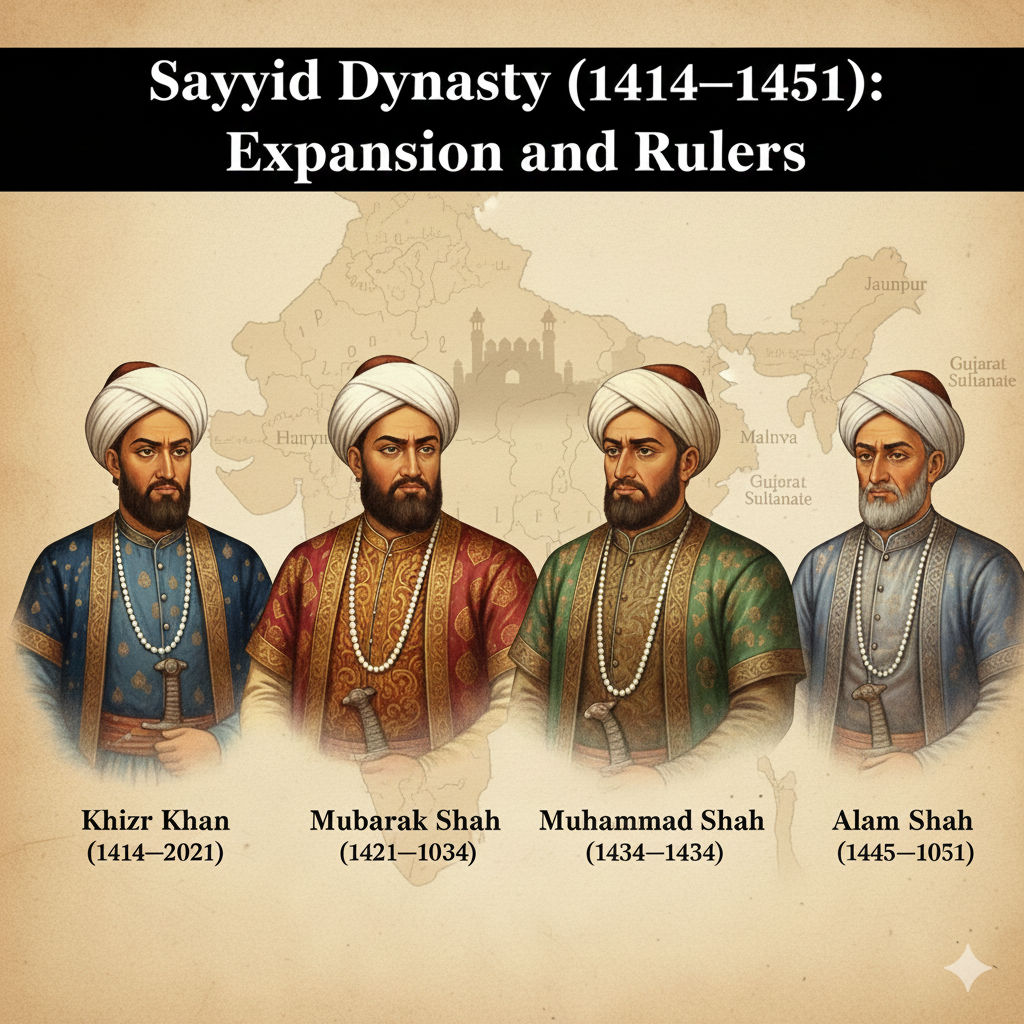
Expansion of Sayyid Dynasty and Prominent Rulers
The Sayyid dynasty (1414–1451) was the fourth ruling dynasty of the Delhi Sultanate. It was founded by Khizr Khan after the fall of the Tughlaq dynasty. This dynasty ruled a small territory centered around Delhi, and its strength depended heavily on the support of the Timurid Empire. Their reign is characterized by weak political authority, frequent rebellions, and regional fragmentation. Four rulers governed successively, each contributing to the shaping of this period. Below is a detailed overview of their rule.
1. Khizr Khan (1414–1421)
Reign: 1414–1421
Establishment and Administration
- Khizr Khan was the founder and first ruler of the Sayyid dynasty.
- Originally a chieftain of Multan, he was a supporter of Timur.
- After Timur’s invasion of India in 1398, Khizr Khan was appointed governor of Delhi.
- In 1414, he defeated the last Tughlaq ruler and established the Sayyid dynasty.
- He did not assume the title of “Sultan” and instead ruled as Timur’s representative (“Timuri Vakil”).
- His power was mostly confined to Delhi, Doab, and parts of Haryana.
Important Events
- He attempted to suppress rebellions and expand his authority.
- Failed to control regions such as Jaunpur, Malwa, and Gujarat.
- His rule remained relatively stable but limited in scope.
2. Mubarak Shah (1421–1434)
Reign: 1421–1434
Administration and Challenges
- Mubarak Shah succeeded Khizr Khan and assumed the title of “Sultan.”
- He worked to consolidate his power and suppress rebellions in Gwalior, Kannauj, and Doab.
Important Events
- In 1428, he built a strong fort and introduced administrative reforms.
- He encouraged art and culture in his court.
- In 1434, he was assassinated due to a conspiracy by his nobles.
3. Muhammad Shah (1434–1445)
Reign: 1434–1445
Administration and Weakness
- Muhammad Shah took power after Mubarak Shah’s assassination.
- He proved to be a weak and inefficient ruler.
- Under his reign, regional chiefs revolted and further weakened the dynasty.
Important Events
- Regions like Jaunpur, Malwa, and Gujarat strengthened their independence.
- Muhammad Shah attempted to suppress rebellions but largely failed.
4. Alam Shah (1445–1451)
Reign: 1445–1451
Disqualification and Downfall
- Alam Shah became the last ruler of the Sayyid dynasty.
- He was a weak ruler who preferred luxury and comfort over governance.
- He abandoned administrative responsibilities and moved to Badaun.
Important Events
- In 1451, Alam Shah handed over power to Bahlol Lodi, founder of the Lodi dynasty.
- This marked the end of the Sayyid dynasty and the rise of the Lodi rule.
Expansion of the Sayyid Dynasty
The Sayyid dynasty’s territorial expansion was very limited. Their rule was mainly restricted to Delhi and nearby areas such as Haryana and the Doab region. Several independent states emerged during this period:
- Jaunpur: Ruled by the Sharqi dynasty.
- Malwa: Under the influence of the Ghori dynasty.
- Gujarat and Bengal: Independent sultanates.
- Rajasthan and South India: Dominated by Rajput states and the Bahmani Sultanate.
Importance of the Sayyid Dynasty
1. political instability
The Sayyid period was marked by political instability, weak rulers, and ineffective administration.
2. Limited Power
As representatives of Timur, their authority was confined mainly to Delhi.
3. Culture and Architecture
The dynasty built a few mosques and structures, but their architectural contribution was limited.
4. Path Toward the Lodi Dynasty
The weakness of the Sayyid dynasty created an opportunity for Bahlol Lodi to rise to power.
Conclusion
The 37-year rule of the Sayyid dynasty marked a period of political weakness, administrative fragmentation, and internal rebellion in the Delhi Sultanate. Although its rulers made efforts to strengthen their authority, their limited resources and capabilities hindered progress. The dynasty ended in 1451 when Alam Shah abdicated, allowing the Lodi dynasty to ascend to power.
Characteristics of the Sayyid Dynasty
The Sayyid dynasty (1414–1451) represents a period of decline and fragmentation in the Delhi Sultanate. Despite rising to power after the Tughlaq dynasty, their influence remained weak due to limited administrative and military strength. The major characteristics of the dynasty are as follows:
1. Weak Political Power
- The dynasty depended on Timur’s support and ruled as his representatives.
- Authority remained confined to Delhi and its surroundings.
- Strong regional states like Jaunpur, Gujarat, Malwa, and Bengal challenged Delhi’s authority.
- The rulers lacked a large army and sufficient resources.
2. Administrative Weakness
- The administrative system was disorganized and largely ineffective.
- Revenue collection was weak, and provincial governors often revolted.
- Corruption and disorder spread among officials.
- Central control gradually diminished as feudal powers grew stronger.
3. Rule as Timur’s Representatives
- Khizr Khan and his successors considered themselves representatives of Timur.
- They did not formally claim the title of “Sultan,” except Mubarak Shah.
- This allegiance prevented the creation of an independent political identity.
4. Limited Military Power and Frequent Rebellions
- The dynasty lacked a strong army.
- Independent states emerged in Jaunpur, Malwa, Gujarat, and Bengal.
- Rebellions were common around Delhi.
- Attempts to suppress uprisings often failed.

⭐ Editor's Choice
Discover a highly rated product selected for its quality, functionality, and positive customer feedback.
View Details & Reviews →5. Economic Weakness
- Political instability harmed economic growth.
- Ineffective tax systems reduced revenue.
- Breakup of the Sultanate affected trade and agriculture.
6. Limited Cultural and Architectural Contribution
- The dynasty built a few religious buildings, mainly mosques.
- Architectural works reflected a simpler version of the Tughlaq style.
- Cultural patronage remained minimal due to political and administrative problems.
7. Path Toward the Rise of the Lodi Dynasty
- The dynasty’s weaknesses made it easy for Bahlol Lodi to assume power.
- In 1451, Alam Shah voluntarily handed over the throne, marking the start of Lodi rule.
8. religious tolerance and Sufi Influence
- The Sayyid rulers followed moderate religious policies.
- They patronized Islamic scholars and Sufi saints.
- Efforts were made to reduce religious tensions.
9. Disintegration of the Delhi Sultanate
- The Sultanate fragmented into independent regional states.
- Rajput states regained dominance in their regions.
- Delhi’s authority weakened significantly.
Role of Rulers of the Sayyid Dynasty
- Khizr Khan (1414–1421): Founder and representative of Timur.
- Mubarak Shah (1421–1434): Tried to suppress rebellions but was unsuccessful.
- Muhammad Shah (1434–1445): Weak ruler with administrative failures.
- Alam Shah (1445–1451): Incompetent ruler; abdicated power to the Lodi dynasty.
Conclusion
The Sayyid dynasty’s reign was one of the weakest and most unstable periods in the Delhi Sultanate. Weak rulers, poor administration, economic decline, and fragmentation of territory defined this era. Although they attempted to reorganize the Sultanate, their limited strength made it impossible. Ultimately, their weaknesses opened the way for the rise of the Lodi dynasty. This period is remembered as a time of decline for the Delhi Sultanate and the emergence of powerful regional sultanates.
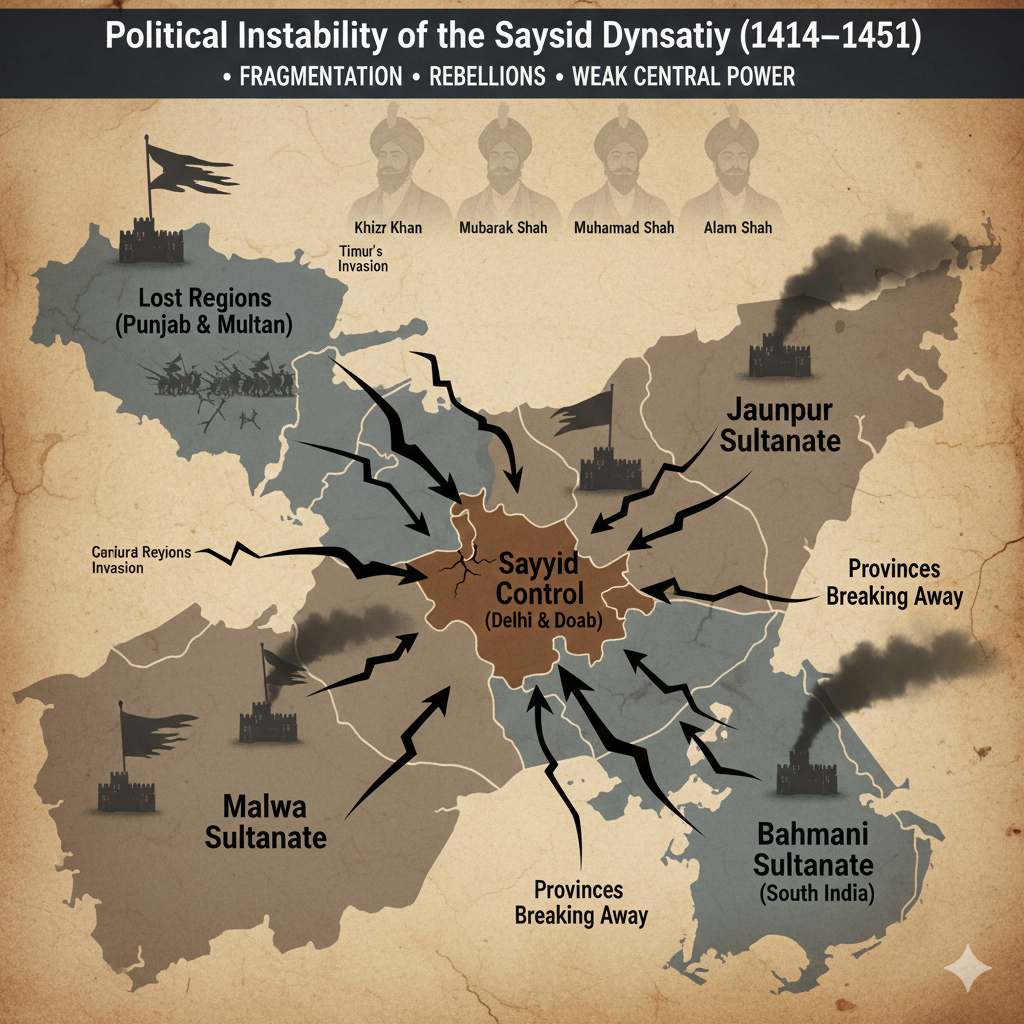
Political Instability
Political Instability: Causes, Consequences and Effects
Political instability refers to the weakening of the governance system, declining central authority, and lack of continuity or stability in administration. The entire reign of the Sayyid dynasty (1414–1451) was marked by instability and disorder. This instability played a major role in the decline of the Delhi Sultanate and encouraged the rise of regional powers.
Major Reasons for Political Instability During the Sayyid Dynasty
1. Weakness of Central Power
- The Sayyid rulers controlled only Delhi and nearby regions such as Haryana and Doab.
- They could not maintain authority over the vast territories of India.
- Weak military and administrative structures made it difficult to suppress rebellions.
2. Timur’s Invasion and Disintegration of the Delhi Sultanate
- Timur’s invasion in 1398 severely weakened the Delhi Sultanate.
- After the fall of the Tughlaq dynasty, the legitimacy of power diminished.
- The Sayyid dynasty emerged under Timur’s patronage, making it politically fragile.
3. Rise of External Forces
- Independent sultanates emerged in Jaunpur, Bengal, Malwa, Gujarat, and the Bahmani region.
- These powers strengthened themselves politically and militarily, limiting Delhi’s influence.
4. Internal Rebellions and Revolts of Governors
- Governors of regions like Doab, Haryana, and Gwalior frequently revolted.
- The rulers spent most of their strength suppressing rebellions instead of strengthening the empire.
5. Weak Rulers and Administrative Inefficiency
- The Sayyid rulers—Khizr Khan, Mubarak Shah, Muhammad Shah, and Alam Shah—lacked strong political and military leadership.
- Their policies failed to organise the state or withstand external threats.
6. Impact of Economic Downturn
- Poor economic conditions reduced resources for administration and military upkeep.
- Weak tax collection and disrupted trade further affected the economy.
Consequences of Political Instability
1. Limited Sphere of Influence of the Delhi Sultanate
The authority of the Sultanate was restricted to Delhi and surrounding regions. Outside powers declared independence and rejected Delhi’s dominance.
2. Rise of Regional Sultanates
- Sharqi Sultanate in Jaunpur
- Ahmed Shah’s rule in Gujarat
- Ghori dynasty in Malwa
- Independent rulers in Bengal
- Bahmani Sultanate and Vijayanagara Empire strengthened in South India
3. military weakness and External Aggression
Weak military structures made the Sultanate vulnerable to both internal revolts and external attacks.
4. Rise of the Lodi dynasty
The continuous instability paved the way for the rise of Bahlol Lodi, who took power in 1451 and ended the Sayyid dynasty.
Effects of Political Instability
1. Administrative and Social Disintegration
Anarchy spread as the administrative system collapsed. Law and order deteriorated, and public trust in the rulers declined.
2. Stalling of Cultural Development
There was no notable progress in art, literature, or culture due to continuous disturbances. Architectural patronage also remained very limited.
3. Fear of Foreign Invasion
Weak governance increased the threat of external invasions, further damaging Delhi’s political reputation.
4. Dominance of Regional Powers
Regional states established strong independent rule, reducing Delhi’s power to a small local entity.
Analysis of Political Instability During the Sayyid Dynasty
Lack of Governance System
The Sayyids lacked both the strong administration of the Tughlaqs and the military strength of the Khilji and Slave dynasties. Their dependence on Timur prevented them from establishing legitimacy.
Impact of Revolts
Frequent rebellions drained their resources and weakened Delhi’s central authority further.
Preparing the Way for the Lodi Dynasty
The failures of the Sayyid dynasty demonstrated the need for a strong central power. Bahlol Lodi capitalized on this weakness and ended the dynasty in 1451.
Conclusion
Political instability during the Sayyid dynasty resulted from weak rulers, administrative failures, rebellions, and the rise of external powers. This instability weakened not only the dynasty but also the entire Delhi Sultanate. It marked the weakest phase of the Sultanate and laid the foundation for the rise of regional powers and ultimately the Lodi dynasty.
Limited Impact
The Meaning of Limited Influence and Its Extent in the Context of the Sayyid Dynasty
Limited impact refers to when the control or influence of a ruling power is confined to a small region, with minimal political, military, or cultural authority. During the Sayyid dynasty (1414–1451), the influence of the Delhi Sultanate became extremely limited. Their rule remained restricted to Delhi and surrounding areas, and they failed to re-establish dominance over India.
Main Reasons for the Limited Influence of the Sayyid Dynasty
1. Weak Military and Political Power
- The Sayyids lacked a strong army.
- Frequent rebellions and external attacks weakened the dynasty.
- Their authority remained confined to Delhi, Haryana, and the Doab region.
2. Rule Under the Patronage of Timur
- Khizr Khan ruled with Timur’s consent, making him appear less independent.
- Due to loyalty to Timur, the Sayyids could not establish strong political influence.
3. Rise of Regional Powers
- Independent states emerged in Jaunpur, Bengal, Gujarat, Malwa, and Bahmani regions.
- These states challenged and weakened Delhi’s authority.

⭐ Editor's Choice
Discover a highly rated product selected for its quality, functionality, and positive customer feedback.
View Details & Reviews →4. Administrative Instability
- Weak revenue collection and disorganized governance reduced Delhi’s control.
- Frequent rebellions further restricted their influence.
5. Economic Weakness
- Poor economic conditions prevented military expansion.
- Loss of trade routes and revenue sources weakened the Sultanate further.
6. Weak Rulers
- From Khizr Khan to Alam Shah, the rulers were politically and militarily weak.
- They failed to expand influence beyond Delhi.
Consequences of Limited Impact
1. Decline of the Delhi Sultanate
The influence of the Sultanate was restricted to Delhi, Haryana, and Doab. Other regions became independent and powerful.
2. Dominance of Regional Powers
States such as Jaunpur, Malwa, Gujarat, and Bengal strengthened their independence and grew militarily and economically.
3. Decline of Delhi’s Power
Delhi’s influence diminished to a local power, allowing the Lodi dynasty to rise and attempt reunification.
4. Increased Threat of External Attacks
Limited influence made the Sultanate more vulnerable to foreign invasions and weakened its international standing.
Analysis of Limited Influence
Military Weakness
The Sayyids lacked the military capacity to defeat external powers or stop internal rebellions.
Political Failure
The rulers failed to reunify the Sultanate, leading to the end of Delhi’s broader control.
Economic Crisis
Low revenue and disrupted trade prevented administrative and military expansion.
Rise of Regional Sultanates
Independent regional powers expanded and established their authority, reducing Delhi’s influence drastically.
Conclusion
The limited influence of the Sayyid dynasty marked the decline of the Delhi Sultanate and the rise of powerful regional states. Weak rulers, economic failures, military limitations, and administrative inefficiency confined Delhi’s authority to a small region. This period
Political Instability During the Sayyid Dynasty (1414–1451)
Political instability refers to the weakening of the governance system, reduced central authority, and lack of continuity in administration. The entire rule of the Sayyid dynasty (1414–1451) was marked by instability, rebellions, and fragmentation. This instability played a major role in the decline of the Delhi Sultanate and encouraged the rise of powerful regional states.
Major Reasons for Political Instability
1. Weakness of Central Power
- The dynasty's influence was limited to Delhi and nearby regions (Haryana, Doab).
- The inability to control distant provinces weakened the Delhi Sultanate.
- The administrative and military structure was too weak to suppress rebellions effectively.
2. Impact of Timur’s Invasion
- The 1398 invasion by Timur devastated the Delhi Sultanate.
- After the fall of the Tughlaq dynasty, the legitimacy of central power collapsed.
- The Sayyid dynasty was established under Timur’s patronage, making it politically weak.
3. Rise of External Forces
- Jaunpur, Bengal, Malwa, Gujarat, and the Bahmani Sultanate became independent.
- These powers strengthened their military and reduced Delhi’s dominance.
4. Internal Rebellions
- Governors of Doab, Haryana, and Gwalior revolted frequently.
- Rulers spent most of their time suppressing revolts instead of strengthening the empire.
5. Weak Rulers & Administrative Inefficiency
- Khizr Khan, Mubarak Shah, Muhammad Shah, and Alam Shah were politically weak.
- Their policies failed to reorganize the Sultanate or resist external attacks.
6. Economic Decline
- Economic weakness restricted military and administrative growth.
- Weak tax systems and constant revolts reduced revenue.
Consequences of Political Instability
1. Limited Influence of the Delhi Sultanate
The Sultanate remained confined to Delhi and nearby territories.
2. Rise of Regional Sultanates
- Sharqi Sultanate (Jaunpur)
- Gujarat and Bengal Sultanates
- Ghoris of Malwa
- Bahmani Sultanate in the South
3. military weakness
External aggression and rebellions weakened the Sayyid rule significantly.
4. Rise of the Lodi dynasty
Political instability paved the way for Bahlol Lodi, who ended the Sayyid dynasty in 1451.
Effects of Political Instability
- Administrative and social breakdown
- Collapse of law and order
- Stagnation of culture and architecture
- Weak central authority encouraged foreign invasion
- regional powers became dominant
Conclusion
Political instability in the Sayyid dynasty, caused by weak rulers, rebellion, administrative failures, and rise of external forces, weakened the Delhi Sultanate. This period marked one of the weakest phases of the Sultanate and opened the path for regional powers and the Lodi dynasty.
Limited Influence of the Sayyid Dynasty
The term "limited influence" refers to restricted control of a ruling power over a small area. During the Sayyid dynasty (1414–1451), the Delhi Sultanate became confined mostly to Delhi and adjacent regions. The dynasty failed to re-establish its dominance across India.
Main Reasons for Limited Influence
1. Weak Military and Political Power
- The dynasty lacked a strong army.
- Frequent rebellions and external attacks further weakened their rule.
2. Rule Under Timur’s Patronage
- Khizr Khan ruled with the consent of Timur.
- This reduced their authority and independence.
3. Rise of Regional Powers
- Jaunpur, Malwa, Bengal, Gujarat, and Bahmani Sultanates became independent.
- Delhi failed to regain control over them.
4. Administrative Instability
- Weak administration and failed tax systems reduced central power.
5. Economic Weakness
- Lack of revenue weakened military and administrative abilities.
6. Weak Rulers
The rulers lacked leadership skills to expand their influence.
Consequences of Limited Influence
- Decline of the Delhi Sultanate
- Rise of independent regional powers
- Reduced military strength
- Higher risk of external attacks
Conclusion
Limited influence during the Sayyid dynasty marked the decline of the Delhi Sultanate and rise of strong regional powers. Weak rulers, poor administration, and economic failures restricted the Sultanate to a small region.
Cultural Contribution of the Sayyid Dynasty (1414–1451)
Although politically weak, the Sayyid dynasty made some cultural contributions, particularly in architecture, Sufism, literature, and art. Influenced by Timurid styles, their cultural works reflect simplicity and Islamic-Persian traditions.
Main Areas of Cultural Contribution
1. Architecture & Monumental Construction
- Adoption of Timurid architectural style
- Simple, low-budget structures
- Fusion of Indian & Islamic elements
Examples
- Tombs of Sayyid rulers in Delhi’s Lodi Gardens (e.g., Muhammad Shah's Tomb)
- Small Gumtis and simple mosques
2. Preservation of Religious & Sufi Culture
- Support to Sufi saints and Islamic scholars
- Promotion of religious tolerance and harmony
3. Literature and Language
- Persian remained the administrative and literary language.
- Persian poetry and texts flourished modestly.
4. Art and Music
- Limited patronage of art and music under Timurid influence.
5. Tomb Architecture
- Use of octagonal tomb designs
- Simplistic stone and tile construction
Reasons for Limited Cultural Output
- Economic weakness
- Unstable political environment
- Lack of resources post-Timur’s invasion
- Rise of culturally rich regional kingdoms
Significance of Cultural Contributions
- Introduction of Timurid architectural elements in India
- Fusion of Indian and Islamic styles
- Preservation of Sufi traditions
Conclusion
Despite political instability, the Sayyid dynasty contributed modestly to cultural development, especially in architecture and Sufi traditions. These small contributions helped preserve the cultural continuity of the Delhi Sultanate.
Economic Weakness of the Sayyid Dynasty (1414–1451)
The Sayyid dynasty suffered severe economic instability due to limited territory, weak administration, loss of revenue, and the fallout of Timur’s invasion. This economic decline contributed directly to their political and military downfall.
Main Causes of Economic Weakness
1. Timur’s Devastating Invasion
- Timur’s plunder destroyed Delhi’s treasury.
- Population loss affected labour and production.
- Agriculture and trade collapsed.
2. Limited Area and Revenue
- The dynasty ruled only Delhi, Doab, and nearby regions.
- Major provinces like Bengal, Gujarat, Malwa became independent.
3. Decline in Agricultural Production
- Farmlands destroyed due to wars.
- Irrigation systems collapsed.
4. Failure of Tax Collection
- Rebellions disrupted revenue collection.
- Local chiefs refused to pay taxes.
5. Decline in Trade and Commerce
- Loss of trade routes and ports.
- Independent sultanates controlled major commercial centres.
6. High Military Expenditure
- Frequent wars depleted financial resources.
7. Decline of Currency System
- Poor-quality and counterfeit coins affected trade.
Consequences of Economic Weakness
⭐ Editor's Choice
Discover a highly rated product selected for its quality, functionality, and positive customer feedback.
View Details & Reviews →- Administrative failure
- Decline in military strength
- Limited cultural development
- Rise in tax burden on the public
- Strengthening of regional powers
- Fall of the Sayyid dynasty
Historical Significance
- Marked the decline of the Delhi Sultanate
- Shifted economic and political power to regional sultanates
- Forced the Lodi dynasty to implement reforms
Conclusion
The economic weakness of the Sayyid dynasty, caused by Timur’s invasion, limited territory, poor administration, and collapse of agriculture and trade, played a major role in their downfall. This period is seen as one of the weakest in Delhi Sultanate History and paved the way for the rise of the Lodi dynasty.
References

⭐ Editor's Choice
Discover a highly rated product selected for its quality, functionality, and positive customer feedback.
View Details & Reviews →- Habib, Irfan. The Delhi Sultanate: A Historical Overview. Oxford University Press.
- Satish Chandra. Medieval India: From Sultanate to the Mughals. Har-Anand Publications.
- Jackson, Peter. The Delhi Sultanate: A Political and Military History. Cambridge University Press.
- Encyclopaedia Britannica – Delhi Sultanate and Sayyid Dynasty Articles.
- Aligarh Muslim University – Medieval Indian history Notes.
- National Archives of India – Records on Delhi Sultanate.