
Chola Dynasty (9th – 13th Centuries )

Chola Dynasty (9th – 13th Centuries)

Chola Dynasty (9th – 13th Centuries)

The Chola dynasty was one of the most important South Indian dynasties in Indian history, ruling mainly over present-day Tamil Nadu and surrounding regions. Spanning from the 9th to the 13th centuries, the Cholas are remembered for their political, military, cultural, and architectural achievements.

Origin and Expansion

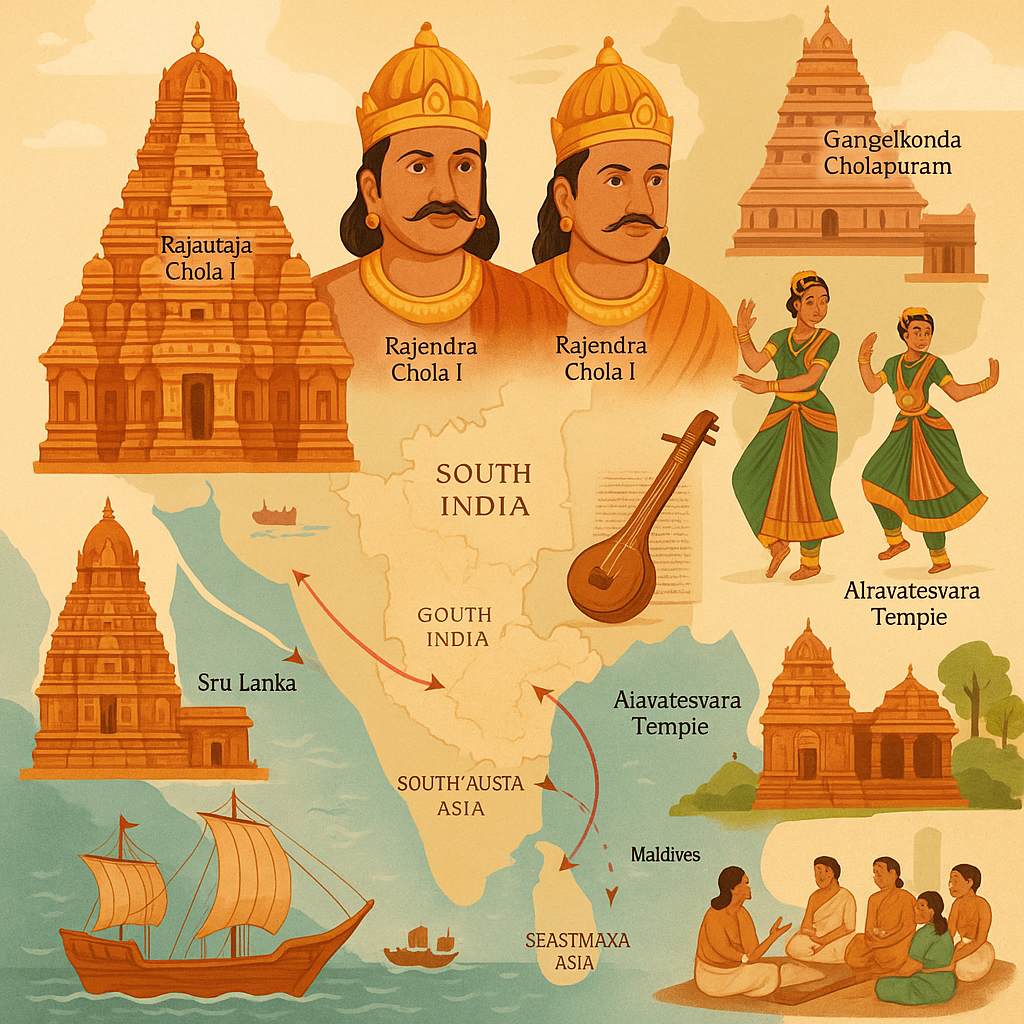
The Chola dynasty originated in South India and is mentioned in Sangam literature. The early rulers were influential at the local level, but the empire reached its peak during the reigns of Rajaraja Chola I (985–1014 AD) and his son Rajendra Chola I (1014–1044 AD).

The Chola Empire extended across South India, Sri Lanka, the Maldives, Southeast Asia, and even Indonesia. Through strong maritime trade and successful military campaigns, the Chola rulers established widespread influence and power.

Prominent Rulers

Rajaraja Chola I

He strengthened the foundation of the Chola Empire and built the magnificent Brihadeeshwara Temple at Thanjavur.

Rajendra Chola I

He further expanded the empire and led successful military expeditions up to the Ganges River.

Cultural Contributions

The Chola dynasty played a major role in enriching South Indian art, literature, and architecture.

Temple Construction

The Chola rulers built several magnificent temples, including:

  • The Brihadeeswarar Temple of Thanjavur
  • The Gangaikonda Cholapuram Temple
  • The Airavatesvara Temple of Darasuram

Dance and Music

Classical dance forms such as Bharatanatyam and the tradition of Carnatic music were encouraged during this period.

Script and Literature

The Chola era is considered the golden age of Tamil literature, with remarkable advancements in writing and scholarship.

Administration and Economy

Local Self-Government

The Chola administrative system was highly organized and efficient. Town administration and Gram Sabhas (village assemblies) were promoted, strengthening local self-governance.

Trade

Maritime trade played a crucial role in the economic prosperity of the Chola Empire. The rulers established strong trade relations with Southeast Asian regions.

Causes of Collapse

The Chola dynasty declined in the 13th century due to conflicts with the Pandya dynasty and the Hoysala Empire, along with the gradual weakening of central authority.

Conclusion

The Chola dynasty remains a glorious chapter in Indian history. Their architectural marvels, cultural heritage, and administrative innovations continue to reflect India’s rich civilizational tradition.

Origin, Expansion and Prominent Rulers of the Chola Dynasty

Origin and Expansion of the Chola Dynasty

Origin

The Chola dynasty originated in South India and is considered one of the oldest dynasties of India. It is mentioned in Sangam literature (3rd–6th century), which portrays the Cholas as a powerful and prosperous empire whose main territory was in the coastal regions of the Kaveri River.

The early center of the Chola dynasty was Uraiyur (in present-day Tamil Nadu), located on the banks of the Kaveri River. Uraiyur was an important center for cotton trade. In the early period, Chola kings ruled small territories, often facing conflicts with the Pallavas and Pandyas.

Important Mythological References

The origin of the Chola dynasty is also linked to mythology. It is considered a Suryavanshi dynasty. The first historical ruler is believed to be Vijayalaya Chola, who reorganized the dynasty around 850 AD. He captured Thanjavur from the Pallavas and made it the capital, marking the beginning of a new era.

Period of Expansion (Political and Strategic)

The Chola Empire expanded significantly during the reigns of Rajaraja Chola I and his son Rajendra Chola I.

Rajaraja Chola I (985–1014 AD)

  • Provided a strong foundation for the Chola Empire.
  • Defeated the Pandya and Chera dynasties, establishing dominance over South India.
  • Launched a successful military expedition against Sri Lanka and annexed its northern region.
  • Gained control over parts of Kerala (Malabar Coast), South Karnataka, and Andhra Pradesh.

Rajendra Chola I (1014–1044 AD)

  • Brought the Chola Empire to its peak.
  • Established complete control over Sri Lanka.
  • Led the famous expedition to Bengal, earning the title “Gangaikonda Chola”.
  • Conducted successful military campaigns in Southeast Asia (Malaysia, Sumatra, Java, Cambodia) and defeated the Srivijaya Empire.
  • Extended Chola influence beyond India, strengthening its status as a maritime empire.

Economic and Cultural Expansion

Maritime Trade

  • The Cholas greatly encouraged maritime trade.
  • Trade relations were established with Southeast Asia, China, and Arab countries.
  • This trade brought immense economic prosperity.

Art and Architecture

  • Chola expansion reflected strong cultural influence wherever they ruled.
  • Magnificent temples like the Brihadeeswara Temple (Thanjavur) and Gangaikonda Cholapuram stand as architectural marvels.

Influence on Southeast Asia

The maritime expeditions of the Cholas had a deep impact on Southeast Asian countries. They established political and cultural ties with the rulers there. The influence of the Cholas spread Indian culture, temple architecture, and trade networks across the region.

Conclusion

The expansion of the Chola dynasty was not only due to military strength but also because of organized administration, a powerful navy, and strong economic policies. The Chola dynasty remains a glorious chapter in South Indian history, establishing India as a prosperous and influential power.

Major Rulers of the Chola Dynasty

Many important rulers expanded the Chola Empire's influence in South India, Sri Lanka, and Southeast Asia. Their contributions shaped political, cultural, and architectural development.

1. Vijayalaya Chola (850–871 AD)

  • Founder of the later Chola dynasty.
  • Defeated the Pallavas and captured Thanjavur, making it the capital.
  • Reorganized the dynasty and initiated its expansion.
  • Built a famous temple dedicated to Goddess Durga, showcasing his religious devotion.

2. Aditya Chola I (871–907 AD)

  • Son of Vijayalaya Chola.
  • Strengthened the empire by defeating the Pallavas and Pandyas.
  • Expanded territory around Kanchipuram and Tirupati.
  • Unified the coastal areas of the Kaveri River.

3. Parantaka Chola I (907–955 AD)

  • Ruled for nearly 48 years.
  • Expanded the empire by defeating Sri Lankan and Pandya rulers.
  • Faced defeat against the Rashtrakutas later in his reign.
  • Significant administrative and cultural development occurred during his rule.

4. Rajaraja Chola I (985–1014 AD)

One of the greatest rulers of the Chola Empire.

Major Achievements

  • Transformed the Chola Empire into a powerful maritime empire.
  • Conquered northern Sri Lanka and annexed it.
  • Established supremacy over the Pandya and Chera dynasties.
  • Built the magnificent Brihadisvara Temple in Thanjavur.
  • Developed a powerful navy to support trade and military expeditions.

5. Rajendra Chola I (1014–1044 AD)

Son of Rajaraja Chola I, who brought the empire to its greatest glory.

Major Achievements

  • Conquered territories up to the Ganges and earned the title “Gangaikonda Chola”.
  • Established control over the entire Sri Lanka.
  • Defeated the Srivijaya Empire in Southeast Asia (Malaysia, Sumatra).
  • Built the city of Gangaikonda Cholapuram as his new capital.

6. Rajadhiraja Chola (1044–1054 AD)

  • Continued the military legacy of Rajendra Chola.
  • Fought major battles against the Chalukyas and Pandyas.
  • Died during a war against the Chalukyas of Kalyani.

7. Kulottunga Chola I (1070–1122 AD)

  • Ruled for nearly 50 years.
  • Brought stability to the Chola Empire.
  • Focused on administrative reforms and strengthened trade.
  • Encouraged art, literature, and cultural development.

8. Rajaraja Chola II (1146–1173 AD)

  • Built several temples in Thanjavur.
  • During his reign, the Chola Empire showed early signs of decline.

9. Kulottunga Chola III (1178–1218 AD)

  • Considered the last powerful Chola ruler.
  • Faced continuous conflicts with the Pandya dynasty.

Features of the Chola Reign

  • Chola rulers were great warriors and efficient administrators.
  • They encouraged temple construction, art, literature, and maritime trade.
  • The Chola Empire had a highly developed navy, making it a dominant maritime power.

Conclusion

The prominent rulers of the Chola dynasty left a significant impact on South India and the coastal regions. Their contributions in architecture, administration, and culture have made the Chola dynasty immortal in Indian history.

Brihadeeshwara Temple
Brihadeeshwara Temple & Gangaikonda Cholapuram — Architecture and History

Brihadeeshwara Temple (Thanjavur)

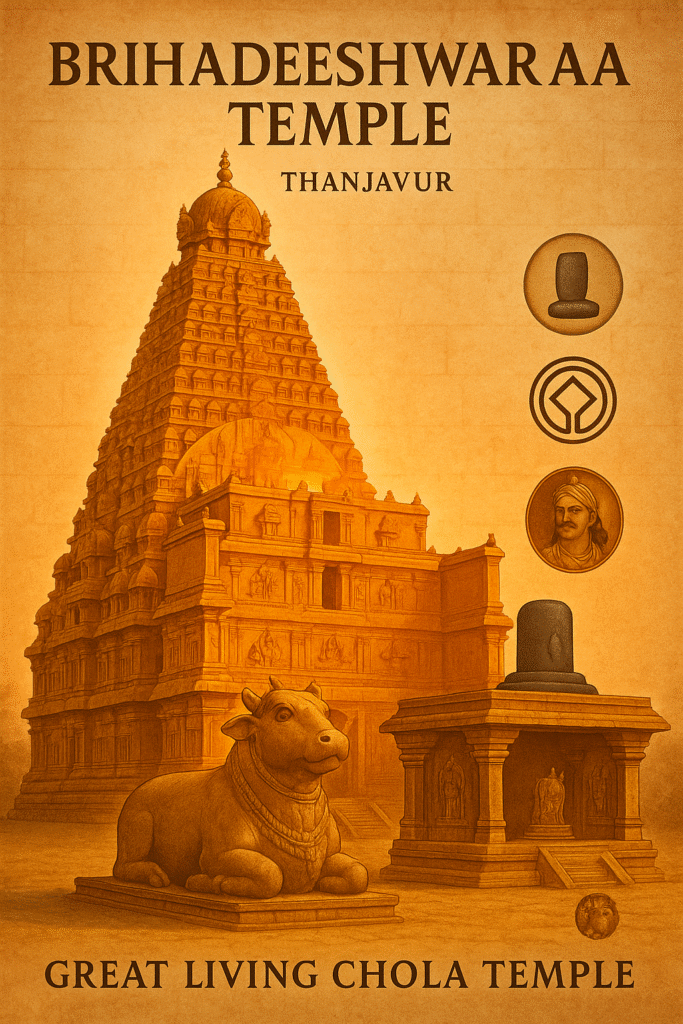
The Brihadeeshwara Temple, also known as Rajarajesvaram and Periya Kovil, is a magnificent temple located in Thanjavur, South India. Built during the Chola dynasty, it is an excellent example of architectural brilliance and is considered one of the most impressive temples in India.

Construction and History

  • The Brihadeeshwara Temple was built by Rajaraja Chola I in 1010 AD.
  • The temple is dedicated to Lord Shiva and symbolizes his power and grandeur.
  • It stands as a testimony to the prosperity and architectural excellence of the Chola dynasty.

Architecture and Features

Amazing Example of Dravidian Architecture

  • The temple is made entirely of granite stone.
  • The tower (vimana) is about 216 feet high, making it one of the tallest temple towers in India.
  • The kalasha (finial) on top weighs around 80 tons and is carved from a single stone.

Nandi Mandapam (Bull Sculpture)

  • A massive Nandi (bull) statue made of granite stands at the entrance.
  • It is one of the largest Nandi statues in India.

Gorgeous Carvings on the Walls

  • The temple walls feature carvings depicting Lord Shiva, Goddess Parvati, and other deities.
  • The artwork displays the grandeur of Chola-era paintings and sculptures.

Main Sanctum

  • The sanctum sanctorum houses a huge Shiva Lingam.
  • The temple is designed to illuminate the sanctum with the first rays of the sun, making it unique.

Religious and Cultural Significance

The Brihadeeshwara Temple is not just a religious site but also a symbol of the cultural and artistic excellence of the Chola dynasty. It is recognized as a part of the UNESCO World Heritage Site — “Great Living Chola Temples.”

Special Events and Festivals

  • Grand celebrations take place during Mahashivaratri and other Shiva festivals.
  • During the Chola period, dance and music performances were held here regularly.

Conclusion

The Brihadeeshwara Temple is a priceless treasure of India’s architectural and religious legacy. It reflects the grandeur of the Chola Empire and continues to attract millions of visitors with its beauty and historic importance.

Gangaikonda Cholapuram

Gangaikonda Cholapuram is a historic town in South India, established by Emperor Rajendra Chola I in the 11th century. It served as the capital of the Chola Empire and is renowned for the majestic Gangaikonda Choleshwara Temple, symbolizing the power and cultural richness of the Cholas.

Founding and Naming

  • In 1025 AD, Rajendra Chola I continued the military tradition of his father, Rajaraja Chola I, and led a victorious expedition to the Ganges.
  • To commemorate this victory, he named the new capital Gangaikonda Cholapuram, meaning “the city of the Cholas who conquered the Ganga.”
  • He shifted the capital from Thanjavur to this new city.

Gangaikonda Choleshwara Temple

1. Architecture and Structure

  • The temple is a masterpiece of Chola architecture, built in a style similar to Brihadeeshwara Temple.
  • The vimana (tower) is about 182 feet high, giving the temple an imposing appearance.
  • The sanctum houses a massive 13-foot Shiva Lingam, one of the largest in India.
  • The walls and pillars are adorned with detailed carvings and sculptures reflecting the Chola artistic tradition.

2. Huge Nandi Statue

  • A massive Nandi (bull) statue carved from a single stone stands in the temple complex.
  • This sculpture is an outstanding example of Chola artistry.

3. Reservoir (Eri)

  • Rajendra Chola constructed a huge reservoir called Chola Gangam.
  • It symbolized the bringing of Ganga water to the new capital.

Significance and Cultural Contribution

Religious Significance

  • The town and temple were major centers of Shiva worship during the Chola dynasty.
  • Deities like Lord Shiva, Goddess Parvati, and other gods were worshipped here.

Art and Culture

  • The temple walls depict gods, mythological scenes, and the victories of the Chola rulers.
  • They represent some of the finest examples of Chola-era sculpture.

Administrative and Trade Center

  • Gangaikonda Cholapuram served as the political, administrative, and military hub of the Chola Empire.
  • It was also an important center for maritime trade and economic activities.

Downfall and Current Status

Gangaikonda Cholapuram began declining after the fall of the Chola Empire in the 13th century. It later came under the rule of the Pandyas, Hoysalas, and Vijayanagara Empire. Today, it is recognized as a major historical site and is part of the UNESCO World Heritage list.

Conclusion

Gangaikonda Cholapuram and its temple stand as timeless symbols of the Chola Empire’s architectural genius and cultural heritage. They remain priceless assets of Indian history and continue to reflect the glory of the Cholas.
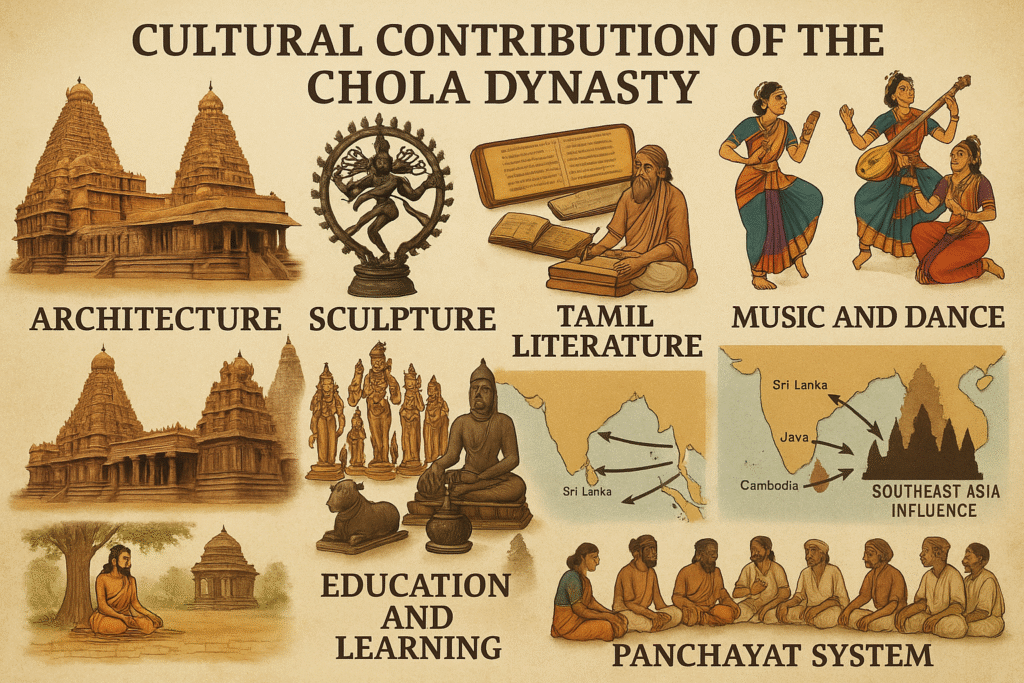
chola cultural contributions collage.
Cultural & Administrative Contributions of the Chola Dynasty

Cultural Contribution of the Chola Dynasty

The Chola dynasty (9th to 13th century) made an extraordinary contribution to cultural, artistic, and religious advancement in the Indian subcontinent. Their cultural heritage spread widely across South India and Southeast Asia, and remains a source of pride in Indian history.

1. Architecture

Temple Construction Art

  • The Dravidian architectural style flourished during the Chola period.
  • Magnificent temples like the Brihadeeshwara Temple (Thanjavur), Gangaikonda Choleshwara Temple, and Airavatesvara Temple represent outstanding examples of Indian architecture.

Features of Chola Temples

  • Huge and grand shikhara (vimana).
  • Beautiful carvings on granite stones.
  • Sculptures depicting religious and mythological stories.
  • Large Nandi statues and intricately carved pillars.

2. Sculpture

The Chola dynasty is renowned for its copper and bronze sculptures.

  • The bronze statues of Lord Shiva as Nataraja (performing the Tandava dance) are among the most precious cultural legacies of the Cholas.
  • The sculptures beautifully depict emotions, divinity, and artistic finesse.
  • Figures of gods, goddesses, kings, queens, and dancers highlight the craftsmanship of Chola sculptors.

3. Literature and Education

Tamil Literature

  • The Cholas made significant contributions to Tamil literature.
  • Sangam texts were preserved, and new literary works were created.
  • Poet Kamban composed the Kamba Ramayanam, a Tamil rendering of the Ramayana.
  • Religious texts such as Tevaram and Tiruvacakam were composed during this era.

Academic Centres

  • The Cholas established gurukulas and developed temples as centres of learning.
  • Thanjavur and Chidambaram became centres of higher education, promoting Vedic studies, mathematics, astronomy, and Tamil literature.

4. Music and Dance

  • The Chola rulers greatly patronised music and dance.
  • The Nataraja sculpture reflects their deep cultural interest in dance and music.
  • Religious musical and dance performances were regularly held in temples.

5. Religious Contributions

Spread of Shaivism

  • The Cholas were strong followers of Shaivism and promoted the worship of Lord Shiva.
  • Temple construction and religious text composition strengthened Shaivism.

Support for Other Religions

  • The Cholas also supported Vaishnavism and Jainism.
  • Construction of temples and religious establishments reflects their religious tolerance.

6. Maritime Culture and Influence in Southeast Asia

  • With strong naval power, the Cholas spread their culture to Southeast Asia (Sumatra, Java, Malaysia, Cambodia).
  • The influence of Chola architecture and sculpture is seen in many Southeast Asian temples.
  • They introduced Indian temple art, sculpture, and religious traditions to these regions.

7. Social and Economic Contribution

Panchayat System

  • The Cholas strengthened the village panchayat system.
  • Temples served as centres of social and cultural activities.

Business and Culture

  • The Cholas promoted overseas trade, encouraging cultural exchange.
  • Indian culture and Chola art spread widely to Southeast Asian countries.

8. Cultural Heritage of Thanjavur

The Cholas developed Thanjavur as a major cultural and artistic centre. The Brihadisvara Temple and other monuments still reflect the glory of the Chola period.

Conclusion

The Chola dynasty made significant contributions in architecture, sculpture, music, dance, and literature. Their cultural achievements shaped Indian civilisation and influenced Southeast Asia, leaving behind a timeless legacy.

Administration of the Chola Dynasty

The administrative structure of the Chola dynasty was one of the most organised and efficient systems of ancient India. Known for strong governance and an excellent local self-government model, the Chola administration strengthened both society and the economy.

1. Governance Structure

The Chola Administrative System Included:

  • Central Government
  • Provincial Administration
  • Local Self-Government

(a) Central Government

  • The king was the supreme authority in administrative, military, judicial, and religious matters.
  • The king was considered a divine representative, often called “Son of Kaveri” or “Messenger of Lord Shiva.”
  • An efficient group of ministers, military commanders, and officials assisted the king.
  • The council of ministers, known as the “Council,” played a key advisory role.

(b) Provincial Administration

  • The empire was divided into provinces called mandalams.
  • Each mandalam was governed by a Mandaladhipati appointed by the king.
  • Mandalams were further divided into valanadu (districts) and ur (villages).

(c) Local Self-Government

The most remarkable feature of Chola administration.

Gram Panchayat System

  • Villages enjoyed considerable autonomy.
  • The village assembly, known as “Ur” or “Sabha,” handled tax collection, public works, and dispute resolution.

Citizen Committees (Varna System)

  • Committees managed land tax, water resources, and road and temple construction.

Kudavolai System (Election)

Members of the Gram Sabha were selected through a unique lottery system called the Kudavolai System. Eligible names were written on palm leaves and selected through a draw.

2. Tax and Revenue System

Land Tax (Veli)

  • The main source of revenue.
  • Tax was based on the extent of cultivable land.

Other Taxes

  • Taxes on trade, crafts, maritime activities, and water resources.
  • Temples and charities often received tax exemptions.

Revenue Management

  • Land was categorised as fertile, dry, or barren.
  • Detailed revenue records were systematically maintained.

3. Justice System

  • The king was the supreme authority in judicial matters.
  • Fairness and transparency were prioritised.
  • Village-level disputes were settled by the Gram Sabha.
  • Serious cases were handled by the king or Mandalam officers.

4. Military and Navy

Army Organisation

  • The army included infantry, cavalry, elephants, and chariots.
  • The Chola army conquered the Pandya and Chera dynasties.

Development of Navy

  • The Chola navy was among the strongest in Asia.
  • It supported maritime trade and expansion.
  • Rajendra Chola I conquered the Srivijaya Empire using naval power.

5. Temple and Society

Temple Management

  • Temples were supported by the state.
  • Land and money were donated for their maintenance.

Social and Economic Role

  • Temples provided employment to priests, artisans, and traders.
  • They served as centres of learning, culture, and community activities.

6. Business and Economic Administration

  • The Cholas made South India a major trade centre.
  • Ports and trade routes were efficiently managed.
  • Ports like Thanjavur and Nagapattinam traded with China, Sri Lanka, and Southeast Asia.
  • Import and export taxes strengthened the economy.

7. Records and Inscriptions

  • Administrative and historical events were recorded through inscriptions.
  • These inscriptions appeared on temples, pillars, and rocks.
  • They documented land grants, taxes, achievements, and administrative decisions.

Conclusion

The administrative system of the Chola dynasty was highly organised and efficient. Their strong local self-government, tax system, and naval power brought stability and prosperity to the region. The influence of their administration extended beyond South India to Southeast Asia and remains an important model of ancient Indian governance.

Economy, Conclusion & Causes of Collapse – Chola Dynasty

Economy of the Chola Dynasty

The Chola dynasty (9th to 13th century) had one of the most organised and advanced economies of its time. Their policies in agriculture, trade, industry, taxation, and water management provided long-term stability and prosperity. Their economic system strengthened South India and expanded trade relations with Southeast Asia.

1. Agriculture-Based Economy

(a) Importance of Agriculture

  • Agriculture was the backbone of the Chola economy.
  • Most of their territory lay along the Kaveri River, famously known as the “Granary of South India.”
  • Major crops: Rice (main), ragi, millet, sugarcane, coconut, and spices.

(b) Irrigation and Water Management

  • The Cholas built an advanced irrigation system.
  • They constructed reservoirs, dams, and canals.

Chola Gangam (Reservoir)

  • Rajendra Chola I built a massive reservoir at Gangaikonda Cholapuram.
  • This was an excellent example of water management.
  • Canals and artificial lakes ensured year-round irrigation.

2. Tax and Revenue System

(a) Land Tax

  • The main source of revenue.
  • Tax was based on fertility and yield.

Land Classification

  • Fertile land
  • Barren land
  • Arable land

(b) Other Taxes

  • Trade tax on imports and exports.
  • Industry tax on artisans and craftsmen.
  • Water tax for irrigation usage.
  • Temples and religious institutions received tax exemptions.

(c) Revenue Management

  • Tax collection followed a well-organised method.
  • Revenue was used for temple construction, army maintenance, and public works.

3. Trade and Commerce

(a) Internal Trade

  • Highly organised trade in villages and cities.
  • Roads and transportation systems improved trade efficiency.

(b) Maritime Trade

  • The powerful Chola navy boosted overseas trade.
  • Major ports: Nagapattinam, Cuddalore, Thanjavur.
  • Trade partners: Sri Lanka, China, Sumatra, Java, Cambodia, and other Southeast Asian regions.

(c) Export and Import Items

Exports

  • Spices, cotton, ivory, sculptures, and rice.

Imports

  • Silk, horses, precious stones, metals.

(d) Trade Unions

  • Trade associations known as Nagaram managed business activities.
  • They played a crucial role in internal and maritime commerce.

4. Crafts and Industry

(a) Cottage Industry

  • Famous for textiles, metal crafts, sculpture, and weaving.
  • Bronze sculptures (especially Nataraja) became iconic.

(b) Textile Industry

  • Leading producers of silk and cotton textiles.
  • These were exported to China and Arab regions.

(c) Metal Crafts

  • Copper and bronze statues show exceptional craftsmanship.
  • Iron tools and weapons were also produced.

5. Importance of Temples as Economic Centres

  • Temples served as economic hubs, not just religious places.
  • They received revenue from land, money, and taxes.
  • Temples employed farmers, artisans, dancers, and priests.
  • Temple committees managed irrigation, taxes, and social events.

6. Social and Economic Balance

(a) Self-Government System

  • Village assemblies (ur) actively participated in economic affairs.
  • Handled tax collection, irrigation, and dispute resolution.

(b) Charity and Public Works

  • Chola rulers donated generously to temples.
  • They built reservoirs, roads, and hospitals for public benefit.
7. Monetary System

  • A well-organised coinage system existed.
  • Gold, silver, and copper coins were widely used.
  • Coins bore ruler names and religious symbols.

Conclusion

The Chola economy represented a balanced combination of agriculture, trade, crafts, and administration. Their water management, trade networks, and revenue policies ensured long-term prosperity. Their economic model remains inspiring even today.

Epilogue of the Chola Dynasty

The Chola dynasty is a golden chapter in South Indian history. Their contributions in art, architecture, administration, culture, and economy made them immortal. This epilogue summarises their greatness, decline, and lasting legacy.

1. The Greatness of the Chola Dynasty

(a) Stable and Organised Governance

  • Their local self-government system was unique in Indian history.
  • Village assemblies strengthened grassroots democracy.

(b) Flourishing Art and Culture

  • Massive progress in architecture, sculpture, and literature.
  • Brihadeeshwara, Gangaikonda Choleshwara, and Airavatesvara Temples remain marvels.
  • Bronze sculptures, especially Nataraja, reflect their artistic brilliance.

(c) Maritime Power and Trade

  • Strong navy and wide-ranging maritime trade.
  • Culture and commerce expanded to Southeast Asia.

(d) Religious and Social Contributions

  • Promotion of Shaivism and Vaishnavism.
  • Temples acted as social, cultural, and economic centres.

2. Fall of the Chola Dynasty

(a) Succession Struggles

  • Internal conflicts weakened the empire.

(b) Rise of Rival Dynasties

  • Pandya and Chalukya dynasties captured Chola territories.

(c) External Attacks

  • Invasions by the Delhi Sultanate weakened the Cholas.

(d) Economic Decline

  • Loss of trade routes and declining agriculture led to reduced revenue.

(e) Administrative Weakness

  • Local self-government weakened; corruption increased.

3. Legacy of the Chola Dynasty

  • Architectural masterpieces like the Brihadisvara Temple remain UNESCO heritage sites.
  • Their panchayat system reflects ancient Indian democratic values.
  • Cultural influence seen across Southeast Asia.
  • Shaivite and Vaishnavite traditions still shape South Indian culture.
  • Tamil literature flourished under the Cholas.

4. Relevance of the Cholas Today

The Cholas’ legacy of governance, culture, and architecture continues to inspire modern India. Their achievements highlight how organised administration and cultural progress can lead a society toward prosperity.

Reasons for the Fall of the Chola Empire

Though the Cholas ruled for centuries, their empire eventually weakened due to several internal and external factors. These include political instability, economic decline, military weaknesses, and administrative challenges.

1. Political Reasons

(a) Succession Disputes

  • Frequent power struggles weakened the empire.
  • Administrative chaos allowed enemy dynasties to grow stronger.

(b) Weak Centralisation

  • The once-efficient Gram Sabha system suffered corruption.
  • Local autonomy weakened central authority.

2. External Aggressions

(a) Attacks by Chalukyas

  • Western Chalukyas and Hoysalas launched repeated invasions.
  • They captured several Chola territories.

(b) Rise of the Pandyas

  • The Pandya dynasty regained power in the 13th century.
  • The Pandyas captured southern Chola regions.

(c) Invasion of the Delhi Sultanate

  • Malik Kafur’s invasion greatly weakened the Cholas.

3. Economic Reasons

(a) Decline in Trade

  • Control of sea routes slipped from Chola hands.
  • Decline of the Srivijaya Empire disrupted trade networks.

(b) Weak Tax Collection

  • Revenue decreased due to agricultural and trade decline.

(c) Excessive Resource Use

  • Costly wars and temple construction drained the treasury.

4. Administrative Reasons

(a) Corruption

  • Local administration became corrupt and inefficient.

(b) Weak Military

  • The army and navy became weak over time.

5. Social and Religious Reasons

(a) Social Disintegration

  • Caste divisions and economic inequality grew.

(b) Religious Conflict

  • Rivalries between Shaivism, Vaishnavism, and other sects caused social tensions.

6. Climatic and Environmental Causes

  • Decline in irrigation systems affected agriculture.
  • Environmental changes reduced fertility of the Cauvery delta.

7. Cultural Degradation

  • Temples began to be used for administrative and military purposes.
  • Cultural activities declined during the later Chola period.

Conclusion

The fall of the Chola Empire resulted from political instability, economic decline, external invasions, and administrative weakness. Yet, their cultural and administrative legacy remains deeply rooted in South Indian society. Structures like the Brihadisvara Temple still testify to their greatness. Their downfall teaches us that a strong empire must maintain balanced governance, economic stability, and social harmony.

References

  • Nilakanta Sastri, K.A. The Cholas. University of Madras, 1955.
  • UNESCO World Heritage Centre. “Great Living Chola Temples.” Accessed 2024.
  • Keay, John. India: A History. HarperCollins, 2000.
  • Archaeological Survey of India (ASI). “Chola Temples – Excavation & Conservation Reports.”
  • Tamil Nadu State Department of Archaeology. “Cultural Heritage of the Chola Period.”
  • Sangam Literature Digital Library. “Purananuru, Pattinappaalai & Other Texts.”
  • Online journals on South Indian History (Indian Culture Portal, IGNCA).

Leave a Comment

Your email address will not be published. Required fields are marked *

Scroll to Top