
Historical Background
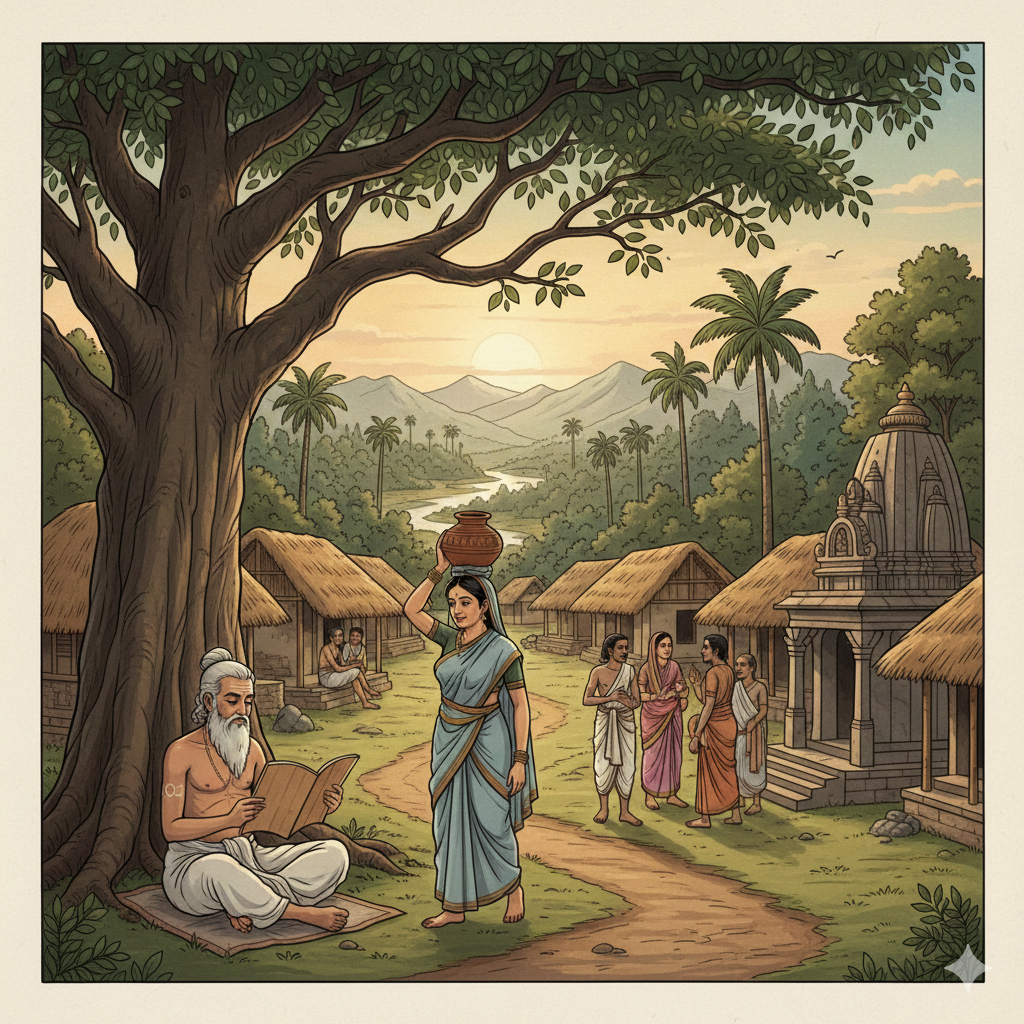
The Post-Vedic period represents a crucial and transformative phase in ancient Indian history. It is generally placed between 1000 BCE and 600 BCE, marking the transition from a semi-nomadic, ritual-centered society of the Rigvedic age to a more settled, agricultural, and socially stratified civilization. During this time, population increased, villages expanded into towns, economic activities diversified, and new philosophical ideas started shaping the intellectual landscape of India. The evolution of the Post-Vedic Society during this phase laid the groundwork for later political and social institutions.
Definition and Timeline of the Post-Vedic Period
The Post-Vedic period refers to the era that followed the Rigvedic age, where society became more structured, complex, and philosophically advanced. The key texts of this period include the Yajurveda, Samaveda, Atharvaveda, along with the Brahmanas, Aranyakas, and Upanishads. These texts not only expanded the ritualistic traditions of the earlier Vedic era but also opened the doors to deep philosophical inquiry into the nature of life, consciousness, truth, and the universe.
Evolution of social structure and the Caste System
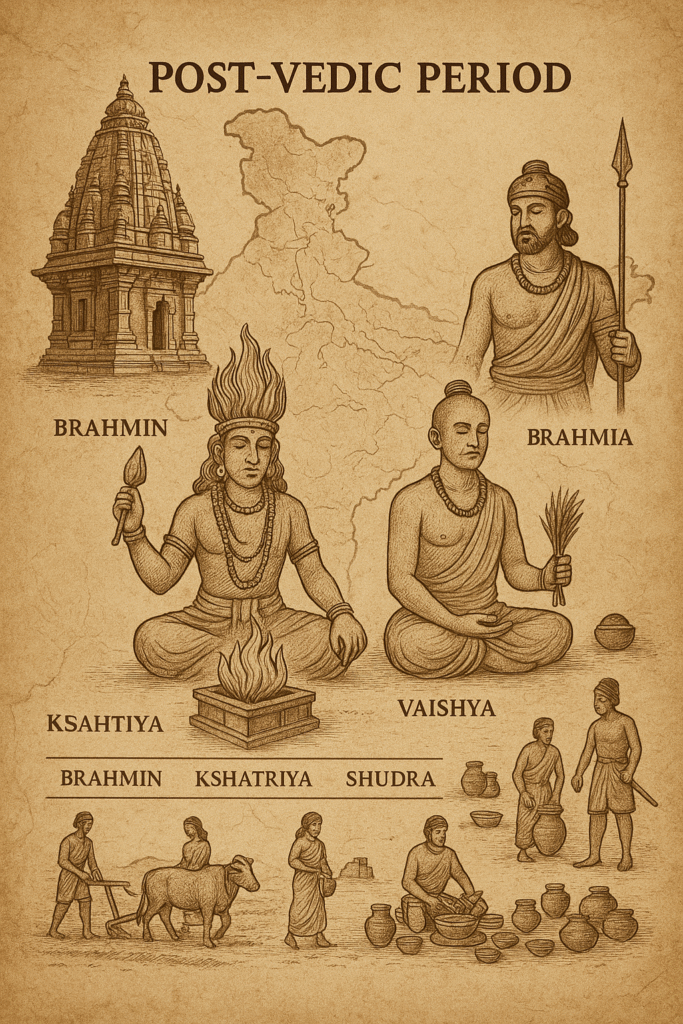
One of the most significant developments of the Post-Vedic age was the emergence of a more defined and organized social hierarchy. While the Rigvedic society practiced a flexible, occupation-based division, the Post-Vedic society gradually embraced a birth-based caste system. The four-fold varna structure—Brahmins, Kshatriyas, Vaishyas, and Shudras—became more rigid. Brahmins gained religious authority, Kshatriyas controlled political power, Vaishyas expanded economic activities, and Shudras were confined largely to labour and service roles. This transformation marked a decisive phase in the Post-Vedic Society, strengthening social order but also increasing inequality.
Family and Village Administration
The family served as the fundamental social unit, with the Grihastha Ashram being considered the most important stage of life. Joint families were common, and responsibilities were collectively shared. The village, headed by a leader known as the Gramani, functioned as the center of administration. Decisions related to agriculture, trade, security, and justice were taken collectively, reflecting a strong sense of community participation.
Religious Beliefs and Ritual Practices
Religion during the Post-Vedic period became more ritualistic and elaborate. Yajnas (sacrificial rituals) gained prominence, and the role of Brahmins increased due to their knowledge of mantras and rituals. The pantheon of gods evolved—while nature deities like Indra and Varuna remained significant, deities associated with fire, sacrifice, and cosmic order such as Agni, Soma, and Prajapati became central in religious activities.

| 👉 Buy on Amazon |
| As an Amazon Associate I earn from qualifying purchases. | |
Rise of Philosophical Thought
A remarkable contribution of the Post-Vedic age was the birth of philosophical inquiry. The Upanishads encouraged contemplation of deep metaphysical questions: What is the nature of the soul? What is the ultimate reality? What is liberation? Concepts such as Brahman, Atman, and Moksha took root during this period and laid the foundation for later schools of Indian philosophy, including Vedanta, Sankhya, and Yoga. This was the beginning of India's profound spiritual and intellectual legacy.
Economic Developments and Agricultural Expansion
Agriculture became the backbone of the Post-Vedic economy. The introduction of iron tools such as the plough and sickle increased productivity and allowed expansion into forested regions. Improved irrigation techniques, use of wells, and development of permanent settlements transformed the economic landscape. Trade flourished, with grains, cattle, metals, and textiles becoming key commodities. A merchant class emerged, and barter began evolving into more organized forms of exchange.
Craftsmanship and Trade
Crafts such as pottery, metallurgy, and jewelry-making advanced significantly. The production of painted grey ware and intricate metal tools reflected technological progress. Vaishyas played a major role in trade and commerce, establishing long-distance trade networks. The early foundations of market systems and occupational specialization became visible during this era.
Political Changes and Formation of States
Politically, the Post-Vedic period saw the evolution of small tribal groups into larger territorial units known as Janapadas, which later grew into the great Mahajanapadas. This period witnessed a shift from clan-based authority to structured monarchies and early republics. Kings gained more centralized control, supported by ministers, priests, and a standing army. Taxation systems developed, and the concept of organized governance took shape.
Law and Order
The administration of justice became more formalized. The concept of Dharma, or righteous duty, served as the guiding principle for law and order. Assemblies such as the Sabha and Samiti, which played a major role in early Vedic times, gradually lost influence as monarchical power strengthened. Regulations concerning crime, punishment, and social conduct became more structured.
Culture, Language, and Literature
The Post-Vedic period was also a vibrant cultural era. Sanskrit evolved into a more refined language, becoming the medium for sophisticated literary and philosophical expression. The composition of Brahmanas and Upanishads enriched Indian literature. Music, dance, and artistic traditions thrived, reflecting the cultural diversity and creativity of the time.
In summary, the Post-Vedic period provided a strong foundation for the growth of Indian civilization. It bridged the gap between the early Vedic pastoral lifestyle and the structured, philosophically rich society that led to the rise of Buddhism, Jainism, Mahajanapadas, and later empires. This historical background helps us understand how social, economic, and intellectual changes shaped the course of ancient India.
Causes of Change
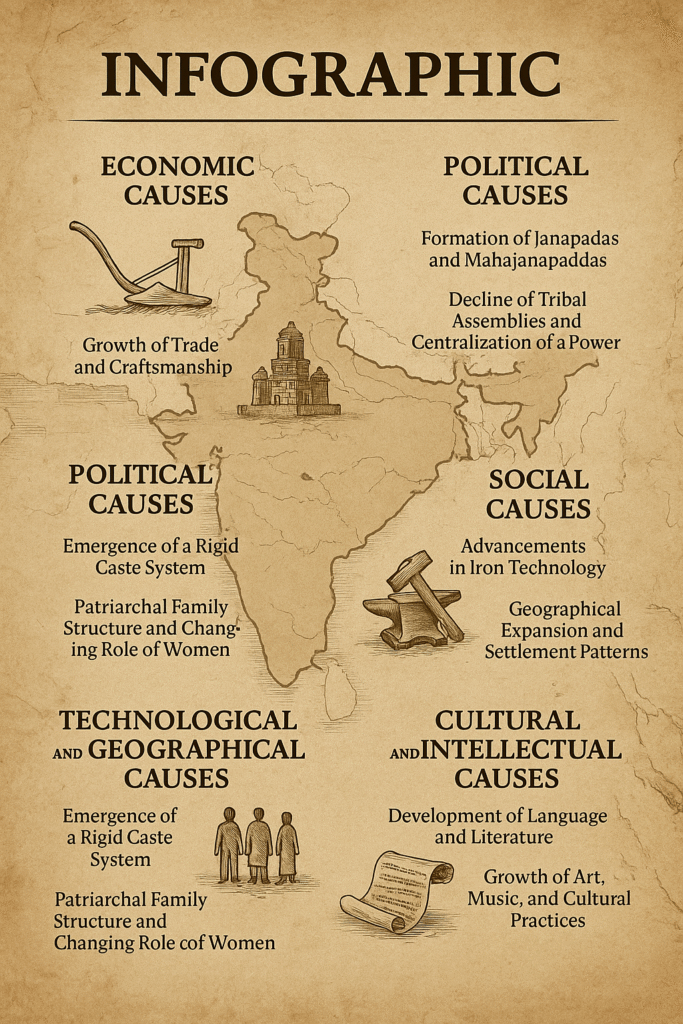
The transformation of Post-Vedic society was not the result of a single factor but a combination of economic, political, religious, technological, social, and geographical forces working together. This period marked a transition from simple pastoral life to a more organized and stratified society. Agriculture flourished, kingdoms expanded, intellectual debates deepened, and new religious ideas challenged older traditions. These developments brought about profound and lasting changes in the structure and character of ancient Indian society. The following sections explore these causes in detail and explain the evolution of the Post-Vedic Society.
1. Economic Causes
Expansion of Agriculture and Increased Productivity
Agriculture became the backbone of the Post-Vedic economy. The introduction of iron tools, such as the plough, axe, and sickle, revolutionized farming practices. Dense forests were cleared, new lands were cultivated, and irrigation methods improved. With the rise of surplus production, society moved from a semi-nomadic lifestyle to a settled village economy. This economic shift significantly strengthened the foundations of the Post-Vedic Society and influenced patterns of land ownership and hierarchy.
Growth of Trade and Craftsmanship
The rise of agriculture was accompanied by the growth of trade. Grains, metals, livestock, pottery, textiles, and ornaments became important items of exchange. Craftsmen and artisans multiplied, leading to the development of new professions. The merchant class, particularly the Vaishyas, gained economic importance. This rise in commercial activity widened economic inequality and contributed to the stratification of society.
2. Political Causes
Formation of Janapadas and Mahajanapadas
The political landscape of the Post-Vedic period changed dramatically with the emergence of large territorial units known as Janapadas. Over time, these expanded into powerful Mahajanapadas. The rise of monarchies brought about a centralized system of governance. Kings collected taxes, maintained armies, and issued administrative orders. This political consolidation reshaped social structures and created a more regulated and bureaucratic society.

| 👉 Buy on Amazon |
| As an Amazon Associate I earn from qualifying purchases. | |
Decline of Tribal Assemblies and Centralization of Power
During the Rigvedic period, tribal assemblies such as the Sabha and Samiti played a crucial role in decision-making. However, in the Post-Vedic period, these assemblies began to lose influence as monarchic power increased. Decision-making became centralized, and laws were imposed from above. This shift reduced the participatory nature of governance and increased political inequality.
3. Religious and Ideological Causes
Rise of Ritualism and Priesthood
Religion became more complex and dominated by elaborate rituals. Yajnas (sacrificial ceremonies) required extensive resources, leading to the rise of a powerful priestly class—the Brahmins. Their control over knowledge and rituals enhanced their social status and authority. Religious life became more formalized, which widened the gap between social groups and created new norms for behavior, duty, and hierarchy within the Post-Vedic Society.
Development of Philosophical Thought
While ritualism increased, there was also a parallel rise in philosophical inquiry. The Upanishads introduced profound discussions on the nature of the soul (Atman), ultimate reality (Brahman), karma, and liberation. These ideas encouraged people to question traditional beliefs and explore deeper spiritual truths. This intellectual awakening played a key role in transforming societal values and inspired later religious traditions such as Buddhism and Jainism.
Personal Story: Understanding Social Change Through Lived Experience
history is not found only in ancient texts, archaeological evidence, or preserved manuscripts. It also lives silently within our everyday experiences, conversations, traditions, and the subtle shifts we observe in society. Several moments in my own life helped me understand how the transformations that emerged during the Post-Vedic period are still visible in modern society. The story below reflects one such experience that shaped my understanding of social change in the Post-Vedic Society.
A Morning in the Village and Changing Traditions
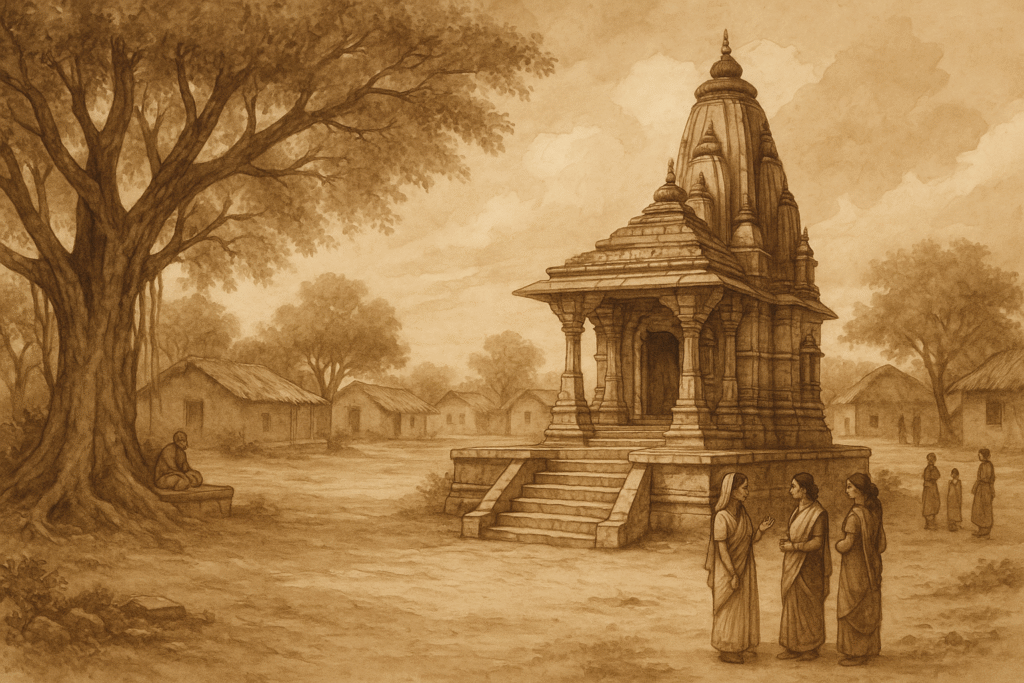
During one of my visits to my village, I noticed how old customs and social interactions were gradually changing. One early morning, I accompanied my grandfather to the ancient Shiva temple located at the center of the village. The temple once served as a hub of community life—elders held discussions there, rituals were performed, and young people learned moral lessons.

| 👉 Buy on Amazon |
| As an Amazon Associate I earn from qualifying purchases. | |
But that morning, the steps of the temple were nearly empty, silent in a way I had never seen before. My grandfather looked around and said softly, “Times have changed. Earlier the village came together here, but today everyone follows their own way.” His words reminded me of the transformation during the Post-Vedic era, when community assemblies like the Sabha and Samiti gradually lost power as centralized kingdoms emerged.
A Conversation With an Elder: Changing Links Between Caste and Work
Not far from the temple, I met an elderly villager—Ramlaal, someone who often shared stories of past social norms. He recalled one such story from his father’s time:
“In those days, every family had its traditional work. The blacksmith worked with iron, the potter shaped clay, and families like ours worked in the fields. But now it’s all changing. The younger generation is leaving the village, choosing new jobs, and skill is becoming more important than caste.”
His words instantly reminded me of the shift that occurred during the Post-Vedic period—when the caste system became rigid and occupation became tied to birth. Yet today, society is slowly breaking those boundaries. Opportunities and choices are shaping identity more than birth-based divisions. I realized that the same social structure that became rigid centuries ago in the Post-Vedic Society is now gradually loosening.
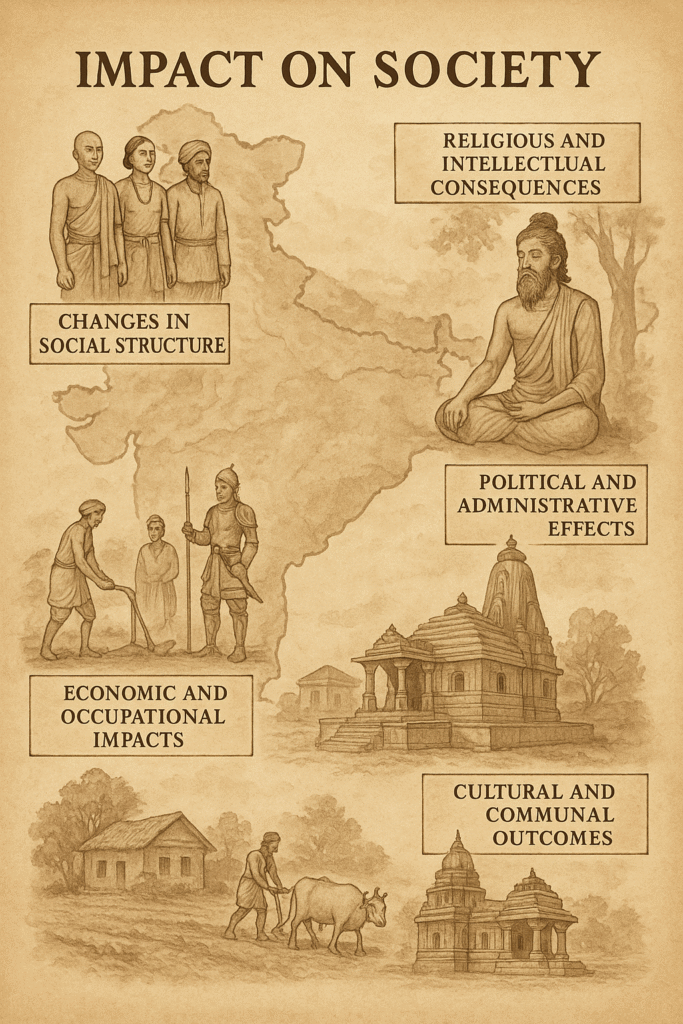
Impact on Society
The transformations that unfolded during the Post-Vedic period left deep and lasting imprints across nearly every layer of social life. Far from being confined to ritual or elite domains, these changes reshaped family structures, economic relationships, political authority, religious practice, and cultural expression. Understanding the social impact of this period helps explain many continuities and tensions in later South Asian history and reveals how the Post-Vedic Society evolved into a more structured and hierarchical order.
1. Changes in social structure
Entrenchment of Varna and Social Stratification
One of the most visible social outcomes was the increasing rigidity of the varna system. What had begun as a relatively flexible, occupation-oriented division hardened into more birth-based categories. This shift limited social mobility by formalizing roles and privileges for Brahmins, Kshatriyas, Vaishyas, and Shudras. As social position became more hereditary, access to resources, ritual status, and political influence concentrated in particular groups, producing long-term inequalities that deeply shaped the Post-Vedic Society.
Household Organisation and Patriarchy
The Post-Vedic changes strengthened patriarchal household norms and expanded the scope of joint family arrangements. The grihastha (householder) ideal became central to social life, and male authority over property and public decisions grew more pronounced. These patterns affected inheritance rules, marriage practices, and gendered divisions of labour, often constraining women’s public roles and access to formal educational and religious privileges.
2. Religious and Intellectual Consequences
Concentration of Ritual Authority
A more elaborate ritual system elevated the role of priestly specialists. Knowledge of mantras, rites, and liturgical rules became a source of social capital, and Brahminical authority expanded into domains of education and legal norms. Ritual complexity tended to centralize religious legitimation in learned elites, which both maintained cultural continuity and limited broader communal participation in religious decision-making.

| 👉 Buy on Amazon |
| As an Amazon Associate I earn from qualifying purchases. | |
Philosophical Diversification
At the same time, the Post-Vedic era fostered intense intellectual activity. The Upanishadic turn toward metaphysics and self-inquiry diversified spiritual horizons and challenged purely ritualistic frameworks. This intellectual ferment laid the groundwork for alternative religious movements—Buddhism and Jainism among them—that questioned hierarchies and offered different ethical and social ideals.

| 👉 Buy on Amazon |
| As an Amazon Associate I earn from qualifying purchases. | |