Balochistan: Geography, History, Culture and Global Importance
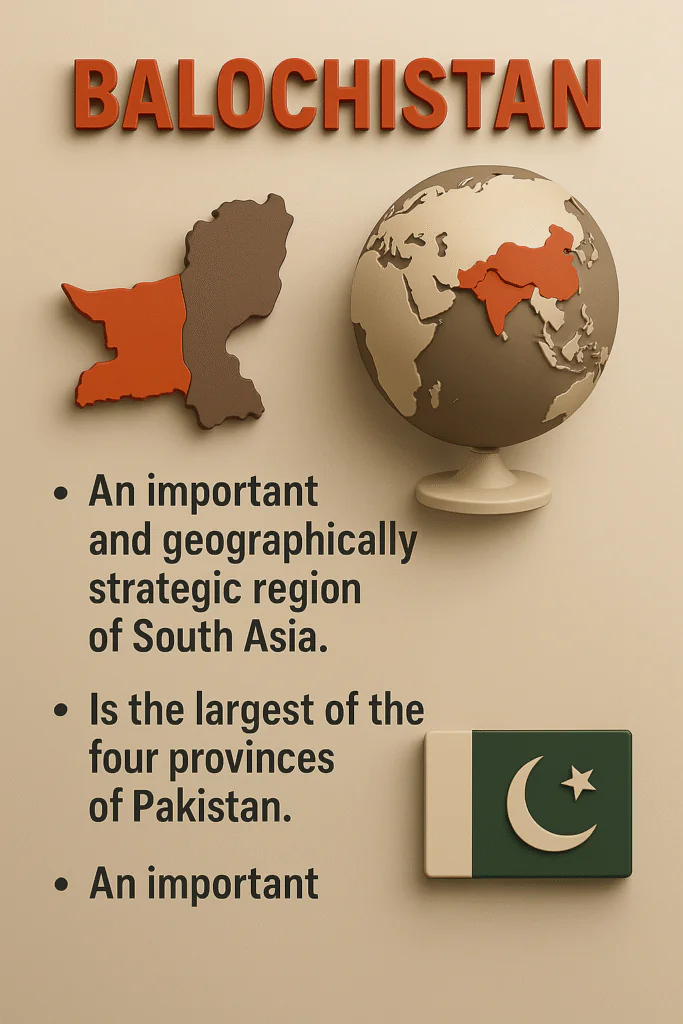
Balochistan, an important and geographically strategic region of South Asia, is the largest of the four provinces of Pakistan. The province is known for its vast deserts, hills and rich natural resources. The total area of Balochistan is about 347,190 square kilometers, which is 44% of the total area of Pakistan.

The region borders Afghanistan in the north, Iran in the west and the Arabian Sea in the south. The headquarters of Balochistan is Quetta, which is the center of business activities and historical heritage.
Cultural Diversity and Economy
Cultural diversity is seen in Balochistan. The major languages here are Balochi, Pashto and Brahui. Its people are famous for their traditions, hospitality and folk dance.
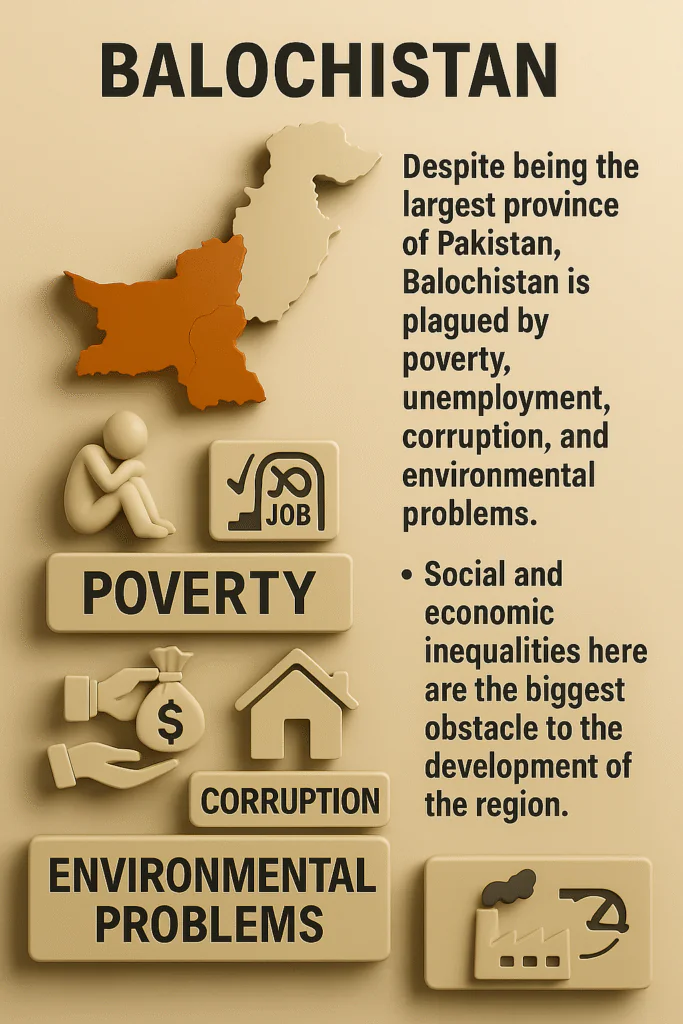
The economy of Balochistan is mainly dependent on natural resources such as gas, coal, and minerals. The region is also of global importance due to the Gwadar port and the China-Pakistan Economic Corridor (CPEC). However, the region still faces challenges in economic and social development, such as poverty, lack of education, and political instability.
Baluchistan’s Regional and Global Relevance
Baluchistan, due to its cultural heritage, natural beauty, and geopolitical importance, is an important part not only of Pakistan but of the entire region.
Place Naming of Baluchistan
Balochistan is named after the "Baloch" tribe that lives there. The region is mainly inhabited by the Baloch people, who are famous for their cultural heritage, traditions, and bravery.
Ancient Origins
Some historians believe that the word "Baloch" derives from the ancient Persian word "Baloch," meaning "high land."
Tribal Name
The name itself is linked to the name of the Baloch tribe, which has inhabited the region for centuries.
Cultural Influence
The Baloch tribes gave the region the name Baluchistan because of their cultural and social influence on it. The word "Baloch" means "land" or "region," so "Baluchistan" means "land of the Baloch people."
The history of Balochistan and its people have always been known for their independence, culture, and resources. This naming has established the identity of this region at the global level.
Location of Baluchistan
Balochistan is located at the confluence of South Asia and Central Asia, which is an important region from geographical, cultural and historical point of view.
Geographical Location
Most of Balochistan is in Pakistan, but it also extends to parts of Iran and Afghanistan. The main administrative center of Balochistan is Quetta, which is also important from historical and cultural point of view.

This region is rich in natural resources, and includes desert areas as well as mountainous areas. Its naming is a testimony to the fact that the Baloch tribe has left their deep mark on the region, and the area treasures their cultural and historical heritage.
⭐ Editor's Choice
Discover a highly rated product selected for its quality, functionality, and positive customer feedback.
View Details & Reviews →Historical Background of Baluchistan
Baluchistan, which is located at the juncture of South Asia and Central Asia, is known for its rich and diverse historical background. The region has witnessed ancient civilizations, empires, and cultural exchanges.
Ancient Period
The history of Baluchistan is linked to the Indus Valley Civilization (3000 BC). Mehrgarh, one of the oldest agricultural sites in the world, is located in this region. The Mehrgarh civilization was advanced in agriculture, animal husbandry and craftsmanship. It is counted among the oldest and organized civilizations of the Indian subcontinent.

Medieval History
In the medieval period, Baluchistan was ruled by many external invading empires. Prominent among them are Persia, Maurya Empire, and Kushan Empire. After the arrival of Islam in the seventh century, Baluchistan became an important center of Islamic culture and traditions.
Rise of the Baloch Tribes
The modern form of Baluchistan emerged during the 12th and 13th centuries, when the Baloch tribes became established in the region. The Baloch tribes came mainly from Persia and Central Asia and established their cultural identity and rule in the region.
Colonial Period
The British Empire took control of Baluchistan in the 19th century. In 1876 the British government declared Baluchistan a princely state and organized it administratively. During British rule, Baluchistan was considered a strategically important region, especially due to its borders with Afghanistan and Iran.
Modern Period
After the India-Pakistan partition in 1947, Baluchistan became part of Pakistan. However, disputes and rebellions continued in Baluchistan over its merger with Pakistan. Today, Baluchistan is the largest province of Pakistan and is economically important due to natural resources (gas, coal, minerals).
The historical background of Baluchistan makes it a region that was not only the center of ancient civilization but is still important today due to its cultural and geographical uniqueness.
Balochistan: Geography, Natural Resources, History and Culture
Geography and Natural Resources of Balochistan
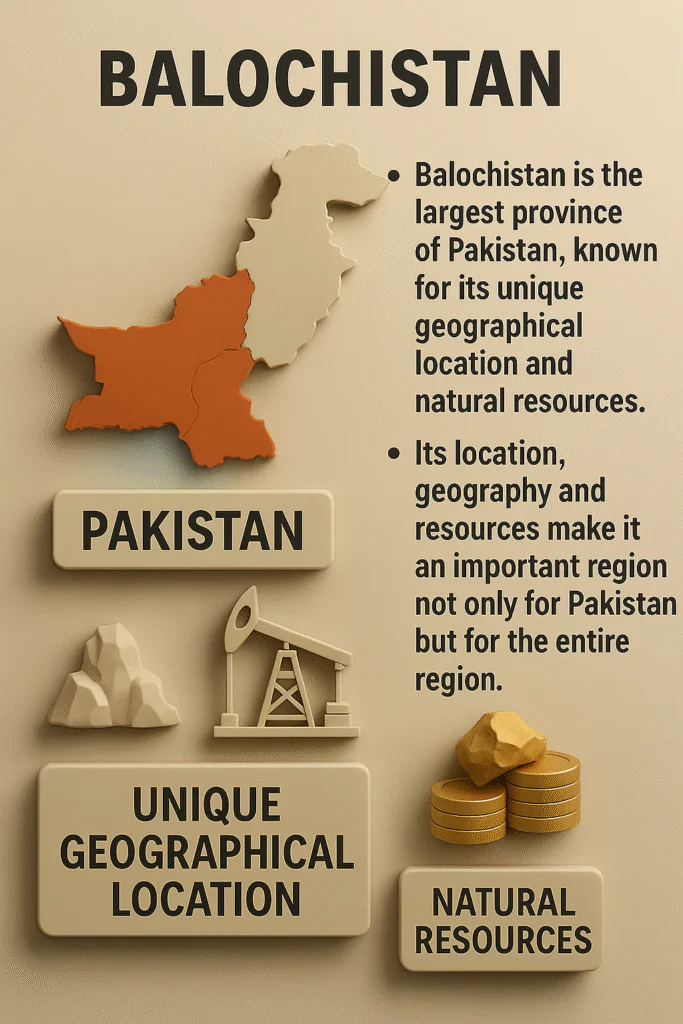
Balochistan is the largest province of Pakistan, covering about 44% of the total area. It is a land of contrasts — vast deserts, towering mountains, rich minerals, and a long coastal belt. The total area of the province is approximately 347,190 square kilometers.
Boundaries
- North — Afghanistan
- West — Iran
- South — Arabian Sea
- East — Sindh and Punjab provinces
Topography
The geography of Balochistan is mountainous and arid. The terrain is dominated by plateaus, deserts, and rugged hills. Major ranges include the Sulaiman Range, Kirthar Range, Makran Mountains, and Chagai Hills.
Coastline
The Makran coastline stretches over 770 kilometers along the Arabian Sea, featuring ports such as Gwadar and Pasni. This coastal belt is vital for trade and fisheries.
Climate
The climate of Balochistan is mainly arid and semi-arid. Summers are extremely hot, while winters bring snowfall in highlands like Ziarat. The southern coast enjoys a mild maritime climate due to sea influence.
Natural Resources
Balochistan is the richest region of Pakistan in terms of natural resources. It holds massive reserves of copper, gold, coal, and iron, as well as natural gas and oil.
- Mineral Resources: Copper, gold, coal, iron, chromite, and marble.
- Major Projects: Reko Diq and Saindak mining projects are world-renowned.
- Natural Gas: The Sui Gas Field provides 40% of Pakistan’s total gas production.
- Fisheries: Coastal regions support large-scale fishing industries.
Rivers and Water Resources
Balochistan’s water system depends mainly on rainfall. Major rivers include the Dasht River and Hingol River, which flow through arid regions and support limited agriculture.

⭐ Editor's Choice
Discover a highly rated product selected for its quality, functionality, and positive customer feedback.
View Details & Reviews →Environmental Features
- Hingol National Park: The largest national park of Pakistan, home to rare wildlife and unique formations like the “Princess of Hope”.
- Makran Coast: Rich in marine ecosystems.
- Chagai Desert: Known for its dry plateau and mineral wealth.
History and Culture of Balochistan
Balochistan is a land of ancient civilizations and diverse cultural traditions. Its people, music, architecture, and tribal customs give it a distinct identity in South Asia.
Historical Importance
The history of Balochistan goes back thousands of years. It has witnessed the rise and fall of empires and civilizations, from the Mehrgarh Civilization to the Islamic period and British colonial rule.
Ancient Civilizations
Mehrgarh (7000 BC) is one of the earliest agricultural settlements in the world. It shows evidence of farming, pottery, and animal domestication. The region was also part of ancient trade routes linked to the Indus Valley Civilization.
Islamic Influence
After the 7th century, Islam spread across Balochistan, shaping its architecture, art, and traditions. Mosques, tombs, and forts built during this period reflect a blend of Persian and local styles.
British Rule and Freedom Movement
The British Empire took control of Balochistan in the 19th century and declared it a princely state in 1876. The period marked infrastructural development but also fueled local resistance and nationalist movements. After the 1947 partition, Balochistan became part of Pakistan, though disputes over autonomy persisted.
Cultural Diversity
Balochistan’s culture is defined by its tribal communities — Baloch, Brahui, and Pashtun. Each tribe preserves its traditions, music, and folk arts. The people are known for their hospitality, courage, and loyalty.
Languages
Major languages spoken in Balochistan include Balochi, Brahui, and Pashto. Urdu and Sindhi are also understood. These languages reflect the deep cultural and linguistic diversity of the region.
Traditions and Customs
Tribal customs play a major role in social life. Baloch men wear traditional attire — a loose kurta, shalwar, and turban — symbolizing pride and identity. Tribal laws (Jirga system) continue to guide social and political matters.
Folk Music and Dance
Baloch folk music is rich and rhythmic, often accompanied by instruments like dhol, sarod, and bansuri. Famous folk dances include Liwa and Chaap, performed during celebrations and harvest festivals.
Festivals
- Eid-ul-Fitr and Eid-ul-Azha: Celebrated with traditional feasts and communal prayers.
- Sibi Festival: A major cultural event featuring horse riding, crafts, and music.
- Folk Festivals: Harvest and wedding ceremonies are filled with local songs and dances.
Heritage Sites and Architecture
- Mehrgarh: Recognized by UNESCO as one of the earliest agricultural sites.
- Hingol National Park: Houses natural formations and the sacred “Nani Ka Mandir”.
- Makran Coast: Known for its marine ecology and natural beauty.
- Ziarat: Famous for its colonial-era buildings and scenic landscapes.
Conclusion
The geography, natural resources, and culture of Balochistan make it one of South Asia’s most fascinating regions. From its ancient civilizations and mineral wealth to its diverse traditions and landscapes, Balochistan stands as a symbol of endurance, beauty, and heritage. Its people’s resilience and cultural pride continue to define this land of mountains and deserts in the heart of Pakistan.
Balochistan: Social and Political Situation, Economic Development and Education
Social and Political Situation of Balochistan
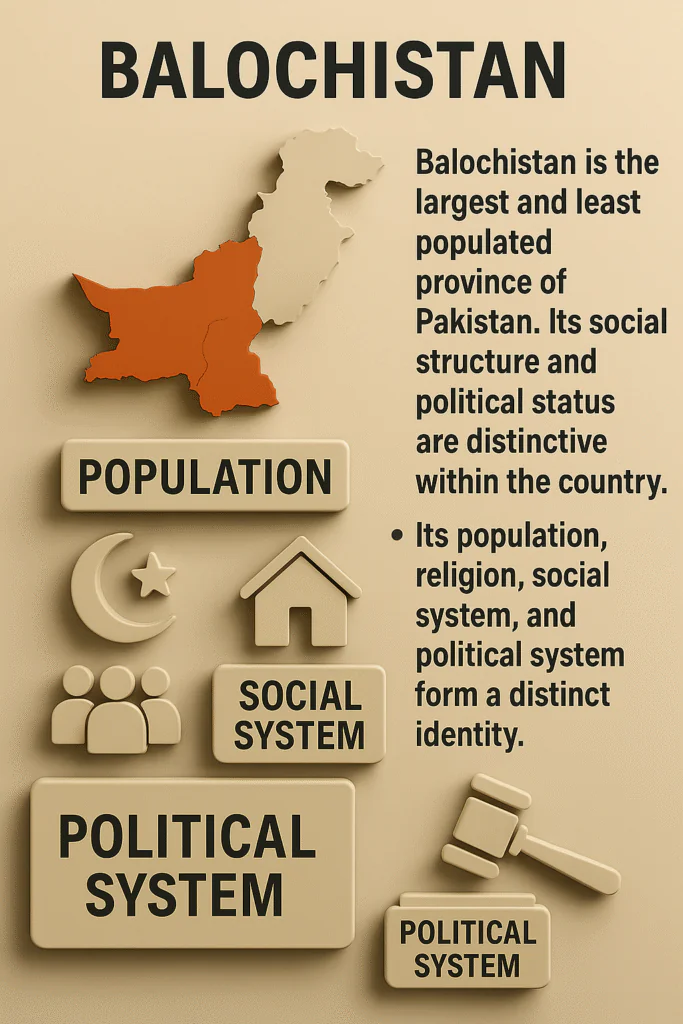
Balochistan is the largest but least populated province of Pakistan. Its social structure and political framework make it a distinctive and complex region within the country. The interplay of tribal traditions, resource management, and modern governance defines its socio-political environment.
Population and Social Structure
Balochistan covers about 44% of Pakistan’s total land area, but only around 5–6% of the population lives here. According to 2023 estimates, its population is nearly 14 million (1.4 crore).
- Religion: Islam is the dominant faith; most people are Sunni Muslims, while Shia Muslims and minorities like Hindus and Christians also live here.
- Tribal System: Society is primarily tribal, led by chiefs known as Sardars. Major tribes include the Baloch, Brahui, and Pashtun.
- Social Values: Family honor, hospitality, and loyalty to tribe form the backbone of social life.
Governance System and Constitution
Balochistan is one of the four provincial administrative units under Pakistan’s federal system. It operates under the 1973 Constitution of Pakistan, which grants limited provincial autonomy.

⭐ Editor's Choice
Discover a highly rated product selected for its quality, functionality, and positive customer feedback.
View Details & Reviews →- Governor: Appointed by the federal government.
- Chief Minister: Elected by the provincial assembly, responsible for day-to-day administration.
- Legislature: Provincial Assembly of Balochistan (65 seats).
Despite constitutional autonomy, disputes over natural resource control and federal interference remain sources of tension between the province and central government.
Major Political Parties
Political movements in Balochistan often revolve around resource ownership, tribal identity, and regional autonomy.
- Baloch National Party (BNP): Advocates for provincial autonomy and local control of natural resources.
- Jamiat Ulema-e-Islam (JUI): A religious political group supporting Islamic governance and social traditions.
- Pakistan Muslim League (PML): A national party with provincial influence.
- Pakistan Tehreek-e-Insaf (PTI): Prominent national party with representation in Balochistan’s political landscape.
- Baloch Liberation Army (BLA): An armed separatist organization seeking independence for Balochistan.
Social Issues and Challenges
Despite vast resources, Balochistan faces major socio-economic problems such as poverty, illiteracy, and underdevelopment.
- Poverty and Development: Balochistan remains Pakistan’s most underdeveloped province; rural poverty exceeds 70%.
- Resource Distribution: Locals often complain that resource profits benefit the federal government, not the province.
- Terrorism and Instability: Insurgencies and extremist violence have disrupted growth and governance.
- Human Rights: Enforced disappearances, military operations, and curbs on media freedom draw global attention.
Economic Development of Balochistan
Balochistan’s economy is primarily based on its abundant natural resources, agriculture, and fisheries. However, weak infrastructure, lack of investment, and security challenges hinder progress.
Natural Resource-Based Economy
The province contributes significantly to Pakistan’s overall resource production.
- Natural Gas: The Sui Gas Field is the backbone of Pakistan’s energy supply.
- Minerals: Balochistan produces copper, gold, and coal through projects like Reko Diq and Saindak.
- Marble and Chromite: Exported globally and form part of the small-scale industrial base.
- Coastal Trade: The Makran coast supports fishing and international trade through Gwadar port.
Industrial Development
The industrial base remains underdeveloped due to lack of infrastructure, energy shortages, and poor investment climate.
- Mining and extraction are the primary industries.
- Industrial zones near Gwadar are being developed under the China-Pakistan Economic Corridor (CPEC).
- Manufacturing and technology sectors are minimal but growing with foreign assistance.
Agriculture and Livestock
Approximately 70% of the province is arid, limiting agricultural activities. However, fertile valleys produce wheat, barley, and fruits such as apples, pomegranates, and cherries — earning Balochistan the title of the “Fruit Bowl of Pakistan.”
Fishing and Coastal Economy
The coastal belt contributes significantly to fisheries and maritime exports. Fish, shrimp, and seafood products from Gwadar and Pasni are exported to the Middle East and beyond.
Infrastructure and Trade
Projects like the Gwadar Port and CPEC are transforming Balochistan into an international trade corridor. Roads, railways, and energy pipelines are being developed to integrate the province with regional trade networks.
Education and Technological Development
Education in Balochistan remains the most underdeveloped compared to other provinces of Pakistan. Lack of infrastructure, trained teachers, and accessibility are key issues affecting literacy.
Current Education Statistics
- Literacy Rate: Approximately 44% (national average 62%).
- Female Literacy: Around 25–30% — among the lowest in South Asia.
- School Availability: Nearly half the population has limited access to basic education.
Challenges in Education
- Shortage of qualified teachers and educational institutions.
- Poor infrastructure in rural areas.
- Social and cultural barriers limiting girls’ education.
- Insufficient funding and weak policy implementation.
Higher and Technical Education
Prominent institutions such as the University of Balochistan and BUITEMS (Balochistan University of Information Technology) provide higher education. However, technical and vocational training remains limited.
Government and NGO Efforts
Both government and non-governmental organizations have initiated programs to promote literacy and women’s education. Scholarships, awareness campaigns, and mobile schools have been introduced in remote areas.
Science and Technological Growth
Technological development is still in its early stages, but CPEC-related projects have improved infrastructure and connectivity. Renewable energy initiatives — solar and wind — are being encouraged in remote districts.
Future Prospects
The economic potential of Balochistan is immense. Sustainable use of mineral wealth, expansion of education, and equitable resource distribution can transform it into a prosperous province. Empowering local communities and investing in human capital remain the keys to long-term stability and growth.
Conclusion
The social and political structure of Balochistan is deeply rooted in tribal traditions, while its economy is driven by natural wealth and global trade corridors. However, poverty, illiteracy, and underdevelopment continue to challenge its progress. A strong focus on education, infrastructure, and equitable governance can enable Balochistan to realize its true potential and play a defining role in Pakistan’s development.