

Hindu Swastika
Hindu Swastika: Importance and Meaning
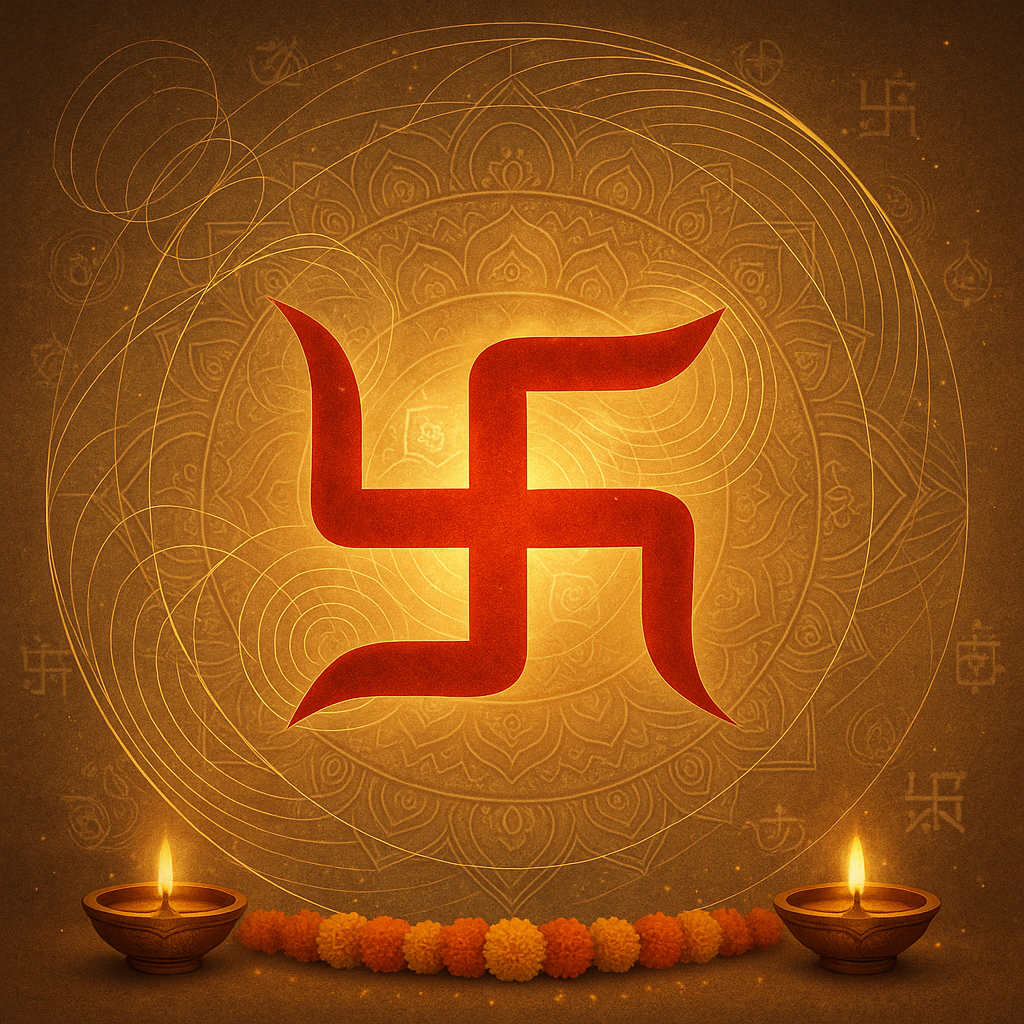
The Swastika is considered one of the most holy and auspicious symbols in Hindu religion. It is a four-armed cross-like mark whose arms are bent at right angles, symbolizing different directions. The word “Swastika” comes from the Sanskrit words “su” (good) and “asti” (to be), meaning “auspicious” or “well-being.”
Religious and Spiritual Importance of the Swastika
Symbol of Lord Ganesha and Auspicious Beginnings
In Hinduism, the Swastika is associated with Lord Ganesha and is used at the beginning of every auspicious task or ceremony.
Representation of Four Directions
The four sides of the Swastika represent the East, West, North and South directions, symbolizing the completeness of nature.
Presence in Vedic Tradition
According to the Vedas and Puranas, the Swastika is a symbol of happiness, peace, prosperity and good fortune.
Use in Yagya and Puja
During religious rituals, yajnas and offerings to the fire, the Swastika is drawn to invoke positive energy.
Importance in Astrology and Vastu
The Swastika is used in Vastu to remove deficiencies and enhance positive vibrations in the environment.
Scientific and Spiritual Perspective of the Swastika
Energy Balance
The Swastika is believed to balance positive energy and cosmic forces, creating harmony in the surroundings.
Golden Ratio and Cosmic Balance
This symbol is also associated with mathematical symmetry and the universal Golden Ratio, signifying natural balance and beauty.
Mental and Spiritual Impact
Viewing the Swastika is believed to bring mental calmness, clarity, and positivity.
Types and Uses of the Swastika
Right-Facing Swastika
The right-facing Swastika has arms bent in the direction of the clock’s movement. It is considered highly auspicious and is used in rituals and worship.
Left-Facing Swastika
The left-facing Swastika has arms bent in the opposite direction and is usually used in Tantric practices.
Jain and Buddhist Swastika
In Jainism, the Swastika represents the Tirthankaras, while in Buddhism it is considered a sacred symbol associated with various phases of Lord Buddha’s teachings.

Amazon Product Title Here
Enhance your daily routine with this reliable and well-designed product that delivers consistent performance. Built with quality materials and user-friendly features, it offers convenience, durability, and comfort — ideal for everyday use at home or work.
🛒 Check Price on Amazon* As an Amazon Associate I earn from qualifying purchases.
Historical and Cultural Importance
The Swastika is not limited to Hinduism alone. It has also been found in Jain, Buddhist, Greek, Roman, and ancient Egyptian civilizations. Across the world, it has long been regarded as a symbol of prosperity, good luck and auspiciousness.
In Indian culture, it is deeply connected with business, architecture, art, and daily life activities.
Conclusion
The Swastika is not just a religious symbol—it represents peace, prosperity and positive energy. In Hindu tradition, it is considered extremely auspicious and is used in almost every sacred activity. For thousands of years, it has remained a vital part of Indian culture and continues to hold profound significance even today.
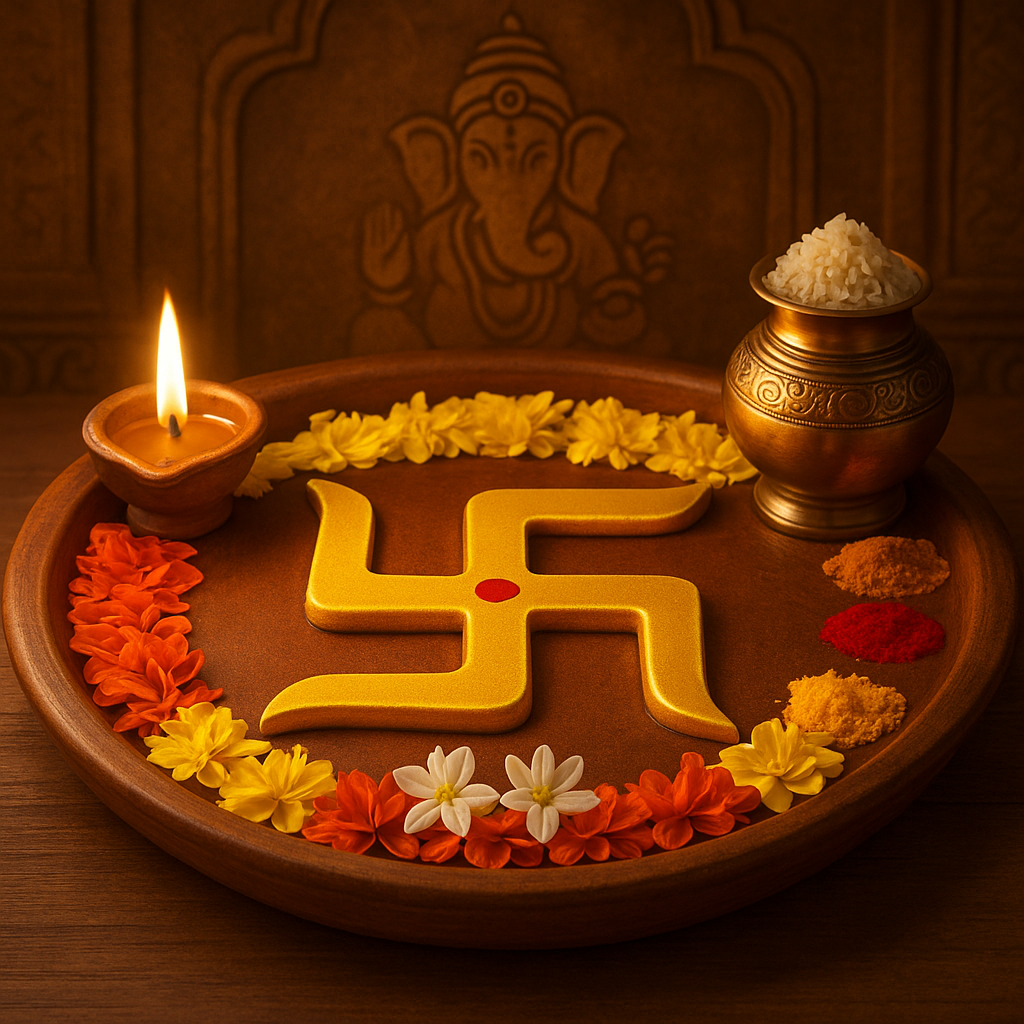
Hindu Swastika – Meaning and Importance
Meaning of the Hindu Swastika
The Swastika is an ancient holy symbol in Hinduism, representing auspiciousness, prosperity and well-being. The word ‘Swastika’ comes from the Sanskrit terms:
- “Su” – meaning ‘good’, ‘auspicious’, ‘well’
- “Asti” – meaning ‘to be’ or ‘existence’
Thus, the literal meaning of Swastika is “a symbol of goodness” or “an auspicious existence.”
Form and Structure of the Swastika
The original Swastika is a four-armed symbol, with each arm bent at a right angle (90°). These four extensions represent infinite progress, prosperity, balance and universal expansion.
The central point or dot often drawn within the Swastika symbolizes cosmic energy and the universal center.
Religious Importance of the Swastika
1. Relationship with Lord Ganesha and Auspicious Functions
The Swastika is considered a symbol of Lord Ganesha, representing wisdom, prosperity and the removal of obstacles. Therefore, before beginning any new work—marriage, puja, worship, rituals or business—Swastika is drawn for divine blessings.
2. Symbol of Four Directions and the Four Vedas
The four sides of the Swastika represent the four directions (East, West, North, South), the four Vedas (Rigveda, Yajurveda, Samaveda, Atharvaveda) and the four Yugas (Satyayuga, Tretayuga, Dwaparayuga, Kaliyuga).
3. Symbol of Creation and the Universe
The Swastika is considered the foundation of nature, representing cosmic energy spreading in all directions.
4. Relationship with Goddess Lakshmi and Prosperity
The Swastika is a symbol of Goddess Lakshmi (wealth and prosperity). Therefore, it is commonly drawn at shop entrances, homes, vaults, safes and business establishments for attracting abundance.
Types of Swastika

Amazon Product Title Here
This high-quality product is designed to deliver reliable performance and everyday convenience. Featuring durable construction and user-friendly functionality, it enhances comfort and usability for daily tasks, making it a practical choice for both home and work environments.
🛒 Check Price on Amazon* As an Amazon Associate I earn from qualifying purchases.
1. Right-Facing Swastika (Dakshinavarti or Clockwise)
- Arms bent in the direction of a clock’s movement.
- Considered highly auspicious.
- Used in all Hindu rituals, ceremonies and worship.
- Symbolizes positive energy, growth and peace.
2. Left-Facing Swastika (Counter-Clockwise)
- Arms bent opposite to the clock’s movement.
- Used in tantric rituals, cremation grounds and occult practices.
- Not used in regular religious rituals.
Scientific and Astrological Significance
1. Energy Balance and Vastu Shastra
Swastika is used in Vastu to remove defects, dispel negativity and enhance positive energy within homes and workplaces.
2. Mathematics and the Golden Ratio
The design of the Swastika is based on the Golden Ratio, symbolizing perfection, symmetry and natural balance—from atoms to galaxies.
3. Health and Mental Calmness
Viewing and meditating upon the Swastika helps promote mental peace, reduce stress and activate positive brain energy.
Historical and Cultural Importance
- India: The Swastika has existed since the Indus Valley Civilization (3300–1300 BCE).
- Buddhism: Considered one of the sacred marks associated with Lord Buddha.
- Jainism: Represents the 24th Tirthankara, Lord Mahavir.
- World Civilizations: Found in Greek, Roman, Egyptian, Celtic and Norse cultures.
Difference Between Hindu Swastika and Nazi Symbol
In the 20th century, the Nazi Party adopted a distorted version of the Swastika called “Hakenkreuz.” This caused a misunderstanding of the symbol globally.
Key Differences:
- Hindu Swastika: Upright, clockwise, symbol of peace and prosperity.
- Nazi Symbol: Tilted 45°, anti-clockwise or distorted, associated with negativity.
Modern Use of the Swastika
- Used in Hindu pujas, rituals and festivals.
- Drawn at home entrances, businesses and shops.
- Used during Diwali, New Year, weddings and housewarming ceremonies.
- Present in temples, scriptures and statues.
Additional Religious Importance of the Swastika
1. Relationship with Lord Ganesha
a. Symbol of Removing Obstacles
Swastika represents Vighnaharta Ganesha, who removes obstacles from life. Therefore, it is drawn before beginning any new undertaking.
b. Symbol of Happiness, Prosperity and Intelligence
Swastika reflects the qualities of success, wisdom and good fortune bestowed by Lord Ganesha.
2. Relationship with Goddess Lakshmi
a. Symbol of Wealth and Prosperity
Swastika symbolizes the blessings of Goddess Lakshmi. It is drawn on ledgers, safes, shop entrances and during Diwali puja.
3. Symbolism of the Four Vedas
- Rigveda: Knowledge and intelligence.
- Yajurveda: Karma and yajna.
- Samaveda: Devotion, music and worship.
- Atharvaveda: Protection, healing and science.
4. Four Yugas and Four Directions
The Swastika symbolizes time cycles and universal balance across all directions.
Swastika in Religious Rituals
1. Housewarming and Vastu
Drawing Swastika at entrances brings positivity, peace and prosperity.
2. Marriage Rituals
Swastika marks are used in wedding mandaps to bless the couple with a harmonious life.
3. Puja and Yagya
Drawn during havans and rituals to invoke divine energy.
Tantric and Astrological Importance
1. Use in Tantric Rituals
The left-facing Swastika is used in specific tantric practices and sadhanas.
2. Relationship with the Nine Planets
Swastika symbolizes the Sun and helps pacify planetary defects.
Swastika in Spiritual Significance
1. Cosmic Energy
The Swastika represents the cosmic wheel of creation, preservation, destruction and rebirth.
2. Balance of the Five Elements
Its structure symbolizes balance among earth, water, fire, air and space.
3. Soul and Divine Connection
Swastika represents the union of the individual soul (Atman) with the Supreme Soul (Brahman).
4. Meditation and Chakras
Used to awaken Kundalini energy and activate the Crown Chakra (Sahasrara).
5. Mention in Vedas and Upanishads
Swastika is associated with truth, dharma, cosmic order and non-duality (Advaita).
Conclusion
The Swastika is not just a religious symbol; it represents peace, prosperity, progress, cosmic balance, spiritual awakening and divine consciousness. For thousands of years, it has been revered in Hindu, Buddhist, Jain and many ancient cultures worldwide.
It inspires humanity toward truth, positivity, harmony and spiritual growth.
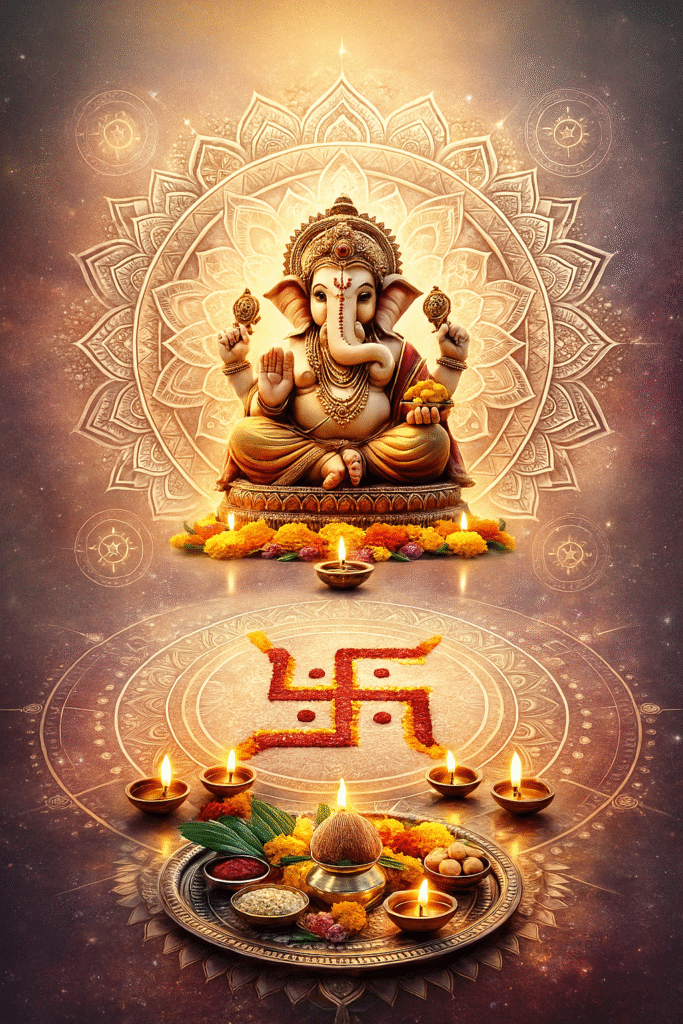
God Ganesh, Auspicious Functions, Swastika Uses, Four Directions, Yagya, Astrology & Vastu Importance
God Ganesh and Auspicious Functions of the Symbol
God Ganesh is the first respected deity in Hindu religion. He is known as Vighnaharta, the remover of obstacles, the giver of intelligence, prosperity and success. Every auspicious work begins with the worship of Lord Ganesha so that the task is completed without obstacles.
Lord Ganesha is considered the deity of auspiciousness. His blessings bring good luck, fortune and success in life. Therefore, his worship is essential during marriage, home entry, business inauguration, education, new beginnings and other religious rituals.
1. God Ganesha: Founder of Auspicious Initiations
1.1 First Respected Deity
In Hinduism, every religious ritual, worship, havan and auspicious work begins with the worship of Lord Ganesha. The belief is that worshipping him eliminates all kinds of obstacles and ensures smooth completion of work.
1.2 Importance of the Word “Shri Ganesh”
Before starting any new task, saying “Shri Ganesh” is a tradition. It signifies invoking Lord Ganesha’s blessings for auspiciousness and success. Scriptures state that Lord Shiva and Goddess Parvati themselves declared Ganesha as the first respected among all gods.
2. Form of Lord Ganesh and Spiritual Message
2.1 Symbolic Importance of Ganesh Ji’s Organs
| Organ | Meaning |
|---|---|
| Big Head | Sign of great knowledge and intellectual power |
| Small Eyes | Micro vision and foresight |
| Big Stomach | Ability to assimilate good and bad experiences |
| Long Ears | Patience and attentive listening |
| Small Strong Legs | Balance and stability |
| Trunk | Intelligence, flexibility and practical wisdom |
2.2 Meaning of Ganesh Ji’s Four Hands
- First Hand: Blessings, peace, success
- Second Hand: Loop symbolizing removal of negativity & bad habits
- Third Hand: Ankush symbolizing discipline & truth
- Fourth Hand: Modak symbolizing enlightenment & devotion
3. Importance of Ganesh Worship in Auspicious Functions
3.1 Marriage and Home Entry
Worship of Lord Ganesha ensures a blissful married life and removes obstacles. During home-entry rituals, placing a Ganesha idol brings positive energy and prosperity.
3.2 New Business and Education
Starting any business, shop or office with Ganesh worship invites success. Students worship Ganesha for knowledge, wisdom and examination success.
3.3 Travel and Vehicle Worship
Before purchasing or using a new vehicle, Ganesha worship ensures safety and protection from mishaps. Long journeys are begun with his prayer for smooth travel.
4. Major Ganesha Mantras and Their Effects
| Mantra | Meaning / Effect |
|---|---|
| Om Gam Ganapataye Namah | Removes obstacles |
| Om Vakratunda Mahakaya Suryakoti Samaprabha, Nirvighnam Kuru Me Deva Sarva Karyeshu Sarvada | Ensures success in all auspicious works |
| Om Shree Ganapataye Varvardaya Sarvajanam Me Vashamanaya Swaha | Brings good luck and prosperity |
5. Ganesha Chaturthi and Ganapati Celebration
5.1 Religious Importance
Ganesha Chaturthi marks the birth of Lord Ganesha. Special puja, fasting and devotional singing are performed.
5.2 Anant Chaturdashi and Ganapati Visarjan
On the 11th day, idols are immersed, symbolizing gaining knowledge and returning it back to the universe.
6. Spiritual Importance of Lord Ganesha
6.1 Spiritual Teachings
- Humility: The mouse teaches humility and letting go of ego.
- Tolerance: The big stomach teaches acceptance.
- Focus & Self-Control: The meditative form inspires calmness.
6.2 Sign of Devotion and Faith
With pure devotion, the blessings of Ganesha manifest quickly, fulfilling desires and bringing auspiciousness.
7. Conclusion
Lord Ganesha is not only the remover of obstacles but also the symbol of wisdom, prosperity, and enlightenment. His worship brings positive energy, success and happiness.
All Four Directions and Their Representation
The four directions—East, West, North and South—represent cosmic balance, energy flow and spiritual principles. In Hinduism, Vastu, astrology, yoga and ancient scriptures, directions hold important significance.
1. Symbolic Meaning of Four Directions
1.1 East (Purva) – Knowledge and New Beginnings
| Symbolism | Description |
|---|---|
| Sunrise | Light, new beginnings, positivity |
| Main Deities | Surya, Indra |
| Element | Fire |
| Mental Effect | Intelligence, inspiration |
1.2 West – Balance and Stability
| Symbolism | Description |
|---|---|
| Sunset | Relaxation, balance |
| Main Deity | Varuna |
| Element | Water |
| Effect | Patience, introspection |
1.3 North – Prosperity and Spiritual Growth
North direction is associated with Lord Shiva and Kubera. It represents stability, creativity, wealth and prosperity.
1.4 South – Power and Transformation
South direction symbolizes discipline, strength, change and self-protection. It is associated with Lord Yama and Lord Hanuman.
2. Effects of Directions on Life
| Direction | Mental Effect | Spiritual Effect |
|---|---|---|
| East | Positivity & inspiration | Enlightenment |
| West | Balance & contemplation | Meditation |
| North | Creativity & prosperity | Spiritual development |
| South | Discipline & strength | Courage |
3. Conclusion
The four directions hold deep physical, mental and spiritual significance. Balancing life according to directions enhances positive energy, prosperity and spiritual growth.
Yagya and Pujas: Uses of the Swastika
In Hinduism, the Swastika is an extremely sacred symbol used in Yagya, Havan, puja and every auspicious ritual. It represents purity, positivity and divine blessings.
1. Importance of Swastika in Yagya and Puja
1.1 Religious and Spiritual Meaning
Swastika comes from the Sanskrit “su-asti,” meaning well-being. It represents Vishnu, Ganesha, Surya and the four Vedas.
1.2 Use in Yagya
| Place | Importance |
|---|---|
| Around the Havan Kunda | Invokes positivity & divine presence |
| Before starting Yagya | Creates purity & auspiciousness |
| On offerings | Attracts divine blessings |
2. Swastika in Pujas
2.1 Ganesh Puja
Near Ganesha idols, red Swastika is drawn for Riddhi-Siddhi and blessings.
2.2 Home Entry & Vastu Puja
Swastika on doors brings peace, happiness and prosperity.

Amazon Product Title Here
This product delivers reliable performance with a durable build and user-friendly features. Its thoughtful design enhances everyday convenience, making it a practical choice for home, office, or travel use and ensuring satisfaction in daily tasks.
🛒 Check Price on Amazon* As an Amazon Associate I earn from qualifying purchases.
2.3 Marriage Rituals
Swastika marks the mandap and kalash to invoke auspicious energy.
3. Scientific & Spiritual Effect
| Effect | Benefit |
|---|---|
| Enhances Positive Energy | Brings prosperity & calmness |
| Removes Negativity | Protects from bad energies |
| Improves Focus | Enhances meditation |
| Brings Success | Good luck & well-being |
4. Mantras for Swastika Worship
- Om Swastika Namah
- Om Shri Ganeshaya Namah
- Om Sarva Mangal Mangalye
- Gayatri Mantra
5. Conclusion
The Swastika is indispensable in Hindu rituals. It symbolizes positivity, purity and divine blessings. Every auspicious ritual begins with it.
Swastika in Astrology and Vastu Shastra
In Astrology and Vastu Shastra, the Swastika is a symbol of good luck, prosperity and positive energy. It is used to remove planetary doshas, improve Vastu energy and bring success.
1. Swastika in Astrology
1.1 Relationship with Navgrahas
| Planet | Effect of Swastika |
|---|---|
| Sun | Boosts confidence & success |
| Moon | Calms the mind |
| Jupiter | Promotes wisdom |
| Venus | Enhances matrimonial happiness |
1.2 Remedies for Horoscope Doshas
- Mangal Dosha: Red swastika offered to Hanuman
- Rahu–Ketu Dosha: Silver swastika worn
- Pitra Dosha: Copper swastika under Peepal tree
- Marriage delay: Saffron swastika at main door
2. Swastika in Vastu Shastra
2.1 Directional Effects
| Direction | Benefit of Swastika |
|---|---|
| East | Brings Solar Energy |
| West | Enhances meditation |
| North | Brings wealth |
| South | Removes negativity |
2.2 Home & Business Use
- Main door Swastika brings prosperity
- Swastika in puja room enhances positivity
- Swastika on kitchen ensures purity
- Shops place Swastika for business growth
3. Special Uses
- Home Entry: Swastika ensures auspiciousness
- Business Growth: Red Swastika on ledgers
- Marriage: Swastika on invitations
4. Conclusion
In Astrology and Vastu, Swastika is a powerful remedy for positivity, growth and well-being. Proper use attracts good luck and removes obstacles.
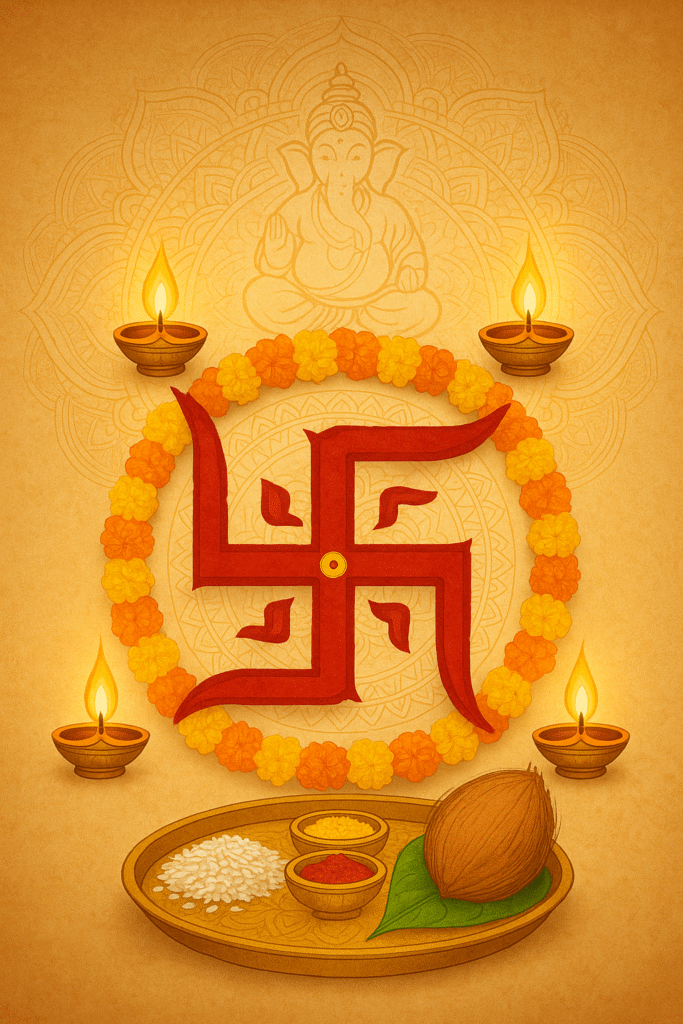
Swastika: Scientific Approach, Spiritual Significance and Types
Swastika: Scientific Approach
The Swastika is an ancient and sacred symbol found in Hinduism, Buddhism, Jainism and many world cultures. Beyond spiritual meaning, the Swastika has a strong scientific foundation. Its design, energy flow and impact have been positively observed under scientific perspectives.
1. Geometric and Mathematical Importance
1.1 Swastika Design and Energy Balance
The Swastika is a perfect geometric figure with four symmetrical arms representing dynamic energy flow in all directions.
| Property | Scientific Importance |
|---|---|
| Symmetrical Geometry | Helps maintain energy balance |
| Clockwise/Anticlockwise Rotation | Controls direction of energy flow |
| Quadrilateral Expansion | Transmits energy in four directions |
Scientific View: Balanced geometry naturally regulates energy. The center point of the Swastika acts as an energy convergence point with high vibration density.
1.2 Mathematical Ratio in the Swastika
The Swastika aligns with the Golden Ratio and Fibonacci sequence—both symbols of natural balance.
- 90° angular precision creates structural symmetry
- Its shape resembles a perfect square combined with a plus sign
- This enhances stability and natural equilibrium
2. Energy Effects in Science
2.1 Swastika and Electromagnetic Waves
Scientific observations show that Swastika geometry focuses electromagnetic energy.
| Scientific Rule | Swastika Relation |
|---|---|
| Ferromagnetism | Helps focus energy |
| Rotational Force | Balances energy through rotational motion |
| Circular Wave Principle | Spreads energy in circular patterns |
Research shows that near a Swastika shape, EM energy becomes more concentrated, making the environment more positive.
2.2 Swastika and Cosmic Energy
| Energy Source | Effect of Swastika |
|---|---|
| Solar Energy | Attracts positive solar vibrations |
| Earth’s Magnetic Field | Balances negative energy |
| Gravity | Maintains stability |
In Vastu, Swastika is used to balance cosmic grids and increase positive energy in homes and temples.
3. Swastika in Health Science
The Swastika positively influences the human mind and body.
3.1 Mental and Physical Benefits
| Health Area | Effect |
|---|---|
| Mental Calmness | Reduces stress and anxiety |
| Nervous System | Balances brain wave activity |
| Blood Circulation | Improves bodily functions |
| Focus and Attention | Enhances concentration |
Studies show that focusing on the Swastika reduces cortisol (stress hormone) and increases dopamine and serotonin, boosting positivity.
3.2 Water Science and the Swastika
Water stored near Swastika markings remains purer and energetically stronger for longer periods.
4. Swastika and Sound Science
Mantras like “Om Swastika Namaste” create sound waves that interact with the geometry of the Swastika, amplifying positive vibrations.
Temple bells near Swastika markings help eliminate negative energies through harmonic resonance.
5. Conclusion
The Swastika is not just a spiritual symbol but also a scientific energy center. It works on principles of physics, mathematics, cosmic energy and bio-energy—enhancing mental peace, positivity and well-being.
Hindu Swastika: Spiritual Approach
The Swastika is a sacred and auspicious symbol in Hinduism, representing prosperity, strength, divine energy and spiritual awakening. It reflects the infinite nature of the universe and the omnipresence of God.
1. Spiritual Meaning
The word Swastika comes from “su” (good) + “asti” (to be), meaning “a symbol of well-being.” It represents four life goals:
- Dharma (righteousness)
- Artha (wealth)
- Kama (desires)
- Moksha (liberation)
2. Relationship with Lord Ganesha
The Swastika is closely associated with Lord Ganesha, the remover of obstacles and giver of success. It represents four qualities of Ganesha—wisdom, intellect, power and knowledge.
3. Mention in the Vedas
- Rigveda: Symbol of prosperity
- Yajurveda: Represents natural energy balance
- Atharvaveda: Protective shield
4. Four Directions and Five Elements
The four arms represent:
- East – Knowledge
- West – Balance
- North – Prosperity
- South – Protection
The Swastika also symbolizes the five elements—earth, water, fire, air and space.
5. Swastika and Chakra Science
It aids in awakening the Root Chakra and Crown Chakra, enhancing spiritual consciousness and meditation depth.
6. Swastika in Major religions
6.1 Hinduism
Represents Vishnu, Surya, Ganesha and divine order.
6.2 Buddhism
Symbolizes Buddha’s heart, compassion and eternal blessings.
Amazon Product Title Here
Elevate your everyday routine with this high-quality product that combines durability, comfort, and practical features. Designed for reliable performance, it delivers convenience and ease of use — perfect for home, office, or travel needs.
🛒 Check Price on Amazon* As an Amazon Associate I earn from qualifying purchases.
6.3 Jainism
Represents the four realms of existence and Tirthankara Neminath.
6.4 Ancient Civilizations
Egypt, Greece and Celtic cultures used it as a symbol of cosmic balance.
7. Swastika in Meditation
Focusing on the Swastika increases mental peace, positivity and spiritual depth.
8. Spiritual Benefits in Daily Life
- Brings positive vibration at home
- Enhances prosperity in business
- Protects during havan and rituals
- Improves spiritual growth
9. Conclusion
The Swastika is a divine spiritual symbol representing cosmic energy, peace, protection and spiritual awareness.
Hindu Swastika: Types and Their Importance
Different forms of the Swastika appear in Hindu scriptures, Vastu and Astrology. Each type has a unique meaning and specific use.
1. Main Types of Swastika
1.1 Clockwise Swastika (Right-Handed)
This is the most auspicious form. Its arms rotate clockwise.
- Symbol of prosperity, progress and divine blessings
- Represents Vishnu, Ganesha, Surya and Lakshmi
- Used in marriage, home entry, business, temples
1.2 Anticlockwise Swastika (Left-Handed)
Associated with Tantric practices, Goddess Kali, Bhairava and Shiva’s Rudra form.
- Used in spiritual protection rituals
- Removes negative energies
- Applied in special Sadhanas and rituals
1.3 Ganapati Swastika
Swastika with “Om” or Ganesha symbol at the center.
- Used for new beginnings
- Brings success and removes obstacles
1.4 Lakshmi Swastika
Includes markings of Shree, Riddhi, Siddhi and Good Luck.
- Used in Diwali, Dhanteras, and business prosperity rituals
- Placed on vaults and main doors
1.5 Brahma Swastika
Represents four Vedas and universal knowledge. Used in education and learning spaces.
2. Other Special Types
2.1 Navgraha Swastika
Contains symbols of the nine planets. Used for planetary remedies.
2.2 Vastu Swastika
Used in homes and buildings to remove Vastu defects.
2.3 Agni Swastika
Used in havan and fire rituals; represents purity.
3. Colour Significance
| Colour | Meaning |
|---|---|
| Red | Energy, power, prosperity |
| Yellow | Wisdom, knowledge |
| White | Purity, peace |
| Green | Health, growth |
4. Conclusion
Each type of Swastika carries deep spiritual, astrological and Vastu significance. When used correctly, it brings prosperity, protection and divine blessings.
Hindu Swastika: Uses, Meaning, Types, History & Cultural Significance
The Swastika is one of the most sacred symbols in Hinduism, symbolizing prosperity, luck, strength and positive energy. Beyond religious rituals, it is equally important in Vastu, astrology, tantra, health and spiritual practices. Its use spans auspicious functions, worship, business, rituals and daily life.
Hindu Swastika: Uses
1. Use of Swastika in Religious Rituals
The Swastika is used most prominently in Hindu religious functions and rituals.
1.1 Worship and Yajna (Havan)
- Before any auspicious work, a Swastika is drawn.
- It attracts divine blessings and positive energy.
- During havan and yajnas, Swastika is drawn with mantras to purify the environment.
1.2 Home Entry and Marriage
- Swastika is drawn on doors, walls and puja areas during Griha Pravesh.
- In marriage, the mandap, kalash and puja places are marked with Swastika.
- It brings prosperity and peace in marital life.
1.3 Temples and Puja Places
- Hindu temples feature the Swastika as a symbol of divine grace.
- It is marked at the entrance, sanctum walls and puja halls.
2. Use of Swastika in Vastu Shastra
In Vastu Shastra, the Swastika balances energy and removes defects.
2.1 Swastika on Main Door
- Drawing Swastika on the main door brings positive energy.
- Removes Vastu doshas and enhances prosperity.
- Made using vermilion, turmeric or cow dung paste.
2.2 Vault and Business Counters
- Swastika on vaults, lockers and cash boxes attracts wealth.
- Writing “Shubh–Labh”, “Riddhi–Siddhi” enhances benefits.
2.3 Inside the Home
- Applied in puja room, kitchen and meeting spaces.
- Promotes peace, clarity and positive atmosphere.
3. Use of Swastika in Astrology
3.1 Planetary Remedies
- Used to calm Rahu, Ketu, Saturn and troubled planetary positions.
- Copper, silver or turmeric Swastika is used for Navgraha remedies.
3.2 Horoscope Remedies
- For marriage delays, financial issues or health problems, Swastika is used with spiritual remedies.
- Red Swastika on Tuesdays and Saturdays brings relief from obstacles.
4. Use in Tantric and Spiritual Sadhana
4.1 Counterclockwise Swastika in Tantric Practices
- Used in power sadhanas, black tantra and protection rituals.
- Destroys negative energies and enhances spiritual defence.
4.2 Meditation and Concentration
- Meditating on the Swastika awakens the Crown (Sahasrara) and Root (Muladhara) chakras.
- Improves attention and spiritual depth.
5. Use of Swastika for Defence and Protection
5.1 Protection from Negative Energies
- Swastika on main doors prevents entry of evil energies.
- Turmeric Swastika on children’s foreheads protects them from the evil eye.
5.2 Safety During Travel
- Swastika drawn on vehicles before travel ensures safety and success.
6. Commercial and Social Uses
6.1 Business and Industry
- During the opening of new shops, factories or offices.
- Signifies wealth growth and successful business ventures.
6.2 Government and Social Events
- Used in ashrams, religious institutions and social events.
7. Conclusion
The Swastika is not merely a religious sign but a universal symbol of positivity. It is used in worship, vastu, astrology, business, tantra and protective rituals. It signifies wealth, health, peace, progress and mental stability.
Right-Handed Swastika (Clockwise)
The right-handed Swastika is the most auspicious form in Hinduism. It signifies prosperity, divine blessings and positive cosmic energy.
1. What is a Dakshinavarti Swastika?
- The arms turn in clockwise direction.
- Represents the sun, cosmic rotation and positive power.
- Symbol of Ganesha, Vishnu, Surya and Lakshmi.
2. Spiritual and Religious Importance

Amazon Product Title Here
This durable and well-designed product offers reliable performance for everyday use. Featuring a user-friendly design, it delivers convenience and comfort while handling daily tasks, making it a practical choice for home or professional needs.
🛒 Check Price on Amazon* As an Amazon Associate I earn from qualifying purchases.
2.1 Symbol of Auspiciousness
- Brings happiness, prosperity and success.
- Used at the beginning of all auspicious works.
2.2 Symbol of Gods
The right-handed Swastika represents:
- Lord Vishnu
- Lord Ganesha
- Lord Surya
- Goddess Lakshmi
2.3 Symbol of Four Directions & Vedas
- Four arms represent East, West, North and South.
- Also represents Rigveda, Yajurveda, Samaveda and Atharvaveda.
3. Uses of Right-Handed Swastika
3.1 Worship and Rituals
- Used before puja, havan, homa and navgraha shanti.
- Most important in Ganesha worship and housewarming puja.
3.2 Vastu
- Main door, puja room and vaults are marked with clockwise Swastika.
- Removes Vastu dosha and brings prosperity.
3.3 Business & Wealth Growth
- Used in shops, offices and commercial places for wealth increase.
- Marked on lockers and cash boxes for abundance.
3.4 Auspicious Beginnings
- Used before starting a new job, marriage, journey or business.
4. Astrological and Tantric Importance
4.1 Planetary Remedies
- Reduces negative influence of Saturn, Rahu and Ketu.
- Made using sindoor, sandalwood or turmeric.
4.2 Tantra-Mantra
- Used in positive energy sadhanas.
- Protects from negative entities.
5. Rules for Making a Right-Handed Swastika
- Draw on a clean surface using turmeric, vermilion or saffron.
- Write auspicious words on its four sides.
- Always draw in a clockwise direction.
- Light a ghee lamp afterwards for enhanced results.
6. Scientific View
- Attracts solar and positive energy.
- Helps calm the mind and increases mental clarity.
- Represents balance and cosmic rhythm.
7. Conclusion
The right-handed Swastika is the symbol of good fortune, divine blessings, prosperity and success. When drawn correctly, it removes obstacles and brings positive outcomes.
Counter-Clockwise Swastika (Left-Handed)
The counterclockwise Swastika is significant in Hindu, Jain and Buddhist traditions. While the right-handed Swastika is auspicious, the left-handed one is used in tantric, powerful and transformative practices.
1. What is a Counterclockwise Swastika?
- Arms turn in an anti-clockwise direction.
- Called “Vamavarti Swastik”.
- Symbol of Shakti, tantra, Rudra, and intense spiritual disciplines.
2. Spiritual and Religious Importance
2.1 Symbol of Power and Mechanism
Used in:
- Power Sadhana
- Tantric rituals
- Shakti worship
- Secret spiritual practices
2.2 Symbol of Destruction & Rebirth
- Represents the destructive and regenerative cosmic forces.
- Associated with Durga, Bhairava, Kali and Shiva’s fierce forms.
2.3 Use in Tantric Rituals
- Used in Aghora sadhana, vashikaran, Mahakali puja, Baglamukhi rituals.
- Drawn during powerful night rituals.
3. Uses of Counterclockwise Swastika
3.1 Sadhana & Siddhis
- Used by advanced seekers and tantric practitioners.
- Helps activate spiritual powers and protection.
3.2 Planetary Remedies
- Used to reduce the harmful effects of Rahu, Ketu and Saturn.
- Helpful in Kaal Sarp Dosh, ancestral defects and strong planetary obstacles.
3.3 Protection from Negative Energies
- Used to protect individuals and places from ghosts, spirits and sorcery.
- Applied in cremation-ground sadhanas and protective rituals.
3.4 Use in Specific Rituals
- Used during powerful night rituals.
- Drawn using blood sandalwood, black sesame, Bhairava yantras or tantric lamps.
4. Rules and Precautions
- Not used in regular puja or auspicious rituals.
- Used only under guidance of a qualified guru.
- Activated using specific mantras.
- Drawn only where required: cremation sites, tantric rooms, or ritual places.
5. Scientific Perspective
- Absorbs negative energy and transforms it into power.
- Influences Root and Third-Eye chakras.
- Boosts mental strength and confidence.
6. Difference: Right-Handed vs Counter-Clockwise Swastika
| Speciality | Right-Handed Swastika | Counter-Clockwise Swastika |
|---|---|---|
| Rotation | Clockwise | Anti-clockwise |
| Meaning | Luck, prosperity, mildness | Tantra, power, mysticism |
| Associated Gods | Ganesha, Vishnu, Lakshmi | Kali, Bhairava, Tara |
| Primary Use | Puja, Vastu, business | Tantric rituals, planetary remedies |
| Effect | Peace, growth, prosperity | Power awakening, protection |
| Precaution | Safe for all rituals | Use only under guidance |
7. Conclusion
The counter-clockwise Swastika is associated with tantra, intense Spiritual energy and powerful rituals. It is used for protection, planetary remedies and specialized sadhanas. It should only be used with proper knowledge and guidance.
Jain and Buddhist Swastika
The Swastika is a sacred symbol in Hinduism, Jainism and Buddhism. It represents good fortune, peace, prosperity and spiritual progress.
1. Importance in Jainism
1.1 Meaning of Jain Swastika
- Represents four realms of existence:
- Heaven (Deva Lok)
- Human world (Manushya Lok)
- Hell (Narak Lok)
- Animals & fauna (Tiryanch Lok)
Above the Swastika, three dots and a crescent represent the path to salvation.
1.2 Religious Importance
- Symbol of non-violence, truth and self-control.
- Sign of teachings of Tirthankaras.
- Used in scriptures, idols and temple rituals.
1.3 Use in Jain Rituals
- Made using rice, kumkum or turmeric during puja.
- Represents the four-fold Jain sangha.
- Symbol of purity, self-discipline and liberation.
2. Importance in Buddhism
2.1 Meaning of Buddhist Swastika
- Represents the footprints of Buddha.
- Symbol of Dharma, meditation, peace and compassion.
- Made in both left-turning and right-turning forms.
2.2 Religious Importance
- Represents Buddha, Dharma and Sangha.
- Symbolizes cosmic balance and heart chakra energy.
2.3 Use in Buddhist Practice
- Used in monasteries, temples and meditation halls.
- Engraved on Buddha statues and scriptures.
- Chanted along with meditation for peace.
3. Comparison: Jain vs Buddhist Swastika
| Feature | Jain Swastika | Buddhist Swastika |
|---|---|---|
| Meaning | Four realms and salvation path | Buddha’s teachings and cosmic harmony |
| Direction | Generally right-facing | Often left-facing |
| Use | Temples, rituals, texts | Monasteries, statues, meditation |
| Colors | Red, Yellow, Saffron | Gold, Black, White |
| Religious Focus | Self-control and salvation | Meditation and compassion |
4. Conclusion
The Swastika is revered in Jain and Buddhist traditions as a symbol of peace, spiritual growth and divine blessings. It represents cosmic order, Dharma and purity.
Historical Significance of the Hindu Swastika
The Swastika is an ancient and sacred symbol used across Hindu, Jain, Buddhist and global civilizations. It represents prosperity, eternity and divine order.
1. Historical References in Hindu Tradition
1.1 In the Vedas and Puranas
- Mentioned in Rigveda, Yajurveda, Atharvaveda and Samaveda.
- Symbol of cosmic balance and divine energy.
- Linked with Vishnu, Ganesha, Surya and Lakshmi.
1.2 In Ramayana and Mahabharata
- In Ramayana, symbol of victory and righteousness.
- In Mahabharata, described as an auspicious sign used in rituals.
1.3 In Temples and Vastu Shastra
- Seen in ancient temple carvings and inscriptions.
- Used in architecture to represent harmony and energy flow.
- Adopted by various Hindu dynasties on flags, coins and seals.
2. Global Historical Use
2.1 Indus Valley Civilization
- Found on pottery, seals and clay figurines.
- Proves its ancient roots in Indian civilization.
2.2 Greece and Rome
- Used as a symbol of victory, good luck and power.
- Seen on pottery, shields and architectural designs.
2.3 China and Japan
- Called “Wan” (卍) in China, symbolizing longevity and good luck.
- In Japan, symbolizes Buddha’s footprints and temples.
2.4 Europe and America
- Used in ancient Celtic, Norse and Native American art.
- Symbol of sun, life force and cyclical nature.
3. Use in Indian Dynasties
3.1 Maurya and Gupta Empires
- Used on royal seals, coins and inscriptions.
- Symbol of authority, divinity and culture.
3.2 Chola, Chalukya and Vijayanagara Empires
- Used widely in temples and architecture.
- Symbol of prosperity, strength and spiritual awareness.
4. Modern Era Usage
4.1 Freedom Movement
- Symbol of cultural pride and self-identity.
- Used during the Swadeshi movement.
4.2 Contemporary Hindu Society
- Still used in festivals, weddings, business, architecture and rituals.
- Represents fortune, purity and divine blessings.
5. Conclusion
From the Vedic period to modern times, the Swastika remains a universal symbol of sacredness, positivity and cultural heritage.
Cultural Importance of the Swastika
The Swastika is deeply rooted in Indian culture. It symbolizes good fortune, energy, prosperity and balance. Its use spans rituals, festivals, art, architecture, business, education and marriage traditions.
1. Importance in Indian Culture
Amazon Product Title Here
Discover reliable performance and everyday convenience with this well-designed product. Built with durable materials and user-friendly features, it offers consistent use and practical functionality for daily tasks, making it a valuable addition to your home or work setup.
🛒 Check Price on Amazon* As an Amazon Associate I earn from qualifying purchases.
1.1 Auspicious Functions
- Drawn during marriage, Griha Pravesh, business openings and festivals.
- Associated with Ganesha and Lakshmi.
1.2 Vastu Shastra
- Represents energy balance and cosmic harmony.
- Drawn on doors to attract positivity.
2. Folk Culture and Traditions
2.1 Folk Art
- Seen in Rangoli, Mandana, Alpana and wall paintings.
- A cultural heritage symbol across Indian states.
2.2 Music and Dance
- Used symbolically in classical dances like Kathak and Bharatanatyam.
- Engraved on instruments such as tabla, mridangam and veena.
3. Use in Indian Festivals
3.1 Diwali
- Drawn on doors, temples, vaults and shops.
- Represents blessings of Goddess Lakshmi.
3.2 Holi
- Swastika drawn before Holika Dahan to remove negativity.
3.3 Navratri and Durga Puja
- Drawn on pots, sanctums and puja altars.
- Represents power, purity and spiritual awakening.
4. Use in Indian Society
4.1 Business
- Applied during openings of shops, industries and accounts.
- Symbol of prosperity and success.
4.2 Education
- Seen in gurukuls and educational rituals.
- Students mark Swastika for auspicious beginnings.
4.3 Marriage Traditions
- Applied on mandap, kalash, doors and bridal mehndi.
- Symbol of prosperity and joy in married life.
5. Worldwide Cultural Impact
5.1 Buddhism and Jainism
- Symbol of peace, compassion and Dharma.
- Represents salvation path and spiritual purity.
5.2 China and Japan
- Symbol of longevity, harmony and Buddha’s presence.
5.3 Western Civilizations
- Used in ancient Greece, Rome, Germany and Native American cultures.
- Symbol of Solar Energy and life force.
6. Conclusion
The Swastika is an inseparable part of Indian culture and global spiritual heritage. It symbolizes prosperity, peace, harmony, energy, art and tradition.
References
Ancient Texts & Indian Scriptures
- Rigveda – Symbol of auspiciousness and well-being.
- Manusmriti – Use of auspicious symbols in rituals.
- Vastu Shastra – Use of Swastika in architecture.
- Skanda Purana & Bhagavata Purana – Use in deity worship.
Educational & Historical Books
- Thomas Wilson (1896) – The Swastika: The Earliest Known Symbol
- Nanditha Krishna – The Art and Iconography of Hinduism
- Alain Daniélou – The Myths and Gods of India
- Heinrich Zimmer – Philosophies of India
Modern Research & Cultural Studies
- Stella Kramrisch – Hindu Temple
- Richard Gombrich – Theravāda Buddhism
- Jyotindra Jain – Jaina Iconography
Cross-Cultural References
- David W. Anthony – Indo-European Civilizations
- Mallory & Adams – Encyclopedia of Indo-European Culture
- Symbols.com – Swastika
Online Sources
- Encyclopaedia Britannica – Swastika
- World History Encyclopedia – Swastika