
Music and Dance in Ancient India: History, Development and Cultural Significance
1. Introduction to Ancient Indian Music and Dance
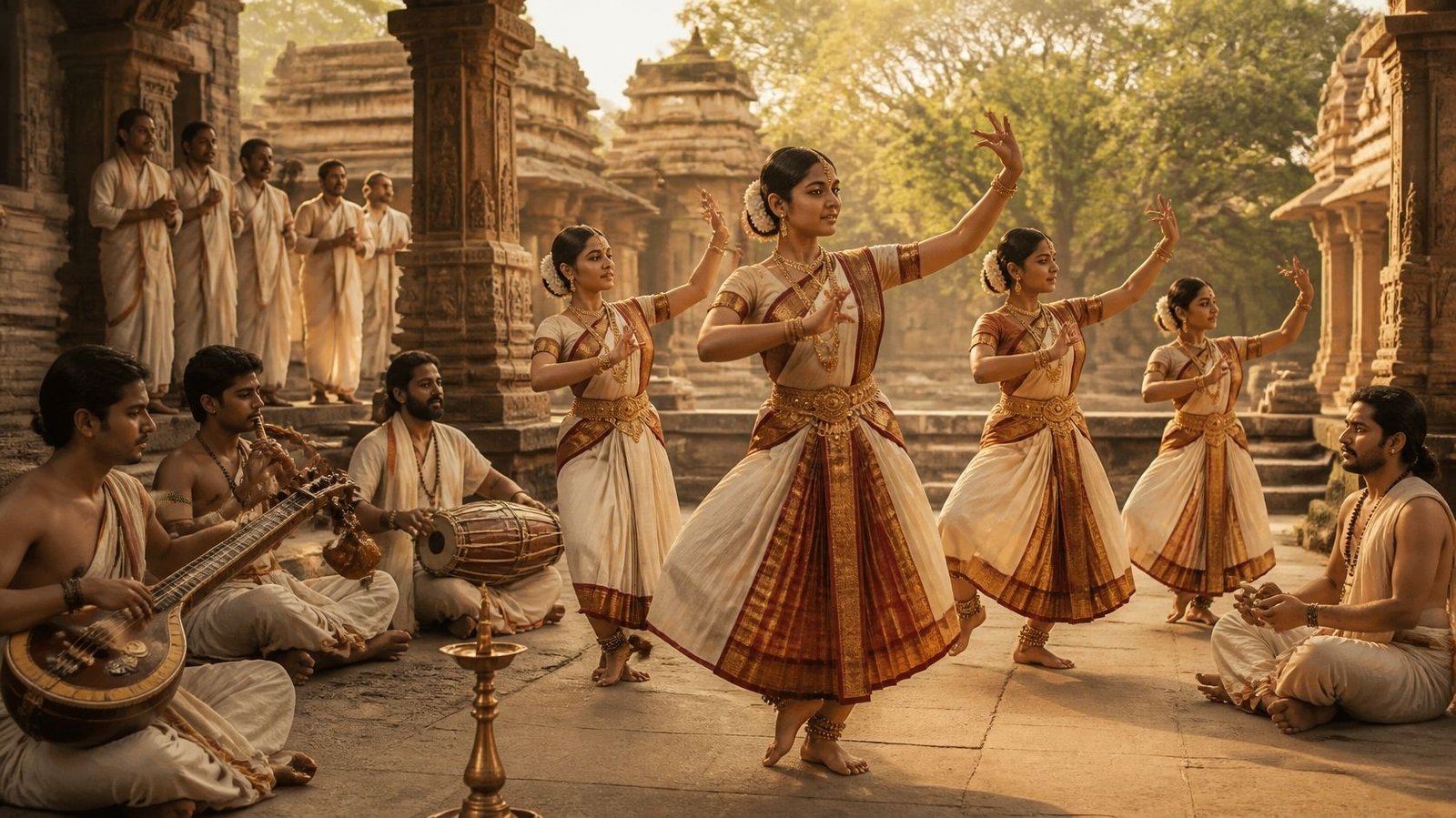
Ancient Indian civilization was not only renowned for its religious, philosophical, scientific and literary achievements but also for its rich traditions of music and dance. In Indian culture, music and dance were not considered merely forms of entertainment; rather, they were regarded as important elements of religious devotion, spiritual practice, social expression and cultural life. These art forms played a significant role in temples, royal courts, religious ceremonies and social celebrations.
Indian musical traditions have maintained a close relationship between singing, instrumental music and dance. Over time, these art forms developed into organized systems with their own principles and techniques. Concepts such as swara (musical notes), laya (rhythm), tala (rhythmic cycles) and raga (melodic frameworks) evolved in Indian music, while expression, gestures, movements and acting became important elements of dance. These traditions reflected the religious beliefs, lifestyles and cultural diversity of Indian society.
2. Origin of Music and Dance in Ancient India
The origins of music and dance are connected with the early social life of human civilization. Early humans may have developed an understanding of sound and rhythm through natural sounds, birdsong, rainfall and the rhythmic activities of everyday life. Gradually, the use of rhythmic sounds and physical movements during collective celebrations, religious activities and social gatherings contributed to the development of musical and dance traditions.
Prehistoric rock paintings found in the Indian subcontinent contain groups of human figures and scenes of collective activities. The Bhimbetka Rock Shelters in Madhya Pradesh are important archaeological sites in this context. Some paintings depict activities that are interpreted as possible group dances or celebrations. However, it is difficult to identify any specific musical style or musical instrument solely from these paintings.
The archaeological remains of the Indus Valley Civilization are also important for understanding the early history of Indian performing arts. The famous bronze statue of the Dancing Girl discovered at Mohenjo-daro indicates an awareness of bodily movements and artistic expression in this civilization. In addition, certain objects discovered at various archaeological sites have been associated with possible musical instruments, although their actual functions must be interpreted cautiously.
3. Development of Music During the Vedic Period
The Vedic Period holds a special place in the systematic development of ancient Indian music. Among the four Vedas, the Samaveda is considered the most significant from the perspective of music. The tradition of reciting hymns from the Rigveda with specific tones and rhythms contributed to the development of Vedic music. During religious sacrifices and rituals, special attention was given to the accuracy of pronunciation, tonal patterns and rhythm.
The Samaveda primarily contains hymns from the Rigveda arranged in a form suitable for singing. These hymns were performed by Udgatri priests during specific religious ceremonies. Samagana involved the disciplined use of musical tones and rhythm. In this way, the Samaveda provided an important religious foundation for the ancient Indian musical tradition.
Vedic literature also contains references to concepts related to musical tones. Three principal tonal accents were used in the recitation of Vedic mantras: Udatta, Anudatta and Svarita. Their purpose was to maintain the correct pronunciation and meaning of the sacred hymns. These accents should not be directly equated with the seven notes of later classical music, but they are important for understanding the historical development of Indian tonal traditions.
- The Samaveda is regarded as a major Vedic foundation of Indian musical traditions.
- Vedic hymns were sung rhythmically during religious ceremonies.
- Udatta, Anudatta and Svarita were Vedic tonal accents.
- Samagana contributed to the development of religious musical traditions.
4. Social Significance of Music and Dance in Vedic Society
In Vedic society, music and dance were used not only in religious ceremonies but also during festivals and collective gatherings. Vedic literature contains references to dancing, singing and instrumental music. The Rigveda mentions individuals associated with dancing and includes passages related to musical activities. These references indicate that music and dance were part of the cultural activities of contemporary society.
During religious occasions, hymns were recited and Samagana was performed to praise the deities. On the other hand, singing and dancing during social festivals and collective gatherings served as expressions of joy and community unity. Thus, these art forms had both religious and secular significance in ancient Indian society.
- Samaveda — Major Vedic musical tradition.
- Mohenjo-daro — Famous bronze statue of the Dancing Girl.
- Bhimbetka — Important site of prehistoric rock paintings.
- Udatta, Anudatta and Svarita — Vedic tonal accents.
5. Development of Classical Music in Ancient India
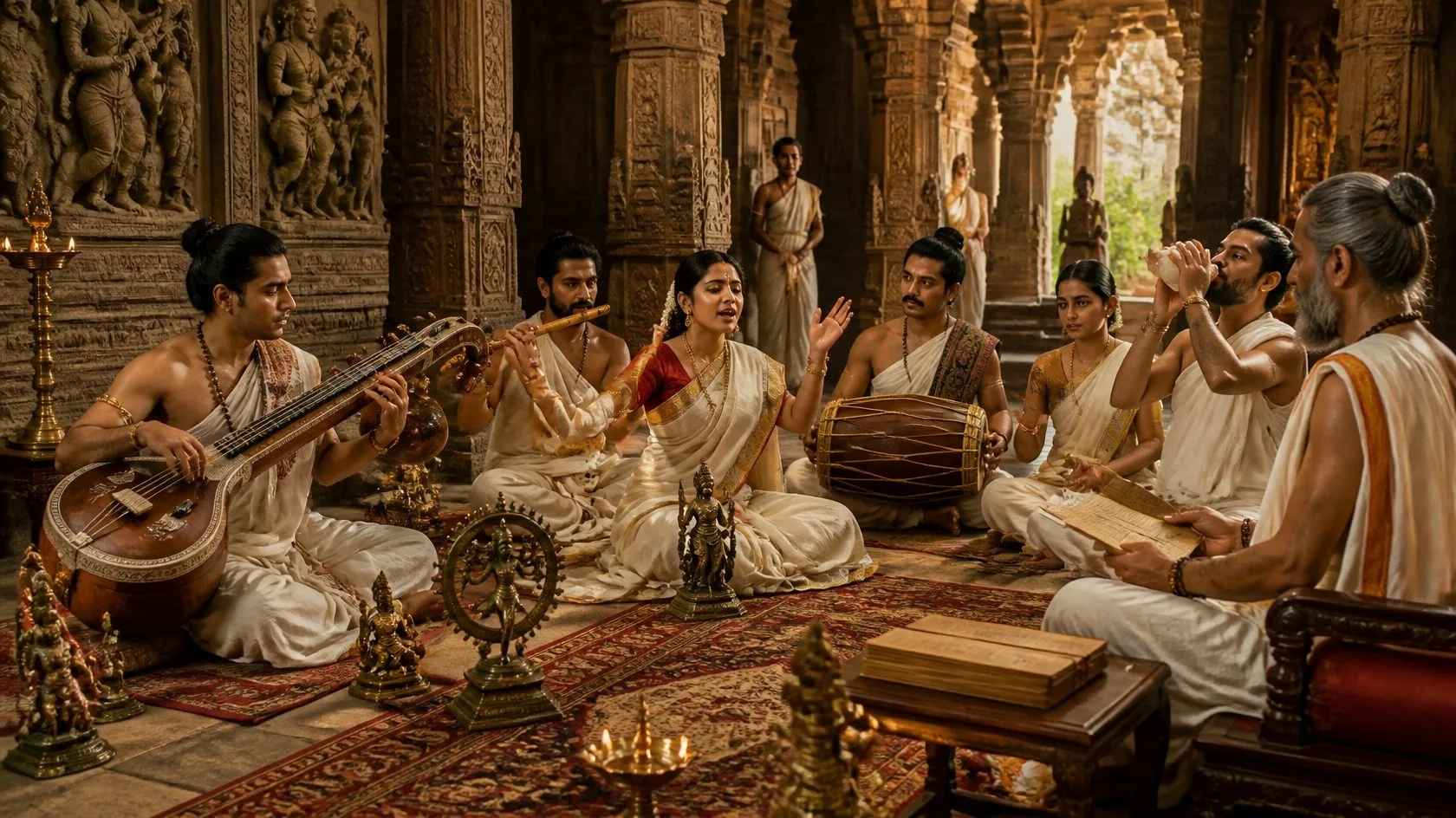
After the Vedic Period, Indian music gradually began to develop in a more systematic and theoretical form. Instead of remaining limited to religious rituals, music gradually became an important part of royal courts, temples, theatrical performances and social gatherings. Vedic traditions, Gandharva music, the Natya Shastra and various ancient musical texts made significant contributions to the development of ancient Indian music.
Gandharva music occupied a special place in ancient Indian musical traditions. It was associated with singing, instrumental music and theatrical performances. Over time, rules relating to musical notes, rhythm, tala and methods of musical presentation developed. Indian music was no longer merely a source of entertainment but became an important medium of religious and cultural expression.
6. Musical Notes and the Saptak in Indian Music
The foundation of Indian music is its system of musical notes. Indian music recognizes seven principal natural notes, collectively known as the Saptak. These notes play an important role in creating melodies and ragas.
- Sa – Shadja
- Re – Rishabha
- Ga – Gandhara
- Ma – Madhyama
- Pa – Panchama
- Dha – Dhaivata
- Ni – Nishada
The group of these seven notes is known as the Saptak. Indian music traditionally describes three main registers: Mandra Saptak, Madhya Saptak and Tara Saptak. The Mandra Saptak represents lower-pitched notes, the Madhya Saptak represents the normal middle range, and the Tara Saptak represents higher-pitched notes.
Ancient Indian music developed an understanding of the purity of musical notes and the relationships between them. Later, different musical styles and ragas evolved on the basis of these concepts.
7. Tradition of Raga and Tala
One of the most important characteristics of Indian music is its system of Raga and Tala. A raga is an organized melodic framework based on selected musical notes, through which particular musical and emotional effects are created. The selection of notes, their sequence and the method of presentation are important elements of a raga.
The concept of raga developed gradually in ancient Indian music. Ancient musical texts mention concepts such as Swara, Jati, Grama and Murchhana. In later periods, the raga system became more developed and organized. Therefore, it would not be accurate to consider the modern raga system completely identical to the musical traditions of ancient India.
Tala provides the foundation for organizing time and rhythm in music. It maintains the rhythmic structure and tempo of vocal and instrumental performances. Rhythm and tala held special importance in ancient Indian music. They were also widely used in dance and theatrical performances.
- A Saptak consists of seven principal natural musical notes.
- Raga is a melodic framework based on an organized arrangement of notes.
- Tala organizes rhythm and time in musical performances.
- Grama and Murchhana are important concepts of ancient Indian music theory.
8. Major Musical Instruments in Ancient India
Along with vocal music, ancient India also had a rich tradition of instrumental music. Musical instruments were used during religious ceremonies, royal court performances, festivals and theatrical presentations. In Indian musicology, instruments were classified into different categories according to the methods through which they produced sound.
The Natya Shastra of Bharata Muni mentions four major categories of musical instruments:
Four Major Categories of Musical Instruments
1. Tata Vadya (String Instruments): Instruments that produce sound through the vibration of strings. The Veena is an important example.
2. Avanaddha Vadya (Membranophones): Instruments covered with stretched membranes that produce sound when struck. Mridanga and Dundubhi are examples.
3. Ghana Vadya (Solid Percussion Instruments): Instruments that produce sound when solid materials are struck against each other or with another object. Manjira and Jhanj are examples.
4. Sushira Vadya (Wind Instruments): Instruments that produce sound through the flow of air. Flute and conch shell are examples.
These musical instruments were used in music, dance and theatrical performances. The Veena was regarded as an important string instrument in ancient Indian music. The flute was associated with melodious sounds and various folk and religious musical traditions. Percussion instruments such as the Mridanga helped maintain rhythm during singing and dancing.
9. Contribution of Bharata Muni and the Natya Shastra
The Natya Shastra, traditionally attributed to Bharata Muni, occupies an extremely important position in the development of ancient Indian music and performing arts. It is regarded as one of the major theoretical texts on Indian theatre, music and dance. The text discusses various aspects of dramatic art, along with music, musical instruments, notes, rhythm, acting and dance.
The Natya Shastra systematically explains different aspects of vocal music, instrumental music and dance. It mentions musical concepts such as Grama, Murchhana, Jati, Laya and Tala. In addition, through the theories of Rasa and Bhava, it explains how acting and music create emotional experiences in the minds of audiences.
Bharata Muni's contribution was not limited to musical theories. The text also provides a systematic framework for theatre, acting, physical gestures and stage presentation. For this reason, the Natya Shastra is an important source for understanding the historical traditions of Indian classical music and dance.
- Bharata Muni — Traditionally associated with the Natya Shastra.
- Saptak — Seven principal natural musical notes.
- Veena — An example of Tata Vadya (string instrument).
- Mridanga — An example of Avanaddha Vadya (membranophone).
- Manjira — An example of Ghana Vadya (solid percussion instrument).
- Flute — An example of Sushira Vadya (wind instrument).
- Natya Shastra — An important ancient Indian text on music, dance and theatre.
10. Origin and Development of Dance in Ancient India
The tradition of dance in ancient India was extremely old and rich. Dance was not considered merely a form of entertainment but an important medium of religious devotion, social expression and cultural life. In early societies, rhythmic physical movements were performed during collective celebrations, religious rituals and social ceremonies. Over time, these activities gradually developed into organized forms of dance.
The famous bronze statue of the Dancing Girl discovered from the Indus Valley Civilization holds a special place in the history of ancient Indian art. This statue was discovered at Mohenjo-daro and is associated with the Harappan Civilization, dating to approximately 2500 BCE. It is an important example of artistic expression and awareness of human body postures during that period.
Vedic literature also contains references to music and dance. Dance was performed during religious ceremonies, festivals and social occasions. In later periods, dance acquired a more organized form, and specific principles relating to gestures, expressions and dramatic performance gradually developed.
11. Bharata Muni's Natya Shastra and Indian Dance
The Natya Shastra, traditionally attributed to Bharata Muni, occupies an extremely important position in the theoretical development of Indian dance traditions. It is a major ancient text on Indian theatre, music and dance. The text provides detailed descriptions of various dance techniques, bodily movements, hand gestures, expressions and principles of acting.
The Natya Shastra explains the methods of expressing emotions and ideas through dance and acting. It describes four major types of Abhinaya: Angika Abhinaya, Vachika Abhinaya, Aharya Abhinaya and Sattvika Abhinaya. Through these four forms of expression, an artist communicates physical movements, speech, costumes and inner emotions to the audience.
The theory of Rasa and Bhava also holds special importance in the Natya Shastra. According to this theory, dance and acting can create different emotional experiences in the minds of audiences. Thus, dance became more than a physical activity; it developed into an effective medium for expressing emotions and ideas.
- Angika Abhinaya – Expression through the body and physical movements.
- Vachika Abhinaya – Expression through speech, dialogue and sound.
- Aharya Abhinaya – Expression through costumes, ornaments and decoration.
- Sattvika Abhinaya – Natural expression of inner emotions and feelings.
12. Tandava and Lasya Dance Traditions
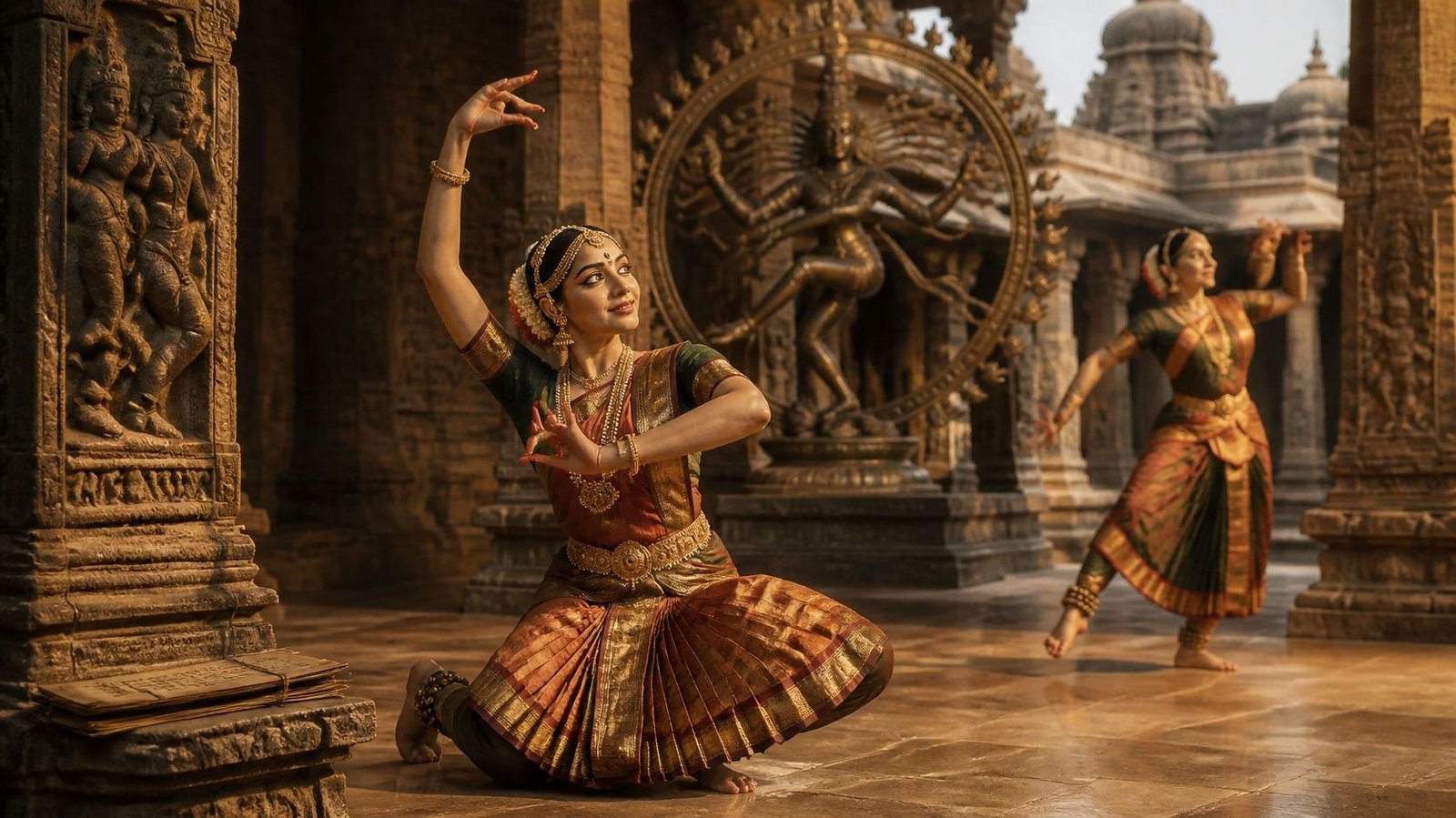
Tandava and Lasya are two important dance concepts in Indian religious and cultural traditions. Tandava is traditionally associated with Lord Shiva. It represents strength, energy, movement and the symbolic concepts of creation and destruction. The concept of Tandava is particularly visible in the Nataraja form of Lord Shiva.
In contrast, Lasya is associated with grace, beauty, emotional expression and gentle movements. According to traditional beliefs, it is associated with Goddess Parvati. Tandava and Lasya represent two different expressive aspects of Indian dance traditions: energy and power on one side, and grace and gentleness on the other.
- Tandava – An energetic, powerful and dynamic dance concept.
- Lasya – A graceful, gentle and expressive dance concept.
- Tandava is traditionally associated with Lord Shiva.
- Lasya is traditionally associated with Goddess Parvati.
13. Development of Dance Traditions in Temples
During ancient and medieval India, temples became important centres of dance and music. Dance performances were organized in temples during religious ceremonies, festivals and special occasions. Dance was regarded as a medium of expressing devotion and dedication to deities.
Several temples in South India provided special patronage to dance traditions. Different dance postures can be seen in temple sculptures, walls and architectural structures. The Nataraja Temple at Chidambaram and other South Indian temples are important examples of the relationship between Indian dance and religious art.
The tradition of women performing dances in temples also developed. In different regions, these women were known as Devadasis. They participated in religious and cultural ceremonies associated with temples. Over time, several temple-associated dance traditions evolved and contributed to the historical development of Indian classical dance forms.
14. Major Characteristics of Ancient Indian Dance
Physical postures, hand gestures, facial expressions, rhythm and tala were important elements of ancient Indian dance. Artists used these elements to present religious stories, mythological episodes and social themes. The combination of music and acting was one of the major characteristics of Indian dance traditions.
Different forms of dance developed in India under the influence of regional cultures and religious beliefs. These traditions later contributed to the historical background of classical dance forms such as Bharatanatyam, Kathak, Odissi, Kuchipudi and others. However, these modern forms evolved over several centuries and should not be considered exactly identical to the dance forms of ancient India.
- Natya Shastra – An important ancient text on Indian dance and theatre.
- Bharata Muni – Traditionally regarded as the author of the Natya Shastra.
- Tandava – A dance concept associated with Lord Shiva.
- Lasya – A dance concept traditionally associated with Goddess Parvati.
- Nataraja – The dancing form of Lord Shiva.
- Devadasi – A historical tradition of women associated with temple dance and religious service.
- Angika, Vachika, Aharya and Sattvika – Four major types of Abhinaya.
15. Cultural Significance of Music and Dance in Ancient India
Music and dance were important parts of ancient Indian culture. They were not limited to entertainment but were closely connected with religion, spirituality, education, social life and artistic expression. Through music and dance, people expressed their emotions, beliefs, traditions and cultural values.
In religious traditions, music was used during prayers, yajnas, festivals and devotional ceremonies. Singing Vedic hymns and chanting sacred verses helped create a spiritual atmosphere. Dance was also associated with religious rituals and temple traditions. It gradually became an important medium for expressing stories related to gods, goddesses and religious beliefs.
Music and dance also played an important role in royal courts and public celebrations. Kings and wealthy patrons supported musicians, dancers and other artists. Performances were organised during festivals, royal ceremonies and special occasions.
16. Music and Dance During the Mauryan Period
The Mauryan Empire (c. 322–185 BCE) was one of the most important political powers in ancient Indian history. During this period, administration, urban life, trade, art and cultural activities developed significantly. Music and dance were also part of the wider cultural environment.
The Arthashastra, traditionally associated with Kautilya (Chanakya), contains references to performers and various forms of artistic activity. These references indicate that musicians, dancers and entertainers had a place in society. Professional artists could also be associated with royal establishments and public events.
During the reign of Ashoka (c. 268–232 BCE), Buddhism received royal support and spread to different regions. Buddhist monasteries, stupas and religious centres became important cultural institutions. Although direct evidence about the exact forms of music and dance performed during the Mauryan period is limited, the artistic traditions of the period provide valuable historical context.
17. Development of Music and Dance During the Gupta Period
The Gupta period, generally dated from the fourth to the sixth century CE, is often described as a major phase of cultural and artistic development in ancient India. Literature, sculpture, painting, architecture, music and dance received considerable attention during this period.
Sanskrit literature provides important information about the artistic environment of the Gupta age. The works of Kalidasa contain descriptions of music, dance, instruments and performances, reflecting the cultural importance of these art forms.
One important historical source is a gold coin issued by Gupta ruler Samudragupta. It depicts the king seated and playing a veena. This coin is significant because it provides material evidence of the association between royal authority and musical accomplishment.
Sculptures and other artistic remains from the Gupta period also show the importance of musicians, dancers and musical instruments in contemporary society. These developments contributed to the wider evolution of Indian performing arts.
18. Archaeological and Historical Evidence of Ancient Indian Music and Dance
Archaeological discoveries, sculptures, paintings, coins and ancient literary texts provide valuable information about the development of music and dance in ancient India. These sources help historians understand how performing arts evolved across different periods.
The bronze figurine known as the Dancing Girl was discovered at Mohenjo-daro, one of the major urban centres of the Indus Valley Civilization. Its posture and artistic form are often discussed in connection with early representations of human movement and performance. However, the exact purpose of the figurine is not definitively known.
The rock shelters of Bhimbetka in Madhya Pradesh contain prehistoric paintings depicting human activities, including group scenes and figures in different postures. Some paintings have been interpreted as possible representations of collective movement or dance.
The Buddhist monuments of Sanchi and Bharhut contain sculptures depicting musicians, dancers, musical instruments and scenes from religious and social life. These artistic representations offer insights into the performing arts of ancient India.
The paintings of Ajanta depict various aspects of contemporary life, including courtly activities, musical instruments, dancers and musicians. They provide valuable visual evidence of the artistic traditions that flourished in ancient India.
The gold coin showing Samudragupta playing a veena is an important numismatic source. It demonstrates the association of music with royal culture during the Gupta period.
Bharata Muni's Natya Shastra is one of the most important ancient Indian texts on performing arts. It discusses drama, dance, music, acting, gestures, emotions and performance techniques. It remains a major source for understanding the theoretical foundations of Indian performing arts.
19. Influence of Ancient Indian Music and Dance on Modern India
Ancient Indian musical and dance traditions have had a lasting influence on the cultural identity of modern India. Although these art forms have changed over centuries, many of their basic concepts, artistic principles and performance traditions continue to be important.
The classical music traditions of India are broadly represented by two major systems: Hindustani classical music, which developed primarily in northern India, and Carnatic classical music, which is associated mainly with southern India. Both traditions use concepts such as raga and tala, although their musical styles, compositions and performance practices differ.
Ancient Indian ideas about rhythm, melody, expression and musical instruments also influenced the development of later musical traditions. Instruments such as the veena, tabla, sitar, flute and various percussion instruments have become important parts of India's musical heritage, though their forms and historical development differ across periods.
Indian classical dance also reflects a long history of artistic evolution. Major classical dance forms recognised in modern India include:
- Bharatanatyam: A classical dance tradition associated with Tamil Nadu.
- Kathak: A classical dance form that developed in northern India.
- Odissi: A classical dance tradition associated with Odisha.
- Kathakali: A dance-drama tradition of Kerala.
- Kuchipudi: A classical dance form originating in Andhra Pradesh.
- Manipuri: A classical dance tradition associated with Manipur.
- Mohiniyattam: A classical dance form of Kerala.
The principles of expression, gestures, rhythm and dramatic presentation discussed in the Natya Shastra continue to be relevant in the study and practice of Indian performing arts. However, today's classical dance forms developed through long historical processes and should not be treated as unchanged versions of ancient practices.
20. Conclusion
Music and dance were among the most significant artistic expressions of ancient Indian civilization. Their roots can be traced through prehistoric artistic remains, Vedic traditions, classical Sanskrit literature, sculptures, paintings and archaeological discoveries.
From the musical hymns of the Vedic period to the systematic ideas of Bharata Muni's Natya Shastra, Indian music and dance gradually developed into sophisticated forms of artistic expression. The Mauryan and Gupta periods also contributed to the wider cultural environment in which these traditions flourished.
These art forms were closely connected with religion, spirituality, social life, royal patronage and education. They provided people with ways to express emotions, communicate stories and preserve cultural values across generations.
Even today, Indian classical music and dance represent the richness and diversity of India's cultural heritage. Their continued practice demonstrates how ancient artistic traditions can remain meaningful in modern society.
Thus, the history of ancient Indian music and dance is not merely the history of entertainment; it is an important part of India's intellectual, spiritual and cultural development.
- Samaveda: Closely associated with the musical chanting of Vedic hymns.
- Natya Shastra: An important ancient text traditionally attributed to Bharata Muni.
- Four categories of musical instruments: Tata, Avanaddha, Ghana and Sushira.
- Abhinaya: Angika, Vachika, Aharya and Sattvika.
- Samudragupta: A Gupta ruler depicted playing a veena on a gold coin.
- Modern classical dance forms: Bharatanatyam, Kathak, Odissi, Kathakali, Kuchipudi, Manipuri and Mohiniyattam.