
Yemen–Saudi Arabia Relations: History, War, Iran, India and the Role of the United States
Historical Background | Geopolitics | Middle East | International Relations
What Will You Learn in This Article?
- The historical relationship between Yemen and Saudi Arabia.
- The geographical and strategic importance of Yemen.
- How religion, trade, and regional politics shaped their relations.
- The roles of Iran, India, and the United States in the wider geopolitical context.
1. Introduction: Why Are Yemen–Saudi Arabia Relations Important?
Yemen and Saudi Arabia share a long, complex, and often turbulent history. Their relationship has been shaped by geographical proximity, tribal connections, religious traditions, border disputes, regional rivalries, and competing political interests. Although the two countries share a long border and deep historical links, their relations have repeatedly shifted between cooperation, tension, and armed conflict.
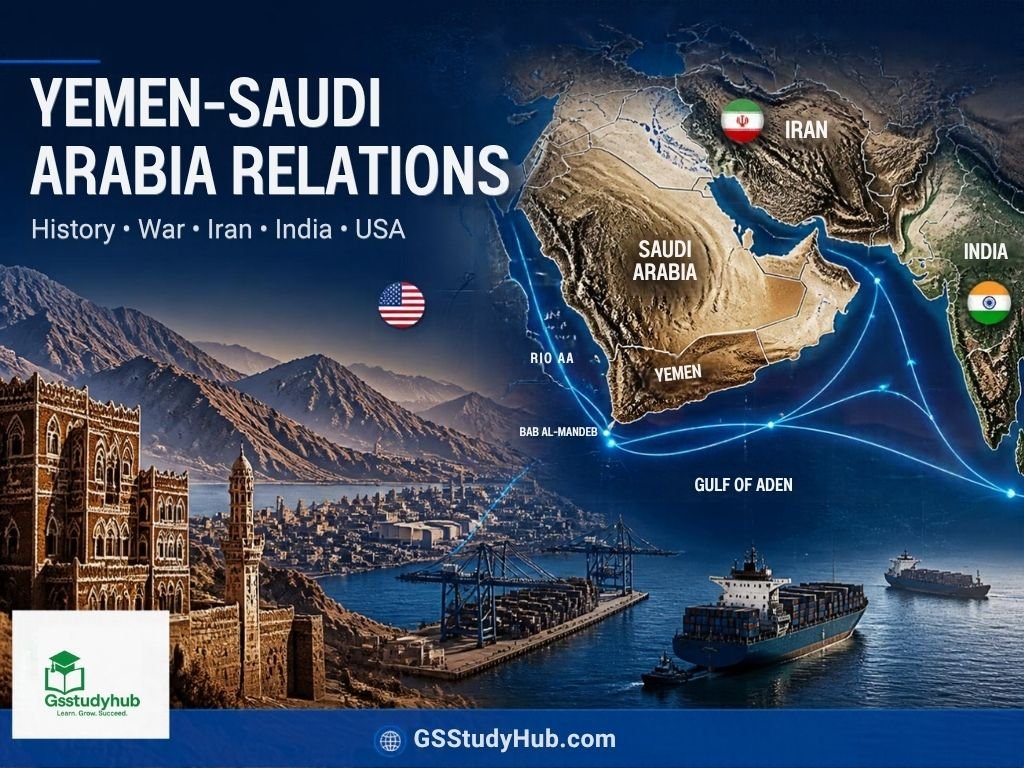
Yemen occupies a strategically important position in the southern part of the Arabian Peninsula, close to the Bab al-Mandeb Strait. This maritime passage connects the Red Sea with the Gulf of Aden and the wider Indian Ocean. Its location makes Yemen important not only to Saudi Arabia but also to international shipping, energy transportation, and global trade.
The relationship became particularly complicated after the emergence of the modern Saudi state, the political division of Yemen, the 1962 revolution in North Yemen, and the rise of the Houthi movement. Since 2014–2015, Yemen's conflict has also become part of a broader regional rivalry involving Saudi Arabia and Iran, alongside the interests of the United States and other international powers.
2. Geographical Importance of Yemen and Saudi Arabia
Saudi Arabia occupies most of the Arabian Peninsula, while Yemen lies to its south. The two countries share a land border, making developments inside Yemen directly relevant to Saudi Arabia's national security.
Saudi Arabia has historically been concerned about instability along its southern frontier. Political upheaval, armed groups, cross-border attacks, and the presence of rival regional powers in Yemen can all affect Saudi security calculations.
Yemen's coastline is equally important. The country borders the Red Sea and the Gulf of Aden, near the Bab al-Mandeb Strait. Ships travelling between the Mediterranean Sea and the Indian Ocean through the Suez Canal generally pass through this maritime corridor. Disruption in the area can increase shipping costs, affect delivery schedules, and create risks for international commerce.
This location also explains why countries outside the Middle East, including India and the United States, closely follow developments in Yemen. For India, the region is connected to energy security, trade, maritime routes, and the safety of Indian nationals. For the United States, it is relevant to regional security, counterterrorism, and the protection of international shipping.
3. Ancient Civilizations, Trade, and Early Connections
Yemen has a long history of settled civilizations, agricultural development, and regional commerce. Ancient kingdoms in the region, including Saba, became known for trade networks and the cultivation of valuable commodities. The area's location helped connect the Arabian Peninsula with the Horn of Africa, the Red Sea, and routes leading towards the Indian Ocean.
Trade contributed to the movement of people, ideas, languages, and religious traditions across the region. The Arabian Peninsula was not a politically unified territory during much of its early history. Instead, it contained different kingdoms, tribal communities, trading centres, and local authorities.
The areas that now form Yemen and Saudi Arabia therefore developed through overlapping commercial, cultural, and tribal networks rather than through a single continuous state. These connections created historical links, but they did not eliminate competition over territory, resources, political authority, or trade routes.
4. The Rise of Islam and the Transformation of Regional Relations
The emergence of Islam in the seventh century transformed political and religious life across the Arabian Peninsula. Yemen became part of the expanding Islamic world, connecting its communities more closely with the wider religious, commercial, and intellectual networks of the region.
Over subsequent centuries, Yemen and the territories that now form Saudi Arabia experienced different dynasties, political authorities, and religious developments. Local rulers and tribal leaders continued to play important roles in determining political control, particularly in areas where geography made central administration difficult.
Yemen also developed distinctive religious traditions, including a significant Zaydi Shia community in its northern highlands. Saudi Arabia's religious and political institutions developed along a different historical path. These differences later became relevant to political competition, although modern conflicts cannot be explained by religious differences alone.
Conclusion
Yemen and Saudi Arabia share deep geographical, historical, religious, and commercial connections. However, their relationship has never been determined by these connections alone. Differences in political authority, border security, and regional interests have repeatedly influenced their relations.
To understand the modern conflict, it is necessary to examine the emergence of the Saudi state, the historical division of Yemen, the 1934 war, and the agreements that shaped their shared border.
6. Ottoman and British Influence in Yemen and the Arabian Peninsula
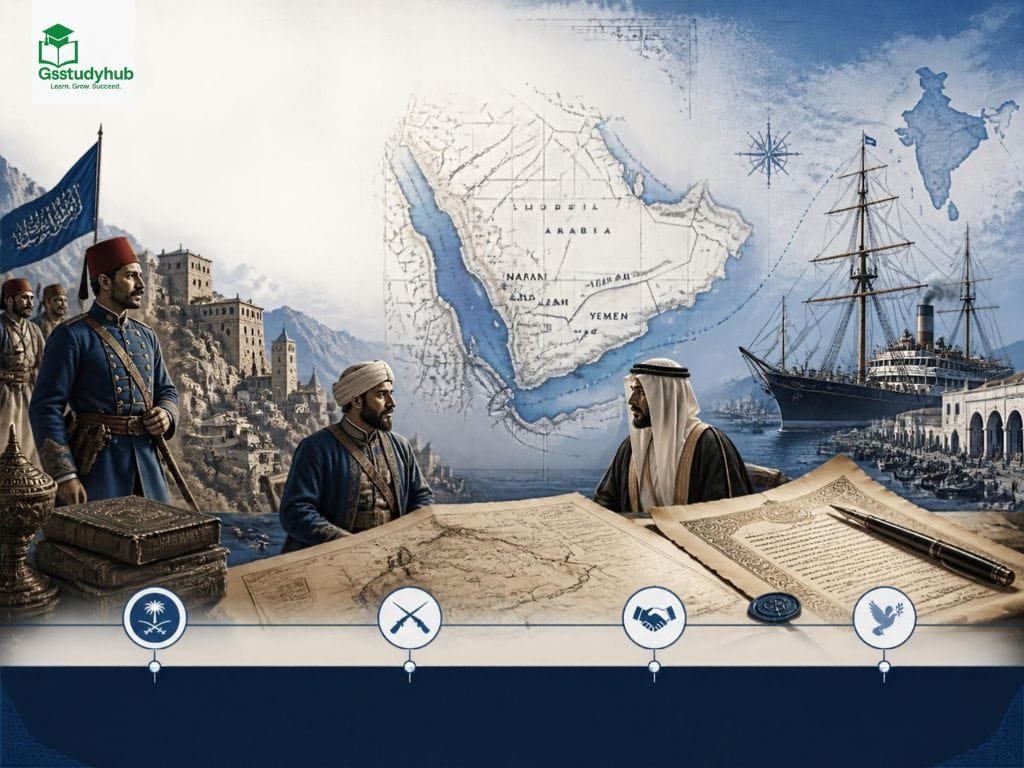
During the nineteenth and early twentieth centuries, the political landscape of the Arabian Peninsula was shaped by the declining Ottoman Empire, British imperial expansion, and the ambitions of local rulers. Yemen occupied a strategic position because of its Red Sea coastline and proximity to the maritime route connecting Europe, Asia, and the Indian Ocean.
The Ottoman Empire maintained authority over parts of Yemen during different periods, particularly in the northern highlands. However, Ottoman control was repeatedly challenged by local resistance, tribal politics, and the difficult mountainous terrain. The relationship between Ottoman authorities and local communities was therefore often marked by negotiation as well as conflict.
Britain established a strong presence around Aden in the nineteenth century. Aden became important as a coaling station and naval base on the route to India, especially after the opening of the Suez Canal in 1869. British influence gradually extended across parts of southern Yemen through protectorate agreements with local rulers.
As a result, the territories that later formed modern Yemen developed under different political circumstances. Northern Yemen experienced Ottoman influence and local imamate rule, while southern Yemen came under substantial British influence. These different experiences contributed to the political divisions that persisted into the twentieth century.
7. The Formation of Modern Saudi Arabia
The modern Saudi state emerged through the expansion of the Al Saud political leadership across the Arabian Peninsula. Abdulaziz ibn Abdul Rahman Al Saud, widely known as Ibn Saud, gradually consolidated control over different territories, including Riyadh and the Hejaz.
In 1932, the Kingdom of Saudi Arabia was formally established. The creation of a unified state brought new importance to the question of its borders, particularly along the southern frontier adjoining Yemen.
At the time, the northern Yemeni highlands were under the rule of Imam Yahya Muhammad Hamid al-Din. Both sides had territorial and political interests in border regions, including areas around Asir, Jizan, and Najran. Competing claims and disagreements over authority increased tensions between the two governments.
The dispute was not simply a matter of drawing a line on a map. It also involved the authority of local rulers, tribal relationships, access to strategically important territory, and the security of the emerging Saudi state.
8. The Saudi–Yemeni War of 1934
Tensions over territorial claims escalated into the Saudi–Yemeni War of 1934. The conflict involved the Kingdom of Saudi Arabia under Ibn Saud and the Mutawakkilite Kingdom of Yemen under Imam Yahya.
Saudi forces advanced into disputed areas, and the conflict ended with Yemen facing significant military and diplomatic pressure. The outcome strengthened Saudi Arabia's position in the border dispute and led to negotiations between the two governments.
The war demonstrated the strategic importance of the southwestern Arabian Peninsula. It also showed how disagreements over territory could develop into wider political and military confrontations, even between neighbouring societies with longstanding cultural and religious connections.
The conflict concluded with the Treaty of Taif, signed on 20 May 1934. The agreement established arrangements concerning the disputed border territories and provided a framework for relations between the two kingdoms. The treaty became a major milestone in the modern history of Saudi–Yemeni relations.
9. The Treaty of Taif and the Border Question
The Treaty of Taif was an important attempt to manage the territorial dispute between Saudi Arabia and Yemen through a formal agreement. It helped end the immediate war and established a basis for subsequent diplomatic relations.
However, the treaty did not eliminate every source of tension. Border administration, tribal connections across the frontier, political instability in Yemen, and changes in the regional balance of power continued to influence bilateral relations.
The border question remained especially sensitive because the two countries were developing along different political paths. Saudi Arabia was consolidating a monarchy, while Yemen experienced competing political movements, republican change, and later the division between northern and southern states.
The border arrangements were subsequently revisited, culminating in the 2000 Treaty of Jeddah, which formally settled outstanding boundary issues between the two countries. This later agreement reflected the need for a more definitive framework for managing their shared frontier.
10. How These Events Shaped Later Relations
The events of the early twentieth century established several themes that continued to influence Saudi–Yemeni relations: border security, political stability, the influence of local power structures, and the concern that instability in one country could affect the other.
For Saudi Arabia, developments in Yemen became increasingly important as the region experienced republican revolutions, Cold War competition, and changing alliances. For Yemen, relations with its wealthy and powerful neighbour were shaped by sovereignty concerns, economic needs, and competing domestic political interests.
These historical foundations help explain why later events—including the 1962 revolution in North Yemen, the emergence of separate northern and southern states, and the unification of Yemen in 1990—had a major impact on bilateral relations.
11. The 1962 Revolution in North Yemen and the Civil War
A major turning point in Yemen–Saudi Arabia relations came in September 1962, when a group of military officers overthrew the monarchy in North Yemen and established the Yemen Arab Republic. The revolution challenged the rule of Imam Muhammad al-Badr, who succeeded his father, Imam Ahmad, earlier that year.
The revolution triggered a prolonged civil war between republican forces and royalists who supported the former ruling order. The conflict soon became part of a wider regional struggle. Egypt, under President Gamal Abdel Nasser, supported the republicans, while Saudi Arabia supported the royalists.
For Saudi Arabia, the establishment of a revolutionary republic on its southern border raised concerns about regional stability and the spread of revolutionary political ideas. For Egypt, support for the republicans formed part of its broader regional ambitions and rivalry with conservative monarchies.
The civil war therefore became more than an internal Yemeni dispute. It reflected competing regional visions of political authority and the future of the Arabian Peninsula. External involvement prolonged the conflict and made Yemen an important arena of Middle Eastern competition.
12. Saudi Arabia, Egypt, and Regional Rivalry
During the North Yemen civil war, Saudi Arabia and Egypt backed rival factions. Egypt deployed troops to support the republican government, while Saudi Arabia provided assistance to royalist forces. The conflict became closely linked to the broader rivalry between Nasser's revolutionary Arab nationalism and the conservative monarchies of the Arabian Peninsula.
The war placed pressure on both regional powers. Egypt faced considerable military and financial costs, while Saudi Arabia sought to prevent a political outcome that it believed could threaten its security. Yemen's mountainous terrain and complex tribal relationships made the conflict difficult to resolve through military means alone.
A gradual shift towards political settlement followed changes in the regional environment. The 1967 Arab–Israeli War weakened Egypt's regional position and contributed to changes in its priorities. Egypt subsequently reduced its military involvement in Yemen.
In 1970, Saudi Arabia recognised the republican government of North Yemen. This marked an important step towards more pragmatic relations, although mutual suspicion and competition over influence continued.
13. North Yemen and South Yemen: Two Separate States
Yemen remained divided into two states for much of the twentieth century. North Yemen became the Yemen Arab Republic after the 1962 revolution. Southern Yemen, centred on Aden, had experienced a different political history under British rule.
Britain withdrew from Aden in 1967, and the People's Republic of South Yemen was established. In 1970, it adopted the name People's Democratic Republic of Yemen and developed a socialist political system with close ties to the Soviet Union.
The existence of two Yemeni states created additional complexity for Saudi Arabia. North Yemen generally maintained closer relations with conservative Arab governments, while South Yemen followed a different ideological and international path. Relations between the two Yemeni states were themselves marked by periods of tension and armed conflict.
Despite their political differences, economic considerations, shared cultural ties, and changing international circumstances gradually encouraged discussions about unification. The end of the Cold War and changes in the global political order created new opportunities for cooperation.
14. Yemen's Unification in 1990
On 22 May 1990, North Yemen and South Yemen formally united to create the Republic of Yemen. Ali Abdullah Saleh, who had led North Yemen, became president of the unified state, while Ali Salim al-Beidh, a leading figure from the south, became vice president.
Unification raised hopes that Yemen could overcome its political division and establish a more stable national system. However, integrating the two states proved difficult. Differences in political institutions, military structures, economic conditions, and ideological traditions created serious challenges.
Tensions between northern and southern leaders eventually escalated into a civil war in 1994. Forces loyal to President Saleh defeated the southern secessionist movement, preserving formal unity but leaving important political grievances unresolved.
For Saudi Arabia, a unified Yemen represented both an opportunity and a concern. A stable neighbour could support regional trade and security, but political uncertainty and disputes over influence continued to affect bilateral relations.
15. The 2000 Treaty of Jeddah: Settling the Border Dispute
Despite periods of cooperation, the Saudi–Yemeni border remained a sensitive issue during the late twentieth century. Disagreements over territory, security, and the movement of people contributed to recurring tensions between the two governments.
An important diplomatic breakthrough came on 12 June 2000, when Saudi Arabia and Yemen signed the Treaty of Jeddah. The agreement formally settled their outstanding land and maritime boundary disputes and established a more comprehensive framework for managing their shared frontier.
The treaty was significant because it reduced uncertainty over the international boundary and provided a basis for improved bilateral cooperation. However, resolving a border dispute could not by itself remove wider political, economic, and security challenges.
Yemen continued to face governance difficulties, economic pressures, and internal political tensions. These issues later contributed to instability that would have far-reaching consequences for Saudi Arabia and the wider Middle East.
16. From Historical Disputes to Modern Instability
The period from 1962 to 2000 shaped the political relationship between Yemen and Saudi Arabia. The North Yemen revolution exposed the impact of regional rivalries, the division between north and south created lasting political differences, and unification introduced new challenges of governance and national integration.
Although the Treaty of Jeddah addressed the boundary question, it did not resolve Yemen's internal political and economic problems. Weak institutions, public grievances, regional inequalities, and competition among political and armed groups continued to affect the country's stability.
These unresolved issues became increasingly important during the Arab Spring of 2011. The political transition that followed eventually broke down, contributing to the rise of the Houthi movement and the conflict that escalated in 2014–2015.
The next part examines the Arab Spring, the Houthis, Saudi Arabia's military intervention, and Iran's role in the conflict.
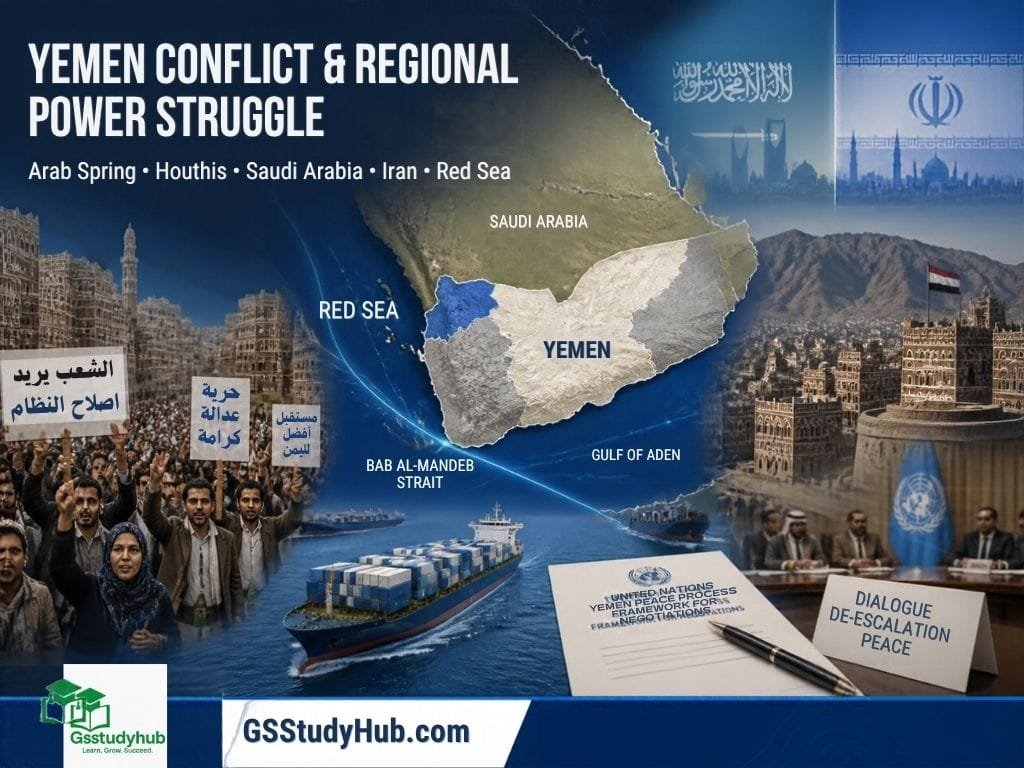
17. The Arab Spring of 2011 and Yemen's Political Transition
The Arab Spring, which began in 2010–2011, brought major political changes across the Middle East and North Africa. In Yemen, large demonstrations emerged against President Ali Abdullah Saleh, who had governed North Yemen and later the unified Republic of Yemen for more than three decades.
Protesters demanded political reform, action against corruption, improved economic opportunities, and an end to Saleh's long rule. Yemen was already facing serious challenges, including unemployment, poverty, weak state institutions, regional grievances, and growing insecurity.
In 2011, a Gulf Cooperation Council initiative provided a framework for Saleh to transfer power to Vice President Abdrabbuh Mansur Hadi. Hadi became president in 2012, beginning a transitional political process intended to reform state institutions and establish a more inclusive political system.
However, the transition faced substantial obstacles. Political factions disagreed over the distribution of power, military and security institutions remained divided, and economic conditions deteriorated. The national dialogue process produced proposals for a new political framework, but disputes over federalism, representation, and the allocation of authority remained unresolved.
18. The Rise of the Houthi Movement
The Houthi movement, also known as Ansar Allah, emerged from northern Yemen's Zaydi Shia community. Its origins are associated with religious and cultural revival, opposition to government policies, and grievances concerning political marginalisation and regional development.
The movement fought several rounds of conflict against the Yemeni government between 2004 and 2010. These confrontations weakened relations between the state and the movement and contributed to instability in northern Yemen.
Following the political upheaval of 2011, the Houthis expanded their influence. In 2014, they advanced towards Sana'a, Yemen's capital, and took control of the city in September. The government of President Hadi came under increasing pressure, and the political transition rapidly deteriorated.
In early 2015, Hadi left Sana'a and subsequently sought support from abroad. The Houthis consolidated control over important state institutions and expanded their military operations. Their advance triggered opposition from rival Yemeni factions and alarmed neighbouring Saudi Arabia.
The Houthis' rise cannot be explained solely by their religious identity or foreign support. Yemen's internal political divisions, weak institutions, economic grievances, and the breakdown of the transition all contributed to the movement's growing power.
19. Saudi Arabia's Military Intervention in Yemen in 2015
Saudi Arabia viewed the Houthi takeover of Sana'a and their subsequent military expansion as a serious security challenge. Riyadh was particularly concerned about instability along its southern border and the possibility that a movement supported by Iran could gain greater strategic influence in Yemen.
In March 2015, Saudi Arabia led a military coalition that began air operations against Houthi forces and their allies. The intervention was presented as an effort to support the internationally recognised government of President Hadi and restore its authority.
The conflict soon developed into a prolonged and devastating war. Air strikes, ground fighting, economic disruption, restrictions affecting imports, and attacks on infrastructure contributed to a severe humanitarian crisis. Millions of Yemenis faced displacement, food insecurity, disease, and limited access to healthcare and other essential services.
The intervention did not produce a quick political settlement. Yemen remained divided among different armed and political authorities, while the Houthis retained control over Sana'a and significant areas of the country's northwest.
The conflict also created risks for Saudi Arabia. Houthi forces launched missiles and drones towards Saudi territory, including infrastructure and other targets. Cross-border attacks reinforced Saudi concerns about its national security and the long-term costs of the war.
20. Iran's Role in the Yemen Conflict
Iran's relationship with the Houthi movement has become a central issue in the regional politics of Yemen. Saudi Arabia and several of its partners have accused Iran of providing military assistance, technology, training, and other forms of support to the Houthis. Iran has acknowledged political support for the movement while the scope and details of specific forms of assistance have been subjects of international reporting and dispute.
Tehran's regional strategy includes relationships with a range of non-state and political actors in the Middle East. Support for the Houthis offers Iran a means of exerting influence near the Arabian Peninsula and the strategically important Red Sea approaches.
For Saudi Arabia, this relationship raises concerns about encirclement, missile and drone threats, and the possibility that Yemen could become a platform for pressure against Saudi territory and maritime interests. The conflict has therefore become connected to the wider Saudi–Iranian rivalry.
Nevertheless, describing Yemen's war as simply a proxy conflict between Iran and Saudi Arabia would overlook its domestic causes. Yemeni political divisions, local alliances, competition over territory, and grievances against the government have all played important roles.
21. Diplomacy, De-escalation, and the Search for Peace
After years of fighting, Saudi Arabia and the Houthis increasingly explored ways to reduce hostilities. The United Nations supported negotiations and efforts to improve humanitarian access, while regional diplomacy sought to reduce the risk of further escalation.
A United Nations-mediated truce in 2022 significantly reduced large-scale cross-border fighting for a period, although it did not resolve the underlying conflict. Subsequent discussions between Saudi Arabia and Houthi representatives created opportunities for further de-escalation, but major political and security questions remained unsettled.
The conflict also became more closely connected to maritime security when Houthi attacks and threats affected commercial shipping in the Red Sea and surrounding waters. These developments drew additional international attention and increased the risks to global trade.
A durable settlement would require more than an agreement between Saudi Arabia and the Houthis. It would also need to address the participation of other Yemeni political groups, the future structure of the state, security arrangements, economic recovery, and humanitarian needs.
22. Why Yemen Matters to the Wider World
Yemen's conflict has implications far beyond the Arabian Peninsula. Its location near the Bab al-Mandeb Strait means that instability can affect international shipping routes connecting Europe, the Middle East, East Africa, and Asia.
The United States has interests in regional security, counterterrorism, and the protection of maritime commerce. India has concerns about energy supplies, trade routes, shipping costs, and the safety of its citizens in the wider region.
For Saudi Arabia, the central priorities include border security, the prevention of attacks, regional stability, and a political outcome that does not leave the country exposed to continuing threats from Yemen.
These overlapping interests explain why the Yemen conflict has become an international geopolitical issue rather than remaining solely a domestic civil war.
23. Historical Relations Between Saudi Arabia and the United States
Relations between Saudi Arabia and the United States developed significantly during the twentieth century, particularly as oil became a major factor in the global economy. Although the two countries have different political systems and social traditions, their relationship has been shaped by shared interests in energy markets, regional security, and economic cooperation.
A major milestone came in 1933, when Saudi Arabia granted an oil concession to an American company. The discovery and development of commercially significant oil resources transformed Saudi Arabia's economy and created a foundation for long-term commercial relations with American businesses.
In February 1945, US President Franklin D. Roosevelt met Saudi King Abdulaziz Ibn Saud aboard the USS Quincy in the Suez Canal region. The meeting became an important symbol of the emerging relationship between the two countries. Over subsequent decades, energy cooperation, defence ties, arms sales, and regional security became major elements of their partnership.
The relationship has not always been free of disagreement. Differences over regional conflicts, human rights, oil production, and foreign policy have periodically created tensions. Nevertheless, both governments have continued to cooperate in areas where their strategic interests overlap.
24. The Role of the United States in the Yemen Conflict
The United States has played several roles in relation to Yemen, including counterterrorism operations, support for regional security, diplomatic engagement, and assistance connected to the conflict. Its policies have evolved as security threats and regional priorities have changed.
When the Saudi-led coalition began its military intervention in March 2015, the United States provided forms of support to Saudi Arabia and other coalition partners. These included intelligence cooperation, logistical assistance, and other security-related support. The scope and nature of American involvement changed over time amid concerns about civilian casualties and the humanitarian consequences of the war.
US policy has also included diplomatic efforts aimed at reducing hostilities and supporting a negotiated settlement. Washington has worked with international partners and supported United Nations-led initiatives intended to improve prospects for peace.
The United States has faced a difficult policy balance: maintaining security partnerships with Gulf countries, limiting threats from armed groups, protecting maritime routes, and reducing civilian suffering in Yemen. These objectives have not always been easy to reconcile.
25. Counterterrorism and Al-Qaeda in the Arabian Peninsula
Yemen has long faced security challenges involving extremist armed organisations, particularly Al-Qaeda in the Arabian Peninsula (AQAP). The group has used instability, weak state institutions, and ungoverned areas to establish networks and conduct attacks.
The United States has carried out counterterrorism operations against AQAP, including targeted strikes and cooperation with regional partners. These operations have been justified by Washington as efforts to prevent attacks against American interests and other targets.
Counterterrorism policy has nevertheless generated controversy, including concerns about civilian casualties, accountability, sovereignty, and the long-term effectiveness of military action. The wider conflict has also created conditions in which extremist groups can exploit insecurity and divisions among local authorities.
Saudi Arabia has its own security concerns regarding extremist networks and instability near its southern border. Both countries have therefore had reasons to cooperate on intelligence and security, although their priorities and methods have not always been identical.
26. The Strategic Importance of the Red Sea and Bab al-Mandeb Strait
The Bab al-Mandeb Strait is a narrow maritime passage between Yemen on the Arabian Peninsula and Djibouti and Eritrea in the Horn of Africa. It connects the Gulf of Aden with the Red Sea and forms part of the shipping route linking the Indian Ocean to the Suez Canal and the Mediterranean Sea.
The route is important for international trade because ships travelling between Europe and Asia can use it to avoid the longer journey around the southern tip of Africa. The corridor is also relevant to energy transportation and the movement of manufactured goods, food, and industrial materials.
Attacks on commercial vessels, threats against shipping, or a major disruption in the area can force companies to consider alternative routes. Rerouting ships around the Cape of Good Hope can increase travel time, fuel consumption, insurance costs, and freight expenses.
For Saudi Arabia, maritime security matters because the country depends on stable trade routes and has important commercial interests connected to the Red Sea. For the United States, protecting freedom of navigation is a major strategic concern. For India, the passage is relevant to trade with Europe, energy security, and the movement of Indian vessels and seafarers.
27. Maritime Security and the Wider Regional Balance
Maritime insecurity in the Red Sea can involve more than direct attacks on commercial ships. It can also affect naval deployments, insurance markets, port operations, shipping schedules, and confidence among international businesses.
The United States and other countries have deployed naval forces or participated in maritime security initiatives to protect shipping and respond to threats. These efforts reflect concerns that instability in the Red Sea could affect global commerce and wider regional security.
However, military protection alone cannot resolve the political conditions underlying Yemen's conflict. Long-term stability depends on reducing hostilities, addressing domestic grievances, improving governance, and establishing a sustainable political settlement.
Saudi Arabia's interests are therefore both immediate and long-term: preventing cross-border attacks while supporting an environment in which Yemen no longer represents a persistent source of regional instability.
28. Why the US–Saudi Partnership Matters for Yemen
The US–Saudi partnership influences Yemen through defence cooperation, diplomatic engagement, regional security planning, and discussions about the future of the conflict. At the same time, both countries must consider the consequences of prolonged warfare and the risks associated with further regional escalation.
Saudi Arabia seeks a secure border and a political arrangement that reduces the threat of missile and drone attacks. The United States seeks regional stability, protection of international shipping, and the reduction of security threats from armed groups.
These interests overlap, but differences can arise over military strategy, civilian protection, the use of force, and the diplomatic approach to Iran and the Houthis. The future of the relationship will depend partly on how effectively both countries balance security objectives with diplomatic and humanitarian priorities.
29. India–Saudi Arabia Relations: From Energy to Strategic Partnership
India and Saudi Arabia share a significant relationship based on energy security, trade, investment, defence cooperation, and people-to-people connections. Saudi Arabia is an important partner for India because of its role in global oil markets, its economic influence in the Gulf, and the presence of a large Indian community in the kingdom.
Energy has traditionally been one of the central pillars of bilateral relations. India imports a substantial share of its crude oil requirements, and Saudi Arabia has been an important supplier. Changes in oil prices and production can influence India's import bill, inflation, transport costs, and wider economic conditions.
Over time, the relationship has expanded beyond energy. Both countries have pursued cooperation in investment, infrastructure, technology, security, and economic development. Saudi Arabia's economic diversification agenda and India's development priorities have created opportunities for cooperation in areas such as renewable energy, manufacturing, logistics, and digital services.
Security cooperation is also relevant. Both countries have interests in combating terrorism, preventing the financing of extremist networks, and maintaining stability across the Gulf and the wider Middle East. Regional developments, including the Yemen conflict and tensions involving Iran, therefore remain important subjects in their diplomatic engagement.
30. India's Relations with Yemen
India and Yemen have historical connections through maritime trade across the Arabian Sea and the Indian Ocean. For centuries, merchants and sailors connected ports along the Indian coast with southern Arabia, facilitating the exchange of goods, commercial practices, and cultural influences.
In the modern period, India has maintained diplomatic relations with Yemen and has had interests in trade, development cooperation, and regional stability. However, prolonged conflict and insecurity have complicated economic activity and normal diplomatic engagement.
The humanitarian consequences of Yemen's war have also been a concern for the international community. India has supported humanitarian principles and has undertaken evacuation operations when security conditions have threatened Indian nationals in the region.
The safety of Indian citizens, including workers, businesspeople, seafarers, and other residents, is an important consideration during periods of instability. India's diplomatic and consular planning must account for rapidly changing security conditions and the availability of safe travel routes.
India also has a broader interest in a peaceful and stable Yemen. Continued conflict can disrupt trade, increase maritime risks, and create economic uncertainty across the wider Indian Ocean region.
31. India–United States Relations and West Asian Security
India and the United States have developed a broad strategic partnership involving defence, technology, trade, maritime security, and cooperation across the Indo-Pacific. Although their approaches to individual Middle Eastern issues may differ, both countries have interests in stable shipping routes and the security of international commerce.
The Red Sea and the Bab al-Mandeb Strait are important to this relationship because they connect major commercial routes between Asia and Europe. Disruption in these waters can affect shipping schedules, freight rates, insurance costs, and supply chains that serve Indian businesses and consumers.
India and the United States can cooperate through diplomatic engagement, information sharing, and wider maritime-security initiatives. However, cooperation does not mean that their policies are identical. India traditionally places considerable emphasis on strategic autonomy, balanced relationships, and the protection of its independent foreign-policy choices.
India's relations with Saudi Arabia, Iran, Israel, and the United States illustrate the complexity of its West Asia policy. New Delhi seeks to preserve important economic and strategic relationships while avoiding unnecessary involvement in rivalries that could harm its national interests.
32. Energy Security, Trade, and Economic Consequences
Yemen's location near major maritime routes means that instability can affect international trade even when fighting is concentrated far from India's borders. Shipping companies may change routes, delay deliveries, or face higher insurance premiums when vessels operate in areas exposed to attacks or security threats.
Longer shipping routes can increase fuel consumption and operating costs. These additional expenses may eventually affect the prices of imported goods and the competitiveness of businesses that depend on timely international deliveries.
Energy security is another major concern for India. Disruption across the wider Middle East can influence oil-market expectations and transport costs. The actual impact depends on the scale and duration of disruption, global production levels, alternative supply routes, and market conditions.
India can reduce its exposure to such risks through diversified energy supplies, strategic petroleum reserves, improved logistics, renewable energy development, and continued diplomatic engagement with regional partners.
Saudi Arabia and India also have an interest in keeping trade routes reliable. For Saudi Arabia, maritime security supports exports and economic diversification. For India, it supports energy imports, merchandise trade, and commercial connections with Europe and other international markets.
33. The Indian Diaspora and People-to-People Connections
Indian nationals living and working in Saudi Arabia and other Gulf countries contribute to economic and social connections between India and the region. They work across a wide range of sectors, including healthcare, engineering, construction, information technology, retail, education, and professional services.
Remittances sent by Indian workers abroad support families and contribute to India's foreign-exchange inflows. The welfare of these workers is therefore both a humanitarian priority and an important element of India's broader economic relationship with the Gulf.
Conflict and instability in neighbouring Yemen can create additional consular and security challenges. Governments may need to prepare evacuation arrangements, monitor travel risks, and coordinate with airlines, shipping operators, and regional authorities.
Strong diplomatic relationships and effective consular services can help protect citizens and maintain confidence in cross-border economic cooperation. These people-to-people links give India a direct interest in peace and stability across the Arabian Peninsula.
34. Comparison: The Interests of Saudi Arabia, Iran, the United States, and India
The Yemen conflict affects these countries in different ways. Their priorities overlap in some areas, particularly maritime security, but differ in their regional strategies and preferred political outcomes.
| Country | Major Interests | Key Concerns |
|---|---|---|
| Saudi Arabia | Border security, regional stability, and economic development | Cross-border attacks and hostile armed groups near its frontier |
| Iran | Regional influence and relationships with allied movements | Regional rivalries and pressure from competing powers |
| United States | Maritime security, counterterrorism, and regional partnerships | Threats to shipping, armed groups, and wider regional escalation |
| India | Energy security, trade, citizen safety, and strategic autonomy | Shipping disruption, higher transport costs, and regional instability |
These interests demonstrate why the Yemen conflict cannot be understood as a purely local struggle. It is connected to regional competition, international shipping, energy markets, and the foreign-policy priorities of several major countries.
35. Yemen–Saudi Arabia Relations: Current Challenges and Future Prospects
Yemen–Saudi Arabia relations remain closely connected to border security, regional diplomacy, economic conditions, and the future political structure of Yemen. Although diplomatic efforts have created opportunities to reduce hostilities, a comprehensive and lasting settlement requires agreement on several difficult issues.
One major challenge is Yemen's political fragmentation. Different authorities and armed groups control different areas, and their political objectives are not always compatible. A sustainable settlement would need to address the participation of major Yemeni stakeholders and establish arrangements for governance, security, and the distribution of national resources.
A second challenge is the humanitarian and economic crisis. Years of conflict have damaged infrastructure, disrupted public services, weakened the economy, and increased dependence on humanitarian assistance. Reconstruction will require funding, institutional reform, reliable access to essential goods, and cooperation among Yemeni authorities and international partners.
Saudi Arabia also faces the challenge of securing its southern border while avoiding a return to prolonged, costly military confrontation. For Riyadh, a durable political arrangement that reduces cross-border threats would be an important security objective.
The wider regional environment matters as well. Relations between Saudi Arabia and Iran can influence the prospects for de-escalation, while international diplomacy and United Nations initiatives can help create conditions for negotiations.
36. The Future of Iran–Saudi Arabia Relations and Yemen
The relationship between Iran and Saudi Arabia has been an important influence on Middle Eastern geopolitics. Their rivalry has involved competing regional interests, security concerns, and relationships with different political and armed actors.
Diplomatic engagement between the two countries can help reduce the risk of escalation, although improved relations do not automatically resolve Yemen's internal disputes. Yemeni political groups have their own priorities, and a settlement must address those priorities rather than treating Yemen solely as an arena for regional competition.
A reduction in regional tensions could create greater space for negotiations, reconstruction, and economic cooperation. Conversely, renewed confrontation could increase security risks and complicate efforts to reach a settlement.
The future will therefore depend on several interconnected factors: the willingness of Yemeni parties to negotiate, the security policies of neighbouring states, the scope of external support to armed groups, and the effectiveness of international diplomatic initiatives.
37. India's Strategic Interests in a Peaceful Yemen
India has a direct interest in stability across the Arabian Peninsula and the wider Indian Ocean region. Its priorities include energy security, reliable trade routes, the safety of Indian nationals, and constructive relationships with regional partners.
Disruption around the Bab al-Mandeb Strait and the Red Sea can affect shipping costs, delivery schedules, insurance premiums, and trade between India and Europe. Prolonged insecurity can also create challenges for Indian seafarers and businesses operating along international maritime routes.
India's diplomatic approach is influenced by its relationships with Saudi Arabia, Iran, the United States, and other regional countries. Maintaining constructive engagement with these partners gives New Delhi opportunities to support dialogue while protecting its independent foreign-policy choices.
In the long term, a stable Yemen could create opportunities for renewed trade, development cooperation, maritime connectivity, and humanitarian assistance. For India, peace would benefit both its economic interests and the wider stability of the region.
38. Conclusion: A Conflict with Regional and Global Consequences
The historical relationship between Yemen and Saudi Arabia has evolved through centuries of cultural connections, trade, territorial disputes, political competition, and changing regional alliances. The emergence of the modern Saudi state, the 1934 war, the North Yemen revolution, the division between North and South Yemen, and the unification of 1990 all shaped their bilateral relations.
Yemen's political transition after the Arab Spring broke down amid domestic divisions and competing claims to power. The Houthi takeover of Sana'a in 2014 and the Saudi-led military intervention in 2015 transformed the crisis into a prolonged conflict with severe humanitarian consequences.
Iran's relationship with the Houthis added another dimension to the conflict, linking Yemen more closely to the wider regional rivalry involving Saudi Arabia. The United States has been involved through security cooperation, counterterrorism, maritime protection, and diplomatic engagement.
India, meanwhile, has important interests in energy security, trade, the welfare of its citizens, and the safety of maritime routes connecting Asia with Europe. These interests demonstrate how developments in Yemen can affect countries far beyond the immediate conflict zone.
Ultimately, military measures alone cannot guarantee lasting stability. A sustainable future for Yemen will require inclusive negotiations, effective institutions, economic recovery, humanitarian support, and cooperation among domestic and international stakeholders. Peace would benefit Yemen's population, improve Saudi Arabia's security, reduce regional tensions, and support the stability of international trade.
39. Frequently Asked Questions (FAQs)
1. Why have Yemen and Saudi Arabia experienced conflict?
Their relationship has been affected by territorial disputes, border security, political instability, competing regional interests, and the modern conflict involving the Houthis.
2. What was the significance of the 1934 Saudi–Yemeni War?
The war was fought over territorial and political disputes. It ended with the Treaty of Taif, which established an important framework for managing relations between the two kingdoms.
3. Who are the Houthis?
The Houthis, also known as Ansar Allah, are a Yemeni political and armed movement that emerged from northern Yemen's Zaydi Shia community and became a major force in the country's conflict.
4. What role does Iran play in Yemen?
Iran supports the Houthi movement politically, and international reporting has documented Iranian assistance in military-related areas. The extent of specific forms of assistance has been disputed. Yemen's domestic political conditions also play a major role in the conflict.
5. Why is Yemen important to India?
Yemen is located near the Bab al-Mandeb Strait, an important maritime passage connecting the Red Sea with the Gulf of Aden. Stability in this region matters to India's trade, energy security, shipping, and the safety of Indian nationals.
6. Why is the United States involved in Yemen?
US interests include counterterrorism, regional security, relationships with Gulf partners, diplomatic efforts, and the protection of international maritime routes.
7. What is needed for lasting peace in Yemen?
A sustainable settlement would require inclusive negotiations, reduced hostilities, security arrangements, economic recovery, humanitarian assistance, and cooperation among Yemeni parties and regional and international stakeholders.
40. References and Further Reading
The following institutions provide useful starting points for researching Yemen's political history, the humanitarian crisis, regional diplomacy, and maritime security. Consult their relevant reports and updates when verifying specific dates, events, and current developments.
- United Nations — International diplomacy and Yemen-related initiatives.
- Office of the UN Special Envoy for Yemen — Peace efforts and political negotiations.
- UN Office for the Coordination of Humanitarian Affairs: Yemen — Humanitarian conditions and assistance.
- World Bank — Economic conditions and development research.
- Ministry of External Affairs, Government of India — India's foreign policy and official statements.
- US Energy Information Administration — Energy markets and international energy analysis.