
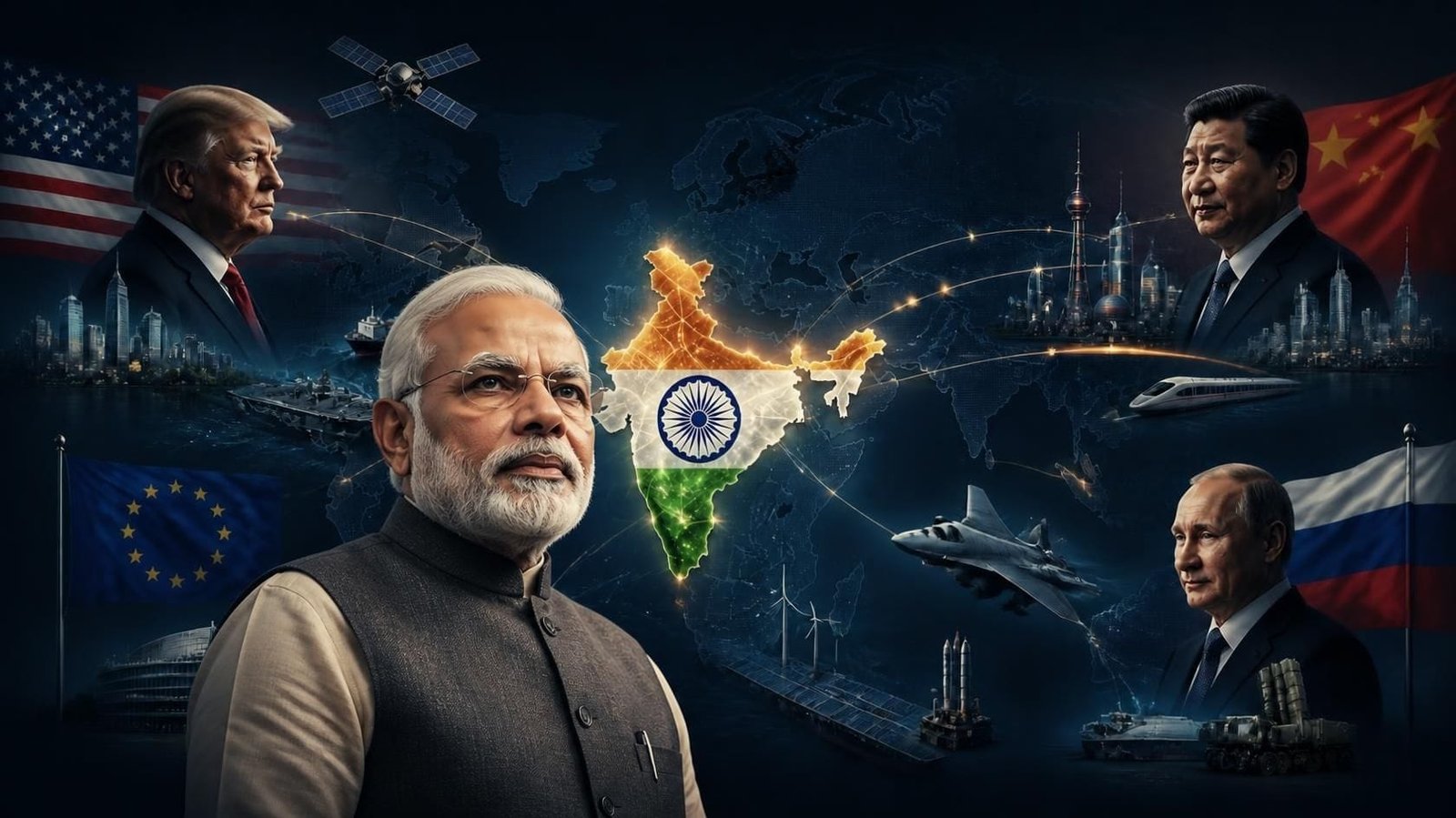
Introduction: India's Strategic Autonomy in a Changing World Order
global politics in the 21st century is going through a period of rapid transformation. The unipolar world order that emerged after the end of the Cold War is gradually moving towards a multipolar world order. The United States remains one of the world's major economic, military, and technological powers, but China's rapidly growing economic and military influence has changed the global balance of power. At the same time, Russia's strategic role, Europe's growing security concerns, and the increasing voice of the Global South have made international politics more complex.
One of the most important consequences of this changing situation is that it is becoming increasingly difficult for any country to depend entirely on a single power or alliance in international relations. The US-China strategic competition has turned trade, technology, semiconductors, supply chains, maritime security, and the Indo-Pacific region into major areas of global strategic competition. Meanwhile, the Russia-Ukraine war has affected not only Europe's security environment but also energy, food security, global trade, and diplomatic relations. These developments have made it clear that global politics has become more uncertain and competitive than before.
Why is Strategic Autonomy Important for India?
In such circumstances, the topic of India's Strategic Autonomy and the Changing World Order becomes particularly important. Strategic Autonomy means that India should maintain the ability to make independent decisions based on its national interests and long-term strategic priorities. It does not mean keeping distance from the rest of the world or staying outside international partnerships. Rather, it means that India can cooperate with different countries while ensuring that its important decisions are not made under pressure from any single power.
This approach is not entirely new in India's foreign policy. After independence, India attempted to maintain an independent position during the Cold War through the Non-Aligned Movement, rather than becoming part of the power blocs led by the United States or the Soviet Union. However, global circumstances changed over time, and India's foreign policy also evolved. Today, India appears to have moved beyond traditional non-alignment towards a policy of Multi-Alignment.
At present, India is expanding cooperation with the United States in defence, technology, and the Indo-Pacific, while its long-standing defence and energy relations with Russia also remain important. India cooperates with Japan and Australia through the QUAD and is also strengthening its relations with Europe, ASEAN, West Asia, and countries of the Global South. These diverse partnerships help India avoid excessive dependence on any single power.
For India, Strategic Autonomy is not limited to foreign policy. It is also connected with national security, economic strength, energy security, defence production, technological self-reliance, cyber security, critical minerals, and global supply chains. If India strengthens its domestic capabilities in these areas, it can make more independent decisions in the face of international pressures.
Therefore, the biggest challenge for India in the changing world order is to maintain a balance in its relations with the United States, Russia, China, Europe, and other centres of power while keeping its national interests as the highest priority. Understanding India's Strategic Autonomy and the Changing World Order is therefore essential because India's role in the global balance of power is likely to become increasingly important in the coming years.
In conclusion, the fundamental objective of India's Strategic Autonomy is not to distance itself from any particular power, but to strengthen its economic, military, technological, and diplomatic capabilities so that India can make independent decisions according to its national interests in the global balance of power.

Meaning of Strategic Autonomy: What Does Strategic Autonomy Mean for India?
Strategic Autonomy has become an important concept in international relations and foreign policy. In simple terms, it means that a country has the ability to take important national, security, and foreign policy decisions based on its national interests, without being forced to make those decisions under pressure from an external power. In a changing global environment, this ability is considered an important foundation of an independent foreign policy and long-term strategic strength.
In the Indian context, Strategic Autonomy does not mean that India should distance itself from other countries or stay away from international organisations and partnerships. On the contrary, India can cooperate with different countries according to its requirements. The important point is that relations with any one country or power bloc should not limit India's ability to make independent decisions.
Strategic Autonomy in Simple Terms
For India, the basic idea of Strategic Autonomy can be explained as: “Partnerships with many countries, but final decisions based on India's national interests.” This means India can cooperate with a country in defence, trade, technology, or energy, while maintaining its ability to take important strategic decisions independently.
This is why India is strengthening relations with the United States, Russia, Europe, Japan, Australia, ASEAN, and West Asian countries at the same time, depending on the area of cooperation.
Strategic Autonomy and National Interest
National interest is the most important foundation of Strategic Autonomy. The foreign policy of any country is ultimately connected with its security, economic development, energy requirements, technological capabilities, and the interests of its citizens. Therefore, for India, Strategic Autonomy means that national security and long-term requirements should remain at the centre of its decisions in international affairs.
For example, energy security is an important national interest for India. If a global crisis causes energy prices to rise or disrupts supplies from a particular region, India needs alternative sources. Similarly, excessive dependence on external sources for defence equipment, critical technologies, semiconductors, and critical minerals can affect India's strategic independence.
Strategic Autonomy and Independent Decision-Making
Another major element of Strategic Autonomy is the ability to make independent decisions. This does not mean that India should always take decisions that other countries may not support. It simply means that India should be able to make important decisions according to the circumstances and its own national interests rather than external pressure.
This capability is particularly important in the Changing World Order because competition among major powers is increasing. The strategic competition between the United States and China, tensions between Russia and the West, and growing competition in the Indo-Pacific require India to balance several different interests at the same time.
Is Strategic Autonomy the Same as Non-Alignment?
Strategic Autonomy and Non-Alignment are not exactly the same concepts. Non-Alignment was primarily a policy developed during the Cold War to maintain distance from the power blocs led by the United States and the Soviet Union. At that time, India chose to follow an independent foreign policy rather than joining a military bloc.
Strategic Autonomy is a broader concept suited to modern international conditions. It does not require a country to remain isolated. A country can develop strategic partnerships with several countries and organisations at the same time, provided that its ability to make independent decisions remains intact. This is why Multi-Alignment has become increasingly important in India's foreign policy.
Four Major Foundations of India's Strategic Autonomy
- National Interest: Giving priority to India's long-term interests while making foreign policy decisions.
- Independent Decision-Making: Maintaining the ability to make important strategic decisions without external pressure.
- Multi-Dimensional Partnerships: Cooperating with different countries in different areas according to India's requirements.
- National Capabilities: Reducing excessive dependence through a strong economy, defence capabilities, technology, and energy security.
Thus, the real objective of India's Strategic Autonomy is not to distance itself from the world but to increase India's own capabilities and available options. A strong economy, modern defence system, technological capabilities, energy security, and broad diplomatic relations provide India with the ability to make independent decisions according to its national interests amid the changing world order.
India's Strategic Autonomy and the Changing World Order: Major Countries, Agreements and Transactions
To understand India's Strategic Autonomy and the Changing world order, it is important to look at the kind of political, economic, defence, technological and energy relations India maintains with major countries. Today's world order is rapidly becoming multipolar. The United States, China, Russia, Europe, Japan, Australia and the countries of West Asia are playing important roles in global politics. India's policy is not to completely align itself with any one power, but to cooperate with different countries according to its national interests.
This is why, on one hand, India cooperates with the United States and its partners in areas such as QUAD, defence technology, semiconductors, space and the Indo-Pacific, while on the other hand it continues defence, energy and nuclear cooperation with Russia. Similarly, despite competition and border-related challenges with China, trade relations continue to exist. India has also developed different strategic and economic partnerships with countries such as France, Japan, Australia, the UAE and Saudi Arabia.
India's Relations with Major Countries: At a Glance
| Country | Major Agreements / Arrangements | Major Transactions / Cooperation | Importance for Strategic Autonomy |
|---|---|---|---|
| United States | LEMOA, COMCASA, BECA, 2+2 Dialogue, QUAD | Defence, energy, technology, semiconductors, space and trade | Advanced technology and Indo-Pacific cooperation |
| Russia | Long-term defence cooperation, Kudankulam cooperation, defence-technology projects | Oil, gas, defence equipment, nuclear energy and space | Strategic options in energy and defence |
| China | Border-related dialogue and various bilateral mechanisms | Trade, imports-exports and manufacturing supply chains | Balanced relations amid competition |
| France | Strategic Partnership, 2+2 Dialogue, Horizon 2047 | Defence, Rafale, space, nuclear energy and maritime cooperation | Independent partnership with Europe and in the Indo-Pacific |
| Japan | CEPA, 2+2 Dialogue, India-Japan Strategic Partnership | Investment, infrastructure, technology, supply chains and defence | Indo-Pacific and economic security |
| Australia | ECTA, 2+2 Dialogue, QUAD | Trade, education, minerals, energy and defence | Critical Minerals and Indo-Pacific security |
| UAE | CEPA, Comprehensive Strategic Partnership | Trade, investment, energy, logistics and finance | Economic and strategic access to West Asia |
| Saudi Arabia | Strategic Partnership Council | Crude oil, energy, investment, trade and Indian diaspora | energy security and West Asia policy |
How Do These Relations Strengthen Strategic Autonomy?
The most important aspect of this entire arrangement is diversification. India does not want to become completely dependent on any one country for defence, energy, technology or trade. Energy and defence cooperation with Russia, advanced technology and strategic cooperation with the United States, defence and nuclear partnership with France, infrastructure and investment from Japan, and energy and trade relations with West Asia—together, all these create different strategic options for India.
Key Takeaway
India's Strategic Autonomy does not mean maintaining distance from any country; rather, it means maintaining relations with all major powers on the basis of India's national interests. In the changing world order, India's strength lies in its multi-dimensional relationships, economic capabilities, defence self-reliance, energy security, technological capabilities and independent foreign policy. This Multi-Alignment helps India maintain an independent role in the global balance of power.
Historical Development of Strategic Autonomy in India
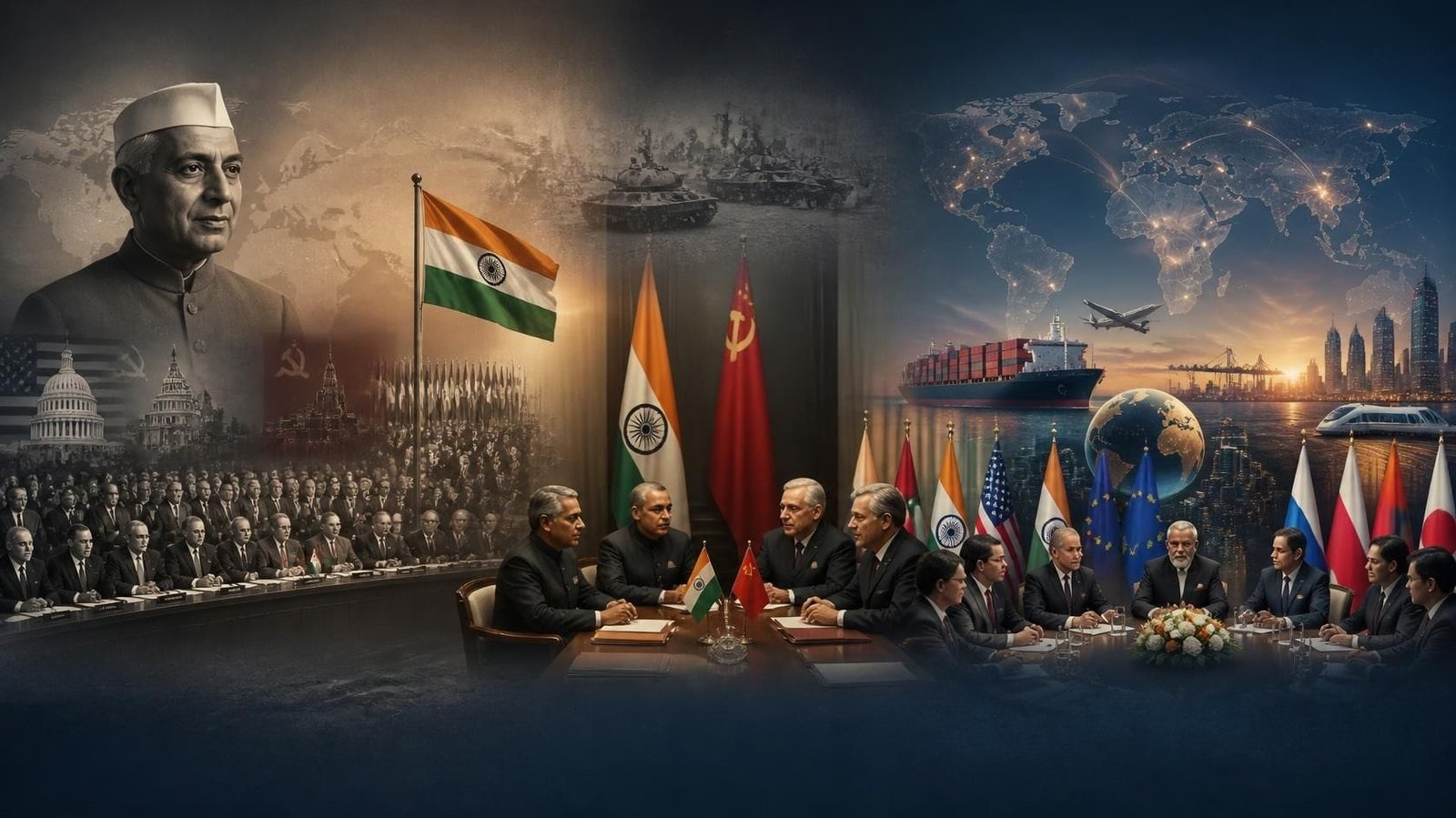
Understanding the historical development of India's Strategic Autonomy is essential to understand its present form. India's Strategic Autonomy did not develop as a policy at one particular point in time. Rather, it gradually evolved through changing global circumstances, national security requirements, and India's foreign policy experiences after independence. The way India manages its relations with different global powers today has its foundations in the early years after independence.
The Nehru Era and the Non-Aligned Movement
After independence, one of India's biggest foreign policy challenges was to determine how it could maintain an independent identity in rapidly changing global politics. At that time, the world was largely divided into two power blocs because of the Cold War. On one side was the Western bloc led by the United States, while on the other side was the communist bloc led by the Soviet Union.
Instead of joining any military power bloc, India adopted the policy of Non-Alignment. Prime Minister Jawaharlal Nehru attempted to strengthen India's independent foreign policy through this approach. India's objective was to make decisions on international issues according to its national interests and circumstances rather than according to the instructions of any major power.
Relationship Between Non-Alignment and Strategic Autonomy
The Non-Aligned Movement became an early foundation for the development of India's Strategic Autonomy. India attempted to demonstrate that a country did not need to formally align itself with a major power in order to conduct an independent foreign policy. However, Strategic Autonomy today is a broader concept than traditional Non-Alignment.
Balanced Relations with the United States and the Soviet Union During the Cold War
India adopted a policy of Non-Alignment, but this did not mean that India avoided relations with the United States or the Soviet Union. India attempted to develop relations with both major powers according to its national interests.
India's relations with the United States developed in areas such as the economy, agriculture, education, and technology, while cooperation with the Soviet Union became stronger in defence, industrial development, and strategic affairs. In this way, India maintained cooperation with both sides according to its circumstances. This approach later became an important feature of India's Strategic Autonomy.
The 1971 India-Soviet Friendship Treaty
The 1971 India-Soviet Treaty of Peace, Friendship and Cooperation was an important event in the history of India's foreign policy. At that time, a serious political and security crisis was developing in South Asia. Regional security and national interests had become extremely important for India.
The agreement between India and the Soviet Union further strengthened relations between the two countries. It also demonstrated that India could develop a strong partnership with a particular country according to its strategic requirements while continuing to maintain an independent foreign policy in broader terms.
Changes in India's Foreign Policy After 1991
The collapse of the Soviet Union in 1991 and major changes in the global balance of power created new strategic and economic challenges for India. At the same time, India also took important steps towards economic liberalisation.
Under the changing circumstances, India began rapidly strengthening its relations with the United States, Europe, Japan, Southeast Asia, and other regions. India's foreign policy was no longer limited to the power balance of the Cold War. Trade, investment, technology, energy, and economic development also became important components of India's foreign policy.
21st Century: From Non-Alignment to Multi-Alignment
The 21st century brought another important change in India's foreign policy. Instead of traditional Non-Alignment, India increasingly moved towards a more practical approach of Multi-Alignment. This means that India can cooperate with different countries in different strategic and economic areas while maintaining its ability to make independent decisions.
Today, India cooperates with the United States in defence and technology, maintains its traditional defence and energy relations with Russia, works with Japan and Australia through the QUAD, and is also strengthening relations with Europe, ASEAN, and countries of the Global South. This multi-dimensional diplomacy reflects the modern form of India's Strategic Autonomy.
Thus, the development of India's Strategic Autonomy began with the Non-Alignment policy during the Nehru era and evolved through balanced relations during the Cold War, the 1971 India-Soviet partnership, the restructuring of foreign policy after 1991, and the Multi-Alignment approach of the 21st century. Today, these historical experiences provide India with the ability to pursue an independent and balanced foreign policy based on its national interests in the changing world order.
Changing World Order: From a Unipolar to a Multipolar World
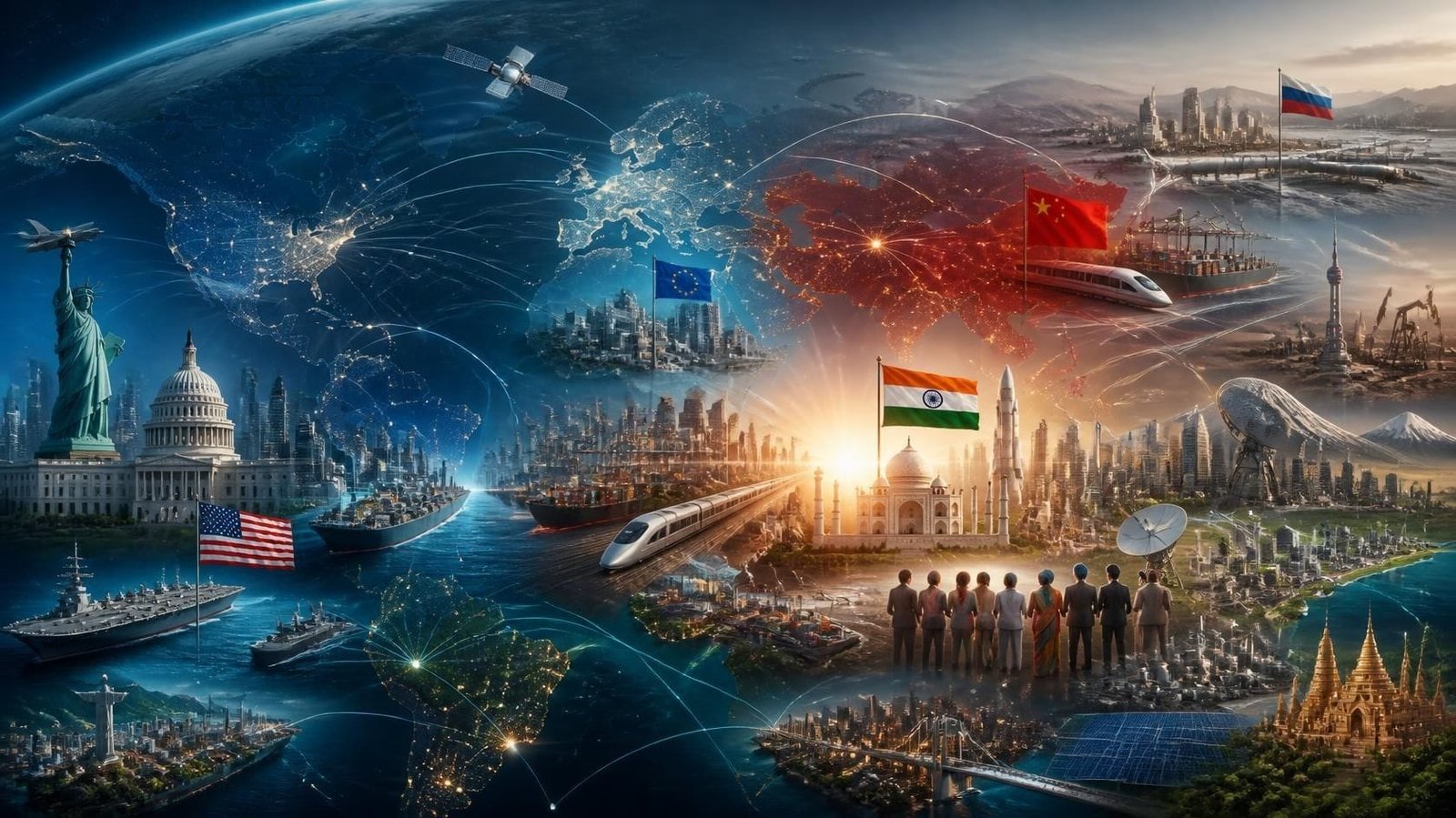
The changing world order is one of the most important features of contemporary international politics. After the end of the Cold War, the world appeared to move towards a unipolar system, in which the United States had the greatest economic, military, and technological influence. However, over the past few decades, significant changes have taken place in the global balance of power. The rise of China, the strategic role of Russia, the growing activity of Europe, and the increasing influence of India and other emerging powers have gradually pushed the world towards a multipolar world order.
This transformation does not mean that the global power of the United States has disappeared. The United States remains one of the world's major economic, military, technological, and diplomatic powers. However, several other centres of power are now emerging and playing important roles at the regional and global levels. Therefore, understanding the present international system only through the influence of one major power is no longer sufficient.
From a Unipolar to a Multipolar World
After the Cold War, the United States possessed exceptional economic and military influence at the global level. Over time, however, China's economic power increased, India's global role became stronger, European countries began paying greater attention to their strategic capabilities, and Russia continued to maintain its global strategic role. At the same time, countries of the Global South increasingly demanded greater representation in global decision-making. All these developments have contributed to making the world order more multipolar.
The Rise of China and the Global Balance of Power
The rise of China is one of the most important aspects of the changing world order. Over the past few decades, China has expanded its economy, manufacturing capacity, technological sector, military strength, and global trade relationships. China is no longer only a regional power but has become a major centre of global politics.
China's growing power is visible in the Indo-Pacific, global trade, maritime security, technology, and supply chains. Its increasing influence has also intensified strategic competition between China and the United States and other countries. For India, China's rise is particularly important because both countries are major Asian powers and have issues related to the border, trade, and regional influence.
The Major Global Role of the United States
Despite the rise of China, the global role of the United States remains extremely important. Its strong economy, military capabilities, technological strength, and extensive international partnerships continue to make the United States an influential power in global politics.
US engagement in the Indo-Pacific has increased, and its strategic cooperation with countries such as India, Japan, and Australia has also become important. The role of the United States remains extensive in global security, technology, trade, and the international financial system.
Russia's Strategic Role
Russia also remains an important strategic power in the changing world order. Russia possesses significant military capabilities, nuclear power, energy resources, and broad geopolitical influence. The Russia-Ukraine war has increased tensions between Russia and Western countries, making the global balance of power even more complex.
Russia is particularly important for India because the two countries have long-standing defence, energy, and strategic relations. This is why India continues to maintain its relationship with Russia while simultaneously expanding cooperation with other major powers in the changing world order.
Growing Importance of Europe, India, and Other Emerging Powers
The role of Europe and India is also becoming increasingly important in the changing world order. European countries are economically and technologically powerful and are paying greater attention to strengthening their security and strategic capabilities.
India, meanwhile, is emerging as an important global power because of its rapidly growing economy, large market, military capabilities, technological progress, and strategic geographical position. In addition, Japan, Australia, Brazil, Indonesia, and other emerging economies are also increasing their influence in regional and global politics.
The Growing Role of the Global South
The growing role of the Global South is another important feature of the new world order. Countries across Asia, Africa, Latin america, and other developing regions are demanding greater representation in global institutions and decision-making processes. Their collective voice is becoming stronger on issues such as food security, climate change, development finance, energy, and global trade.
India is playing an active role in bringing the concerns of the Global South to international platforms. India's objective is to ensure that the priorities of developing countries receive greater importance in the global economic and political system.
What Does This Mean for India?
The changing world order presents both a challenge and a major opportunity for India. A multipolar world gives India more options to develop relationships with different centres of power and advance its national interests. These circumstances also provide a strong foundation for India's Strategic Autonomy, because India can cooperate with different countries according to its requirements without becoming excessively dependent on any single power.
India-US Relations: The Changing Partnership in the Context of Strategic Autonomy
India-US relations have strengthened rapidly over the past few decades, and today the two countries are important partners in several strategic, economic, and technological areas. During the Cold War, there were differences between the two countries on several issues. However, changing global circumstances, China's growing influence, and the increasing importance of the Indo-Pacific region have given a new direction to India-US cooperation.
Today, India-US relations are not limited to defence. Cooperation between the two countries has expanded into areas such as defence, technology, trade, energy, space, cyber security, and education. At the same time, India seeks to balance this partnership with its Strategic Autonomy. India maintains strong relations with the United States, but it does not completely shape its foreign policy according to american strategic priorities.
Why Are India-US Relations Important?
For India, the United States is an important economic, technological, and strategic partner. At the same time, the United States views India as an important and influential power in the Indo-Pacific region. The growing cooperation between the two countries is not only aimed at strengthening bilateral relations but also at promoting peace, security, technological cooperation, and stability in changing global circumstances.
defence cooperation: An Important Foundation of the India-US Partnership
Defence cooperation between India and the United States has increased significantly in recent years. Cooperation related to military exercises, defence technology, information sharing, and defence equipment has expanded. The armed forces of both countries participate in various joint military exercises, which help strengthen mutual military coordination and operational capabilities.
For India, an important objective of defence cooperation with the United States is to gain better access to modern technology and advanced defence capabilities. At the same time, India is focusing on increasing its defence production capacity and strengthening its domestic defence industry. Thus, India's objective is not simply to remain dependent on imports but also to develop technological and industrial capabilities.
technology cooperation and the New Strategic Partnership
In the present era, Technology has become an important foundation of global power. Cooperation between India and the United States in areas such as Artificial Intelligence, semiconductors, Cyber Security, Quantum Technology, Space, and other emerging technologies is becoming increasingly important.
For India, American technological and investment capabilities are useful, while the United States sees India as a large market, a source of technological talent, and a reliable partner. Technological cooperation between the two countries can contribute to strengthening India's economic and strategic capabilities.
India-US Cooperation in the Indo-Pacific
The Indo-Pacific has become an important region of global strategic competition. maritime security, trade routes, supply chains, and regional stability are highly important in this region. Both India and the United States emphasise the importance of maintaining a free, open, and rules-based Indo-Pacific region.
The Indo-Pacific is particularly important for India because a significant part of the country's economy and maritime trade is connected with the Indian Ocean and its associated sea routes. Cooperation with the United States helps India strengthen regional maritime security and strategic capabilities.
India's Role in the QUAD
The QUAD is an important multilateral cooperation platform comprising India, the United States, Japan, and Australia. Its major areas of focus include cooperation in the Indo-Pacific, maritime security, disaster relief, health, critical and emerging technologies, and resilient supply chains.
For India, the QUAD is important because it provides an opportunity to expand regional cooperation. However, India does not view the QUAD as a traditional military alliance. This position also reflects India's policy of Strategic Autonomy.
India Is With the United States, but Not Completely Dependent on It
Despite the strengthening of India-US relations, India does not completely align its foreign policy with the United States. This is an important feature of India's Strategic Autonomy. While cooperating with the United States in defence and technology, India also maintains its traditional relations with Russia.
Similarly, India continues to manage both competition and dialogue with China, while also strengthening relations with Europe, Japan, ASEAN, West Asia, and countries of the Global South. The objective is not to become completely aligned with any one power, but to cooperate with different countries according to India's national interests.
Importance for India's Strategic Autonomy
India-US relations are an important means of strengthening India's strategic capabilities, but the purpose of this relationship is not to end India's independent foreign policy. India's approach is to benefit from a strong partnership with the United States while maintaining its Strategic Autonomy. This balance enables India to build independent and practical relations with different centres of power in the changing world order.
India-Russia relations have remained one of the most important pillars of India's foreign policy and strategic autonomy. The relationship between the two countries is not based only on current political circumstances but has developed over several decades. India and Russia have maintained long-standing cooperation in areas such as defence, energy, space, nuclear cooperation, and strategic affairs. Even amid the changing world order and shifts in the global balance of power, India has continued to maintain its relationship with Russia.
Russia is particularly important for India because it has been one of India's major defence partners for a long period. Although India has expanded defence cooperation with the United States, France, Israel, and other countries in recent years, Russian defence technology and equipment continue to have an important place in India's security system.
Why Are India-Russia Relations Important?
The biggest feature of India-Russia relations is their long-term and multi-dimensional nature. The two countries have developed cooperation in areas such as defence, energy, nuclear power, space, and strategic cooperation. For India, relations with Russia are important because they provide an additional strategic option for maintaining its Strategic Autonomy.
Traditional Defence Partnership
defence cooperation has been the oldest and most important foundation of India-Russia relations. Since the Soviet era, India has acquired a large amount of defence equipment and military technology from the Soviet Union. Fighter aircraft, helicopters, tanks, missile systems, and other military equipment have played an important role in the development of India's defence capabilities.
Defence cooperation between the two countries has not been limited to the purchase of weapons. Important cooperation has also taken place in joint production and technology development. Projects such as BrahMos are a major example of India-Russia defence technology cooperation. Such cooperation has helped India strengthen its defence capabilities and gain access to advanced military technologies.
Energy Cooperation and India's National Interest
In the present era, energy security has become an important dimension of India-Russia relations. Stable and adequate supplies of oil and gas are extremely important for India's economy. Amid fluctuations in global energy markets and geopolitical crises, India follows a policy of maintaining energy relations with multiple countries.
Energy cooperation with Russia helps India maintain diversity in its energy sources. This is important because sudden changes in energy prices and supplies can directly affect economic growth, inflation, and industries. Therefore, energy relations have also become an important part of India's Strategic Autonomy.
The Russia-Ukraine War and India's Strategic Autonomy
After the Russia-Ukraine war, India-Russia relations received particular international attention. Several Western countries, including the United States and European countries, imposed sanctions on Russia and attempted to limit their relations with Moscow. In this situation, India faced the challenge of balancing its national interests with its different international partnerships.
India attempted to follow an independent policy based on its national interests in these circumstances. India did not completely end its relations with Russia, while at the same time emphasising the importance of dialogue, diplomacy, and international law. This approach is considered an important example of India's Strategic Autonomy.
Why Does India Want to Maintain Relations with Russia?
- Defence: Long-standing military and technological cooperation.
- Energy: Cooperation in diversifying energy sources and supplies.
- strategic cooperation: Dialogue on global and regional issues.
- Space and Nuclear Sector: Cooperation in advanced technology areas.
- Strategic Option: Helps India avoid excessive dependence on any single power.
Importance of Russia for India's Strategic Autonomy
India is maintaining its relations with Russia while also expanding strategic partnerships with the United States and Europe. This is an important feature of India's foreign policy. Instead of becoming a permanent part of any one power bloc, India seeks to develop relations with different countries according to its national interests.
Thus, India-Russia relations are not simply a matter of traditional friendship; they are part of India's broader strategic approach. Through defence, energy, and strategic cooperation, Russia provides India with an important strategic option. In the changing world order, India's challenge is to maintain its long-standing relationship with Russia while simultaneously expanding cooperation with the United States, Europe, and other partners. Maintaining this balance can further strengthen India's Strategic Autonomy.