

Introduction
The Preamble of the Indian Constitution is the introductory part of the Constitution that reflects its fundamental philosophy, objectives, and guiding principles. It is often referred to as the "Soul of the Constitution", the "Identity Card of the Constitution", and the "Key to the Constitution" because it expresses the vision and aspirations of the Constitution makers.
The Preamble declares India to be a Sovereign, Socialist, Secular, Democratic Republic and promises Justice, Liberty, Equality, and Fraternity to all citizens. Although it does not directly confer legal rights, it serves as an important guide for interpreting constitutional provisions and understanding the spirit of the Constitution.
The Supreme Court, in the landmark Kesavananda Bharati Case (1973), recognized the Preamble as an integral part of the Constitution and emphasized its role in protecting the Basic Structure of the Constitution. Therefore, the Preamble is not merely an introduction but a significant constitutional document that forms the foundation of India's democratic and legal system.
What is the Preamble of the Indian Constitution?
The Preamble of the Indian Constitution is the introductory statement that outlines the fundamental philosophy, objectives, and guiding principles of the Constitution. It reflects the vision of the Constitution makers and declares the core values on which the Republic of India is founded.
The Preamble begins with the words "We, the People of India", emphasizing that the Constitution derives its authority from the people of India. It proclaims India as a Sovereign, Socialist, Secular, Democratic Republic and guarantees Justice, Liberty, Equality, and Fraternity to all citizens.
Although the Preamble does not grant any enforceable legal rights, it serves as a guiding framework for interpreting constitutional provisions. It expresses the ideals and aspirations of the nation and acts as the foundation for the Indian constitutional system.
Historical Development of the Preamble
The Preamble of the Indian Constitution did not emerge independently; it evolved through a series of historical and constitutional developments during India's freedom struggle. It reflects the aspirations of the people of India and the vision of the Constitution makers for an independent, democratic, and inclusive nation.
1. Objectives Resolution (1946)
The foundation of the Preamble was laid by the Objectives Resolution, introduced by Pandit Jawaharlal Nehru in the Constituent Assembly on 13 December 1946. The Resolution outlined the guiding principles and objectives that later became the basis of the Preamble.
2. Adoption by the Constituent Assembly
After extensive debates and discussions, the Constituent Assembly adopted the Constitution, including the Preamble, on 26 November 1949. It officially expressed the ideals, philosophy, and constitutional goals of independent India.
3. Enforcement of the Constitution
The Constitution of India came into force on 26 January 1950, a date chosen to commemorate the Purna Swaraj Declaration of 1930. From this day, the Preamble became an integral part of the Constitution.
4. The 42nd Constitutional Amendment (1976)
During the Emergency, the 42nd Constitutional Amendment Act, 1976 introduced three important words into the Preamble: "Socialist," "Secular," and "Integrity" (added to the phrase "Unity and Integrity of the Nation"). These additions further strengthened the constitutional vision of India.
5. Judicial Recognition
In the landmark Kesavananda Bharati v. State of Kerala (1973) case, the Supreme Court held that the Preamble is an integral part of the Constitution and plays a vital role in interpreting constitutional provisions. The Court also recognized that the ideals expressed in the Preamble form part of the Basic Structure Doctrine.
- 13 December 1946: Objectives Resolution introduced by Jawaharlal Nehru.
- 22 January 1947: Objectives Resolution adopted by the Constituent Assembly.
- 26 November 1949: Constitution and Preamble adopted.
- 26 January 1950: Constitution came into force.
- 1976: 42nd Constitutional Amendment added the words "Socialist," "Secular," and "Integrity."
- 1973: Kesavananda Bharati judgment recognized the Preamble as part of the Constitution.
Meaning of the Preamble as a Legal Document
The Preamble of the Indian Constitution serves as the introductory statement that expresses the fundamental philosophy, objectives, and guiding principles of the Constitution. As a legal document, it does not create enforceable rights or impose legal obligations on citizens. Instead, it provides the constitutional vision that guides the interpretation and application of the Constitution.
Whenever there is ambiguity in interpreting constitutional provisions, courts may refer to the Preamble to understand the intention of the Constitution makers. It reflects the ideals of Justice, Liberty, Equality, and Fraternity and defines India as a Sovereign, Socialist, Secular, Democratic Republic.
Although the Preamble is not an independent source of legal power, it has significant constitutional value. The Supreme Court has recognized it as an integral part of the Constitution and has relied on it while interpreting the Basic Structure Doctrine and other constitutional principles.
Legal Significance of the Preamble
- Acts as the guiding philosophy of the Constitution.
- Helps courts interpret ambiguous constitutional provisions.
- Reflects the objectives and aspirations of the Constitution makers.
- Supports the Basic Structure Doctrine established by the Supreme Court.
- Provides constitutional direction for legislation and governance.
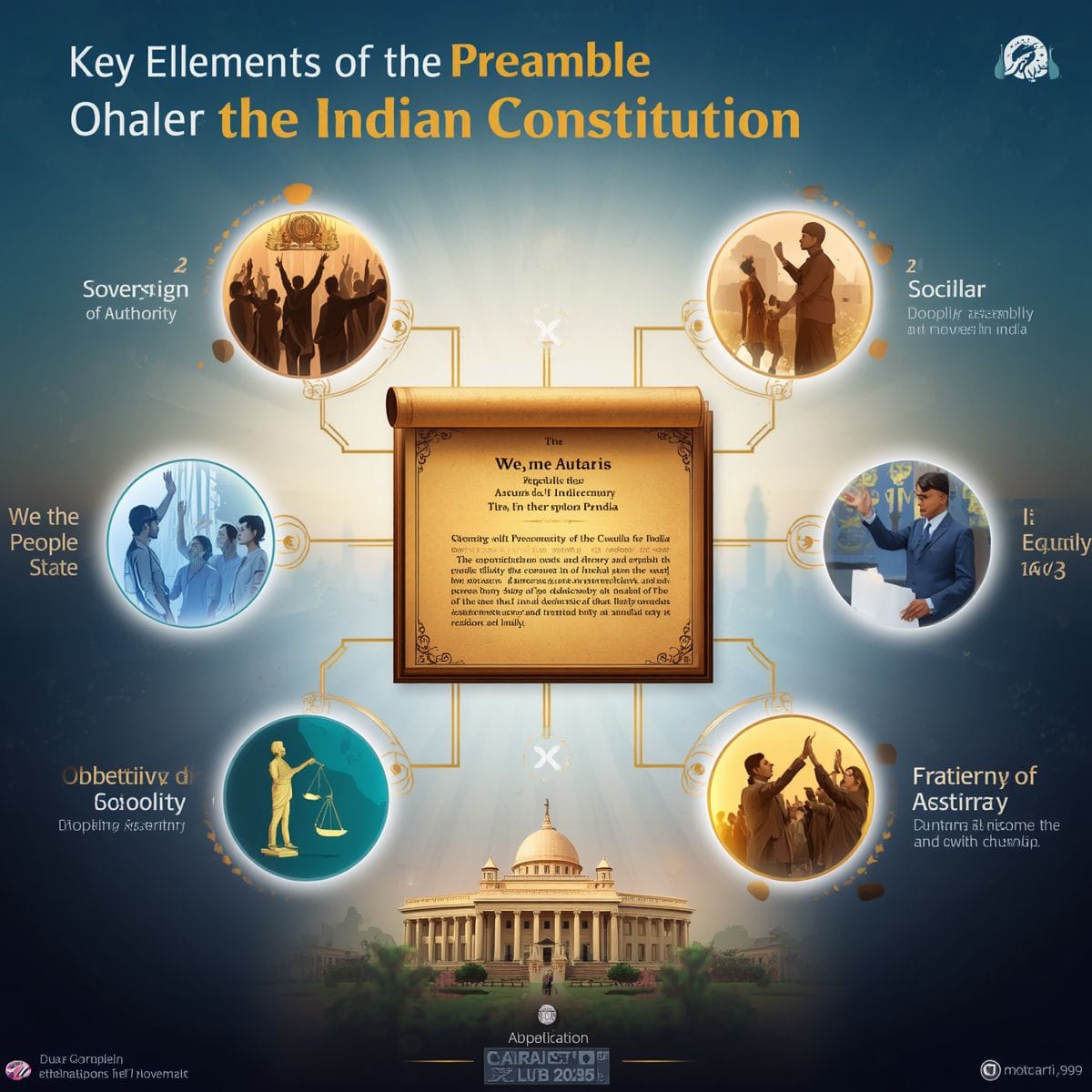
Key Elements of the Preamble of the Indian Constitution
The Preamble of the Indian Constitution outlines the fundamental values, objectives, and constitutional philosophy of India. It consists of several key elements that define the nature of the Indian State and the ideals that the Constitution seeks to achieve.
1. Source of Authority
The Preamble begins with the words "We, the People of India", signifying that the Constitution derives its authority from the people and reflects the principle of popular sovereignty.
2. Nature of the Indian State
- Sovereign: India is an independent nation with full authority over its internal and external affairs.
- Socialist: The State aims to promote social and economic justice and reduce inequalities.
- Secular: India treats all religions equally and does not recognize any official religion.
- Democratic: The government is elected by the people through free and fair elections.
- Republic: The Head of the State is elected rather than inheriting the position.
3. Objectives of the Constitution
The Preamble promises the following constitutional ideals to all citizens:
- Justice – Social, Economic, and Political.
- Liberty – Freedom of thought, expression, belief, faith, and worship.
- Equality – Equal status and equal opportunity for every citizen.
- Fraternity – Promoting brotherhood while ensuring the dignity of individuals and the unity and integrity of the nation.
4. Adoption of the Constitution
The Preamble concludes by declaring that the people of India adopted, enacted, and gave the Constitution to themselves on 26 November 1949, demonstrating the democratic origin of the Constitution.
Features of the Preamble of the Indian Constitution
The Preamble of the Indian Constitution highlights the fundamental principles, values, and objectives upon which the Constitution is based. It serves as the guiding philosophy of the Constitution and reflects the vision of its framers.
Key Features of the Preamble
- Source of Authority: The Constitution derives its authority from "We, the People of India", emphasizing popular sovereignty.
- Declaration of the Nature of the State: It defines India as a Sovereign, Socialist, Secular, Democratic Republic.
- Statement of Constitutional Objectives: It aims to secure Justice, Liberty, Equality, and Fraternity for all citizens.
- Reflects the Constitutional Philosophy: The Preamble expresses the ideals and vision of the Constitution makers and serves as the foundation of constitutional governance.
- Guiding Principle for Interpretation: Courts use the Preamble to interpret constitutional provisions whenever ambiguity arises.
- Integral Part of the Constitution: The Supreme Court, in the Kesavananda Bharati Case (1973), recognized the Preamble as an integral part of the Constitution.
- Not a Source of Enforceable Rights: The Preamble does not grant enforceable legal rights but provides constitutional guidance and direction.
- Foundation of the Basic Structure: The principles contained in the Preamble form an important part of the Basic Structure Doctrine.
Objectives of the Preamble of the Indian Constitution
The Preamble of the Indian Constitution sets out the fundamental objectives that the Constitution seeks to achieve. It reflects the vision of the Constitution makers and provides the guiding principles for governance, justice, and national unity.
Major Objectives of the Preamble
- To Establish a Sovereign Nation: Ensure India's complete independence in internal and external affairs.
- To Promote Social, Economic, and Political Justice: Create a fair and equitable society by eliminating discrimination and inequality.
- To Secure Liberty: Guarantee freedom of thought, expression, belief, faith, and worship to every citizen.
- To Ensure Equality: Provide equal status and equal opportunities for all citizens without discrimination.
- To Promote Fraternity: Foster a sense of brotherhood while protecting the dignity of every individual.
- To Preserve the Unity and Integrity of the Nation: Strengthen national integration and maintain the unity of India.
- To Establish Democratic Governance: Ensure that the government derives its authority from the people through democratic elections.
- To Uphold Constitutional Values: Guide the State in protecting democracy, secularism, socialism, justice, and the rule of law.
Constitutional Significance of the Preamble
The Preamble of the Indian Constitution holds immense constitutional significance as it reflects the fundamental philosophy, objectives, and values upon which the Constitution is based. Although it does not confer enforceable legal rights, it serves as a guiding framework for constitutional interpretation and governance.
Importance of the Preamble in the Constitution
- Foundation of the Constitution: It outlines the basic philosophy and vision of the Constitution makers.
- Guide to Constitutional Interpretation: Courts refer to the Preamble when interpreting ambiguous constitutional provisions to understand the intent of the Constitution.
- Reflects Constitutional Values: It embodies the ideals of Justice, Liberty, Equality, and Fraternity, which form the cornerstone of India's constitutional system.
- Supports the Basic Structure Doctrine: The principles enshrined in the Preamble are considered part of the Constitution's Basic Structure and cannot be destroyed by constitutional amendments.
- Guides Law-Making and Governance: It provides direction to the Legislature, Executive, and Judiciary in framing laws and implementing constitutional policies.
- Promotes National Unity: The Preamble emphasizes the unity, integrity, and dignity of the nation and its citizens.
- Acts as a Constitutional Compass: It serves as the guiding principle for protecting democracy, secularism, social justice, and the rule of law.

Judicial View of the Preamble
The Preamble of the Indian Constitution has played a significant role in constitutional interpretation by the Indian Judiciary. Although it does not confer enforceable legal rights, the Supreme Court has consistently recognized its importance in understanding the spirit, objectives, and philosophy of the Constitution.
Judicial Perspective on the Preamble
- Interpretative Tool: The Judiciary uses the Preamble as a guiding principle to interpret constitutional provisions whenever ambiguity arises.
- Integral Part of the Constitution: In the landmark Kesavananda Bharati v. State of Kerala (1973), the Supreme Court held that the Preamble is an integral part of the Constitution.
- Basis of the Basic Structure Doctrine: The principles contained in the Preamble help identify and protect the Basic Structure of the Constitution from destructive amendments.
- Guiding Constitutional Philosophy: The Preamble reflects the ideals of Justice, Liberty, Equality, and Fraternity, which guide judicial interpretation and constitutional governance.
- Support for Constitutional Morality: Courts rely on the values of the Preamble to uphold constitutional morality, democratic principles, and the rule of law.
Landmark Supreme Court Judgments on the Preamble
The Supreme Court of India has delivered several landmark judgments that have clarified the constitutional status and legal significance of the Preamble of the Indian Constitution. These decisions have established the Preamble as an important guide for constitutional interpretation and the protection of the Constitution's basic principles.
Major Supreme Court Judgments
- Berubari Union Case (1960): The Supreme Court initially held that the Preamble is not a part of the Constitution and cannot be used as an independent source of governmental powers or legal rights.
- Kesavananda Bharati v. State of Kerala (1973): The Supreme Court overruled the Berubari decision and held that the Preamble is an integral part of the Constitution. It also recognized that the ideals reflected in the Preamble form part of the Basic Structure Doctrine.
- Indira Nehru Gandhi v. Raj Narain (1975): The Court relied on the principles of the Preamble to uphold democracy, free and fair elections, and the rule of law as essential constitutional values.
- Minerva Mills Ltd. v. Union of India (1980): The Supreme Court emphasized that the harmony between Fundamental Rights and Directive Principles of State Policy is part of the Constitution's Basic Structure, as reflected in the Preamble.
- S.R. Bommai v. Union of India (1994): The Court declared that secularism, as enshrined in the Preamble, is a part of the Basic Structure of the Constitution and must be preserved by the State.
- 1960 – Berubari Case: Preamble not considered part of the Constitution.
- 1973 – Kesavananda Bharati: Preamble recognized as an integral part of the Constitution.
- 1975 – Indira Gandhi Case: Reinforced democracy and the rule of law.
- 1980 – Minerva Mills: Strengthened the Basic Structure Doctrine.
- 1994 – S.R. Bommai: Declared secularism a part of the Basic Structure.
42nd Constitutional Amendment and the Preamble
The 42nd Constitutional Amendment Act, 1976, often referred to as the "Mini Constitution", brought significant changes to the Preamble of the Indian Constitution. During the Emergency period (1975–1977), the amendment expanded the constitutional philosophy by adding new terms that emphasized India's commitment to social justice, secularism, and national unity.
Changes Introduced by the 42nd Amendment
- The word "Socialist" was inserted to emphasize the objective of achieving social and economic justice.
- The word "Secular" was added to affirm that the State treats all religions equally and has no official religion.
- The word "Integrity" was added to the phrase "Unity of the Nation", making it "Unity and Integrity of the Nation".
Preamble: Before and After the 42nd Amendment
| Before 1976 | After the 42nd Amendment (1976) |
|---|---|
| Sovereign Democratic Republic | Sovereign Socialist Secular Democratic Republic |
| Unity of the Nation | Unity and Integrity of the Nation |
Constitutional Significance
- Strengthened the constitutional commitment to social and economic equality.
- Formally recognized secularism as a constitutional value.
- Reinforced the importance of national unity and integrity.
- Expanded the guiding philosophy of the Constitution without altering its basic framework.
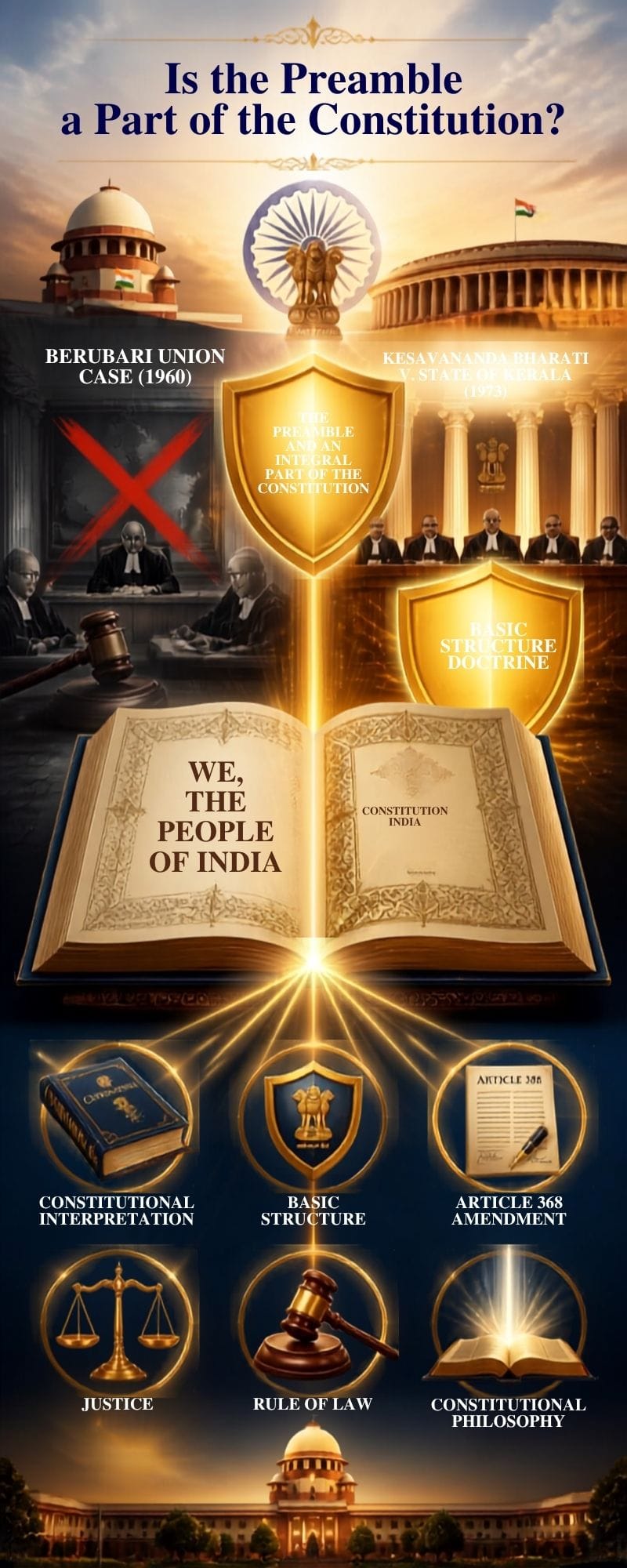
The Preamble a Part of the Constitution?
Yes, the Preamble is an integral part of the Indian Constitution. Although there was initially a different judicial opinion, the Supreme Court later clarified its constitutional status through landmark judgments.
Judicial Position
- Berubari Union Case (1960): The Supreme Court held that the Preamble was not a part of the Constitution and could not be treated as an independent source of governmental powers.
- Kesavananda Bharati v. State of Kerala (1973): The Supreme Court overruled the earlier view and declared that the Preamble is an integral part of the Constitution. It also held that the ideals contained in the Preamble form the foundation of the Basic Structure Doctrine.
Constitutional Importance
- Forms an integral part of the Constitution.
- Reflects the philosophy and objectives of the Constitution.
- Guides the interpretation of constitutional provisions.
- Supports the Basic Structure Doctrine.
- Can be amended under Article 368, provided the Basic Structure is not altered.
Relationship Between the Preamble and Fundamental Rights
The Preamble and the Fundamental Rights (Part III) of the Indian Constitution are closely interconnected. While the Preamble lays down the fundamental ideals and objectives of the Constitution, the Fundamental Rights provide the legal framework to realize those ideals in practice.
How the Preamble Relates to Fundamental Rights
- Justice: Fundamental Rights promote social, economic, and political justice by protecting individuals from arbitrary state action.
- Liberty: Rights such as freedom of speech, expression, movement, and religion give practical effect to the concept of liberty mentioned in the Preamble.
- Equality: Articles 14 to 18 ensure equality before the law, equal protection of laws, and prohibit discrimination and untouchability.
- Dignity and Fraternity: Fundamental Rights safeguard the dignity of individuals and promote a sense of unity and fraternity among citizens.
- Constitutional Interpretation: Courts often interpret Fundamental Rights in light of the values and objectives expressed in the Preamble.
Preamble vs. Fundamental Rights
| Preamble | Fundamental Rights |
|---|---|
| States the ideals and objectives of the Constitution. | Provides enforceable legal rights to citizens. |
| Acts as a guiding principle. | Can be enforced through the courts. |
| Expresses constitutional philosophy. | Implements the philosophy in practice. |
Relationship Between the Preamble and the Directive Principles of State Policy
The Preamble and the Directive Principles of State Policy (DPSPs) are closely connected in achieving the objectives of the Indian Constitution. While the Preamble sets out the ideals and goals of the Constitution, the Directive Principles provide guidelines to the State for establishing a just, equitable, and welfare-oriented society.
Relationship Between the Preamble and DPSPs
- Common Constitutional Objectives: Both aim to establish social, economic, and political justice for all citizens.
- Promotion of Welfare State: The Directive Principles help the State achieve the vision of a welfare state envisioned in the Preamble.
- Implementation of Constitutional Ideals: DPSPs translate the ideals of Justice, Equality, and Social Welfare into practical policies and governance.
- Guidance for Law-Making: Legislatures use the Directive Principles as a framework for enacting laws that fulfill the constitutional goals expressed in the Preamble.
- Complementary Nature: The Preamble provides the constitutional vision, while the Directive Principles provide the policy framework for achieving that vision.
Preamble vs. Directive Principles of State Policy
| Preamble | Directive Principles of State Policy |
|---|---|
| States the philosophy and objectives of the Constitution. | Provides policy guidelines for the State. |
| Defines constitutional values. | Helps implement those values through governance. |
| Acts as a constitutional guide. | Acts as a guide for legislation and public policy. |
| Not enforceable in courts. | Also non-justiciable but fundamental to governance. |
Criticisms of the Preamble
Although the Preamble of the Indian Constitution is widely regarded as the philosophical foundation of the Constitution, it has also been subject to criticism by constitutional scholars and legal experts. These criticisms mainly relate to its legal enforceability, language, and practical implementation.
Major Criticisms of the Preamble
- Not Legally Enforceable: The Preamble does not confer enforceable legal rights and cannot be directly invoked in a court of law.
- Broad and Idealistic Language: Terms such as Justice, Liberty, Equality, and Fraternity are broad constitutional ideals and are open to different interpretations.
- Not an Independent Source of Power: The Preamble neither grants powers to the government nor imposes legal obligations on citizens by itself.
- Limited Practical Application: Its principles require implementation through constitutional provisions, legislation, and judicial interpretation rather than operating directly.
- Debate Over the Words "Socialist" and "Secular": Some scholars argue that the insertion of these terms through the 42nd Constitutional Amendment (1976) has been a matter of political and constitutional debate.
- No Detailed Definitions: The Preamble does not define key constitutional concepts, leaving their interpretation to the courts and constitutional practice.
Important Facts for UPSC/SSC Exams
The Preamble of the Indian Constitution is one of the most important topics in Indian Polity for competitive examinations such as UPSC, SSC, State PCS, CDS, CAPF, NDA, Judiciary, and Banking. The following facts are frequently asked in objective and descriptive exams.
| Topic | Important Fact |
|---|---|
| Name | Preamble of the Indian Constitution |
| Inspired By | Objectives Resolution proposed by Jawaharlal Nehru (13 December 1946) |
| Adopted On | 26 November 1949 |
| Effective From | 26 January 1950 |
| Authority | "We, the People of India" |
| Nature of the State | Sovereign, Socialist, Secular, Democratic Republic |
| Core Objectives | Justice, Liberty, Equality, and Fraternity |
| 42nd Amendment (1976) | Added the words "Socialist", "Secular", and "Integrity" |
| Landmark Judgment | Kesavananda Bharati v. State of Kerala (1973) |
| Basic Structure Doctrine | The Preamble is an integral part of the Constitution and helps identify the Basic Structure. |
| Legal Status | Integral part of the Constitution but not a source of enforceable rights. |
| Amendable? | Yes, under Article 368, without altering the Basic Structure. |
Frequently Asked Questions (FAQ)
1. What is the Preamble of the Indian Constitution?
The Preamble is the introductory part of the Indian Constitution that outlines its philosophy, objectives, and guiding principles. It reflects the vision of the Constitution makers and the aspirations of the people of India.
2. Is the Preamble a part of the Indian Constitution?
Yes. In the Kesavananda Bharati v. State of Kerala (1973) case, the Supreme Court held that the Preamble is an integral part of the Constitution.
3. Does the Preamble provide enforceable legal rights?
No. The Preamble does not grant enforceable legal rights. However, it serves as an important guide for interpreting constitutional provisions.
4. Which words were added to the Preamble by the 42nd Constitutional Amendment?
The 42nd Constitutional Amendment Act, 1976 added the words "Socialist," "Secular," and "Integrity" to the Preamble.
5. What are the main objectives of the Preamble?
The Preamble aims to secure Justice, Liberty, Equality, and Fraternity while establishing India as a Sovereign, Socialist, Secular, Democratic Republic.
6. Who introduced the Objectives Resolution?
The Objectives Resolution, which became the basis of the Preamble, was introduced by Pandit Jawaharlal Nehru on 13 December 1946.
7. Can the Preamble be amended?
Yes. The Preamble can be amended under Article 368, provided that the amendment does not alter the Basic Structure of the Constitution.
8. Why is the Preamble called the "Soul of the Constitution"?
The Preamble is called the "Soul of the Constitution" because it expresses the fundamental philosophy, objectives, and values upon which the entire Constitution is based.
Conclusion
The Preamble of the Indian Constitution is more than just an introductory statement; it is the philosophical foundation and guiding spirit of the Constitution. It reflects the vision of the Constitution makers and defines the core values of Justice, Liberty, Equality, and Fraternity that shape India's democratic framework.
Although the Preamble does not create enforceable legal rights, it plays a crucial role in constitutional interpretation and serves as a guiding principle for the Legislature, Executive, and Judiciary. Landmark Supreme Court judgments, particularly Kesavananda Bharati v. State of Kerala (1973), have affirmed that the Preamble is an integral part of the Constitution and forms the basis of the Basic Structure Doctrine.
In conclusion, the Preamble remains the constitutional vision of India, providing direction for governance, protecting democratic values, and ensuring that the ideals of the Constitution continue to guide the nation. For students of UPSC, SSC, State PCS, Judiciary, and other competitive examinations, a thorough understanding of the Preamble is essential for mastering Indian Polity and Constitutional Law.