
Emergency In India – Types and Constitutional Provisions
Emergency In India refers to extraordinary situations when normal democratic functioning is temporarily altered to protect national security, constitutional order, or financial stability. During my studies of Indian polity, I realized how deeply emergency provisions have shaped our democracy and constitutional framework.
The Indian Constitution provides emergency provisions under Articles 352, 356 and 360. These provisions are meant to safeguard the nation during serious crises.
🔴 Types of Emergency In India
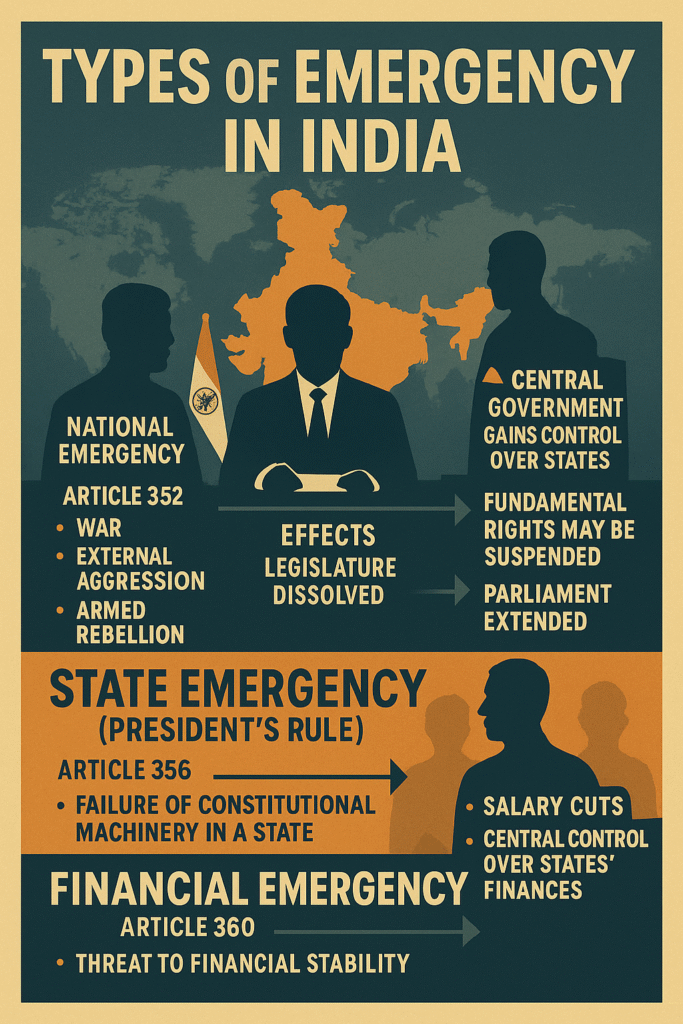
1. National Emergency – Article 352
Cause:
War, external aggression, or armed rebellion.
Applicable To:
Declared by the President on the advice of the Prime Minister and Council of Ministers.
Effect:
- Union Government gains extended powers over States.
- Fundamental Rights may be restricted.
- Parliament’s tenure can be extended up to one year at a time.
National Emergency has been applied three times:
- 1962 – China War (Jawaharlal Nehru)
- 1971 – Pakistan War (Indira Gandhi)
- 1975 – Internal Crisis (Indira Gandhi)
2. State Emergency (President’s Rule) – Article 356
Reason:
Failure of constitutional machinery in a state.
Effect:
- State Legislative Assembly may be dissolved or suspended.
- State administration comes under the Central Government.
This type of Emergency In India has been imposed several times in different states when political instability occurred.
3. Financial Emergency – Article 360
Reason:
Threat to the financial stability or credit of India.
Effect:
- Reduction in salaries of government employees including judges.
- Complete financial control by the Union Government.
No Financial Emergency has ever been declared in India.
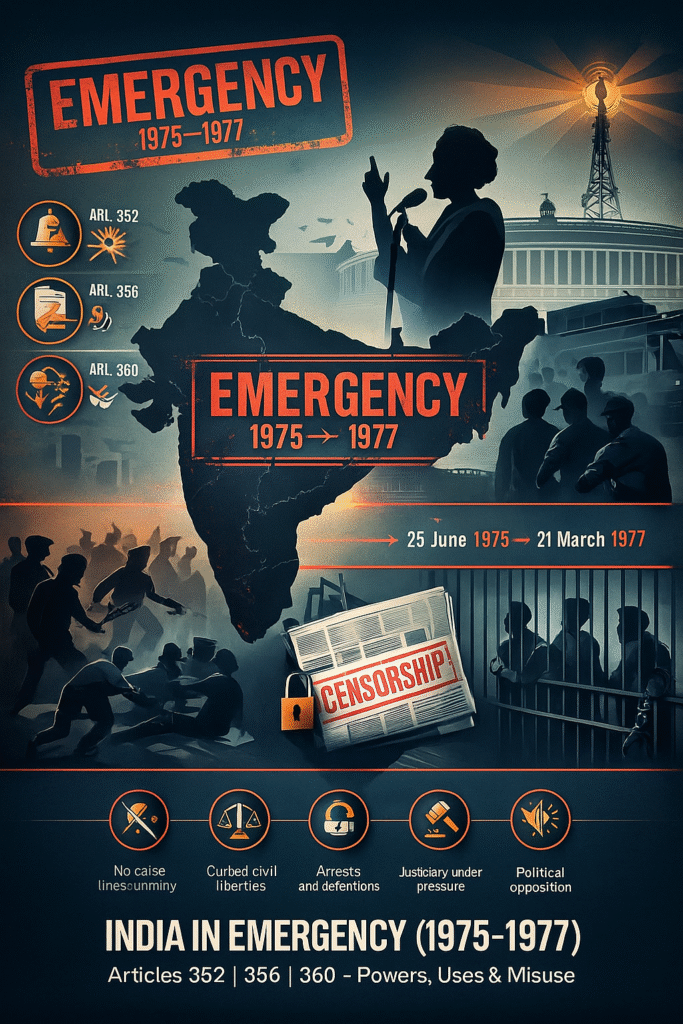
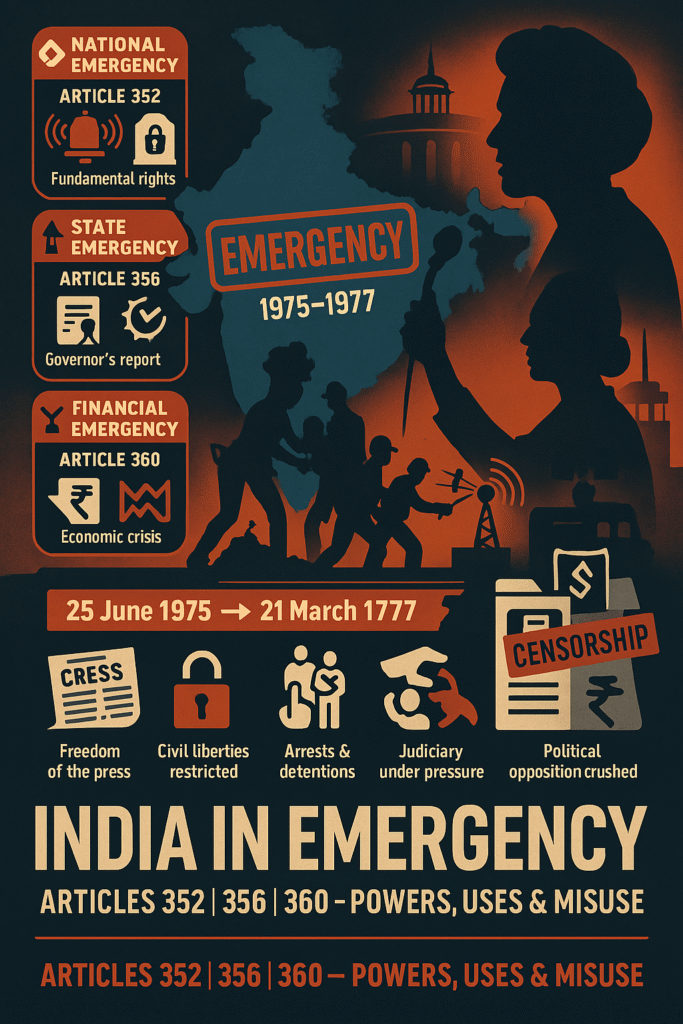
🔍 The 1975 Emergency In India (Most Controversial Phase)
Duration:
25 June 1975 to 21 March 1977
Declared By:
Prime Minister Indira Gandhi
Official Cause:
Internal disturbance
Major Effects:
- Press censorship
- Arrest of opposition leaders
- Suspension of civil liberties
The 1975 Emergency In India is often described as one of the darkest periods in Indian democratic history because of restrictions on fundamental rights and political freedoms.
Conclusion
Overall, Emergency In India is a constitutional mechanism designed to protect the nation during extreme crises. However, history shows that its misuse can weaken democratic institutions. The lessons from 1975 remind us that safeguarding democracy requires accountability, transparency and constitutional responsibility.
Types of Emergency in India
During my study of India’s constitutional framework, I discovered how the Emergency provisions were designed to protect the nation in extraordinary situations. The Indian Constitution clearly defines three types of Emergencies, each applicable under specific circumstances. Below is a simple and clear explanation of all three types.
🔴 1. National Emergency – Article 352
Declaration Based On:
- War
- External Aggression
- Armed Rebellion
Who Declares:
President of India, based on the advice of the Prime Minister.
Effects:
- Central Government gets full control over the States.
- Fundamental Rights of citizens can be suspended.
- Parliament's tenure can be extended.
Instances When Applied:
- 1962 – China War
- 1971 – Pakistan War
- 1975 – Internal Crisis (Indira Gandhi)
🟠 2. State Emergency (President’s Rule) – Article 356
Declaration Based On:
When any State fails to operate according to the Constitutional mechanism, i.e., the government of the state cannot function as per the Constitution.
Who Declares:
President of India, based on the Governor’s report or other reliable information.
Effects:
- State Legislative Assembly can be suspended or dissolved.
- President takes over all executive powers of the State.
When This Happens:
- When a State Government loses majority
- Riots, political instability, or administrative failure
👉 This Emergency has been applied many times in various States.
🟡 3. Financial Emergency – Article 360
Declaration Based On:
When the financial stability or credit of the country is threatened.
Who Declares:
President of India.
Effects:
- Central Government can reduce salaries and allowances of government employees.
- State governments lose financial freedom.
- All major financial decisions come under the control of the Central Government.
👉 Till today, no Financial Emergency has ever been applied in India.
📌 Conclusion
| Type | Article | Reason | Applied Till Now |
|---|---|---|---|
| National Emergency | Article 352 | War, external assault, armed rebellion | 3 times |
| State Emergency | Article 356 | Constitutional crisis in a State | Many times |
| Financial Emergency | Article 360 | Financial instability | Never applied |
Understanding these Emergency provisions helps us appreciate the delicate balance between national security and democratic rights. These rules exist to protect the integrity of the nation, but their use must always remain responsible and limited.
National Emergency – Article 352
National Emergency is applied under Article 352 of the Indian Constitution when the unity, integrity, or security of the country faces a serious threat. It is considered the most powerful form of emergency because once applied, it affects the entire governing structure of the nation.
🔹 Grounds for Proclamation
The President can declare a National Emergency when:
- War occurs
- External aggression takes place
- Armed rebellion arises
📌 Earlier, “internal disturbance” was also a valid reason. But the 44th Constitutional Amendment (1978) removed it and replaced it with “armed rebellion.”
🔹 Procedure for Proclamation
- The President can declare a National Emergency only on the written advice of the Council of Ministers headed by the Prime Minister.
- The proclamation must be approved by both the Lok Sabha and Rajya Sabha within 1 month.
- Once approved, the Emergency remains in force for 6 months and can be extended further every 6 months with parliamentary approval.
🔹 Effects of National Emergency
- The Centre gets full control over the States.
- Fundamental Rights may be restricted (especially Article 19).
- Lok Sabha’s tenure can be extended for up to 1 year at a time.
- Legislative powers of States may shift to the Centre.
- The federal structure becomes more unitary in nature.
🔹 History of National Emergency in India
| Year | Reason | Prime Minister | Duration |
|---|---|---|---|
| 1962 | War with China | Jawaharlal Nehru | 1962 – 1968 |
| 1971 | War with Pakistan | Indira Gandhi | 1971 – 1977 |
| 1975 | Internal political crisis | Indira Gandhi | 25 June 1975 – 21 March 1977 |
⚠️ The 1975 Emergency is considered the most controversial phase in Indian democracy. It involved press censorship, political arrests, and suspension of fundamental rights.
🔹 Important Constitutional Amendment
44th Constitutional Amendment Act, 1978
- Made written advice of the Cabinet mandatory for declaring Emergency.
- Suspension of Article 19 is now allowed only during war or external aggression.
- Set the time limit for parliamentary approval to 1 month.
📝 Conclusion
National Emergency under Article 352 is a serious constitutional provision. It gives extensive powers to the Central Government, but history (especially 1975) shows that misuse is possible. Therefore, applying National Emergency requires serious caution, responsibility, and adherence to constitutional safeguards.

Three Times National Emergency in India
India has faced three National Emergencies under Article 352. Each emergency was declared for different reasons and under different circumstances. Below is the complete summary of all three:
🇮🇳 India’s Three National Emergencies
| Order | Year | Reason | Prime Minister | Duration |
|---|---|---|---|---|
| 1 | 1962 | War with China (External Attack) | Pandit Jawaharlal Nehru | October 1962 – January 1968 |
| 2 | 1971 | War with Pakistan (External Aggression) | Indira Gandhi | December 1971 – March 1977 |
| 3 | 1975 | Internal Crisis (Political Instability & Opposition Agitation) | Indira Gandhi | 25 June 1975 – 21 March 1977 |
🔎 Properties of the Three Emergencies
✅ 1962 – China War
- Declared due to China’s attack on India.
- Lasted for nearly 5 years 3 months.
✅ 1971 – Pakistan War
- Happened during the Bangladesh Liberation War.
- Declared due to threats to national security.
✅ 1975 – Internal Crisis (Most Controversial)
Reason:
- Opposition movements led by Jayaprakash Narayan.
- Mass public protests.
- Allahabad High Court judgement declaring Indira Gandhi’s election invalid.
Results:
- Press censorship
- Suspension of citizens’ fundamental rights
- Arrest of opposition leaders
State Emergency (President’s Rule) – Article 356
State Emergency, commonly known as President’s Rule, is applied under Article 356. It is imposed when the State Government fails to function according to the Constitution.
📌 Grounds for Proclamation
President can apply Article 356 when:
- The State Government is unable to function constitutionally.
- Law and order breakdown occurs (riots, violence, political instability).
- No party is able to form a government (e.g., post-election hung assembly).
- The Governor submits a report or the President receives other credible information.
⚙️ Procedure of Declaration
- The Governor sends a detailed report to the President.
- The President issues the order under Article 356.
- The order must be approved by Parliament within 2 months.
- Once approved, it remains in force for up to 6 months.
- It can be extended every 6 months for a maximum of 3 years (beyond 3 years only in special situations).
🔎 Effects of President’s Rule

Featured Amazon Product
✔ Premium quality & design
✔ Great performance & reliability
✔ Excellent value for money
View on Amazon- The State Legislative Assembly is suspended or dissolved.
- The State Government is run by the Centre through the Governor.
- All powers of the Council of Ministers shift to the President.
📜 History of President’s Rule
- The first President’s Rule was imposed on 20 June 1951 in Punjab.
- So far, it has been imposed 100+ times in different States.
- Frequent cases: Uttar Pradesh, Bihar, Karnataka, Kerala, etc.
⚖️ Important Supreme Court Case
✔ SR Bommai Case (1994)
- Supreme Court ruled that Article 356 must not be misused.
- President’s decision is subject to judicial review.
📝 Conclusion
State Emergency is a constitutional remedy used when a State Government completely fails to function. However, excessive or politically motivated use can harm India’s democracy. Therefore, it must be applied with caution, fairness, and strict constitutional discipline.
Economic / Financial Emergency – Article 360
A Financial Emergency is declared under Article 360 of the Indian Constitution when the financial stability or credit of India (or any part of India) comes under serious threat.
📌 Grounds for Proclamation
The President may declare a Financial Emergency if satisfied that:
“The financial stability or credit of India or any part thereof is threatened.”
⚙️ Procedure for Declaration
- The President issues a proclamation of Financial Emergency.
- The proclamation must be approved by Parliament within 2 months.
- Once approved, it remains in force indefinitely until it is revoked.
🔎 Effects of Financial Emergency
- Centre gains full control over State financial affairs.
- Centre may reduce salaries, allowances, and pensions of:
- Central Government employees
- State Government employees
- Even Judges of the High Courts and Supreme Court
- States must seek Centre’s permission for all major financial decisions.
- Parliament may enact laws regarding State expenditure and revenue.
❌ Has India Ever Declared a Financial Emergency?
No. India has never declared a Financial Emergency till today.
In 1991, during the severe economic crisis (foreign exchange reserves falling sharply), the possibility existed, but India avoided it through immediate reforms and international assistance (IMF).
⚖️ Precautions & Concerns
- State autonomy may be weakened.
- India’s federal structure could get diluted.
- Judiciary’s independence might be affected (salary control).
📝 Conclusion
A Financial Emergency is a serious constitutional tool, applicable only in extreme financial crises. Though never used, its existence ensures that the Centre has constitutional mechanisms to deal with financial instability.
1975 National Emergency – The Most Controversial Emergency in India
From 25 June 1975 to 21 March 1977, India underwent the most controversial National Emergency in its democratic history. This Emergency was declared under Article 352.
📌 Official Reason for the 1975 Emergency
Government’s official justification:
- “Internal Disturbance”
But the real reasons were:
- Challenges to Indira Gandhi’s political power
- Growing pressure from the Opposition
- Allahabad High Court judgment cancelling Indira Gandhi’s election
⚖️ Chronology of Major Events
| Date | Event |
|---|---|
| 12 June 1975 | Allahabad High Court declared Indira Gandhi’s election invalid |
| 24 June 1975 | Supreme Court granted partial relief but barred her from voting as MP |
| 25 June 1975 (Night) | President Fakhruddin Ali Ahmed declared National Emergency |
| 26 June 1975 | Emergency announced nationwide — censorship on press & mass arrests began |
🔗 Main Features of the 1975 Emergency
- Suspension of Fundamental Rights (especially Article 19 – Freedom of Speech)
- Press censorship
- Arrest of opposition leaders (Jayaprakash Narayan, Atal Bihari Vajpayee, L.K. Advani, etc.)
- Ban and restrictions on organizations like RSS & Jan Sangh
- Forced Sterilization Campaign under Sanjay Gandhi’s leadership
- Pressure on Judiciary and weakening of judicial independence
👥 Key People During the 1975 Emergency
- Indira Gandhi – Prime Minister, central decision-maker
- Jayaprakash Narayan – Leader of the Opposition movement
- Sanjay Gandhi – Influential figure, acted without holding any official position
- Fakhruddin Ali Ahmed – President who signed the Emergency proclamation
📉 Effects & Criticism
- Damage to democratic institutions
- Violation of human rights
- Suppression of political opposition
- Atmosphere of fear and repression across the country
🗳️ End of the Emergency & Elections
- Emergency withdrawn in March 1977
- Fresh Lok Sabha elections conducted
- Indira Gandhi suffered a massive defeat
- Janata Party formed the government
- Morarji Desai became the Prime Minister
📝 Conclusion
The 1975 Emergency is a powerful reminder that misuse of constitutional powers can severely weaken a democracy. It stands as a historic warning to protect democratic values and constitutional limits.
Conclusion: 1975 Emergency In India
The 1975–77 Emergency In India remains one of the most defining and controversial chapters in the history of Indian democracy. It clearly demonstrated how the concentration or misuse of constitutional powers can significantly affect civil liberties, institutional independence, and democratic accountability.
During this period:
- The voice of opposition and free press was suppressed,
- Fundamental Rights were curtailed under Article 352,
- Political leaders were arrested without due process,
- And constitutional institutions faced serious strain.
Yet, when the Emergency ended in 1977, the citizens of India exercised their democratic right to vote and brought a peaceful change of government. This historic political transition reinforced the strength and resilience of Indian democracy.
👉 The 1975 Emergency In India stands as a lasting reminder that while the Constitution provides extraordinary powers during crises, the true safeguard of democracy lies in active institutions, judicial independence, free media, and vigilant citizens.
Frequently Asked Questions (FAQ) – 1975 Emergency In India
1. What was the 1975 Emergency In India?
The 1975 Emergency In India was a National Emergency declared on 25 June 1975 under Article 352 of the Constitution citing “internal disturbance.” It lasted until 21 March 1977.
2. Who declared the 1975 Emergency?
The Emergency was declared by President Fakhruddin Ali Ahmed on the advice of Prime Minister Indira Gandhi.
3. What were the major effects of the Emergency?
Major effects included suspension of Fundamental Rights, press censorship, arrest of opposition leaders, and centralization of executive power.
4. Under which Article was the Emergency declared?
The 1975 Emergency was declared under Article 352 of the Indian Constitution.
5. Why is the 1975 Emergency considered controversial?
It is considered controversial because of the restrictions on civil liberties, misuse of preventive detention laws, and weakening of democratic institutions.
6. How did the Emergency end?
The Emergency ended in March 1977 after general elections were announced, leading to a change in government and restoration of democratic processes.
📚 References
- Government of India. The Constitution of India – Article 352, 356, 360 (Official Document).
- Shah Commission of Inquiry (1977–78). Report on the 1975 Emergency.
- Granville Austin. Working a Democratic Constitution: The Indian Experience.
- Bipan Chandra. India Since Independence – Chapter on Emergency.
- Ramachandra Guha. India After Gandhi – The Emergency Period.
- Supreme Court of India Judgement (ADM Jabalpur vs Shivkant Shukla, 1976).
- Lok Sabha Debates Archive – Discussions on Emergency Provisions.


Pingback: Emergency of 1975 In India - Quality awareness