
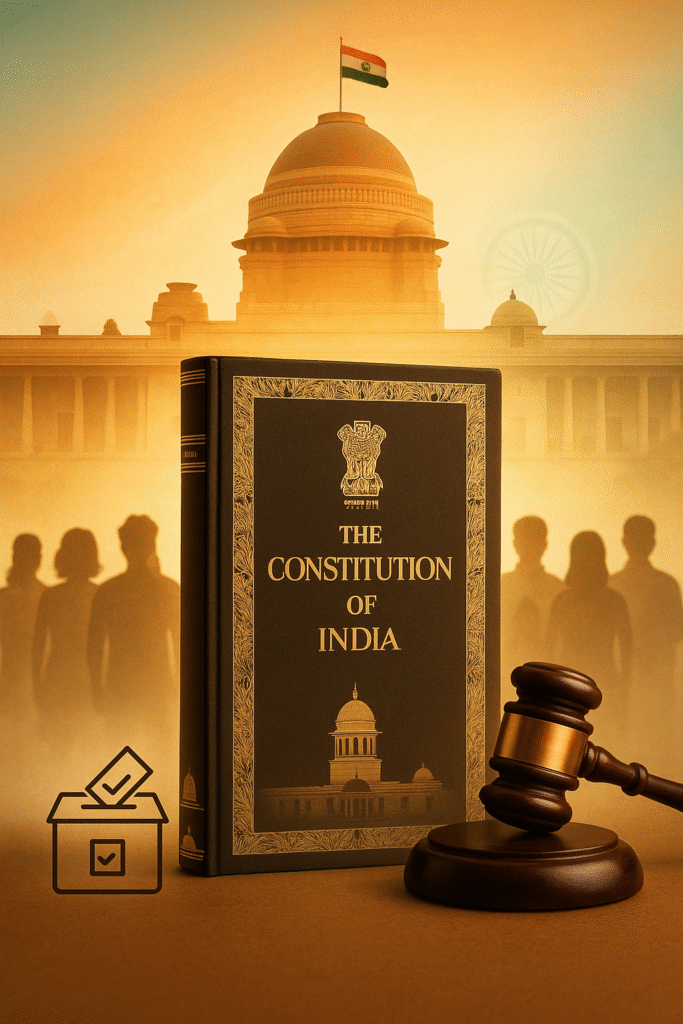
India is a Republic
"India is a republic"—this sentence reflects an important feature of the Indian Constitution and democratic system.
Why is India a Republic?
"Republic" means a nation whose head (President) is elected by the people, and is not ruled by a hereditary king or emperor. India became a republic on January 26, 1950, when its Constitution came into effect.
Key Features of a Republic
1. Elected Head
Elected head: The head of state (President) of India is indirectly elected by the people and does not belong to any royal dynasty.

Top Rated Amazon Product
Popular and trusted product with strong customer feedback. Check the latest price, offers & availability on Amazon.
👉 Check on Amazon2. The Constitution is Supreme
The Constitution is supreme: Government in India is governed by the Constitution, not by the whims of any one individual.
3. Democratic System
Democratic system: The government in India is elected by the people and is accountable to them.
4. Independence of the Judiciary
Independence of the judiciary: The judiciary in India is independent and protects the Constitution.
Conclusion
India is a sovereign, socialist, secular, democratic republic. The word "republic" ensures that power is vested in the people and the head of the country is elected by the people, not by hereditary rights.
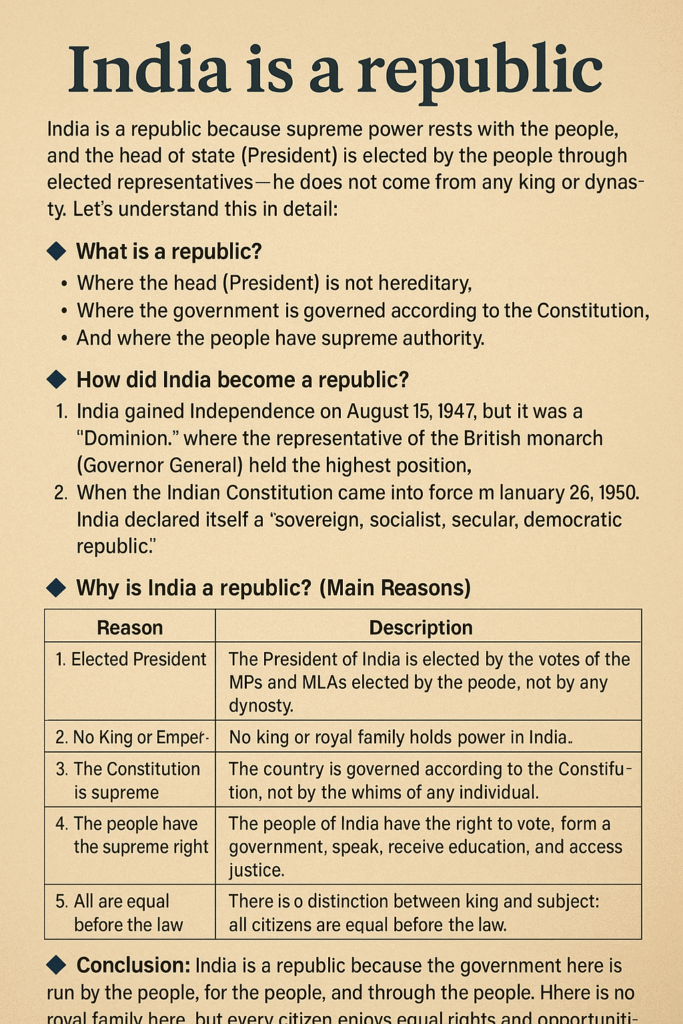
Why is India a Republic?
India is a republic because supreme power rests with the people, and the head of state (President) is elected by the people through elected representatives—he does not come from any king or dynasty. Let's understand this in detail:
🔷 What is a Republic?
A republic is a country:
- where the head (President) is not hereditary,
- where the government operates according to the Constitution,
- and where the people have supreme authority.
🔷 How Did India Become a Republic?
- India gained independence on August 15, 1947, but it was a "Dominion," where the British monarch's representative (Governor General) held the highest position.
- When the Indian Constitution came into effect on January 26, 1950, India declared itself a "sovereign, socialist, secular, democratic republic."
🔷 Why is India a Republic? (Main Reasons)
| Reason | Description |
|---|---|
| 1. Elected President | The President of India is elected by the votes of the people's elected MPs and MLAs, not by any dynasty. |
| 2. No king or emperor | No king or royal family holds power in India. |
| 3. The Constitution is supreme | The country is governed according to the Constitution, not by the whims of any individual. |
| 4. The people have the supreme right | The people of India have the right to vote, form a government, speak, receive education, and seek justice. |
| 5. All are equal before the law | There is no distinction between king and subject; all citizens are equal before the law. |
🔷 Conclusion
India is a republic because the government here is run by the people, for the people, and through the people. There is no royal family here; instead, every citizen has equal rights and opportunities.
✨ This is the true beauty of democracy—and this is the republican form of India.
Key Features of a Republic
A republic is a system of governance in which the people are supreme, and the head of the country is elected by the people. Let's understand its key features in simple terms:
🔷 1. Elected Head of State (President)
In a republic, the head of the country (such as the President) is elected directly or indirectly by the people. This position does not come from any king or royal family.
🔷 2. Constitution-Based Governance
Governance in a republic is governed by a written constitution. The constitution is supreme, and all citizens, leaders, and officials are subject to it.

Amazon Choice Product
Well-reviewed and trusted product with high user satisfaction. Check the latest price & availability on Amazon.
👉 View on Amazon🔷 3. Rule of Law
In a republic, all citizens enjoy equality before the law. Whether king, minister, or common man—everyone must obey the law.
🔷 4. Democratic Process
- The people have the right to vote.
- The government is elected by the people.
- The government is accountable to the people.
🔷 5. The People Are Supreme
In a republic, the ultimate source of power is the people. The people elect their representatives, and they form the government.
🔷 6. Independence of the Judiciary
In a republic, the judiciary (courts/judges) is independent, ensuring that the Constitution and laws are followed.
🔷 7. Equal Rights and Freedoms
A republic guarantees equal rights, freedom, and justice to every citizen—such as freedom of expression, freedom of religion, the right to education, etc.
🔚 Conclusion
The greatest characteristic of a republic is that it is not a rule by a king, but by the people. The government, elected by the people, works in the best interests of all, according to the rules set by the Constitution.
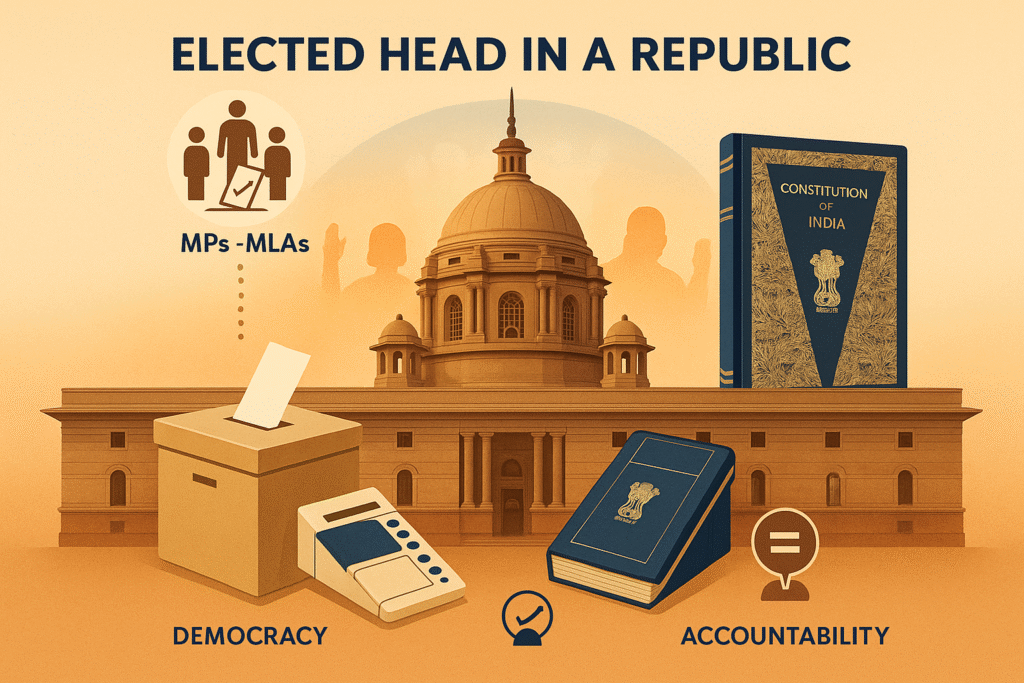
Elected Head of State
Elected Head of State means that the supreme leader of a country (such as the President) is elected by the people, not by descent, royal family, or birthright.
🔷 Why is an elected head of state important in a republic?
- ✅ Symbol of democracy—It proves that power lies with the people, not with a king or dynasty.
- ✅ Accountability—A head elected by the people is accountable to the people.
- ✅ Principle of Equality—A person cannot hold the highest office solely on the basis of their birth.
🔷 Elected Head in India:
India is a republic, and the President is elected.
- The President is elected by the elected members of the Lok Sabha, Rajya Sabha, and all State Legislative Assemblies.
- This election takes place under Articles 54 and 55 of the Constitution.
- The President's term is 5 years.
🔷 Types of elected heads in democratic countries:
| Type | Example | Description |
|---|---|---|
| President | India, USA | Elected by the people or their representatives |
| Prime Minister | India (head of the executive), UK | Elected by Parliament, President/King is the nominal head |
| Not a hereditary monarch | In a republic | The headship is not hereditary |
🔚 Conclusion
An elected head is a fundamental hallmark of a republic. This ensures that the supreme power of the country rests not with a dynasty, but with representatives elected by the trust and vote of the people.
The Constitution is Supreme (Constitution is Supreme)

Best Selling Amazon Product
Highly rated and popular product chosen by many buyers. Check the latest price, offers & availability on Amazon.
👉 Check on Amazon"The Constitution is Supreme" means that in any country, governance, law, justice, and the rights of citizens—all operate according to the Constitution, not the will of any individual, government, or institution.
🔷 What does the supremacy of the Constitution mean?
- ✅ The Constitution is supreme – No person in the country, whether the President, Prime Minister, Minister, Judge, or ordinary citizen, is considered above the Constitution.
- ✅ All decisions are made according to the Constitution – All laws made by Parliament, government policies, and court decisions are made within the limits of the Constitution.
- ✅ The government's power is limited – The Constitution determines what the government can and cannot do.
- ✅ The judiciary is the protector of the Constitution – If any law or action is against the Constitution, the court can declare it unconstitutional.
🔷 Supremacy of the Constitution in India:
- The Constitution came into force in India on January 26, 1950, and since then, it has become the supreme law.
- According to Article 13 of the Constitution, any law that violates fundamental rights is null and void.
- The Supreme Court and High Courts have the power to interpret and protect the Constitution.
🔷 Examples:
- If a government enacts a law that curtails freedom of speech, the court can invalidate it under Article 19 of the Constitution.
- If a minister or official acts outside the Constitution, they can be restrained.
🔚 Conclusion
"The Constitution is supreme" – this principle is the foundation of democracy. It ensures that the country is ruled by law, not by any individual or party. It guarantees security, equality, and justice to citizens.
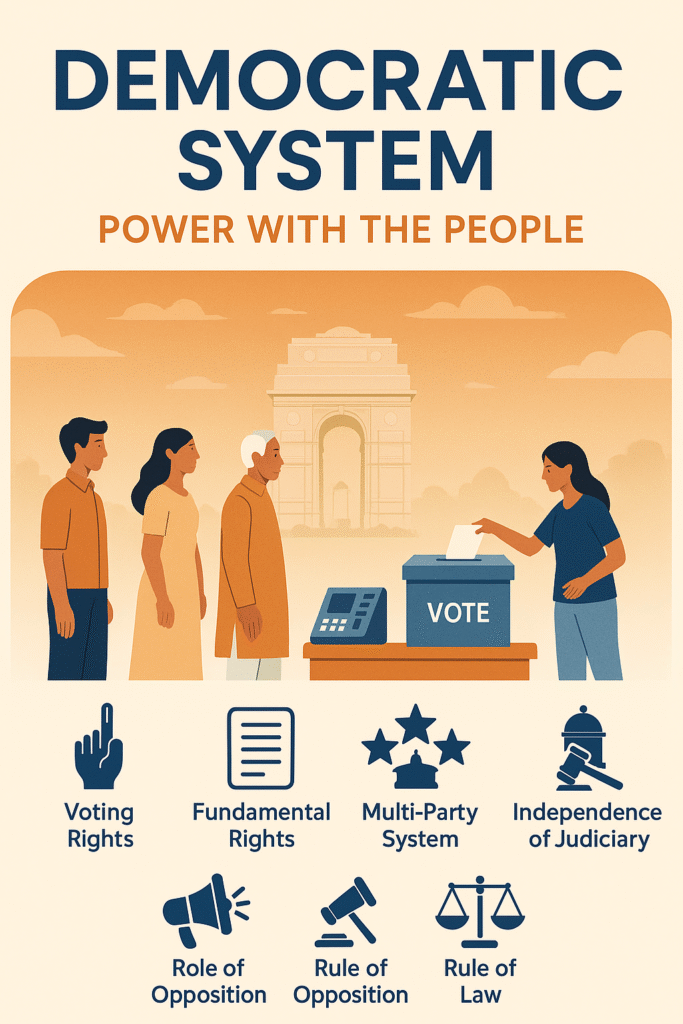
Democratic System
A democratic system is a system of governance in which power is vested in the people, and the government is elected by the people, for the people, and through the people.
🔷 Meaning of democracy:
"Lok" = people
"Tantra" = governance or system
👉 That is, "rule of the people" = democracy
🔷 Key features of a democratic system:
| Feature | Description |
|---|---|
| ✅ The people are supreme. | The government is formed by the votes of the people and is accountable to the people. |
| ✅ Electoral System | All adult citizens (above 18 years of age in India) have the right to vote. |
| ✅ Fundamental Rights | Every citizen has the right to speak, think, practice religion, and receive education. |
| ✅ Multi-Party System | In a democracy, there are various political parties, and the public elects them. |
| ✅ Independence of the Judiciary | Courts and judiciary are independent and protect the Constitution. |
| ✅ Role of the Opposition | In a democracy, the opposition has the right to speak and criticize the government. |
| ✅ Rule of Law | All citizens, leaders, and officials are subject to the law. No one is above the law. |
🔷 Democratic System in India:
- Lok Sabha elections are held every five years in India.
- Citizens elect their representatives through voting.
- Elected representatives go to Parliament and make laws and govern the country.
🔚 Conclusion:
A democratic system is one in which citizens have the right to freedom, equality, and participation. In this system, the people elect their own government and exercise control over it. This system of governance prioritizes public voice and public interest.
Independence of the Judiciary
"Independence of the judiciary" means that the courts of the country make decisions in accordance with the Constitution and the law, free from any political pressure, government, or external interference.
🔷 What is the judiciary?
The judiciary is the institution that:
- Interprets the law
- Administers justice for violations of the law
- Protects the rights of citizens
- (In India, the Supreme Court, High Courts, and District Courts are its members)
🔷 Why is the independence of the judiciary important?
- ✅ Protection of the Constitution: The judiciary oversees whether the government is acting in accordance with the Constitution.
- ✅ Protection of the rights of the people: If a citizen's rights are violated, they can approach the court.
- ✅ Keeping the government under control: The court can decide whether a law made by the government is constitutional or not.
- ✅ Fairness in justice: When the judiciary is independent, it delivers fearless and impartial judgments.
Amazon Best Seller Product
Highly rated and popular product with excellent customer feedback. Check the latest price and availability on Amazon.
👉 View on Amazon🔷 How is the independence of the judiciary ensured in India?
- Appointment of judges: Judges of the Supreme Court and High Courts are appointed through a special process (the collegium system).
- Security of tenure: Judges cannot be removed without cause; removal can only be done through impeachment by Parliament.
- Salaries and service conditions are protected – Judges' salaries and benefits cannot be changed except by Parliament.
- Independence from the government – The judiciary is separate and independent from the executive (government) and the legislature (Parliament).
- Judicial review – The court can examine whether any law or government action is against the Constitution.
🔷 Examples:
- If a government enacts a law that curtails freedom of speech, the court can invalidate it under Article 19 of the Constitution.
- If a minister or official acts outside the Constitution, they can be restrained.
🔚 Conclusion:
The independence of the judiciary is a fundamental pillar of democracy. It ensures justice, equality, and the rule of law prevail in the country. Only when the judiciary is independent can citizens be assured of their rights and the government remains within the bounds of the Constitution.

Top Rated Amazon Choice
Highly rated and trusted product with excellent user reviews. Check the latest price & availability on Amazon.
👉 View on Amazon
Amazon Popular Choice Product
Well-reviewed and popular product with great user feedback. Check the latest price, offers & availability on Amazon.
👉 View on AmazonReferences
Below are the sources and reference materials that support the information included in this article:
- Constitution of India – Preamble, Fundamental Rights, and Key Articles.
- Government of India – Official Publications on democratic structure, governance, and constitutional bodies.
- NCERT Political Science Books – Chapters on Democracy, Republic, Sovereignty, Secularism, and Constitution.
- Ministry of Law and Justice – Verified constitutional documents and amendments.
- Supreme Court of India Judgments related to constitutional interpretation and judicial independence.
- Indian Polity by M. Laxmikanth – Standard reference book on Indian Constitution and governance.
These references provide authentic information to understand India's democratic, sovereign, secular, socialist, and republican framework.