
The Partition of India – Causes, Process, Consequences & Impact
Introduction
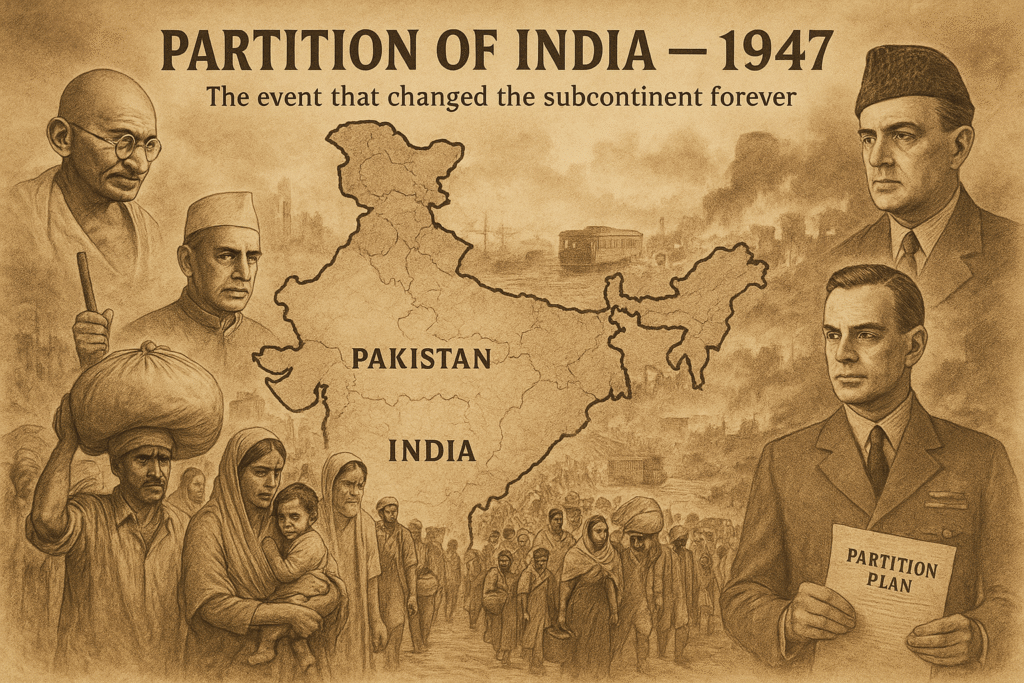
The Partition of India was one of the most significant and tragic events of the 20th century. It marked the division of British India into two independent nations—India and Pakistan—on August 15, 1947. The event reshaped the lives of millions, leaving behind stories of struggle, displacement, courage, and resilience. Understanding its causes and consequences is essential to learning from history and honoring those who lived through this extraordinary moment.
Main Reasons for the Partition of India
1. Religious Differences
Growing disagreements and tensions between the Hindu and Muslim communities created deep social divides.
2. Demand of the Muslim League
The Muslim League, led by Mohammad Ali Jinnah, strongly demanded a separate nation—Pakistan—for Muslims.
3. British “Divide and Rule” Policy
The British government strategically promoted divisions to weaken Hindu-Muslim unity.
4. Political Instability
Frequent conflicts between the Congress and the Muslim League over power-sharing and representation worsened tensions.
5. 1946 Communal Riots
Following the Muslim League’s “Direct Action Day,” widespread riots occurred in Kolkata, Noakhali, Bihar, and Punjab, intensifying the demand for partition.
Process of Partition
June 3, 1947 – The Mountbatten Plan
Lord Mountbatten presented the proposal to divide India, which was accepted by the Congress and the Muslim League.
August 15, 1947 – Independence
India and Pakistan officially emerged as two independent countries.
Division of Pakistan
Pakistan was formed as two regions separated by over 1,600 km:
• West Pakistan (now Pakistan)
• East Pakistan (now Bangladesh)
Consequences of Partition
1. Massive Population Migration
Nearly 15 million people migrated across borders in search of safety and identity.
2. Widespread Violence
Millions were killed, and incidents of looting, kidnapping, and assault occurred on an unprecedented scale.
3. Refugee Crisis
Both nations struggled to provide shelter, food, and support to millions of displaced families.
4. Kashmir Dispute
The partition left Jammu and Kashmir as a disputed region, leading to conflicts that continue even today.
Important Personalities
Mahatma Gandhi
Opposed the partition and undertook fasts to end communal violence.
Pandit Jawaharlal Nehru
Became the first Prime Minister of independent India.
Mohammad Ali Jinnah
The founder of Pakistan and its first Governor-General.
Lord Mountbatten
The last Viceroy of India who supervised the execution of the Partition Plan.
Conclusion
The Partition of India was not just a political event—it was an emotional and life-changing moment for millions. Its impact continues to shape the history, identity, and relations of both India and Pakistan. Remembering it encourages us to reflect on unity, peace, and the importance of building a future free from division and hatred.
Background and History of the Partition of India
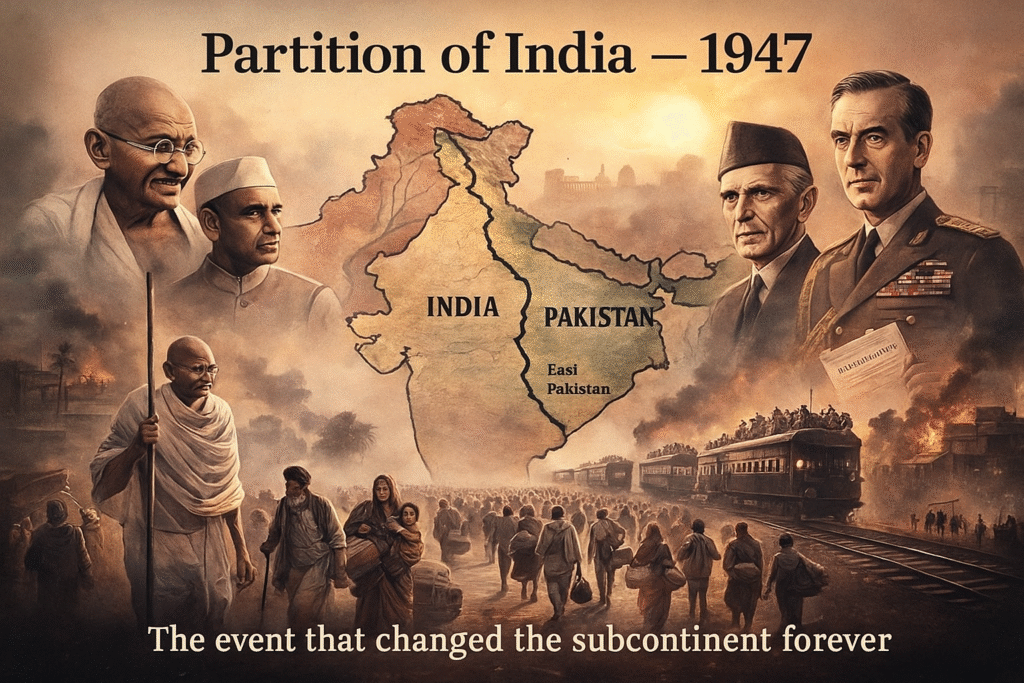
To understand the background and history of the Partition of India, we must examine the social, religious, and political changes of the 19th and 20th centuries. This partition did not occur suddenly; rather, it was the result of a series of historical events, conflicts, and policies that gradually led to it.
Historical Background of the Partition of India
1. British Colonialism (1757–1947)
- After the Battle of Plassey in 1757, the East India Company began to rule India.
- After the Revolution of 1857 (the First War of Independence), India came under direct British rule.
- The British policy of “divide and rule” weakened Hindu-Muslim unity.
2. Indian National Movement and Religious Polarization
- 1885: The Indian National Congress was founded, initiating the demand for Swaraj.
- 1906: The Muslim League was formed to safeguard the political rights of Muslims.
- 1909: The Morley-Minto Reforms introduced separate electorates for Muslims, deepening political divisions.
3. Khilafat and Non-Cooperation Movements (1919–1922)
- Gandhiji supported the Khilafat Movement to strengthen Hindu-Muslim unity.
- This unity weakened after the movement’s failure and the Chauri Chaura incident in 1922.
4. 1930s: Rise of the Two-Nation Theory
- Muhammad Iqbal (1930) and Muhammad Ali Jinnah promoted the idea of a separate Muslim nation.
- 1940: The Muslim League passed the Lahore Resolution, demanding an independent “Muslim nation”—the foundation of Pakistan.
5. World War II and the Quit India Movement
- 1939–1945: Britain involved India in World War II without prior consultation.
- 1942: Congress launched the Quit India Movement in protest.
- The Muslim League supported the British government, gaining political advantages.
History of the Partition of India (Chronological Events)
| Year | Event | Description |
|---|---|---|
| 1940 | Lahore Resolution | Muslim League demands a separate Muslim nation. |
| 1946 | Cabinet Mission Plan | Final attempt to keep India united, but unsuccessful. |
| 16 August 1946 | Direct Action Day | Communal riots erupt in Kolkata and various regions. |
| 3 June 1947 | Mountbatten Plan | Partition of India and Pakistan officially finalized. |
| 15 August 1947 | Independence Day | India and Pakistan emerge as two independent nations. |
Social and Political Impact of Partition
- Nearly 15 million people migrated between India and Pakistan.
- More than 1 million people lost their lives in communal violence.
- Massive riots occurred in regions such as Kashmir, Bengal, and Punjab.
- India faced the enormous challenge of rehabilitating refugees.
- The foundation of long-term hostility between India and Pakistan was laid.
Conclusion
The partition of India was not merely a political decision; it was the outcome of religious disagreements, colonial strategies, and leadership failures. It remains a significant event that continues to shape India-Pakistan relations and serves as a reminder of the suffering endured by millions during this turbulent period.
Main Causes of the Partition of India
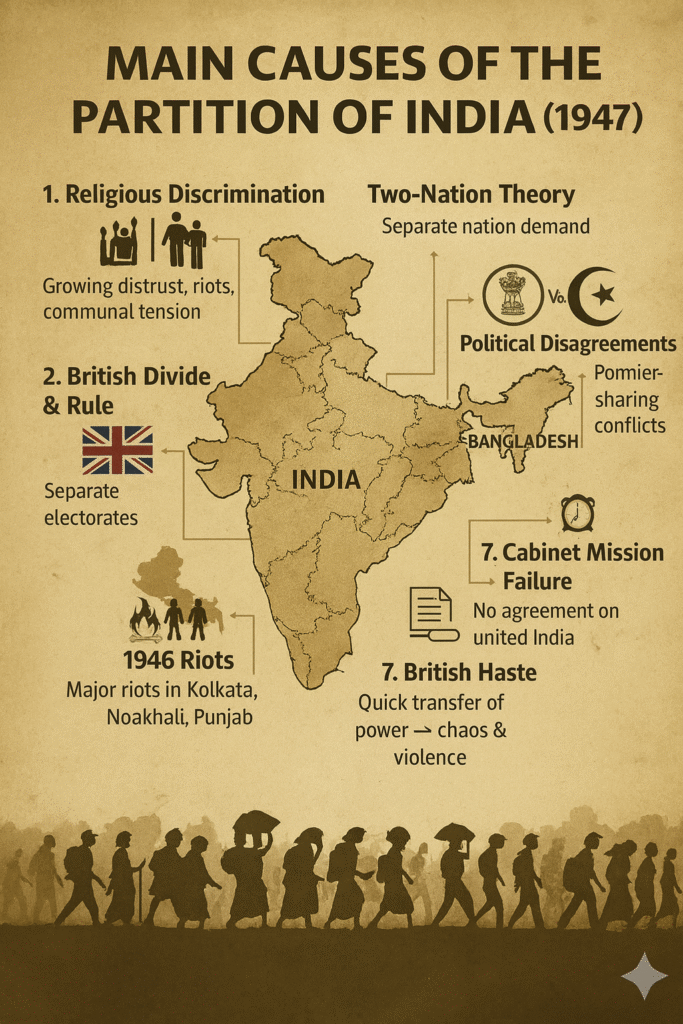
The Partition of India (1947) had many deep and complex causes. These causes were linked to political, religious, social, and colonial policies. The main causes of the Partition of India are detailed below:
Main Causes of the Partition of India
1. 🕌 Religious Discrimination and Communalism
- Growing religious distance between the Hindu and Muslim communities over the years.
- Distrust and fear between the two communities towards each other.
- Communal tensions and riots had been occurring continuously since the 19th century, which strengthened the feeling of a separate nation.
2. 🏛️ Muslim League and the Two-Nation Theory
- Mohammad Ali Jinnah and the Muslim League believed that Hindus and Muslims were two separate "nations."
- The Lahore Resolution of 1940 demanded the creation of Pakistan.
- According to the two-nation theory, Muslims have a distinct cultural, religious, and political identity, which cannot be preserved in a Hindu-majority India.
3. 🇬🇧 British Policy: 'Divide and Rule'
- The British deliberately weakened Hindu-Muslim unity.
- The Morley-Minto Reforms of 1909 and the Communal Award of 1932 introduced a religion-based electoral system.
- This encouraged communal politics and weakened unity.
4. ⚖️ Political Disagreements and Power Struggles
- Constant disputes between the Congress and the Muslim League over power sharing.
- Congress won a landslide majority in the 1937 elections, but the Muslim League did not achieve the expected success, leaving them dissatisfied.
- The Muslim League feared that Muslims would be discriminated against in independent India.
5. 🔥 Communal Riots of 1946 and Direct Action Day
- The Muslim League called for 'Direct Action Day' on August 16, 1946.
- Horrific communal riots broke out in Kolkata, Noakhali, Bihar, and Punjab.
- This violence shattered the last vestige of Hindu-Muslim unity.
6. 📜 Failure of the Cabinet Mission (1946)
- The British government made a last-ditch effort to keep India united, but agreement between the Congress and the Muslim League failed.
- The Muslim League rejected the plan and reiterated its demand for Pakistan.
7. ⏳ Britain's Haste and the Partition Plan
- Britain was economically weakened after World War II.
- It decided to transfer power from India as quickly as possible.
- Lord Mountbatten hastily implemented the Partition Plan (June 3, 1947), leading to increased violence and chaos.
Conclusion
The Partition of India was the result of numerous historical events, religious differences, political disagreements, and colonial maneuvers. It was not merely a geographical division, but also a symbol of deep social and emotional pain that affected the lives of millions.
The Role of Religious Differences in the Partition of India
Religious differences were one of the primary and decisive causes of the Partition of India (1947). The religious, cultural, and social differences that had grown over the years between the Hindu and Muslim communities laid the foundation for the division of India into two parts.
1. What Were the Religious Differences?
India was a multi-religious country, but Hindus and Muslims were the two largest communities.
- Different religious beliefs (Hindus were polytheistic, Muslims were monotheistic)
- Different customs, festivals, clothing, and food habits
- Different social structures and laws (such as Muslim Personal Law)
These differences were further exacerbated by political parties and colonial rule, rather than being unified.
2. Growing Distrust on Religious Basis
- Incidents such as cow slaughter and temple-mosque disputes led to communal tensions.
- The Muslim community feared that the Hindu majority would oppress them in independent India.
- The Hindu community feared and disagreed with the Muslim League's demand for a separate nation.
3. Communal Riots and Violence
- Hindu-Muslim riots began to increase after 1920—bloodshed occurred in Kolkata, Kanpur, Punjab, Bengal, and other regions.
- After Direct Action Day in 1946, terrible communal violence erupted, making partition inevitable.
4. The Muslim League and the Demand for a Religious Nation
- The Muslim League believed that Muslims were a “separate nation” with distinct religions, cultures, and political interests.
- Jinnah stated: “Hindus and Muslims are two separate nations; they cannot live together.”
- The two-nation theory became the ideological foundation of Pakistan.
Conclusion
Religious differences were not merely a matter of faith, but became a political weapon that communal organizations and the British government used to further their own interests. This religious difference became the primary reason for the most painful chapter in India's history—Partition.
The Muslim League's Demands and Its Role in the Partition of India
The Muslim League was one of the most prominent political forces in the Partition of India. Its demands and ideology shaped the decisive direction of India's partition in 1947.
1. Establishment of the Muslim League
- Establishment: December 30, 1906, Dhaka (Bengal)
- Objective: To pledge allegiance to the British and protect the political, religious, and social rights of Muslims.
- Early Leadership: Aga Khan, Nawab Salimullah, Mohsin ul Mulk, etc.
2. Evolution of the Muslim League's Demands
Early Period (1906–1930)
- Maintained distance from the Congress.
- Demanded separate electorates for Muslims (1909 – Morley-Minto Reforms).
- Supported the British government's Muslim-friendly policies.
Changes After 1930
- In 1930, Allama Iqbal envisioned a separate Muslim state.
- The Muslim League suffered defeat in the 1937 elections, raising fears of Muslim suppression in a Hindu-majority India.
3. Lahore Resolution (1940) – Demand for Pakistan
- Passed on March 23, 1940, at the Lahore session of the Muslim League.
- The resolution declared: “The Muslims of India are a separate nation and have the right to an independent state.”
- This marked the formal beginning of the demand for “Pakistan.”
4. Jinnah's Role and the Two-Nation Theory
- Jinnah transformed the Muslim League into a powerful political force.
- He stated: “Hindus and Muslims are two distinct nations. Their religion, culture, history, and lifestyle are different.”
- This belief became the ideological basis of the two-nation theory.
5. Direct Action Day (August 16, 1946)
- The Muslim League refused to recognize India as a single nation and called for direct action.
- This led to devastating riots in Kolkata and other cities.
6. Mountbatten Plan and Partition
- The Muslim League supported the Mountbatten Plan (June 3, 1947).
- Pakistan became an independent nation on August 14, 1947, and India on August 15, 1947.
Conclusion
The Muslim League's demand was not merely a political one; it was an ideological movement born out of concern for the separate identity, rights, and security of Muslims. This demand divided India into two parts and forever changed the lives of millions of people.

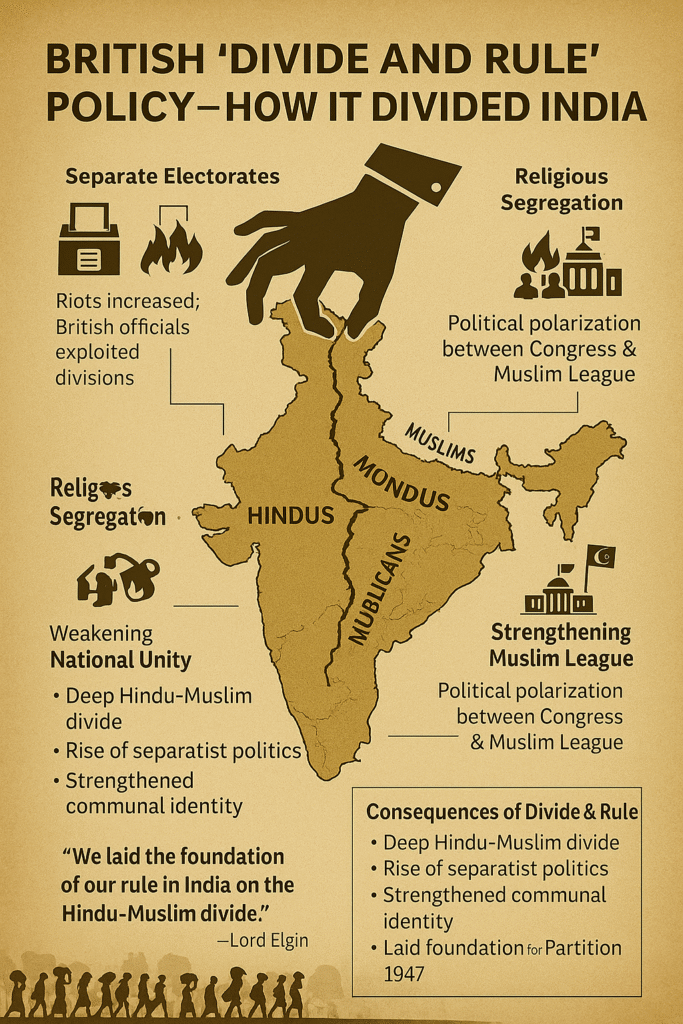
British 'Divide and Rule' Policy
"Divide and Rule" was a strategy used by the British Empire to rule over a long period of time by dividing Indian society along religious, ethnic, linguistic, and regional lines. This policy laid the groundwork for the Partition of India (1947) and created a deep rift in Hindu-Muslim relations.
1. Objective of the Policy
The British government's primary objective was:
“Divide Indians among themselves so that they could never unite and stand against British rule.”
- Created ideological and political divisions between Hindus and Muslims
- Promoted discrimination between Dalits and upper castes, Sikhs and Hindus, and other ethnic groups
2. How Was the Policy Used?
(a) Separate Electorates
- Morley-Minto Reforms of 1909:
- Muslims received separate voter lists and separate constituencies
- This gave the Muslim League political recognition and strengthened separateness
- Communal Award of 1932:
- Separate electorates granted to Dalits, Sikhs, and other minorities
- Gandhi signed the Poona Pact (1932) in protest
(b) Role in Communal Riots
- British officials often ignored riots instead of preventing them
- Sometimes secretly favored one community to incite another
(c) Religious Segregation in Institutions and Education
- Recruitment in schools, colleges, the army, and administration began on religious lines
- Example: Muslim soldiers recruited in the Bengal Army replacing Hindus
3. Consequences
- Hindu-Muslim unity seen in the 1857 Revolution gradually eroded
- Political polarization between the Muslim League and the Congress increased
- Religious identity became more powerful than nationalism
- Paved the way for the partition of India
4. Important Quotes
“We laid the foundation of our rule in India on the Hindu-Muslim divide.” — Lord Elgin
Conclusion
The British policy of 'divide and rule' deeply divided Indian society. It not only damaged India's unity but also paved the way for the Partition of 1947. This policy is considered one of the most cunning and destructive strategies of colonial imperialism.
The Role of Political Instability in the Partition of India
The Partition of India (1947) wasn't solely due to religious reasons; political instability was also a major factor. In the final years of British rule, disagreements between the Congress, the Muslim League, and the British government created an unstable political environment.
1. What Was Political Instability?
Political instability means:
“A situation in which there is a constant crisis in the formation, leadership, decision-making,
and cooperation of governments, leading to a breakdown of governance.”
This situation prevailed in Indian politics after 1940:
- Lack of trust between the Congress and the Muslim League
- Bias in decisions by the British
- Lack of clear direction and agreement in leadership
2. Main Causes of Political Instability
(a) Conflict Between the Congress and the Muslim League
- The Muslim League wanted to be recognized as the sole representative of Muslims
- Congress claimed it represented all Indians
(b) 1937 Provincial Elections
- Congress won a landslide victory
- The Muslim League felt Muslims would not receive fair representation
(c) Failure of the Cabinet Mission (1946)
- The British government's last attempt to keep India united
- Disagreement between Congress and the League over constitution and power-sharing
- The League rejected the mission and demanded “Pakistan Now or Never”
(d) Conflict in the Interim Government
- Included leaders of both Congress and Muslim League
- No cooperation; open conflict between Jinnah and Nehru
- Government failed to function properly
3. Consequences of Instability
- The constitution-making process stalled
- Communal tensions and riots increased
- The Muslim League declared Direct Action Day (1946), leading to mass violence
- British concluded partition was the only solution
Conclusion
Political instability played a decisive role in the partition of India. Lack of communication, lack of trust, and leadership failures pushed the country toward partition. This instability was not merely a leadership failure but the result of a deep, long-standing political conflict.
The 1946 Riots—Direct Action Day and Its Terrible Consequences
The communal riots of 1946, just before the Partition of India, were one of the most horrific and decisive events in Indian history. The violence began with the Muslim League's declaration of "Direct Action Day" on August 16, 1946, aimed at strongly advocating for Pakistan.
Background: The Demand for Pakistan and the Cabinet Mission
- The Cabinet Mission Plan (1946) was a last-ditch effort to keep India united.
- The Congress and the Muslim League could not agree on this plan.
- When the Muslim League felt that the demand for Pakistan was not being met, Jinnah declared:
“Now our only path is direct action.”
Direct Action Day — August 16, 1946
- The Muslim League planned this day as a “demonstration and show of strength.”
- Place: Calcutta (now Kolkata) — where a major Muslim League rally was held.
- Objective: To make the British and Congress realize the necessity of Pakistan.
What Happened on Direct Action Day?
1. Terrible Communal Riots (Kolkata Riots)
- From August 16th to 19th, massive violence erupted between Hindus and Muslims in Kolkata.
- Homes, shops, and religious sites were burned down by both sides.
- People were pulled off trains and killed; homes set on fire; women were raped.
2. Death and Destruction
- Approximately 5,000 people were killed
- More than 15,000 were injured
- More than 100,000 people were rendered homeless
This riot is known in history as the “Great Calcutta Killing.”
Noakhali and Bihar Riots (1946)
The violence of Direct Action Day did not stop in Kolkata—it spread to other regions:
Noakhali (East Bengal – now Bangladesh)
- In October 1946, large-scale attacks targeted Hindus.
- Thousands were killed, and women were tortured.
Bihar Riots
- In retaliation for the Noakhali violence, Hindus attacked Muslims in Bihar.
- Many Muslim settlements were burned.
Consequences
- The last remaining trust between Hindus and Muslims was destroyed.
- It became clear that the two communities no longer wished to live together.
- The British and Indian leaders realized that partition was inevitable.
Conclusion
The riots of 1946, especially Direct Action Day, served as an immediate precursor to India's partition. This violence laid the psychological and political groundwork for the division of India into two parts. These riots were not merely communal—they were also a political warning that if the demand for Pakistan was ignored, the country could plunge into even greater bloodshed.
The Process of Partition of India (1947)
The Partition of India was not a one-day event; rather, it was a political, administrative, and constitutional process that was implemented in a planned manner. This process began after the riots and political setbacks of 1946 and culminated in the formation of India and Pakistan as independent nations on August 14–15, 1947.
1. Background
- 1940: Muslim League's Lahore Resolution — demand for a separate Muslim nation
- 1946: Violence and communal tensions following Direct Action Day
- By early 1947, it became clear that India could no longer remain united
2. Mountbatten Plan (June 3, 1947)
The foundation stone for the Partition of India was laid through the "June 3 Plan" or "Mountbatten Plan."
- India would be divided on religious grounds.
- Provinces with mixed populations, such as Punjab and Bengal, would be divided based on voting.
- Both India and Pakistan would be Dominion states (members of the British Commonwealth).
- The existing Constituent Assembly would remain in India; a new Constituent Assembly would be formed for Pakistan.
3. Indian Independence Act (18 July 1947)
A law passed by the British Parliament that legally sanctioned the entire partition process.
- India and Pakistan would become two independent nations from August 15, 1947.
- British rule would end, and sovereignty would be granted to both countries.
- A Boundary Commission would be formed to partition Punjab and Bengal.
4. Boundary Commission
- Sir Cyril Radcliffe was appointed to demarcate boundaries.
- Radcliffe drew the borders in just five weeks, despite never having visited India before.
- Consequences:
- Many villages and towns were placed on the wrong side
- Millions discovered overnight that they were now in another country
- Mass violence broke out across the region
5. Population Migration and Violence
- Approximately 15 million people migrated between India and Pakistan along Hindu-Muslim-Sikh lines.
- An estimated 1 million people were killed.
- Abductions, rapes, murders, and discovery of dead bodies in train compartments became tragically common.
6. Declaration of Independence
- August 14, 1947: Birth of Pakistan (Muhammad Ali Jinnah becomes Governor General)
- August 15, 1947: India's Independence Day (Jawaharlal Nehru becomes Prime Minister)
Conclusion
The process of India's partition was completed through political agreement, legal framework, and administrative action — but it was accompanied by an immense human tragedy. This partition proved to be one of the most painful and decisive turning points in India's history.
3 June 1947 Plan (Mountbatten Plan / 3rd June Plan)
The 3 June 1947 Plan, also known as the "Mountbatten Plan," was the official plan for the partition of India. It was based on the creation of the two independent nations of India and Pakistan. The plan was presented by the British Viceroy, Lord Mountbatten.
Objective of the Plan
“Following the growing political crisis in India, communal riots, and the failure of a compromise between the Congress and the Muslim League, the British government decided to transfer power by dividing India.”
Key Points – Major Provisions of the June 3rd Plan
1. Partition of India Accepted
- Decision to divide India into two parts on religious grounds:
- India (Hindu majority)
- Pakistan (Muslim majority)
2. Freedom of Decision for Provinces
- Legislative Assemblies in Punjab, Bengal, Sindh, and NWFP were to vote on whether to join India or Pakistan.
- If provinces were divided, separate regional voting would take place.
3. Demarcation of Boundaries
- A "Boundary Commission" was established to demarcate the India–Pakistan border.
- Sir Cyril Radcliffe was appointed to draw the boundaries.
4. Two Independent Dominions
- India and Pakistan would become Dominion nations within the British Commonwealth.
- Both countries were allowed to form their own Constituent Assemblies.
5. Status of Princely States
- More than 500 princely states (Hyderabad, Kashmir, Junagadh, etc.) were allowed to join India, Pakistan, or remain independent.
6. Date Fixed
- Transfer of power was fixed for August 15, 1947.
Plan Announced
The plan was announced jointly on June 3, 1947, by British Prime Minister Clement Attlee, Lord Mountbatten, Nehru, Jinnah, and Sikh leader Baldev Singh.
Results
- The Indian Independence Act, 1947 was passed.
- India and Pakistan became two independent nations.
- Millions were displaced, and widespread communal violence occurred during the partition.
Conclusion
The June 3rd Plan was a pivotal moment in Indian history, giving India independence but also bringing the pain of Partition. Although the plan aimed to restore peace, it also resulted in human tragedy, riots, and the loss of millions of lives.
15 August 1947: India's Independence Day
15 August 1947 is the historic day when India gained independence from nearly 200 years of British colonial rule and emerged as an independent nation. This day is celebrated every year as Independence Day in India.
Significance of August 15, 1947
- End of British Rule: Marked the complete end of British colonial rule in India.
- Partition of India: Pakistan also became an independent nation on this day.
- Transfer of Power: British authority was transferred to Indian leaders.
- Formation of the Constituent Assembly: The drafting of the Indian Constitution began.
Major Events
In India 🇮🇳
- Pandit Jawaharlal Nehru delivered his iconic “Tryst with Destiny” speech at the Red Fort.
- India became a Dominion State (member of the British Commonwealth).
- Nehru became the first Prime Minister of independent India.
In Pakistan 🇵🇰
- Muhammad Ali Jinnah was sworn in as Pakistan's first Governor-General in Karachi.
- Pakistan became a new independent nation.
Challenges After Independence
- The Partition led to the displacement of nearly 15 million refugees.
- Widespread communal riots and violence affected millions.
- India faced the challenge of forming its own government, administrative system, and Constitution.
Nehru's Speech on August 15, 1947 (Tryst with Destiny)
“Today marks a new beginning for India, a dream and aspiration... Whatever India has achieved to date is the result of the yearning for freedom... We are now masters of our destiny.”
Conclusion
August 15, 1947, is a proud day in Indian history, bringing freedom but also marking the beginning of partition and human tragedy. This day reminds us of the price of freedom and the importance of unity as a nation.
Pakistan Was Divided into Two Parts
After the partition of India, Pakistan was divided into two geographically distinct parts. Understanding this division is important because it deeply influenced Pakistan's politics and history in the decades that followed.
Two Parts of Pakistan
1. West Pakistan
- The main part of present-day Pakistan.
- Included Punjab, Sindh, Balochistan, and NWFP (now Khyber Pakhtunkhwa).
- Located to the west of India.
2. East Pakistan
- Today's Bangladesh.
- The Muslim-majority part of the Bengal province, located east of India.
- Separated from West Pakistan by around 1,600 kilometers across the Bay of Bengal.
Why Was Pakistan Divided into Two Parts?
- Pakistan was created based on religious lines, but Muslim-majority areas were scattered across India.
- Muslim-majority regions of Bengal and Punjab were included in Pakistan.
- These two regions were not geographically connected—India lay between them.
Impact and Challenges
1. Political and Administrative Difficulties
- Administration was difficult due to the vast distance separating the two regions.
- Bengali Muslims lived in East Pakistan, while Punjabis, Sindhis, and Pashtuns lived in West Pakistan.
- Cultural and linguistic differences created further divisions.
2. Economic Inequality
- West Pakistan enjoyed greater political and economic power.
- People of East Pakistan felt economically and politically neglected.
3. The Ultimate Birth of Bangladesh (1971)
- Growing discontent in East Pakistan led to a liberation struggle.
- In 1971, East Pakistan became independent and was renamed Bangladesh.
In Brief
| West Pakistan | East Pakistan (Bangladesh) |
|---|---|
| Punjab, Sindh, Balochistan, NWFP | East Bengal (Bangladesh) |
| Located to the west of India | Located east of India across the Bay of Bengal |
| Political and economic center | Cultural and linguistic differences |
| Later known simply as Pakistan | Became independent in 1971 as Bangladesh |
If you would like, I can create a presentation on this topic with more detailed notes, a timeline, or maps.
Consequences of the Partition of India
The Partition of India had profound and wide-ranging consequences, affecting society, politics, and the economy—not only at the time but for decades to come.
1. Human Tragedy and Displacement
- More than 15 million people were forced to flee their homes.
- Large numbers of Hindu, Muslim, and Sikh communities became refugees between India and Pakistan.
- More than 1 million people died during the exodus.
- Kidnapping, rape, and atrocities against women increased.
2. Communal Violence
- After the Partition, massive communal riots broke out in both India and Pakistan.
- Thousands of villages and towns were burned.
- Deep tension and animosity grew between the two countries.
3. Political and Administrative Impacts
- India and Pakistan became two independent nations.
- Both countries had to form their own governments, constitutions, and administrative systems.
- Distance and disputes increased between East and West Pakistan.
4. Economic Losses
- The economies of both countries were affected.
- Trade routes were closed.
- Many industries, agricultural areas, and assets were divided.
- Both nations faced significant economic challenges.
5. Social Impact
- The social structure of India and Pakistan changed drastically.
- Communities were separated along religious lines.
- Massive efforts were made to rehabilitate refugees and restore social harmony.
6. Future Conflicts and Tensions
- The Kashmir dispute began and continues to this day.
- Led to multiple wars and conflicts between India and Pakistan.
- Political tensions and mistrust increased between the two nations.
In Summary
| Type | Consequences |
|---|---|
| Humanitarian | Millions displaced, mass deaths, atrocities |
| Communal | Large-scale riots and violence |
| Political | Two nations formed; new governments; new disputes |
| Economic | Trade disruption, divided resources, losses |
| Social | Social divide, refugee crisis |
| Long-term | Kashmir issue, enduring India-Pakistan conflict |
Population Migration — During the Partition of India
The most significant and painful consequence of the Partition of India was the massive displacement or migration of population. It is considered the largest mass migration in Indian history.
What Was Population Migration?
- After Partition, Hindus, Sikhs, and Muslims migrated between India and Pakistan based on religion.
- Muslims migrated from India to West and East Pakistan.
- Hindus and Sikhs migrated from Pakistan to India.
Statistics and Facts
| Migrant Group | Number (Approx.) |
|---|---|
| Muslims from India to Pakistan | 7–8 lakh |
| Hindus & Sikhs from Pakistan to India | 10–12 lakh |
| Total displaced | Approximately 15 million people |
Problems During Migration
- Violence and riots — attacks, massacres, rape, and torture.
- Train atrocities — thousands died on refugee trains.
- Homelessness — millions left without shelter, food, or clothing.
- Abduction and assault of women on both sides.
Major Routes of Migration
- Large-scale migration occurred between Punjab and Sindh.
- Many Muslims migrated from East Bengal to East Pakistan.
- Refugee camps were established throughout India.
Consequences
- A widespread humanitarian crisis unfolded.
- The social fabric of both nations was torn apart.
- Tensions and hostility between India and Pakistan increased.
- Both nations had to undertake massive efforts to rehabilitate refugees.
In Brief
| Subject | Description |
|---|---|
| Population Displacement | Approximately 15 million people forced to flee |
| Cause | Formation of new nations based on religion |
| Problems | Violence, torture, refugee crisis |
| Effects | Social breakdown, long-term tensions |
Violence and Riots—During the Partition of India
The violence and riots that occurred during the Partition of India made this historic event extremely tragic and painful. This violence was primarily based on religious grounds, with fierce conflict between Hindu, Muslim, and Sikh communities.
Causes of Violence and Riots
- Religious and Communal Tensions: Long-standing religious differences escalated during Partition.
- Divide and Rule Policy: British policies further widened communal divides.
- Population Migration: Mass migration increased insecurity and fear.
- Political Instability: Power struggles led to higher tensions.
- Ambiguity in Boundary Demarcation: Hasty border decisions caused chaos.
Nature of the Riots
- Villages, towns, and cities were burned.
- Thousands were killed in mass violence.
- Abduction and rape of women were widespread.
- Families were separated; homes destroyed.
- Trains turned into “trains of blood.”
Major Riots and Violent Incidents
| Incident | Place | Time | Details |
|---|---|---|---|
| Direct Action Day | Bengal, Calcutta | August 1946 | Muslim League riots |
| Punjab Riots | Punjab Province | 1947 | Widespread communal violence |
| Bengal Partition Riots | Bengal | 1947 | Hindu-Muslim conflict |
| Delhi Riots | Delhi | 1947 | Violence during displacement |
Impact of the Riots
- Millions of people were killed or injured.
- The social fabric of many communities was destroyed.
- People lost homes, property, and livelihoods.
- The refugee crisis worsened significantly.
- Tension and hostility between India and Pakistan escalated.
Conclusion
The violence and riots of the Partition of India overshadowed the joy of independence and led to one of the worst human tragedies in history. This dark chapter reminds us of the need for communal harmony and peace.
Refugee Crisis—After the Partition of India
One of the most serious problems after the Partition of India was the refugee crisis. Millions of people left their homes and became refugees in the new nations, causing a widespread humanitarian and social crisis.
What Was the Refugee Crisis?
- Hindus, Sikhs, and Muslims began migrating to their new nations after Partition.
- Millions arrived unprepared, without basic necessities.
- People lacked housing, employment, clean water, and food.
Refugee Crisis Statistics
| Country | Number of Refugees (Approx.) |
|---|---|
| India (from Pakistan) | 7–8 million |
| Pakistan (from India) | 5–6 million |
Refugee Problems
- Housing crisis: Many refugees lived under the open sky or in temporary camps.
- Food and health issues: Lack of food and sanitation caused diseases.
- Unemployment: Lack of jobs increased hunger and poverty.
- Social tensions: Conflicts arose between locals and refugees.
- Women’s safety: Violence and harassment against women increased.
Rehabilitation Efforts
- India and Pakistan established temporary camps and colonies for refugees.
- National and international aid organizations provided relief.
- Over time, many refugees settled and rebuilt their lives.
Impact of the Refugee Crisis
- Social structures changed drastically.
- The economic burden increased in both India and Pakistan.
- Displacement deepened hostility between the two nations.
In Summary
| Problem | Description |
|---|---|
| Displacement | Millions fleeing without preparation |
| Housing | Living in temporary camps |
| Food & Health | Lack of food, sanitation, and rise of diseases |
| Employment | No jobs in the new locations |
| Social Tensions | Conflicts between locals and refugees |
The Kashmir Dispute—India-Pakistan's Longest and Most Complex Conflict
The Kashmir dispute is a central and sensitive issue between India and Pakistan, which has consistently caused tensions and wars between the two countries since the Partition of 1947.
Geographic and Political Perspective of Kashmir
- Kashmir is a mountainous region stretching across Jammu, the Kashmir Valley, and Ladakh.
- At the end of British rule in 1947, Kashmir was a princely state with a Hindu ruler, but a Muslim-majority population.
- Maharaja Hari Singh had to decide whether to join India or Pakistan.
Origin of the Dispute
- In October 1947, Pakistan-backed tribal raiders attempted to seize Kashmir.
- Maharaja Hari Singh sought help from India and signed the Instrument of Accession.
- This triggered the first India-Pakistan war (1947–48).
Major Events
| Year | Event |
|---|---|
| 1947 | King of Kashmir accedes to India |
| 1947–48 | First India-Pakistan War |
| 1949 | United Nations mediation; Line of Control (LoC) established |
| 1965 | Second India-Pakistan War |
| 1999 | Kargil War |
United Nations Resolution
- In 1949, the UN proposed that both sides withdraw troops and hold a referendum.
- Pakistan agreed to withdraw, but India insisted on obligations being met before a referendum.
- The referendum has not been conducted to date.
Reasons for the Dispute
- Geographical and strategic importance: Kashmir’s location is vital for military and water resources.
- Religious basis: Muslim-majority region ruled by a Hindu leader.
- Political claims: Both India and Pakistan claim Kashmir as integral territory.
- Communal differences: Religious and regional identities intensified tensions.
Consequences and Impact
- Multiple wars and military conflicts between India and Pakistan.
- Millions affected; lives lost; region remains unstable.
- Strained diplomatic relations between the two nations.
- Ongoing security challenges and political instability in Kashmir.
In Brief
| Aspect | Description |
|---|---|
| Location | Jammu and Kashmir State |
| Causes of Dispute | Political, Religious, and Geographical Issues |
| Key Events | Wars of 1947, 1965, 1999 |
| UN Resolution | Laydown of arms and referendum proposal |
| Current Status | Divided by the Line of Control; tensions continue |
The Partition of India and Important Figures
Many leaders and thinkers played a role in the Partition of India, influencing this historic event with varying views and objectives. Here are some key figures who played a significant role in the process, causes, and consequences of Partition.
1. Mahatma Gandhi
- Role: Advocate of nonviolence and communal harmony.
- Thoughts: Opposed Partition and worked for Hindu-Muslim unity.
- Efforts: Fasting and peace missions to reduce violence.
2. Jawaharlal Nehru
- Role: Congress leader, first Prime Minister of India.
- Thoughts: Wanted unity but accepted Partition.
- Efforts: Helped establish independent India's government.
3. Muhammad Ali Jinnah
- Role: Leader of the Muslim League; founder of Pakistan.
- Idea: Demanded a separate nation for Muslims.
- Efforts: Pressured for Pakistan and became first Governor-General (1947).
4. Lord Mountbatten
- Role: Last British Viceroy.
- Idea: Oversaw independence and partition process.
- Efforts: Planned and executed the transfer of power in 1947.
5. Sir Syed Ahmed Khan
- Role: Pioneer of Muslim revival.
- Idea: Promoted education and political awareness among Muslims.
- Impact: Strengthened Muslim identity; foundation for Muslim League’s demands.
6. Sardar Vallabhbhai Patel
- Role: Congress leader; first Home Minister of India.
- Ideas: Wanted to keep India united.
- Efforts: Integrated princely states after Partition.
7. Allama Iqbal
- Role: Poet and philosopher.
- Ideas: Proposed the concept of Pakistan.
Summary
| Name | Role | Contribution/Influence |
|---|---|---|
| Mahatma Gandhi | Leader of nonviolence; unity advocate | Opposed Partition; worked for communal harmony |
| Jawaharlal Nehru | Congress leader, first PM | Advocated unity; established independent India |
| Muhammad Ali Jinnah | Muslim League leader | Founder of Pakistan; demanded separate nation |
| Lord Mountbatten | Last British Viceroy | Oversaw independence and partition |
| Sir Syed Ahmed Khan | Muslim revivalist | Raised political awareness of Muslims |
| Sardar Vallabhbhai Patel | First Home Minister of India | Unified India; merged princely states |
| Allama Iqbal | Thinker, poet | Conceptualized idea of Pakistan |
Mahatma Gandhi — Great Leader of India's Partition and Freedom Struggle
Full name: Mohandas Karamchand Gandhi
Nickname: Bapu, Mahatma Gandhi
Born: October 2, 1869, Porbandar, Gujarat
Died: January 30, 1948, New Delhi
Biography of Mahatma Gandhi
Gandhiji was a great leader, thinker, and pioneer of the freedom struggle, who promoted non-violence and the principles of Satyagraha. He played a crucial role in India’s independence from British rule.
Mahatma Gandhi's View on the Partition of India
- Believed that India's unity was essential and all religions should coexist peacefully.
- Strongly opposed Partition and worked tirelessly for Hindu-Muslim unity.
- Deeply saddened by communal violence and loss of life during Partition.
- Organized several fasts, including the 1947 fast, to stop riots.
Gandhiji's Main Principles and Efforts
| Principle | Description |
|---|---|
| Non-violence | A method of achieving freedom without violence |
| Satyagraha | Fighting for rights through truth |
| Swaraj | Self-rule and self-reliance |
| Communal harmony | Brotherhood among all religions |
Contributions of Mahatma Gandhi
- Key role in the Quit India Movement (1942).
- Worked for Hindu-Muslim unity, often at personal risk.
- Worked for peace and rehabilitation after Partition.
- Mobilized people and fought for their rights during freedom struggle.
Death of Mahatma Gandhi
Gandhiji was assassinated by Nathuram Godse on January 30, 1948. His death led to widespread shock and grief across India.
Mahatma Gandhi's Place in History
Gandhiji is known as the "Father of the Nation" and remains a global symbol of peace and nonviolence. His thoughts and ideals continue to inspire millions around the world.
Pandit Jawaharlal Nehru — India's First Prime Minister and Freedom Fighter
Full name: Jawaharlal Nehru
Born: November 14, 1889, Allahabad, British India
Died: May 27, 1964, New Delhi, India
Biography of Pandit Nehru
Nehru was a prominent leader in the Indian independence movement and became the first Prime Minister of independent India. A leading member of the Congress Party and a close associate of Mahatma Gandhi, Nehru played a central role in building the foundation of India’s development, modernity, and democracy.
Nehru's Role in the Partition of India
- As Congress President, Nehru emphasized India's unity.
- He opposed Partition but ultimately accepted it due to political circumstances.
- As the first Prime Minister, he focused on stability, development, and reconstruction.
- Handled the refugee crisis and rebuilding efforts after Partition.
Nehru's Key Ideas and Ideals
| Topic | Description |
|---|---|
| Democracy | Making India a democratic republic |
| Modernity | Promoting science, technology, and industry |
| Secularism | Equal respect for all religions |
| Social reform | Eradication of untouchability and promoting education |
| Economic planning | Development through five-year plans |
Nehru's Contributions
- Introduced political, social, and economic reforms.
- Led the Constituent Assembly, making India a republic.
- Adopted neutrality in global politics (Non-Alignment Movement).
- Established key institutions like IITs, AIIMS, UGC, DRDO, etc.
Nehru's India After Partition
- Focused on refugee rehabilitation and national integration.
- Worked on peaceful relations despite tensions with Pakistan.
- Handled the Kashmir dispute through diplomacy and military action.
Conclusion
Pandit Nehru was a leading figure in India's freedom struggle and the architect of modern India. He is remembered for unifying a diverse nation and leading it toward development and progress.
Mohammad Ali Jinnah – Founder of Pakistan and Leader of the Muslim League
Full Name: Mohammad Ali Jinnah
Born: December 25, 1876, Karachi (now Pakistan)
Died: September 11, 1948, Karachi, Pakistan
Biography of Jinnah
Mohammad Ali Jinnah was a prominent political leader and lawyer who fought for the rights of Muslims in India. As the leader of the Muslim League, he is regarded as the “founding father” of Pakistan. Jinnah demanded a separate nation where Muslims could protect their religious and cultural identity.
Jinnah's Role in the Partition of India
- Transformed the Muslim League into a strong political voice for Muslims.
- Strongly advocated the creation of a separate Muslim nation—Pakistan.
- Demanded partition so Muslims could preserve their identity.
- Introduced the Lahore Resolution (1940), demanding Pakistan.
- Became Pakistan’s first Governor-General after the Partition.
Jinnah's Key Ideas and Beliefs
| Topic | Description |
|---|---|
| Muslim separatism | Demand for a distinct Muslim identity and political independence |
| Dream of Pakistan | A nation where Muslims have political and cultural safeguarding |
| Rational leadership | Achieved goals through legal, constitutional, and political struggle |
Jinnah's Influence and Contributions
- Strengthened the political rights of Muslims.
- Played a central role in the Partition of India.
- Paved the way for the formation of Pakistan.
- Transformed the Muslim League into a powerful political force.
After Jinnah
- Jinnah’s death in 1948 caused political instability in Pakistan.
- His political and ideological influence continues in Pakistan.
- He is still honored as a great leader and nation-builder.
Summary
| Aspect | Details |
|---|---|
| Born | December 25, 1876 |
| Main Role | Leader of the Muslim League; Founder of Pakistan |
| Main Contribution | Political movement for Pakistan |
| Died | September 11, 1948 |
Lord Mountbatten—Last British Viceroy and Key Representative of India's Independence
Full Name: Louis Francis Mountbatten, 1st Earl of Burma
Born: June 25, 1900, Britain
Died: August 27, 1979, Britain
Introduction to Lord Mountbatten
Lord Mountbatten was the last Viceroy of the British Empire, overseeing India's independence from British rule and the partition of India and Pakistan. He was appointed to manage the process of independence in 1947.
Mountbatten's Role in India's Partition
- In 1947, Britain appointed Mountbatten as the last Viceroy to oversee India's independence.
- He presented the Mountbatten Plan (June 3, 1947), outlining the partition of India and Pakistan.
- He set the final date of Partition — August 15, 1947.
- Acted as a mediator between the Congress, Muslim League, and other political groups.
- Accelerated the transfer of power, bringing an end to British rule.
Mountbatten's Challenges and Tasks
| Task/Challenge | Description |
|---|---|
| Creating the Partition Plan | Creating the two nations of India and Pakistan |
| Communal Violence | Attempting to control widespread violence during Partition |
| Transfer of Power | Ensuring a smooth political transition from British rule |
| Merging the Princely States | Integrating over 500 princely states into India or Pakistan |
Impact of Mountbatten's Decisions
- Hasty decisions often intensified communal violence and chaos.
- The partition plan led to the creation of the Line of Control (LoC).
- Although independence was achieved, the rushed transfer caused humanitarian crises.
Mountbatten's Later Life
- After leaving India, he held several positions in the British government and military.
- He was assassinated in an IRA bombing in 1979.
Summary
| Facebook Details | Information |
|---|---|
| Born | June 25, 1900 |
| Role | Last British Viceroy |
| Main Contribution | Planning India's Partition and Independence |
| Died | August 27, 1979 |
Conclusion: The Partition of India
The Partition of India in 1947 was one of the greatest political and social events in history. Alongside independence, it was also a tragedy that claimed millions of lives and displaced millions more.
Key Points
- Causes of Partition: Religious differences, political conflict, British partition policy, Muslim League’s demand for Pakistan, and India’s political instability.
- Process: India was divided into two nations—India and Pakistan—through rapid British planning and decisions of political leaders.
- Consequences: Violence, riots, refugee crisis, and lasting communal tensions.
- Role of Key Figures: Leaders like Gandhi, Nehru, Jinnah, and Mountbatten shaped the course of events.
- Legacy: Tensions between India and Pakistan continue, particularly over Kashmir.
Final Thoughts
The Partition of India profoundly shaped the history of the Indian subcontinent. It reminds us of the importance of secularism, tolerance, and unity. Even today, we must learn from this tragedy and work towards maintaining social harmony and national unity.
