
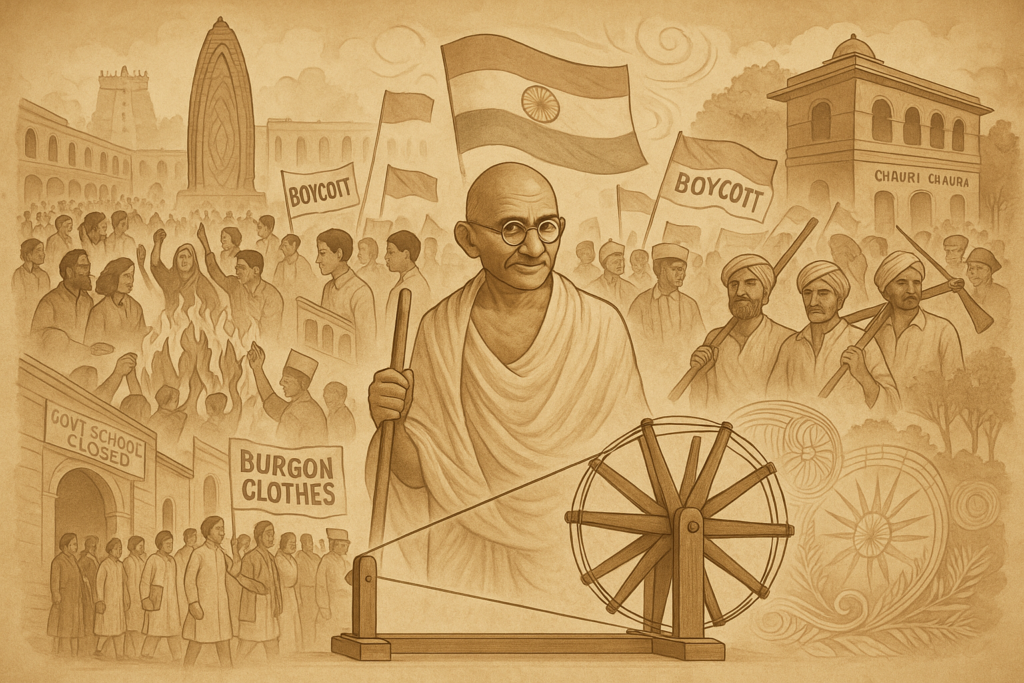
The Non-Cooperation Movement (1920–1922)
The Non-Cooperation Movement was an important phase of the Indian freedom struggle, launched by Mahatma Gandhi on 1 August 1920. Its aim was to protest against the British government through peaceful and non-violent methods so that India could ultimately achieve Swaraj (self-rule). The movement inspired the Indian people to refuse cooperation with British rule.
Reasons for the Non-Cooperation Movement
Jallianwala Bagh Massacre (1919)
This brutal massacre created widespread anger among the Indian people.
Rowlatt Act (1919)
This law allowed arrests without trial, leading to nationwide discontent and protest.
Khilafat Movement
The movement, launched in support of the Caliph, encouraged Gandhiji to promote Hindu-Muslim unity.
Discontent Against British Policies
Heavy taxes, discriminatory policies, and economic exploitation also fueled widespread dissatisfaction.
Main Objectives of the Non-Cooperation Movement
✔ Comfortable & easy to use daily
✔ Excellent performance & value
✔ Well-liked by Amazon customers
- Complete non-cooperation with British rule.
- Boycott of government jobs, courts, schools, and foreign clothes.
- Promotion of Indian institutions and indigenous products.
- Public awakening through non-violent protest to achieve Swaraj.
Main Events of the Movement
Resignation from Government Posts
People resigned from educational institutions, government jobs, and legislative bodies.
Boycott of Foreign Clothes
Foreign clothes were burned publicly, and the use of Khadi was widely adopted.
Promotion of the Swadeshi Movement
Swadeshi goods and industries were encouraged to strengthen local production.
Support from Farmers and Workers
Farmers in Bihar, Uttar Pradesh, Punjab, and Bengal refused to pay taxes and protested against British policies.
Chauri Chaura Incident (1922)
On 4 February 1922, at Chauri Chaura in Gorakhpur, protesters set fire to the local police station, resulting in the death of several policemen. Shocked by this violent turn, Gandhiji immediately called off the movement because he firmly opposed any form of violence.
Results and Impact
- The movement gave a new direction to the Indian freedom struggle.
- It strengthened people’s self-confidence and deepened the idea of Swaraj.
- Gandhiji established himself as a national leader.
- The British government became increasingly fearful of the unity and rising awareness among Indians.
Conclusion
The Non-Cooperation Movement was a milestone in the Indian freedom struggle. It widely spread political consciousness and reinforced the principle of non-violence. Although the movement did not fully achieve its intended goals, it strengthened the foundation for India’s eventual independence.