
Maratha Empire
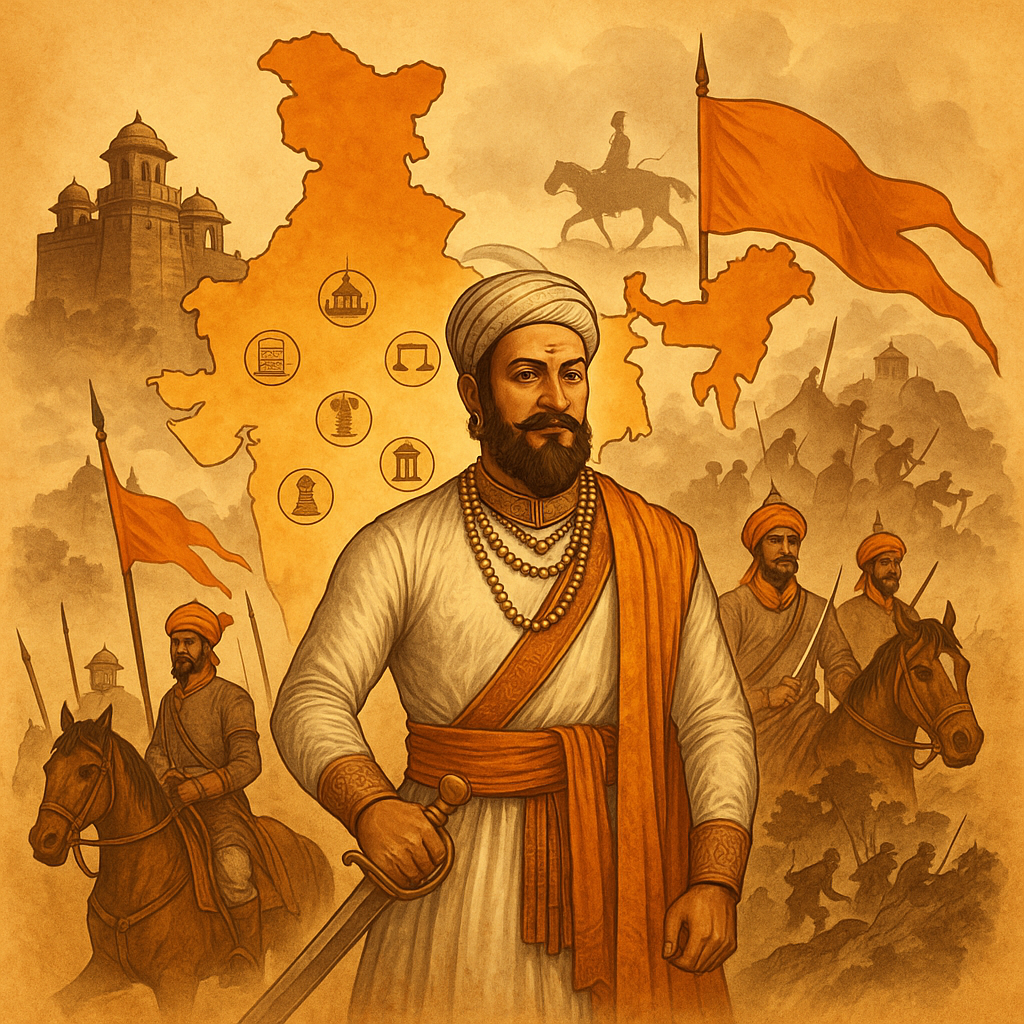
The Maratha Empire is an important chapter in the history of India, which had a profound impact on Indian politics, culture, and society in the 17th and 18th centuries. The empire was founded in 1674 by Chhatrapati Shivaji Maharaj and expanded from South India to Northern India. The Maratha Empire became renowned for its efficient administration, military strategies, and the spirit of Hindavi Swaraj (indigenous rule).
Establishment of the Maratha Empire
Chhatrapati Shivaji Maharaj laid the foundation of the Maratha Empire in the 17th century while fighting against the Adilshahi and Mughal powers.
Contribution of Shivaji Maharaj
- He was crowned at Raigad in 1674 and declared himself Chhatrapati.
- Shivaji established the administrative structure called the Ashtapradhan Mandal, consisting of eight chief ministers managing various departments.
- He strengthened the empire by building forts and adopting the guerrilla warfare strategy known as Ganimi Kava.
Administrative System
The administrative system of the Maratha Empire was efficient and well-organized.
Ashtapradhan Mandal
The state’s administration was divided among eight ministers:
- Peshwa (Prime Minister)
- Amatya (Finance Minister)
- Mantri (Political Advisor)
- Senapati (Military Chief)
- Sumant (Foreign Minister)
- Nyayadhish (Judicial Head)
- Panditrao (Head of Religious Affairs)
- Sachiv (Administrative Officer)
Chauth and Sardeshmukhi
The Marathas introduced two important taxation systems:
- Chauth – one-fourth of the revenue collected from the region.
- Sardeshmukhi – a tax levied on property.
Expansion of the Maratha Empire
After the death of Shivaji Maharaj, his successors Sambhaji, Rajaram, and Tarabai carried forward the empire. However, the major expansion occurred in the 18th century under Peshwa Balaji Vishwanath and his descendants.

Contribution of the Peshwas
- The Peshwas extended Maratha influence to Central and Northern India.
- The Maratha performance in the Third Battle of Panipat (1761) against Ahmed Shah Abdali was historic, though it ended in defeat.
Military Strength
The military strength of the Maratha Empire lay in their strategic brilliance and guerrilla warfare techniques. Their army included infantry, cavalry, and artillery. They also developed a navy to ensure maritime security.
Cultural and Social Impact
The Maratha Empire enriched Indian Culture through religious tolerance and the construction of temples, forts, and reservoirs. Their governance and cultural contributions influenced various regions of India.
Causes of Collapse
The decline of the Maratha Empire was the result of internal and external challenges:
- The empire weakened significantly after the Third Battle of Panipat.
- Defeat in the Maratha-Anglo Wars against the British led to the end of the empire.
- Internal conflicts and power struggles among regional leaders weakened unity.
Conclusion
The Maratha Empire occupied an important place in Indian History not only politically, but also culturally, socially, and administratively. It stood as a symbol of Indian independence, strength, and self-reliance.
Establishment of the Maratha Empire
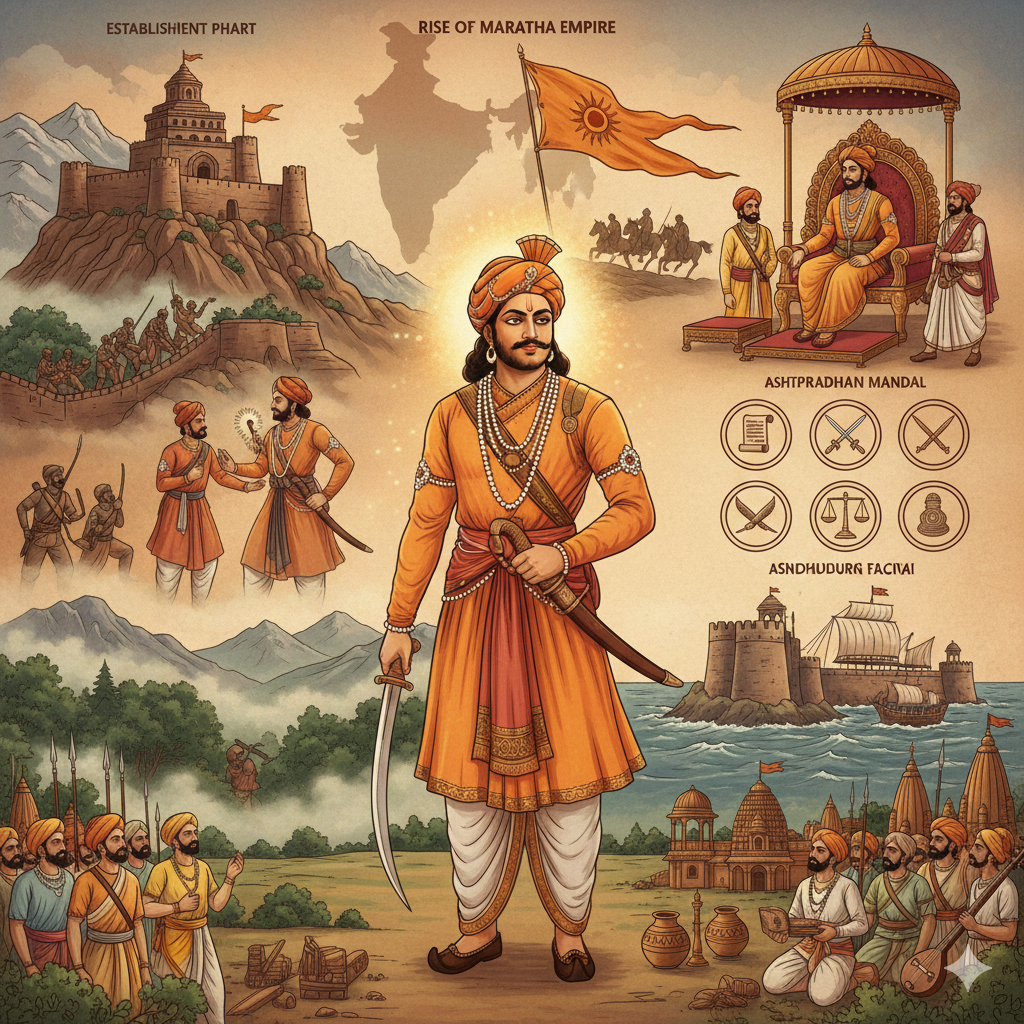
The establishment of the Maratha Empire is an important event in the History of India, initiated by Chhatrapati Shivaji Maharaj in the 17th century. Its foundation was laid at a time when powerful empires like the Mughals, Adilshahi, and Nizamshahi dominated India. Shivaji Maharaj established the Maratha Empire through his courage, intelligence, and efficient administrative policies.
Background of the Establishment of the Maratha Empire
Geographical Location and Situation
- The Western Ghats (Sahyadri Mountains) of Maharashtra were full of inaccessible hills and dense forests, providing strategic security.
- The region was a battleground of power struggles between the Mughals and the Adilshahi, offering Shivaji an opportunity to unify smaller states.
Early Life of Shivaji Maharaj
- Shivaji was born in Shivneri Fort on 19 February 1630. His father, Shahaji Bhosale, served as a general in the Bijapur Sultanate, and his mother, Jijabai, was a religious and courageous woman.
- Jijabai instilled values of independence and self-respect in Shivaji from childhood.
Inspiration and Ideals
- Shivaji drew inspiration from the Ramayana, Mahabharata, and Indian History.
- He began working with the vision of establishing indigenous rule, known as Hindavi Swaraj.
Main Stages of the Establishment of the Maratha Empire
1. Capture of the First Forts (1645–1655)
- Shivaji captured the Torna Fort in 1645—his first significant conquest.
- He later captured Raigad, Purandar, and other forts, making them the base of his power.
- During these campaigns, he utilized the guerrilla warfare method known as Ganimi Kava.
2. Struggle Against Adilshahi
- Shivaji launched a rebellion against the Adilshahi Sultanate of Bijapur.
- In 1659, Afzal Khan led a massive Adilshahi army to suppress Shivaji, but Shivaji defeated him through tactical strategy at Pratapgad.

3. Struggle Against the Mughal Empire
- Shivaji began resisting Mughal ruler Aurangzeb’s expansionist policies.
- In 1664, he attacked Surat and collected wealth, which strengthened the Maratha army financially.
- Shivaji captured several forts from the Mughals and declared independence.
4. Coronation (1674)
- On 6 June 1674, Shivaji declared himself “Chhatrapati” and formally established the Maratha Empire.
- After his coronation, he emphasized the concept of Hindavi Swaraj, representing independent and indigenous rule.
5. Administrative Reforms
- Shivaji created a strong administrative structure and established the Ashtapradhan Mandal, appointing ministers for different departments.
- He improved the revenue system, judicial structure, and army organization.
Main Reasons for the Establishment of the Maratha Empire
- Efficient Leadership: Shivaji Maharaj’s strategic thinking and leadership offered a strong foundation for the empire.
- Guerrilla Warfare: The Ganimi Kava strategy enabled the Marathas to defeat larger enemy forces.
- Support of Local People: Shivaji earned the trust of peasants, traders, and common citizens, who became the backbone of his movement.
- Geographical Advantage: The rugged hills and forts of the Sahyadris provided natural defense to the Maratha Empire.
Conclusion
The establishment of the Maratha Empire was not merely a political development but a symbol of self-respect, independence, and indigenous governance. With unmatched courage and resourcefulness, Chhatrapati Shivaji Maharaj laid the foundation of an empire that left a profound impact on all of India, not just the South. His contribution remains inspiring and unparalleled in Indian history.
Chhatrapati Shivaji Maharaj
Chhatrapati Shivaji Maharaj was one of the greatest rulers in Indian History, who established the Maratha Empire with his skill, foresight, and courage. His contribution was not limited to the expansion of the Maratha Empire; he also played an important role in shaping Indian culture, the Administrative System, and military strategies.
Contribution of Shivaji Maharaj
1. Establishment of Hindavi Swaraj
- Shivaji Maharaj realised the concept of Hindavi Swaraj, meaning indigenous rule.
- He established an independent Maratha Empire to free Indians from the control of foreign rulers.
- He fought for self-respect and freedom, inspiring new energy within Maratha society.
2. Guerrilla Warfare System (Ganimi Kava)
- Shivaji developed an effective guerrilla warfare system known as Ganimi Kava.
- This strategy included surprise attacks, strategic withdrawals, and use of difficult terrain.
- Through this system, he defeated the armies of Adilshahi, Nizamshahi, and the Mughals.
3. Military Organization
- Shivaji organised and strengthened the Maratha army.
- He established infantry, cavalry, and also a strong navy.
- He was among the first Indian rulers to develop a navy for maritime security.
- He built sea forts such as Sindhudurg and Vijaydurg to protect coastal regions and trade routes.
4. Administrative Reforms
- Shivaji established an efficient and well-organised administrative system.
- He formed the Ashtapradhan Mandal, consisting of eight ministers responsible for various departments:
- Peshwa – Prime Minister
- Amatya – Finance Minister
- Sumant – Foreign Minister
- Senapati – Military General
- Mantri – Home Minister
- Panditrao – Head of Religious Affairs
- Nyayadhish – Head of the Judicial System
- Sachiv – Administrative Officer
- He improved the tax system and started collecting revenue directly from farmers, reducing exploitation.
5. religious tolerance
- Shivaji Maharaj strongly supported religious tolerance.
- He respected all religions and included Muslim soldiers and officers in his army.
- He never harmed any place of worship.
6. Construction and Use of Forts
- Shivaji built or rebuilt nearly 300 forts, which became the backbone of his military strategy.
- Major forts include Raigad, Sindhudurg, Pratapgad, and Purandar.
- These forts served not only as military bases but also as administrative centres.
7. Economic Reforms
- Shivaji introduced several reforms to strengthen the empire’s economy.
- He implemented the Chauth and Sardeshmukhi tax systems.
- He protected merchants and farmers and ensured their rights were safeguarded.
8. Resistance to Foreign Invaders
- Shivaji successfully confronted powerful forces such as the Mughal Empire, Adilshahi, and Nizamshahi.
- He defeated many foreign invaders and weakened their control in India.
- He strengthened Indian rule in the Indian subcontinent.
9. Coronation and Cultural Contributions
- Shivaji was coronated at Raigad Fort on 6 June 1674, where he assumed the title of Chhatrapati.
- He promoted Marathi language, literature, and culture.
- He supported temples and cultural heritage across his empire.
10. Safety of Women and Farmers
- Shivaji respected women greatly and punished crimes against them strictly.
- He protected farmers and labourers, taking strong measures against their exploitation.
Conclusion
Chhatrapati Shivaji Maharaj’s contribution to Indian History is unique and inspiring. He not only established a powerful empire but also developed an administrative and military system that stood unmatched in the Indian subcontinent. His ideology, leadership, and courage made him a remarkable ruler whose legacy continues to symbolize freedom, self-respect, and national pride.
Administrative System of Chhatrapati Shivaji Maharaj
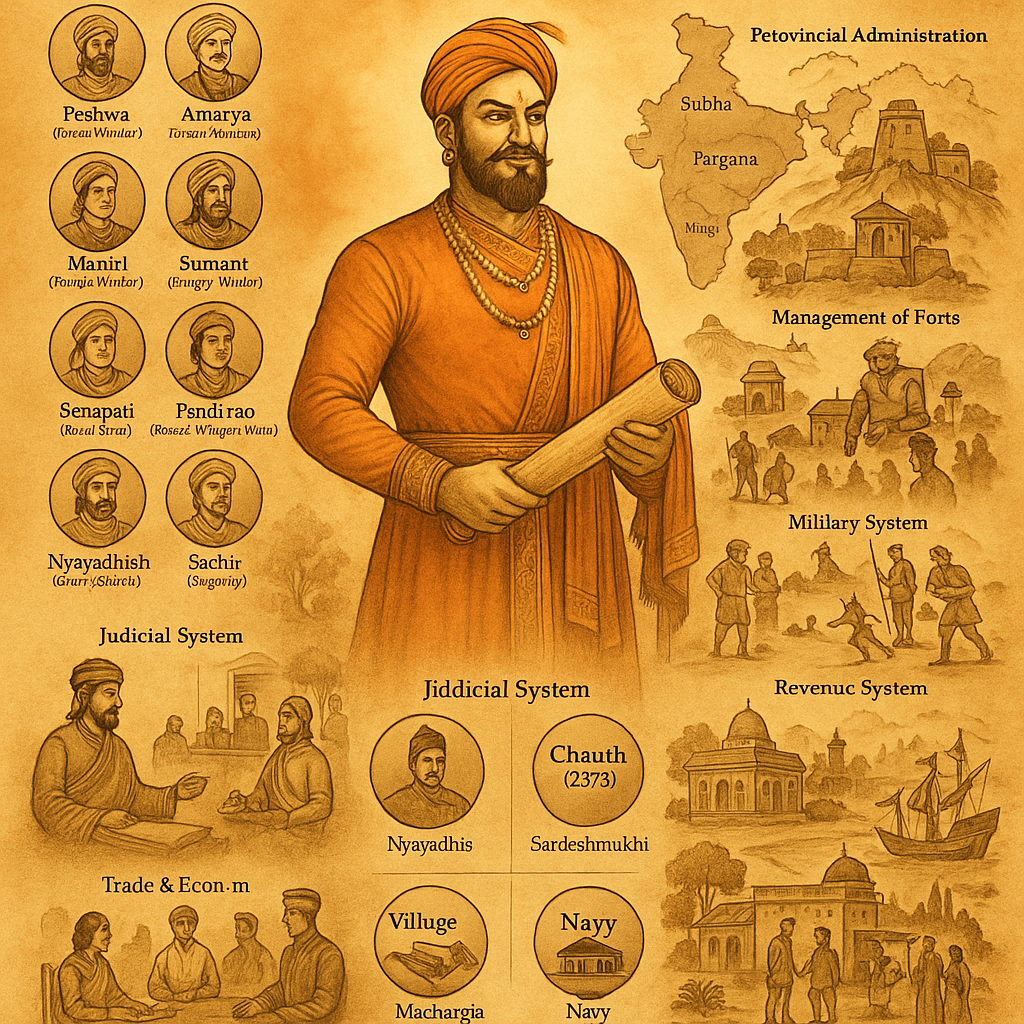
Chhatrapati Shivaji Maharaj’s administrative system was well-organized, efficient, and highly effective, significantly strengthening the Maratha Empire. This system met the political and economic needs of the time and presented an ideal model of disciplined and organized governance. Shivaji Maharaj built his administrative structure on the principles of justice, security, and development.
Major Aspects of the Administrative System
1. Ashtapradhan Mandal
Shivaji Maharaj formed a cabinet called the Ashtapradhan Mandal, consisting of eight chief ministers responsible for various departments. This council was the central authority of the empire’s administration.
- Peshwa (Prime Minister): Chief advisor and executive head of the state.
- Amatya (Finance Minister): Managed revenue, accounts, and financial matters.
- Mantri (Home Minister): Oversaw political affairs and internal administration.
- Sumant (Foreign Minister): Handled diplomatic relations with other states.
- Senapati (Army Chief): Head of the military and responsible for planning strategies.
- Panditrao (Head of Religious Affairs): Supervised religious activities and rituals.
- Nyayadhish (Chief Justice): Oversaw the judicial system and civil justice.
- Sachiv (Secretary): Managed royal documents, correspondence, and administrative orders.
2. Provincial Administration
- The empire was divided into provinces known as Subhas.
- Each province was governed by a Subedar.
- Under the Subedar, there were officials such as the Karkun (Accountant) and Havaldar (Security Head).
- Subhas were further divided into smaller administrative units called Parganas.
3. Management of Forts
- Forts were of utmost strategic importance during Shivaji’s reign.
- Each fort was supervised by a Fortified (Fort Commander), responsible for security and management.
- Shivaji established an organised system for the fort’s army and administrative staff.
- Forts were made militarily and economically strong.
4. Army and Military System
- Shivaji created a strong and disciplined army consisting of infantry, cavalry, and artillery.
- Soldiers were paid regular salaries and received a share of the loot during battles.
- A powerful Navy was established—an exceptional initiative in Indian History.
- Military operations were based on the guerrilla warfare system, which became a key strength.
5. Tax and revenue system
- Shivaji developed a simple and fair revenue system to reduce the burden on farmers.
- Chauth: A 25% tax collected from regions outside Maratha territories.
- Sardeshmukhi: A 10% tax received by Maratha rulers in addition to the Chauth.
- Revenue assessment was based on land productivity.
- Farmers were provided security and support to prevent exploitation.

6. Judicial System
- Shivaji established a fair and efficient system of justice.
- Judges were appointed for civil, religious, and criminal matters.
- Strict punishments were imposed, especially for crimes against women.
- Village Panchayats played an active role in resolving local disputes.
7. Religious and Cultural Policy
- Shivaji promoted religious tolerance and respected all faiths.
- Both Hindus and Muslims were given respectable positions in his administration and army.
- Religious places and cultural heritage were protected.
- Encouragement was given to the study of the Vedas, Puranas, and other religious texts.
8. Trade and Economic Policy
- Merchants and artisans were provided protection and support.
- The navy was strengthened to secure maritime trade routes.
- Special attention was given to markets and trade centres.
- Foreign trade was encouraged to boost economic growth.
Qualities of Shivaji Maharaj’s Administrative System
- Efficiency and Organisation: A disciplined and well-structured governance model.
- Public Welfare: Protection for farmers, traders, and the general public.
- Security and Defence: Strong military and fort system safeguarded the empire.
- Religious Tolerance: Harmony and unity among diverse communities.
Conclusion
Chhatrapati Shivaji Maharaj’s administrative system is an outstanding example of his foresight and leadership. It was not only successful during his time but also inspired rulers for generations to come. His governance policies—based on justice, security, and development—provided stability and prosperity to the Maratha Empire.
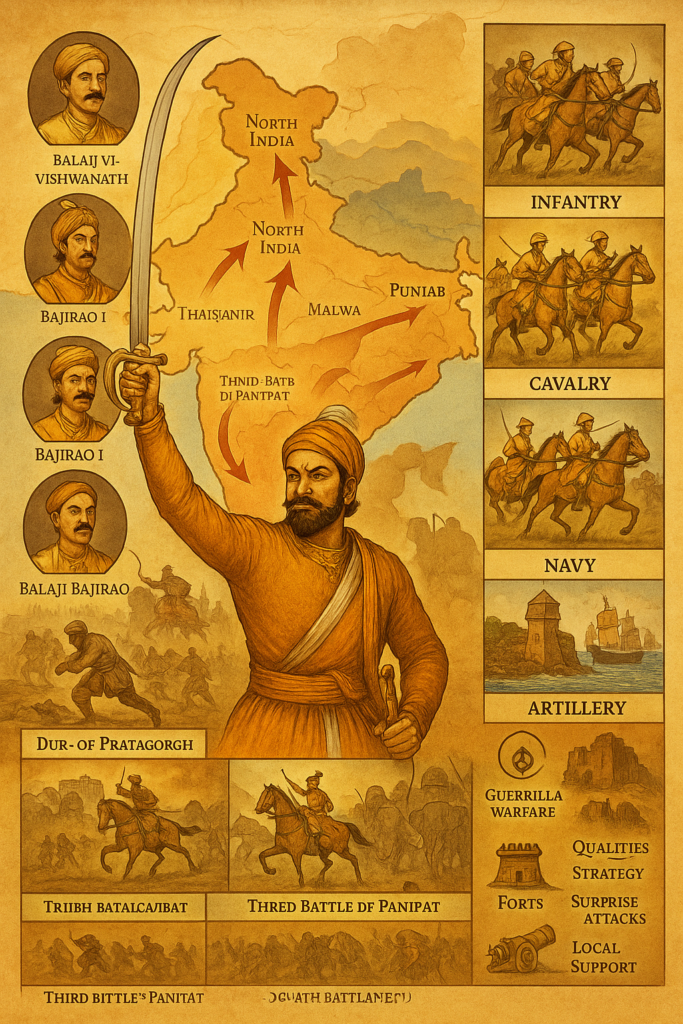
Expansion of the Maratha Empire
The expansion of the Maratha Empire in the 17th and 18th centuries is one of the most significant events in Indian History. It began under the leadership of Chhatrapati Shivaji Maharaj and continued through the Maratha rulers and chiefs who followed him. The Maratha Empire established its dominance not only in western India but also in northern, central, and southern India.
Expansion of the Maratha Empire: Major Phases
1. Initial Expansion under Shivaji Maharaj (1645–1680)
- Shivaji Maharaj laid the foundation of the Maratha Empire and captured key regions.
- From 1645 to 1680, he expanded power in Konkan, Western Maharashtra, and parts of South India.
- Battle of Pratapgarh (1659): Shivaji defeated Afzal Khan, weakening the Bijapur Sultanate.
- Attack on Surat (1664): Conducted to create economic pressure on the Mughals.
- After his coronation at Raigad in 1674, Shivaji accelerated the expansion of the empire.
2. Period After Shivaji (1680–1707)
- After Shivaji’s death, the Empire faced challenges from the Mughals.
- Aurangzeb’s Deccan Campaign targeted the Marathas.
- Sambhaji Maharaj and later Rajaram Maharaj continued resisting Mughal forces.
- After Aurangzeb’s death in 1707, the weakened Mughal Empire allowed the Marathas to rebuild and expand.
3. Expansion During Peshwa Leadership (1707–1761)
Balaji Vishwanath (1713–1720)
- First Peshwa of the Maratha Empire.
- Obtained rights to collect Chauth and Sardeshmukhi from the Mughals.
Bajirao I (1720–1740)
- Greatest contributor to the northward expansion of the Maratha Empire.
- Captured Malwa, Gujarat, Bundelkhand, and areas around Delhi.
- Established Maratha influence from the Narmada to the Ganga–Yamuna region.
Balaji Bajirao (1740–1761)
- Further expanded the empire and strengthened its influence.
- Extended Maratha power into Punjab and Bengal.
4. Third Battle of Panipat (1761)
- The Marathas suffered a major defeat against Ahmad Shah Abdali.
- This was a temporary setback, though the empire weakened for a period.
5. Reconstruction and Later Expansion (1761–1818)
Mahadji Shinde
- Re-established Maratha dominance in North India.
- Placed the Mughal Emperor of Delhi under Maratha protection.
Nana Fadnavis
- Strengthened the administrative and economic structure of the empire.
By the late 18th century, the Marathas had expanded influence into Karnataka, Tamil Nadu, Orissa, and beyond.
Expansion of the Empire: Major Regions
South India
- Shivaji and his successors took control of Thanjavur, Karnataka, and Goa.
North India
- Under the Peshwas, the Marathas reached Delhi, Agra, Gwalior, and Punjab.
- They captured Delhi in 1757 and brought the Mughals under their authority.
Western and Central India
- Marathas established dominance over Gujarat, Malwa, Bundelkhand, and Rajasthan.
Main Reasons for the Expansion of the Empire
- Organised Army and Guerrilla Warfare: Shivaji’s strategies and the Peshwas’ disciplined army made expansion possible.
- Peshwa Leadership: Their diplomacy and strategic planning strengthened the empire.
- Mughal Weakness: Declining Mughal rule provided opportunities for expansion.
- Local Support: Support from peasants and local people helped sustain Maratha campaigns.
Conclusion
The expansion of the Maratha Empire is a unique chapter in Indian history. Shivaji Maharaj laid its foundation, and the Peshwas took it to its peak. Though the Third Battle of Panipat and the rise of British power weakened the empire, its military organisation, administration, and expansion policies continue to inspire India even today.
Military Strength of the Maratha Empire
The military strength of the Maratha Empire was the backbone of their victories. The strategies created by Chhatrapati Shivaji Maharaj, combined with resourcefulness and guerrilla tactics, made the Maratha army formidable. The Peshwas and Maratha chiefs further enhanced this military tradition. Their strength lay not only in combat skills but also in discipline, organization, and innovative strategies.
Structure of the Maratha Army
Infantry
- Known for swift and precise attacks.
- Used bows, swords, spears, and muskets.
- Trained to fight in mountainous and forest terrain.
Cavalry
- The most effective component of the Maratha army.
- Divided into:
- Bargir (Heavy Cavalry): Engaged in major direct attacks.
- Shiledars (Light Cavalry): Experts in guerrilla tactics and cutting enemy supply lines.
- Famous for speed, precision, and strategy.
Navy
- Shivaji created India’s first organised navy.
- Sea forts like Sindhudurg and Vijaydurg helped secure maritime routes.
- The navy defended against Portuguese, Dutch, and British naval threats.
Military Organisation
1. Guerrilla Warfare (Ganimi Kava)
- Used to defeat larger and better-equipped enemy armies.
- Focused on surprise attacks, capturing key points, and rapid retreat.
- Highly effective in hilly and forest regions.
2. Strategic Role of Forts
- About 300 forts formed the backbone of the empire’s defence.
- Important forts included Raigad, Pratapgad, Sindhudurg, and Purandar.
- Forts served as military bases, administrative centres, and armouries.
3. Discipline in the Army
- Strict discipline was enforced among soldiers.
- Regular salaries ensured loyalty and stability.
- Loot was distributed systematically to prevent dissatisfaction.
4. Advanced Weapons and Techniques
- The Marathas adopted foreign weapons and artillery technologies.
- Artillery was developed with the help of European experts.
- Maratha cannons and guns were famous for their power and precision.
Success in Major Military Operations
1. Killing of Afzal Khan & Battle of Pratapgarh (1659)
- Shivaji defeated Afzal Khan of Adilshahi.
- This marked the first major demonstration of Maratha military strength.
2. Attacks on Surat (1664 & 1670)
- Created economic pressure on the Mughal Empire.
- Strengthened the Maratha treasury and strategic position.
3. Wars Against the Mughals
- Continuous guerrilla warfare weakened Mughal forces during Aurangzeb’s Deccan Campaign.
4. Third Battle of Panipat (1761)
- Though defeated, the Maratha army displayed exceptional organisational strength.
Features of the Maratha Army
- Organised and Disciplined: Key reason for repeated military success.
- Indigenous Strategies: Guerrilla warfare made the army adaptable.
- Strategic Use of Forts: Provided strong defensive advantage.
- Maritime Power: The navy strengthened their coastal influence.
- Popular Support: Local people assisted with resources and guidance.
Conclusion
The military strength of the Maratha Empire was a major factor behind their victories. Shivaji Maharaj’s vision, his guerrilla warfare techniques, and the disciplined army developed by the Peshwas made the Marathas a formidable force in Indian history. Their military strategies, use of forts, and organisational skills remain admirable and inspirational even today.
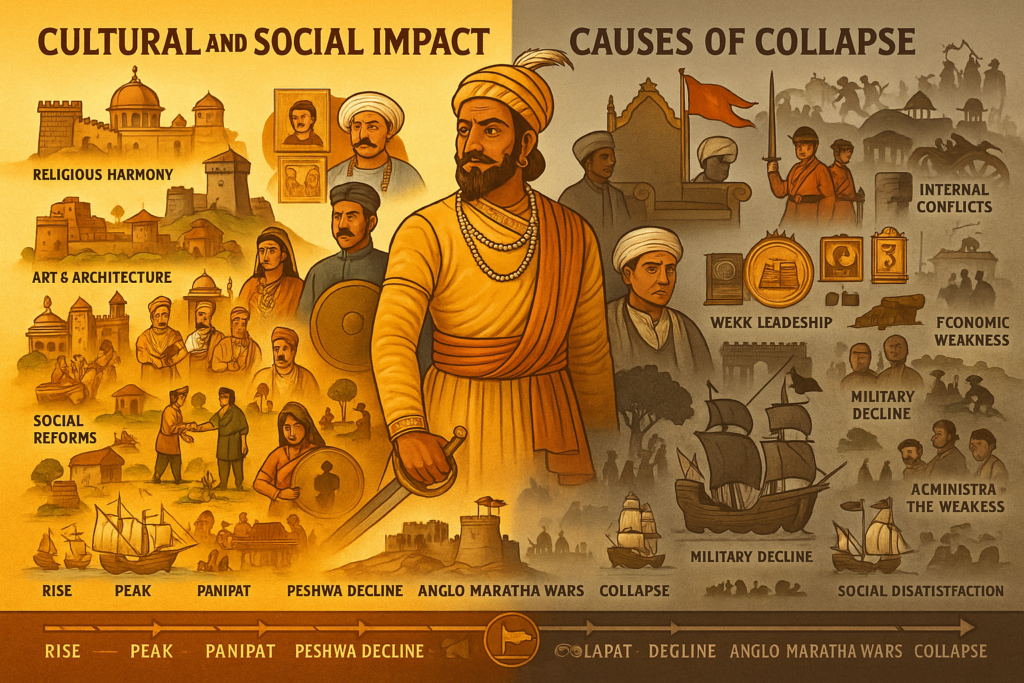
Cultural and Social Impact of the Maratha Empire
The Maratha Empire had a profound and lasting impact on Indian society and culture. Chhatrapati Shivaji Maharaj and his successors contributed not only in the political and military spheres but also enriched India culturally and socially. The Marathas promoted social justice, secularism, and the development of art, literature, and culture.
Cultural Influences
1. religion and Religious Tolerance
Religious Harmony
- Shivaji Maharaj showed respect for all religions.
- He protected both Hindu and Muslim places of worship.
- No religion was used as a political tool during his rule.
Religious Freedom
- Shivaji opposed forced conversions.
- He rejected discrimination based on religion.
Preservation of Temples and Texts
- Shivaji rebuilt many temples.
- He promoted the study of Hindu scriptures.
2. Art and Architecture
- Many forts and fortifications built during Maratha rule reflect a unique architectural style.
- Forts like Raigad, Pratapgad, and Sindhudurg remain architectural landmarks.
- Classical and folk music were encouraged in Maratha courts.
- Various dance forms and rituals flourished.
3. Literature and Language
- Development of Marathi: Marathi flourished in administration and literature.
- Sant Literature: Works of Sant Tukaram, Dnyaneshwar, Namdev, and Eknath enriched Marathi culture.
- Use of Persian and Sanskrit: Both languages were patronised; Persian was used administratively during Peshwa rule.
Social Impact
1. social justice and Equality
- Shivaji reduced caste and class discrimination.
- People from all communities received positions in the army and administration.
- Strict laws were enforced against crimes targeting women.
2. Agrarian and Rural Reforms
- The welfare of farmers was prioritised.
- The tax system was made simple and fair.
- Irrigation and agricultural improvements were encouraged.
3. Development of Trade and Industry
- Sea routes were protected to promote foreign trade.
- Artisans and traders received security and support.
4. Religious and Social Reforms
- Due to religious tolerance, peace and stability were maintained in society.
- Saints and reformers spread awareness against superstition and unnecessary rituals.
Policies Toward Women
- Strict rules were created to ensure women’s safety.
- Reforms improved women’s rights in marriage, education, and society.
- Severe penalties were imposed for crimes against women.
Importance of Cultural and Social Contributions
- Nationalism and Self-Respect: The Marathas awakened national pride among Indians.
- Social Harmony: Reduction in caste and religious discrimination created unity.
- Development of Education and Literature: Marathi literature and education flourished.
- Religious Tolerance: Strengthened cultural unity across regions.
Conclusion
The Maratha Empire not only enriched India culturally but also promoted values of justice, equality, and nationalism. The vision of Shivaji Maharaj and his successors helped shape a society based on peace, tolerance, and cultural development. Their contributions remain unforgettable in Indian History.
Causes of the Collapse of the Maratha Empire
The fall of the Maratha Empire was a major turning point in Indian History. Founded by Shivaji Maharaj, the empire dominated Indian politics until the late 18th century. However, by 1818, the empire collapsed due to several political, military, economic, and social factors.
Main Reasons for the Fall of the Maratha Empire
1. Third Battle of Panipat (1761)
- The Marathas suffered a devastating defeat against Ahmed Shah Abdali.
- Thousands of soldiers were killed, weakening military capability.
- Political confidence was lost after this major defeat.
2. Internal Divisions and Conflicts
- Constant power struggles occurred between Maratha chiefs and the Peshwas.
- Holkar, Scindia, Gaekwad, and Bhonsle fought for personal power.
- This infighting weakened the unity of the empire.
3. Lack of Organized Leadership
- Strong leadership was present during Shivaji’s time.
- Successors lacked the same capability.
- After the decline of the Peshwas, leadership became unstable.

4. Rise of British Power
- The British East India Company strategically weakened the Marathas through diplomacy and warfare.
- Anglo-Maratha Wars (1775–1818): The Marathas suffered continuous defeats.
- The Third Anglo-Maratha War (1817–1818) ended the empire completely.
5. Economic Weakness
- Continuous wars exhausted financial resources.
- Trade and agriculture were disrupted, reducing revenue.
- The British controlled major trade routes, weakening the Maratha economy.
6. Military Weakness
- Guerrilla warfare techniques of Shivaji were abandoned.
- The Marathas adopted traditional warfare, making them weaker.
- They could not match British modern military tactics and weapons.
7. Administrative Problems
- The administrative structure weakened under the later Peshwas.
- Regional chieftains were given excessive autonomy, weakening central authority.
8. Foreign Intervention
- External enemies like Abdali, the Nizam, Hyder Ali, and Tipu Sultan created obstacles.
- The British took advantage of these conflicts to strengthen their position.
9. Neglect of the Navy
- Shivaji established a strong navy, but successors ignored it.
- As a result, the Portuguese and British gained dominance over sea routes.
10. Social Dissatisfaction
- Heavy taxes on farmers and merchants caused resentment.
- Internal social dissatisfaction further weakened the empire.
Effects of the Fall of the Maratha Empire
- British Dominance: British control expanded dramatically after the Maratha collapse.
- End of Local Autonomy: Regional rulers lost independence; British centralisation spread.
- Cultural Influence: European ideas and culture began influencing Indian society.
- Foundation of Nationalism: The legacy of Shivaji inspired future Indian independence movements.
Conclusion
The fall of the Maratha Empire resulted from internal divisions, weak leadership, economic challenges, and British expansion. However, the Marathas’ cultural, social, and political contributions continue to inspire India. Their resistance laid the foundation for the later national freedom movement.
📚 References

- "Life of Chhatrapati Shivaji Maharaj" – Historical texts and regional chronicles.
- Archival records, copper plates, and administrative documents from the Maratha period.
- Indian History: Medieval and Modern Era – University-level textbooks.
- Research papers and academic studies on the Maratha Empire.
- Reports of the Archaeological Survey of India on Marathi forts and heritage sites.
- Historical sources relating to the Peshwa period and Maratha warfare.
- Literature on the contribution of Shivaji Maharaj and the Marathas to Indian nationalism.