
Dadra and Nagar Haveli and Daman and Diu
When I first started reading and learning about Dadra and Nagar Haveli and Daman and Diu, I realised that this small union territory holds a big story of courage, culture, and change. In this article, I am sharing my understanding and learnings in a simple, story-like way so that students, travellers, and curious readers can feel connected to this unique region of India.
If you want to explore more about the administrative structure of India, you can also read my detailed article on Union Territories of India (internal link).
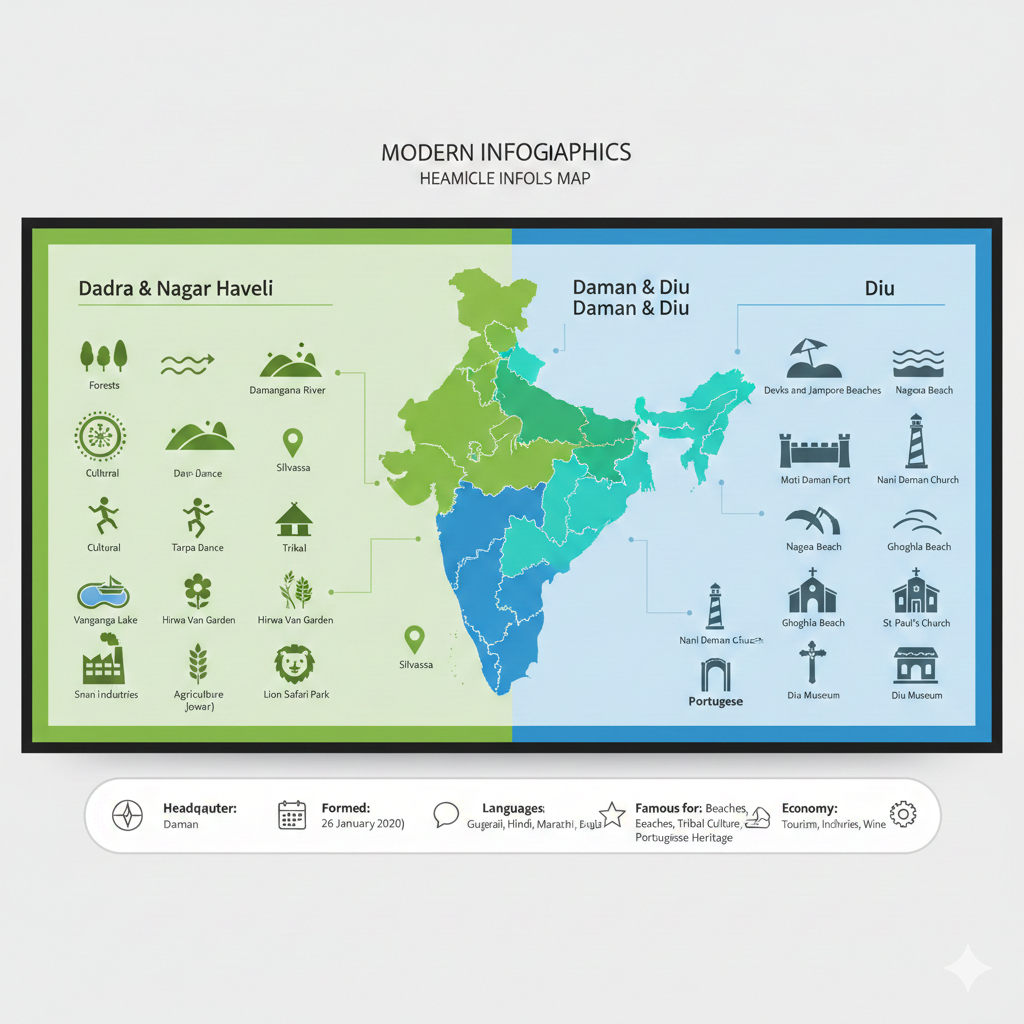
Overview of Dadra and Nagar Haveli and Daman and Diu
Dadra and Nagar Haveli and Daman and Diu is a union territory of India. It came into existence after the merger of two earlier union territories – Dadra and Nagar Haveli, and Daman and Diu – on 26 January 2020. After this merger, a single union territory was formed.
The administrative headquarters of this union territory is located in Daman. Despite its small size, the region reflects a beautiful blend of Indian and Portuguese influences, making it both historically significant and culturally rich.
Geographical Location
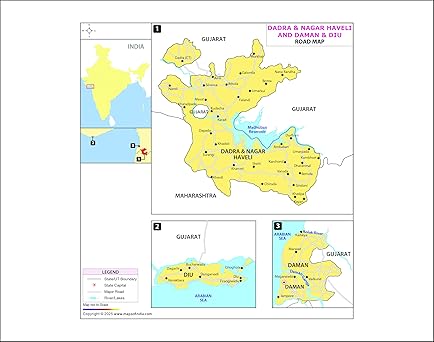
This union territory is situated on the western coast of India.
- Dadra and Nagar Haveli: A small land area located between the states of Gujarat and Maharashtra.
- Daman and Diu: Two separate coastal areas on the western seaboard.
- Daman: Situated to the south of Gujarat, along the Arabian Sea.
- Diu: An island located near the Saurashtra region of Gujarat.
Historical Background
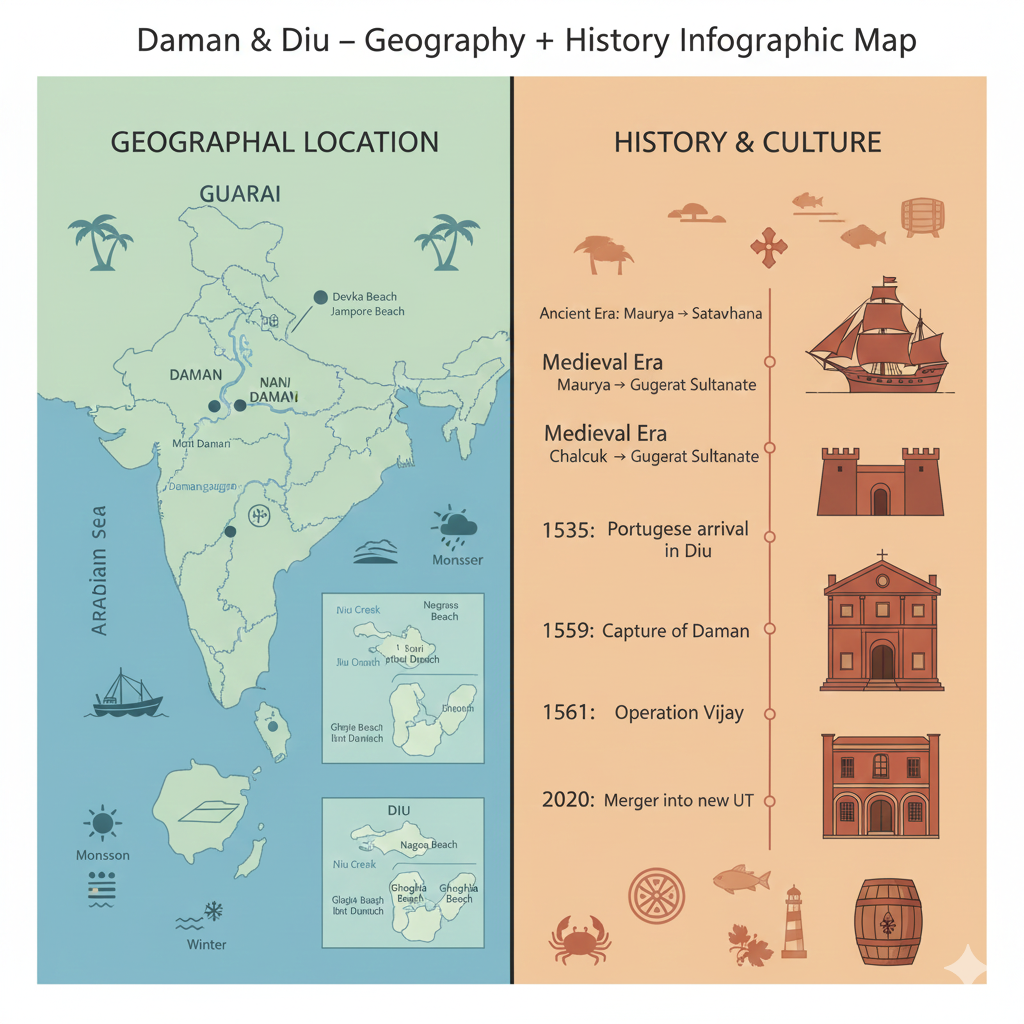
The history of Dadra and Nagar Haveli and Daman and Diu is closely linked with Portuguese rule. The Portuguese captured these areas in the 16th century, and the region remained under their control for a long time.
- Dadra and Nagar Haveli was liberated in 1954.
- In 1961, the Indian Army liberated Daman and Diu from Portuguese rule under “Operation Vijay”.
- In 1987, Goa was made a separate state, and Dadra and Nagar Haveli and Daman and Diu continued as union territories.
- On 26 January 2020, the two union territories were merged into a single union territory.
This journey from colonial rule to freedom and administrative reorganisation shows how even a small region can carry a big historical story.
Culture and Language
The culture of this union territory is diverse and colourful. Here, local tribal traditions, Indian customs, and Portuguese influences come together to create a unique cultural identity.
- Major languages: Gujarati, Hindi, Marathi, English, and local tribal dialects.
- Folk music and dance form an important part of the cultural heritage.
- Traditional arts, festivals, and local customs reflect the harmony of different communities.
Natural Beauty and Major Tourist Places
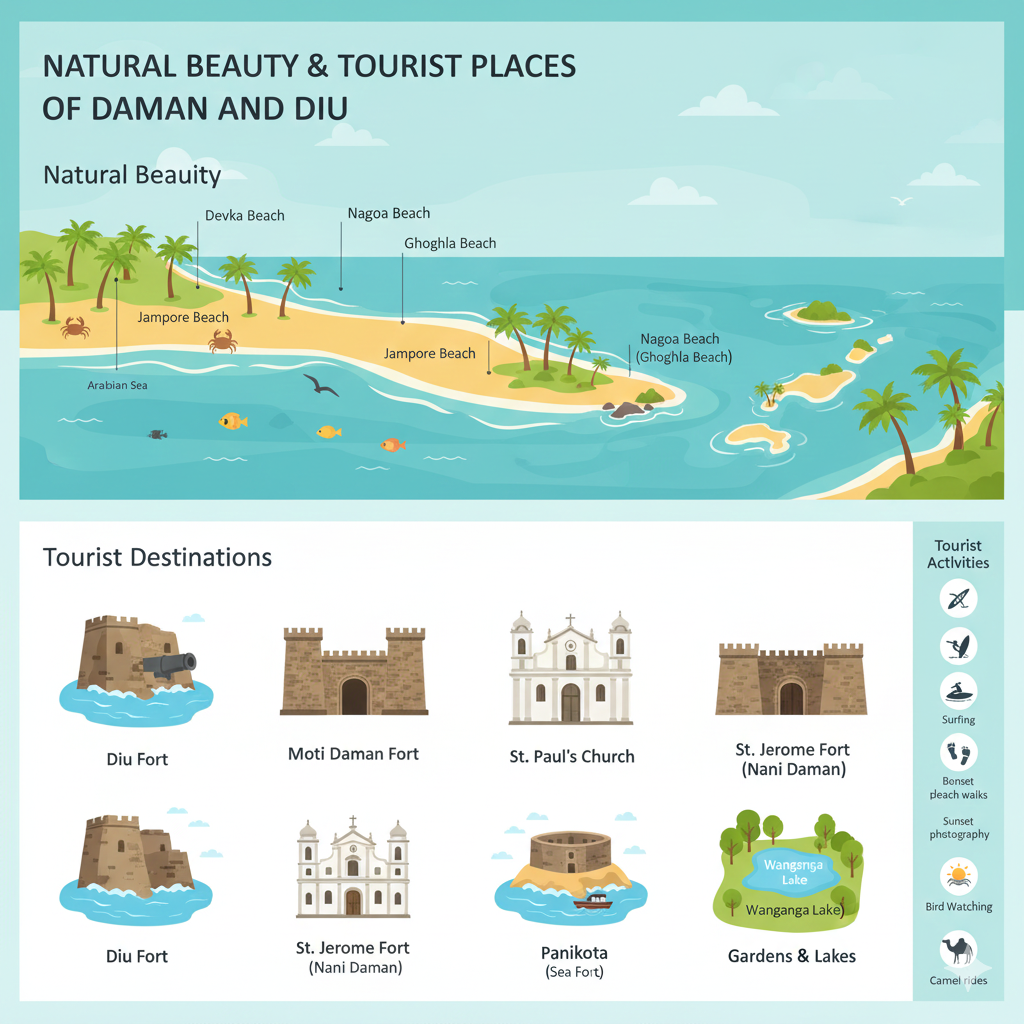
Dadra and Nagar Haveli and Daman and Diu are known for serene beaches, green landscapes, wildlife, and historical monuments. The calm environment and natural charm make it an attractive destination for tourists.
Daman – Beaches and Heritage
- Devka Beach: A peaceful and scenic beach, ideal for quiet walks and relaxation.
- Jampore Beach: Known for its calm waves and water sports activities.
- Fort St. Jerome (Nani Daman Fort): A historic fort representing Portuguese architecture and defence.
- Lighthouse: Offers a spectacular view of the sea and the surrounding area.
Diu – Island of Calm and Culture
- Nagoa Beach: Famous for swimming and water sports.
- Diu Fort: A major historical site with strong Portuguese influence.
- St. Paul’s Church: Known for its beautiful carvings and European-style architecture.
- Ghoghla Beach: A relatively calm and less crowded beach, ideal for those seeking peace.
Dadra and Nagar Haveli – Greenery and Adventure
- Wildlife Sanctuary: A haven for nature and wildlife lovers.
- Water Sports: Various activities at lakes and rivers for adventure enthusiasts.
- Wanganga Lake: A scenic lake where visitors can enjoy boating and nature views.
Economic Situation
The economy of Dadra and Nagar Haveli and Daman and Diu is mainly based on industry and tourism. Many small and large industries operate here, supported by favourable policies.
- Industrial units provide employment and contribute to economic growth.
- Tourism, driven by beaches, forts, churches, wildlife, and natural beauty, is a major source of income.
The peaceful atmosphere, business opportunities, and growing tourism together make this region economically significant despite its small size.
Key Features of the Union Territory
- Famous for its natural beauty, beaches, forts, churches, and cultural heritage.
- Administratively, it comes under the direct control of the Central Government of India.
- The combination of tribal culture, Portuguese legacy, and modern development makes it unique.
Dadra and Nagar Haveli and Daman and Diu is one of those regions of India where a unique confluence of culture, history, and modernity can be seen together.
Introduction to Dadra and Nagar Haveli
Dadra and Nagar Haveli is a small and beautiful part of this union territory, located on the west coast of India. It lies between Gujarat and Maharashtra and is famous for its natural beauty, tribal culture, and greenery. For learners and travellers, this region offers a chance to experience both nature and culture very closely.
Geographical Location of Dadra and Nagar Haveli
- Location: Situated between the Valsad district of Gujarat and the Palghar district of Maharashtra.
- Area: Approximately 491 square kilometres.
- Major towns: Silvassa (capital), Dadra.
- River: The Damanganga River is the major river of this region, providing important natural resources.
Historical Background
- From 1779 to 1954, the region remained under Portuguese rule.
- In 1954, it became independent from Portuguese control.
- In 1961, it was officially incorporated into India and given the status of a union territory.
Culture of Dadra and Nagar Haveli
The culture of Dadra and Nagar Haveli is mainly based on tribal traditions and folk arts. Several tribal communities such as the Warli, Kokna, and Dodhia live here.
- Folk dance and music: Tarpa dance and Warli painting are the cultural identity of this region.
- Major festivals: Diwali, Holi, and the folk festivals of the Warli tribal communities.
Languages Spoken
- Major languages: Gujarati, Hindi, Marathi, and tribal dialects.
Tourist Spots in Dadra and Nagar Haveli
Silvassa
Silvassa is the capital of Dadra and Nagar Haveli. It has many gardens and museums that showcase the culture and natural beauty of the region.
Wanganga Lake Gardens
A beautiful lake and garden area where visitors can enjoy boat rides and spend peaceful time in nature.
Lion Safari Park
Located near Kilvani village, it is an ideal place for wildlife lovers who wish to see animals in a natural environment.
Hiran Garden
This garden is famous for its greenery and attractive waterfalls, making it a good spot for family outings and photography.
Religious and Natural Places
Balaji Temple, Satmalia Deer Park, and the scenic surroundings of Vanganga Lake together create a mix of religious and natural attractions that draw tourists throughout the year.
Economy of Dadra and Nagar Haveli
- Agriculture: The main livelihood here. Paddy, jowar, and rice are the primary crops.
- Industry: Silvassa has many industrial units. Due to tax exemption and favourable policies, many big industries have been established here.
- Tourism: Natural beauty, greenery, and a peaceful environment make tourism an important part of the local economy.
The region is famous for its tribal culture, dense forests, greenery, and rivers, which make it environmentally rich. It is not only known for its beauty and cultural heritage but is also an important area for business and industry due to its tax benefits and strategic location.
Introduction to Daman and Diu
Daman and Diu was a beautiful union territory of India, which was merged with Dadra and Nagar Haveli on 26 January 2020 to form the present union territory. The region is famous for its natural beauty, beaches, Portuguese architecture, and cultural heritage. Although Daman and Diu are geographically located in different places, they are connected through history and culture.
Daman – Location and Features
Location
- Daman is located on the southern coast of Gujarat, along the Arabian Sea.
- It is situated close to the Valsad district of Gujarat.
Geographical Features
- Area: About 72 square kilometres.
- Major river: The Damanganga River divides Daman into two parts – Moti Daman and Nani Daman.
Historical Background of Daman
- Daman came under the control of the Portuguese in 1559.
- It remained under Portuguese rule until 1961.
- In 1961, it was liberated by India under “Operation Vijay”.
Tourist Places in Daman
- Devka Beach: A calm and beautiful beach that attracts tourists for its peaceful environment.
- Jampore Beach: Known for its calm waves, soft sand, and water sports.
- Moti Daman Fort: A historic fort built by the Portuguese, important from a defence and architectural point of view.
- Nani Daman Church: Reflects the Portuguese architectural style and religious heritage.
- Lighthouse: Offers a spectacular view of the sea and surrounding landscape.
Diu – Island of History and Calm
Location
- Diu is a small island located to the south of the Saurashtra region of Gujarat.
- It lies between the Gulf of Khambhat and the Arabian Sea.
- It is separated from the mainland by the Diu Creek.
Geographical Features
- Area: About 40 square kilometres.
- Its island nature and coastal setting give it a unique landscape and climate.
Historical Background of Diu
- Diu came under Portuguese control in the 16th century.
- It was liberated by the Indian Army in 1961.
Tourist Places in Diu
- Diu Fort: A major historical site representing the legacy of Portuguese rule.
- Nagoa Beach: Popular for swimming, relaxing, and water sports.
- Ghoghla Beach: A relatively calm and less crowded beach, ideal for peaceful walks.
- St. Paul’s Church: Known for its intricate carvings and European-style architecture.
- Diu Museum: Preserves antiquities and artefacts related to the Portuguese period.
Culture of Daman and Diu
The Portuguese influence can be clearly seen in the culture of Daman and Diu. At the same time, Indian traditions are also deeply rooted here.
- Major languages: Gujarati, Hindi, English, and Portuguese.
- Traditional folk dance and music are important parts of local celebrations.
- Christian festivals like Christmas and Easter are celebrated with great enthusiasm and devotion.

Economy of Daman and Diu
- Tourism: The main pillar of the economy. Beaches, forts, churches, and heritage buildings attract tourists from across India and abroad.
- Fisheries: Fishing is carried out on a large scale and supports local livelihoods.
- Wine production: The wine production industry is relatively well developed here, adding to the economic diversity.
Daman and Diu, despite their small geographical size, hold great importance for India from a historical, cultural, and natural point of view. Every corner of this region offers a new story, a unique experience, and a quiet lesson in how different cultures can live together in harmony.
FAQ about Dadra and Nagar Haveli and Daman and Diu
Q1. What is Dadra and Nagar Haveli and Daman and Diu?
Dadra and Nagar Haveli and Daman and Diu is a union territory of India. It was formed on 26 January 2020 after the merger of the two earlier union territories – Dadra and Nagar Haveli, and Daman and Diu.
Q2. What is the capital of Dadra and Nagar Haveli and Daman and Diu?
The administrative headquarters of the union territory is located in Daman.
Q3. Why is this union territory historically important?
The region was under Portuguese rule for several centuries. Dadra and Nagar Haveli was liberated in 1954, while Daman and Diu were freed in 1961 under “Operation Vijay”. This colonial past and the struggle for liberation make it historically important.
Q4. What are the main tourist attractions in Daman and Diu?
Major tourist attractions include Devka Beach, Jampore Beach, Moti Daman Fort, and the Lighthouse in Daman, and Diu Fort, Nagoa Beach, Ghoghla Beach, St. Paul’s Church, and Diu Museum in Diu.
Q5. What is special about the culture of Dadra and Nagar Haveli?
The culture of Dadra and Nagar Haveli is strongly influenced by tribal traditions. Communities like the Warli, Kokna, and Dodhia live here. Warli painting, Tarpa dance, and local festivals are important parts of its cultural identity.
Q6. Which languages are commonly spoken in this union territory?
Gujarati, Hindi, Marathi, English, Portuguese (in some areas), and various tribal dialects are commonly spoken across Dadra and Nagar Haveli and Daman and Diu.
Conclusion
Dadra and Nagar Haveli and Daman and Diu may look small on the map, but in reality it is a region of big stories and rich experiences. From tribal culture to Portuguese architecture, from peaceful beaches to dense forests, from industry to tourism – everything here shows how history, nature, and modern life can come together.
For me, learning about this union territory has been like reading a living storybook of India – full of struggle, diversity, and hope. If you ever get a chance to visit, or even study this region in detail, you will surely feel that it is not just a place, but an experience that stays with you.
Culture and Language of Daman and Diu
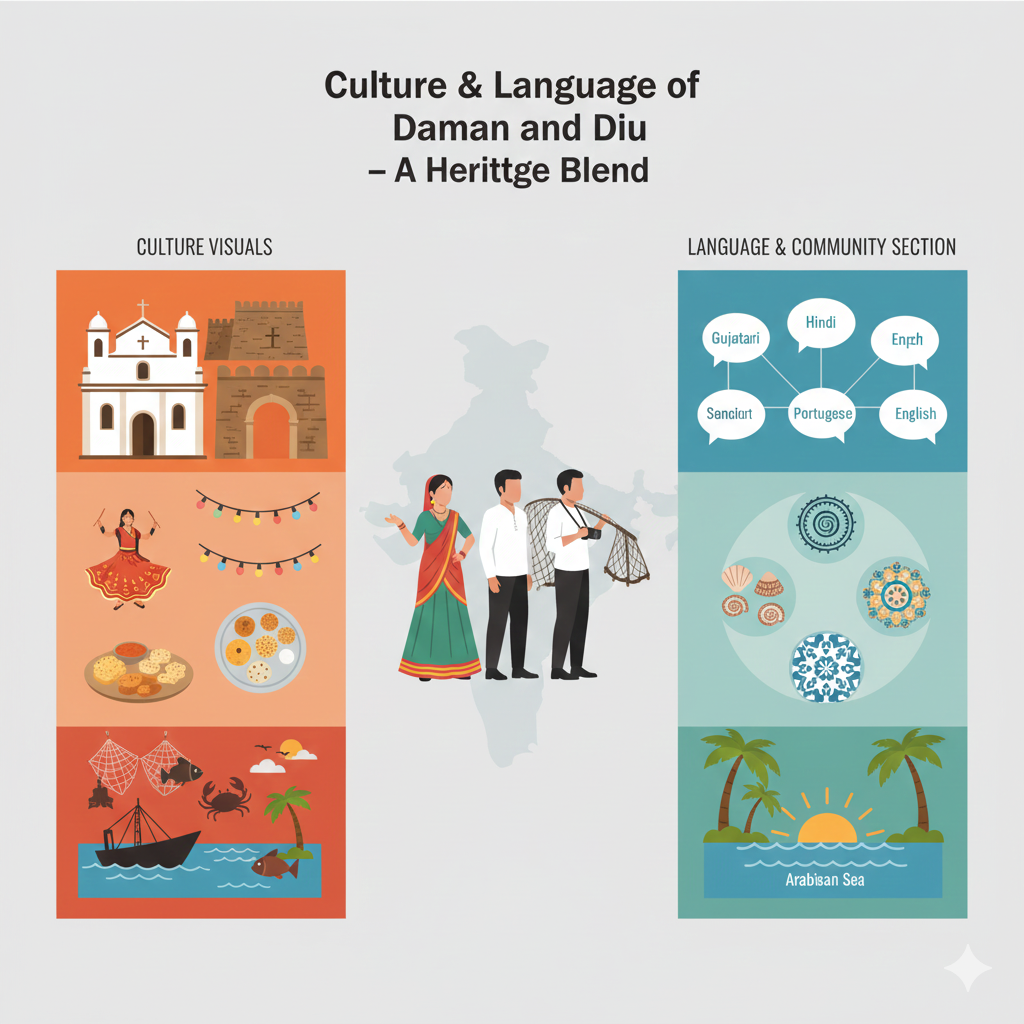
Daman and Diu, located on the western coast of India, is a region where various cultures beautifully merge. The culture here reflects Portuguese influence, Gujarati traditions, and local customs. Along with marine life, festivals, and religious beliefs, the diversity of this region is seen in its language, art, food, and daily lifestyle.
Culture
The culture of Daman and Diu is rich, diverse, and historically influenced by multiple communities.
1. Religious Influence
- Hinduism: Hinduism has a strong presence here, with several ancient temples such as Somnath Mahadev Temple and Hanuman Temple.
- Christianity: Christianity spread during Portuguese rule. Important churches include St. Paul’s Church and Bom Jesus Church.
- Islam: A small Muslim population also contributes to the cultural fabric of the region.
2. Architecture and Art
- The Portuguese influence is clearly visible in local architecture.
- Forts, churches, and coastal structures represent Portuguese-style construction.
- Folk art and traditional handicrafts are part of the local heritage.
3. Music and Dance
- Folk music and dance form an important part of cultural traditions.
- Popular dance forms include Mando and Decani, which blend Portuguese and local styles.
- Sea songs and religious hymns are commonly sung.
4. Festivals and Celebrations
- Navratri: Celebrated with great enthusiasm due to Gujarati influence. Garba and Dandiya are performed widely.
- Christmas and Easter: Major Christian festivals celebrated with church decorations and prayer services.
- Diu Festival: An annual event featuring music, dance, and cultural programs for tourists.
5. Food and Dishes
- Seafood plays a central role in local cuisine—fish, shrimp, and crab dishes are common.
- Gujarati dishes like dhokla, fafda, and khandvi are popular.
- Portuguese dishes such as vindaloo and fish stew are also part of the food culture.
Language
Daman and Diu showcases linguistic diversity shaped by local culture and historical influences.
1. Gujarati
Gujarati is the primary language, widely used in administration, business, and daily communication.
2. Hindi
Hindi is also commonly spoken and helps in communication between locals and tourists.
3. Portuguese
Due to centuries of Portuguese rule, the influence of the Portuguese language still exists, especially among older generations and Christian communities.
4. English
English is mainly used in tourism, business, and hospitality due to the increasing number of visitors.
Cultural Mix
Daman and Diu represents a unique blend of Gujarati, Portuguese, and local coastal traditions.
Gujarati Influence
Visible in folk dances like Garba and in vegetarian cuisine.
Portuguese Influence
Seen in Christianity, church architecture, and maritime lifestyle.
Local Traditions
The customs and festivals of fishing communities play an important role in local culture.
Importance of Culture and Language
The culture and language of Daman and Diu reflect its rich historical and social heritage. The region symbolizes India’s unity in diversity, where multiple languages, traditions, and religions coexist peacefully. Tourism plays a crucial role in preserving and promoting this culture internationally.
Conclusion
The culture and language of Daman and Diu represent its historical legacy, Portuguese influence, and Indian diversity. The lifestyle, traditions, architecture, and linguistic richness make this region unique, vibrant, and culturally significant.
Key Features of Daman and Diu
Daman and Diu, part of the integrated union territory “Dadra and Nagar Haveli and Daman and Diu,” is located in the western coastal region of India. Its historical, geographical, cultural, and economic characteristics make it unique. The region is widely known for its serene beaches, Portuguese heritage, and natural beauty.
1. Geographical Features
(i) Coastal Region
- Daman and Diu are located along the Arabian Sea.
- The region is famous for its beaches, bays, and marine life.
- The climate is tropical, with hot summers and pleasant winters.
(ii) Regional Division
- Daman: Located near the Valsad district of Gujarat. Known for tourism and industrial activities.
- Diu: Situated at the southern end of the Kathiawar Peninsula in Gujarat. The region is peaceful and full of natural beauty.
(iii) Marine Life and Biodiversity
- This coastal region is rich in Marine Biodiversity, with various species of fish, crabs, and sea birds.
2. Historical Features
(i) Portuguese Influence
- Daman and Diu remained under Portuguese rule for nearly 450 years.
- The Portuguese built impressive forts, churches, and architectural structures.
- Their influence is visible in religious places, food, music, and architecture.
(ii) freedom struggle and Merger with India
- The region was liberated in 1961 under India’s Operation Vijay.
- In 1987, after Goa became a state, Daman and Diu became a separate union territory.
3. Cultural Characteristics
(i) Religion and Traditions
- Communities following Hinduism, Christianity, and Islam live harmoniously here.
- Prominent religious sites include St. Paul’s Church, Somnath Mahadev Temple, and Hanuman Temple.
- Major festivals such as Navratri, Christmas, and Easter are celebrated with enthusiasm.
(ii) Language and Arts
- Gujarati, Hindi, and English are the major languages spoken.
- Portuguese influence still exists in some communities.
- Folk dance, music, and traditional handicrafts form the cultural identity of the region.
(iii) Festivals and Celebrations
- Diu Festival and Navratri Festival are key cultural events.
- Tourists actively participate in cultural and religious programs.
4. Characteristics of Tourist Destinations
Beaches
- Jampore Beach (Daman): Famous for peaceful surroundings and water sports.
- Nagoa Beach (Diu): Popular for water sports and scenic beauty.
- Devka Beach (Daman): Ideal for family outings and sunset views.
Historical Places
- Diu Fort: A grand example of Portuguese architecture.
- Moti Daman Fort: The main historical fort of Daman.
- St. Paul’s Church: Represents Portuguese architectural style and Christian tradition.
Museums and Other Sites
- Diu Museum: Showcases Portuguese-era heritage items.
- Panikota Fort: A historical sea fort accessible by boat.
5. Economic Characteristics
(i) Tourism-Based Economy
- Tourism is the main economic driver.
- Growing tourist arrivals boost local businesses and employment.
(ii) Industrial Activities
- Daman has many industries, including plastics, textiles, chemicals, and pharmaceuticals.
- Tax benefits make it an attractive destination for industrial investments.
(iii) Fisheries and Marine Trade
- Fishing is a major source of livelihood.
- Marine exports contribute significantly to trade.
6. Environmental Characteristics
(i) Coastal Protection
- Special initiatives are taken to maintain beach cleanliness and coastal conservation.
- The greenery and clean environment reflect successful environmental initiatives.
Biodiversity
- The region has rich coastal and marine biodiversity.
- It is ideal for bird watching and nature observation.
7. Social and Lifestyle Characteristics
Lifestyle
- The lifestyle here is simple, peaceful, and culturally vibrant.
- Seafood and Gujarati cuisine are integral to the local diet.
Education and Health
Education and healthcare facilities are developing steadily due to income from industries and tourism.
8. Modern Development and Government Initiatives
(i) Promotion of Tourism
- Government organises the Diu Festival and other cultural events.
- Tourist spots are being modernised and beautified.
(ii) Promotion of Industries
- Tax exemptions and infrastructure development attract industries.
Environmental protection
- Special schemes are implemented to maintain environmental balance and beach cleanliness.
Conclusion
Daman and Diu is one of India’s most unique coastal regions, known for its natural beauty, historical heritage, and cultural diversity. Its geographical location, tourist attractions, and industrial growth make it economically and culturally significant. The region is a treasure for tourists, historians, nature lovers, and cultural explorers.