
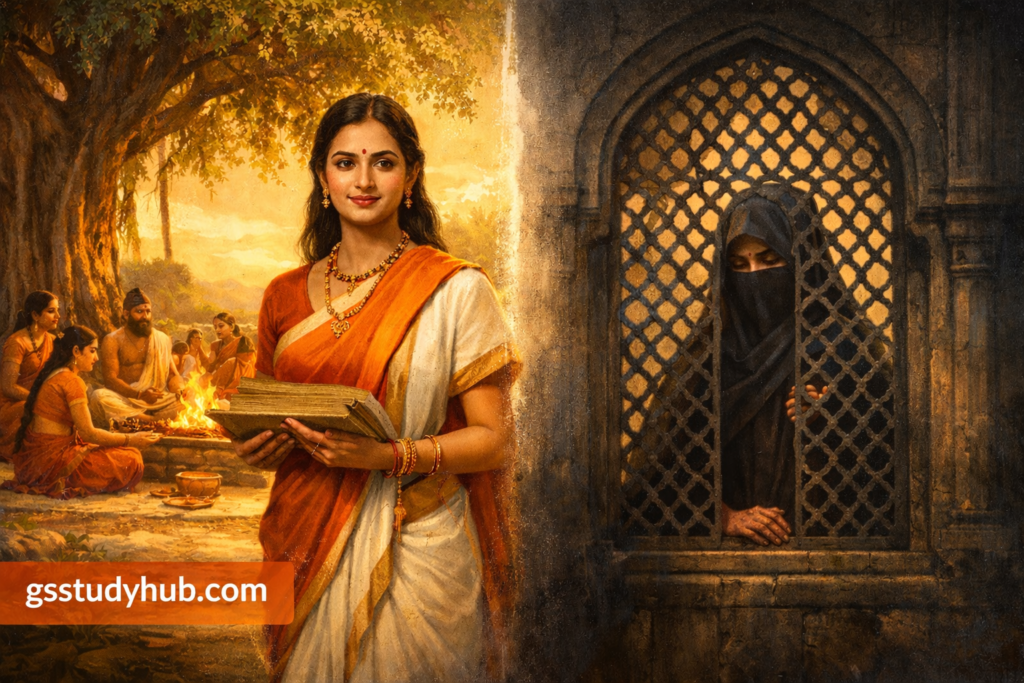
1. Women in the Vedic Period: A Golden Era?
When examining the historical evolution of women empowerment in India, the Vedic period often appears as a remarkable beginning. Many historians describe this era as a time when women enjoyed intellectual freedom, social respect, and spiritual authority. Unlike later historical phases, women were not entirely confined to domestic spaces but actively participated in public and religious life.
Ancient texts such as the Rigveda contain references suggesting that the status of women was not merely symbolic but socially recognized. Women took part in rituals, philosophical debates, and educational pursuits. However, an important question remains: was this level of empowerment universal across all social groups, or limited to certain classes? Understanding this complexity helps us evaluate whether the Vedic age truly represented a golden era for women.
Education and Social Status
Education played a central role in shaping the position of women during the Vedic period. Historical interpretations indicate that some women had access to formal learning and, in certain cases, underwent the Upanayana ceremony, marking the beginning of their educational journey. They studied the Vedas, composed hymns, and engaged in intellectual discussions.
Marriage was generally conducted at a mature age, allowing time for intellectual growth and personal development. Socially, women were regarded as equal partners in household and religious responsibilities. Their participation in yajnas alongside their husbands symbolized shared spiritual duties and mutual respect.
This suggests that early forms of women empowerment were reflected in lived social practices rather than abstract ideals. However, over time, these privileges gradually declined, leading to structural limitations in later historical periods.
Women Scholars in Vedic India
The presence of women scholars further strengthens the argument that gender equality had deep historical roots in ancient India. Figures such as Gargi Vachaknavi and Maitreyi stand as enduring examples of intellectual freedom. Gargi famously engaged in philosophical debate with the sage Yajnavalkya, demonstrating her command over complex metaphysical ideas.
Maitreyi, similarly, participated in profound discussions about the nature of the soul and immortality. Their involvement was not symbolic but intellectually rigorous, reflecting genuine scholarly authority. These examples indicate that the Vedic period recognized women’s capacity for philosophical and spiritual leadership.
Although historians continue to debate how widespread such opportunities truly were, it remains clear that the foundations of women empowerment in India can be traced back to this early civilizational phase.
2. Decline in Status During the Medieval Period
Following the relatively empowered position of women in the Vedic age, the medieval period marked a significant transformation in Indian society. Political instability, repeated invasions, and shifting socio-religious structures deeply affected women's status. The earlier environment that allowed intellectual participation and social visibility gradually weakened, and women were increasingly confined to domestic roles.
Access to education and public life became restricted over time. Practices such as purdah (seclusion), child marriage, and limitations on property rights gained wider acceptance. These customs evolved gradually under conditions of insecurity and rigid social hierarchy rather than emerging suddenly.
As kingdoms competed for power and communities emphasized protection and lineage purity, families often limited women’s mobility. In such circumstances, gender equality was overshadowed by patriarchal control and conservative social norms. Women’s autonomy became secondary to perceived social stability.
One of the most tragic developments of this era was the institutionalization of practices such as sati and the normalization of early marriage. These customs significantly reduced personal freedom and restricted intellectual growth. Although regional differences existed and not all communities experienced identical conditions, the broader historical pattern indicates a decline in women’s public and intellectual presence.
It would, however, be inaccurate to describe the medieval period as entirely regressive. There were notable exceptions where women exercised political authority and cultural influence. Yet, in structural terms, this era represents a difficult phase in the historical evolution of women empowerment in India. The limitations of this period later inspired reform movements that sought to restore dignity, equality, and social justice.
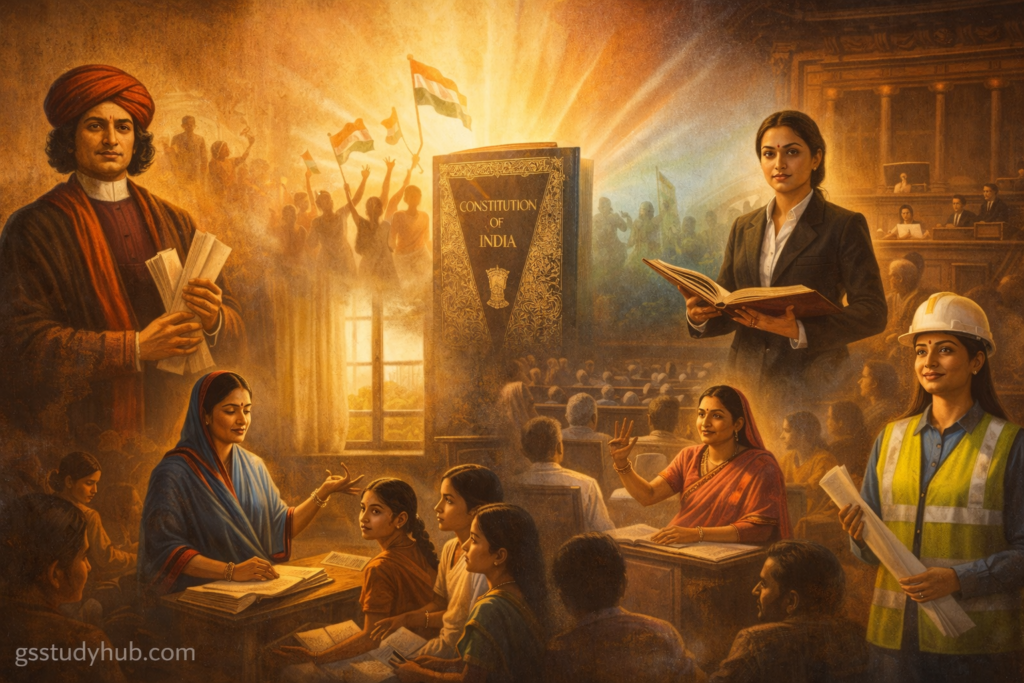
3. Reform Movements and Awakening
The decline in the status of women during the medieval period eventually led to a powerful wave of reform and social awakening in the 19th century. This phase marked a turning point in India’s social history. Reformers began challenging rigid traditions, harmful customs, and institutionalized discrimination against women.
The idea of women empowerment gradually re-emerged as a moral, social, and intellectual necessity for national progress. Reform movements emphasized education, legal reform, and dignity, laying the foundation for modern gender equality in India.
Role of Raja Ram Mohan Roy
Raja Ram Mohan Roy emerged as one of the earliest and most influential reformers advocating for women’s rights in modern India. Deeply disturbed by the practice of sati, he actively campaigned for its abolition. His persistent efforts led to the enactment of the Bengal Sati Regulation Act of 1829, which legally banned the inhumane custom.
Beyond the abolition of sati, Roy supported women’s inheritance rights and access to education. He believed that true social progress required intellectual development and legal safeguards for women. By challenging orthodox religious interpretations and promoting rational thought, he helped reshape public opinion and initiate structured reform efforts.
Role of Savitribai Phule
If Raja Ram Mohan Roy laid the intellectual foundation of reform, Savitribai Phule transformed the movement into a grassroots educational revolution. As one of India’s first female teachers, she established schools for girls at a time when female education faced strong social resistance.
Despite enduring harassment and social boycott, she remained committed to expanding educational access. Savitribai firmly believed that education was the most powerful instrument of empowerment. She understood that without literacy and awareness, women would remain trapped in cycles of dependency and discrimination.
Along with Jyotirao Phule, she worked to uplift marginalized communities and promote gender equality. Her efforts not only expanded opportunities for girls but also redefined empowerment as a broader struggle for social justice and inclusivity.
Together, these reformers ignited a wider awakening that challenged oppressive customs and inspired future generations. This reform era represents a critical bridge between historical decline and the constitutional commitment to equality in independent India.
4. Women Empowerment After Independence
With India’s independence in 1947, the vision of nation-building extended beyond political freedom to social justice and equality. The architects of modern India understood that empowering women was essential for building a democratic and progressive society. As a result, the Constitution of India embedded principles of equality, dignity, and non-discrimination at its core.
This marked a transformative phase in the journey of women empowerment, as it shifted from a reformist aspiration to a constitutional commitment backed by legal authority.
- Constitution of India, 1950 – Official Website: https://legislative.gov.in/constitution-of-india/
Post-independence India introduced significant policy initiatives to strengthen gender equality and inclusive development. Access to education expanded, employment opportunities gradually increased, and women began participating more actively in political processes.
Legislative measures such as the Maternity Benefit Act, the Protection of Women from Domestic Violence Act, and laws against workplace harassment reinforced the structural foundation of women’s rights. Reservation for women in Panchayati Raj Institutions institutionalized political participation at the grassroots level, making representation more inclusive.
Constitutional Provisions
The Constitution of India provides a strong legal framework for gender justice and equal rights. It guarantees equality before the law and prohibits discrimination on the basis of gender. By recognizing women as equal citizens with fundamental rights, the Constitution laid the groundwork for long-term social transformation.
These safeguards ensure that empowerment is not dependent solely on social attitudes but is supported by enforceable legal protections.
Article 14, 15, 16
Article 14 guarantees equality before the law and equal protection of the laws to all citizens. This provision forms the foundation of legal equality, ensuring that women cannot be denied justice or fair treatment.
Article 15 prohibits discrimination on grounds of religion, race, caste, sex, or place of birth. It also allows the state to make special provisions for women and children. This enables affirmative action policies designed to correct historical disadvantages.
Article 16 ensures equality of opportunity in matters of public employment. By guaranteeing equal access to government jobs and public offices, this article strengthens the economic dimension of empowerment and promotes meaningful participation in governance.
Together, these constitutional provisions transformed women empowerment from a social ideal into a legally enforceable reality. While challenges remain in implementation, the constitutional framework continues to serve as a strong institutional foundation for advancing gender equality in modern India.
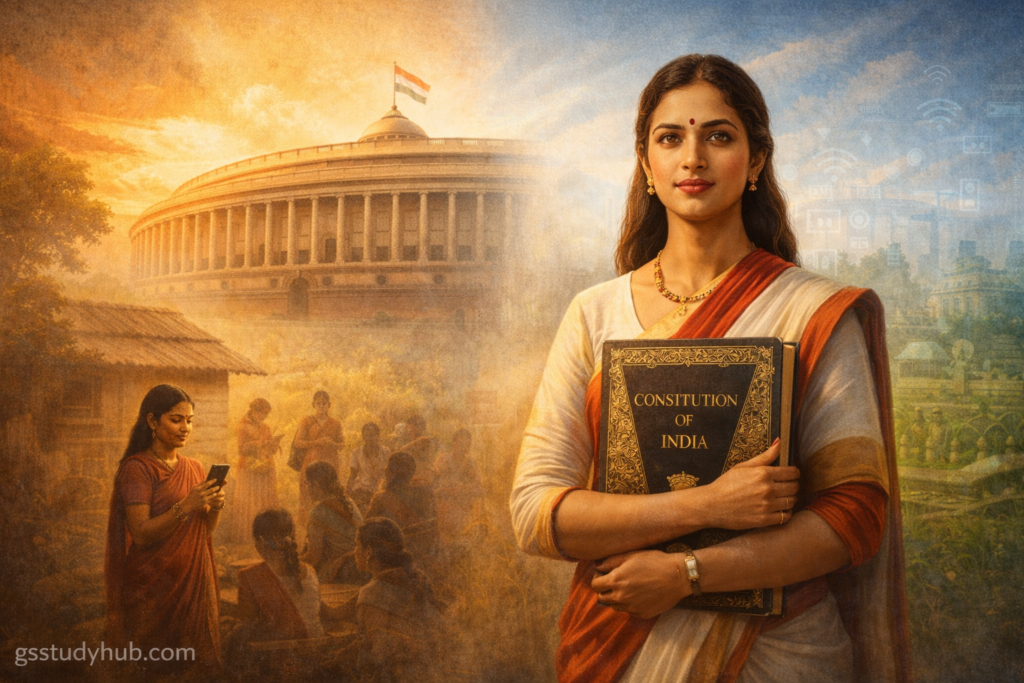
5. Women Reservation Bill 2023: A Historic Step
The passage of the Women Reservation Bill 2023 marks a historic milestone in India’s democratic evolution. The bill provides 33% reservation for women in the Lok Sabha and State Legislative Assemblies, aiming to ensure greater gender representation in political decision-making. For decades, this proposal remained pending despite widespread debate and support. Its eventual approval reflects a significant political commitment toward inclusive governance.
Although women constitute nearly half of India’s population, their representation in Parliament and state legislatures has historically remained disproportionately low. This structural imbalance has often limited the scope of gender-sensitive policymaking. By reserving seats for women, the bill seeks to correct this imbalance and strengthen meaningful participation within the democratic framework.
The reform moves beyond symbolic recognition and attempts to institutionalize political equality. However, its implementation is linked to the completion of the next census and delimitation process, which may delay its operational impact.
Critics argue that reservation alone cannot guarantee substantive women empowerment unless it is supported by improvements in education, economic independence, and social attitudes. Representation must be accompanied by real authority, leadership opportunities, and structural support.
From intellectual participation in the Vedic age to constitutional guarantees after independence and now formal legislative representation, the Women Reservation Bill 2023 stands as a defining chapter in the evolving story of women empowerment in India. It reflects not only legislative reform but also a broader societal acknowledgment that gender equality is fundamental to democratic progress.
6. Challenges Ahead
Despite significant progress in recent decades, the journey toward gender equality in India is far from complete. Constitutional safeguards, social reform movements, and legislative measures such as the Women Reservation Bill represent major milestones. However, lasting women empowerment requires more than legal provisions; it demands structural transformation in society, the economy, and collective mindset.
Persistent inequalities continue to shape lived realities across regions and social groups. One of the major challenges is the gap between urban and rural opportunities. While metropolitan areas have seen improvements in education, employment, and digital access, many rural communities still struggle with limited resources.
Access to quality education, healthcare, financial services, and technology remains uneven. The digital divide, in particular, has emerged as a modern barrier, restricting participation in the evolving knowledge-based economy.
Deep-rooted social norms and patriarchal attitudes further slow the pace of progress. Workplace discrimination, wage inequality, underrepresentation in leadership roles, and instances of domestic violence reveal the gap between legal rights and social realities. Even when women enter political institutions through reservation, ensuring meaningful participation rather than symbolic representation remains a crucial challenge.
Economic independence is another cornerstone of sustainable women empowerment. Increasing female labor force participation, supporting women entrepreneurs, and expanding skill development programs are essential for long-term stability. Without financial autonomy, social and political gains may remain fragile.
Therefore, policy reforms must be supported by grassroots awareness, education, and institutional accountability. Ultimately, women empowerment is an ongoing process rather than a completed achievement. The future depends on how effectively India bridges the gap between constitutional ideals and everyday realities.
By addressing structural inequalities and transforming societal attitudes, the vision of inclusive and sustainable empowerment can move closer to becoming a lived experience for all women.
Related Reading: Buddhist Sangha and Its Expansion
7. Conclusion: The Future of Women Empowerment in India
From the intellectual vibrancy of the Vedic age to the institutional reforms of modern India, the journey toward women empowerment has been long, complex, and transformative. Each historical phase—medieval decline, 19th-century reform movements, constitutional guarantees after independence, and the Women Reservation Bill 2023—has shaped the evolving narrative of gender equality in India.
This journey reflects not only legal and political change but also the gradual transformation of social consciousness. Today, India stands at a decisive crossroads. Legal frameworks and policy initiatives have expanded opportunities in education, employment, and political participation, yet structural inequalities still persist.
Read also: Water Scarcity in India: Causes, Regions & SolutionsThe true strength of empowerment lies in bridging the gap between constitutional ideals and lived realities. Social attitudes, economic independence, digital inclusion, and access to quality education will determine how effectively progress translates into everyday life.
Sustained commitment at multiple levels—government policy, institutional accountability, and community awareness—is essential. Encouraging women’s leadership, expanding skill development, and ensuring workplace equality will define the next stage of national growth. Political representation through reservation has opened a new chapter, but meaningful participation must follow representation.
Ultimately, women empowerment is not a destination but a continuous process of social evolution. When women are empowered intellectually, economically, and politically, national development accelerates. India’s future as an inclusive and progressive democracy will depend on how consistently it nurtures equality and opportunity across generations.
📚 Recommended Books on Women Empowerment
To understand the journey of women empowerment from the Vedic age to the Women’s Reservation Bill 2023, these carefully selected books provide historical depth and modern political insight.
These expert-recommended books on women empowerment in India explore the evolution of gender equality — from the Vedic period to modern constitutional reforms like the Women’s Reservation Bill 2023.
| Book | Cover | Focus Area | Rating | Check Price |
|---|---|---|---|---|
| Book Title 1 ⭐ Editor’s Choice |  | Comprehensive Feminist & Historical Analysis | 4.6/5 ⭐⭐⭐⭐⭐ | Check Price on Amazon |
| Book Title 2 |  | Indian Feminist Perspective | 4.4/5 ⭐⭐⭐⭐☆ | Check Price on Amazon |
| Book Title 3 |  | Women in Indian Politics | 4.3/5 ⭐⭐⭐⭐☆ | Check Price on Amazon |
| Book Title 4 |  | Reservation Bill Analysis | 4.2/5 ⭐⭐⭐⭐☆ | Check Price on Amazon |
| Book Title 5 |  | Gender & Society Studies | 4.1/5 ⭐⭐⭐⭐☆ | Check Price on Amazon |
If you want one well-balanced and insightful book connecting historical foundations of women empowerment with modern reforms like the Women’s Reservation Bill 2023, Book Title 1 stands out as the most comprehensive choice.
Check Price on AmazonFrequently Asked Questions (FAQs)
1. What is the meaning of women empowerment?
Women empowerment refers to providing women with equal rights, opportunities, and the freedom to make decisions in social, economic, educational, and political spheres. It ensures that women can participate confidently and independently in national and societal development.
2. How was women empowerment reflected in the Vedic period?
During the Vedic period, women had access to education, participated in religious rituals, and engaged in philosophical debates. Scholars such as Gargi and Maitreyi illustrate that early Indian society recognized women’s intellectual and spiritual capabilities.
3. Why did the status of women decline during the medieval period?
Social instability, rigid customs, and patriarchal norms during the medieval era restricted women’s mobility and educational access. Practices such as child marriage and seclusion reduced their participation in public and intellectual life.
4. How does the Indian Constitution support gender equality?
The Indian Constitution guarantees equality before the law (Article 14), prohibits gender-based discrimination (Article 15), and ensures equal opportunity in public employment (Article 16). These provisions create a strong legal framework for equal rights and protection.
5. What is the significance of the Women Reservation Bill 2023?
The Women Reservation Bill 2023 provides 33% reservation for women in the Lok Sabha and State Legislative Assemblies. It strengthens political representation and promotes inclusive decision-making within democratic institutions.
6. What are the major challenges to achieving gender equality in India?
Major challenges include wage gaps, limited workforce participation, social stereotypes, unequal rural access to education, and underrepresentation in leadership roles. Addressing these issues is essential for sustainable and inclusive development.
References
- Rigveda – Various Mandalas referencing the role of women in Vedic education and philosophical discourse.
- Brihadaranyaka Upanishad – Dialogues of Gargi Vachaknavi and Maitreyi illustrating women’s intellectual participation in ancient India.
- The Constitution of India, 1950 – Articles 14, 15, and 16 (Equality before Law and Prohibition of Discrimination).
- Raja Ram Mohan Roy – Campaign Against Sati and the Bengal Sati Regulation Act, 1829.
- Savitribai Phule – Contributions to Women’s Education and Social Reform in 19th Century India.
- Ministry of Law and Justice, Government of India – The Constitution (106th Amendment) Act, 2023 (Women’s Reservation Bill).
- National Commission for Women (NCW) – Reports on Gender Equality and Women Empowerment in India.
- UN Women – Global Reports on Gender Equality and Women Empowerment.