

Uttar Pradesh: The Heartland of India
Uttar Pradesh, commonly known as UP, is one of the most important states of the Indian subcontinent. Located in northern India, it holds great significance from historical, cultural, political, and economic perspectives. It has also played a defining role in shaping Indian civilization and continues to influence modern India.
Geographical Location
Position
Uttar Pradesh is situated in the north-central region of India.
Boundaries
- North: Uttarakhand and Nepal
- South: Madhya Pradesh and Chhattisgarh
- East: Bihar and Jharkhand
- West: Haryana, Rajasthan, and Delhi
Area
Total area: 2,43,286 sq. km.
Geographical Diversity
- Fertile plains, Terai region, and Vindhya mountain ranges
- Major rivers: Ganga, Yamuna, Saryu, and Ghaghra
- Tropical climate with seasonal variations
History and Cultural Significance
Uttar Pradesh has been the cradle of Indian civilization and a centre of religious, spiritual, and historical development.
Ancient Period
- Many events of the Ramayana and Mahabharata took place here
- Ancient heritage cities: Kaushambi, Ayodhya, and Varanasi
Buddhism and Jainism
- Gautam Buddha gave his first sermon at Sarnath (Varanasi)
- Kushinagar is where Buddha attained Mahaparinirvana
Medieval History
- Agra and Fatehpur Sikri were major Mughal centres
- The Taj Mahal, a UNESCO World Heritage Site, symbolizes this era
Modern History
- The Revolt of 1857 began in Meerut
- Varanasi, Kanpur, and Jhansi were pivotal in India’s freedom struggle
Administrative Structure
- Capital: Lucknow
- Districts: 75
- Divisions: 18
- Major Cities: Kanpur, Varanasi, Agra, Prayagraj, Meerut, Gorakhpur
- Languages: Hindi (official), Urdu (second official)
Economic Structure
Uttar Pradesh's economy is primarily based on agriculture, industry, and the service sector.
Agriculture
- India’s largest producer of sugarcane
- Cultivation of wheat, rice, potatoes, and oilseeds
Industry
- Leather industry of Kanpur
- Banarasi saree industry of Varanasi
- Food processing and sugar industries
Tourism
- Taj Mahal (Agra)
- Kumbh Mela (Prayagraj)
- Sarnath, Ayodhya, Mathura–Vrindavan
Education and Knowledge Centres
Major Universities and Institutes
- Aligarh Muslim University
- Banaras Hindu University
- IIT Kanpur
- Kashi Vidyapeeth
Education Level
The state has contributed significantly to primary, secondary, and higher education.
Culture and Tradition
The culture of Uttar Pradesh is rich, vibrant, and diverse, reflected through its traditional arts, music, and religious heritage.

Top Amazon Product
High quality and value-for-money product with excellent customer satisfaction and reliable performance.
👉 Buy Now on AmazonLanguages and Dialects
- Hindi, Urdu
- Awadhi, Bhojpuri, Braj Bhasha
Folk Dances
- Kathak
- Raasleela
Folk Music
- Birha
- Kajri
- Hori
Religious Traditions
The state is home to sacred places of Hindus, Muslims, Jains, and Buddhists.
Major Tourist Spots
- Agra: Taj Mahal, Agra Fort
- Varanasi: Kashi Vishwanath Temple, Ganga Aarti
- Ayodhya: Ram Temple, Saryu River
- Prayagraj: Sangam, Kumbh Mela
- Mathura–Vrindavan: Krishna Janmabhoomi, Banke Bihari Temple
- Fatehpur Sikri: Buland Darwaza
Geographical and Statistical Facts
- Population: Approx. 240 million (2021)
- Lok Sabha Seats: 80 (highest in India)
- State Animal: Reindeer
- State Bird: Sarus Crane
- State Tree: Ashoka
- State Flower: Palash
Conclusion
Uttar Pradesh is a historically and culturally rich state that has shaped India's past and continues to influence its future. With its vast population, diverse economy, spiritual heritage, and educational institutions, the state remains a powerful contributor to India’s cultural identity and national development.

Geographical Location of Uttar Pradesh: Detailed Information
Uttar Pradesh has a diverse and unique geographical landscape. Situated in northern India, its position, natural regions, river systems, mountains, and climate make it one of the most important states of the country.
Location and Area
Location
Uttar Pradesh is located in the northern part of India between 23°52’N to 30°24’N latitude and 77°05’E to 84°38’E longitude.
Area
The total geographical area of the state is 2,43,286 sq km, accounting for 7.33% of India’s total area. It is the fourth-largest state in India by size.
Boundaries
Uttar Pradesh is known as the “Heartland of North India” due to its central position and multiple state borders. It also shares an international boundary.
- North: Uttarakhand and Nepal
- South: Madhya Pradesh and Chhattisgarh
- East: Bihar and Jharkhand
- West: Haryana, Rajasthan, and Delhi
The international border shared with Nepal enhances its strategic importance.
Geographic Structure and Topography
Uttar Pradesh can be divided into three major geographical regions:
1. Terai Region
- Located in the northern belt adjoining the Himalayan foothills
- Fertile soil known as “Bhabar” and “Terai”
- Dense forests and abundant wildlife
2. Gangetic Plains
- The largest and most fertile region of the state
- Rivers such as Ganga, Yamuna, Ghaghra, and Sarayu flow here
- Alluvial soil supports high agricultural productivity
3. Vindhyachal and Bundelkhand Plateau
- Located in the southern part of the state
- Rocky terrain and relatively less fertile soil
- Spread across Banda, Chitrakoot, Jhansi, and surrounding districts
River System
The rivers of Uttar Pradesh play a vital role in agriculture, culture, and livelihood.
The Ganges
- The most important river of the state
- Enters UP from Haridwar (Uttarakhand)
- Flows through major cities like Varanasi, Prayagraj, and Kanpur
- Continues eastward toward West Bengal and the Bay of Bengal
Yamuna River
- Main tributary of the Ganges
- Flows through Agra, Mathura, and Prayagraj
Saryu River
- Flows near Ayodhya
- Religious significance in Hindu tradition
Ghaghra and Rapti Rivers
- Flow through northern and eastern UP
- Major sources of irrigation for the Terai belt
Soil and Vegetation
Soil
- Alluvial soil dominates most of the state
- Southern regions have red and rocky soil
Vegetation and Forests
- Dense forests in northern UP
- Sal, Shisham, and bamboo forests in the Terai region
- Dudhwa National Park (Lakhimpur Kheri) is a major wildlife reserve
Climate
Uttar Pradesh has a Tropical Monsoon Climate.

Featured Amazon Product
Premium-quality Amazon product with excellent performance and strong customer reviews. Perfect choice for everyday use and great value for money.
👉 Buy Now on AmazonSummer (March–June)
Temperature ranges from 25°C to 45°C.
Rainy Season (June–September)
Annual rainfall ranges between 800 mm to 1200 mm.
Winter (November–February)
Temperature ranges from 3°C to 20°C.
Natural Resources and Agriculture
Natural Resources
- Rich in water, forests, and minerals
- Coal, limestone, and dolomite found in Sonbhadra region
Agriculture
- About 70% of the population depends on agriculture
- Main crops: wheat, rice, sugarcane, potatoes, pulses
Key Features
- Ganga–Yamuna plains form the “agricultural bowl” of India
- Terai forests help maintain ecological balance
- Vindhya and Bundelkhand plateau are rich in minerals
Thus, the geographical location of Uttar Pradesh makes it culturally, religiously, and economically vital to India.
Uttar Pradesh Administrative Information
Uttar Pradesh, the most populous state of India, operates under an extensive and well-structured administrative system designed to manage governance efficiently.
Major Administrative Structure
1. Governor
- Constitutional head of the state
- Appointed by the President of India
- Oversees the legislature and executive functions
- Can convene or prorogue legislative sessions and impose President’s Rule if needed
2. Chief Minister
- Executive head of the state government
- Leads the Council of Ministers
- Responsible for law and order, development, and administration
3. Council of Ministers
- Works under the Chief Minister
- Includes Cabinet Ministers, Ministers of State (Independent Charge), and Ministers of State
- Handles key departments like education, health, agriculture, police, etc.
4. Legislature
The Legislature of Uttar Pradesh is bicameral.
Legislative Assembly (Vidhan Sabha)
- 403 elected members
- Responsible for law-making and approving the state budget
Legislative Council (Vidhan Parishad)
- 100 members
- Reviews and revises bills passed by the Assembly
Administrative Divisions
1. Divisions
- 18 administrative divisions
- Each headed by a Divisional Commissioner
2. Districts
- 75 districts
- Led by a District Magistrate (DM)
- Responsible for law and order, revenue, and development
3. Tehsils
- Sub-units of districts
- Headed by a Sub-Divisional Magistrate (SDM)
4. Blocks
- Sub-units of tehsils
- Administered by a Block Development Officer (BDO)
5. Village Panchayats
- Grassroot-level governance units
- Implement local development works
Key Administrative Officers
- Chief Secretary: Senior-most bureaucrat; coordinates departments
- DGP: Head of the state police; maintains law and order
- Board of Revenue: Handles land records and revenue matters
- District Magistrate: Oversees all district-level administration
Local Governance
Urban Bodies
- Municipal Corporation: Administers large cities; headed by a Mayor
- Municipalities: Administers medium-sized cities
- Town Area Committees: For smaller towns
Rural Bodies
- Gram Panchayats: Manage rural development and administration
Judicial System
High Court
- Located in Allahabad (Prayagraj)
- Has a bench in Lucknow
Lower Courts
- District Courts operate at district level
Special Administrative Facts
- Lok Sabha Seats: 80 (highest in India)
- Rajya Sabha Seats: 31
- Legislative Assembly: 403 seats
- Legislative Council: 100 seats
The administrative structure of Uttar Pradesh ensures efficient governance over its vast area and large population. It plays a central role in maintaining law and order, promoting development, and driving the state’s progress.
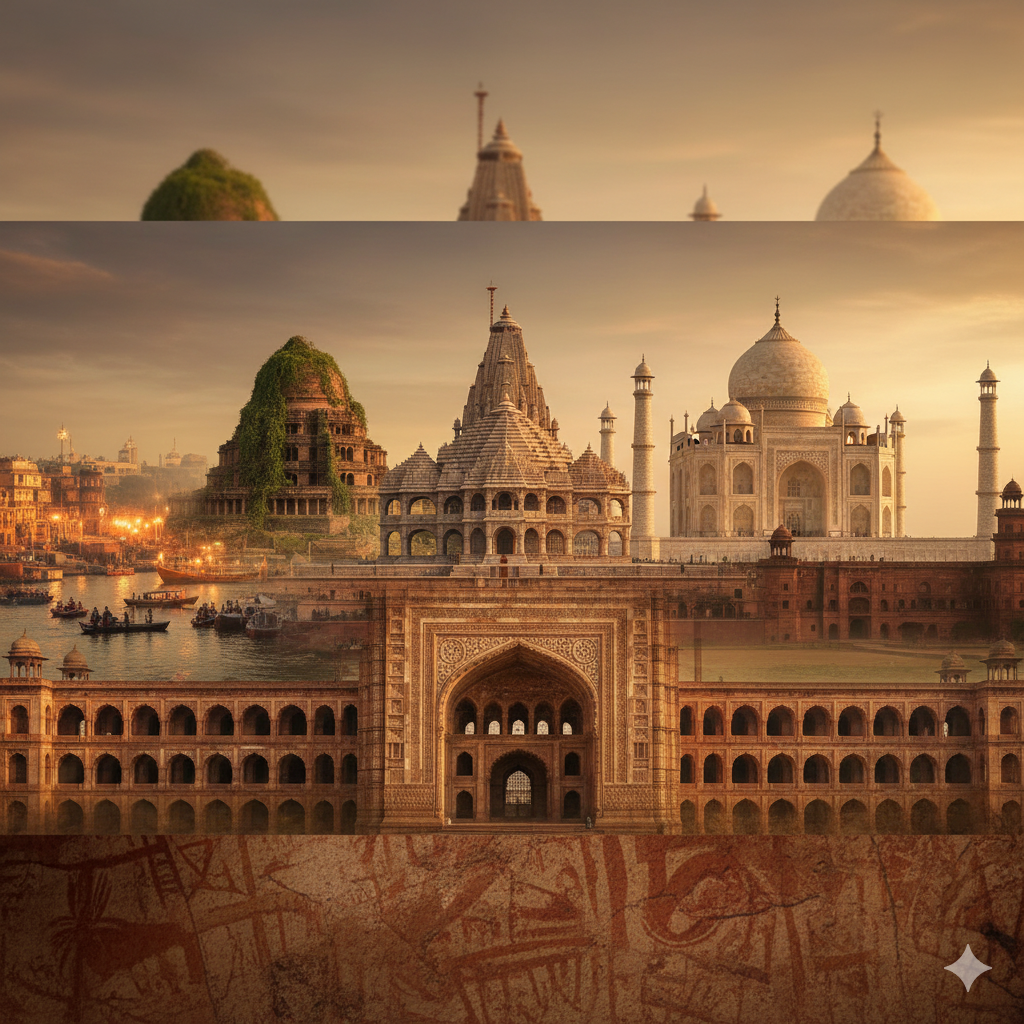
History and Culture of Uttar Pradesh
Uttar Pradesh is one of the most historically and culturally rich states of India. For thousands of years, it has served as the centre of Indian civilization, religion, politics, art, and culture. The state is globally known for its heritage, traditions, and historical sites that reflect ancient, medieval, and modern developments.
History of Uttar Pradesh
1. Ancient Period (Prehistoric Era to 12th Century)
Prehistoric Era
- Archaeological remains from the Paleolithic and Neolithic ages have been found in various parts of Uttar Pradesh.
- Cave paintings in Sonbhadra and Mirzapur confirm the presence of ancient civilizations.
Vedic Age
- Uttar Pradesh was the centre of Vedic civilization.
- Important ancient cities like Ayodhya, Mathura, and Kashi are mentioned in Vedic literature.
- Events from the Ramayana and Mahabharata are associated with this region.
- After the Kurukshetra War, the Pandavas were connected to Hastinapur (present-day Meerut).
Buddhism and Jainism
- Gautama Buddha delivered his first sermon at Sarnath (Varanasi).
- Kushinagar is where Buddha attained Mahaparinirvana.
- Many Jain Tirthankaras were born in Uttar Pradesh.
- Sravasti, Kaushambi, and Sankisa were major centres of Buddhism.
Ancient Empires
- During the Maurya Empire (Chandragupta & Ashoka), the region became a centre of strong administration and culture.
- During the Gupta Empire (4th–5th century), Uttar Pradesh witnessed a golden age.
- Prayag (Prayagraj) and Varanasi were major centres of education and culture.
2. Medieval Period (12th to 18th Century)
Delhi Sultanate and Mughal Empire
- Muslim rulers began establishing power in the 12th century.
- Agra became the main centre of the Mughal Empire.
- The region developed immensely under Akbar, Jahangir, Shah Jahan, and Aurangzeb.
- Architectural wonders like the Taj Mahal, Fatehpur Sikri, and parts of the Red Fort symbolize this era.
Cultural Contribution
- Music, dance, and painting flourished during the Mughal period.
- Legendary musician Tansen made significant contributions to Hindustani classical music.
3. Modern Period (18th Century to India’s Freedom Struggle)
Nawabi Period of Awadh
- Lucknow became the cultural centre under the Nawabs of Awadh.
- They promoted arts, literature, music, and architecture.
- Structures like Bada Imambara and Chikankari embroidery represent the Nawabi heritage.
War of Independence 1857
- The First War of Indian Independence started in Uttar Pradesh.
- The Sepoy Mutiny broke out in Meerut.
- Freedom fighters like Rani Lakshmibai of Jhansi, Nana Saheb of Kanpur, and Begum Hazrat Mahal of Awadh played crucial roles.
Modern Education and Culture
- Banaras Hindu University (BHU) made the region a major hub of modern education.
Culture of Uttar Pradesh
The culture of Uttar Pradesh is a blend of diverse religions, traditions, folk arts, languages, spirituality, and festivals, making it one of India's richest cultural landscapes.
1. Religious Culture
Hinduism
- Ayodhya – Birthplace of Lord Rama
- Mathura – Birthplace of Lord Krishna
- Varanasi – One of the oldest living cities and the abode of Lord Shiva
Buddhism
- Sarnath – Place where Buddha gave his first sermon
- Kushinagar – Place of Buddha’s Mahaparinirvana
Islam
- The Mughal and Nawabi eras enriched Islamic art and culture.
- Historical mosques in Lucknow and Agra reflect this heritage.
Jainism
- Sravasti and other ancient places are important Jain pilgrimage sites.

Featured Amazon Product
High-quality and reliable product with excellent performance and customer satisfaction. A great choice for everyday use with good value for money.
👉 Buy Now on Amazon2. Folk Arts and Traditions
Folk Dance and Music
- Kathak – The classical dance form that originated in Lucknow and Varanasi.
- Popular folk songs include Biraha, Kajri, Hori, and Alha.
- Legendary musicians like Tansen and Ustad Bismillah Khan belong to Uttar Pradesh.
Handicrafts and Arts
- Banarasi Sarees (Varanasi)
- Chikankari Embroidery (Lucknow)
- Marble Craft (Agra)
3. Food of Uttar Pradesh
- Lucknowi Kebabs and Awadhi Biryani
- Peda from Mathura, Petha

Geographical Features of Uttar Pradesh
Uttar Pradesh is a vast and diverse state located in northern India. Its geographical features include fertile plains, forests, hills, river systems, and mineral-rich plateaus. These features influence the state’s climate, vegetation, natural resources, agriculture, and overall lifestyle.
1. Location and Area
- Latitude & Longitude: 23°52’N to 30°24’N latitude and 77°05’E to 84°38’E longitude
- Total Area: 2,43,286 sq. km (about 7.33% of India’s area)
Boundaries
- North: Uttarakhand and Nepal
- East: Bihar
- West: Haryana, Rajasthan and Delhi
- South: Madhya Pradesh and Chhattisgarh
2. Geographical Divisions
Uttar Pradesh can be divided into three major geographical regions:
(i) Terai and Bhabar Region
- Located at the foothills of the Himalayas
- Fertile soil known as Bhabar and Terai
- Rich in dense forests and wildlife
- Major rivers: Saryu, Ghaghra, Rapti
- Highly significant for agriculture
(ii) Ganga–Yamuna Plains
- The largest and most fertile region of the state
- Formed by alluvial deposits of Ganga, Yamuna, Ghaghra, and Gomti
- Called the “Agricultural Bowl of India”
- Main crops: wheat, rice, sugarcane, pulses
- Flat and well-irrigated terrain
(iii) Vindhyachal & Bundelkhand Plateau
- Located in the southern part of Uttar Pradesh
- Rocky and less fertile soil
- Major districts: Jhansi, Chitrakoot, Banda, Sonbhadra
- Rich in minerals
3. River System
(i) River Ganga
- Main river of Uttar Pradesh
- Enters from Haridwar (Uttarakhand)
- Meets Yamuna and Saraswati at Prayagraj
- Major cities on banks: Varanasi, Kanpur
(ii) Yamuna River
- Main tributary of Ganga
- Flows through Agra, Mathura, Prayagraj
(iii) Saryu & Ghaghra Rivers
- Saryu flows near Ayodhya (religious importance)
- Ghaghra supports agriculture in eastern UP
(iv) Gomti & Rapti Rivers
- Gomti flows through Lucknow
- Rapti irrigates areas around Gorakhpur
4. Climate
Uttar Pradesh has a Tropical Monsoon Climate.
(i) Summer
- March to June
- Temperature: 25°C to 45°C
- Western area remains hotter
(ii) Monsoon
- July to September
- Rainfall: 800 mm to 1200 mm annually
- Terai region receives higher rainfall
(iii) Winter
- November to February
- Temperature: 3°C to 20°C
- Fog and cold waves are common
5. Soil and Agriculture
Types of Soil
- Alluvial Soil: Covers Ganga–Yamuna plains; highly fertile
- Red Soil: Found in Bundelkhand & Vindhya region; high iron content
- Black Soil: Limited presence; suitable for cotton
Agriculture
- About 70% population depends on agriculture
- Main crops: wheat, rice, sugarcane, potatoes, pulses, oilseeds
- UP is India’s largest sugarcane producer
6. Flora and Fauna
Vegetation
- Terai forests: Sal, Rosewood, Bamboo
- Central & southern areas: shrubs and bushes
Wildlife
- Dudhwa National Park (Lakhimpur Kheri)
- Home to tigers, deer, and rare birds
- Chambal River has gharials and dolphins
7. Mineral Resources
- Sonbhadra: Coal, limestone, dolomite
- Mirzapur: Silica, sandstone
- Jhansi: Granite, limestone
8. Economic Activities
- Agriculture-based economy
- Sugar mills, brass industry (Moradabad), silk (Varanasi)
- Tourism and handicrafts contribute to the service sector
Conclusion
The geographical features of Uttar Pradesh make it one of India’s most important states. Fertile soil, abundant water resources, minerals, and diverse climate support agriculture, industry, and tourism. This geographical diversity influences the state’s culture, economy, and social life.

Top Amazon Product
Premium-quality product with excellent performance and reliable durability — ideal for everyday use and excellent value for money.
👉 Buy Now on AmazonEconomy of Uttar Pradesh
Uttar Pradesh, the most populous state in India, has a diverse and rapidly expanding economy. Agriculture, industry, services, handicrafts, and tourism form the backbone of its economic structure.
1. Gross State Domestic Product (GSDP)
- GSDP (2023–24): Approx. ₹23 lakh crore
- UP is India’s third-largest economy
- Growth rate: 6% to 7% in recent years
2. Major Sectors of the Economy
(i) Agriculture and Allied Activities
- 70% population depends on agriculture
- Main crops: wheat, rice, maize, sugarcane, pulses, oilseeds
- Vegetables & fruits: potatoes, tomatoes, mangoes (Langra, Dussehri)
Irrigation
- Rivers: Ganga, Yamuna, Ghaghra, Gomti
- Canals, tubewells, wells are major irrigation sources
(ii) Industry
Agro-Based Industries
- 119 sugar mills
- Largest sugarcane and sugar producer in India
- Jute and cotton-based industries
Handicrafts and Cottage Industries
- Varanasi: Banarasi sarees and silk
- Lucknow: Chikankari embroidery
- Moradabad: Brass utensils and decorative items
- Firozabad: Glass and bangles
- Bhadohi: Carpet industry
Manufacturing
- Kanpur: Leather industry
- Agra: Footwear manufacturing
- Allahabad & Noida: Heavy industries and industrial hubs
IT & Electronics
- Noida & Greater Noida are growing IT hubs
- Companies like Samsung, TCS, and HCL operate here
(iii) Service Sector
- Tourism is a major revenue source
- Major destinations: Agra (Taj Mahal), Varanasi, Ayodhya, Mathura, Prayagraj
- Educational hubs: AMU, BHU
- Healthcare and banking services expanding rapidly
3. Major Economic Activities
(i) Mineral Wealth & Energy Production
- Coal, limestone, dolomite in Sonbhadra & Mirzapur
- Sand and sandstone mining
- Hydroelectric & thermal power plants
- Growing solar energy capacity
(ii) Construction & Infrastructure
- Rapid expansion of roads, railways, metro networks
- Major projects: Purvanchal Expressway, Bundelkhand Expressway
- Urban development in Lucknow, Noida, Kanpur
(iii) Exports
- Major exports: leather, carpets, brass items, agricultural products
- Moradabad’s brass and Bhadohi’s carpets famous worldwide
4. Economic Challenges
- High unemployment
- Excessive dependence on agriculture
- Need for improved industrial investment
- Infrastructure gaps in rural areas
- Urban–rural development imbalance
5. Government Initiatives
- Promotion of industrial units & MSME sector
- Subsidies & reforms in agriculture
- Development of tourism infrastructure
- Improvement in healthcare & education
6. Future Prospects
- Increasing investment opportunities
- Growth of industrial corridors (including DMIC)
- Rise of Digital UP and IT infrastructure
- Boost in food processing & agro-industries
Conclusion
The economy of Uttar Pradesh is grounded in agriculture but rapidly growing through industry and services. With effective policy implementation, improved infrastructure, and rising investments, the state has the potential to become one of India’s leading economic powerhouses.
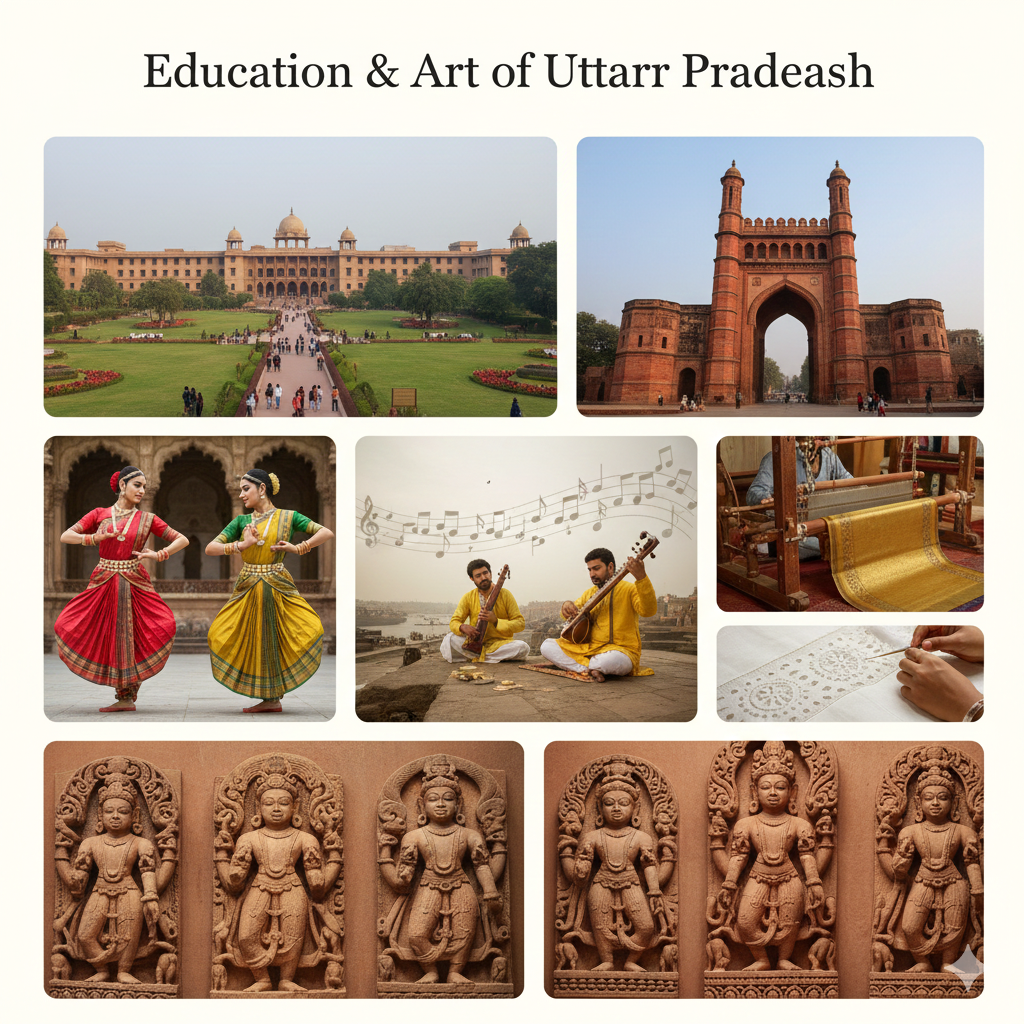
Education and Art in Uttar Pradesh
Uttar Pradesh is a major cultural and educational centre of India. The state's education system, artistic traditions, literature, music, and handicrafts reflect its rich historical and cultural identity. Uttar Pradesh has played a leading role in shaping India’s educational and artistic heritage.
1. Education
(i) History of Education
Uttar Pradesh has a long and prestigious educational history. Ancient centres like Varanasi (Kashi), Allahabad (Prayagraj), and Mathura were significant hubs of religious, cultural, and intellectual learning. These places contributed enormously to ancient Indian education.
(ii) Current Scenario of Education
The education sector in Uttar Pradesh is continuously improving, although challenges remain. The goal is to provide quality education to every child in the state.
School Education
- The state has a wide network of government and private schools.
- Primary Education: Government schools have a higher enrolment.
- Secondary Education: Private schools play an increasingly important role.
- UP Board Examinations: Lakhs of students appear every year for Class 10 and 12. UP Board is one of the largest education boards in India.
Major Universities and Educational Institutions
- Banaras Hindu University (BHU), Varanasi: One of India’s largest and most prestigious universities.
- Aligarh Muslim University (AMU), Aligarh: Renowned for excellence in science, humanities, literature, and arts.
- University of Allahabad: Known for its historical academic tradition.
- Lucknow University: A major educational hub offering diverse courses.
- IIT Kanpur: One of India's top engineering and research institutes.
- Mahatma Gandhi Kashi Vidyapeeth, Kanpur University and many other institutions contribute significantly to higher education.
New Education Policies and Reforms
- Mid-Day Meal Scheme: Provides nutritious meals to children in government schools.
- Teacher Training & Career Development: Programmes to improve teacher quality and skills.
- Digital Education: Implementation of e-learning, smart classes, and digital resources.
(iii) Challenges
- Teacher Shortage: Lack of qualified teachers in some rural areas.
- Poor Infrastructure: Inadequate facilities in remote and rural schools.
- Women’s Education: Need to further promote female literacy, though improvements are visible.
2. Art
Uttar Pradesh has a rich and diverse artistic heritage. From classical music to dance, painting, sculpture, literature, and handicrafts, the state has made remarkable contributions to Indian and global culture.
(i) Music and Dance
Hindustani Classical Music
- Uttar Pradesh is a major centre of Hindustani classical music.
- Cities like Varanasi, Allahabad, and Lucknow have produced many great musicians.
Kathak Dance
- Kathak, a classical dance form, originated in Uttar Pradesh.
- Popular in Lucknow, Varanasi, and Mathura.
- Lucknow Gharana is world-famous for Kathak.
Notable Musicians & Artists
- Ravindra Jain
- Ustad Rashid Khan
- Ustad Bismillah Khan (from Varanasi)
- Poets like Sandeep and Alok Srivastava
(ii) Painting and Sculpture

Top Amazon Product
Premium quality and highly rated product with excellent performance and durability — ideal for everyday use and value for money.
👉 Buy Now on AmazonPaintings
- Kashi School of Painting: Represents Varanasi’s ancient artistic tradition.
Sculpture
- Mathura Sculpture: Ancient Mathura was a major centre of sculpture and idol-making.
- Ayodhya and Mathura were known for unique stone carvings.
(iii) Handicrafts and Cottage Industries
- Banarasi Sarees: World-famous silk sarees from Varanasi.
- Lucknowi Chikankari: Renowned embroidery craft of Lucknow.
- Bhadohi Carpets: Famous globally for hand-woven carpets.
- Agra Marble Work: Known for fine marble craftsmanship.
(iv) Literature and Poetry
Uttar Pradesh has produced many renowned poets and literary figures.
- Vinoba Bhave
- Hazari Prasad Dwivedi
- Maithili Sharan Gupt
- Pandit Jawaharlal Nehru
- The tradition of Urdu poetry in Lucknow remains deeply influential.
(v) Drama and Theatre
- Folk dances, folk songs, and traditional plays are popular across the state.
- Lucknow has a rich history of classical dramas and theatre performances.
Conclusion
The history of education and art in Uttar Pradesh is deeply rooted in tradition and cultural richness. Its educational institutions, artistic heritage, literature, and handicrafts have shaped not only the cultural identity of the state but also that of India and the world. With continuous reforms and initiatives, Uttar Pradesh is emerging as a major centre of education and culture.
Population of Uttar Pradesh (2021)
The Census of India 2021 has not been fully released yet, but estimates suggest that the population of Uttar Pradesh in 2021 is approximately 240 million.
According to the 2011 Census, Uttar Pradesh had a population of 19.98 crore (199,812,341), making it the most populous state in India.
Population Growth of Uttar Pradesh
Uttar Pradesh remains the most populous state in India, although its population growth rate has gradually declined over recent decades. This decline is the result of successful development initiatives and family planning programmes implemented across the state.
Population Density (2011)
- Population density: 828 persons per sq. km, which is among the highest in India.
Population Structure
Sex Ratio
- According to the 2011 Census, the sex ratio of Uttar Pradesh was 912 females per 1000 males.
- This figure is lower compared to many other Indian states.
Urban and Rural Population
- Rural Population: A large majority of people in UP live in rural areas.
- Urban Population: Urbanisation is increasing, especially in Noida, Lucknow, Kanpur, Varanasi, and Agra.
Conclusion
The population of Uttar Pradesh forms a significant portion of India's total population. Effective development planning requires continued attention to health, education, resource distribution, and population management.
Lok Sabha Seats of Uttar Pradesh
As India’s largest state by population, Uttar Pradesh holds the highest number of Lok Sabha seats among all Indian states.
Total Lok Sabha Seats
- 80 Lok Sabha seats – the highest in India.
- This represents a major share of the total 545 seats in the Indian Parliament.
- UP is followed by Maharashtra (48 seats) and West Bengal (42 seats).
Political Importance
- Major political parties contest vigorously for these seats.
- BJP, SP, Congress, BSP, Apna Dal, and other regional parties have strong influence.
- The large number of seats make UP a decisive factor in forming the central government.
Impact on General Elections
Uttar Pradesh plays a decisive role in national elections. Any political party aiming to form a government at the Centre must perform strongly in this state.
State Flower of Uttar Pradesh
Rajnigandha (Tuberose)
- Scientific Name: Polianthes tuberosa
- Rajnigandha is a fragrant white flower, though some light-pink varieties exist.
- Widely used in weddings, festivals, and traditional ceremonies.
- Represents the beauty and cultural identity of Uttar Pradesh.
State Animal of Uttar Pradesh
Indian Rhinoceros (One-Horned Rhino)
- Scientific Name: Rhinoceros unicornis
- Found mainly in India and Nepal.
- In Uttar Pradesh, it is found especially in Dudhwa National Park.
- Known for its single large horn and thick skin.
- The species is protected and its population is increasing.
- Symbolizes the biodiversity and wildlife richness of the state.
State Bird of Uttar Pradesh
Sarus Crane
- Scientific Name: Antigone antigone
- The tallest flying bird in the world, known for its long legs and red-crowned head.
- Found largely in wetlands and marshy areas across Uttar Pradesh.
- Known for strong pair bonding—Sarus Cranes mate for life.
- A symbol of natural heritage and environmental harmony in the state.

Top Amazon Product
Premium quality and highly rated product with excellent performance and durability — ideal for everyday use and superb value for money.
👉 Buy Now on AmazonReferences
- Bhatia, S.R. & Aggarwal, R.C. Geography of India. Tata McGraw-Hill Education, 2015.
- R.C. Majumdar. History of Medieval India. Bharatiya Vidya Bhavan, 2006.
- Chandra, Satish. Medieval India: From Sultanat to the Mughals. Har-Anand Publications, 2007.
- Singh, Rana P.B. The History and Culture of Uttar Pradesh. National Book Trust, 2010.
- Sharma, R.S. Ancient India and Indian Civilization. Macmillan, 2005.
- Government of Uttar Pradesh Official Portal: up.gov.in
- Census of India 2011 & 2021 Estimates: censusindia.gov.in
- India Tourism – Uttar Pradesh: incredibleindia.org
- Banaras Hindu University (bhu.ac.in), Aligarh Muslim University (amu.ac.in)