
Introduction: My Beginning and the Purpose of This Essay
I never imagined that history would become a mirror for my own life. As a child, an old, faded map and my grandfather’s stories sketched an image of a world divided — a place where nations moved like chess pieces and ordinary people felt the tremors of decisions made far above their heads. Those stories were full of fear, hope, and the human cost hidden behind diplomatic language. They planted a curiosity in me: how do grand political struggles translate into small, lived realities?
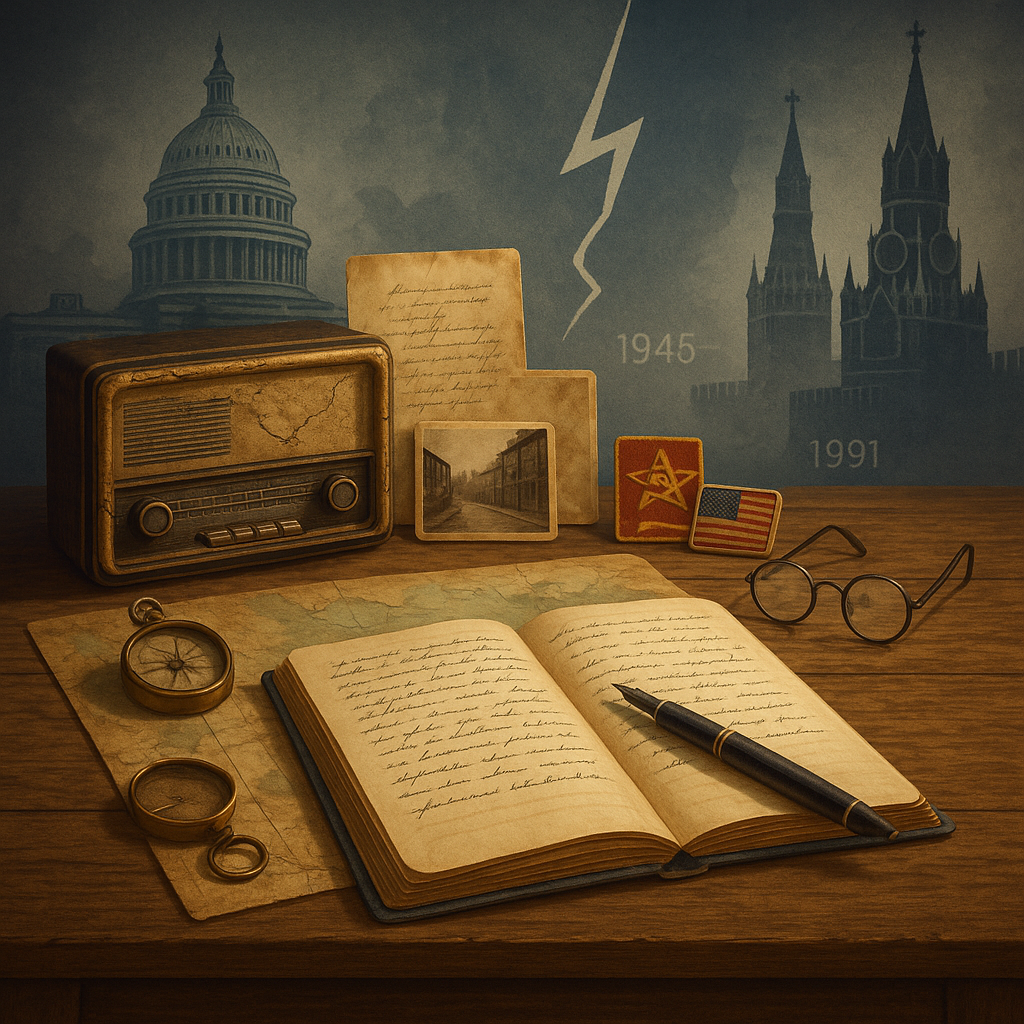
Years later, a visit to a Cold War exhibit transformed that curiosity into a calling. I stood before a brittle letter, a cracked radio, and a photograph of a silent street, and I felt the past press close. I read speeches, sifted through memoirs, and listened to accounts from people who’d lived through the era — soldiers, parents, factory workers, and scientists. Each account added texture: the Cold War stopped being an abstract rivalry and became a series of human choices, errors, and moments of courage.
This essay is the product of those experiences and investigations. It is not just a chronological retelling of events; it is an attempt to weave personal memory with factual history so that the lessons of the U.S.–Soviet competition become relevant to readers today. By mixing narrative with analysis, I aim to show that the Cold War’s greatest value is not merely in dates and treaties but in the policy and moral lessons it offers—lessons about leadership, risk, innovation, and the cost of confrontation.
Throughout this piece, I intersperse my own anecdotes with concise historical context. After each personal vignette, I provide an analytical note: what the episode reveals about diplomatic decision-making, strategic thinking, or societal impact. This approach allows the reader both to travel through memory and to pause for critical reflection. My goal is to ensure that emotional resonance and empirical clarity reinforce one another rather than compete for attention.
Another important aim is accessibility. While this is a long-form essay, I’ve organized it with clear sections and headings so that students, enthusiasts, and policymakers can jump to parts most relevant to them. I also include concrete takeaways and practical suggestions—reading lists, research methods, and steps for applying historical lessons to contemporary problems—so that the essay is not merely informative but actionable.
Finally, I make no claim to exhaustiveness. The Cold War is vast, and any one writer’s perspective is inevitably partial. What I offer instead is a lens: a way of looking that privileges human stories and pragmatic lessons. Where I make factual claims, they are grounded in well-documented events; where I offer interpretation, I try to be explicit about the reasoning behind it.
If you approach history as a resource for understanding the present and shaping the future, this essay is for you. In the sections that follow we will sketch the Cold War’s outline, examine competing ideologies and strategies, and then move into personal episodes that illuminate broader truths. Each segment ends with a short reflection meant to help you draw policy-relevant and moral lessons from the past.
Background: An Overview of the Cold War
The end of the Second World War reshaped the world not only territorially but politically, socially, and ideologically. By 1945, two superpowers emerged with sharply contrasting visions for the future. The United States championed a liberal, market-driven democratic model, while the Soviet Union represented a centralized socialist system built on state control and ideological discipline. Between these poles began a prolonged struggle that historians later named the Cold War—a conflict fought not through direct large-scale battles but through influence, strategy, and competition across nearly every domain of human affairs.
Origins (1945–1949): Seeds of Suspicion and Division
The wartime alliance between the U.S. and the Soviet Union quickly unraveled as soon as the common enemy—Nazi Germany—was defeated. Despite the hopeful tone of the Yalta and Potsdam Conferences, differences over Eastern Europe, reconstruction, and global security frameworks generated deep mistrust. The United States introduced the Truman Doctrine and the Marshall Plan to support struggling European nations and prevent the spread of communism. In response, the Soviet Union consolidated its influence over Eastern Europe, establishing a protective buffer zone through socialist-aligned governments. This early phase cemented ideological polarization and set the stage for decades of geopolitical rivalry.
Major Flashpoints and Crises
The Cold War manifested through escalating confrontations, each revealing how fragile the global balance had become. The Berlin Blockade of 1948–49 was the first major crisis, pushing Western powers to undertake the historic Berlin Airlift and proving the West’s determination to resist Soviet pressure. Soon after, the Korean War (1950–53) became the first large-scale military conflict linked directly to Cold War dynamics, with the U.S. and Soviet Union supporting opposing sides, carefully avoiding direct clashes while fueling a devastating regional war.
By the 1960s, the competition expanded into outer space, science, and nuclear weaponry. The launch of Sputnik in 1957 shocked the world and propelled the U.S.–Soviet rivalry into the Space Race. Nuclear tensions peaked with the Cuban Missile Crisis in 1962, arguably the closest the world has ever come to a full-scale nuclear war. For thirteen extraordinary days, humanity stood at the edge of annihilation before diplomacy and cautious decision-making defused the confrontation, leaving a lasting imprint on global nuclear policy.
Proxy Wars and Worldwide Impact
Direct confrontation between the superpowers remained limited due to the immense destructive power of nuclear weapons, but their rivalry spread across Asia, Africa, Latin America, and the Middle East. Vietnam became a symbol of prolonged conflict driven by ideological goals and superpower interventions. In Afghanistan, the Soviet invasion of 1979 triggered another long proxy struggle, with the United States and its allies supporting resistance movements. Similar patterns played out in Angola, Ethiopia, Nicaragua, and many other regions.
These proxy wars brought enormous human suffering, political instability, and economic disruption. Many newly independent countries found themselves caught between competing blocs, forced to choose sides or join the Non-Aligned Movement—a collective attempt to navigate the Cold War without becoming pawns in superpower rivalry.
Political, Economic, and Cultural Dimensions
The Cold War extended far beyond military affairs. It reshaped global economics, media narratives, culture, and even social aspirations. The United States promoted consumer abundance, freedom of expression, and technological innovation as hallmarks of its model. Meanwhile, the Soviet Union emphasized scientific achievements, collective social welfare, and ideological discipline as evidence of socialism’s superiority. Cultural exchanges, propaganda campaigns, Olympic rivalries, and academic competitions became silent battlegrounds of prestige and influence.
The Space Race was especially symbolic—beyond technological bragging rights, it demonstrated the scientific, industrial, and organizational capacities of each system. The race to put the first satellite, first human, and eventually the first steps on the Moon reflected deeper questions about which ideology could better mobilize human potential.
Path Toward De-escalation and the End
The 1970s saw an era of détente, marked by diplomatic rapprochement and arms-control agreements such as the Strategic Arms Limitation Talks (SALT). But détente was fragile. Renewed tensions in the late 1970s and early 1980s—including the Soviet invasion of Afghanistan and intensified military buildups—again raised fears of confrontation. A major turning point came with Mikhail Gorbachev’s ascent to power in the Soviet Union. His reform programs, perestroika (restructuring) and glasnost (openness), sought to modernize the Soviet system but inadvertently accelerated internal dissent and economic instability.
By 1991, national movements, political unrest, and economic pressures culminated in the dissolution of the Soviet Union, marking the official end of the Cold War. The geopolitical landscape was transformed, and the United States stood as the world’s dominant power—but the lessons and legacies of the Cold War continued to influence global politics, military policy, and international relations for decades to come.
Concluding Note
This background provides the essential framework for understanding the deeper stories and insights explored later in this essay. The Cold War was not merely a standoff between two nations—it was a multi-layered contest shaped by ideology, fear, ambition, innovation, and human choices. In the sections that follow, we will connect these historical events with personal reflections, thematic analysis, and contemporary relevance, showing how a conflict fought in the last century still echoes in decisions made today.
Ideologies & Strategies
The Cold War was not merely a political rivalry or a military standoff; it was a deeply rooted ideological conflict that shaped the identities, ambitions, and actions of two superpowers— the United States and the Soviet Union. Their competition unfolded across diplomacy, economics, science, culture, and even the human imagination. To understand the Cold War fully, we must first understand the ideological engines and strategic doctrines that powered it for nearly half a century.
Capitalism vs. Communism: Two Competing Visions
The United States projected a worldview built on capitalism, representative democracy, and individual freedom. Its model emphasized open markets, private enterprise, civil liberties, and a political system based on pluralism and periodic elections. American leaders believed that economic competition and political freedom created the most prosperous and stable societies.
In contrast, the Soviet Union championed communism and a centrally planned economy. Rooted in Marxist-Leninist principles, the Soviet system sought to eliminate private ownership of major industries, redistribute wealth, and establish a classless society. The state played the central role in economic planning, production, and political decision-making. The Soviet leadership believed that this model was more equitable, efficient, and historically destined to prevail.
These opposing visions created not only geopolitical tension but a philosophical divide. Each side believed its system represented the future of human progress, and this belief fueled efforts to spread its ideology around the world. The Cold War thus became a struggle not just for territory or resources but for the hearts and minds of nations.
The Strategy of Containment: The U.S. Response
The cornerstone of American foreign policy during the Cold War was containment. First articulated by diplomat George Kennan, containment aimed to prevent the spread of communism beyond the regions where it already existed. The United States used military alliances, economic aid, political support, and covert operations to strengthen countries vulnerable to communist influence.
Programs such as the Marshall Plan helped rebuild war-torn Europe, ensuring that economic instability did not become an entry point for Soviet ideology. Military alliances like NATO created security frameworks that tied Western nations together. Containment shaped U.S. involvement in key conflicts including Korea, Vietnam, and various Latin American and Middle Eastern struggles.
Soviet Expansion and Influence: The USSR’s Approach

The Soviet Union believed that global capitalism was inherently exploitative and that supporting revolutionary or socialist movements abroad was both a moral duty and a strategic necessity. It sought to expand its influence through political alliances, economic assistance, and military support for socialist governments and liberation movements.
Eastern Europe became the Soviet Union’s primary sphere of influence, secured through satellite states and mutual defense agreements. Beyond Europe, the USSR supported movements in Asia, Africa, and Latin America, seeing these alliances as essential to building a global socialist front. This expansionist approach was often interpreted by the U.S. as aggressive and destabilizing, reinforcing the logic of containment.
Mutual Assured Destruction (MAD): The Nuclear Balance
One of the most defining features of the Cold War was the development of nuclear weapons and the doctrine of Mutual Assured Destruction (MAD). The idea was stark yet stabilizing: if either superpower launched a nuclear attack, the other would respond with devastating force, resulting in the destruction of both. This balance of terror created a paradox— fear of annihilation became the primary reason neither side initiated a direct military confrontation.
The arms race led to the stockpiling of thousands of nuclear weapons, intercontinental ballistic missiles, and submarine-launched systems. Although terrifying, MAD shaped diplomacy, crisis management, and even scientific cooperation throughout the Cold War era.
Soft Power, Culture, and the Battle for Influence
Beyond weapons and ideology, the U.S. and USSR waged a cultural and intellectual battle. The United States promoted Hollywood films, popular music, technological advancement, and consumer culture to demonstrate the appeal of its lifestyle. The Soviet Union emphasized scientific achievements, athletic excellence, literature, and state-supported cultural programs to show the strength of collective effort.
The Space Race became the most visible symbol of this competition. The launch of Sputnik, Yuri Gagarin’s journey into space, and the eventual American moon landing were all ideological statements wrapped in technological achievement.
Conclusion: The Lasting Impact of Ideological Conflict
The ideological and strategic contest between the United States and the Soviet Union transformed global politics. It shaped alliances, fueled wars, inspired social movements, and influenced technological innovation. These rival visions—one emphasizing individual freedom and markets, the other promising equality through state control—created a dynamic tension that defined an entire era.
Understanding these ideologies and strategies is crucial, because they continue to influence international relations even today. In the next sections, we will connect these historical frameworks with real events, personal reflections, and lessons that remain relevant for modern diplomacy and global cooperation.
Personal Narratives — My Experiences and the Lessons They Taught Me
The Cold War may feel like a distant historical chapter, but for me, it has always been a living story—shaped by the people I met, the books I read, and the moments that shifted my understanding of global politics. Below are four personal anecdotes that deepened my connection to the U.S.–Soviet rivalry and helped me see its human, emotional, and practical dimensions.
Anecdote 1: The Day I First Understood “Two Worlds”
I still remember a classroom moment that changed how I thought about global politics. My history teacher drew two large circles on the blackboard—one labeled “USA,” the other “USSR.” Then he said, “These are not just countries; they are visions of what the world could be.”
That simple sentence stayed with me. That evening, confused yet curious, I asked my grandfather, “Which one was right?” He smiled gently and replied, “History is not about who is right. It is about who believed what—and why.”
For the first time, I understood that the Cold War was not merely a standoff but an ideological conflict between capitalism and communism. I felt as though two different lenses were placed before my eyes, reshaping how I looked at nations, societies, and choices.
Lesson: Ideologies are not abstract theories. They shape governments, influence ordinary lives, and determine how nations behave under pressure. Understanding them helps us understand the motivations behind global conflicts.
Anecdote 2: A Broken Radio in a Museum
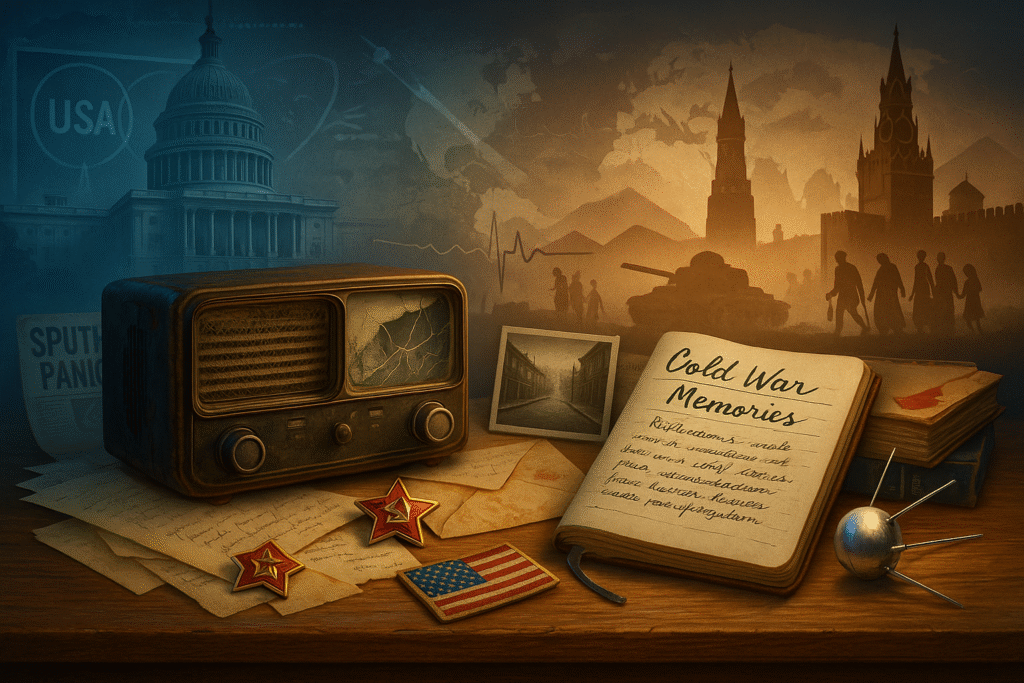
Years later, during a visit to a modern history museum, I came across an object that froze my steps—a cracked, old radio encased in glass. The label beside it read: “This radio broadcasted the first news of the Cuban Missile Crisis to a family who remained indoors for an entire week.”
I stood silently, imagining that family—children frightened, parents whispering, streets empty. Global politics suddenly felt painfully intimate. Decisions made in Washington or Moscow were not just diplomatic moves; they sent waves of fear that rippled across millions of homes.
That radio became a symbol for me—an object that held the echo of fear, uncertainty, and the fragile thread of hope that people cling to during geopolitical storms.
Lesson: Political decisions at the highest levels have very real human consequences. The Cold War taught the world that leadership is not only strategy—it is responsibility.
Anecdote 3: The Story of “Sputnik” and a Spark of Inspiration
During a college science project, I explored the history of Sputnik, the first artificial satellite launched by the Soviet Union in 1957. Watching original footage and reading accounts from scientists on both sides felt like stepping into a moment that shook the world.
My professor explained how Americans panicked, fearing that the USSR had surpassed them technologically. Yet this panic sparked an extraordinary transformation—massive investment in science, engineering, and education. NASA was born. Within 12 years, humans walked on the Moon.
This story struck me deeply. Competition—when balanced by discipline—can create extraordinary progress. Sputnik was not just a metal sphere; it was a catalyst for innovation, ambition, and global scientific awakening.
Lesson: Rivalry can be destructive, but it can also push societies toward their highest potential. The Cold War’s technological race is proof that fear, when channeled wisely, becomes fuel for advancement.
Anecdote 4: The Afghan Conflict Through a Friend’s Eyes
One of the most personal lessons from the Cold War came from a friend I met during my studies—an Afghan student whose family had lived through the Soviet-Afghan war of 1979. His stories were raw, painful, and unforgettable.
He described how tanks rolled past his village, how families hid in mountains for safety, and how his grandmother still trembled when recalling those nights. “For the world, it was the Cold War,” he said quietly. “For us, it was survival.”
That conversation changed me. I realized that proxy wars—often treated as strategic chess moves in textbooks—were devastating realities for the people trapped in them. He taught me that the Cold War was not fought only in diplomatic meetings or ideological speeches; it carved scars on real lives.
Lesson: Proxy conflicts show the tragic cost of geopolitical rivalry. They remind us that the weakest nations often pay the highest price in great-power competitions.
The Collective Impact of These Experiences
Together, these personal encounters shaped my understanding of the Cold War in a way no textbook could. They taught me that the U.S.–Soviet rivalry was a global story woven from fear, ambition, innovation, ideology, and deep human suffering.
These episodes also helped me see leadership differently: great powers are not just makers of policy—they are shapers of lives. The stakes of their decisions extend far beyond their borders and into the dreams and fears of ordinary people.
As we proceed to the next sections, these experiences will serve as a bridge—connecting historical events with human emotions and transforming abstract theories into meaningful lessons for today’s world.
Key Themes & Analysis
The Cold War was far more than a strategic rivalry; it was a multilayered struggle shaped by leadership, ideology, technology, fear, hope, and human experience. The United States and the Soviet Union influenced global politics so profoundly that their decisions continue to echo in today’s geopolitical landscape. In this section, we explore the major themes that define the essence of the U.S.–Soviet competition and the lessons embedded within it.
Leadership and the Burden of Decision-Making
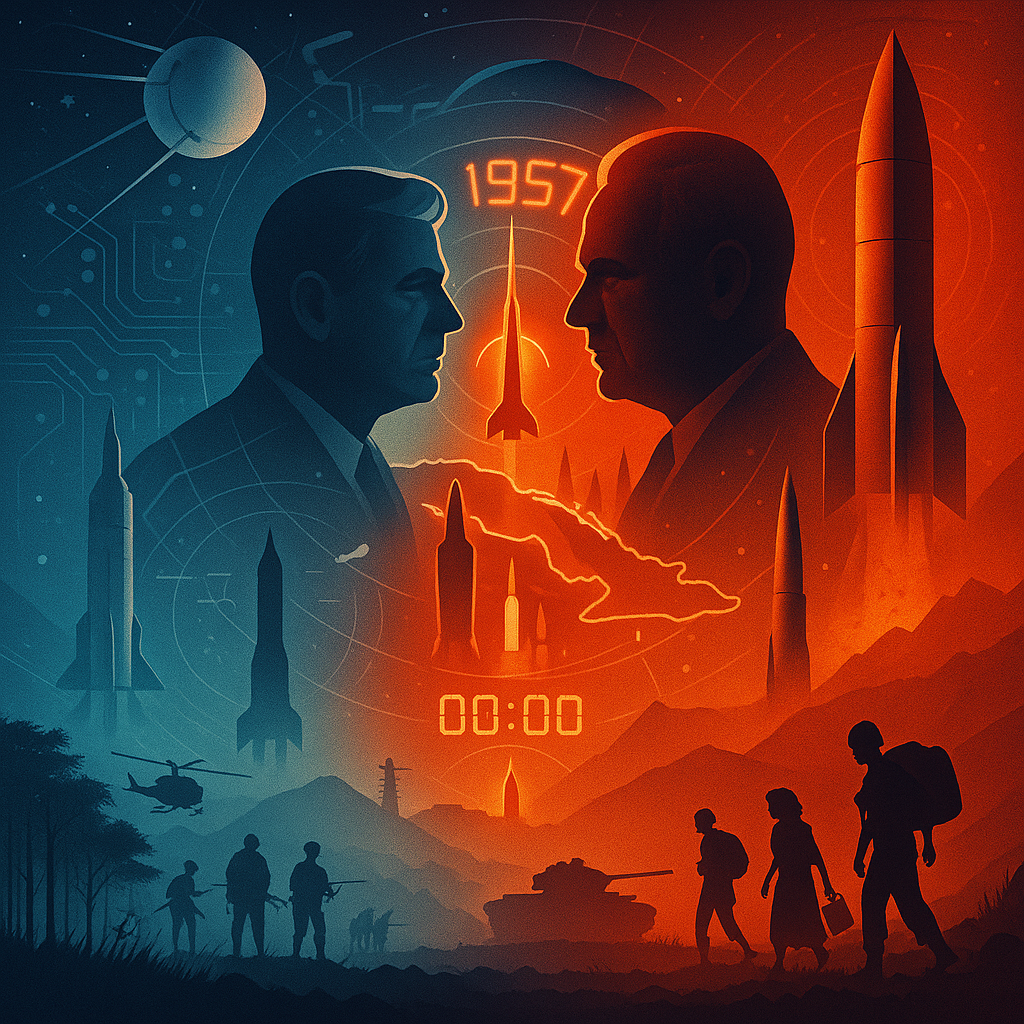
At the heart of the Cold War were leaders who faced extraordinary pressure. Crises such as the Berlin Blockade, the Korean War, and most dramatically, the Cuban Missile Crisis forced leaders like John F. Kennedy and Nikita Khrushchev to make decisions that could either preserve peace or unleash catastrophe.
The Cuban Missile Crisis is perhaps the clearest example. For thirteen tense days in 1962, the world hovered on the brink of nuclear war. One miscalculation could have led to unimaginable destruction. The crisis demonstrated that leadership during high-stakes moments demands not only strategic brilliance but emotional restraint, empathy, and the ability to understand an opponent’s fears and motivations.
Analysis: The Cold War teaches us that leadership is not about demonstrating power alone. It is about balancing firmness with diplomacy, confidence with caution, and national interest with global responsibility.
Technological Competition and the Race for Innovation
No era illustrates the power of technological rivalry better than the Cold War. The Space Race, nuclear arms development, and military advancements were not just scientific milestones—they were symbols of ideological supremacy. When the Soviet Union launched Sputnik in 1957, it shocked the world and sparked a technological renaissance in the United States.
This competition accelerated advancements in aerospace engineering, physics, computing, satellite communication, and missile technology. The Cold War’s technological push ultimately gave birth to innovations that people use daily today—GPS, early computer systems, global telecommunications, and even foundational work that led to the internet.
Analysis: Rivalry can be a catalyst for progress. The Cold War proves that competition, when channeled constructively, drives nations to achieve scientific breakthroughs and expand the boundaries of human potential.
Proxy Wars: The Human Cost of Geopolitical Ambitions
While the U.S. and USSR avoided direct conflict, their rivalry spilled into countries across Asia, Africa, and Latin America. Nations like Korea, Vietnam, Angola, and Afghanistan became battlegrounds for ideological influence, with devastating consequences for their populations.
Millions of civilians were displaced or killed as local conflicts were fueled by foreign funding, weapons, and political manipulation. For the superpowers, these wars were strategic calculations. For the affected nations, they were matters of survival, trauma, and long-term instability.
Analysis: The Cold War reveals a harsh truth: global power struggles often exact their highest toll on nations that are least equipped to bear the burden. It underscores the ethical responsibility of major powers to consider humanitarian consequences—not just strategic outcomes.
Information Warfare, Propaganda, and Cultural Competition
The Cold War shaped not only military and political strategies but also narratives, culture, and public imagination. Hollywood films, jazz music, and American consumer culture became tools of soft power. Meanwhile, the Soviet Union used literature, ballet, Olympic dominance, and scientific achievements to showcase the strength of socialism.
Media and propaganda played critical roles in framing public perception. Each side sought to portray itself as morally superior, technologically advanced, and socially progressive. This created a symbolic battlefield where culture, values, and ideas became strategic weapons.
Analysis: The Cold War demonstrates that influence is not achieved only through armies and weapons. Cultural power—the ability to shape beliefs and aspirations—can be equally decisive in global competition.
Global Alliances and the Reshaping of World Order
The Cold War redefined international diplomacy. NATO and the Warsaw Pact became symbols of an ideologically divided world. Non-Aligned nations attempted to chart their own course, resisting pressure to join either bloc. International institutions such as the United Nations became arenas where ideological battles were fought through resolutions, debates, and diplomatic maneuvers.
The global map of alliances shaped military strategies, economic partnerships, and political identities. Many of these geopolitical structures still influence today’s world, from modern NATO operations to contemporary debates about global security.
Analysis: Alliances formed during the Cold War highlight how national interests, geography, and external pressures combine to shape foreign policy. The era teaches us that diplomacy must constantly adapt to shifting power dynamics.
Concluding Reflection
The key themes of the Cold War—leadership, technology, cultural influence, ideological conviction, and human suffering—formed the foundation of a global transformation. These themes remind us that the Cold War was not merely a clash of empires but a test of human judgment, resilience, and imagination.
By studying these ideas, we gain more than historical knowledge—we gain insight into how nations think, how fear shapes policy, how innovation emerges from competition, and how humanity must navigate power responsibly. In the next sections, we will connect these themes to contemporary relevance and practical lessons for the world we live in today.
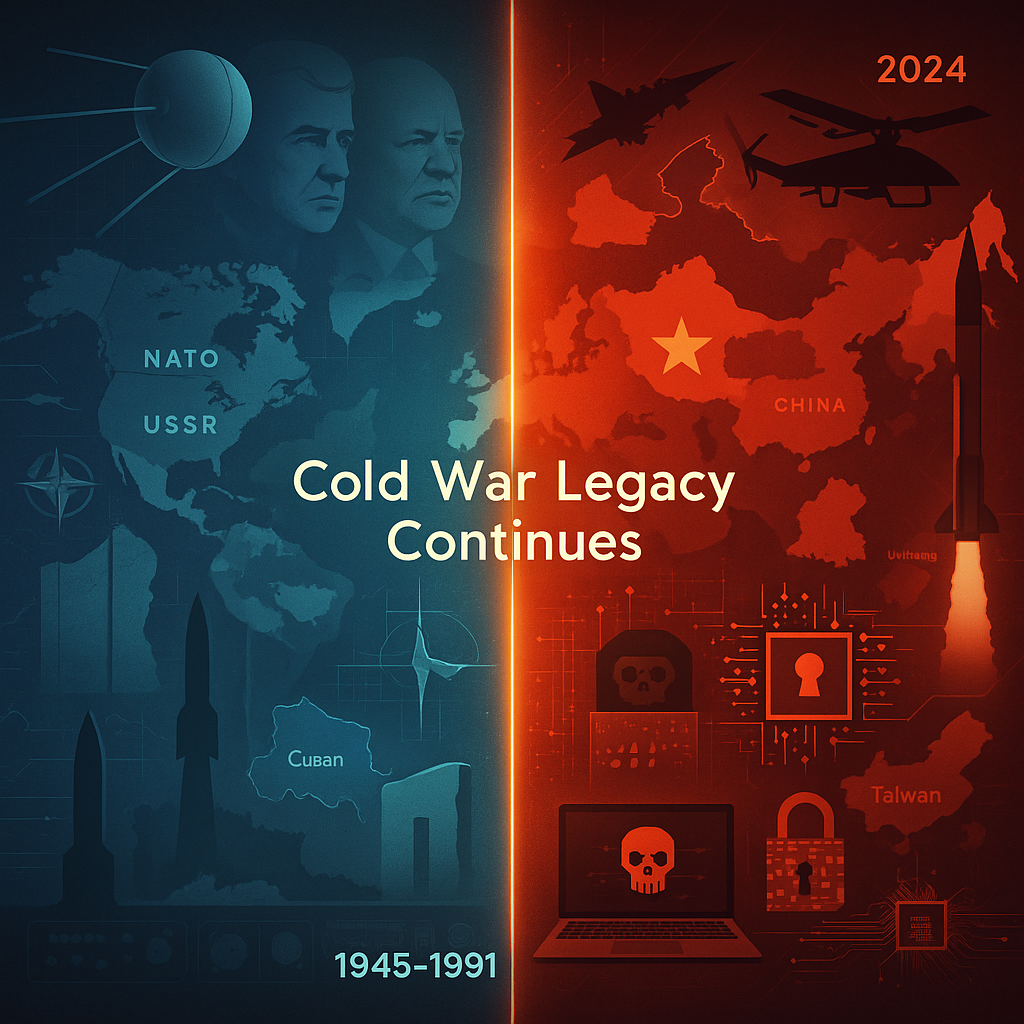
Relevance Today: Why the Cold War Still Matters
Although the Cold War officially ended more than three decades ago, its legacy continues to shape the modern world. The ideas, strategies, institutions, and security frameworks that emerged during the U.S.–Soviet rivalry remain central to today’s geopolitical environment. Understanding the Cold War is not an academic exercise—it is a key to understanding the tensions, alliances, and technological battles of the 21st century.
Great-Power Competition Has Re-Emerged
While the ideological battle of capitalism versus communism is no longer as sharp, competition among major powers has returned in new forms. The United States and Russia still clash over NATO expansion, Ukraine, cyber security, and influence in Eastern Europe. Meanwhile, China’s rise has created a new axis of competition that resembles earlier Cold War dynamics—spheres of influence, military modernization, and economic rivalries.
These developments show that the underlying logic of the Cold War—power balancing, strategic mistrust, and pursuit of global influence—remains deeply embedded in international relations.
Technology and Cyber Warfare: The New Arms Race
During the Cold War, the Space Race and nuclear competition defined technological rivalry. Today, cyber warfare, artificial intelligence, quantum computing, satellite systems, and digital surveillance have become the key battlegrounds.
Cyberattacks, election interference, hacking of critical infrastructure, and misinformation campaigns are now tools of statecraft. Just as nuclear weapons created a doctrine of deterrence, modern technology has created new forms of vulnerability and new strategic calculations.
The race to dominate AI, chip manufacturing, and space-based communication systems mirrors the urgency and intensity of Cold War-era technological competition.
Diplomacy and Crisis Management Are More Important Than Ever
The Cuban Missile Crisis taught the world a historic lesson: communication and diplomacy are essential to preventing catastrophic conflict. In today’s era of flashpoints—from Ukraine to Taiwan—this lesson is even more relevant.
Multilateral institutions such as the United Nations, NATO, the European Union, and the G20 continue to serve as platforms for negotiation and conflict resolution. The idea of maintaining “hotlines” for crisis communication, developed during the Cold War, is still central to modern diplomacy, helping to reduce misunderstandings during tense moments.
Proxy Conflicts Are Still a Reality
The Cold War’s indirect confrontations have modern parallels. Conflicts in Syria, Yemen, Ukraine, Sudan, and parts of Africa reflect similar patterns—regional disputes intensified by the involvement of larger powers pursuing their own strategic interests.
As in the Cold War, the greatest suffering falls on ordinary people. Displacement, humanitarian crises, and long-term instability remind us of the devastating costs of geopolitical rivalry.
Ideological Tensions Haven’t Disappeared
While the conflict between capitalism and communism has faded, a new ideological contest has emerged: democracy versus authoritarianism. Questions about human rights, digital freedom, media control, and political systems remain central to global debates.
Many countries still navigate between competing models of governance, just as they did during the Cold War. This ideological friction influences trade policies, security partnerships, and diplomatic alignments across the world.
Conclusion: Lessons for a Complex World
The Cold War’s relevance today lies in the lessons it offers: the importance of balance, the necessity of diplomacy, the risks of unchecked rivalry, and the need for transparency in leadership. The world is more interconnected and technologically advanced than ever, but the fundamentals of global stability remain strikingly similar.
By understanding the Cold War, we gain insight into how modern power operates, how crises escalate, and how they can be prevented. In the next section, we will explore practical takeaways and guiding principles that students, policymakers, and global citizens can draw from this history to navigate today’s rapidly changing world.
Practical Takeaways and Actionable Lessons
The Cold War offers more than historical insights—it provides practical lessons that remain highly relevant for students, policymakers, researchers, and global citizens today. The U.S.–Soviet rivalry demonstrates how leadership, technology, diplomacy, and human values can shape the future of nations. Below are key takeaways that can guide modern decision-making in an increasingly complex world.
1. Leadership Requires Calm, Patience, and Clear Communication
The Cuban Missile Crisis revealed that the ability to stay calm under pressure can save millions of lives. Whether in global politics or personal challenges, effective leadership is measured by restraint, thoughtful analysis, and open channels of communication. Strong decisions are those made with clarity, not fear.
2. Competition Can Drive Innovation When Managed Wisely
The Space Race showed that rivalry, when directed toward constructive goals, can accelerate scientific and technological breakthroughs. Even today, healthy competition—between nations, institutions, or individuals—can inspire creativity, problem-solving, and progress. The key is to ensure that competition fuels innovation, not conflict.
3. Be Critical of Information and Media Narratives
During the Cold War, propaganda, misinformation, and exaggerated fears often escalated tensions. In today’s digital world, where fake news and algorithm-driven content spread rapidly, critical thinking is essential. Verify information, check multiple sources, and avoid narratives that promote division or fear without evidence.
4. Prioritize the Human Impact of Policy Decisions
Proxy wars in Korea, Vietnam, and Afghanistan highlight that geopolitical strategies often fall hardest on ordinary people. Understanding the human cost of conflict is crucial. Policies—whether foreign or domestic—must prioritize human dignity, safety, and long-term stability above short-term power gains.
5. Global Cooperation Is the Foundation of Long-Term Peace
The end of the Cold War demonstrated that genuine peace emerges from dialogue, transparency, and international cooperation. In today’s interconnected world, issues like climate change, cyber security, pandemics, and economic crises require collective action. No nation can solve global problems alone.
Conclusion: The practical lessons of the Cold War remind us that while power dynamics shift, the core principles of peace, wisdom, empathy, and balance remain constant. By applying these lessons thoughtfully, we can confront modern challenges with greater awareness, responsibility, and resilience.
Frequently Asked Questions (FAQs)
Q1: What was the Cold War?
The Cold War was a prolonged period of political, ideological, and strategic rivalry between the United States and the Soviet Union, lasting from around 1947 to 1991. It did not involve direct large-scale fighting between the two superpowers but unfolded through proxy wars, nuclear competition, diplomatic tensions, and cultural influence.
Q2: What were the main causes of the Cold War?
The primary cause was the clash of ideologies—America’s capitalist, democratic system versus the Soviet Union’s communist, state-controlled model. Both nations sought to expand their influence globally, creating mistrust, competition, and geopolitical division.
Q3: What were “proxy wars” during the Cold War?
Proxy wars were conflicts in which the U.S. and the USSR supported opposite sides without engaging in direct combat with each other. Examples include the Korean War, Vietnam War, the conflict in Angola, and the Soviet–Afghan War. These wars had devastating impacts on the countries involved.
Q4: Why was the Space Race important?
The Space Race symbolized the scientific and technological rivalry between the two superpowers. The Soviet launch of Sputnik and the U.S. Apollo missions represented more than exploration—they were demonstrations of political prestige, innovation, and ideological superiority on a global stage.
Q5: Why is the Cold War still relevant today?
Many Cold War-era structures—such as NATO, nuclear deterrence strategies, intelligence frameworks, and geopolitical alliances—continue to influence international relations. Modern tensions, cyber warfare, and global power competition reflect patterns established during the Cold War, making its lessons crucial for today’s world.
Conclusion
The rivalry between the United States and the Soviet Union was not just a chapter in history—it was a defining era that shaped global politics, technology, diplomacy, and human lives in countless ways. Through this article, we explored how ideology, leadership, innovation, culture, and human experiences intersected during the Cold War. The lessons from that period remain deeply relevant today, offering guidance for understanding modern conflicts, emerging technologies, and shifting geopolitical landscapes.
The Cold War reminds us that global tensions can escalate rapidly when fear overrides dialogue, but they can also be resolved when nations choose diplomacy over aggression. It shows how competition, if guided wisely, can lead to remarkable achievements—yet if driven by hostility, it can inflict long-lasting damage on innocent populations. Most importantly, it teaches that humanity must always be at the center of policy decisions, for the consequences of power struggles are felt most intensely by ordinary people.
Whether you are a student, researcher, educator, policymaker, or simply someone who loves history, the Cold War’s insights can help you interpret today’s world with greater clarity. And if you are in a position of leadership or influence, this era reminds you of the immense responsibility that accompanies power.
References
The following trusted sources and research collections provide reliable information, primary documents, and in-depth analysis on the Cold War. They are ideal for students, researchers, and anyone interested in exploring the U.S.–Soviet rivalry in greater detail.
- Encyclopaedia Britannica — Cold War — A clear and comprehensive overview of major events and themes.
- JFK Library & Museum — Primary documents, speeches, and archival material related to the Cuban Missile Crisis.
- U.S. National Archives — Government records, declassified files, and diplomatic documents from the post–World War II period.
- Gorbachev Foundation / Russian State Archives — Sources on Soviet reforms, glasnost, perestroika, and the USSR’s final years.
- Cold War International History Project (Wilson Center) — Research papers, decoded telegrams, and scholarly studies.
- BBC History / History.com — Accessible timelines, summaries, and event-based explanations.
- Books by John Lewis Gaddis — Widely regarded as authoritative works on the Cold War’s origins and evolution.
- NASA Historical Archives — Documents on the Space Race, satellite programs, and U.S. space policy.
