
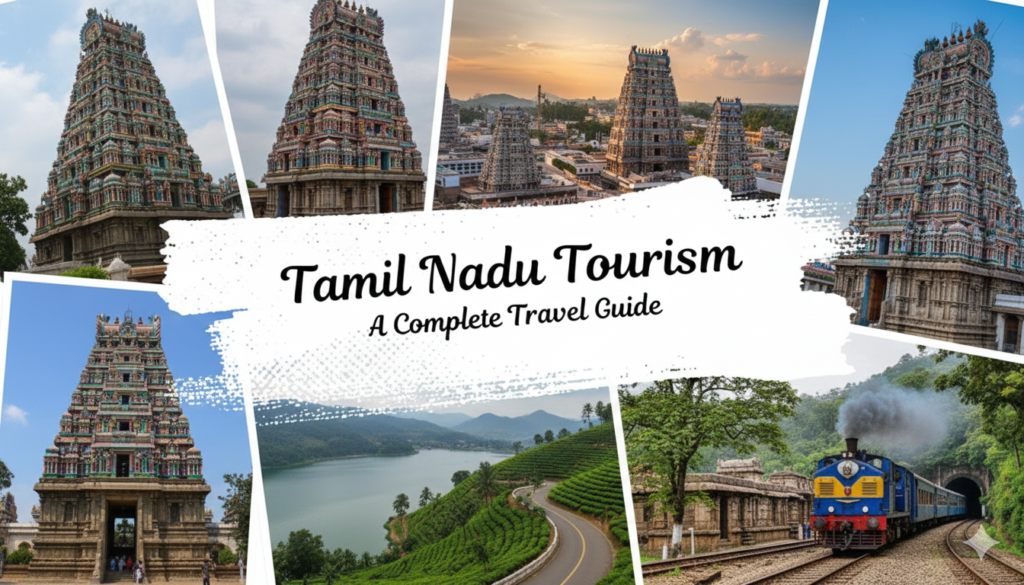
Tamil Nadu — My Journey through Culture, History & Natural Beauty

First Impressions & Overview
On my first day in Tamil Nadu I felt the rhythm of a place where time and progress move together. Located on the southeastern coast of India, Tamil Nadu stretches across roughly 130,058 sq km and sits along the Bay of Bengal. Chennai (formerly Madras) is its bustling capital and a gateway to the state's culture, commerce and cuisine.
Geographical Location & Natural Beauty
Geographically, Tamil Nadu is framed by Karnataka and Andhra Pradesh to the north and Kerala to the west. To the east it opens onto the Bay of Bengal, and to the south lies the Indian Ocean. The state is blessed with scenic ranges such as the Nilgiris, Annamalai and the Western Ghats — each offering hill stations, wildlife and cooler climate retreats.
Learning from the land
Walking the tea slopes of Ooty and the paths of Kodaikanal taught me that the state's geography supports both agriculture and tourism — two pillars that work together to sustain local communities.
History — Living Dravidian Heritage
Tamil Nadu's history is inseparable from the ancient Dravidian civilization. The Chola, Pandya and Chera dynasties shaped the region's language, art, and architecture. The grand temples — such as the Brihadeeswarar Temple in Thanjavur and the Meenakshi Temple in Madurai — are enduring testaments to that era.
Why it matters
These monuments are not only tourist sites but active cultural hubs. My visits revealed how festivals and daily rituals preserve traditional skills: stone carving, classical music, and temple dance.
Language & Culture
Tamil — a classical language
Tamil is one of the world’s oldest living languages and enjoys classical language status. Its literature and poetry echo across festivals, street performances and classrooms.
Performing arts
Tamil Nadu is the heartland of Bharatanatyam and Carnatic music. Watching a traditional performance in a small temple hall taught me that art here is woven into everyday life.
Festivals and community
Pongal, Diwali and the Tamil New Year are celebrated with deep community participation — a valuable reminder that festivals are both cultural expression and local economy boosters.
Economy: Agriculture, Industry & Services
The state’s economy is balanced across agriculture, industry and services:
- Agriculture: Rice, coconut and sugarcane are important crops.
- Industry: Automobile manufacturing, textiles and a growing IT sector form the industrial backbone.
- Tourism: Beaches, temples and hill stations attract domestic and international visitors.
Practical takeaway
Local livelihoods often depend on seasonal cycles — for travellers this means planning visits mindful of local festivals and harvests can create richer experiences and support local vendors.
Major Cities & What to Expect
Chennai
Chennai is Tamil Nadu’s capital, an industrial and educational hub with beaches, museums and a lively food scene.
Coimbatore
Known as a textile and industrial city, Coimbatore is practical for business travel and manufacturing visits.
Madurai
Madurai is famed as a city of temples; its Meenakshi Temple is both an architectural masterpiece and a living center of religious culture.
Tiruchirapalli (Trichy)
Trichy offers historic forts, temples and a sense of the region’s layered history.
Top Tourist Places (Highlights)
These are the places I recommend based on time, accessibility and cultural value:
- Meenakshi Temple, Madurai — experience a living temple complex.
- Group of Monuments at Mahabalipuram — coastal sculptures and rock-cut temples.
- Kanyakumari — view of three seas meeting and sunrise/sunset vistas.
- Ooty & Kodaikanal — hill stations for cooler weather and scenic walks.
- Rameswaram — a sacred island town with important pilgrimage sites.
For more travel resources, see our Tamil Nadu itinerary guide.
Conclusion — Why Tamil Nadu Left an Impression
Tamil Nadu blends modernity and antiquity in a way that feels organic. Its cultural depth, historical sites and natural variety make it uniquely special. My biggest learning: when you travel here, slow down — the most meaningful experiences come from conversations, local food, and attending just one local festival.
Frequently Asked Questions
- What language is primarily spoken in Tamil Nadu?
- Tamil is the primary language; it is one of the oldest classical languages of India.
- Which hill stations are popular in Tamil Nadu?
- Ooty and Kodaikanal are two of the most popular hill stations in the state.
- What are the must-visit temples?
- Meenakshi Temple in Madurai and Brihadeeswarar Temple in Thanjavur are among the most famous.
- What drives the economy of Tamil Nadu?
- A combination of agriculture (rice, coconut, sugarcane), industry (automobile, textile, IT) and tourism support the economy.
Geographical Location of Tamil Nadu
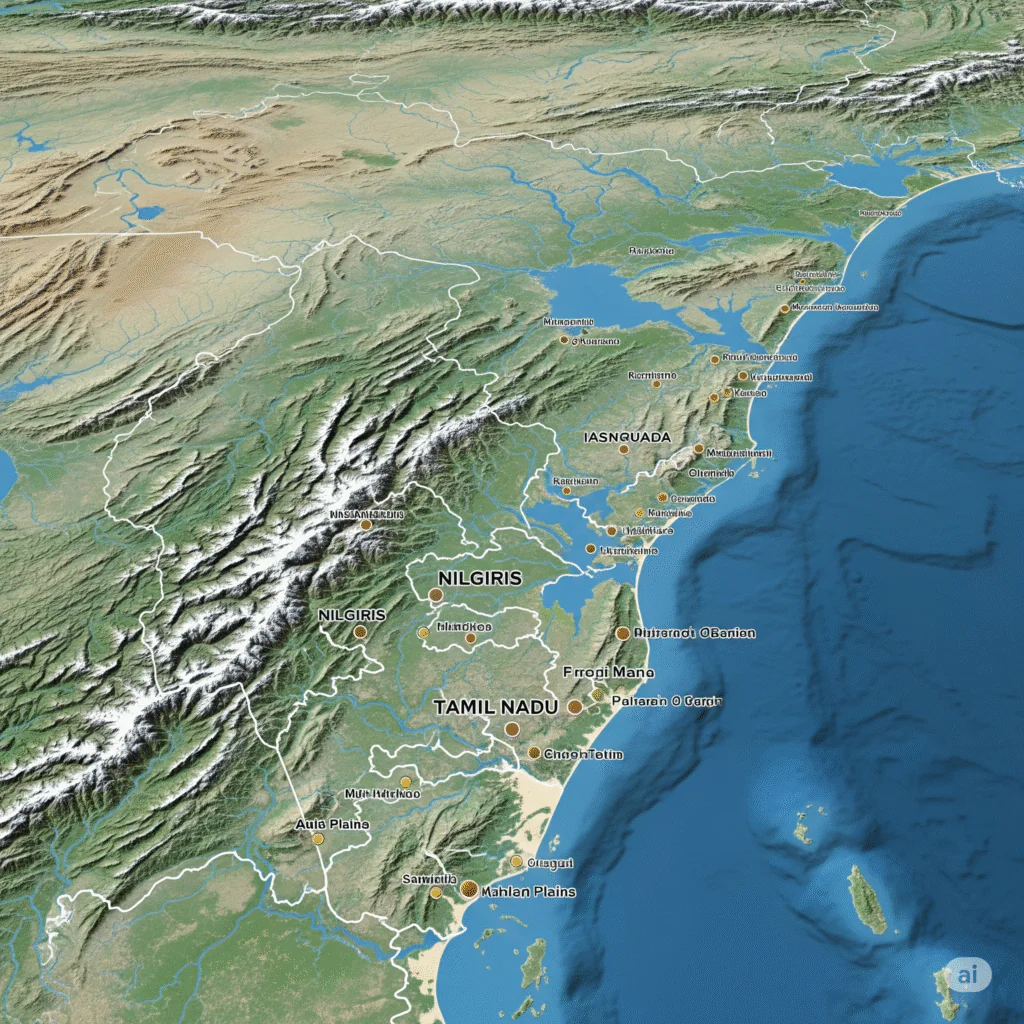
The geographical location of Tamil Nadu makes it naturally diverse, rich, and unique. Situated in the southern part of India, the state consists of several distinct regions with significant geographical importance. Below is a detailed explanation of its location, features, and natural diversity.
Status and Boundaries
- Latitude: 8°5′ North to 13°35′ North
- Longitude: 76°15′ East to 80°20′ East
Boundaries
- North: Karnataka and Andhra Pradesh
- West: Kerala
- South: Indian Ocean
- East: Bay of Bengal
Coastline: Tamil Nadu has a coastline of about 1,076 km, making it one of India’s major coastal states. This coastline is crucial for fisheries, maritime trade, and tourism.
Major Geographical Features
1. Mountainous Region
Several important mountain ranges and hill systems shape the landscape of Tamil Nadu:
Western Ghats
- Includes the Nilgiri and Annamalai Hills
- Ooty (Udhagamandalam) is a major tourist destination in the Nilgiris
Eastern Ghats
- Located near the Tamil Nadu–Andhra Pradesh border
- Contains many waterfalls, streams, and scenic valleys
Shevaroy & Kodaikanal Hills
- Kodaikanal is famous for its peaceful climate, greenery, and lakes
2. Plains
A large part of Tamil Nadu consists of fertile plains formed by major rivers.
Cauvery Delta
The region around the Cauvery River is extremely fertile and is known as the “Rice Bowl of South India.” These plains support extensive agriculture and play a major role in the state’s economy.
3. Rivers
Rivers are vital for Tamil Nadu’s agriculture, drinking water, and irrigation systems.
- Cauvery River: Lifeline of Tamil Nadu
- Vaigai River: Main water source for Madurai and nearby regions
- Tamiraparani River: Important river in southern Tamil Nadu
- Other Rivers: Panniyar, Palar, and Cheyyar
Note: Most rivers in Tamil Nadu are rain-fed and depend heavily on the monsoon.
4. Coastal Region
The eastern coast of Tamil Nadu lies along the Bay of Bengal.
- Important for maritime trade and fisheries
- Major coastal tourist places include Marina Beach (Chennai) and Mahabalipuram
5. Climate
Tamil Nadu experiences a tropical climate:
- Summer: 25°C to 45°C
- Winter: 20°C to 30°C
- Monsoons:
- Southwest Monsoon (June–September)
- Northeast Monsoon (October–December) — brings most of the rainfall
6. Forests & Wildlife
The forests of the Western Ghats and parts of the Eastern Ghats are rich in biodiversity.
Major National Parks & Sanctuaries
- Mudumalai National Park
- Indira Gandhi Wildlife Sanctuary
- Guindy National Park
Wildlife includes elephants, tigers, deer, and many rare bird species.
7. Island Region
- Pamban Island: Located near Rameswaram and Dhanushkodi
- From here, the legendary Ram Setu (Adam’s Bridge) towards Sri Lanka is visible
Important Geographic Facts
- Doddabetta Peak is the highest point in Tamil Nadu, located in the Nilgiri Hills.
- The state has numerous rivers and lakes that help manage water scarcity.
- Beaches, mountains, and forests make Tamil Nadu a paradise for tourists and nature lovers.
Conclusion
Tamil Nadu’s geographical location makes it naturally diverse and resource-rich. Its mountains, plains, coastline, rivers, and climate not only support its economic and cultural heritage but also make it one of India’s most attractive tourist and agricultural regions.
Explore more: History of Tamil Nadu | Tamil Nadu Tourism Guide
History of Tamil Nadu
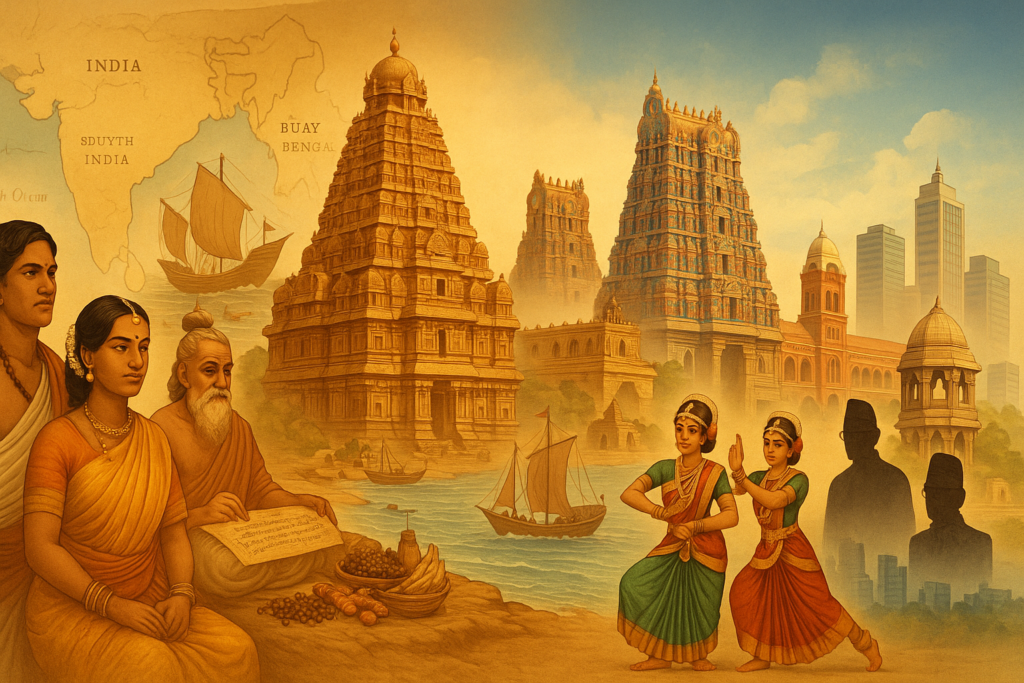
The history of Tamil Nadu is extremely rich and diverse, making it one of the most ancient and culturally significant regions of India. For thousands of years, this land has been a center of civilization, literature, art, and religion. The history of Tamil Nadu begins with the Dravidian civilization and continues through the ancient, medieval, and modern periods. Let us understand it in detail:
Ancient History
1. Dravidian Civilization
The history of Tamil Nadu is closely linked with the Dravidian civilization, which existed during the same era as the Indus Valley Civilization (Harappa and Mohenjo-daro). The Dravidian people are believed to be the original inhabitants of Tamil Nadu. Their language and culture, especially Tamil, have a historical continuity of nearly 4,000–5,000 years.
Sangam Age (300 BC – 300 AD)
- This was the golden age of Tamil literature, art, and culture.
- Three major Sangams (literary assemblies) helped produce classical works such as the Tirukkural, Ettuttukkai, and Pattuppattu.
- Tamil society flourished in agriculture, trade, and artistic activities.
2. Major Ancient Dynasties
(a) Chola Dynasty
- The Cholas emerged during the Sangam period and were powerful from the 9th to the 13th century.
- Rajaraja Chola I: Built the iconic Brihadeeswarar Temple in Thanjavur.
- Rajendra Chola: Expanded the empire into Southeast Asia.
- The dynasty was known for outstanding administration, maritime trade, naval power, and temple architecture.
(b) Pandya Dynasty
- Centered in Madurai, the Pandyas were renowned for pearl production and maritime commerce.
- They contributed greatly to Sangam literature and cultural development.
(c) Chera Dynasty
- The Cheras ruled parts of western Tamil Nadu and Kerala.
- They dominated the spice trade and sea routes.
- Major port: Muziris.
Medieval History (7th to 17th Century)
1. Pallava Dynasty (7th – 9th Century)
The Pallavas ruled from Kanchipuram in northern Tamil Nadu and were great patrons of architecture, literature, and religion.
- The Shore Temple and Rathas of Mahabalipuram are masterpieces of Pallava architecture.
- They supported Shaivism and Vaishnavism.
2. Resurgence of the Chola Empire (9th – 13th Century)
- The Cholas expanded their empire across South India, Sri Lanka, and parts of Southeast Asia.
- The Dravidian temple architectural style reached its peak during this era.
- The Chola canal systems and administrative reforms were highly advanced.
3. Rise of the Pandya Empire (13th – 14th Century)
- The Pandyas regained power, contributing to trade, art, and temple construction.
- However, the Delhi Sultanate later weakened their authority by establishing the Madurai Sultanate.
Modern History (17th Century to 20th Century)
1. Vijayanagara Empire (14th – 17th Century)
- Tamil Nadu became part of the Vijayanagara Empire, which revived art, religion, and temple architecture.
- Many important temples were renovated during this time.
2. Maratha and European Influence (17th – 18th Century)
- Parts of Tamil Nadu were ruled by Marathas and local rulers.
- European powers — Portuguese, Dutch, French, and British — began establishing trade bases.
- The British East India Company developed Madras (now Chennai) into a major administrative and trading center.

3. British Colonization (18th – 20th Century)
- Tamil Nadu came under British rule as part of the Madras Presidency.
- The region played a significant role in India’s freedom struggle.
- Important leaders included:
- C. Rajagopalachari – First Governor-General of independent India
- Subramanya Bharati – Poet, reformer, and freedom fighter
- V.O. Chidambaram Pillai – Leader of the Swadeshi movement and founder of India’s first indigenous shipping company
Post-Independence (1947 to Present)
- In 1956, the Madras Presidency was reorganized on linguistic lines, forming the state of Tamil Nadu.
- In 1969, it was officially renamed Tamil Nadu.
- Today, the state is a major cultural, industrial, educational, and economic hub of India.
Special Historical Contributions
1. Dravidian Movement
During the 20th century, Periyar and other leaders launched a movement promoting social equality, rationalism, and revival of Dravidian identity. Political organizations like Dravidar Kazhagam and DMK emerged from this movement.
2. Temple Architecture
Tamil Nadu’s temples — including the Brihadeeswarar Temple (Thanjavur), Meenakshi Temple (Madurai), and Nataraja Temple (Chidambaram) — represent some of the finest examples of Dravidian architecture.
3. Tamil Literature
Tamil literature has contributed greatly to Indian cultural heritage, from the Sangam age to modern times. Works like the Tirukkural continue to offer ethical, philosophical, and social guidance to humanity.
Conclusion
Tamil Nadu has witnessed vibrant civilizations, cultural revolutions, and political transformations. From the ancient Dravidian era to the present day, this land has played an important role in shaping India’s culture and history. The contributions of its rulers, scholars, and artists make Tamil Nadu an invaluable part of India’s historical legacy.
Explore more: Geographical Features of Tamil Nadu | Culture of Tamil Nadu
Language and Culture of Tamil Nadu
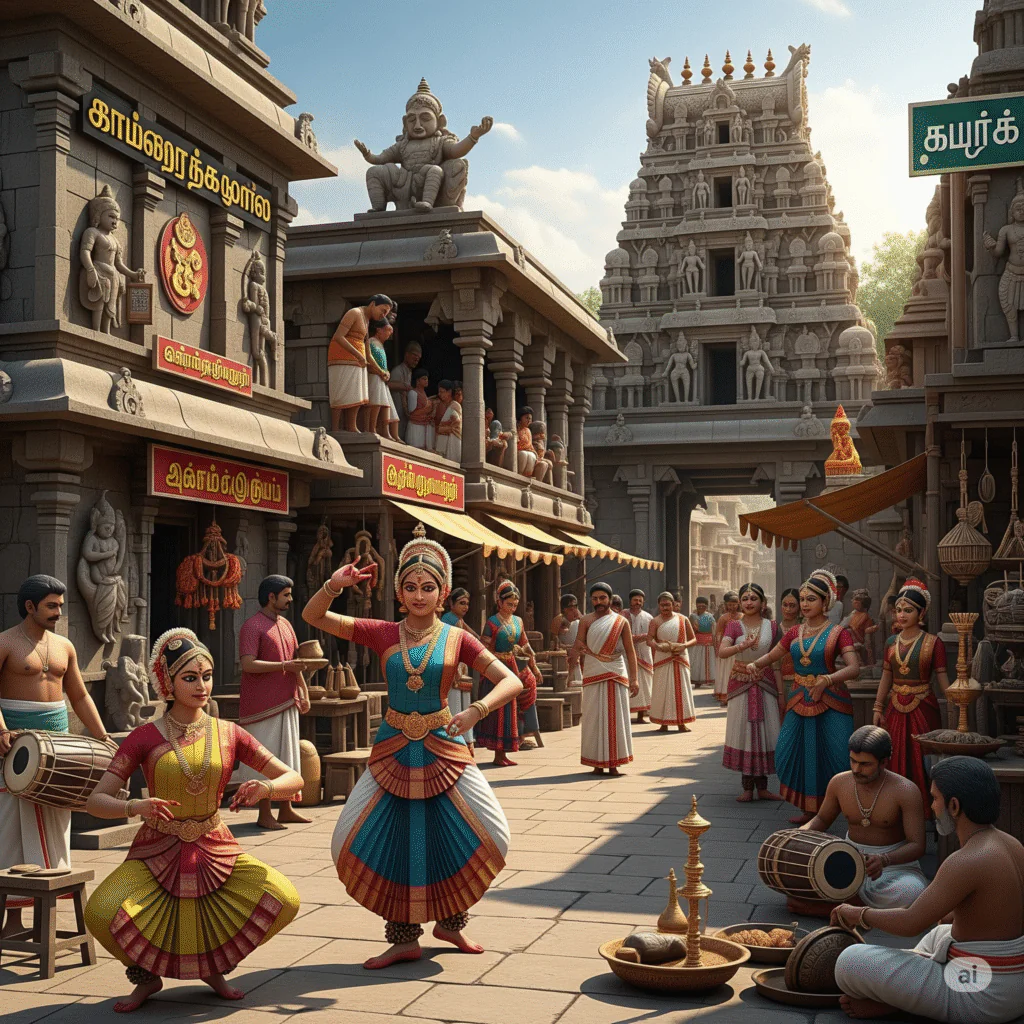
The language and culture of Tamil Nadu are among its most precious and glorious aspects. The state is globally known for its ancient language, rich traditions, and vibrant cultural heritage. Let us understand this in detail:
Language
1. Tamil Language
- Tamil is one of India’s major classical languages and is among the oldest languages in the world.
- Tamil literature dates back more than 2,000 years.
- It belongs to the Dravidian language family and is spoken by over 8 crore people.
- The Government of India granted Tamil the status of “Classical Language” in 2004.
2. Tamil Literature
The golden age of Tamil literature was the Sangam period (300 BC – 300 AD).
- Tirukkural by Thiruvalluvar – focuses on ethics, philosophy, and life principles.
- Silappadikaram and Manimekalai – famous Tamil epics.
- Agananuru and Purananooru – notable Sangam poetic works.
- Bhakti literature by Alvars (Vaishnavite saints) and Nayanars (Shaivite saints) enriched devotional writing.
3. Modern Tamil
- Tamil cinema and media have significantly influenced modern Tamil literature and culture.
- The Tamil language is widely promoted through computers, technology, and the Internet.
Culture
The culture of Tamil Nadu beautifully blends Indian traditions with unique local expressions. Music, dance, food, architecture, and religious customs form the cultural backbone of the state.
1. Religion and Religious Traditions
Tamil Nadu’s culture is closely connected to its religious practices.
- Main religious traditions: Shaivism and Vaishnavism.
- Prominent temples:
- Meenakshi Temple, Madurai
- Brihadeeswarar Temple, Thanjavur
- Rameswaram Temple
- Chidambaram Nataraja Temple
- Popular worship traditions: Ayyappa Puja, Murugan Puja, and Amman Puja.
2. Arts and Performances
(a) Dance – Bharatanatyam
- The most famous classical dance of Tamil Nadu.
- Associated with Lord Shiva and known for expressive storytelling.
- Characterized by graceful postures, expressions, and rhythmic movements.
(b) Music – Carnatic & Folk
- Tamil Nadu is a major center of Carnatic music.
- Legendary composers: Tyagaraja, Muthuswami Dikshitar, Syama Shastri.
- Folk and devotional music hold a special place in rural regions.
3. Festivals
- Pongal – the biggest and most important festival of Tamil Nadu (4 days).
- Diwali – festival of lights.
- Tamil New Year (Puthandu).
- Karthigai Deepam – festival of lights and devotion.
- Jallikattu – traditional bull-taming sport during Pongal.
- Navaratri Golu – decorative doll display tradition.
4. Architecture and Sculpture
- The Dravidian architectural style of Tamil Nadu is world famous.
- Key features: towering gopurams, large courtyards, intricate stone sculptures.
- Mahabalipuram’s Rathas and Shore Temple are UNESCO World Heritage Sites.
- Brihadeeswarar Temple showcases the architectural brilliance of the Cholas.
5. Traditional Wear
- Men: Veshti (dhoti).
- Women: Kanchipuram sarees, known for elegance and richness.
- Traditional jewelry and jasmine (gajra) are worn during festivals.
6. Food
- Tamil cuisine is simple, nutritious, and flavorful.
- Main dishes: Sambar, rasam, idli, dosa, vada.
- Common ingredients: coconut, tamarind, spices.
- Chettinad Cuisine is famous for its spicy and aromatic dishes.
- Pongal is cooked especially during festivals.
7. Traditional Sports & Arts
- Jallikattu – traditional bull-taming sport.
- Kolam – daily decorative rangoli patterns at home entrances.
- Storytelling – narrations of religious and mythological stories.
8. Cinema and Modern Culture
- Tamil cinema (Kollywood) is a major cultural influence.
- It has popularised Tamil art, literature, and music globally.
- Icons: M. G. Ramachandran, Sivaji Ganesan, and A. R. Rahman.
Conclusion
The language and culture of Tamil Nadu are its true identity. Its traditions span thousands of years and remain vibrant even today. Tamil Nadu’s literature, architecture, dance, music, festivals, and cuisine form a unique cultural heritage that reflects the depth and diversity of Indian civilization.
Explore more: History of Tamil Nadu | Geography of Tamil Nadu

Economy of Tamil Nadu
The economy of Tamil Nadu is one of the most diversified and prosperous in India. With strong performance in industry, agriculture, services, and trade, Tamil Nadu ranks among the top contributors to India’s Gross State Domestic Product (GSDP).
1. Total Size and Structure of the Economy
- GSDP: Over ₹20 lakh crore (2023–24), ranking 3rd in India.
- Growth Rate: Average annual growth above 8%.
- Per Capita Income: Higher than the national average.
Sectoral Contribution
- Agriculture: ~12%
- Industry: ~32%
- Services: ~56%
2. Agriculture and Allied Sectors
(a) Major Crops
- Paddy (Rice) – Tamil Nadu is known as the “Rice Bowl”.
- Sugarcane, millets, pulses, oilseeds.
- Spices: Turmeric, cardamom.
- Horticulture: Bananas, mangoes, coconuts, citrus fruits.
(b) Irrigation
- The Cauvery River is the state's main water source.
- The Cauvery Delta is the agricultural heartland.
- Numerous reservoirs and dams aid irrigation.
(c) Dairy & Fisheries
- Tamil Nadu is among India’s leading milk-producing states.
- Fisheries form a major income source in coastal regions.
3. Industrial Sector
The industrial sector is the backbone of Tamil Nadu’s economy.
(a) Major Industries
Automobile & Auto Components
- Tamil Nadu is India’s automobile hub; Chennai is known as the “Detroit of India”.
- Major companies: Hyundai, Ford, Renault-Nissan, Ashok Leyland.
Cotton & Textile Industry
- Coimbatore – “Manchester of South India”.
- Tamil Nadu is India’s largest cotton-producing and exporting state.
- Tiruppur is a global textile hub.
Steel & Cement
- Salem and Tiruchirappalli are major steel centers.
- Cement industries support infrastructure growth.
Electronics & IT
- Major IT companies in Chennai: TCS, Infosys, Wipro.
- Tamil Nadu is a leader in electronics hardware manufacturing.
Petrochemicals & Energy
- Petrochemical industries in Nagapattinam and the Mannar Basin.
- Koodankulam Nuclear Power Plant.
(b) Special Economic Zones (SEZs)
- Several SEZs promote exports and industrial activities.
- MRC Nagar and Sriperumbudur are key hubs.
4. Service Sector
The service sector contributes more than half of Tamil Nadu’s economy.
(a) Information Technology (IT)
- Tamil Nadu is a top IT and BPO export hub.
- Rajiv Gandhi Software Tech Park enhances the IT ecosystem.
(b) Tourism
- Major religious sites: Meenakshi Temple, Rameswaram.
- Cultural sites: Mahabalipuram, Thanjavur.
- Nature spots: Ooty, Kodaikanal.
- Chennai is a leading medical tourism destination.
(c) Financial Services
- Chennai is known as the “Financial Capital of South India”.
- Strong presence of banking and insurance institutions.
5. Trade and Export
(a) Major Export Products
- Automobiles and components
- Textiles and apparel
- Leather products
- Electronics and machinery
(b) Ports and Maritime Trade
- Major ports: Chennai, Tuticorin, Ennore.
- These ports play a crucial role in India’s export economy.
6. Energy and Infrastructure
(a) Energy Production
- Tamil Nadu leads India in electricity generation.
- Strong in nuclear, wind, and solar energy.
- Known as India’s “Wind Power Hub”.
(b) Transportation & Logistics
- Tamil Nadu has the largest road network in India.
- Southern Railway headquarters is in Chennai.
- Airports: Chennai, Coimbatore, Madurai, and more.
7. Social & Human Development
(a) Education & Employment
- High literacy rate, above national average.
- Top institutions: IIT Madras, NIT Trichy.
- Major employment hub in India.
(b) Healthcare
- High-quality government and private healthcare services.
- Chennai is a center for medical tourism.
Conclusion
The economy of Tamil Nadu is a model of diversity and sustainability. Balanced contributions from agriculture, industry, and service sectors make it a major economic powerhouse. With strengths in tourism, IT, automobiles, and exports, Tamil Nadu continues to play a vital role in India’s economic progress and innovation.
Explore more: Culture of Tamil Nadu | Industrial Development of Tamil Nadu
Major Cities of Tamil Nadu
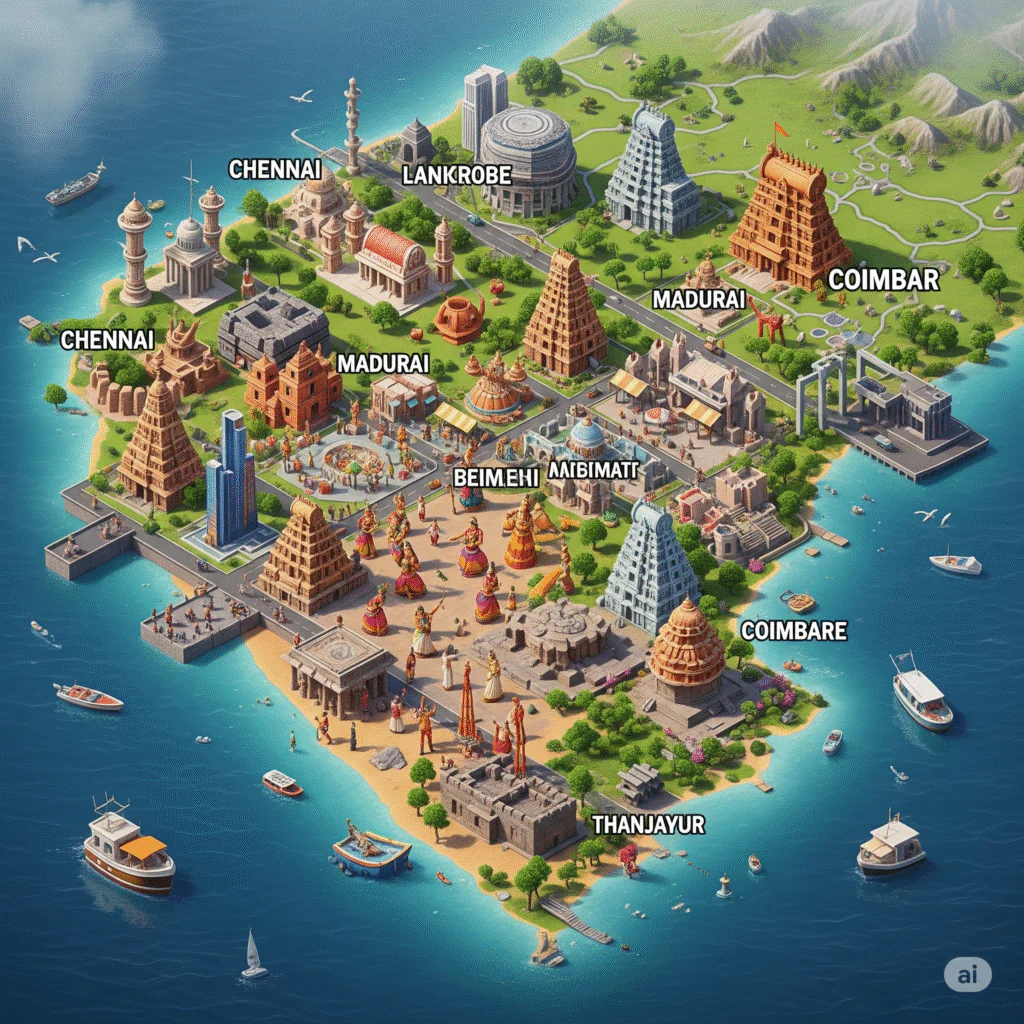
Tamil Nadu has many major cities that are known for their historical, cultural, economic, and tourism importance. These cities reflect the rich heritage and diversity of the state. Here is a detailed description of the major cities of Tamil Nadu:
1. Chennai (Formerly Madras)
Introduction
- The capital of Tamil Nadu and the fourth-largest metropolis in India.
- Known as the “Gateway to South India” and the “Detroit of India.”
Features
Economic Centre
- Major hub for IT and BPO industries.
- A leading centre for automobile manufacturing.
Tourism
- Marina Beach – the longest urban beach in India.
- Kapaleeswarar Temple, St. Thomas Basilica, and Fort St. George.
Education and Health
- IIT Madras and Anna University.
- Chennai is a major hub for medical tourism.
Culture
- Centre for Carnatic Music and Bharatanatyam.
2. Coimbatore
Introduction
- The second largest city in Tamil Nadu.
- Known as the “Manchester of South India.”
Features
Industrial Centres
- Renowned for textiles and cotton-based industries.
- Major hub for electronics and machinery manufacturing.
Education
- PSG College and Amrita University.
Tourism
- Marudhamalai Temple, Valparai, and Siruvani Falls.
Health Care
- A major medical centre in South India.
3. Madurai
Introduction
- The third largest city in Tamil Nadu.
- Known as the “City of Temples.”
Features
Religious Significance
- Meenakshi Amman Temple, built by the Pandya dynasty.
- Alagar Kovil and Thiruparankundram.
History
- A major centre during the Sangam era.
- The ancient design of Madurai is based on a lotus pattern.
Tourism
- Gandhi Memorial Museum.
- Scenic views along the Vaigai River.
4. Tiruchirappalli (Trichy)
Introduction
- Commonly known as Trichy.
- A major religious and industrial centre of Tamil Nadu.
Features
Religious Places
- Srirangam Temple (dedicated to Lord Vishnu).
- Rockfort Temple.
Industrial Contribution
- Steel and engineering industries.
Education
- NIT Tiruchirappalli.
Tourism
- Beautiful views along the Cauvery River.
5. Thanjavur
Introduction
- Known as the “Heritage City of Tamil Nadu.”
- Major cultural and political centre during the Chola period.
Features
Religious & Cultural Places
- Brihadeeswarar Temple (UNESCO World Heritage Site).
- Saraswathi Mahal Library.
Art & Music
- Famous for Thanjavur paintings and musical instruments.
Agricultural Centre
- Located in the fertile Cauvery Delta region.

6. Salem
Introduction
- A major industrial city of Tamil Nadu.
- Located near the Western Ghats.
Features
Industrial Centres
- Salem Steel Plant.
- Textile and handloom industries.
Tourism
- Yercaud Hill Station.
- Kannanur Kilisagar Dam.
Education
- Vinayaka Mission University.
7. Tirunelveli
Introduction
- An ancient city and a major centre of the Pandya dynasty.
Features
Religious Places
- Nellaiappar Temple.
- Courtallam Falls.
Agriculture
- Major producer of sugarcane and paddy.
Tourism
- The Tamiraparani River and surrounding natural beauty.
8. Vellore
Introduction
- A major medical and educational hub of Tamil Nadu.
Features
Treatment
- Christian Medical College (CMC), world-renowned hospital.
Religious Places
- Golden Temple (Sripuram).
Education
- VIT University.
Industrial Contribution
- Major leather industry hub.
9. Erode
Introduction
- Known as the “Textile City.”
Features
Textile Industry
- Leading handloom and powerloom centre of India.
Agriculture
- Top producer of turmeric.
Tourism
- Bhavanisagar Dam.
10. Rameswaram
Introduction
- One of the four sacred Dhams of India.
- Located on Pamban Island.
Features
Religious Significance
- Ramanathaswamy Temple.
- Dhanushkodi – rich historical importance.
Tourism
- Pamban Bridge.
- Marine biodiversity and scenic views.
Conclusion
The major cities of Tamil Nadu reflect its diversity, cultural heritage, and economic strength. Each city contributes uniquely through its history, traditions, industries, and tourism. The balanced development of these urban centers is a key driver of Tamil Nadu’s progress.
Explore more: Economy of Tamil Nadu | Tourism in Tamil Nadu
Tourism of Tamil Nadu
Tamil Nadu tourism offers a beautiful blend of historical, cultural, religious, and natural attractions. The state is renowned for its magnificent temples, ancient monuments, serene beaches, and refreshing hill stations. Below is a detailed description of the major tourist destinations in Tamil Nadu:
1. Meenakshi Temple, Madurai
Introduction
- Dedicated to Goddess Meenakshi (Parvati) and Lord Sundareswarar (Shiva).
- The spiritual and cultural landmark of Madurai.
- One of the most famous temples in India.
Features
Architecture
- Built in the Dravidian architectural style.
- Has 14 majestic gopurams (gateway towers) with thousands of sculptures.
- The “Aayiram Kaal Mandapam” (Hall of 1000 Pillars) is a major attraction.
Religious Significance
- Symbolizes ancient religious and cultural traditions of Tamil Nadu.
- The famous festival “Meenakshi Thirukalyanam” is celebrated annually.
Tourism
- A major pilgrimage and tourist destination for visitors from around the world.
2. Group of Monuments at Mahabalipuram
Introduction
- Located south of Chennai; also known as Mamallapuram.
- A UNESCO World Heritage Site built during the Pallava dynasty (7th–8th century).
Features
Major Monuments
- Pancha Rathas: Five chariot-shaped monolithic structures.
- Shore Temple: A beautiful temple built on the seashore.
- Arjuna’s Penance: Giant rock relief depicting mythological stories.
- Krishna’s Butter Ball: A massive balancing rock.
Artistry
- Known for its remarkable rock-cut sculptures, caves, and temples.
Tourism
- Popular for its beaches, architecture, and heritage value.
3. Kanyakumari
Introduction
- Located at the southernmost tip of India.
- Famous for the confluence of the Indian Ocean, Bay of Bengal, and Arabian Sea.
Features
Religious Significance
- Kanyakumari Devi Temple – an important Shakti Peeth.
- Believed to be the place where Goddess Parvati performed penance.
Natural Beauty
- World-famous views of sunrise and sunset over the ocean.
Main Attractions
- Vivekananda Rock Memorial – located on a rock island in the sea.
- Thiruvalluvar Statue – 133 feet high, dedicated to the poet Thiruvalluvar.
- Gandhi Mandapam – built to honor Mahatma Gandhi’s ashes.
Tourism
- A major cultural and spiritual destination visited by millions annually.
4. Hill Stations of Ooty and Kodaikanal
(a) Ooty (Udhagamandalam)
Introduction
- Known as the “Queen of the Nilgiris.”
- Located in the Nilgiri Hills of the Western Ghats.
Natural Beauty
- Surrounded by tea plantations, lush forests, and serene lakes.
Main Attractions
- Ooty Lake
- Doddabetta Peak – highest peak in the Nilgiris
- Government Botanical Garden
- Nilgiri Mountain Railway – UNESCO World Heritage Site
Tourism
- Popular honeymoon and summer destination.
(b) Kodaikanal
Introduction
- Known as the “Princess of the Hills.”
- Located in the Palani Hills.
Natural Beauty
- Famous for its lakes, valleys, forests, and waterfalls.
Main Attractions
- Kodai Lake
- Pillar Rocks
- Silver Cascade Waterfall
- Bryant Park
Climate
- Weather remains cool and pleasant throughout the year.
5. Rameswaram
Introduction
- One of the four sacred Dhams of Hinduism.
- According to the Ramayana, Lord Rama built “Ram Setu” (Adam’s Bridge) from here.
Features
Religious Significance
- Ramanathaswamy Temple, dedicated to Lord Shiva.
- The temple has 22 holy theerthakundas (sacred water tanks).
Main Attractions
- Pamban Bridge – connects Rameswaram to mainland India.
- Dhanushkodi – believed to be the site of Ram Setu.
- Ram Padam – symbolic footprints of Lord Rama.
Tourism
- A major pilgrimage and historical destination.
Conclusion
These major tourist destinations showcase the historical, religious, and natural diversity of Tamil Nadu. From cultural treasures like Meenakshi Temple and Mahabalipuram to the serene beauty of Kanyakumari, Ooty, Kodaikanal, and the spiritual depth of Rameswaram, Tamil Nadu offers unforgettable experiences for every traveler.
References
- Official Website of Government of Tamil Nadu – https://www.tn.gov.in
- Tamil Nadu Tourism Department – https://www.tamilnadutourism.tn.gov.in
- NCERT Geography & History Books (Class 6–12)
- India Year Book, Publications Division
- UNESCO World Heritage Centre – Mahabalipuram
- World Atlas / CIA World Factbook
Explore more: Major Cities of Tamil Nadu | History of Tamil Nadu