
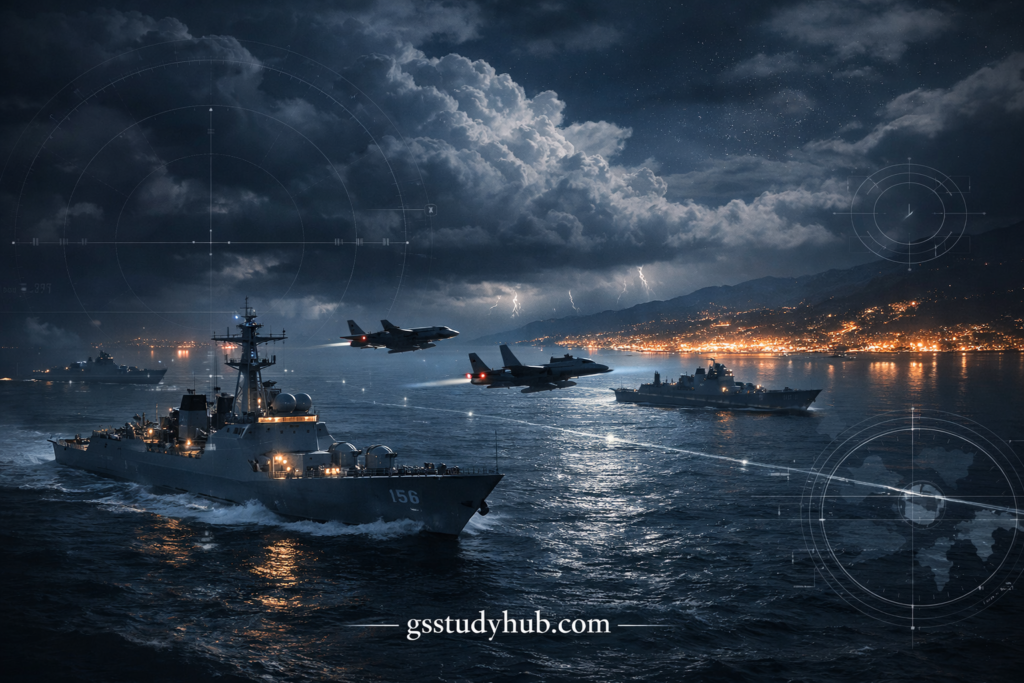
Taiwan Strait Tension 2026: Could it be Asia's Next Ukraine? 5 Critical Reasons & Impact on India
Taiwan Strait Crisis 2026 has emerged as the most dangerous geopolitical flashpoint in Asia. As Chinese warships cross the Median Line and fighter jets intensify high-frequency drills, the world is asking a haunting question — could Taiwan become Asia’s next Ukraine?
February 2026: The waters of the South China Sea are churning with more than just waves. As Chinese warships conduct high-intensity drills and fighter jets breach the Median Line with alarming frequency, the world watches with bated breath. The haunting question echoes across global capitals: “Is the world standing on the brink of another Great War?”
Just as the Russia-Ukraine conflict reshaped the global order in 2022, a similar geopolitical chessboard is being laid around Taiwan today. Is Beijing following the Moscow blueprint, or will the "Island of Chips" prove to be a different beast altogether? In this GS Study Hub exclusive, we dive deep into facts, history, and the future strategy to understand if Taiwan is indeed the 'Next Ukraine'.
1. The Strategic Lockdown: The 'First Island Chain'
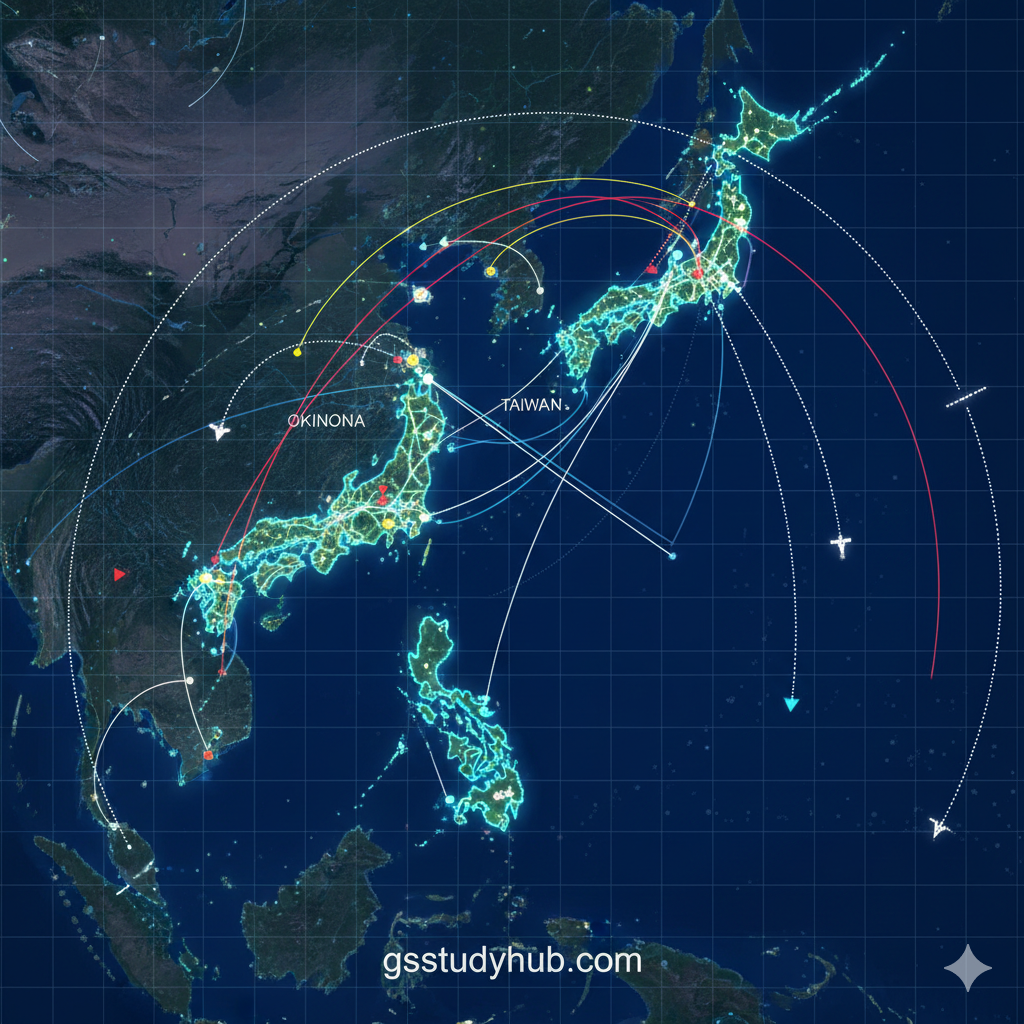
Taiwan is not merely a 36,000 sq km island; it is the "Unsinkable Aircraft Carrier" of the Pacific. For China, seizing Taiwan is the only way to break through the 'First Island Chain'—a string of US-aligned islands (Japan, Philippines, Taiwan) that currently cages the Chinese Navy within its coastal waters.
The Silicon Shield
Taiwan produces over 90% of the world’s most advanced semiconductors. Companies like TSMC are the central nervous system of the global tech industry. A conflict here wouldn't just be a territorial dispute; it would be a total blackout for global electronics, from your smartphone to advanced AI defense systems.
2. Ukraine vs. Taiwan: Key Similarities & Fatal Differences
While the rhetoric of "Sovereignty" remains similar to the Ukraine crisis, the tactical reality is worlds apart.
| Feature | Ukraine (Continental War) | Taiwan (Maritime Conflict) |
|---|---|---|
| Geography | Flat land borders (Easy for tanks) | 100-mile wide sea (Difficult amphibious assault) |
| Economic Value | Breadbasket (Grain & Energy) | Technology Hub (Semiconductors/Chips) |
| US Intervention | Weapon supply, no direct troops | "Strategic Ambiguity" with high chance of direct naval support |
| War Style | Traditional Artillery & Land invasion | Cyber-warfare, Naval blockade, and Missiles |
3. 5 Reasons Why 2026 is the Critical Year
Geopolitical analysts identify the 2026-2027 window as the "Danger Zone" for several reasons:
- PLA Modernization: China's goal to achieve 'Centenary Goals' for its military by 2027 makes 2026 a preparation peak.
- The Porcupine Strategy: Taiwan is rapidly transforming into a 'Porcupine'—stockpiling drones and sea mines to make an invasion too costly for China.
- Political Transition: Upcoming elections in the US and shifts in Taiwan’s internal politics could trigger a "Now or Never" sentiment in Beijing.
- Shift to Blockade Tactics: Instead of a full-scale invasion, China is testing 'Grey Zone' tactics—cutting off Taiwan’s supply lines to force a surrender.
- Asymmetric Warfare: Lessons from Ukraine have taught Taiwan that small, mobile drone swarms can sink massive warships.
4. The Impact on India: Why New Delhi is Concerned
Two-Front War Risk: Any conflict in Taiwan could embolden China to increase pressure on the LAC (Ladakh/Arunachal). India must be prepared for a synchronized threat.
Supply Chain Paralysis: India’s 'Make in India' and Automobile sectors rely heavily on Taiwanese chips. A war would lead to a massive hike in prices of cars, laptops, and medical equipment.
Trade Routes: Over 50% of India's trade passes through the South China Sea. A blockade would choke India's export-import economy.
Conclusion: A New World Order?
Taiwan is the ultimate litmus test for the 21st century. If Asia's "Ukraine" ignites, the fallout will be far more devastating than anything seen in Europe. While diplomacy remains the preferred tool, the drums of war are getting louder. For students of geopolitics and aspirants of competitive exams, understanding this "Silicon Shield" is crucial.
Join the Discussion at GS Study Hub
Do you think China will risk a global economic collapse by invading Taiwan in 2026? Share your analysis in the comments below.
Don't forget to share this article with fellow aspirants!
Is the world truly moving away from the U.S. dollar? Explore how De-Dollarization 2026 could reshape the global economy and what this shift means for emerging powers like India and China.
The Historical Background of the Taiwan Conflict: Decoding the "Two Chinas" Mystery
The thunder of fighter jets over the Taiwan Strait in 2026 is not a modern phenomenon; it is the echo of a century-old unfinished business. To understand why China is willing to risk a global war over this small island, one must look beyond the headlines. At GS Study Hub, we break down the complex history of Taiwan—from the Qing Dynasty to the 1949 Civil War—to provide you with a comprehensive geopolitical perspective.
1. From Imperial Outpost to Japanese Colony
Taiwan’s history with mainland China is long but interrupted. While Chinese settlers moved to the island for centuries, official administration was often loose.
- The Qing Era (1683–1895): Taiwan was officially incorporated into the Qing Empire. However, following the defeat in the First Sino-Japanese War, the Qing government was forced to cede Taiwan to Japan under the Treaty of Shimonoseki.
- Japanese Occupation (1895–1945): For 50 years, Taiwan was a Japanese colony. This period significantly shaped Taiwan's infrastructure and identity, creating a cultural gap between the island and the mainland.
2. 1949: The Great Divide
The modern conflict is a direct result of the Chinese Civil War. After World War II, Japan retreated, and Taiwan was returned to China. However, a bloody war broke out between two factions on the mainland:
2. The Communist Party (CCP): Led by Mao Zedong.
In 1949, the Communists won control of mainland China and established the People's Republic of China (PRC). The defeated KMT fled to Taiwan, bringing 2 million soldiers and civilians. They established the Republic of China (ROC) on the island, claiming they were still the legitimate government of all of China.
3. The Battle for International Recognition
For decades, the West recognized the ROC (Taiwan) as the "true China." However, the tides shifted during the Cold War as the PRC’s global influence grew.
4. One China Policy vs. One China Principle
This is the most critical part of the conflict today. The two terms are often confused but mean very different things:
| Term | Definition | Proponent |
|---|---|---|
| One China Principle | There is only one China, Taiwan is an inalienable part of it, and the PRC is the sole government. | Beijing (China) |
| One China Policy | Acknowledges Beijing's position but maintains unofficial, robust economic and security ties with Taiwan. | USA, India, and others |
5. The Evolution of Democracy
Since the 1990s, Taiwan has transformed from a military dictatorship into one of Asia’s most vibrant democracies. This has led to a major shift in identity:
- Generational Shift: Most people in Taiwan now identify as "Taiwanese" rather than "Chinese."
- Political Will: The current ruling party (DPP) emphasizes Taiwan’s sovereignty, which Beijing views as "separatism" and a "red line" for military action.
Conclusion: An Unfinished Chapter
The Taiwan dispute is essentially an "unfinished Civil War." While China views reunification as a matter of national rejuvenation and "Face," Taiwan views its current status as a fight for survival and democratic freedom. As we look toward the 2026-2027 window, the weight of this history continues to dictate the moves of global superpowers.
Stay Ahead with GS Study Hub
Was this historical breakdown helpful for your exam preparation? Let us know in the comments!
Share this analysis to help fellow aspirants master Geopolitics.
gsstudyhub.comThe Red Sea crisis is impacting shipment lanes — but could it also accelerate changes in global finance? Explore how De-Dollarization 2026 might reshape global money power and what it means for world trade.
The Geopolitical Significance of the Taiwan Strait
The escalation of the Taiwan Strait Crisis 2026 is not just a regional issue but a global strategic challenge involving China, the United States, and Indo-Pacific allies.
In the high-stakes theater of 21st-century geopolitics, the Taiwan Strait stands as the ultimate "Pressure Cooker." This 180-km wide body of water separating mainland China from the island of Taiwan is more than just a maritime boundary; it is the center of a global power struggle between the United States and China. At GS Study Hub, we decode why this narrow strip of water is essential to global security, trade, and technology.
1. The Strategic Location of Taiwan
Taiwan sits at the crossroads of the East China Sea and the South China Sea. Its geography makes it a vital gateway for any naval movement in the Western Pacific.
- Proximity to China: Located just 100 miles from the Chinese coast, it represents a "Security Breach" in China's maritime defense if controlled by a hostile power.
- Regional Hub: It acts as a bridge between the American-allied nations of Japan to the North and the Philippines to the South.
2. Significance of the "First Island Chain"
The First Island Chain is a conceptual maritime defense perimeter stretching from the Kuril Islands through Japan and Taiwan down to the Philippines.
3. The Lifeline of Global Trade
The Taiwan Strait is one of the world's most heavily trafficked commercial waterways. A blockade here would result in a systemic collapse of global trade.
- Container Traffic: Nearly 50% of the world's container fleet and 88% of the world's largest ships by tonnage pass through this strait.
- Energy Security: It is a primary route for liquefied natural gas (LNG) and oil tankers heading to Japan and South Korea.
- Economic Warfare: Even a temporary closure of the strait would lead to a surge in insurance premiums and shipping costs, triggering global inflation.
4. The "Silicon Shield": Global Tech Dependence
Perhaps the most critical factor in 2026 is Taiwan's dominance in the semiconductor industry. This is often referred to as the "Silicon Shield"—the idea that the world cannot afford a war in Taiwan because it would destroy the global economy.
| Industry Leader | Market Dominance | Global Impact of Conflict |
|---|---|---|
| TSMC (Taiwan) | Produces ~92% of the world's most advanced chips (sub-10nm). | Immediate halt in production of Smartphones, AI Servers, and EVs. |
| Dependency | The US, China, and India all rely on Taiwan for high-end defense electronics. | A "Tech Dark Age" where military and civilian innovation stalls for years. |
5. Why it Matters for India
As a rising power in the Indo-Pacific, India has deep stakes in the stability of the Taiwan Strait:
- Maritime Trade: Over 55% of India's trade in the Indo-Pacific passes through the South China Sea and adjacent straits.
- Semiconductor Mission: India’s ambition to become a global electronics hub relies on partnerships with Taiwanese firms.
- Regional Balance: A Chinese victory in Taiwan would drastically shift the balance of power in Asia, emboldening China on India's Himalayan borders.
Conclusion
The Taiwan Strait is the "Great Wall of the Sea" for the 21st century. It is where economic interests, technological dominance, and military strategy collide. For students of international relations and competitive exams, the Taiwan Strait is not just a geographical feature—it is the pulse of the modern world order.
Alongside the US–China tech competition, global economic influence is also shifting. For deeper insight into how currency dominance is evolving worldwide, read De-Dollarization 2026 and the emerging global currency landscape, a detailed analysis of post-dollar monetary trends.
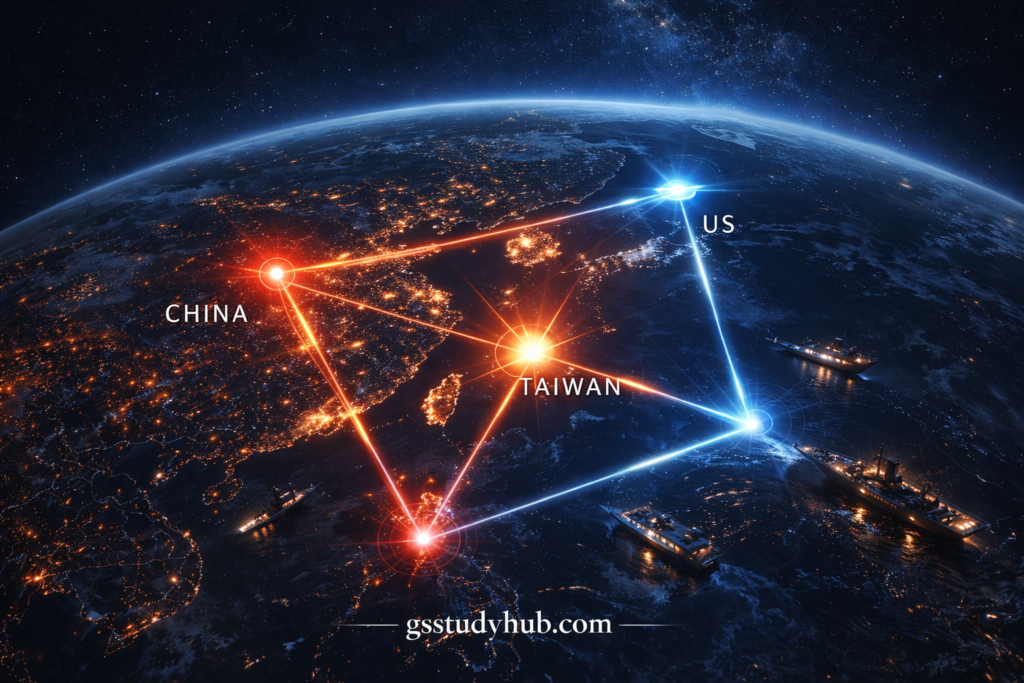
Taiwan, China, and the United States: Decoding the 2026 Strategic Triangle
As the Taiwan Strait Crisis 2026 intensifies, Washington and Beijing are recalibrating their strategies to avoid direct confrontation while maintaining deterrence.
As of February 2026, the Indo-Pacific has become the most contested theater on Earth. The escalating friction in the Taiwan Strait is no longer just a regional dispute; it is a systemic confrontation between the world's two largest economies—China and the United States. At GS Study Hub, we analyze the shifting roles of these three pivotal entities that hold the key to global stability.
For China, the "reunification" with Taiwan is the centerpiece of President Xi Jinping's "Great Rejuvenation of the Chinese Nation." Beijing views the island as a breakaway province that must be brought back under the fold of the People's Republic of China (PRC).
- Strategy: Utilization of 'Grey Zone' tactics—constant military incursions into Taiwan's ADIZ (Air Defense Identification Zone) to exhaust their defense forces.
- The 2027 Timeline: The CCP has accelerated military modernization with a clear directive to be combat-ready for a cross-strait operation by 2027.
Taiwan has evolved into a global technological indispensable power. Its democratic identity, separate from the mainland, is now more robust than ever, fueled by a generation that identifies solely as Taiwanese.
- The Porcupine Defense: Realizing it cannot match China ship-for-ship, Taiwan is investing in "Asymmetric Warfare"—mobile missile launchers, sea mines, and thousands of low-cost drones.
- Global Leverage: By controlling 90% of advanced chip manufacturing, Taiwan ensures that any attack on its soil is an attack on the global digital infrastructure.
The United States remains the security guarantor of the Western Pacific. For Washington, the fall of Taiwan would mean the collapse of the "Rules-Based Order" and the loss of its status as the world’s primary naval power.
- End of Ambiguity: While the official policy remains 'Strategic Ambiguity,' the 2026 U.S. National Defense Strategy shows a clear tilt toward direct intervention to prevent a forceful change in the status quo.
- Allied Network: The U.S. is strengthening the 'AUKUS' and 'QUAD' frameworks to ensure that China faces a multilateral front rather than a bilateral one.
2026 Strategic Matrix: Objectives and Risks
| Entity | Primary Objective | Greatest Deterrent |
|---|---|---|
| China | Territorial Unification & Breaking the First Island Chain | US Military Intervention & Global Sanctions |
| Taiwan | Maintaining Sovereignty & Economic Autonomy | Energy Blockade & Cyber Sabotage |
| United States | Containment of China & Free Indo-Pacific | Risk of Escalation to a Nuclear Conflict |
The Global Fallout: What’s at Stake?
A conflict involving Taiwan, China, and the United States would lead to a projected $10 trillion loss to the global economy. This is why 2026 remains a year of intense diplomacy masked by military posturing. The triangle is locked: if one side moves too aggressively, the entire structure of the modern world collapses.
Taiwan vs. Ukraine: Decoding the Global Fault Lines
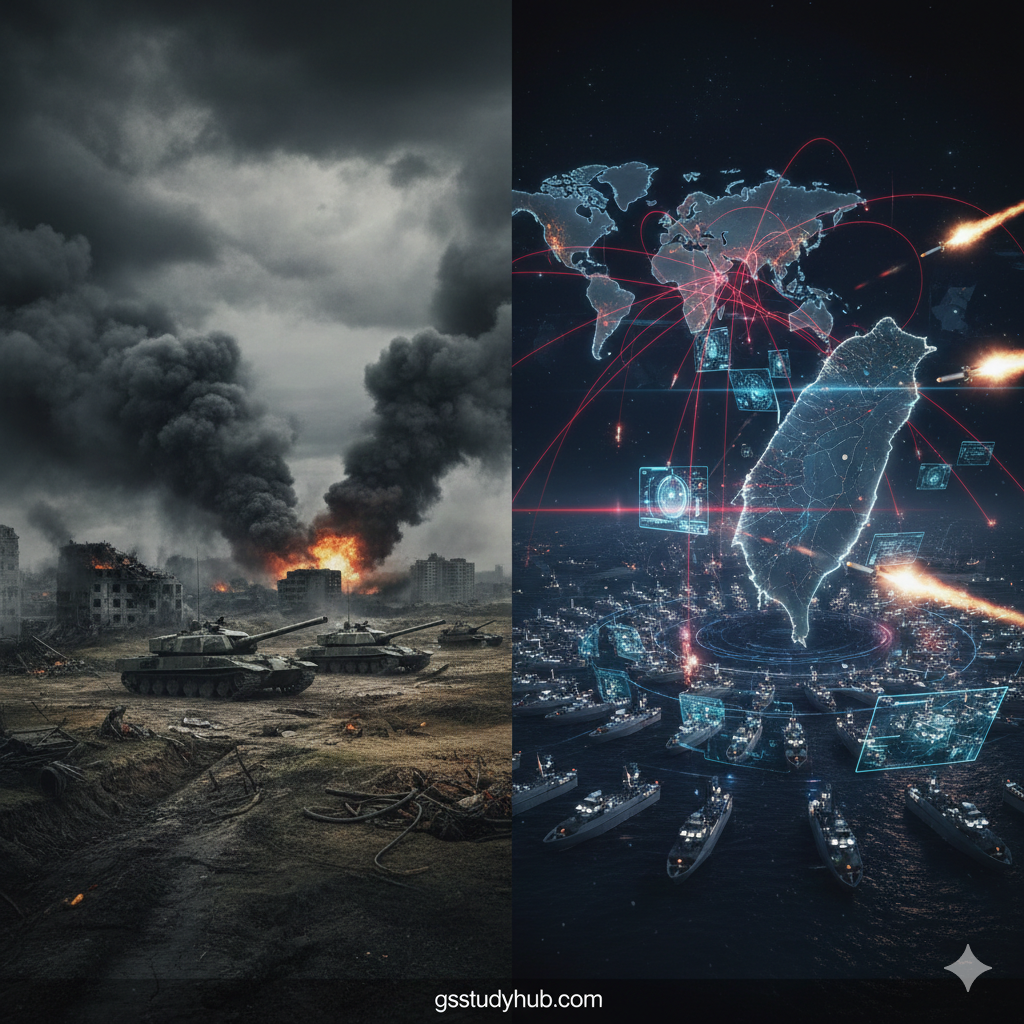
In early 2026, the global geopolitical landscape is defined by two major flashpoints. While the war between Ukraine and Russia continues to reshape European security, the rising tensions in the Taiwan Strait threaten to ignite a similar crisis in East Asia. At GS Study Hub, we analyze the striking similarities and the fatal differences between these two struggles for sovereignty.
1. The Comparative Matrix
| Factor | Ukraine | Taiwan |
|---|---|---|
| Aggressor Power | Russia | China |
| Strategic Value | NATO Buffer Zone | Indo-Pacific Pivot |
| Global Alliance | NATO Support (Indirect) | US-Japan-Australia Support |
| Economic Leverage | Agricultural & Energy Hub | Global Semiconductor Hub |
2. NATO vs. Indo-Pacific Security Architecture
The security frameworks in Europe and Asia play a decisive role in how these conflicts unfold:
- NATO and Ukraine: Because Ukraine is not a formal member of NATO, the alliance has avoided direct military involvement to prevent a broader escalation with Russia. Instead, support is limited to intelligence, financial aid, and weapon systems.
- The Indo-Pacific Web: Unlike the monolithic structure of NATO, the Indo-Pacific relies on a "hub-and-spoke" system of bilateral treaties. However, the 2026 defense posture suggests that the U.S. and Japan view Taiwan as vital to their own national security, potentially leading to more direct intervention than seen in Ukraine.
3. The Nuclear Deterrence Paradox
Nuclear weapons have fundamentally altered the calculations in both regions:
- The European Theater: Russia's massive nuclear arsenal acts as a deterrent against NATO's direct entry into the war, keeping the conflict localized within Ukraine's borders.
- The Asian Theater: While China possesses nuclear capabilities, it faces a U.S. "Nuclear Umbrella" that covers its regional allies. A conflict in Taiwan carries a much higher risk of direct superpower collision, as both sides consider the island a "Red Line" for their global standing.
4. Lessons Learned from Russia-Ukraine
The conflict between Ukraine and Russia has served as a laboratory for modern warfare. Taiwan has observed Russia’s logistical failures and Ukraine’s successful use of low-cost drones. Consequently, Taiwan has accelerated its "Porcupine Strategy," focusing on mobile, lethal, and asymmetric capabilities to ensure that a Chinese invasion becomes an "unaffordable victory."
Conclusion: A Shared Struggle
Ultimately, Ukraine and Taiwan represent the frontlines of democracy against authoritarian expansionism. While the geography and economic stakes differ, the fundamental question remains the same: Will the world allow borders to be redrawn by force in 2026? The answer lies in the resolve of NATO in the West and the democratic alliances in the Indo-Pacific.
To understand rising prices and their wider economic effects, read Global Inflation and Its Impact on Developing Countries, which explains how inflation is shaping economies across the developing world.
Taiwan: The Semiconductor Capital of the World
The global economic stakes of the Taiwan Strait Crisis 2026 are unprecedented, especially because of Taiwan’s dominance in advanced semiconductor manufacturing.
In 2026, the global economy does not run on oil alone—it runs on semiconductors. And the pulse of this industry beats in Taiwan. More than a mere geographic location, Taiwan has become the "Foundry of the Future," holding the keys to global technological advancement and security.
The Global Semiconductor Crisis & TSMC Dominance
The term "Silicon Shield" refers to the strategic protection Taiwan enjoys because of its vital role in the chip industry. At the heart of this shield is TSMC (Taiwan Semiconductor Manufacturing Company). As of early 2026, TSMC remains the only foundry in the world capable of mass-producing 2nm and 3nm chips at scale.
Primary Keywords: Semiconductor shortage 2026, TSMC financial report, high-performance computing (HPC), AI chip manufacturing, global supply chain resilience.
1. The Backbone of AI, Military, and Smartphones
The current AI revolution is physically dependent on Taiwan. Whether it is the GPUs powering the latest LLMs or the processors in high-end smartphones, they all originate from Taiwanese fabs.
- AI Giga-cycle: 55% of TSMC's revenue now comes from high-performance computing, surpassing smartphone chips for the first time.
- Defense Tech: The U.S. F-35 fighter jets and advanced missile guidance systems rely on "Trusted Foundry" sources, many of which are linked back to Taiwanese engineering.
2. Economic Impact: A $10 Trillion Risk
Recent economic models suggest that a major disruption in the Taiwan Strait would cost the global economy approximately $10.6 trillion in the first year alone—nearly 10% of global GDP. This impact would dwarf the 2008 financial crisis and the COVID-19 pandemic combined, causing an immediate "Tech Dark Age."
3. The Global Race for Resilience
While the United States and India are investing billions in the CHIPS Act and India Semiconductor Mission respectively, the "Center of Excellence" remains in Taiwan. The logistical expertise, the 40-year-old ecosystem, and the concentration of talent make Taiwan an irreplaceable node in the global grid.
For more on strategic tensions shaping Asia and beyond, read South China Sea Dispute and Its Impact on Global Politics, a detailed look at how maritime conflict influences world affairs.
U.S. Strategy: Strategic Ambiguity
The ongoing Taiwan Strait Crisis 2026 represents a turning point in Indo-Pacific geopolitics. Unlike previous tensions, the current crisis combines military pressure, economic leverage, and technological dominance into a single strategic contest.
In February 2026, the United States' policy toward Taiwan faces a dual challenge. On one hand, Washington seeks to avoid direct provocation of China; on the other, it balances its commitment to Taiwan's security through a policy of "Strategic Ambiguity."
Taiwan Relations Act (TRA) - The Cornerstone
The 1979 Taiwan Relations Act remains the primary pillar of American policy. Under the 2026 National Defense Authorization Act (NDAA), the U.S. has approved an additional $1 billion in military assistance for Taiwan. While this law does not mandate the U.S. to send troops for Taiwan's defense, it explicitly authorizes the provision of "defensive weaponry."
Military Drills and Power Projection
Since the beginning of 2026, the United States has increased its military footprint in the region. Held in February-March 2026, "Exercise Iron Fist" stands as the most prominent example, involving over 5,000 personnel.
- Objective: To neutralize potential Chinese naval blockades in the South China Sea and the Taiwan Strait.
- T-Dome System: The U.S. is currently evaluating the deployment of the "Integrated Battle Command System" (IBCS) to Taiwan, designed to intercept and neutralize advanced missile threats.
The Role of Japan: The New Security Hub
The year 2026 has witnessed a historic shift in Japan's geopolitical stance. Under the leadership of Prime Minister Sanae Takaichi, Japan has made it clear that an attack on Taiwan would constitute an "Existential Risk" to Japanese national security.
| Country | Strategic Contribution (2026) | Primary Concern |
|---|---|---|
| United States | Arms supply and Freedom of Navigation Operations (FONOPs) | Avoiding direct kinetic conflict with China |
| Japan | Significant defense budget hike (2% of GDP) and base expansion in Okinawa | Disruption of vital trade routes during a conflict |
Japan and the United States have jointly reinforced the missile defense perimeter across Okinawa and the Nansei Islands. This 'Joint Command' is developing a "Grand Defense" strategy to deter any potential amphibious landing operations by China.
[Image of Japan's Nansei Islands defensive layout showing missile batteries and radar stations]Conclusion
In conclusion, the American policy of "Strategic Ambiguity" is evolving into "Strategic Deterrence." In 2026, the trilateral alignment between the United States, Japan, and Taiwan remains the most significant factor preventing the outbreak of war in the region.
gsstudyhub.comTo explore how technological ties affect broader global power dynamics, read Geopolitics of US–China Technology Dependence, an analysis of how tech interdependence shapes international relations.
China’s Strategy: Reunification or Pressure Tactics?
In 2026, China’s stance on Taiwan has reached its most aggressive phase. Under the leadership of President Xi Jinping, Beijing has made it clear that the 'reunification' of Taiwan is not just a goal but a cornerstone of his 'National Rejuvenation' policy. The critical question for 2026 is whether China intends to launch a full-scale invasion or continue using sophisticated 'Pressure Tactics' to force a surrender.
1. Military Exercises: The New Normal
By early 2026, China's military drills have transitioned from mere shows of force to sophisticated "dress rehearsals" for a real-world blockade or invasion.
- Justice Mission 2025 & Joint Sword 2026: These exercises have moved closer to Taiwan's shores, simulating the total encirclement of the island and practicing counter-intervention against foreign navies.
- ADIZ Incursions: With record-high sorties (over 3,700 in 2025), the PLA Air Force aims to exhaust Taiwan’s pilot fleet and normalize a permanent military presence across the Median Line.
2. Grey Zone Warfare: Winning Without Fighting
China is a master of 'Grey Zone' tactics—actions that fall below the threshold of conventional war but aim to achieve the same results by breaking the opponent's will.
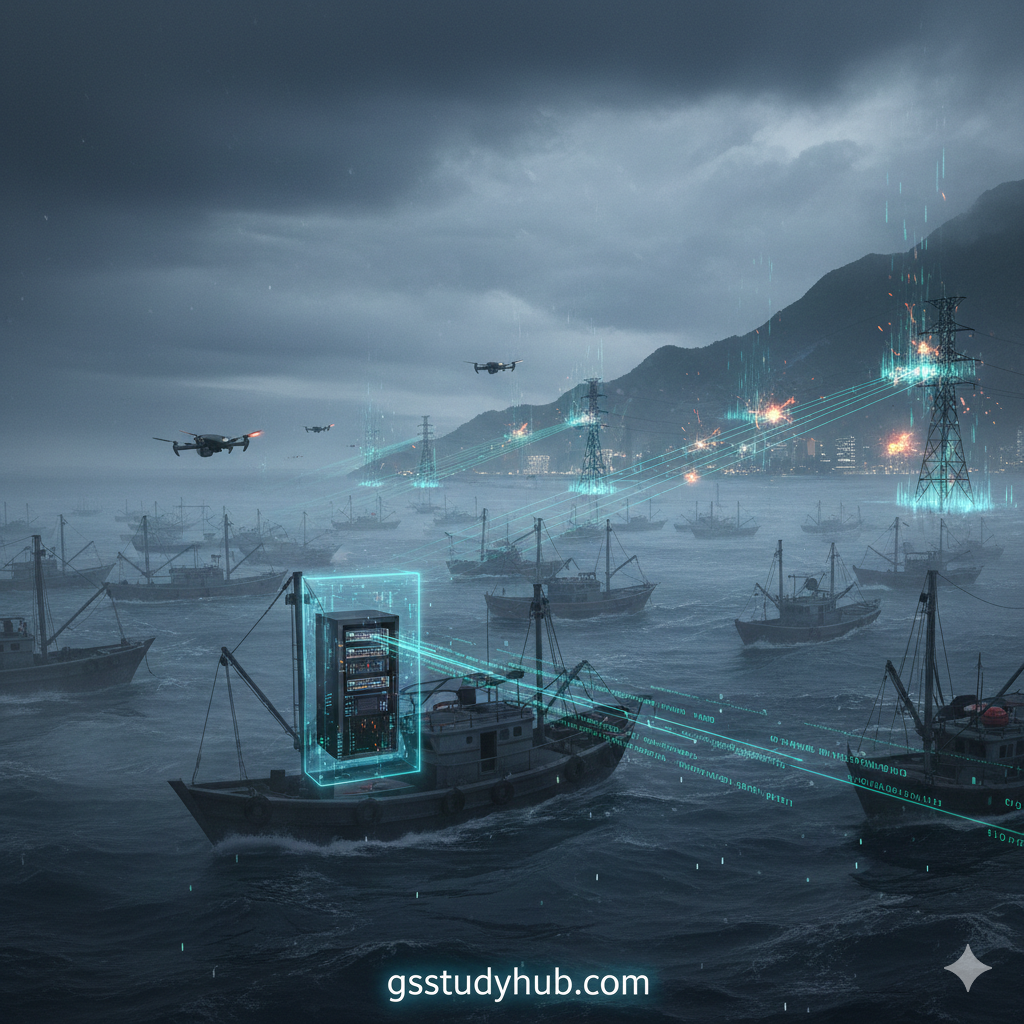
- Cyber Operations: Sustained attacks on Taiwan’s power grids and government infrastructure to create domestic chaos.
- Cognitive Warfare: Using AI-generated disinformation to fuel political division within Taiwan and sow doubt about U.S. commitment.
- Maritime Militia: Using massive fleets of "fishing vessels" (Ghost Fleets) to harass Taiwanese coast guard and assert control over restricted waters.
3. The Economic Blockade Scenario
Many military analysts in 2026 believe that an 'Economic Blockade' is a more likely immediate threat than a kinetic invasion. This strategy aims to "strangle" Taiwan’s economy into submission.
| Tactical Approach | Execution Method | Impact on Taiwan |
|---|---|---|
| Naval Blockade | PLAN vessels encircling major ports like Kaohsiung and Keelung. | Total cutoff of energy (LNG) and food imports. |
| Digital Isolation | Severing undersea fiber-optic internet cables. | Loss of global connectivity and financial market collapse. |
| Trade Coercion | Banning key Taiwanese exports (electronics, fruit, fish). | Massive drop in GDP and domestic industrial paralysis. |
Conclusion: Pressure or Invasion?
Ultimately, Xi Jinping's 2026 strategy appears to be 'reunification through maximum pressure.' While the capability for a full military invasion is growing relentlessly, the preferred path is to weaken Taiwan internally and isolate it internationally until "peaceful" reunification becomes the only option left on the table. However, with the PLA rehearsing decapitation strikes, the threat of force remains a very real second option.
For insights on how scientific advancement influences society and global competitiveness, read China: Science, Technology and Social Structure, a detailed exploration of technology’s role in China’s societal transformation.
Potential Scenarios: What Lies Ahead?
The tension in the Taiwan Strait is no longer a bilateral issue but a global concern. Strategic analysts have mapped out three primary scenarios for the 2026–2030 window that could redefine the world order:
1. Cold Peace (Tension but No War)
In this baseline scenario, China avoids a direct kinetic assault but continues aggressive 'Grey Zone' warfare. This includes near-daily military incursions, cyber-sabotage, and intensified diplomatic isolation of Taiwan.
- Global Impact: No hot war, but significantly higher operational costs due to increased insurance and shipping rates in the region.
- Outcome: A prolonged war of attrition where Taiwan focuses on resilience and the U.S. boosts "Integrated Deterrence."
2. Limited Military Conflict (The "Quarantine" Scenario)
Instead of a full invasion, Beijing might attempt to seize Taiwan’s outlying islands (like Kinmen or Matsu) or enforce a naval "Quarantine." This would be presented as a law-enforcement action rather than an act of war.
- Global Impact: Severe disruption to the global semiconductor supply chain and extreme volatility in world markets.
- Outcome: Massive economic sanctions imposed on China by the G7, leading to a "de-coupling" of the global economy.
3. Full-Scale Invasion (Amphibious Assault)
The most catastrophic scenario involving a massive amphibious landing supported by missile strikes and paratroopers to seize the main island of Taiwan.
- Global Impact: A projected 10% drop in global GDP and a high risk of escalation into World War III.
- Outcome: A high-intensity conflict involving direct U.S. and Japanese military intervention.
Prediction 2026–2030: Future Outlook
According to GS Study Hub’s strategic analysis, the next five years will be a "Pressure Cooker" period for global security:
- 2026-2027: China reaches its "Centenary Goal" for military modernization, achieving the capability to theoretically sustain a cross-strait operation.
- 2028: Western powers (U.S., EU, and India) achieve partial semiconductor self-reliance, potentially weakening Taiwan's "Silicon Shield" protection.
- 2029-2030: China’s internal demographic decline and economic plateau may push Beijing into a "Now or Never" mindset regarding reunification.
Conclusion: The 2026–2030 window is the "Danger Zone." While the world hopes for a Cold Peace, the military build-up on both sides suggests that the margin for error is shrinking daily.
gsstudyhub.comTo learn more about China’s political transformation and its historical roots, read China in the Communist Revolution of 1949, a comprehensive look at the events that reshaped modern China.
The Taiwan Crisis: Far-Reaching Implications for India
For New Delhi, the Taiwan Strait Crisis 2026 is not a distant conflict but a strategic concern with direct economic and security implications.
In February 2026, the escalating tension in the Taiwan Strait is no longer a distant East Asian problem. As an emerging global power, India is among the nations most vulnerable to this conflict. From strategic maritime security to economic stability, Taiwan’s status is of "critical" importance to New Delhi’s national interests.
1. The Indo-Pacific Strategy and the Role of QUAD
India is a staunch advocate for a "Free and Open Indo-Pacific." The primary objective of the QUAD (India, US, Japan, and Australia) is to prevent any unilateral military action that disrupts the regional status quo.
- The Two-Front War Dilemma: Analysts fear that if China moves against Taiwan, it could simultaneously escalate tensions along the Line of Actual Control (LAC) to pin down India and prevent it from supporting regional allies.
- Security Coordination: During the 2026 crisis, real-time intelligence sharing and naval coordination among QUAD members (such as through the Malabar Exercises) have become the bedrock of India’s maritime defense.
2. Blow to Global Supply Chains and Trade
Nearly 55% of India’s trade passes through the South China Sea and the waters surrounding Taiwan. Any kinetic conflict would effectively paralyze India’s primary Supply Chain routes.
Economic Stagflation Risk: A blockade in the Taiwan Strait would lead to a vertical spike in crude oil prices and freight costs, potentially pushing India’s inflation rate to record highs in 2026.
3. The Indian Semiconductor Mission (ISM) and Tech Autonomy
While India has launched the Indian Semiconductor Mission to become a global chip hub, the nation currently remains dependent on Taiwan for advanced logic chips and fabrication equipment.
| Sector | Impact (2026-27) | India's Strategic Response |
|---|---|---|
| Electronics | Projected 40% price hike in smartphones and laptops. | Accelerated Supply Chain Diversification with partners like Japan and Israel. |
| Automobile | Severe delays in EV and passenger vehicle production due to chip shortage. | Fast-tracking domestic fabrication units under the ISM. |
| Defense Systems | Shortage of critical chips for missile guidance and radar systems. | Strategic stockpiling of military-grade semiconductors. |
4. Diplomatic Tightrope: 'Act East' vs. 'One China'
New Delhi is navigating a complex diplomatic "tightrope walk." While India continues to strengthen economic ties with Taiwan under its 'Act East Policy,' it officially avoids directly challenging the 'One China Policy.' However, by 2026, India’s stance has become increasingly assertive, viewing peace in the Taiwan Strait as a "Global Common" essential for world stability.
Conclusion: The Taiwan crisis is a major wake-up call for New Delhi. It is imperative for India to bolster its naval presence in the Indo-Pacific and ensure the Indian Semiconductor Mission succeeds at a war-footing to insulate the economy from global shocks.
To understand how military alliances influence global security and policy, read NATO Strategy in Eastern Europe and Its Global Impact, a detailed analysis of NATO’s role and its wider implications.
Conclusion: War or Diplomacy?
Ultimately, the trajectory of the Taiwan Strait Crisis 2026 will determine whether diplomacy prevails or Asia witnesses a destabilizing conflict.
The Taiwan Strait crisis of 2026 stands at a historical crossroads. As global superpowers maneuver their fleets and economic sanctions are prepared, the world faces a haunting question: Has humanity learned enough from the Ukraine conflict to prevent a catastrophic sequel in Asia?
The Case for Diplomacy
Despite the roar of military drills, China, the United States, and Taiwan remain acutely aware that the cost of a full-scale kinetic war would far outweigh any perceived victory. Taiwan's "Silicon Shield" and the intricate web of global economic interdependence act as a powerful deterrent, forcing the sword to remain in its scabbard. In 2026, diplomacy is no longer a choice; it is a global necessity.
Ultimately, the issue of Taiwan is not just about a piece of land; it is about the "rules of the game" for the 21st century. Will international law and democratic values prevail, or will the world revert to the doctrine of "Might is Right"? The answer will define the global order for generations to come.
"History bears witness that wars are never solutions; they are merely the birth of new and more complex tragedies."
We Value Your Perspective
Do you believe Taiwan will become the "Next Ukraine"? Or will global economic interests effectively deter China from military action?
Share your analysis in the comments below! If you found this GS Study Hub report insightful, share it with your fellow aspirants and colleagues.
To explore how emerging alliances are reshaping global power structures, read BRICS Expansion and the Changing World Order – Impact Explained, a detailed look at how BRICS growth is influencing international dynamics.
Frequently Asked Questions (FAQ)
What is the 'One China Policy'?
The One China Policy is a diplomatic acknowledgement of China's position that there is only one Chinese government. Under this policy, nations recognize the People's Republic of China (PRC) as the sole legal government of China and acknowledge its claim over Taiwan. While the PRC asserts that Taiwan is a province, Taiwan views itself as a sovereign state. Most countries, including the US and India, maintain this policy to preserve diplomatic ties with Beijing while keeping unofficial relations with Taipei.
Which countries officially recognize Taiwan?
As of February 2026, only 12 sovereign states and the Holy See (Vatican City) maintain full diplomatic relations with Taiwan. These include nations like Paraguay, Belize, and various Pacific island states such as Palau and the Marshall Islands. Most major global powers do not have official ties but interact with Taiwan through "Representative Offices" that function as de facto embassies to facilitate trade, security, and cultural exchange.
What is India's official stance on Taiwan?
India officially adheres to the 'One China Policy' and does not have formal diplomatic ties with Taiwan. However, since 1995, India has operated the India-Taipei Association (ITA) to manage commercial and people-to-people links. In 2026, India's stance has become more nuanced; while it avoids formal recognition, it treats Taiwan as a critical partner in the Indo-Pacific and a strategic ally in the Indian Semiconductor Mission. New Delhi now emphasizes that peace in the Taiwan Strait is vital for global security.