
Sweden – A Modern Nordic Nation with Global Influence
Located in Northern Europe, this Nordic country is widely recognized for its peaceful society, technological innovation, and high living standards. Known for balancing economic growth with social equality, it stands among the most developed nations in the world.
Quick Country Overview
Geographical Position
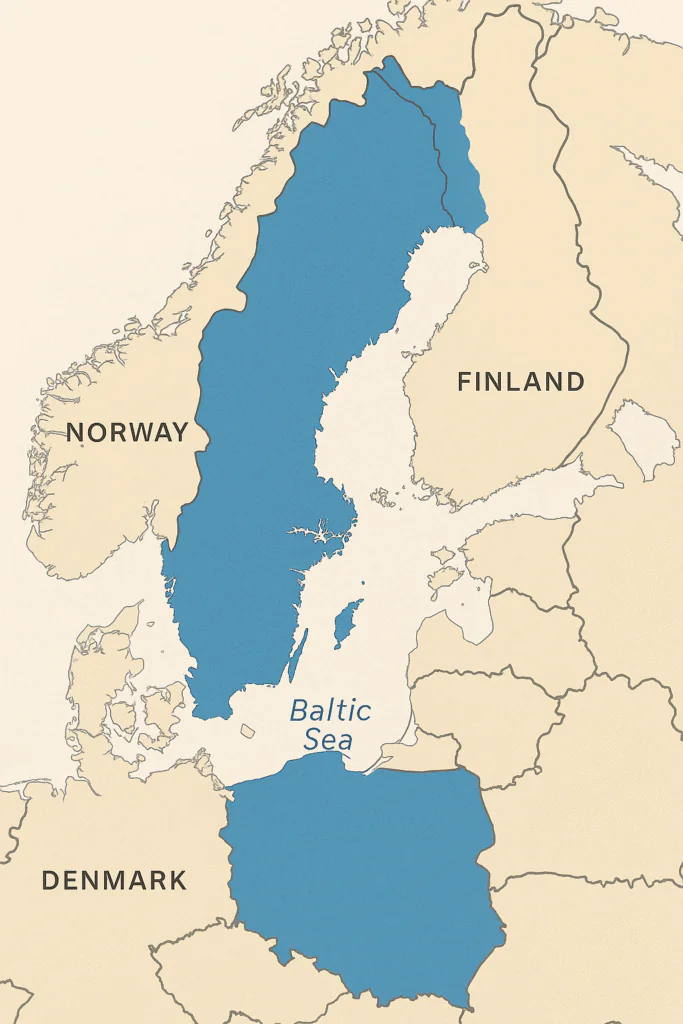
Situated on the Scandinavian Peninsula, the country shares borders with Norway and Finland while facing the Baltic Sea to the east.
- Capital: Stockholm
- Main Cities: Gothenburg, Malmö, Uppsala
- Total Area: ~450,000 sq. km
- Landscape: Forests, lakes, mountains, coastal regions
Political System and Governance
The nation follows a constitutional monarchy combined with a parliamentary democracy. Governance emphasizes transparency, accountability, and strong institutional stability.
- Ceremonial Monarch as Head of State
- Prime Minister as Executive Authority
- 349-member Parliament (Riksdag)
- Multi-party democratic structure
Population and Social Structure
With a population of around 10 million, society here values equality, freedom of expression, and social welfare. Education and healthcare systems are publicly funded and highly efficient.
- Literacy Rate: 99%
- High Human Development Index
- Strong gender equality framework
- Life Expectancy: 81–84 years
The philosophy of “Lagom” — meaning balance and moderation — plays a key role in shaping everyday life and governance culture.
Economic Model and Global Standing
Sweden’s economy blends welfare policies with private-sector innovation. It consistently ranks among the world’s most competitive and innovative economies.
- GDP: ~$650 billion (approx.)
- Currency: Swedish Krona (SEK)
- Main Industries: Automotive, Telecom, IT, Steel, Renewable Energy
Major Global Brands
- Volvo
- Ericsson
- IKEA
- Spotify
Why Sweden Matters Globally
This Scandinavian nation plays an active role in climate action, innovation leadership, human rights advocacy, and sustainable development initiatives worldwide.
Conclusion
Sweden represents a powerful example of how economic prosperity and social justice can coexist. Its model of balanced development offers valuable lessons for emerging and developed economies alike.

5. Key Features and Major Achievements
This Nordic nation is widely respected for its peace-oriented foreign policy, innovation-driven economy, social equality and commitment to environmental sustainability. These achievements distinguish it from many other developed countries.
Major Strengths and Global Contributions
1. Peace, Stability and Neutrality
- Since 1809, the country has not participated in any major war.
- It has historically maintained a policy of neutrality and diplomatic balance.
- Regularly ranks among the most peaceful nations in global peace reports.
2. Host of the Nobel Prize Ceremonies
- Inspired by the legacy of Alfred Nobel, annual Nobel Prize ceremonies (except Peace Prize) are held in Stockholm.
- This reflects its contribution to science, literature, and humanitarian progress.
3. High Human Development and Quality of Life
- Consistently ranks among top countries on the Human Development Index (HDI).
- Education, healthcare, safety, and cleanliness standards remain exceptionally high.
- Frequently recognized for strong gender equality policies.
4. Strong Welfare and Social Security Model
- Offers publicly funded education, universal healthcare, unemployment benefits and generous parental leave.
- Its welfare system is considered one of the most efficient globally.
5. Green Energy Leadership
- Over 75% of electricity production comes from renewable sources such as hydro, wind and biofuel.
- Global leader in recycling systems and clean technology.
- Internationally recognized for sustainable environmental policies.
6. Innovation and Global Industry Presence
- Home to internationally known brands such as Spotify, Skype, Klarna, IKEA, Volvo and Ericsson.
- Consistently ranks high in the Global Innovation Index.
- Strong investment in research, digital technology and startup ecosystems.
7. Equality and Inclusive Society
- Strong legal protections for women, minorities and LGBTQ+ communities.
- Widely admired for progressive social policies and parenting benefits.
8. Education and Knowledge Culture
- Free education for domestic and EU students.
- Attracts thousands of international students annually.
- Performs strongly in global education assessments like PISA.
9. Tourism and Cultural Identity
- Famous for Northern Lights, pristine lakes and vast forest landscapes.
- Celebrates traditions such as Midsummer Festival and distinctive Scandinavian design culture.
Final Reflection
The country represents a powerful blend of modern governance, environmental responsibility and social balance. Its achievements extend beyond economic strength — rooted deeply in equality, sustainability and respect for human dignity.
6. India–Sweden Relations
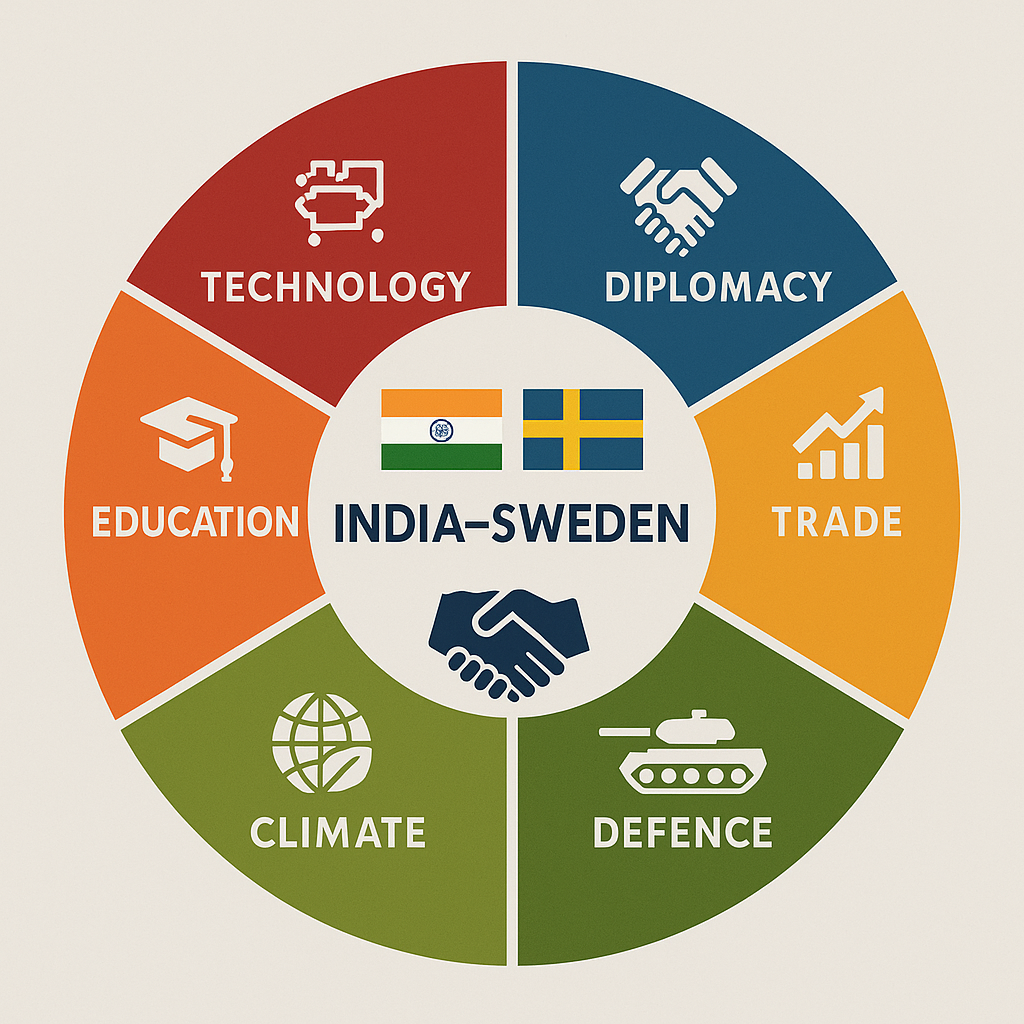
Bilateral relations between India and this Nordic nation are rooted in democratic values, innovation-driven development and a shared commitment to sustainability. Over the decades, cooperation has expanded across diplomatic, economic, technological and cultural domains.
Overview of Bilateral Cooperation
1. Diplomatic Engagement
- Formal diplomatic ties were established in 1957.
- High-level visits have strengthened the partnership:
- Prime Minister Indira Gandhi visited in 1972.
- Prime Minister Narendra Modi visited in 2018.
- Prime Minister Stefan Löfven visited India and participated in the “Make in India” initiative.
- Both countries actively engage through the India–Nordic Summit framework.
2. Economic and Trade Relations
| Sector | Details |
|---|---|
| Bilateral Trade | Trade volume exceeded USD 2 billion in 2024. |
| Nordic Companies in India | Volvo, Ericsson, IKEA, H&M, AstraZeneca, Tetra Pak and others. |
| India’s Exports | Textiles, machinery, pharmaceuticals, chemicals, furniture. |
| Imports to India | Vehicles, communication equipment, machinery, paper products. |
The Nordic country considers India one of the fastest-growing major markets and a strategic partner in Asia.
3. Science, Technology and Innovation
- Under the Joint Innovation Partnership (2018), cooperation includes:
- Artificial Intelligence
- Smart Cities
- E-Health
- Advanced manufacturing
- Research collaborations exist between IITs and leading universities such as KTH and Uppsala University.
- Several Nordic firms operate R&D centers in Indian technology hubs.
4. Education and Cultural Exchange
- Universities in Stockholm and other cities attract Indian postgraduate students.
- Scholarship programs encourage academic mobility.
- An active Indian diaspora contributes to IT, healthcare and research sectors.
5. Climate and Sustainable Development Partnership
- Joint initiatives in renewable energy and green technology.
- India–Nordic cooperation supports climate innovation and circular economy models.
6. Defence and Strategic Dialogue
- Discussions have included defence technology cooperation, including the Gripen fighter proposal.
- Strategic dialogue focuses on maritime security and emerging technologies.
7. Multilateral Cooperation
- Collaboration within platforms such as:
- United Nations
- World Trade Organization
- International Solar Alliance
Strategic Significance
The partnership represents a convergence of innovation capacity, democratic governance and sustainable development goals. As global challenges such as climate change, digital transformation and geopolitical instability intensify, bilateral cooperation is expected to deepen further.
7. Tourism and Cultural Identity
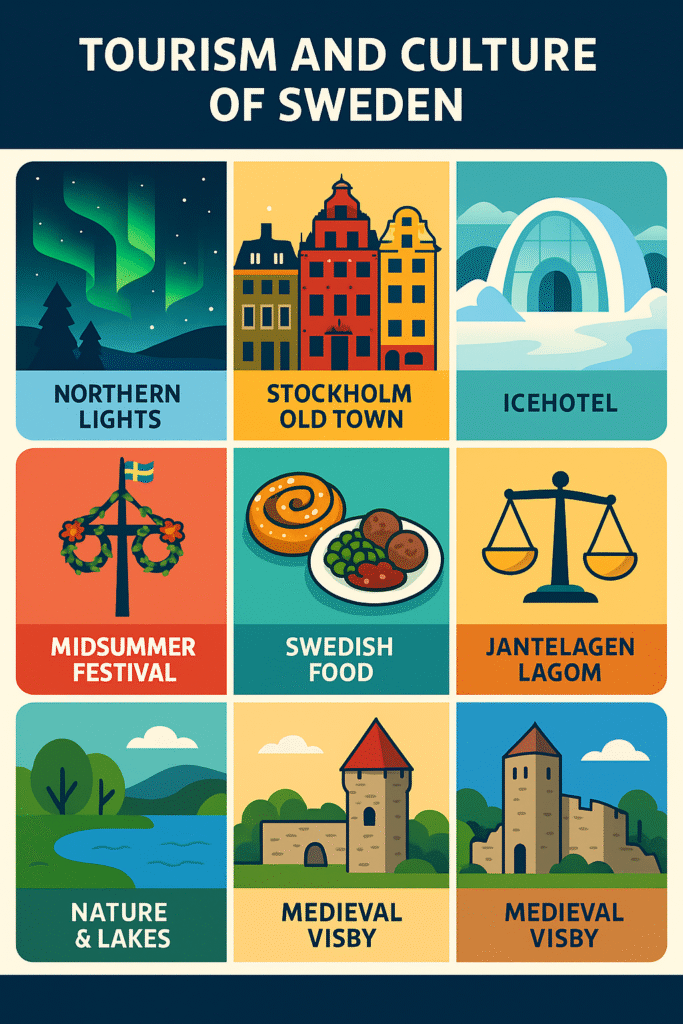
This Nordic country attracts millions of visitors each year due to its pristine natural landscapes, historic towns and distinctive cultural traditions. The tourism sector reflects a harmonious blend of medieval heritage and modern Scandinavian design.
Main Dimensions of Tourism and Culture
1. Natural and Urban Attractions
• Nature Tourism
- Northern Lights (Aurora Borealis): Visible in the Arctic regions, especially around Kiruna and Abisko National Park.
- Lakes and Forest Landscapes: Over 100,000 lakes and vast forest cover dominate the terrain. Vänern and Vättern are among the largest freshwater lakes in Europe.
• Major Urban Centers
- Stockholm: Built across 14 islands; attractions include Gamla Stan, the Vasa Museum and the Royal Palace.
- Gothenburg: Known for maritime heritage, seafood cuisine and cultural festivals.
- Malmö: Connected to Denmark by the Øresund Bridge; showcases modern architecture and multicultural life.
• Unique Destinations
- Icehotel (Jukkasjärvi): A world-famous seasonal hotel constructed entirely from ice and snow.
- Gotland & Visby: UNESCO-listed medieval town famous for stone walls and coastal beauty.
2. Festivals and National Celebrations
| Festival | Significance |
|---|---|
| Midsummer Festival | Celebrates the longest day of the year with flower crowns, traditional dances and folk music. |
| Santa Lucia Day (13 December) | Symbolizes light during winter darkness; marked by candle processions. |
| Walpurgis Night | Bonfires on 30 April welcome the arrival of spring. |
| National Day (6 June) | Flag ceremonies and cultural programs celebrate national unity. |
3. Literature, Music and Creative Arts
- Astrid Lindgren: Globally admired children's author.
- ABBA: International pop music phenomenon.
- Ingmar Bergman: Renowned filmmaker known for artistic cinema.
- Scandinavian Design: Minimalism, functionality and sustainability (IKEA as a global example).
4. Social Values and Folk Traditions
| Concept | Meaning |
|---|---|
| Lagom | Balance and moderation in life — “just enough”. |
| Jantelagen | Emphasis on humility, equality and collective harmony. |
| Allemansrätten | Right of public access to nature, reflecting deep environmental respect. |
5. Religion and Diversity
- Historically Lutheran (Church of Sweden).
- Modern society is largely secular and multicultural.
- Presence of Muslim, Hindu, Buddhist and Jewish communities.
Analytical Perspective
Tourism and cultural traditions reflect a broader philosophy centered on sustainability, equality and respect for nature. The integration of modern design, welfare values and environmental awareness has created a distinctive national identity admired globally.
Final Conclusion
Sweden represents a powerful model of balanced and sustainable development in the modern world. From its strong democratic institutions and innovation-driven economy to its welfare-oriented social system and environmentally conscious policies, the country demonstrates how progress can coexist with equality and human dignity.
Its peaceful diplomatic history, leadership in green energy, commitment to research and technology, and globally respected cultural traditions make it one of the most admired nations in Europe. The partnership with India further strengthens its role in global innovation, trade and climate cooperation.
Beyond economic indicators and global rankings, what truly distinguishes Sweden is its social philosophy — a belief in balance, fairness and collective responsibility. The principles of equality, sustainability and respect for nature continue to shape its domestic policies as well as international engagement.
In a rapidly changing world marked by geopolitical tensions and environmental challenges, Sweden offers valuable lessons for emerging and developed nations alike. It stands not merely as a prosperous country, but as a model of inclusive growth, modern governance and long-term stability.
Frequently Asked Questions (FAQ) about Sweden
1. Where is Sweden located?
Sweden is located in Northern Europe on the Scandinavian Peninsula. It shares borders with Norway to the west and Finland to the northeast, and faces the Baltic Sea to the east.
2. What is the capital of Sweden?
Stockholm is the capital and largest city. It is built on 14 islands and serves as the political, economic and cultural center of the country.
3. What type of government does Sweden have?
Sweden follows a constitutional monarchy with a parliamentary democracy. The monarch is the ceremonial head of state, while the Prime Minister is the head of government.
4. What is Sweden famous for?
Sweden is famous for its high quality of life, innovation, Nobel Prize ceremonies, global brands like IKEA and Volvo, and its commitment to sustainability and environmental protection.
5. What is the main currency used in Sweden?
The official currency is the Swedish Krona (SEK), which is used for all economic and financial transactions.
6. What are the main industries of Sweden?
Major industries include automotive manufacturing, telecommunications, information technology, renewable energy, steel production and pharmaceuticals.
7. How are India and Sweden related?
India and Sweden maintain strong diplomatic, economic and technological relations. Cooperation exists in innovation, clean energy, trade, education and sustainable development.
8. Why is Sweden considered one of the best countries in the world?
It ranks highly due to its strong welfare system, high living standards, innovation, quality education, universal healthcare and commitment to equality and sustainability.
References
- CIA World Factbook – Sweden
Available at: https://www.cia.gov/the-world-factbook/countries/sweden/ - Encyclopaedia Britannica – Sweden
Available at: https://www.britannica.com/place/Sweden - Government Offices of Sweden (Official Portal)
Available at: https://www.government.se/ - Statistics Sweden (SCB)
Available at: https://www.scb.se/en/ - World Bank – Sweden Overview
Available at: https://www.worldbank.org/en/country/sweden - International Monetary Fund (IMF) – Sweden Country Data
Available at: https://www.imf.org/en/Countries/SWE - UNDP – Human Development Reports
Available at: https://hdr.undp.org/ - Sweden.se – Official Information by the Swedish Institute
Available at: https://sweden.se/ - Books and Academic Sources
- Daun, Å. (1996). Swedish Mentality. Penn State University Press.
- Trägårdh, L. (2009). State and Civil Society in Northern Europe: The Swedish Model Reconsidered. Berghahn Books.