
Introduction
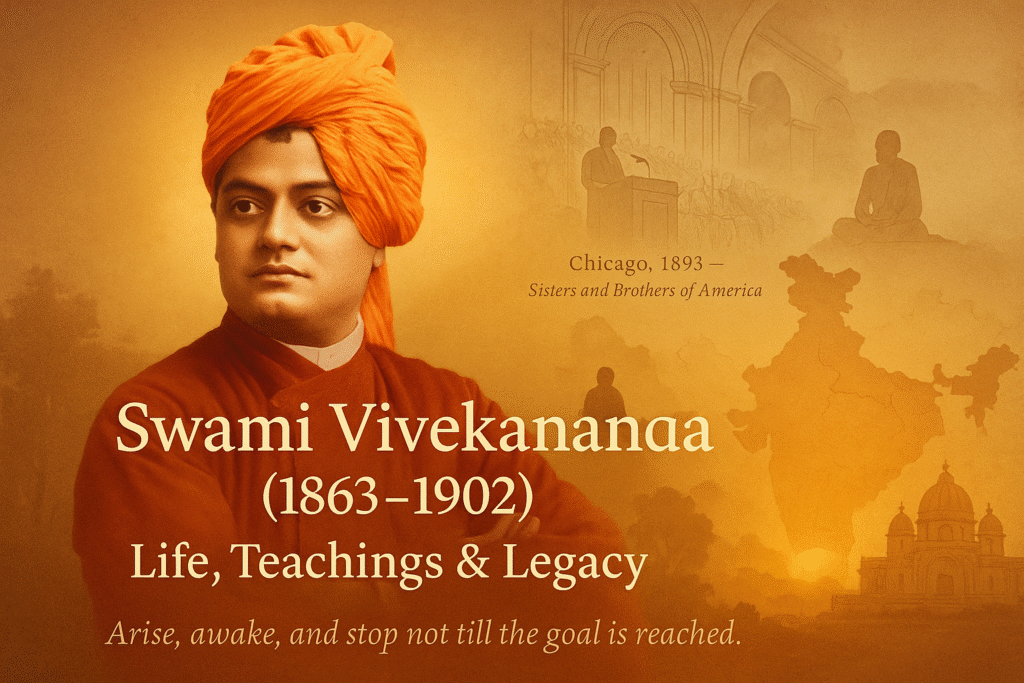
Swami Vivekananda (1863–1902), born Narendranath Datta, was one of India's most influential spiritual leaders, philosophers, thinkers, and social reformers. He was a leading disciple of Sri Ramakrishna Paramahamsa and played an important role in introducing Indian spiritual philosophy, Vedanta, and Yoga to international audiences. His ideas focused on self-confidence, character-building, religious tolerance, education, and service to humanity.
He gained worldwide recognition after delivering his historic speech at the World's Parliament of Religions in Chicago on 11 September 1893. His address, which began with the famous words "Sisters and Brothers of America," received an enthusiastic response and helped introduce the philosophical and spiritual traditions of India to a wider Western audience. His teachings continue to inspire students, educators, spiritual seekers, and social workers.
Early Life of Swami Vivekananda
Birth and Family Background
Swami Vivekananda was born on 12 January 1863 in Calcutta, now known as Kolkata, in British India. His childhood name was Narendranath Datta. His father, Vishwanath Datta, was a lawyer known for his broad outlook and intellectual interests, while his mother, Bhuvaneshwari Devi, was deeply religious and played an important role in shaping his early values and character.
From childhood, Narendranath showed remarkable curiosity, intelligence, courage, and interest in spiritual questions. He was interested in music, physical exercise, philosophy, literature, and religious discussions. His upbringing combined rational thinking with spiritual values, which later became important features of his teachings.
Education and Spiritual Inclination
Narendranath received his education in Calcutta and studied at institutions including the General Assembly's Institution, now known as Scottish Church College. He developed a strong interest in Western philosophy, history, literature, and Indian religious traditions. He also studied texts such as the Upanishads and the Bhagavad Gita and explored questions about the existence of God, the nature of the soul, and the purpose of human life.
His search for spiritual knowledge eventually brought him into contact with Sri Ramakrishna Paramahamsa at Dakshineswar. Ramakrishna's spiritual experiences and teachings deeply influenced Narendranath. Over time, he became his devoted disciple and adopted the monastic life after his guru's death. He later became widely known as Swami Vivekananda.
The Chicago Parliament of Religions (1893)
One of the most significant events in Swami Vivekananda's life was his participation in the World's Parliament of Religions, held in Chicago, United States, in September 1893. The gathering brought together representatives of different religious traditions to discuss faith, philosophy, and interreligious understanding. Vivekananda represented Hindu thought and presented ideas rooted in Vedanta and India's spiritual traditions.
On 11 September 1893, he began his address with the words "Sisters and Brothers of America." His greeting received a warm response from the audience. In his speech, he emphasised religious tolerance, acceptance of different paths, universal brotherhood, and the importance of mutual respect among religions.
His participation helped bring greater international attention to Indian philosophy and spirituality. He subsequently delivered lectures in different parts of the United States and Europe, explaining Vedanta, Yoga, and the practical application of spiritual principles in everyday life.
Key Messages from the Chicago Speech
- Religious tolerance: Different religious traditions should be treated with respect and understanding.
- Universal brotherhood: Humanity should be united through mutual respect, compassion, and cooperation.
- Acceptance of diversity: Different spiritual paths can lead people towards higher understanding.
- Indian spiritual heritage: Indian philosophical traditions have important ideas to contribute to global discussions.
- Practical spirituality: Spiritual values should be reflected in human behaviour and service to society.
Contributions to India's Social and National Life
Inspiration for India's National Awakening
Swami Vivekananda did not participate directly in the organised political struggle against British rule. However, his message of self-confidence, courage, discipline, and national pride influenced India's intellectual and cultural awakening. His writings and speeches encouraged Indians to recognise their heritage, overcome social weaknesses, and work towards the development of the country.
His ideas inspired several later national leaders and thinkers, including Subhas Chandra Bose, Aurobindo Ghosh, and others. His emphasis on strength, character, education, and service became an important source of inspiration for India's youth and national consciousness.
Nationalism and Self-Reliance
Vivekananda believed that a nation's progress depended on the strength, education, confidence, and character of its people. He encouraged Indians to overcome feelings of inferiority and develop faith in their own abilities. He also emphasised that national development should include the upliftment of ordinary people, especially those facing poverty and social disadvantage.
His famous message, "Arise, awake, and stop not till the goal is reached," is widely associated with his teachings and continues to motivate students and young people. The expression is drawn from the Katha Upanishad, and Vivekananda helped popularise it through his speeches and writings.
Social Reform and Education
Swami Vivekananda considered education essential for individual development and national progress. He believed that education should develop confidence, independent thinking, moral strength, and practical abilities rather than merely provide information. He also stressed the importance of improving access to education for disadvantaged communities.
He strongly advocated the dignity and upliftment of the poor and criticised social practices that weakened human dignity. He emphasised women's education and their important role in society. His broader vision of social reform connected spiritual development with practical service, equality, and human welfare.
Foundation of the Ramakrishna Mission
In 1897, Swami Vivekananda founded the Ramakrishna Mission to organise social service alongside spiritual development. Inspired by the teachings of Sri Ramakrishna, the organisation worked towards education, healthcare, relief activities, and the welfare of society.
The Ramakrishna Mission continues to undertake educational, medical, charitable, and humanitarian activities in India and other countries. Its work reflects Vivekananda's belief that serving people is an important expression of spiritual life.
Inspirational Teachings of Swami Vivekananda
Swami Vivekananda's teachings combined Vedanta philosophy with practical guidance for everyday life. He encouraged people to develop inner strength, discipline, compassion, and a sense of responsibility towards society. Some of his most important teachings are explained below.
Self-Confidence and Inner Strength
Vivekananda believed that every individual possesses great potential. He encouraged people to recognise their inner strength, overcome fear, and face difficulties with courage. According to his philosophy, self-confidence is essential for personal growth and meaningful achievements.
Education as Character-Building
He viewed education as a process of developing human potential. In his view, true education should build character, strengthen the mind, encourage independent thinking, and prepare individuals to face real-life challenges. He considered education a powerful instrument for social progress and national development.
Service to Humanity
Vivekananda emphasised that serving humanity is an important expression of spiritual values. He encouraged people to help the poor, support the disadvantaged, and work for the welfare of society. His teachings connected spiritual life with compassion, responsibility, and practical action.
Religious Harmony and Universal Acceptance
He believed that different religions and spiritual traditions could offer meaningful paths for human development. Rather than encouraging religious conflict, he promoted mutual respect, tolerance, and understanding. His message of harmony remains relevant in a world characterised by religious and cultural diversity.
Short Biography of Swami Vivekananda
Swami Vivekananda was born as Narendranath Datta on 12 January 1863 in Calcutta. After receiving his education and developing a deep interest in philosophy and spirituality, he became a disciple of Sri Ramakrishna Paramahamsa. Following his guru's death, he adopted the monastic life and travelled across India, observing the social and economic conditions of its people.
In 1893, he represented Indian spiritual thought at the World's Parliament of Religions in Chicago and gained international recognition. In 1897, he established the Ramakrishna Mission to promote education, social service, and spiritual development. He passed away on 4 July 1902 at Belur Math, near Kolkata, at the age of 39.
Death and Lasting Legacy
Swami Vivekananda passed away on 4 July 1902 at Belur Math in West Bengal. Although his life was relatively short, his influence on Indian philosophy, spirituality, education, and social thought has remained significant. His teachings continue to be studied by people interested in Vedanta, Yoga, personal development, and social service.
His legacy is carried forward through the Ramakrishna Math and Ramakrishna Mission, as well as through his books, lectures, and ideas. His birth anniversary, 12 January, is observed in India as National Youth Day. The observance highlights his emphasis on youth development, self-confidence, discipline, and national progress.
Conclusion
Swami Vivekananda was one of the most influential spiritual thinkers of modern India. Through his speeches, writings, and social initiatives, he connected India's philosophical heritage with practical questions of education, character, national development, and human welfare. His historic Chicago address in 1893 brought international attention to Indian spiritual thought, while the establishment of the Ramakrishna Mission gave an organised form to his vision of service.
His message of courage, self-confidence, religious harmony, education, and service to humanity continues to inspire generations. His life demonstrates how spiritual ideas can be connected with individual improvement and the wider welfare of society.
Frequently Asked Questions (FAQs)
1. Who was Swami Vivekananda?
Swami Vivekananda was an Indian spiritual leader, philosopher, and social reformer. Born as Narendranath Datta on 12 January 1863, he became internationally known for presenting Indian spiritual philosophy at the World's Parliament of Religions in Chicago in 1893.
2. What was the real name of Swami Vivekananda?
His childhood and pre-monastic name was Narendranath Datta. After adopting the monastic life, he became widely known as Swami Vivekananda.
3. When did Swami Vivekananda deliver his famous Chicago speech?
Swami Vivekananda delivered his famous address at the World's Parliament of Religions in Chicago on 11 September 1893. He began his speech with the words "Sisters and Brothers of America."
4. Who was the spiritual guru of Swami Vivekananda?
Sri Ramakrishna Paramahamsa was the spiritual guru of Swami Vivekananda. His teachings and spiritual experiences had a profound influence on Vivekananda's life and philosophy.
5. When was the Ramakrishna Mission established?
Swami Vivekananda established the Ramakrishna Mission in 1897. Its activities include education, healthcare, humanitarian relief, social welfare, and spiritual development.
6. What are the main teachings of Swami Vivekananda?
His main teachings include self-confidence, character-building education, service to humanity, religious harmony, discipline, inner strength, and the upliftment of society.
7. When is National Youth Day celebrated in India?
National Youth Day is celebrated in India on 12 January every year to mark the birth anniversary of Swami Vivekananda. The day highlights his ideas about youth empowerment, education, discipline, and national development.
8. When did Swami Vivekananda die?
Swami Vivekananda passed away on 4 July 1902 at Belur Math in West Bengal. He was 39 years old.
9. Why is Swami Vivekananda important for students and young people?
Swami Vivekananda's teachings encourage students and young people to develop self-confidence, discipline, strong character, independent thinking, and a sense of social responsibility. His ideas remain relevant to education, personal development, and nation-building.
Recommended Book

Swami Vivekananda – Recommended Book
Explore this book and check its full details and latest price on Amazon.
View on AmazonAs an Amazon Associate, I earn from qualifying purchases.

Early Life of Swami Vivekananda
Birth and Family Background
Swami Vivekananda was born on 12 January 1863 in Calcutta, now known as Kolkata, in British India. His birth name was Narendranath Datta. He was born into a well-educated Bengali family that valued intellectual development, cultural traditions, and religious beliefs. His family environment played an important role in shaping his personality, thinking, and spiritual interests.
- Father: Vishwanath Datta, a respected lawyer known for his intellectual outlook and rational thinking.
- Mother: Bhuvaneshwari Devi, a religious and cultured woman who influenced his moral values and spiritual development.
His father encouraged logical reasoning, independent thinking, and an open-minded approach towards different ideas. His mother introduced him to religious stories, traditional values, devotion, and spiritual practices. The combination of rational thinking and spiritual inclination helped develop the distinctive personality that later became an important feature of Vivekananda's philosophy.
Childhood Personality and Interests
From an early age, Narendranath displayed remarkable intelligence, curiosity, courage, and confidence. He was interested in understanding the world around him and often asked questions about religion, philosophy, human life, and the existence of God. He also showed an active interest in physical exercise, sports, music, and intellectual discussions.
His childhood reflected a combination of physical energy, intellectual curiosity, and spiritual interest. These qualities gradually developed into the confidence, discipline, and independent thinking that characterised his later life as a spiritual leader and philosopher.
Education and Thirst for Knowledge
Narendranath was an intelligent and inquisitive student who developed an interest in a wide range of subjects. He received his early education in Calcutta and later studied at institutions including the General Assembly's Institution, now known as Scottish Church College. His educational experiences exposed him to both Indian intellectual traditions and modern Western thought.
He studied subjects such as Western philosophy, history, literature, logic, and social thought. He was particularly interested in examining different philosophical arguments and understanding the relationship between reason, faith, and human existence. His ability to question ideas and analyse different viewpoints helped develop his independent intellectual outlook.
Interest in Indian Philosophy and Religious Texts
Along with Western education, Narendranath developed a deep interest in India's ancient philosophical and spiritual traditions. He studied important texts such as the Vedas, Upanishads, and Bhagavad Gita. These scriptures introduced him to concepts concerning the soul, the nature of reality, self-realisation, and the relationship between human beings and the divine.
He did not limit his learning to religious texts or classroom education. He tried to understand philosophical ideas through logical reasoning, discussion, personal experience, and practical observation. This combination of intellectual inquiry and spiritual exploration later influenced his interpretation of Vedanta philosophy.
Interest in Music, Sports, and Debates
Narendranath was also talented in music and had an interest in physical activities. He participated in sports, exercise, singing, and discussions. His communication skills and confidence helped him express his views effectively. These interests contributed to the development of his disciplined personality and ability to connect with people from different backgrounds.
Meeting with His Guru and Beginning of the Spiritual Journey
Search for the Meaning of God and Spiritual Truth
During his youth, Narendranath became increasingly concerned with fundamental spiritual questions. He wanted to understand whether God truly existed and whether divine reality could be experienced directly. Rather than accepting religious beliefs without examination, he searched for someone who could answer his questions through personal spiritual experience.
One question became especially important in his search for truth:
"Have you seen God?"
He reportedly asked this question to several religious thinkers and spiritual personalities. However, he did not find a completely satisfying answer that matched his desire for direct experience and certainty. His search eventually brought him to Sri Ramakrishna Paramahamsa at Dakshineswar, near Calcutta.
Meeting Sri Ramakrishna Paramahamsa
Narendranath's meeting with Sri Ramakrishna Paramahamsa became a turning point in his life. Ramakrishna's spiritual experiences, devotion, and simple approach to religious truth deeply impressed him. According to traditional accounts of their relationship, Ramakrishna responded to Narendranath's question about seeing God by affirming that he had experienced the divine directly.
Initially, Narendranath approached Ramakrishna with a questioning and analytical attitude. However, repeated meetings and personal experiences gradually strengthened their relationship. Ramakrishna became his spiritual guide and helped him understand the importance of self-realisation, devotion, compassion, and the unity of spiritual truth.
Influence of Guru Ramakrishna Paramahamsa
Sri Ramakrishna had a profound influence on Vivekananda's spiritual development. He taught that spiritual realisation was not merely a matter of intellectual discussion but something that could be experienced through sincere spiritual practice. His teachings also emphasised the importance of recognising the divine presence in all human beings and respecting different religious paths.
Some of the important principles associated with Ramakrishna's teachings include:
- Divinity within every individual: Every human being possesses spiritual potential and deserves dignity and respect.
- Service to humanity: Helping and serving people is an important expression of devotion and spiritual life.
- Religious harmony: Different religious traditions can provide meaningful paths towards spiritual realisation.
- Practical spirituality: Spiritual values should be reflected through compassion, purity, discipline, and everyday actions.
Under Ramakrishna's guidance, Narendranath's spiritual outlook developed significantly. Their guru-disciple relationship became the foundation of Vivekananda's later mission, which combined spiritual philosophy with education, social service, and the upliftment of humanity.
Swami Vivekananda's Inclination Towards Education and Spirituality
Coordination of Modern Education and Spiritual Wisdom
Swami Vivekananda believed that education should develop the complete personality of an individual. In his view, education was not simply the collection of information or the memorisation of facts. Its deeper purpose was to develop character, strengthen the mind, encourage independent thinking, and help individuals recognise their inner potential.
He appreciated the importance of modern scientific and intellectual education while also emphasising the value of India's philosophical and spiritual heritage. He believed that scientific reasoning and spiritual wisdom could complement each other when applied with an open and balanced approach.
Education as a Means of Character-Building
Vivekananda placed great importance on character-building, self-confidence, discipline, and moral strength. He believed that meaningful education should prepare individuals to face life's difficulties and contribute positively to society. Education, according to his broader philosophy, should empower people rather than make them dependent on others.
- Self-reliance: Education should encourage individuals to develop confidence and independence.
- Character development: Moral values, discipline, honesty, and courage are essential elements of learning.
- Practical knowledge: Education should help people solve real-life problems and improve their circumstances.
- Social responsibility: Educated individuals should use their knowledge and abilities for the welfare of society.
Spirituality and Service to Humanity
Vivekananda connected spirituality with practical service and human welfare. He believed that spiritual development should not remain limited to personal meditation or religious discussion. It should also inspire compassion, selflessness, and a commitment to helping others.
His ideas encouraged people to combine inner development with social responsibility. This approach later became an important part of the philosophy behind the Ramakrishna Mission and its activities in education, healthcare, and humanitarian service.
Characteristics of Swami Vivekananda's Early Life
The experiences of Vivekananda's childhood, education, and spiritual search helped shape the qualities that later defined his personality and public life. His early development can be understood through the following characteristics:
- Intellectual curiosity: A strong desire to understand philosophy, science, religion, and human life.
- Self-confidence: The ability to express ideas independently and face difficult questions with courage.
- Spiritual curiosity: A continuous search for truth, God, and the deeper meaning of existence.
- Interest in education: A belief in knowledge, independent thinking, and character development.
- Physical and cultural interests: Participation in sports, exercise, music, and intellectual discussions.
- Social awareness: A growing concern for human dignity, compassion, and the welfare of society.
Conclusion
The early life of Swami Vivekananda played a decisive role in shaping his later achievements as a spiritual leader, philosopher, and social thinker. His family environment encouraged both rational thinking and religious values, while his education introduced him to Indian philosophy and Western intellectual traditions. His meeting with Sri Ramakrishna Paramahamsa gave direction to his spiritual search and helped transform his understanding of religion and human life.
These early experiences became the foundation of his later teachings on self-confidence, education, character-building, religious harmony, and service to humanity. His journey from Narendranath Datta to Swami Vivekananda remains an important example of the relationship between knowledge, spiritual development, and social responsibility.
Recommended Book

Swami Vivekananda – Recommended Book
Explore this book and check its full details and latest price on Amazon.
View on AmazonAs an Amazon Associate, I earn from qualifying purchases.

Swami Vivekananda's Chicago Parliament of Religions and World Fame
Parliament of the World's Religions, 1893
In September 1893, the World's Parliament of Religions was held in Chicago, United States. It brought together representatives of different religious traditions from several parts of the world to discuss religion, philosophy, and spiritual understanding. Swami Vivekananda attended the gathering as a representative of Hindu thought and Indian spiritual philosophy. His participation provided an important opportunity to introduce Vedanta and the broader philosophical traditions of India to an international audience.
At that time, India was under British colonial rule. Vivekananda's presence at an important international religious gathering was significant because he presented Indian philosophical ideas with confidence and emphasised the importance of mutual respect among different religious traditions.
Historic Speech and First Address
On 11 September 1893, Swami Vivekananda delivered his first major address at the Parliament of Religions. He began his speech with the memorable words:
"Sisters and Brothers of America"
According to contemporary accounts, his opening greeting received a prolonged and enthusiastic response from the audience. The address introduced him to a wider international audience and helped establish his reputation as an influential speaker on Indian philosophy and spirituality.
Rather than promoting religious conflict, Vivekananda emphasised tolerance, acceptance, universal brotherhood, and the possibility of harmony among different faiths. His presentation demonstrated that Indian philosophical traditions could contribute meaningfully to global discussions about religion and human values.
Highlights of the Chicago Speech
- Religious tolerance: He emphasised respect and understanding among followers of different religions.
- Universal brotherhood: He presented humanity as a shared community that should be united through compassion and mutual respect.
- Acceptance of religious diversity: He argued that different religious traditions could provide meaningful paths towards spiritual understanding.
- Indian philosophical heritage: He introduced ideas associated with Vedanta and India's spiritual traditions to Western audiences.
- Harmony among religions: He encouraged dialogue and cooperation rather than hostility and religious intolerance.
Impact on the Western World
Vivekananda's participation in the Parliament of Religions brought international attention to his ideas and opened opportunities for further lectures in the United States and Europe. Through his speeches, he explained Vedanta philosophy, Yoga, and the importance of spiritual development in everyday life.
His lectures helped introduce sections of Western audiences to Indian religious and philosophical traditions. He also developed contacts with students, intellectuals, and people interested in spirituality. His international work contributed to a broader exchange of ideas between India and the West.
- He helped introduce Vedanta and Indian spiritual philosophy to a wider Western audience.
- He delivered lectures in different parts of America and Europe.
- He encouraged dialogue between Eastern and Western philosophical traditions.
- His achievements became a source of pride and inspiration for many Indians living under colonial rule.
India's Cultural Identity on the International Stage
Vivekananda's Chicago address became an important moment in the international presentation of Indian spiritual thought. At a time when India was governed by the British, his confident representation of Indian philosophy challenged narrow assumptions about India's intellectual and cultural traditions.
His message encouraged Indians to recognise the value of their philosophical heritage and develop confidence in their own cultural identity. Although his speech did not directly create India's freedom movement, it contributed to the wider intellectual and cultural awakening that strengthened national self-respect during the colonial period.
Contribution of Swami Vivekananda to India's Freedom Struggle
Not Directly Political, but a Source of Inspiration
Swami Vivekananda did not directly participate in organised political activities or the freedom struggle against British rule. His primary work focused on spirituality, philosophy, education, and social service. However, his ideas about self-confidence, national pride, strength, and social upliftment influenced the intellectual environment in which Indian nationalism developed.
He encouraged Indians to overcome feelings of inferiority and recognise their potential. His emphasis on education, discipline, courage, and service helped inspire a generation of people who believed that national progress required strong and confident citizens.
- He encouraged young Indians to develop self-confidence and self-reliance.
- He promoted education, discipline, courage, and character-building.
- He emphasised the importance of national pride and cultural awareness.
- He connected individual development with the wider welfare of society.
Awakening National Consciousness
Vivekananda believed that India needed to rediscover its intellectual, cultural, and spiritual strengths. He encouraged people to take pride in their heritage while working to overcome poverty, ignorance, social discrimination, and other challenges.
His message was especially significant during British rule, when colonial conditions and social inequalities affected the confidence of many Indians. He argued that national development required strong individuals, access to education, social responsibility, and a sense of unity.
Through his speeches and writings, Vivekananda helped strengthen cultural self-respect and a sense of collective responsibility. These ideas contributed to the broader national awakening that developed in India during the late nineteenth and early twentieth centuries.
Influence on Indian Freedom Fighters and National Leaders
Swami Vivekananda's ideas influenced several Indian thinkers and national leaders. His emphasis on courage, spiritual strength, national pride, and service to humanity became an important source of inspiration for people working towards India's social and political transformation.
- Subhas Chandra Bose: Bose greatly admired Vivekananda and regarded him as an important influence on his understanding of Indian nationalism and national service.
- Mahatma Gandhi: Gandhi acknowledged the influence of Vivekananda's writings on his understanding of India's spiritual heritage and the importance of serving humanity.
- Aurobindo Ghosh: Vivekananda's spiritual and national ideas formed part of the wider intellectual environment that influenced Indian nationalist thought.
- Bal Gangadhar Tilak: Tilak and Vivekananda belonged to the broader period of growing Indian national consciousness, although their political activities and approaches were different.
These influences should be understood in their historical context. Vivekananda was not the organiser of India's political freedom movement, but his ideas contributed to the intellectual and cultural environment that inspired later generations.
Social Reform and the Foundation of National Unity
Vivekananda believed that India's progress was closely connected with the welfare and dignity of its people. He criticised social practices that weakened human dignity and emphasised the importance of improving the condition of disadvantaged communities. He also supported women's education and the development of opportunities for all sections of society.
His ideas connected social reform with national development. He believed that a strong nation could not be built while large sections of its population remained poor, uneducated, or socially excluded. This emphasis on human welfare gave his philosophy an important social dimension.
- He emphasised the dignity and upliftment of disadvantaged communities.
- He encouraged education and social awareness.
- He supported women's education and their participation in society.
- He promoted unity, compassion, and service as important national values.
Swami Vivekananda's Inspiration to the Youth
Youth Power and Nation Building
Swami Vivekananda considered young people an important force in the development of society and the nation. He believed that a country could progress when its youth possessed confidence, physical and mental strength, discipline, knowledge, and a clear sense of purpose.
He encouraged young people to avoid laziness, fear, and self-doubt. Instead, he wanted them to develop strong character, acquire meaningful education, and use their abilities for the welfare of others. His teachings connected personal achievement with social responsibility and national development.
Inspirational Message for Young People
"Arise, awake, and stop not till the goal is reached."
This widely quoted expression is associated with Vivekananda's message of determination and perseverance. It is based on a line from the Katha Upanishad, which he helped popularise through his speeches and writings. The message encourages people to remain focused, overcome difficulties, and continue working towards meaningful goals.
Role of Youth in Nation Building
Vivekananda believed that the development of a nation depended on the education, character, and social commitment of its people. He wanted young Indians to develop practical skills, moral strength, and a sense of responsibility towards society. According to his broader vision, education and personal development should contribute to the welfare of the entire country.
- Young people should develop confidence, discipline, and determination.
- Education should focus on character-building as well as professional knowledge.
- Youth should participate in social service and community development.
- Individual success should be connected with the wider interests of society.
- Young citizens should work towards unity, equality, and national progress.
Lessons from Vivekananda for Today's Youth
Vivekananda's teachings remain relevant to students and young professionals because they address personal development, education, social responsibility, and mental strength. His ideas encourage young people to combine ambition with discipline and individual growth with service to society.
- Build self-confidence: Recognise your abilities and face challenges with courage.
- Value education: Develop knowledge, practical skills, independent thinking, and good character.
- Practise discipline: Maintain consistency and dedication while working towards your goals.
- Serve society: Use your education and abilities to help others and improve your community.
- Respect diversity: Promote harmony and mutual understanding among people of different backgrounds.
Foundations of Nationalism in Vivekananda's Thought
Awakening India's Cultural and Spiritual Confidence
Swami Vivekananda viewed India as a civilisation with a rich philosophical, cultural, and spiritual heritage. He believed that India's historical traditions could contribute valuable ideas to the world. At the same time, he did not consider national development possible without education, social improvement, and the upliftment of ordinary people.
His vision of India combined cultural self-respect with a commitment to human welfare. He wanted Indians to understand their heritage without becoming disconnected from modern knowledge, scientific thinking, or practical social needs.
Removing the Sense of Inferiority
During British colonial rule, Vivekananda encouraged Indians to overcome feelings of inferiority and recognise their intellectual and cultural abilities. He presented India's philosophical traditions as a source of confidence and encouraged people to work towards a stronger and more self-reliant society.
His message was not simply about celebrating the past. He also emphasised the need to improve education, remove social weaknesses, develop character, and serve the poor. In this way, cultural pride was connected with practical responsibility and national progress.
Nationalism Linked with Culture, Unity, and Service
Vivekananda's understanding of nationalism was strongly influenced by spiritual and cultural values. He believed that national strength depended on unity, compassion, education, and the dignity of every individual. He also emphasised that social divisions and the neglect of disadvantaged communities weakened the country.
- Cultural confidence: Recognising the value of India's philosophical and cultural traditions.
- National unity: Building cooperation and a sense of shared responsibility among people.
- Social equality: Working towards the dignity and welfare of disadvantaged communities.
- Education: Developing knowledge, character, and self-reliance.
- Service: Connecting national development with the welfare of humanity.
Lasting Influence on Indian National Consciousness
Swami Vivekananda's contribution to Indian nationalism was primarily intellectual, cultural, and spiritual rather than directly political. His ideas encouraged people to develop confidence in their heritage, strengthen their character, and work for social improvement. These principles influenced the wider atmosphere of national awakening and continued to inspire students, thinkers, and leaders in modern India.
Conclusion
Swami Vivekananda's historic participation in the World's Parliament of Religions in Chicago in 1893 brought international attention to Indian spiritual philosophy and established him as an influential speaker on religion and culture. His message of tolerance, universal brotherhood, and acceptance of religious diversity contributed to greater understanding between different traditions.
His influence on India extended beyond spirituality. Through his teachings on self-confidence, education, social service, cultural pride, and national unity, he helped strengthen the intellectual and cultural foundations of India's national awakening. Although he did not directly participate in the organised freedom struggle, his ideas inspired generations of Indians and continue to guide young people towards character-building, social responsibility, and nation-building.
Recommended Book

Swami Vivekananda – Recommended Book
Explore this book and check its full details and latest price on Amazon.
View on AmazonAs an Amazon Associate, I earn from qualifying purchases.
Social Reform and Education: Contributions of Swami Vivekananda
Struggle Against Social Evils
Swami Vivekananda was not only an influential spiritual leader but also a thinker who emphasised social upliftment, human dignity, and equality. He believed that spirituality should be reflected in practical life through compassion, service, and respect for every individual. He was deeply concerned about the social problems affecting Indian society during the nineteenth century, particularly poverty, ignorance, social discrimination, and the neglect of disadvantaged communities.
Vivekananda criticised caste-based discrimination and untouchability because such practices weakened social unity and denied dignity to human beings. His spiritual outlook emphasised the divine potential within every individual. He believed that people should not be judged or treated unfairly on the basis of their social position or background.
- Opposition to social discrimination: He emphasised human dignity and criticised practices that treated people as inferior because of their caste or social background.
- Upliftment of disadvantaged communities: He stressed the importance of education, practical assistance, and opportunities for poorer sections of society.
- Human equality: His spiritual philosophy encouraged people to recognise the dignity and potential of every human being.
- Social unity: He believed that India's progress required cooperation, compassion, and the removal of harmful social divisions.
Emphasis on Women's Education and Empowerment
Swami Vivekananda considered women's education essential for the progress of Indian society. He believed that a nation could not achieve meaningful development while its women remained deprived of education, opportunities, and social respect. He encouraged the development of women's intellectual, moral, and spiritual potential and supported their access to education.
He wanted women to become educated, confident, independent, and capable of making important decisions in their lives. His ideas challenged the social attitudes that restricted women's opportunities and highlighted their important contribution to family, society, and national development.
- He emphasised the importance of education for women's intellectual and social development.
- He encouraged women to develop confidence, strength, and self-reliance.
- He believed that women should receive opportunities to contribute to society.
- He considered women's upliftment an essential part of India's overall progress.
His ideas became an important part of the wider discussion on women's education and social development in modern India. His emphasis on dignity, strength, and education continues to be relevant to discussions about gender equality and women's empowerment.
The Real Purpose of Education According to Swami Vivekananda
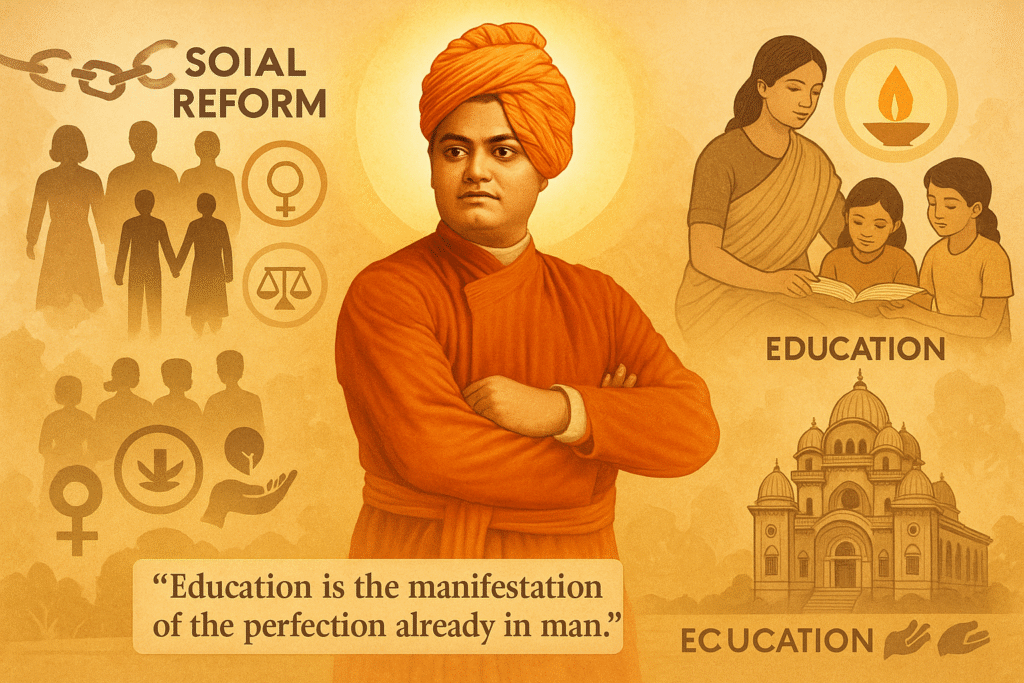
Swami Vivekananda believed that education should not be limited to the memorisation of facts or the collection of information. In his view, the real purpose of education was to develop the abilities already present within an individual. Education should strengthen the mind, build character, encourage independent thinking, and prepare people to face the challenges of life.
"Education is the manifestation of the perfection already in man."
This famous educational idea is associated with Vivekananda's philosophy of human development. He believed that every individual possesses inner potential that can be developed through proper education, discipline, concentration, and practical experience.
Education as Character-Building
Vivekananda gave special importance to character formation. He believed that knowledge becomes truly valuable when it develops honesty, courage, self-control, discipline, and a sense of responsibility. Education should not merely prepare individuals for employment; it should also help them become responsible members of society.
- Character development: Education should encourage honesty, discipline, courage, and moral strength.
- Self-confidence: It should help individuals recognise their abilities and develop faith in themselves.
- Concentration: Students should develop the ability to focus their minds and pursue knowledge deeply.
- Practical knowledge: Learning should help people solve real-life problems and improve their circumstances.
- Social responsibility: Education should encourage individuals to contribute to the welfare of society.
Education and National Development
Vivekananda considered education a powerful instrument for national progress. He believed that the development of India depended on educating ordinary people and improving the conditions of disadvantaged communities. He wanted education to reach beyond a small section of society so that more people could develop the knowledge, confidence, and practical abilities needed for a better future.
His educational philosophy combined intellectual development with moral strength and social responsibility. This approach remains relevant to modern discussions about inclusive education, skill development, character-building, and nation-building.
Ramakrishna Mission and Social Service
In 1897, Swami Vivekananda founded the Ramakrishna Mission to organise humanitarian service, education, and spiritual activities inspired by the teachings of Sri Ramakrishna Paramahamsa. The Mission reflected Vivekananda's belief that spiritual development should be connected with practical service to humanity.
He wanted religious and spiritual ideals to become a source of compassion and social responsibility. Through organised activities, the Mission aimed to support people affected by poverty, illness, lack of education, and natural disasters.
Major Areas of Work of the Ramakrishna Mission
- Education: Schools, colleges, educational institutions, libraries, and other learning initiatives.
- Healthcare: Hospitals, dispensaries, medical camps, and healthcare services for communities.
- Humanitarian relief: Assistance to people affected by floods, earthquakes, cyclones, and other emergencies.
- Social welfare: Activities aimed at supporting disadvantaged communities and improving living conditions.
- Spiritual development: Teaching Vedanta, meditation, ethical values, and the importance of service.
The Ramakrishna Mission continues to undertake educational, medical, charitable, and humanitarian activities in India and other countries. Its work reflects Vivekananda's vision of combining spiritual growth with selfless service and human welfare.
Inspirational Thoughts and Teachings of Swami Vivekananda
Swami Vivekananda's inspirational teachings focus on self-confidence, determination, education, character, service, and national development. His ideas encourage individuals to recognise their inner strength and use their abilities for meaningful personal and social progress.
Self-Confidence and Self-Reliance
Vivekananda believed that self-confidence was essential for personal growth and achievement. He encouraged people to overcome fear, doubt, and dependence on others. According to his philosophy, individuals should recognise their inner potential and develop the courage to face difficulties independently.
He emphasised that real strength comes from within and that people should take responsibility for their own development. This message encouraged young people to become fearless, disciplined, and self-reliant.
"You cannot believe in God until you believe in yourself."
This statement reflects the importance Vivekananda placed on self-confidence and the recognition of human potential.
Goal Achievement and Hard Work
Vivekananda believed that achieving meaningful goals required concentration, determination, discipline, and continuous effort. He encouraged people not to become discouraged by temporary failures or difficulties. Instead, they should remain focused on their objectives and continue working with dedication.
"Arise, awake, and stop not till the goal is reached."
This widely remembered message encourages perseverance, purposeful action, and the determination to overcome obstacles. It is especially relevant to students and young people preparing for education, professional responsibilities, and other challenges in life.
Education and Character-Building
Vivekananda considered education one of the most powerful instruments for developing human potential. He believed that true education should build character, strengthen concentration, improve independent thinking, and develop moral responsibility. The purpose of education was not merely to collect information but to transform individuals into confident and capable human beings.
He also believed that education should prepare people to serve society and contribute to national development. His educational ideas continue to inspire discussions about holistic learning and the relationship between knowledge and character.
Service to Humanity Is Service to God
Service to humanity was an important principle in Vivekananda's spiritual philosophy. He believed that helping the poor, supporting the needy, caring for the sick, and working for the welfare of others were meaningful expressions of spiritual life.
He encouraged people to move beyond selfish interests and recognise their responsibility towards society. His approach connected religious values with compassion, practical action, and respect for human dignity.
"They alone live who live for others."
This message reflects his belief that a meaningful life should include concern for the welfare of other people. His philosophy of service became an important inspiration for the humanitarian activities of the Ramakrishna Mission.
Nationalism and Youth Power
Vivekananda considered young people an important force in India's social and national development. He encouraged them to develop self-confidence, physical and mental strength, discipline, knowledge, and a sense of responsibility. He believed that educated and capable young people could contribute significantly to the progress of the country.
His understanding of nationalism was connected with cultural confidence, social unity, education, and service to humanity. He wanted young Indians to take pride in their heritage while working to overcome poverty, ignorance, and social discrimination.
- Develop self-confidence and take responsibility for personal growth.
- Use education to build knowledge, character, and practical abilities.
- Participate in social service and community development.
- Respect all human beings and promote social harmony.
- Work with discipline and dedication for the progress of the nation.
Conclusion
Swami Vivekananda made an important contribution to modern Indian social and educational thought. His emphasis on human dignity, social upliftment, women's education, character-building, and service to humanity provided a practical dimension to his spiritual philosophy. He believed that individual development and national progress were closely connected with education, self-confidence, and social responsibility.
Through the establishment of the Ramakrishna Mission in 1897, he gave an organised form to his vision of humanitarian service. His inspirational teachings continue to encourage students, educators, social workers, and young people to develop their abilities and work for the welfare of society.
Recommended Book

Swami Vivekananda – Recommended Book
Explore this book and check its full details and latest price on Amazon.
View on AmazonAs an Amazon Associate, I earn from qualifying purchases.
Conclusion: Life, Teachings and Legacy of Swami Vivekananda
Swami Vivekananda (1863–1902) was one of the most influential spiritual leaders, philosophers, and social thinkers of modern India. He was not merely a monk but also an important voice in India's cultural and intellectual awakening. Through his teachings on education, social reform, women's empowerment, self-confidence, and youth development, he presented a vision of a stronger, more educated, and socially responsible society.
His historic address at the World's Parliament of Religions in Chicago in 1893 introduced Indian spiritual philosophy to a wider international audience. His message of religious tolerance, universal brotherhood, and acceptance of different faiths helped promote greater understanding of Vedanta and India's philosophical traditions across the world.
Vivekananda also contributed to India's national awakening by encouraging people to develop cultural self-respect, confidence, education, and a spirit of service. Although he did not directly participate in the organised political freedom struggle, his ideas influenced the wider intellectual environment of Indian nationalism and inspired several generations of thinkers and national leaders.
Major Messages and Teachings of Swami Vivekananda
- Self-confidence: Believe in your abilities and develop the courage to overcome challenges.
- Education: True education should develop knowledge, character, concentration, and inner strength.
- Service to humanity: Helping the poor, needy, and disadvantaged is an important expression of spiritual values.
- Religious harmony: Respect different religious traditions and promote understanding among communities.
- Youth empowerment: Encourage young people to develop discipline, knowledge, determination, and social responsibility.
Lasting Relevance in Modern Society
Even today, Vivekananda's ideas continue to inspire students, educators, social workers, spiritual seekers, and young people. His emphasis on character-building, self-reliance, inclusive education, human dignity, and national development remains relevant to contemporary society.
His life teaches us that individual progress and national development are closely connected with knowledge, confidence, discipline, and compassion. His legacy reminds us that a strong and harmonious society can be built when people use their abilities not only for personal success but also for the welfare of humanity.
In essence, the life and teachings of Swami Vivekananda demonstrate that self-confidence, meaningful education, strong character, and service to humanity are essential foundations for individual development and nation-building.
References and Further Reading
The following books and institutional resources can help readers explore Swami Vivekananda's life, philosophy, speeches, social contributions, and historical influence in greater detail.
Books on Swami Vivekananda
- The Complete Works of Swami Vivekananda – Swami Vivekananda.
- Swami Vivekananda: A Biography – Swami Nikhilananda.
- Swami Vivekananda in the West: New Discoveries – Mary Louise Burke.
- The Life of Swami Vivekananda – Romain Rolland.
Official and Institutional Resources
- Ramakrishna Math and Ramakrishna Mission: Official Website of Belur Math – Information about the organisation, its activities, and the teachings of Sri Ramakrishna and Swami Vivekananda.
- Ministry of Culture, Government of India: Official Website – Cultural resources and information about India's heritage and historical personalities.
- National Book Trust, India: Official Website – Publications and educational reading resources.
Additional Research Resources
- Ramakrishna Math and Mission publications and archival materials.
- Academic research papers on Indian philosophy, Vedanta, religious harmony, and nineteenth-century social reform.
- Google Scholar – For locating academic articles and research publications related to Swami Vivekananda.
Research Note: For historical and academic study, readers should prioritise original writings, published biographies, institutional archives, and scholarly research. General encyclopaedic websites may be used for introductory background, but important historical claims should be checked against reliable primary or academic sources.
Recommended Book

Swami Vivekananda – Recommended Book
Explore this book and check its full details and latest price on Amazon.
View on AmazonAs an Amazon Associate, I earn from qualifying purchases.