

Amazon Product
Click the button below to view full product details and the latest price on Amazon.
👉 View on Amazon*As an Amazon Associate, I earn from qualifying purchases.
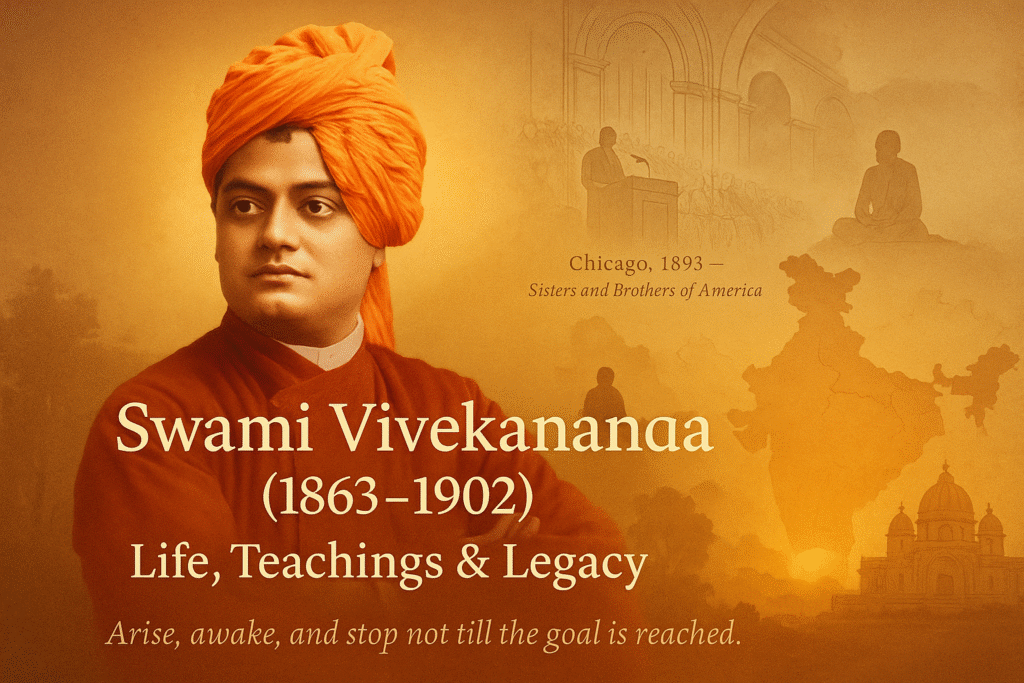
Swami Vivekananda — Life, Teachings & Legacy (1863–1902)

Introduction
Swami Vivekananda (1863–1902), born Narendranath Dutt, was a revered saint, philosopher, and social reformer from India. Inspired by his guru Sri Ramakrishna Paramahamsa, he brought Indian culture, Vedanta philosophy, and the practice of yoga to global attention. His historic speech on 11 September 1893 at the World Parliament of Religions in Chicago resonated with audiences worldwide and established India’s spiritual voice on the international stage.
Early Life
Birth and family
- Born: 12 January 1863, Kolkata
- Real name: Narendranath Dutt
- Father: Vishwanath Dutt (lawyer)
- Mother: Bhuvaneshwari Devi (religious and devout)
Education and spiritual inclination
From childhood, Narendranath was intellectually curious and spiritually inclined. He graduated from Scottish Church College and undertook deep studies of the Upanishads, Bhagavad Gita, and Vedanta. His spiritual apprenticeship under Sri Ramakrishna profoundly shaped his life and mission.
The Chicago Parliament of Religions (1893)
Swami Vivekananda achieved global recognition when he addressed the World Parliament of Religions in Chicago in 1893. Opening with the words “Sisters and brothers of America,” he immediately captured the assembly's attention. In that speech he articulated India's message of tolerance, universal brotherhood, and spiritual depth—introducing Hinduism, Vedanta, and yoga to a Western audience on a large scale.
Key messages from Chicago
- Religious tolerance and universal brotherhood.
- India’s spiritual heritage as a source of universal truths.
- Practical spirituality and service to humanity.
Contributions to India’s Social and National Life
Inspiration for the freedom movement
Although Vivekananda did not participate directly in politics, his ideas deeply influenced India’s freedom fighters and leaders such as Bal Gangadhar Tilak, Aurobindo Ghosh, Subhas Chandra Bose, and Mahatma Gandhi. His call to action—“Arise, awake, and stop not till the goal is reached”—became a motivating slogan for the youth.
Nationalism and self-reliance
Vivekananda urged Indians to build self-confidence and self-reliance. He envisioned India as a spiritual guide for the world, and he sought to rebuild national pride through education, character, and social service.
Social reform and education
Vivekananda strongly opposed caste discrimination and untouchability and emphasized women’s education and equality. In 1897 he founded the Ramakrishna Mission to promote social service, education, and spiritual upliftment across India.
Ramakrishna Mission
The Ramakrishna Mission, established in 1897, remains active in social work, education, and spiritual training—continuing Vivekananda’s vision of practical spirituality and compassionate service.
Inspirational Teachings
Swami Vivekananda’s core teachings remain deeply relevant:
- Self-confidence: Confidence in the self is the foundation of success.
- Education as character-building: True education forms character, not just information.
- Service to humanity: Serving people is service to God—“Manav seva is Parmatma seva”.
Short Biography
Swami Vivekananda (12 January 1863 – 4 July 1902) was a philosopher, social reformer, and spiritual teacher. He spread Vedanta and Yoga worldwide, inspired youth and national awakening in India, and left a lasting legacy through his writings and institutions.
Death and Lasting Legacy
Swami Vivekananda passed away on 4 July 1902 at the age of 39. Despite his short life, his achievements and message became a continuing source of inspiration for youth, educators, and nation-builders. His teachings on self-reliance, character, and service remain central to modern discussions on education, spirituality, and social reform in India.
Conclusion
Swami Vivekananda was more than a monk—he was an architect of India’s spiritual and national renaissance. His message of courage, service, and character-building continues to inspire generations to work for individual uplift and nation-building.

Early Life of Swami Vivekananda
Birth and Family
Swami Vivekananda was born on 12 January 1863 in Kolkata (West Bengal). His real name was Narendranath Dutt.
- Father: Vishwanath Dutt — a respected lawyer known for his sharp intellect.
- Mother: Bhuvaneshwari Devi — a deeply religious and cultured woman.
👉 From his father, Vivekananda inherited logical and analytical thinking, while from his mother he absorbed deep faith and spiritual inclination—creating a unique blend of practicality and spirituality in his personality.
Thirst for Education and Knowledge
Narendra was intelligent, curious, and sharp-minded since childhood.
- He received his education at Scottish Church College, Kolkata.
- He studied Western philosophy, history, literature, and science.
- Along with modern subjects, he deeply explored the Vedas, Upanishads, Bhagavad Gita, and other spiritual texts.
- He excelled in sports, music, and debates.
Meeting with His Guru and Beginning of the Spiritual Journey
During his youth, Narendranath was troubled by profound spiritual questions—especially the question:
“Have you seen God?”
This quest led him to many saints and scholars. Finally, he met Ramakrishna Paramahamsa, whose teachings transformed him completely. Ramakrishna recognized the potential and spiritual depth within Narendra and guided him toward the path of renunciation, service, and realization.

Amazon Product
Click below to view full product details and the latest price on Amazon.
👉 View on Amazon*As an Amazon Associate, I earn from qualifying purchases.
Characteristics of His Early Life
- Brilliant and self-confident personality.
- Deep spiritual curiosity and search for truth.
- Strong interest in education and social upliftment.
- Practice of music, yoga, and meditation.
Swami Vivekananda’s Inclination Towards Education and Spirituality
Thirst for Education and Knowledge
Swami Vivekananda (Narendranath Dutt) was a bright and inquisitive student from an early age.
- He completed his early education in Kolkata and later joined Scottish Church College.
- He developed deep interest in Western philosophy, literature, history, and social sciences.
- He thoroughly studied ancient Indian scriptures such as the Vedas, Upanishads, Bhagavad Gita, and Puranas.
👉 His education was never limited to textbooks—he examined every subject logically and fearlessly.
Beginning of His Spiritual Quest
One question continuously arose in his mind:
“Have you seen God?”
To find the answer, he visited many saints, philosophers, and spiritual practitioners. Eventually, he met Ramakrishna Paramahamsa, who not only answered his question but became his spiritual master.
Influence of Guru Ramakrishna Paramahamsa
Ramakrishna taught him:
- God exists in every living being.
- Serving humanity is the highest form of worship.
- True spirituality is realized through experience, compassion, and purity.
Under Ramakrishna’s guidance, Vivekananda experienced deep spiritual awakening. Their Guru-disciple bond became the foundation of Vivekananda’s future mission.
Coordination of Education and Spirituality
Swami Vivekananda believed that the purpose of education is not just to gather information but to build character and develop inner strength.
- He harmonized Western scientific thought with Eastern spiritual wisdom.
- He emphasized self-reliance, self-discipline, and service as the true goals of education.
- He believed that education becomes meaningful only when it inspires a person to work for society.

Swami Vivekananda’s Chicago Parliament of Religions and World Fame
Parliament of the World’s Religions, 1893
In 1893, the Parliament of the World’s Religions was held in Chicago, USA. Representatives of various religions from around the world were invited. Swami Vivekananda attended the conference as a representative of India, carrying the spiritual essence of Hinduism and Vedanta with him.
Historic Speech and First Address
On 11 September 1893, Swami Vivekananda delivered his first and most celebrated speech at the Parliament.
His address began with the iconic words:
“Sisters and Brothers of America”
With just this one sentence, the entire hall erupted in a long, thunderous applause. Overnight, Swami Vivekananda became a world-renowned figure, admired for his spiritual depth, humility, and powerful presence.
Highlights of the Speech
- Message of India’s tolerance and universal brotherhood.
- Emphasis on the equality of all religions and unity in the search for truth.
- Introduction to the depth and richness of Indian culture and spirituality.
- Assertion that “There may be many paths to truth, but the goal is one.”
Impact on the Western World
- His speech made Hinduism, Vedanta, and Yoga widely known in Western countries.
- He gave numerous lectures across America and Europe, spreading Indian spirituality.
- His ideas deeply influenced Western intellectuals and boosted the pride of Indian immigrants.
New Identity of India
The Chicago address established India as the spiritual guide of the world.
At a time when India was under British rule, Vivekananda’s words awakened confidence and national pride among Indians. His speech laid an ideological foundation that later strengthened India’s freedom struggle.
Contribution of Swami Vivekananda in India’s Freedom Struggle
Not Directly Political, But a Deep Inspiration
Although Swami Vivekananda did not directly participate in politics, his teachings provided moral, spiritual, and ideological strength to India’s freedom movement.
- He taught the youth the values of self-confidence and self-reliance.
- His famous mantra — “Arise, awake and do not stop till you achieve the goal” — became a guiding inspiration for freedom fighters.

Amazon Product
Click below to view product details and the latest price on Amazon.
👉 View on Amazon*As an Amazon Associate, I earn from qualifying purchases.
Awakening National Consciousness
Vivekananda inspired Indians to take pride in their culture, religion, and traditions.
During British rule, when Indians felt inferior, he reminded the nation:
“India has been the Vishwa Guru, and will rise again.”
This strengthened the foundation of nationalism in the Indian psyche.
Influence on Freedom Fighters
Many great leaders and revolutionaries were deeply influenced by Vivekananda’s thoughts:
- Bal Gangadhar Tilak: Adopted Vivekananda’s nationalist approach.
- Mahatma Gandhi: Said Vivekananda’s teachings inspired him to follow truth and service.
- Subhash Chandra Bose: Considered Vivekananda the greatest source of inspiration for modern India.
- Aurobindo Ghosh: Reflected Vivekananda’s ideology in his nationalist philosophy.
The Power to Awaken the Youth
- Vivekananda believed that youth are the real power of the nation.
- He emphasized education, discipline, self-confidence, and organization.
- His teachings inspired thousands of young people to participate in India’s freedom movement.
Relation Between Social Reform and Freedom
- He opposed casteism and untouchability, promoting unity and equality.
- He encouraged women’s education and social service, giving a social foundation to the freedom struggle.
Inspiration to Awaken the Youth
Swami Vivekananda and Youth Power
Swami Vivekananda believed that the youth hold the power to build the future of a nation. When youth have confidence, energy, and the right direction, any country can become a global leader. He inspired them to avoid laziness and follow the path of Karmayoga (selfless action).
Inspirational Message
“Arise, awake and do not stop till you achieve the goal.”
- He assured the youth that no obstacle is too big if the mind is strong.
- He emphasized self-confidence, discipline, and purposeful education.
Role of Youth in Nation Building
- The future of India lies in the hands of its youth.
- He urged them to work for the welfare of society and the nation, not just personal success.
- His teachings inspired many young people to join social reform and the freedom movement.
Lessons for Today’s Youth
- Develop self-confidence and self-reliance.
- Consider education as a tool for character building, not just career making.
- Participate in social service and national welfare.
- Face challenges with courage and keep moving forward.
Foundations of Nationalism
Awakening the Soul of India
Swami Vivekananda taught that India is not merely a geographical landmass but a spiritual nation. He believed India’s true power lies in its culture, religion, and ancient wisdom.
Removing Inferiority Complex
During British rule, Indians were losing confidence. Vivekananda reassured them:
“We are not inferior. We were Vishwa Guru, and we will become so again.”
This message strengthened the sense of self-respect among Indians.
Nationalism Linked to Religion and Culture
Vivekananda saw nationalism as a spiritual and cultural movement, not merely political.
- He emphasized India’s spiritual values as its foundation.
- Unity, equality, and service were core elements of his nationalism.
- He believed true freedom could not be achieved without social reform and self-reliance.
Inspiration for Freedom Fighters
His ideas gave courage and ideological strength to freedom fighters. Leaders such as Tilak, Gandhi, Bose, and Aurobindo saw in his teachings the roadmap for a strong, self-reliant India.
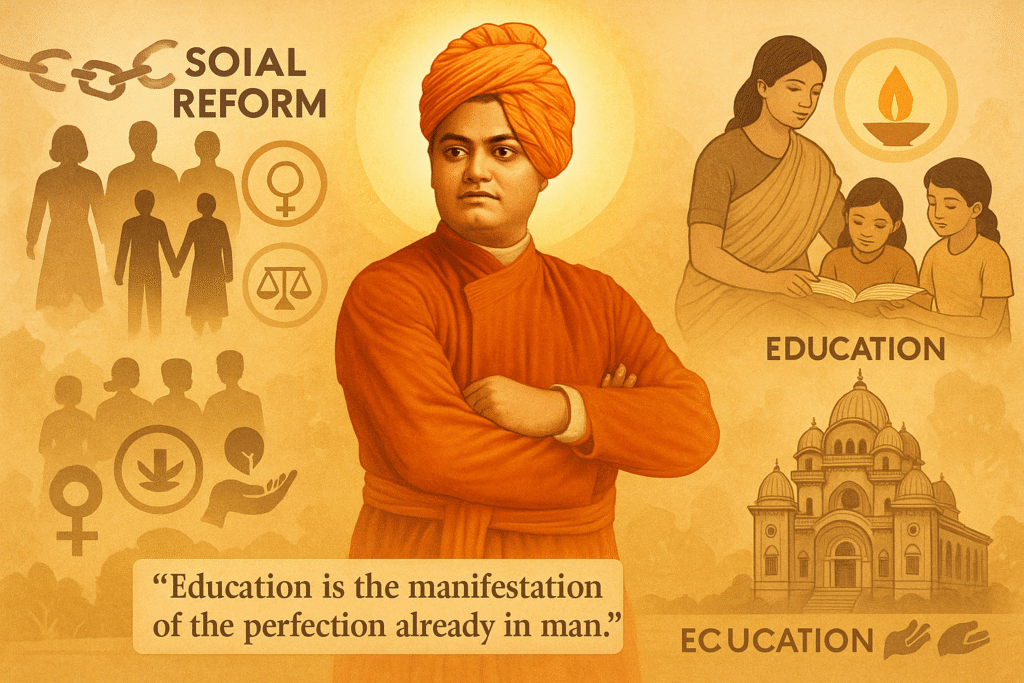
Social Reform and Education
Struggle Against Social Evils
Swami Vivekananda was not only a spiritual guru but also a strong social reformer. He firmly opposed the social evils prevalent during his time.
- He described casteism and untouchability as the biggest obstacles to India’s unity.
- He taught that God resides in every human being; therefore, discrimination of any kind is unjust.
- He emphasized improving the condition of women and granting them the right to education.
Emphasis on Women’s Education
Swami Vivekananda believed that the progress of a nation is directly linked to the progress of its women.
- He argued that without education, women would remain backward in society.
- He wanted Indian women to be strong, self-reliant, educated, and aware.
- His thoughts later played a crucial role in shaping women’s education and empowerment movements in India.

Amazon Product
Click below to view full product details and the latest price on Amazon.
👉 View on Amazon*As an Amazon Associate, I earn from qualifying purchases.
The Real Purpose of Education
According to Vivekananda, education should never be limited to bookish knowledge. Its primary aims should be character building, strengthening self-confidence, and developing a sense of service toward the nation.
He said:
“Education means the manifestation of the perfection already in man.”
Ramakrishna Mission and Social Service
Swami Vivekananda founded the Ramakrishna Mission in 1897 with the objective of promoting education, social service, and religious harmony.
- The Mission established schools, colleges, hospitals, and service institutions across India and abroad.
- It became a center for spiritual training and selfless service.
- Even today, the Ramakrishna Mission continues to serve humanity following his ideals.
Inspirational Thoughts of Swami Vivekananda
Self-Confidence and Self-Reliance
Swami Vivekananda believed that self-confidence is the greatest key to success. He inspired the youth to be fearless, bold, and self-reliant.
“You have to move from inside to outside. No one can save you. You have to move forward on your own.”
Goal Attainment and Hard Work
“Arise, awake and do not stop till you achieve the goal.”
He taught that hard work, determination, and dedication are essential for achieving great goals.
Education and Character Building
Vivekananda considered education a tool for character building rather than merely gathering information. He believed that the purpose of education is to develop the divine potential hidden within every individual.
Service to Humanity Is Service to God
He regarded social service as the highest form of religion. Service to the poor, the needy, and the suffering was, for him, true devotion to God.
“The day you are not able to do anything for anyone, understand that your life is useless.”
Nationalism and Youth Power
Vivekananda awakened India’s youth and reminded them that they are the real strength of the country. He emphasized nationalism, self-pride, and self-respect as the foundation of a strong and independent India.
Conclusion
Swami Vivekananda (1863–1902) was not just a monk or philosopher—he was a pioneer of India’s national renaissance and spiritual awakening. Through his teachings on education, social reform, women empowerment, and youth development, he offered a new vision for Indian society.
His historic speech at the Chicago Parliament of Religions in 1893 introduced India’s spiritual greatness to the world and inspired global respect for Hinduism, Vedanta, and Indian culture. His ideas encouraged countless freedom fighters and strengthened the foundation of modern Indian nationalism.
His eternal messages
- “Arise, awake and do not stop till you achieve your goal.”
- “Manav seva is God seva.”
Even today, these teachings guide millions of youth, thinkers, and social reformers across the world.
👉 In essence, the life and message of Swami Vivekananda teaches us that self-confidence, true education, and social service are the pillars of building a powerful and harmonious nation.
References

Amazon Product
Click the button below to view full product details and the latest price on Amazon.
👉 View on Amazon*As an Amazon Associate, I earn from qualifying purchases.
- The Complete Works of Swami Vivekananda – Swami Vivekananda
- Swami Vivekananda: A Biography – Swami Nikhilananda
- Swami Vivekananda in the West: New Discoveries – Mary Louise Burke
- Vivekananda: A Biography – Swami Nityananda
- Ramakrishna Mission (Official Website): https://belurmath.org
- Ramakrishna Mission & Math Archives
- Ministry of Culture, Government of India – Publications on Swami Vivekananda
- National Book Trust, India – “Swami Vivekananda” Biography
- Wikipedia (used only for introductory background)
- Research papers on Indian philosophy and social reform (Google Scholar)
- The Life of Swami Vivekananda – Romain Rolland