
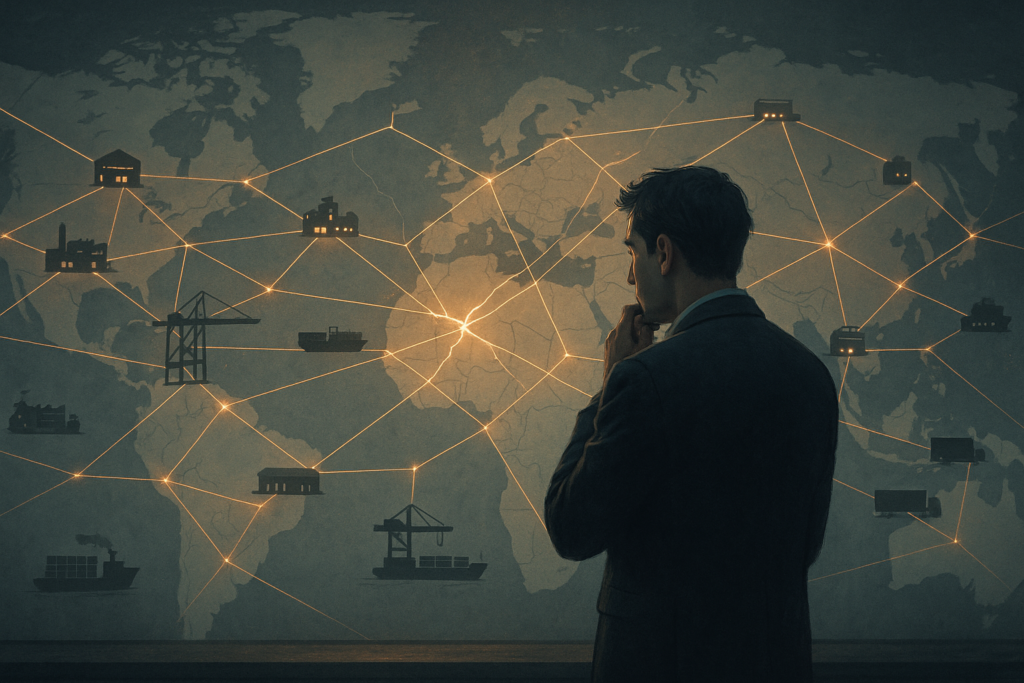
This article is not merely a summary of reports or statistics; it is a narrative shaped by personal experience during the supply chain crisis. At a time when plans looked efficient on paper but materials failed to arrive on the ground, it became clear that a supply chain is not just about logistics, warehouses, and transportation. It is a fragile system built on trust, timing, coordination, and human judgment.
In the early stages, the crisis appeared temporary—delays were explained away, costs slowly increased, and disruptions were treated as exceptions rather than warnings. Over time, however, these minor irregularities exposed deeper structural weaknesses. Each decision began to carry consequences not only for operations and profitability, but also for livelihoods, customer confidence, and long-term sustainability.
The supply chain crisis revealed how deeply interconnected the global economy truly is. A shutdown in one region could ripple across continents, affecting production, pricing, and availability elsewhere. This experience forced a critical reassessment of long-standing assumptions about efficiency, globalization, and risk management, highlighting how resilience and adaptability had been undervalued in pursuit of short-term optimization.
This article emerges from that period of reflection. Rather than focusing solely on the causes of disruption, it seeks to explore the lessons learned through uncertainty and constraint. By weaving personal observations with broader economic insights, the discussion aims to move from crisis toward understanding—and from understanding toward more sustainable and resilient supply chain thinking for the future.
What Is the Supply Chain and Why Is It Important?
A supply chain is not limited to a single process or organization; it is a comprehensive and interconnected system that begins with the sourcing of raw materials and extends through production, storage, transportation, and distribution until a product reaches the final consumer. The smoother and more balanced this system is, the more stable industries, economies, and societies tend to be.
In today’s globalized economy, the importance of the supply chain has increased significantly. Production and consumption are often separated by vast geographical distances, making coordination essential. Even a minor disruption in one link of the chain can trigger delays, cost escalation, and a breakdown of trust across the entire network.
The Basic Concept of the Supply Chain
In simple terms, the supply chain is the network that includes all processes involved in moving a product from raw materials to the end consumer. It brings together suppliers, manufacturers, warehouses, logistics providers, wholesalers, retailers, and consumers into a single functional system.
The core objective of this system is not merely to deliver products, but to ensure that the right product reaches the right place, in the right quantity, at the right time, and at an acceptable cost. When this balance is disrupted, the conditions for a supply chain crisis begin to emerge.
What the Supply Chain Means Through My Experience
For me, the meaning of the supply chain changed the moment a seemingly minor delay began to disrupt the entire system. Processes that once appeared predictable and reliable suddenly became fragile and uncertain. A delay at one point quickly affected production schedules, delivery commitments, and customer confidence.
This experience revealed that a supply chain is not simply the movement of physical goods. It is a complex interaction of decisions, timing, communication, and human coordination. When any one of these elements loses balance, the impact is felt across the entire structure.
The Beginning of the Supply Chain Crisis: When Everything Suddenly Stopped
The supply chain crisis did not begin with a single dramatic event. Instead, it emerged gradually, almost quietly, in ways that were easy to overlook. On the surface, operations appeared to be functioning as planned, yet beneath that appearance, critical disruptions were beginning to form—disruptions that would eventually bring the entire system to a halt.
At first, these issues were dismissed as temporary setbacks. There was a belief that delays would resolve themselves and that normal flow would soon return. This assumption, however, proved to be one of the most costly mistakes. When the flow of a supply chain slows or stops, its effects are never confined to a single point; they spread across every connected link.
The First Warning Sign I Ignored
In the beginning, it felt like nothing more than a routine delay. Raw materials arrived late, a few orders had to be rescheduled, and delivery timelines were adjusted slightly. Such disruptions seemed manageable and were treated as part of the usual risks of doing business.
Over time, however, that single delay became a recurring pattern. One disruption followed another, and what once seemed incidental began to reveal a deeper imbalance within the system. It became increasingly clear that this was not a coincidence, but an early signal of a much larger crisis taking shape.
Uncertainty and the Pressure of Decision-Making
At this stage, uncertainty became the most persistent challenge. Each day raised difficult questions: Would supplies stabilize next week? Should production continue or be paused? Which commitments deserved immediate priority, and which could be asked to wait?
The pressure of these decisions was not purely financial. Every choice affected people—employees whose work depended on continuity, partners relying on commitments, and customers whose trust had been built over time. In this moment, the supply chain crisis moved beyond a logistical problem and became a psychological and ethical challenge, demanding judgment under conditions of constant uncertainty.
Global Causes of the Supply Chain Crisis
The supply chain crisis cannot be attributed to the failure of a single country, industry, or organization. It is the result of multiple global forces interacting simultaneously, exposing structural weaknesses within an increasingly interconnected world economy. These forces revealed that while global supply systems were optimized for efficiency, they were far less prepared for large-scale disruptions.
In the era of globalization, production, transportation, and consumption are deeply interdependent. When a major disruption occurs at the global level, its impact does not remain confined within national borders. Instead, it cascades across regions, industries, and markets, destabilizing the entire supply chain.
COVID-19 and the Supply Chain
The COVID-19 pandemic exposed long-ignored vulnerabilities in global supply chains. Sudden lockdowns, factory shutdowns, labor shortages, and restrictions on movement severely disrupted both production and logistics. What had previously been considered resilient systems proved fragile under prolonged stress.
As a result, shortages of raw materials became widespread, delivery timelines stretched unpredictably, and costs rose sharply. The pandemic demonstrated that excessive reliance on concentrated production hubs and a limited number of suppliers significantly increases risk during periods of global crisis.
Geopolitical Tensions and Trade Disruptions
Even as economies began recovering from the pandemic, supply chains faced renewed pressure from geopolitical tensions and armed conflicts. Economic sanctions, trade restrictions, and tightened border controls added new layers of complexity to international commerce.
Wars and political instability disrupted the supply of energy, food grains, and critical raw materials, directly affecting production costs and consumer prices worldwide. These developments underscored an important reality: supply chains are shaped not only by economic efficiency, but also by geopolitical stability and international relations.
The Most Difficult Moment: When Options Became Limited
This was the phase when experience, patience, and learning were all put to the test. Choices that once seemed obvious and readily available suddenly disappeared, leaving behind a narrow path filled with uncertainty. Every decision carried weight, and each option came with consequences that could not be easily reversed.
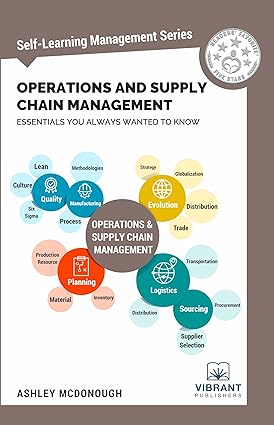
What made this moment especially challenging was the realization that the impact of each decision extended far beyond operations and numbers. Production schedules, delivery commitments, and financial stability were intertwined with human relationships, trust, and responsibility. Often, the choice was not between right and wrong, but between lesser and greater harm.
It was during this period that I understood the limits of technical knowledge in times of crisis. When systems fail, leadership depends less on perfect information and more on judgment, empathy, and the ability to remain steady under pressure. Even when control over circumstances was lost, the response to those circumstances remained a conscious choice.
This difficult phase became a turning point. The supply chain crisis was no longer only an external disruption; it evolved into a personal test of resilience and perspective. From this moment onward, the focus shifted from resisting the crisis to understanding it— and from understanding it to learning how to move forward with greater clarity and strength.
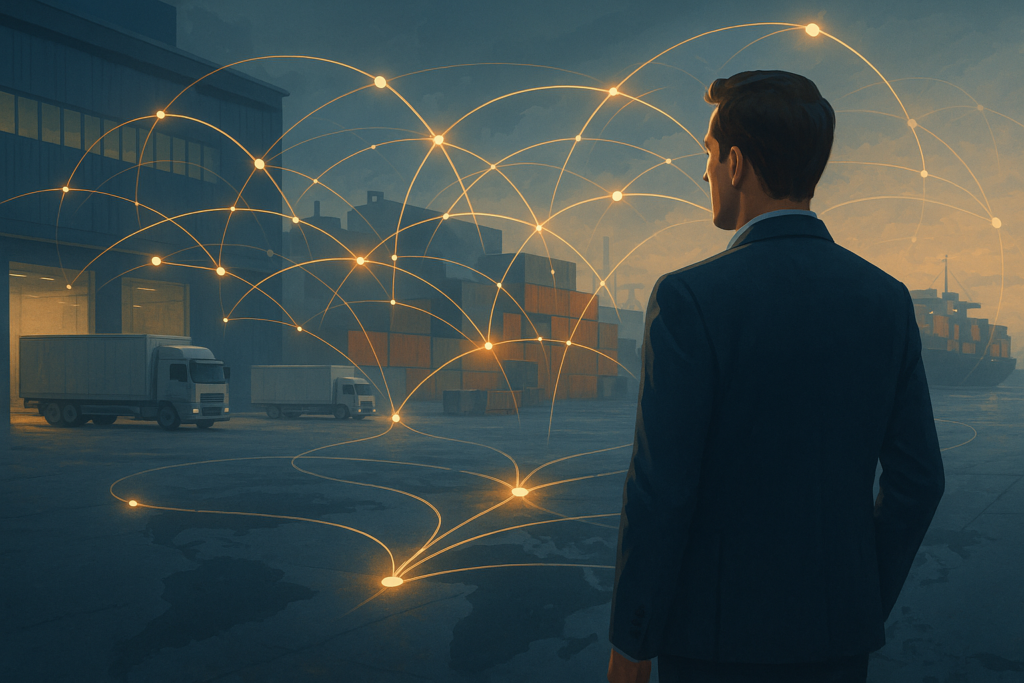
Key Lessons Learned from the Supply Chain Crisis
The supply chain crisis was not only a period of disruption, but also a powerful learning experience. It revealed how systems that appear stable under normal conditions can quickly become fragile under stress. The lessons drawn from this phase extend beyond operational challenges and reshape the way risk, planning, and resilience are understood.
Resilience Is the Greatest Strength
One of the most important lessons from the crisis was that resilience matters more than efficiency alone. Supply chains designed solely for speed and cost optimization struggled the most when unexpected disruptions occurred. In contrast, systems that allowed flexibility, alternative sourcing, and adaptive decision-making were better equipped to absorb shocks.
Resilience is not limited to infrastructure or technology; it also involves mindset and leadership. The ability to respond calmly, reassess priorities, and adjust strategies in uncertain conditions proved to be a decisive factor in navigating the crisis.
The Importance of Localization and Diversification
Another critical lesson was the risk created by excessive dependence on distant and centralized suppliers. When global links broke down, the absence of local or regional alternatives left entire systems vulnerable to prolonged delays and shortages.
Strengthening local supply networks and diversifying sourcing strategies can significantly reduce risk and improve response time during disruptions. A balanced approach—combining global reach with local resilience— has emerged as a key requirement for building more robust and sustainable supply chains in the future.
How Can the Supply Chain Be Strengthened for the Future?
The lessons learned from the supply chain crisis become meaningful only when they are translated into forward-looking strategies. The goal is no longer to restore old systems, but to build supply chains that are resilient, transparent, and capable of adapting to uncertainty and global disruptions.
Strengthening future supply chains requires a balanced approach—one that integrates advanced technology with a strong human-centered perspective. Both elements are essential for long-term stability and performance.
Digital Supply Chains and the Use of Data
Digital technology has the potential to form the backbone of future supply chains. Real-time data, advanced analytics, and artificial intelligence enable better demand forecasting, early risk detection, and more informed decision-making across the network.
A digital supply chain improves visibility at every stage, allowing organizations to identify disruptions before they escalate into crises. In this way, technology contributes not only to efficiency, but also to resilience, transparency, and operational security.
People Matter as Much as Systems
While technology plays a critical role, the foundation of any supply chain remains human judgment and collaboration. The crisis demonstrated that automated systems are effective only when guided by leadership, accountability, and ethical decision-making.
Investment in workforce training, trust-based partnerships, and clear communication strengthens supply chains from within. Future strategies that place people at the center—rather than treating them as supporting elements— are more likely to remain sustainable, adaptable, and effective over time.
Conclusion: Lessons from Crisis and the Path Forward
The supply chain crisis revealed how complex yet fragile modern systems have become. It was not merely a disruption in the movement of goods, but a test of planning, priorities, and preparedness. This experience demonstrated that stability is not a fixed state, but an ongoing process of adaptation and learning.
Throughout the crisis, it became evident that efficiency alone is insufficient. Resilience, balance between globalization and localization, and the integration of technology with human judgment form the true foundation of a strong supply chain. Systems that ignore these elements remain vulnerable to future shocks.
For me, this journey extended beyond operational challenges and became a lesson in leadership and responsibility. Moments of uncertainty clarified that meaningful decisions are those that look beyond immediate gains and focus on long-term sustainability and trust.
Ultimately, the supply chain crisis serves as both a warning and an opportunity. It challenges organizations and policymakers to confront existing weaknesses while offering a chance to build more balanced, resilient, and human-centered systems. If these lessons are taken seriously, future supply chains can emerge stronger, more reliable, and better prepared for an uncertain world.
Frequently Asked Questions (FAQ)
What is a supply chain crisis?
A supply chain crisis occurs when the process of moving goods from raw material sources to final consumers is disrupted. Such disruptions affect production, transportation, cost structures, and consumer trust across industries.
What are the main causes of the supply chain crisis?
The primary causes include global events such as the COVID-19 pandemic, geopolitical tensions, wars, trade restrictions, excessive dependence on centralized suppliers, and a lack of resilience in supply chain design.
Which sectors were most affected by the supply chain crisis?
Manufacturing, logistics, food supply, energy, healthcare, and retail sectors were among the most affected, as these industries rely heavily on timely and continuous supply flows.
How can organizations respond to a supply chain crisis?
Organizations can respond by diversifying suppliers, strengthening local and regional networks, using digital technologies for visibility, and adopting flexible, risk-aware planning strategies.
How can future supply chain disruptions be prevented?
While disruptions cannot be entirely eliminated, their impact can be reduced through data-driven decision-making, proactive risk management, workforce preparedness, and long-term strategic planning.
Can a supply chain crisis also be an opportunity?
Yes, a supply chain crisis can serve as an opportunity to identify weaknesses, rethink existing models, and build more resilient, sustainable, and human-centered supply chains for the future.
References
- World Bank – Global Supply Chain Disruptions and Economic Impact
- International Monetary Fund (IMF) – World Economic Outlook: Supply Chain Risks
- United Nations Conference on Trade and Development (UNCTAD) – COVID-19 and Global Supply Chains
- World Economic Forum – Building Resilient Supply Chains for the Future
- Government of India, Ministry of Commerce and Industry – National Logistics Policy and Supply Chain Reforms
- Organisation for Economic Co-operation and Development (OECD) – Global Value Chains and Supply Shock Analysis