
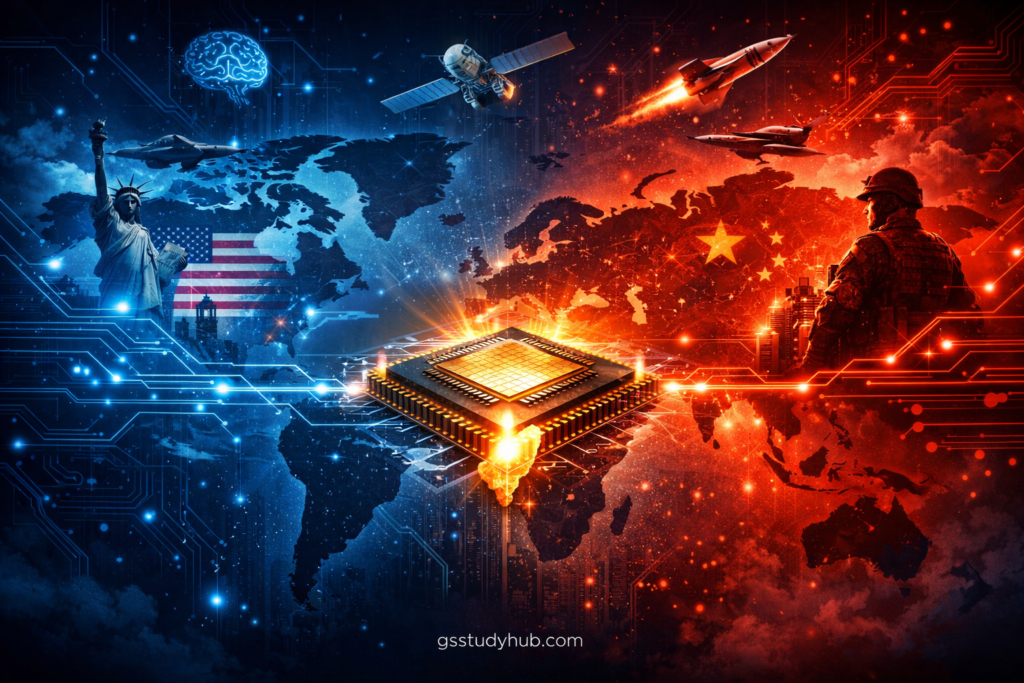
⚡ Semiconductor War: The New Power Politics of the 21st Century
🚀 Introduction – From Oil to Technology: The Great Power Shift
Semiconductor War 2026 is redefining global power politics as nations compete for dominance in AI chips, advanced manufacturing, and strategic supply chains.In the 20th century, oil was more than fuel — it was power itself. Nations that controlled oil fields controlled global trade routes, influenced diplomatic alliances, and shaped the outcomes of wars. Energy security defined national security. The deserts of the Middle East, the rise of energy cartels, and the politics of supply shocks all revolved around one central truth: whoever controlled oil controlled the world.
But the 21st century has rewritten the rules of global dominance. Today, power does not flow through pipelines — it flows through silicon chips. The invisible circuits embedded inside smartphones, fighter jets, satellites, and electric vehicles have become the true engines of geopolitical influence.
This is not just a story of technological evolution. It is a profound transformation of power — a historic shift from oil wells to semiconductor fabs, from fossil fuel diplomacy to digital supremacy.
🔄 From Oil Fields to Chip Foundries: The Strategic Shift
Where oil once determined strategic alliances, today advanced semiconductor manufacturing plants define global power equations. In the past, military strength depended on access to energy. Now, it depends on access to computational capacity.
The new currency of power is not crude oil — it is processing power. Countries capable of designing and fabricating advanced chips possess the ability to:
- Lead in Artificial Intelligence
- Develop next-generation defense systems
- Dominate space exploration
- Control the electric vehicle revolution
Strategic leverage is no longer buried underground — it is engineered at the nanometer scale inside ultra-clean fabrication facilities.
🤖 The Role of Chips in AI, EVs, Defense, and Space
1️⃣ Artificial Intelligence
AI systems thrive on massive computational capacity. From large language models to autonomous battlefield systems, advanced GPUs and AI accelerators power the digital intelligence revolution. Without high-performance chips, AI dominance is impossible.
2️⃣ Electric Vehicles (EVs)
Modern electric vehicles rely on thousands of microchips for battery optimization, sensor fusion, navigation, and autonomous driving. A disruption in semiconductor supply can paralyze entire automotive industries, revealing how deeply chips are embedded in economic stability.
3️⃣ Defense Technology
Missile guidance systems, drone swarms, advanced radar networks, cyber warfare platforms — all depend on sophisticated semiconductors. Export controls on advanced chips have therefore become tools of national security strategy, transforming trade policy into geopolitical weaponry.
4️⃣ Space and Satellite Systems
Satellite communications, GPS infrastructure, and deep-space missions require radiation-resistant microelectronics. The new space race is not merely about rockets — it is about the resilience and precision of microchips that power orbital systems.
🌐 Digital Sovereignty: The New Strategic Imperative
In this evolving landscape, a powerful concept has emerged: Digital Sovereignty.
Digital Sovereignty means:
- Control over national data infrastructure
- Ownership of digital networks and platforms
- Domestic semiconductor manufacturing capability
If a nation depends entirely on foreign technology supply chains, its strategic autonomy becomes vulnerable. Therefore, governments across the world are investing billions into building resilient, domestic semiconductor ecosystems.
Digital Sovereignty is not simply about data protection — it is about technological self-reliance and geopolitical resilience.
🎯 Thesis Statement
Semiconductor War = The New Power Politics of the 21st Century
This is not merely economic competition. It is geopolitical strategy. It is technological arms racing. It is economic statecraft in its most advanced form.
Just as oil shaped the wars and alliances of the 20th century, semiconductors are shaping the rivalries and partnerships of today. The nations that control advanced chip design and fabrication will define the global balance of power in the decades ahead.
Whoever controls the chips — controls the future.
For a deeper understanding of India’s Indo-Pacific diplomacy and strategic balancing against China, check out our complete guide on India’s Indo-Pacific Strategy.

🌍 Global Semiconductor Landscape: The Titans of the Chip War
🚀 The Battle for Silicon Supremacy
In today’s hyper-connected world, semiconductors are not just industrial components — they are the nervous system of global power. Behind every AI breakthrough, every electric vehicle, every satellite orbiting Earth, and every advanced missile system lies a microscopic universe of transistors.
The semiconductor industry has transformed into a geopolitical chessboard, where nations compete not with tanks and oil tankers, but with nanometers, fabrication plants, and export controls.
At the center of this strategic competition stand three dominant forces:
- Taiwan’s TSMC
- America’s Intel
- China’s Semiconductor Ambition
This is the story of how these giants shape the future of global technology, economic security, and military dominance.
🇹🇼 TSMC – The Crown Jewel of Advanced Manufacturing
Taiwan Semiconductor Manufacturing Company (TSMC) is the undisputed titan of advanced chip fabrication. As the world’s largest pure-play foundry, it manufactures chips for Apple, NVIDIA, AMD, and countless global tech giants.
🔬 3nm / 2nm Technology Leadership
TSMC leads the world in cutting-edge 3-nanometer and emerging 2-nanometer process technologies. These ultra-advanced nodes allow billions of transistors to be packed onto a single chip, delivering unprecedented performance and efficiency.
In the semiconductor race, nanometers equal power. The smaller the node, the greater the technological advantage.
🏭 The Global Foundry Model
Unlike companies that design and manufacture chips together, TSMC operates on a pure foundry model. It manufactures chips designed by others. This has positioned Taiwan at the heart of the global supply chain.
Nearly 90% of advanced chips are manufactured in Taiwan — making it a strategic chokepoint.
⚠ Strategic Vulnerability – The Taiwan Risk
TSMC’s dominance is also its greatest geopolitical vulnerability. Taiwan sits at the center of rising U.S.–China tensions. Any instability in the Taiwan Strait could disrupt global technology supply chains.
This “Silicon Shield” both protects Taiwan and makes it the most strategically sensitive territory in the semiconductor war.
🇺🇸 Intel – America’s Manufacturing Revival
Intel represents the United States’ determination to reclaim domestic semiconductor leadership.
🏗 IDM Model
Intel follows an Integrated Device Manufacturer (IDM) model, meaning it both designs and manufactures its own chips. This vertical integration offers strategic autonomy.
However, Intel faced challenges in keeping pace with TSMC’s advanced nodes, triggering a national-level policy response.
💰 The CHIPS Act
The CHIPS and Science Act allocated tens of billions of dollars to boost U.S. semiconductor manufacturing. It marked a decisive shift toward industrial policy in Washington.
This act is not merely economic stimulus — it is a strategic countermeasure to reduce dependence on foreign chip production.
🏭 Domestic Manufacturing Push
Intel is expanding fabrication plants in Arizona and Ohio, symbolizing America’s ambition to re-establish technological sovereignty.
For the U.S., semiconductor resilience equals national security.
🇨🇳 China’s Semiconductor Ambition
China views semiconductors as the foundation of technological independence.
📘 Made in China 2025
Through its “Made in China 2025” strategy, Beijing aims to reduce reliance on foreign semiconductor imports and build a self-sufficient domestic ecosystem.
🏭 SMIC – China’s Foundry Champion
Semiconductor Manufacturing International Corporation (SMIC) is China’s leading chipmaker. Despite making progress in advanced nodes, it faces technological barriers due to export restrictions.
🚫 Technology Sanctions
U.S. export controls have limited China’s access to advanced lithography tools and AI chips. These restrictions aim to slow China’s progress in high-performance computing and military AI systems.
Sanctions have transformed trade policy into geopolitical containment.
🔬 EUV Lithography Monopoly – The Netherlands Factor
At the heart of advanced chip manufacturing lies Extreme Ultraviolet (EUV) Lithography.
Only one company in the world produces EUV machines: ASML of the Netherlands.
Without EUV systems, manufacturing cutting-edge 3nm and 2nm chips is impossible. This gives the Netherlands a uniquely strategic role in the semiconductor ecosystem.
Restrictions on EUV exports to China highlight how technology supply chains have become geopolitical tools.
🤖 AI Chip Restrictions – The New Strategic Weapon
Advanced AI chips — particularly GPUs used for training large-scale models — have become the centerpiece of export controls.
Limiting access to high-performance AI chips aims to prevent strategic rivals from achieving military AI superiority.
In the semiconductor war, control over AI hardware is as critical as nuclear capability was in the Cold War.
🎯 Conclusion – The Silicon Balance of Power
The global semiconductor landscape is no longer a matter of market competition alone. It is a strategic battlefield.
TSMC embodies technological supremacy but carries geopolitical risk. Intel symbolizes America’s industrial revival. China represents relentless ambition under technological constraints.
In the 21st century, the power to design, fabricate, and control semiconductors will define the global order.
The semiconductor war is not coming — it is already here.
The global semiconductor conflict is also deeply connected with energy security and resource geopolitics. As nations compete for technological dominance, control over oil supply chains and clean energy transitions is shaping strategic alliances worldwide. To understand this broader power struggle, read our detailed analysis on Energy Transition vs Oil Politics 2026, where we explain how energy geopolitics is redefining global power equations.

🌊 Taiwan Strait Tensions: The Most Dangerous Geopolitical Flashpoint of the 21st Century
🚀 Where Ocean Waves Carry the Weight of Global Power
On the world map, the Taiwan Strait may appear as just a narrow body of water separating mainland China from Taiwan. But in reality, it is one of the most strategically explosive regions on Earth. Roughly 180 kilometers wide, this stretch of sea has become a global pressure point where military power, economic dominance, and technological supremacy intersect.
Ships do not merely pass through these waters — global trade routes, semiconductor supply chains, and the fragile balance of great-power politics flow through it.
The Taiwan Strait is not just a maritime corridor. It is a geopolitical flashpoint capable of reshaping the global order.
🌍 Strategic Location – Why the Taiwan Strait Matters
The Taiwan Strait connects the South China Sea with the East China Sea, forming a vital artery of the Indo-Pacific maritime network.
A significant portion of global trade — including energy shipments and industrial goods — moves through this region. Japan, South Korea, China, and Southeast Asian economies depend heavily on the uninterrupted flow of maritime traffic across these waters.
Even more critically, Taiwan hosts the world’s most advanced semiconductor manufacturing ecosystem. Any disruption here could trigger a global technological shockwave.
Thus, geography has transformed this narrow strait into a strategic chokepoint of the digital age.
⚖ China’s Claim vs U.S. Support – The Core Strategic Rivalry
China considers Taiwan an inseparable part of its territory under the “One China Principle.” Beijing views reunification — peaceful or otherwise — as a historic and political imperative.
The United States, while officially acknowledging the One China Policy, maintains strong informal ties with Taiwan. Under the Taiwan Relations Act, Washington provides defensive arms and supports Taiwan’s self-defense capability.
This dual framework — recognition without endorsement — creates a strategic ambiguity that defines the region’s delicate balance.
As China expands military drills and the U.S. increases naval presence in the Indo-Pacific, the Taiwan Strait becomes a stage for great-power signaling.
⚔ Military Escalation Risk – Could Conflict Erupt?
In recent years, China has intensified military exercises near Taiwan, including missile launches, air defense identification zone (ADIZ) incursions, and large-scale naval maneuvers.
Simultaneously, the United States conducts Freedom of Navigation Operations (FONOPs) to assert international maritime rights.
Each maneuver sends a strategic message. Each drill increases the risk of miscalculation.
A single incident — accidental collision, misinterpreted signal, or rapid escalation — could transform tension into open confrontation.
📉 If Conflict Breaks Out – Supply Shock Analysis
If armed conflict erupts in the Taiwan Strait, the first impact would be a massive global supply shock.
- Semiconductor production would be severely disrupted.
- Automotive and electronics industries would face immediate shortages.
- AI and high-performance computing sectors would slow dramatically.
- Global stock markets could experience extreme volatility.
Energy shipments passing through nearby sea lanes could be interrupted, driving oil and gas prices upward.
Unlike the oil shocks of the 1970s, this would be a digital supply crisis — striking at the core of modern economic infrastructure.
The ripple effects could push the global economy toward recession, reshaping alliances and accelerating technological decoupling.
📘 UPSC Perspective – Indo-Pacific Strategy & Maritime Security
🌏 Indo-Pacific Strategy
For countries like India, Japan, Australia, and the United States, the Indo-Pacific strategy emphasizes a free, open, and inclusive maritime order.
Stability in the Taiwan Strait is crucial for maintaining the credibility of this vision.
🚢 Maritime Security
The Taiwan Strait forms part of the larger Indo-Pacific maritime security architecture. Its stability ensures uninterrupted trade and strategic balance.
🔑 Strategic Chokepoints
Alongside the Strait of Hormuz and the Strait of Malacca, the Taiwan Strait stands as a vital strategic chokepoint.
Instability in any of these corridors sends immediate tremors through global markets.
🎯 Conclusion – A Narrow Strait, A Global Consequence
The Taiwan Strait is not merely a geographic divide. It is a fault line of the 21st century world order.
If peace prevails, global trade and technological growth will continue to flourish. If conflict erupts, the shockwaves will reshape the global economy and security architecture.
In the age of digital interdependence, the Taiwan Strait is where ocean currents meet geopolitical destiny.
India’s strategic footprint in the Indo-Pacific region is reshaping global geopolitics — from maritime security to multilateral alliances. For a detailed understanding of how New Delhi is navigating great power competition in Asia, read our full analysis on India’s Role in the Indo-Pacific Strategy.
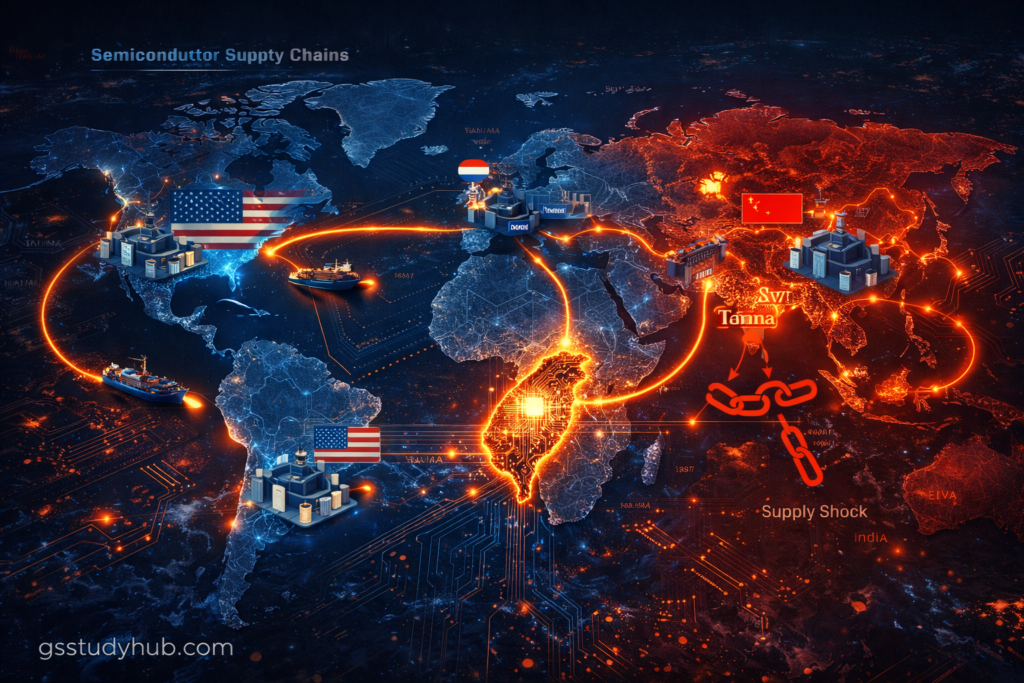
⚔ Supply Chain Security & Economic Warfare: The New Battlefield of Global Power
🚀 When Supply Chains Become Weapons
In the 21st century, wars are no longer fought only with tanks, missiles, and soldiers. They are fought with microchips, minerals, trade routes, and financial sanctions.
Globalization once promised efficiency and interdependence. Supply chains stretched across continents in pursuit of lower costs and faster production. But recent crises have revealed a harsh truth: interdependence can become vulnerability.
Supply Chain Security has emerged as a pillar of national strategy. Economic Warfare has become the silent artillery of modern geopolitics. From pandemic disruptions to sanction battles, the global economy has transformed into a strategic battlefield.
🦠 COVID Chip Crisis – A Wake-Up Call
The COVID-19 pandemic exposed the fragility of global supply networks. Lockdowns halted production lines, ports slowed down, and demand patterns shifted dramatically.
One of the most dramatic consequences was the global semiconductor shortage.
As remote work and digital consumption surged, demand for electronics skyrocketed. Meanwhile, semiconductor fabrication plants struggled with operational disruptions.
The result? A severe chip bottleneck that rippled across industries.
This crisis demonstrated that a virus in one region could trigger a technological paralysis worldwide.
🚗 Auto Industry Collapse – Case Study
The automotive sector became the most visible victim of the chip crisis.
When the pandemic began, many automakers cut chip orders, expecting reduced demand. However, demand rebounded faster than anticipated. By the time manufacturers attempted to secure new chip supplies, production capacity had already been allocated elsewhere.
The result was a dramatic production collapse.
- Millions of vehicles were delayed or canceled.
- Factories halted operations.
- Global car prices surged.
This case illustrated how a shortage of tiny semiconductor components could immobilize billion-dollar industries.
Supply chains were no longer invisible logistical systems — they had become critical infrastructure.
🤝 Friend-Shoring & Near-Shoring – Strategic Realignment
In response to supply vulnerabilities, nations began reconsidering globalization models.
Two strategic concepts gained prominence:
- Friend-Shoring – relocating supply chains to trusted geopolitical partners.
- Near-Shoring – shifting production closer to domestic markets.
The objective is not merely economic efficiency — it is strategic resilience.
Governments are investing in domestic manufacturing ecosystems, reducing overreliance on single-country suppliers.
Globalization is not ending, but it is evolving into a security-driven economic model.
⛏ Rare Earth Minerals Politics – The Hidden Leverage
Rare earth minerals are essential for manufacturing electric vehicles, advanced electronics, and defense systems.
Yet, their production is geographically concentrated. Control over rare earth supply creates strategic leverage.
In times of geopolitical tension, access to critical minerals can be restricted or manipulated.
Thus, mineral resources have transformed from economic commodities into geopolitical bargaining chips.
Supply chain security now includes not only finished goods but also the raw materials powering advanced technologies.
💣 Economic Sanctions as a Weapon
Economic sanctions have evolved into powerful strategic instruments.
Instead of traditional military confrontation, nations increasingly deploy:
- Trade restrictions
- Financial system exclusions
- Technology export controls
Sanctions can isolate economies, weaken currencies, and limit access to advanced technologies.
Economic pressure has become a form of non-kinetic warfare.
📦 Case Study Box – Russia–Ukraine War Lessons
The Russia–Ukraine War highlighted the power of economic tools.
- Swift financial sanctions restricted banking access.
- Energy weaponization disrupted European gas supplies.
- Supply chain fragmentation accelerated global diversification.
The war demonstrated that economic warfare can reshape global alliances without direct military confrontation between great powers.
📦 Case Study Box – US Export Controls on China
The United States imposed strict export controls on advanced semiconductor technologies to China.
- AI chip restrictions targeted high-performance computing.
- Lithography equipment bans limited advanced fabrication capacity.
- Technology containment strategy emerged.
These measures illustrate how economic instruments can influence long-term technological trajectories.
🎯 Conclusion – The Era of Strategic Economics
Supply chains are no longer passive commercial networks. They are strategic arteries of national power.
Economic warfare does not require battlefield explosions — its impact is measured in factory shutdowns, market crashes, and technological slowdowns.
In the digital age, resilience equals power. Control over supply chains equals strategic advantage.
The future of geopolitics will be decided not only by armies — but by algorithms, minerals, microchips, and markets.
As global power dynamics shift in the 21st century, the tension between the Global South and Western powers is becoming a defining feature of the new geopolitical order. To explore how this emerging Great Power competition is reshaping alliances, development policies, and strategic partnerships, check out our detailed analysis on Global South vs West: New Cold War 2026.
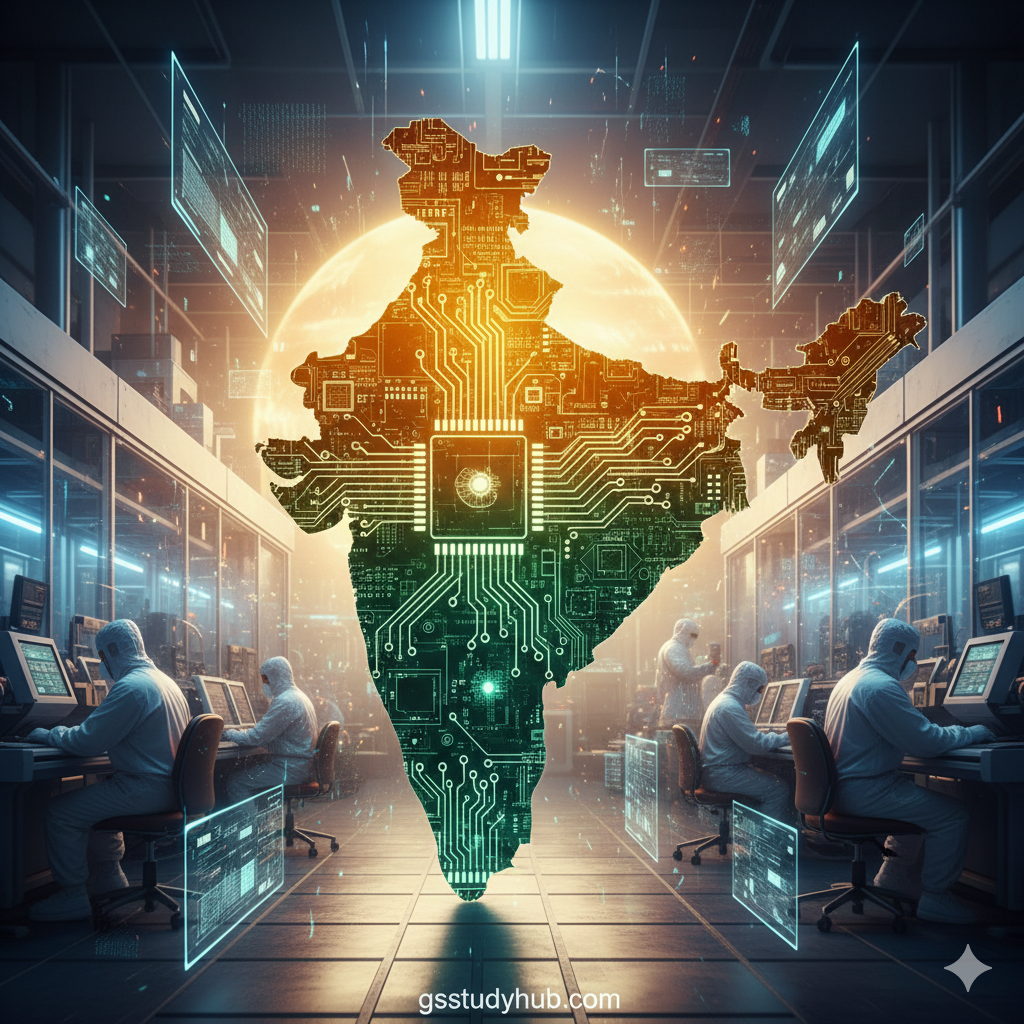
🇮🇳 India’s Semiconductor Strategy: Building a Silicon Future
🚀 From Software Power to Silicon Power
For decades, India has been known as a software superpower — a nation of coders, IT parks, and digital innovation hubs. But the 21st century demands something deeper, something more foundational: control over hardware.
In a world where microchips drive economies, defense systems, artificial intelligence, and digital sovereignty, India has recognized a strategic reality: no nation can aspire to global leadership without semiconductor resilience.
Thus begins India’s bold journey — from being a consumer of chips to becoming a creator of silicon ecosystems.
India’s Semiconductor Strategy is not merely an industrial policy. It is a declaration of strategic ambition.
🏭 India Semiconductor Mission (ISM)
Launched as a flagship initiative, the India Semiconductor Mission (ISM) aims to build a comprehensive semiconductor and display manufacturing ecosystem in India.
With multi-billion-dollar financial incentives, the mission seeks to:
- Attract global chip manufacturers
- Develop domestic fabrication facilities
- Strengthen chip design capabilities
- Promote semiconductor R&D
ISM represents India’s commitment to reduce dependence on imports and secure its position in the global semiconductor value chain.
This is not simply manufacturing — it is nation-building through silicon.
💰 Production Linked Incentive (PLI) Scheme
The PLI Scheme acts as the financial backbone of India’s semiconductor vision.
By offering performance-based incentives, the government encourages companies to invest in large-scale manufacturing within India.
The PLI scheme aims to:
- Boost domestic production
- Create employment opportunities
- Enhance export potential
The strategy aligns economic growth with technological advancement, turning industrial policy into a strategic instrument.
Through PLI, India signals to global investors that it is ready to become a trusted manufacturing partner.
🏗 Gujarat & Dholera Projects – The Silicon Gateway
Gujarat has emerged as the epicenter of India’s semiconductor aspirations. The proposed semiconductor fabrication facilities in Dholera Special Investment Region symbolize India’s manufacturing renaissance.
Dholera offers:
- World-class infrastructure
- Strategic connectivity
- Policy support and incentives
The Gujarat model aims to replicate the success stories of East Asian semiconductor hubs by creating integrated industrial ecosystems.
If successful, Dholera could transform into India’s Silicon Valley of manufacturing.
🌏 Quad Supply Chain Initiative – Strategic Partnerships
India’s semiconductor strategy is not isolated. It is deeply embedded within the broader Indo-Pacific framework.
Through the Quad Supply Chain Initiative (India, USA, Japan, Australia), efforts are underway to:
- Diversify critical supply chains
- Reduce overdependence on single-country sources
- Promote resilient economic networks
This collaboration strengthens India’s role as a strategic balancing power in the global semiconductor race.
⚖ Opportunities vs Challenges
🌟 Opportunities
- Large domestic market demand
- Skilled engineering workforce
- Growing digital economy
- Geopolitical trust factor
⚠ Challenges
- High capital investment requirements
- Technology transfer barriers
- Global competition from established players
- Need for stable power and water infrastructure
Semiconductor fabrication is capital-intensive and technologically complex. Building a globally competitive ecosystem requires long-term policy consistency and sustained investment.
📘 UPSC Angle – Strategic Implications
🇮🇳 Atmanirbhar Bharat
India’s semiconductor mission directly supports the vision of Atmanirbhar Bharat — self-reliance in critical technologies.
🛡 Strategic Autonomy
By reducing technological dependence, India enhances its strategic autonomy in global geopolitics.
🌍 Economic Diplomacy
Semiconductor partnerships strengthen India’s economic diplomacy, positioning it as a reliable node in the global supply chain.
🎯 Conclusion – India’s Silicon Century
India’s semiconductor strategy marks the beginning of a technological transformation.
From policy reforms to global partnerships, India is crafting a roadmap toward digital sovereignty and industrial resilience.
The journey is challenging. The competition is fierce. But the ambition is clear.
India is not just participating in the semiconductor race — it is preparing to shape its future in silicon.
The escalation of tensions in the Taiwan Strait has major implications for global security, economic supply chains, and U.S.–China strategic rivalry. To understand why this crisis could become the “next Ukraine” scenario in Asia, read our in-depth analysis on Taiwan Strait Crisis 2026: Is This the Next Ukraine?. This article explores the geopolitical risks and international responses shaping the future of the Indo-Pacific.
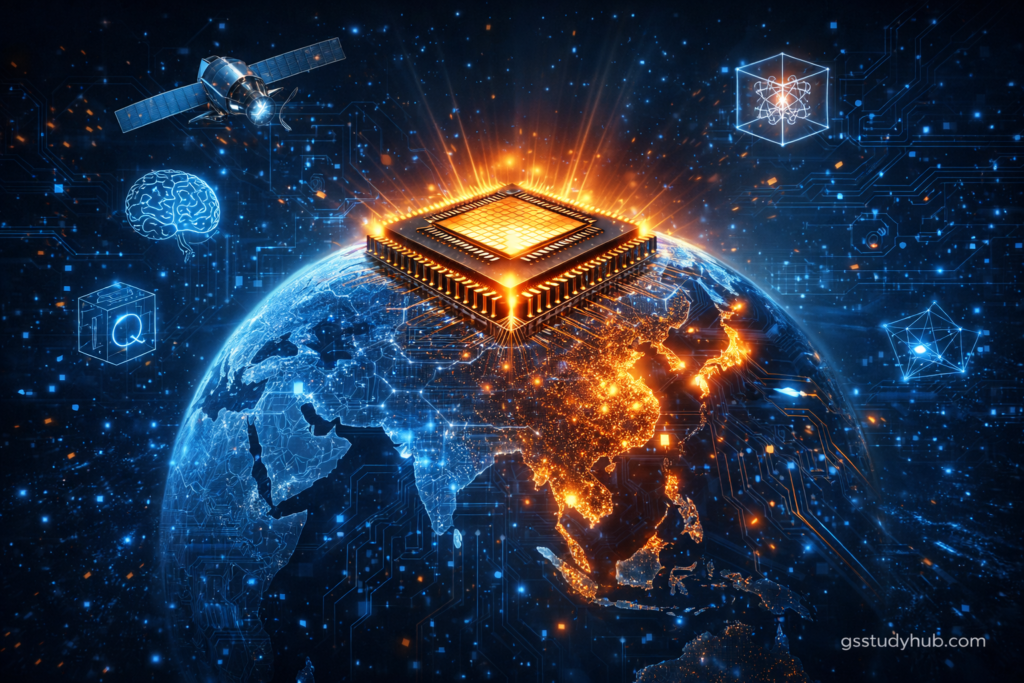
⚔ Tech War 2.0: AI, Defense & The Future of Warfare
🚀 When Algorithms Become Ammunition
The battlefield of the 21st century no longer begins with boots on the ground. It begins with algorithms, microchips, satellite constellations, and quantum processors.
Welcome to Tech War 2.0 — a new era where artificial intelligence determines battlefield awareness, where hypersonic weapons compress reaction time to seconds, and where control over space infrastructure equals strategic dominance.
This is not merely modernization of warfare. It is a paradigm shift. Technology is no longer supporting military power — it is defining it.
🤖 AI Chips & Military Superiority
Artificial Intelligence has emerged as the brain of modern warfare. But AI does not function in isolation — it depends on high-performance AI chips.
Advanced GPUs and AI accelerators process massive volumes of battlefield data in real time. From autonomous drones to predictive logistics systems, AI chips enable decision superiority.
In military terms, speed equals survival. The nation capable of processing intelligence faster than its adversary gains strategic advantage.
- Autonomous weapon systems
- AI-driven surveillance
- Real-time threat detection
Thus, AI chip supremacy is becoming the new metric of military strength.
🚀 Hypersonic Missile Guidance – Speed Beyond Defense
Hypersonic missiles travel at speeds exceeding Mach 5, making them extremely difficult to intercept.
Their precision depends on advanced guidance chips capable of handling high-speed trajectory adjustments.
Unlike traditional ballistic missiles, hypersonic systems maneuver mid-flight, requiring real-time computational power.
Here again, semiconductor technology becomes the silent engine of destructive capability.
The combination of speed and precision reshapes deterrence strategies.
🛰 Space & Satellite Chips – The High Ground of Modern War
In modern conflict, the ultimate strategic high ground is not a hill — it is low Earth orbit.
Satellites provide:
- GPS navigation
- Missile tracking
- Secure communications
- Battlefield intelligence
These systems rely on radiation-hardened chips designed to function in extreme space conditions.
Destroying or disabling satellite infrastructure could blind military forces and disrupt civilian economies simultaneously.
Thus, control over space-based semiconductor technology has become a cornerstone of strategic dominance.
⚛ Quantum Computing – The Next Frontier
Quantum computing represents the next technological revolution.
Unlike classical computers, quantum systems leverage qubits to perform calculations exponentially faster.
In military applications, quantum computing could:
- Break encryption systems
- Optimize logistics instantly
- Enhance AI modeling
Quantum supremacy could redefine cybersecurity and strategic balance.
However, the race for quantum dominance also increases strategic instability.
🧊 Debate Section – Is This a New Cold War?
Many analysts argue that Tech War 2.0 resembles a new Cold War.
Similarities include:
- Technological arms race
- Strategic blocs formation
- Export controls and sanctions
However, differences are equally striking.
Unlike the 20th-century Cold War, today’s rivals are deeply economically interdependent. Supply chains intertwine adversaries in complex ways.
The current competition is less ideological and more technological and economic.
Instead of nuclear stockpiles alone, the measure of power now includes:
- AI capability
- Semiconductor control
- Cyber dominance
Thus, whether we call it a “Cold War” or not, it is undeniably a strategic rivalry of historic magnitude.
🎯 Conclusion – The Algorithmic Battlefield
Tech War 2.0 marks the transition from industrial-age warfare to algorithmic warfare.
Military power is now measured not just in troops or tanks, but in computational capacity, chip fabrication, and technological innovation.
The future battlefield will be silent, digital, and instantaneous.
In Tech War 2.0, whoever controls intelligence, controls victory.
The race for artificial intelligence supremacy between the U.S. and China is rapidly reshaping global power dynamics, military strategy, and economic competitiveness. To explore this unfolding tech rivalry and its implications for global security, read our in-depth analysis on AI Arms Race: US-China Tech War & Global Power Shift. This article examines how innovation competition is turning into strategic leverage in the 21st century.
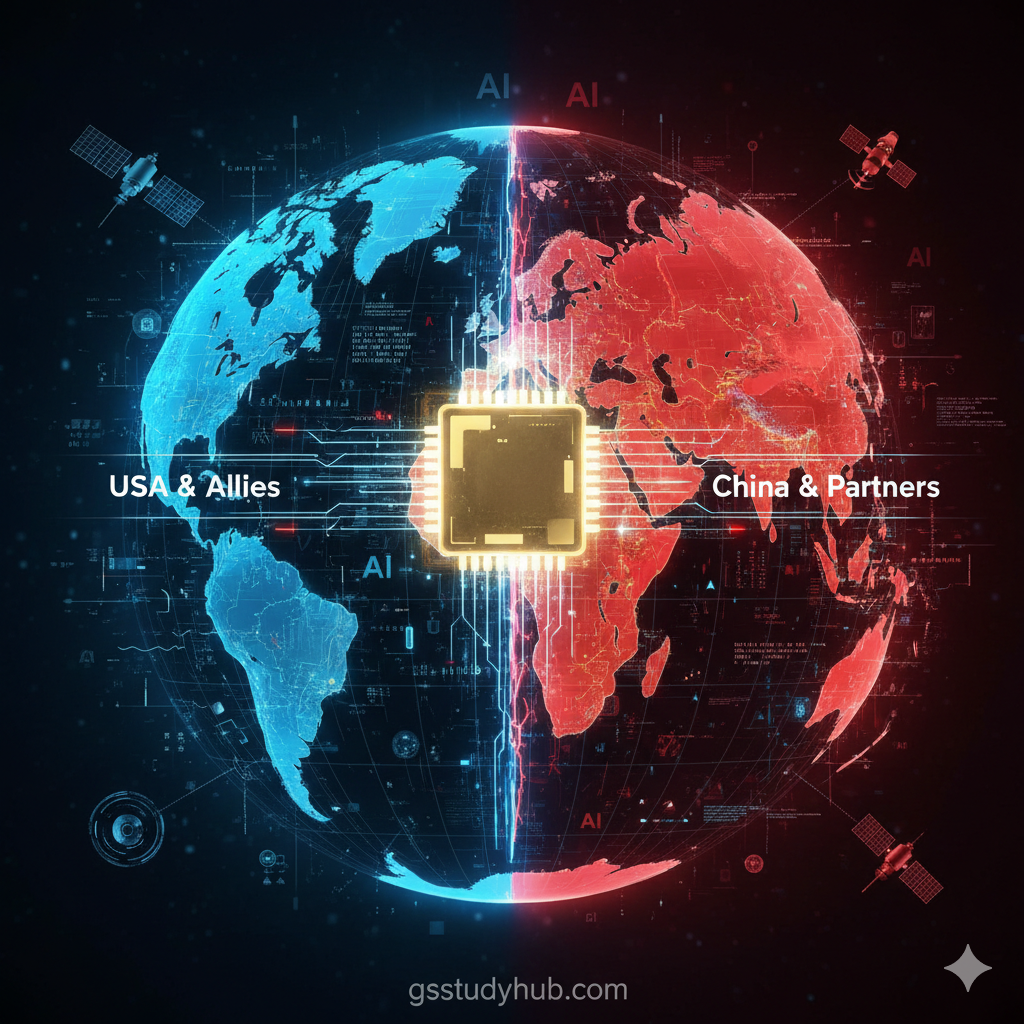
🌍 Economic Impact & Global Power Shift: From Dollar Dominance to Tech Supremacy
🚀 When Power Moves from Currency to Code
For decades, global power revolved around one central pillar — the U.S. Dollar. Oil was priced in it. Trade was settled in it. Foreign reserves were stored in it. The dollar was not just currency — it was geopolitical leverage.
But the 21st century is witnessing a subtle yet profound transformation. Power is no longer defined only by financial dominance. It is increasingly shaped by technological supremacy, digital infrastructure, and control over innovation ecosystems.
We are entering an era where code rivals currency, where data competes with oil, and where the architecture of global power is being rewritten.
💵 Dollar Dominance vs Tech Dominance
Since the end of World War II, the international financial system has revolved around dollar hegemony. Through institutions, reserve currency status, and global trade settlement systems, the dollar granted immense strategic advantages.
However, the rise of digital technologies has introduced a new dimension of power — technological dominance.
Today, control over:
- Semiconductor supply chains
- AI platforms
- Cloud infrastructure
- Digital payment ecosystems
can generate influence comparable to — or even greater than — currency power.
Unlike traditional monetary dominance, technological dominance operates invisibly. It shapes standards, protocols, software ecosystems, and hardware supply chains.
While the dollar influences financial flows, technology influences information flows.
And in the digital age, information is power.
🌐 Digital Colonization – The New Form of Control
Historically, colonial power meant territorial control and resource extraction. In the 21st century, a new phenomenon is emerging: Digital Colonization.
Instead of armies, influence spreads through:
- Social media platforms
- Cloud data centers
- E-commerce ecosystems
- Digital payment networks
When developing nations rely heavily on foreign digital platforms, their data sovereignty becomes vulnerable.
Data — often called the “new oil” — is extracted, processed, and monetized by multinational tech corporations.
Digital dependence can translate into:
- Limited regulatory autonomy
- Exposure to cyber vulnerabilities
- Economic value leakage abroad
Thus, digital colonization does not involve physical occupation — it involves algorithmic influence.
The battlefield is virtual, but the consequences are real.
🌍 Global South Perspective – Between Opportunity and Vulnerability
For nations in the Global South, the global power shift presents both promise and peril.
On one hand, digital technologies provide unprecedented opportunities:
- Financial inclusion
- Startup ecosystems
- Remote work participation
Emerging economies can leapfrog traditional industrial stages through digital innovation.
On the other hand, structural challenges persist:
- Dependence on imported chips
- Limited domestic tech manufacturing
- Cybersecurity vulnerabilities
The risk is clear: without technological self-reliance, nations may remain digitally dependent.
For the Global South, the key question is not merely access to technology — it is ownership of technological capacity.
Strategic investments in education, R&D, and semiconductor ecosystems can determine whether these nations become active participants or passive consumers in the new order.
🤝 Emerging Alliances – Redefining Global Cooperation
As the global power structure evolves, new alliances are forming.
Countries are aligning around:
- Supply chain resilience
- Technology partnerships
- Digital infrastructure cooperation
Strategic groupings are increasingly focused on semiconductor ecosystems, cybersecurity collaboration, and AI research partnerships.
Economic diplomacy now includes:
- Joint technology funds
- Cross-border data agreements
- Critical mineral partnerships
Unlike Cold War-era blocs, today’s alliances are networked and issue-based.
Technology has become the common denominator in global strategic partnerships.
The emerging world order may not be unipolar or bipolar — it may be technopolar.
📊 Economic Consequences – Restructuring the Global System
The shift from dollar dominance to tech dominance reshapes global economics:
- Investment flows increasingly target semiconductor and AI sectors.
- Trade policies prioritize digital goods and services.
- National security frameworks integrate technology controls.
Economic growth is no longer measured only in GDP expansion — it is measured in innovation capacity.
Nations that invest in:
- Research ecosystems
- Digital infrastructure
- Advanced manufacturing
will likely shape the contours of the next global century.
🎯 Conclusion – The Dawn of a Technological World Order
The global power shift is not abrupt — it is evolutionary. Currency dominance is not disappearing overnight. But technological influence is rising steadily.
The future of global power will likely be determined by the intersection of:
- Financial systems
- Digital ecosystems
- Technological innovation
The 20th century was shaped by oil and currency. The 21st century will be shaped by chips and code.
In this new era, those who control technology will influence the architecture of global power.
Historical precedents from the 20th century still shape modern strategic thinking in global power politics. To understand how lessons from the Cold War apply to today’s geopolitical rivalries, alliances, and security dilemmas, read our detailed analysis on Lessons from the Cold War for Today’s Geopolitics. This article explores enduring strategic lessons and their relevance in contemporary global conflicts.
⚖ Ethical & Strategic Questions in the Age of Technological Power
🚀 When Innovation Meets Power Politics
Technology was once celebrated as a force of human progress. It connected continents, democratized information, and accelerated economic growth. But in today’s hyper-competitive geopolitical environment, innovation has acquired a sharper edge.
Artificial Intelligence, semiconductor supply chains, quantum computing, and digital infrastructure are no longer neutral tools. They have become instruments of strategic leverage.
This transformation raises profound questions:
- Is technology a bridge for global cooperation or a wall of national competition?
- Are supply chains engines of prosperity or tools of coercion?
- Who truly governs the digital age — states or corporations?
These are not merely economic dilemmas. They are the defining ethical crossroads of the 21st century.
🌐 Tech Nationalism vs Global Cooperation
In recent years, tech nationalism has gained momentum. Governments increasingly view technological capacity as a matter of national security.
Countries are investing billions in domestic semiconductor fabs, AI research hubs, and digital infrastructure projects.
The rationale is clear: dependence on foreign technology creates vulnerability.
However, technology has historically thrived on global collaboration. Scientific progress accelerates when ideas cross borders freely.
The tension emerges here:
- National resilience demands self-reliance.
- Global innovation demands openness.
If tech nationalism intensifies, it could fragment the digital ecosystem into competing blocs with incompatible standards.
Yet, unchecked globalization could expose nations to strategic manipulation.
Thus, the ethical dilemma is complex:
Can the world balance technological sovereignty with collaborative progress?
⚔ Weaponization of Supply Chains
Global supply chains were originally designed for efficiency. They optimized cost, speed, and productivity.
But recent events have revealed a darker dimension: supply chains can be weaponized.
Export controls, technology bans, rare earth restrictions, and semiconductor embargoes have transformed economic tools into instruments of strategic pressure.
The weaponization of supply chains raises urgent ethical questions:
- Should access to critical technologies be restricted for geopolitical advantage?
- Is economic coercion morally different from military aggression?
- Do sanctions protect security or harm civilian populations?
When supply chains become geopolitical weapons, the ripple effects extend far beyond rival states.
Factories close. Jobs vanish. Prices surge.
Thus, economic conflict often imposes collateral damage on ordinary citizens.
In this environment, the global economy becomes a chessboard where entire industries are strategic pieces.
The moral challenge lies in defining the limits of economic statecraft.
🏢 Corporate Power vs State Power
Perhaps the most fascinating ethical debate centers on the relationship between corporate power and state authority.
Technology giants now command:
- Massive financial resources
- Global user bases
- Control over digital platforms
- Influence over public discourse
Some multinational corporations possess market capitalizations greater than the GDP of many countries.
This concentration of digital influence raises critical concerns:
- Who sets the rules of the digital ecosystem?
- Can democratic accountability keep pace with technological scale?
- Should corporations influence geopolitical strategy?
In some cases, governments rely on private tech companies for cybersecurity, satellite infrastructure, and AI development.
This partnership blurs traditional boundaries.
When corporate interests align with national interests, synergy emerges.
But when corporate incentives prioritize profit over public welfare, ethical tensions intensify.
The digital era has produced a new actor in global politics — the tech corporation as geopolitical stakeholder.
🧭 The Strategic Balance – Ethics in a Competitive World
The intersection of technology and geopolitics demands a recalibration of ethical frameworks.
Three guiding principles may define the future:
- Transparency in technological governance
- Accountability for economic coercion
- Equity in global digital participation
Strategic competition is inevitable. But ethical erosion is not.
The challenge is not to eliminate rivalry — it is to ensure that rivalry does not undermine the shared foundations of global stability.
🎯 Conclusion – The Moral Architecture of the Digital Age
The ethical and strategic questions surrounding technology will shape the future of global order.
If tech nationalism dominates without cooperation, fragmentation may follow.
If supply chains are weaponized without restraint, economic volatility may intensify.
If corporate power eclipses democratic oversight, accountability may weaken.
The digital century demands not only innovation — but wisdom.
In the end, the true test of technological progress is not power alone — but responsibility.
For a deeper look at India’s strategic role in the Quad and Indo-Pacific, see Quad and Indo-Pacific Strategy: India’s Critical Role.
📘 UPSC Integration Section: Technology, Geopolitics & India’s Strategic Future
🚀 When Silicon Shapes Sovereignty
In the 21st century, technology is no longer neutral. It influences diplomacy, shapes internal security, drives economic development, and defines global power hierarchies.
For UPSC aspirants, understanding the intersection of semiconductors, AI supremacy, strategic alliances, and economic statecraft is essential.
This topic integrates seamlessly across GS-II, GS-III, and Essay papers.
🧭 GS-II: International Relations & Governance
🇮🇳 India–US Relations
The semiconductor ecosystem has become a cornerstone of India–US strategic partnership.
Through technology cooperation, supply chain resilience initiatives, and joint semiconductor investments, both nations aim to:
- Diversify supply chains
- Reduce dependence on China
- Strengthen Indo-Pacific stability
Technology diplomacy now supplements traditional defense agreements.
For UPSC answers, this reflects:
- Deepening strategic convergence
- Economic security partnerships
- Technology as a tool of diplomacy
India–US semiconductor collaboration highlights how economic interdependence reinforces strategic alignment.
🐉 The China Factor
China remains central to global semiconductor geopolitics.
US export controls, AI chip restrictions, and supply chain realignments have reshaped global power equations.
India must navigate this environment carefully:
- Balancing strategic competition
- Maintaining economic engagement
- Strengthening domestic capacity
For GS-II, this reflects India’s pursuit of multi-alignment strategy.
India’s approach combines pragmatism with strategic autonomy.
⚙ GS-III: Technology, Security & Economy
🔬 Science & Technology
Semiconductors lie at the heart of modern innovation:
- Artificial Intelligence
- Quantum computing
- Space technology
- 5G & 6G infrastructure
For GS-III answers, emphasize:
- Indigenous R&D
- Innovation ecosystems
- Public–private collaboration
Science & Technology is no longer an isolated domain — it is deeply interlinked with national strategy.
🛡 Internal Security
Digital infrastructure vulnerabilities directly affect internal security.
Cyber warfare, AI-enabled misinformation, and semiconductor supply disruptions can destabilize economies.
Internal security now includes:
- Cyber resilience
- Critical infrastructure protection
- Data sovereignty
Technology policy is therefore national security policy.
📈 Economic Development
Semiconductor manufacturing has multiplier effects:
- High-skilled employment
- Export growth
- Industrial modernization
India’s Semiconductor Mission aligns with:
- Make in India
- Digital India
- Atmanirbhar Bharat
For GS-III, link technology policy to sustainable economic growth.
📝 Essay Integration
🖋 “Technology as the New Currency of Power”
Structure:
- Introduction: Shift from oil and currency to technology.
- Body: AI dominance, semiconductor race, digital sovereignty.
- Global Perspective: US–China rivalry, emerging alliances.
- Ethical Dimension: Digital divide, corporate power.
- Conclusion: Balanced technological governance.
Highlight how innovation influences diplomacy, economy, and military strength.
🖋 “Semiconductor Sovereignty and Global Stability”
Suggested Flow:
- Context: Chip shortages & supply chain fragility.
- Geopolitics: Taiwan Strait, US–China rivalry.
- India’s Role: Semiconductor Mission & Quad cooperation.
- Global Stability: Need for collaborative frameworks.
Balance nationalism with cooperation for a nuanced essay.
🎯 Conclusion – UPSC Ready Perspective
Technology is not merely a sector — it is the backbone of:
- Diplomatic leverage
- Economic resilience
- National security
- Strategic autonomy
For UPSC aspirants, the key lies in interlinking themes — connecting technology with governance, security, and development.
The future of geopolitics will be written in silicon.
Understanding this shift is not optional — it is essential.
The strategic competition between the United States and China increasingly revolves around technological dependencies, supply chains, and innovation leadership. To explore how technology reliance is reshaping global power dynamics and economic security, read our in-depth analysis on Geopolitics of US-China Technology Dependence. This article explains the geopolitical stakes behind digital ecosystems, semiconductors, and technological hegemony.
⚔ Semiconductor War 2026 – The Chip Battle Reshaping the World
📘 Frequently Asked Questions (FAQ)
Silicon is the New Oil. Chips are the New Weapons. Technology is the New Currency of Power.
❓ Q1. What is Semiconductor War 2026?
Semiconductor War 2026 refers to the escalating global strategic competition over advanced chip manufacturing, AI processors, and critical supply chains.
It is not a traditional military war, but a technology-driven geopolitical confrontation between major powers seeking dominance in the digital age.
❓ Q2. Why are semiconductors so important today?
Modern systems depend on chips:
- Artificial Intelligence
- Electric Vehicles
- Missile Guidance Systems
- Satellites & Space Technology
- 5G & Digital Infrastructure
Without semiconductors, the modern global economy would slow down or collapse.
❓ Q3. Why did tensions intensify around 2026?
By 2026, several factors accelerated the conflict:
- Rapid AI arms race
- Expanded US–China export controls
- Rising Taiwan Strait tensions
- Supply chain realignment and friend-shoring
These developments transformed semiconductor competition into a global strategic flashpoint.
❓ Q4. Who are the major players in this war?
Key actors include:
- United States
- China
- Taiwan
- Netherlands (EUV lithography leader)
- India (emerging semiconductor hub)
Each nation seeks technological sovereignty and strategic leverage.
❓ Q5. Is this a new Cold War?
Many analysts describe it as a “Tech Cold War.”
Instead of nuclear stockpiles, the competition revolves around:
- AI chip restrictions
- Technology sanctions
- Export controls
- Strategic alliances
While it lacks direct large-scale military conflict, it reflects a systemic rivalry between great powers.
❓ Q6. Why is Taiwan so central to this conflict?
Taiwan hosts the world’s most advanced semiconductor manufacturing facilities.
If conflict erupts in the Taiwan Strait:
- Global chip supply shock
- Automotive production collapse
- AI development delays
- Severe financial market volatility
Taiwan is often described as the “Silicon Shield” of the global economy.
❓ Q7. How does this affect ordinary people?
Semiconductor disruptions directly impact consumers:
- Higher smartphone and laptop prices
- More expensive cars
- Delays in electronic products
- Increased digital service costs
The chip war is not abstract — it affects everyday life.
❓ Q8. What role do rare earth minerals play?
Rare earth elements are essential for advanced chip production and defense systems.
Control over these minerals creates strategic leverage.
Resource politics has become a critical dimension of the semiconductor war.
❓ Q9. How is India responding?
India launched the India Semiconductor Mission and Production Linked Incentive schemes to develop domestic chip manufacturing.
India aims to achieve:
- Strategic autonomy
- Supply chain resilience
- Integration into global semiconductor networks
India positions itself as a trusted alternative manufacturing hub.
❓ Q10. What does the future look like?
The future may include:
- Regional technology blocs
- Stronger digital sovereignty policies
- Intensified AI competition
- Acceleration of quantum computing race
Semiconductor geopolitics will increasingly define global power structures.
🎯 Final Insight
The 20th century was shaped by oil and currency.
The 21st century is being shaped by chips and code.
Whoever controls semiconductors, controls the future.
The geopolitical significance of semiconductor supply chains and technological dependence is shaping global power dynamics like never before. To explore how chips and tech reliance are transforming international strategy and economic competition, read our detailed analysis on Geopolitics of Chips and Technological Dependence. This article explains the strategic stakes behind semiconductors, supply chains, and tech sovereignty.
🌍 Conclusion: Who Controls the Future?
Silicon, Strategy & the Shifting Axis of Global Power
The 20th century was ruled by oil and nuclear deterrence. The 21st century is being shaped by semiconductors and algorithmic power.
⚔ Semiconductor = Strategic Deterrence
In classical geopolitics, nuclear weapons symbolized ultimate deterrence. They prevented large-scale wars by imposing catastrophic costs.
In the digital era, semiconductors are emerging as a new form of strategic deterrence.
Why?
Because control over advanced chips determines:
- AI military superiority
- Cyber warfare capability
- Hypersonic missile precision
- Space-based surveillance dominance
A nation deprived of advanced semiconductors cannot sustain modern defense systems. It cannot compete in AI innovation. It cannot secure digital sovereignty.
Thus, semiconductor capability acts as a non-nuclear strategic shield.
Export controls, chip bans, and technology restrictions function as deterrence tools — limiting adversaries’ access to cutting-edge innovation.
In this framework, semiconductor dominance becomes not merely economic power, but strategic leverage over the future.
🌏 Asia-Pacific: The Emerging Global Power Center
The epicenter of semiconductor geopolitics lies in the Asia-Pacific region.
This region hosts:
- Taiwan’s advanced chip fabrication
- South Korea’s memory chip leadership
- China’s manufacturing ecosystem
- Japan’s critical materials expertise
- India’s emerging semiconductor ambitions
Unlike previous eras where the Atlantic dominated global politics, the 21st century power axis is shifting toward the Indo-Pacific.
Trade routes, supply chains, digital infrastructure, and strategic maritime chokepoints converge in this region.
Control over Asia-Pacific stability means control over technological continuity.
Tensions in the Taiwan Strait, competition in the South China Sea, and strategic partnerships like the Quad illustrate how deeply semiconductor geopolitics is intertwined with regional security.
The Asia-Pacific is no longer a peripheral theater — it is the core arena of 21st-century power politics.
🇮🇳 India’s Window of Opportunity
Amid great-power rivalry, India stands at a strategic crossroads.
The global supply chain realignment presents a rare window of opportunity.
As companies diversify away from overdependence on single-country production, India can position itself as:
- A trusted semiconductor manufacturing hub
- A design and innovation center
- A strategic balancing power in the Indo-Pacific
India’s strengths include:
- Large skilled workforce
- Growing digital economy
- Strategic partnerships with the US, Japan, and Europe
- Policy initiatives like PLI and India Semiconductor Mission
However, the opportunity is time-sensitive.
Semiconductor manufacturing demands:
- Massive capital investment
- Stable infrastructure
- Long-term policy continuity
If executed effectively, India could transform from a software service powerhouse into a full-spectrum technology leader.
The stakes are high — but so is the potential reward.
🔎 Final Analytical Insight – Who Controls the Future?
The question is not simply which country leads today.
The deeper question is:
Who controls the technological foundations of tomorrow?
Power in the digital century rests on three pillars:
- Innovation Capacity
- Manufacturing Control
- Strategic Alliances
Currency dominance can fluctuate. Military alliances can shift. Energy markets can evolve.
But control over semiconductor ecosystems defines the pace of technological evolution itself.
Semiconductors power artificial intelligence. AI powers economic productivity and military systems. Military systems secure geopolitical influence.
Thus, the chain is clear:
Silicon → Intelligence → Security → Power
The future global order will not be determined solely by ideology or even traditional military might.
It will be shaped by:
- Who controls advanced chip fabrication
- Who leads in AI and quantum research
- Who secures resilient supply chains
Semiconductor dominance does not guarantee peace. But its absence guarantees vulnerability.
Therefore, the ultimate conclusion emerges:
The nation that masters silicon will influence the destiny of the digital century.
In the age of algorithms and automation, the future belongs not merely to the strongest — but to the most technologically sovereign.
The concept of a unipolar world has profound implications for global strategy, alliances, and power hierarchies. To explore firsthand insights on how unipolarity shaped international politics and what lessons it holds for today’s multipolar age, read our detailed analysis on Unipolar World: My Experience & Insights. This article offers a nuanced perspective on the strategic dynamics of unipolar dominance.
📚 Semiconductor War 2026 – The Chip Battle Reshaping the World Reference Section
Research Foundations • Policy Documents • Strategic Reports • Industry Analysis
📘 1. International Policy & Government Sources
The analytical foundation of Semiconductor War 2026 is rooted in official policy frameworks and national strategy documents that reflect how chips have become instruments of power.
- U.S. CHIPS and Science Act (2022) – Framework for revitalizing domestic semiconductor manufacturing.
- U.S. Department of Commerce Export Controls – Restrictions on advanced AI chips and lithography tools.
- China’s Made in China 2025 Strategy – Roadmap for technological self-reliance.
- India Semiconductor Mission (ISM) – India’s national initiative to build chip fabrication capacity.
- European Chips Act – The European Union’s semiconductor sovereignty policy.
These documents reveal how semiconductors have transitioned from commercial goods to strategic national assets.
📊 2. Strategic & Geopolitical Think Tank Reports
Global think tanks provide critical insight into the geopolitical dimensions of the semiconductor race.
- CSIS (Center for Strategic and International Studies) – Technology competition and supply chain resilience reports.
- Brookings Institution – AI geopolitics and digital power analyses.
- Carnegie Endowment for International Peace – Studies on tech nationalism and global stability.
- Observer Research Foundation (ORF) – India’s semiconductor positioning in global geopolitics.
- RAND Corporation – AI warfare and strategic technology competition studies.
These analyses frame semiconductor dominance as a pillar of strategic deterrence and economic leverage.
🔬 3. Technology & Industry Research Sources
Technical and market insights are drawn from leading semiconductor industry reports and corporate disclosures.
- TSMC Annual Reports – Data on advanced node production (3nm, 2nm).
- Intel IDM 2.0 Strategy Reports – Domestic manufacturing revival.
- ASML Technical Documentation – EUV lithography monopoly insights.
- SMIC Financial Reports – China’s chip fabrication progress.
- McKinsey Semiconductor Market Analysis – Industry growth forecasts and supply chain trends.
These sources emphasize the capital intensity, complexity, and geopolitical sensitivity of semiconductor manufacturing.
🌏 4. Geopolitical Events & Case Studies Referenced
- Taiwan Strait Tensions (2022–2026)
- U.S. AI Chip Export Restrictions (Ongoing)
- Russia–Ukraine War Sanctions Impact
- Quad Supply Chain Initiative
- COVID-19 Global Chip Shortage (2020–2023)
These real-world events demonstrate how semiconductor supply chains have become tools of economic statecraft.
📚 5. Conceptual & Theoretical Foundations
The analytical interpretation of Semiconductor War 2026 draws upon key theoretical frameworks:
- Geoeconomics Theory
- Digital Sovereignty Concepts
- Strategic Deterrence Models
- Tech Nationalism vs Globalization Debate
- Supply Chain Security Frameworks
These frameworks help interpret the semiconductor race not merely as industrial rivalry, but as a systemic transformation of global power architecture.
🎯 Analytical Reference Insight
The references collectively suggest a clear strategic pattern:
- Technology is now inseparable from national security.
- Semiconductor control influences AI, defense, and economic stability.
- Supply chain resilience has become a geopolitical priority.
Semiconductors are no longer passive industrial inputs. They are active instruments of global influence.
The convergence of technology, defense, and economics defines the emerging world order of the digital century.
Understanding these references is essential to understanding how the semiconductor war is reshaping global destiny.
📌 End of Reference Section – Semiconductor War 2026