
Russia–Ukraine War Causes, Background and Historical Roots

Russia Ukraine War Causes: Major Background and Historical Roots Explained (2026 Analysis)

Russia Ukraine War Causes: Major Background and Historical Roots Explained

The Russia Ukraine War has reshaped global geopolitics in unprecedented ways. To fully understand the scale of this confrontation, it is essential to closely examine the deeper Russia Ukraine War Causes that gradually pushed both nations toward conflict.

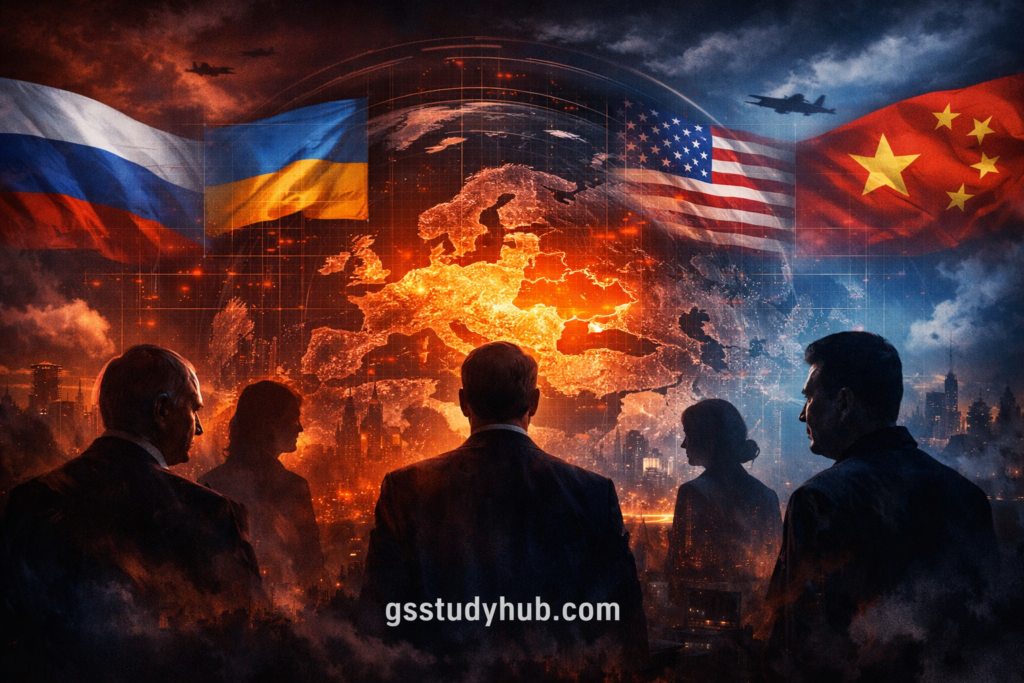
The war between Russia and Ukraine has emerged as one of the most defining geopolitical events of the 21st century. What began as a regional conflict has transformed into a global strategic confrontation involving major powers. By 2026, debates surrounding the Russia Ukraine War Causes increasingly focus on NATO expansion, security dilemmas, and long-term geopolitical rivalry.

At its core, the conflict reflects a clash between contrasting geopolitical trajectories. Russia seeks to reassert influence over its near abroad, while Ukraine has increasingly oriented itself toward Euro-Atlantic integration. This strategic divergence forms one of the central Russia Ukraine War Causes.

Understanding the historical roots and structural Russia Ukraine War Causes is essential for grasping why the conflict erupted and why it continues to shape global politics.

Background of the Russia Ukraine War Conflict

The Russia Ukraine conflict did not emerge suddenly in 2022. Rather, it developed through decades of political, historical, and strategic developments after the Cold War. Many analysts trace the early foundations of the Russia Ukraine War Causes to the unstable post-Soviet transition period.

Historical Roots of Tension Between Russia and Ukraine

Ukraine and Russia share deep historical ties stretching back over a thousand years. These shared origins are frequently cited when examining the long-term Russia Ukraine War Causes.

After the collapse of the Soviet Union in 1991, Ukraine emerged as an independent state. However, unresolved strategic tensions, identity politics, and competing foreign policy orientations gradually intensified the broader Russia Ukraine War Causes.

Internal divisions between pro-European and pro-Russian regions created political instability. Over time, these internal fractures became indirect but significant elements among the evolving Russia Ukraine War Causes.

NATO Expansion and Russia’s Security Concerns

One of the most critical Russia Ukraine War Causes remains the dispute over NATO expansion.

After the Cold War, NATO expanded eastward, incorporating former Soviet-aligned states. From Moscow’s perspective, this expansion intensified the Russia Ukraine War Causes by threatening its traditional security buffer.

Ukraine’s growing aspiration to join NATO became a major red line for Russia and a defining trigger within the immediate Russia Ukraine War Causes.

The clash between Russia’s demand for strategic depth and the West’s emphasis on sovereign choice lies at the heart of the modern Russia Ukraine War Causes.

Main Russia Ukraine War Causes Explained

The outbreak of full-scale war in February 2022 resulted from multiple overlapping Russia Ukraine War Causes rather than a single triggering event.

Security and Strategic Causes

Security concerns form a central pillar of the Russia Ukraine War Causes. Russia demanded legally binding guarantees that Ukraine would not join NATO and that Western military deployments would be limited.

When these demands were rejected, the unresolved security dilemma significantly escalated the immediate Russia Ukraine War Causes.

From Ukraine’s perspective, Russia’s actions violated sovereignty and international law, reinforcing its belief that stronger Western alignment was necessary — a factor that further deepened the Russia Ukraine War Causes.

Geopolitical and Ideological Causes

Beyond security concerns, geopolitical rivalry represents another structural dimension of the Russia Ukraine War Causes.

Russia views the post–Cold War international order as Western-dominated and seeks a multipolar system with recognized spheres of influence. Ukraine’s integration into Western institutions challenges this vision, thereby reinforcing the broader Russia Ukraine War Causes.

Ideological competition between authoritarian and liberal democratic governance models has also amplified the ideological Russia Ukraine War Causes.

Energy Resources and Strategic Geography

Energy transit routes and strategic geography significantly contribute to the economic Russia Ukraine War Causes.

Ukraine’s position as a gas transit hub provides leverage in European energy markets. Control over the Black Sea region adds military and trade advantages, further intertwining economic competition with the strategic Russia Ukraine War Causes.

Conclusion: Understanding the Russia Ukraine War Causes

In conclusion, the Russia Ukraine War Causes are complex, layered, and deeply interconnected. They include NATO expansion disputes, security dilemmas, historical grievances, geopolitical rivalry, and strategic resource competition.

A comprehensive understanding of the Russia Ukraine War Causes is essential for analyzing the future trajectory of European security and the evolving global power balance.

Latest Situation of the War (2026)

By 2026, the Russia–Ukraine War has evolved into a prolonged and high-intensity conflict. While battlefield dynamics continue to change, many of the original Russia Ukraine War Causes — including security disputes and geopolitical rivalry — still shape the direction of the war.

The conflict has transformed from a conventional confrontation into a multidimensional struggle involving cyber warfare, drone operations, missile strikes, sanctions, and information campaigns. These developments show how deeply rooted the structural Russia Ukraine War Causes remain unresolved.

Battlefield Situation

In 2026, fighting remains concentrated mainly in eastern and southern Ukraine, reflecting the strategic geography that forms part of the broader Russia Ukraine War Causes.

  • Several cities are partially destroyed
  • Millions of civilians have been displaced
  • Frequent shelling continues in frontline areas

Both sides are employing evolving military tactics shaped by the long-term Russia Ukraine War Causes linked to territorial control and security guarantees.

Drones, long-range missiles, and satellite surveillance have become central tools of modern warfare, illustrating how technological escalation interacts with the strategic Russia Ukraine War Causes.

Changes in Military Strategy

Instead of large-scale offensives, both sides increasingly rely on precise and targeted strikes. This shift reflects how the core Russia Ukraine War Causes have transitioned from rapid confrontation to prolonged attrition.

  • Targeted attacks on key military infrastructure
  • Disruption of supply and logistics networks
  • Extensive use of electronic and cyber warfare

These developments indicate that without addressing the underlying Russia Ukraine War Causes, the conflict is likely to remain prolonged.

Diplomatic Efforts

Numerous international initiatives have attempted to bring the conflict to an end. However, the fundamental Russia Ukraine War Causes — especially NATO expansion disputes and territorial claims — continue to block meaningful compromise.

Temporary ceasefires have occurred, yet no comprehensive settlement has been achieved because the structural Russia Ukraine War Causes remain contested by both sides.

Global Impact of the Russia–Ukraine War

The Russia–Ukraine War is no longer a regional crisis. Its global consequences are directly connected to the wider geopolitical Russia Ukraine War Causes that reshaped international alignments.

Economic Impact

The war has placed heavy strain on the global economy. Sanctions, energy disruptions, and trade fragmentation are indirect outcomes of the broader Russia Ukraine War Causes.

  • Rising inflation worldwide
  • Volatile energy prices
  • Disruptions to industrial production

Interruptions in oil and gas supplies have triggered energy insecurity in many countries, demonstrating how economic stability is intertwined with the strategic Russia Ukraine War Causes.

Food Security Crisis

Russia and Ukraine are major grain exporters. Disruptions in agricultural supply chains highlight the economic dimension of the Russia Ukraine War Causes.

  • Sharp increase in food prices
  • Higher risk of hunger in poorer countries
  • Growing need for humanitarian assistance

Food security has become a major global concern due to the cascading effects of unresolved Russia Ukraine War Causes.

Political and Strategic Impact

The war has altered the global balance of power, accelerating strategic realignments that stem from the broader geopolitical Russia Ukraine War Causes.

  • Formation of new security partnerships
  • Strains within existing alliances
  • Acceleration toward a multipolar world order

Many countries are now adopting more cautious and interest-driven foreign policies in response to the shifting dynamics created by the enduring Russia Ukraine War Causes.

India’s Position on the Russia-Ukraine War

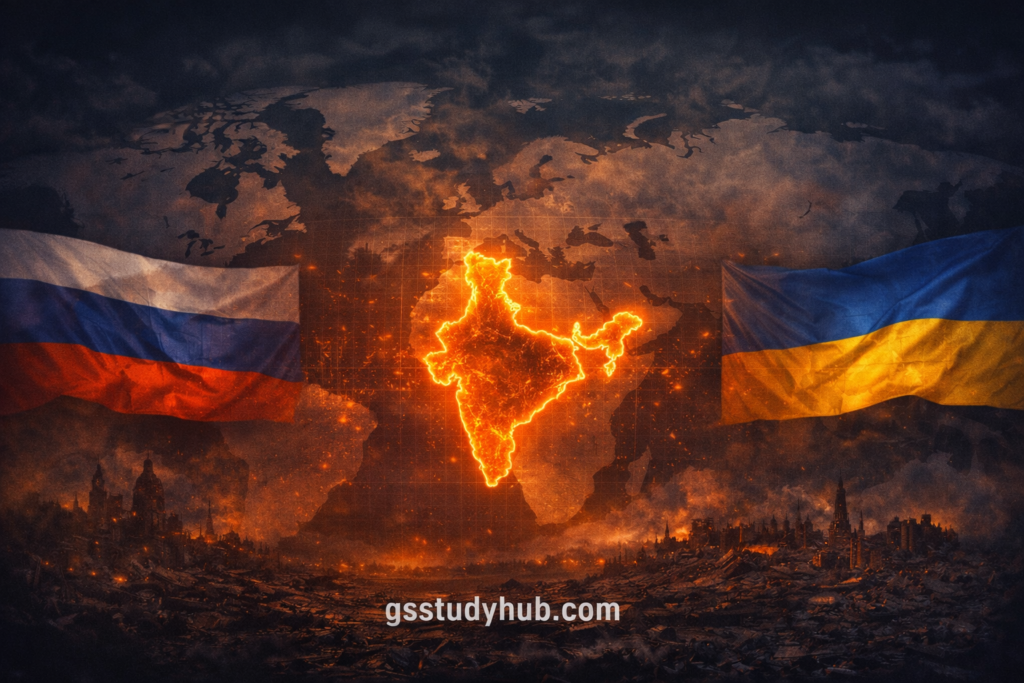
India has adopted a policy of strategic neutrality in the Russia–Ukraine War. Rather than aligning with any single camp, New Delhi has consistently emphasized dialogue, diplomacy, and peaceful resolution.

India’s approach reflects its long-standing tradition of strategic autonomy and independent foreign policy.

At the United Nations and other international forums, India has called for an immediate cessation of hostilities and a return to negotiations.

At the same time, India has avoided explicitly condemning Russia, while also expressing concern over civilian casualties and humanitarian suffering.

This carefully balanced position seeks to protect India’s national interests in a complex geopolitical environment.

Diplomatic Balance

India maintains strong relations with both Russia and Western countries.

Russia has been a long-standing defense partner of India, supplying a significant portion of its military equipment.

Meanwhile, India’s economic and strategic ties with the United States and European Union have expanded rapidly in recent decades.

Preserving productive relations with all major powers remains a core objective of Indian diplomacy.

Energy and Defense Interests

The Russia–Ukraine War has exacerbated global energy challenges, contributing to rising prices and supply uncertainties. To understand how an energy supply imbalance impacts economies and households, see this explanation of the global energy crisis and its effects .

The war has reshaped global energy markets, and India has increased its imports of discounted Russian crude oil to ensure energy security.

From India’s perspective, affordable energy supplies are essential for economic stability and growth.

In defense cooperation, India continues to rely on Russian-origin platforms, even as it diversifies its procurement sources.

India also provided humanitarian assistance to Ukraine, including medicines and relief supplies.

Role of Major Powers

United States

The United States has been the leading supporter of Ukraine, providing extensive military, financial, and intelligence assistance.

Washington views the conflict as a test of the international rules-based order and a challenge to authoritarian revisionism.

The United States has also coordinated large-scale sanctions against Russia in cooperation with its allies.

Europe

European countries, particularly members of the European Union and NATO, have played a central role in supporting Ukraine.

At the same time, Europe has faced significant economic costs due to reduced access to Russian energy.

The war has accelerated European efforts to strengthen defense capabilities and reduce strategic dependencies.

China

China has adopted a cautious and largely neutral stance.

Beijing has called for respect for sovereignty while also emphasizing Russia’s security concerns.

China has avoided direct military involvement but continues economic engagement with Russia.

Beijing presents itself as a potential mediator, though its influence remains limited.

Premium Daily Use Product

★★★★★ (4.7/5 Customer Rating)

Designed for everyday convenience with dependable performance. Great choice for quality, durability, and excellent value.

  • Strong & Durable Build
  • Easy to Use
  • Lightweight & Portable
  • Long-Lasting Performance
  • Great Value for Money
👉 Check Price on Amazon
✔ Secure Payment   ✔ Amazon Trusted Seller   ✔ Fast Delivery

Future Outlook

Most analysts believe that the Russia–Ukraine War is unlikely to end quickly.

A prolonged conflict, marked by periodic escalations and negotiations, appears the most probable scenario.

Any eventual settlement is likely to involve difficult compromises and unresolved tensions.

The war will continue to shape global security architecture for years to come.

For official information on NATO’s expansion, membership policies, and strategic mission, visit the official NATO website .

Lessons for the World

  • The importance of maintaining strategic balance
  • The limits of military solutions in resolving political disputes
  • The critical role of diplomacy and dialogue
  • The need to strengthen international institutions

The conflict demonstrates that durable peace requires political will and mutual accommodation.

Frequently Asked Questions (FAQ)

When did the Russia–Ukraine War begin?

The full-scale war began in February 2022.

What is the main cause of the war?

The primary causes include NATO expansion, Russia’s security concerns, and Ukraine’s westward orientation.

Which side does India support?

India has not supported any side and maintains a neutral, balanced position.

How has the war affected the global economy?

It has contributed to inflation, energy price volatility, and food supply disruptions.

Conclusion

The Russia–Ukraine War represents a watershed moment in contemporary history.

The Russia Ukraine War will continue to influence global geopolitics, strategic alliances, and economic systems for years to come.

It has transformed international politics, reshaped alliances, and exposed deep fractures in the global order.

Whether through negotiation or prolonged confrontation, the outcome of this war will influence the future of global security and diplomacy.

Understanding its causes, impacts, and lessons is essential for navigating an increasingly complex world.

Leave a Comment

Your email address will not be published. Required fields are marked *

Scroll to Top