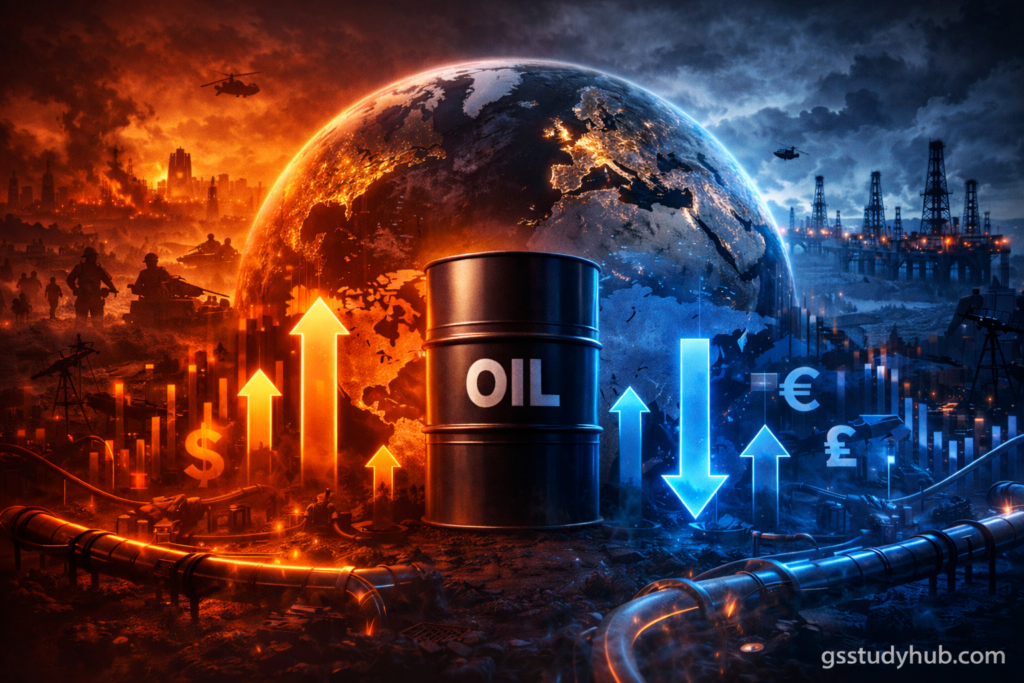

Regional Instability and Oil Prices: Role of Major Powers | Geopolitics Analysis

Regional Instability and Oil Prices: Role of Major Powers in Global Geopolitics

In today’s interconnected world, the relationship between regional instability and oil prices is no longer limited to economics alone. It has become deeply connected to global politics, strategic security, and the everyday lives of ordinary people. The growing linkage between regional instability and oil prices shows how fragile the global energy system has become.

A conflict that begins in a distant region can, within days, shake international markets. Investors immediately react because regional instability and oil prices tend to move in the same direction. Such disruptions push fuel prices higher, accelerate inflation, and create social and political pressure on governments.

Over the years, while closely observing global events, I have come to realize that oil is not just an energy resource—it is a symbol of power, influence, and control. Wherever instability emerges—whether through war, civil conflict, or political turmoil—the security of oil supply comes under threat. This is precisely why regional instability and oil prices remain central to global strategic calculations.

In this article, I will present my experiences and analysis in a storytelling style to explain how regional conflicts shape the global oil market and how major powers use these situations to advance their strategic interests. Understanding the connection between regional instability and oil prices helps decode the larger geopolitical chessboard, where oil stands as one of the most important pieces.

Ultimately, the purpose of this discussion is to show that whenever we hear news of rising instability in any part of the world, its economic ripple effects are rarely isolated. The pattern of regional instability and oil prices reminds us that every rise or fall in crude markets reflects not only supply and demand, but also the deep politics of global power balance.

Premium Quality Daily Use Product

⭐⭐⭐⭐☆ (4.5/5)
Bestseller
Price: ₹499
  • High-quality durable material
  • Ideal for daily use
  • Lightweight & easy to handle
  • Great value for money
👉 Buy on Amazon

Regional Instability and Oil Prices: A Deep Connection

Regional instability and oil prices are closely intertwined in today’s global system. Whenever political tensions rise in major energy-producing regions, financial markets immediately factor in the risks. The historical pattern shows that regional instability and oil prices tend to move together because uncertainty in supply chains increases speculation and precautionary buying.

Even before any physical shortage occurs, the fear of disruption is enough to push prices upward. This psychological reaction of investors demonstrates how sensitive regional instability and oil prices are to geopolitical signals. A single announcement of sanctions, military action, or diplomatic breakdown can shift crude benchmarks within hours.

Oil is not just a commodity; it is a strategic resource that influences national power, foreign policy, and economic stability. Countries that depend heavily on imported energy are especially vulnerable to price shocks triggered by conflicts and geopolitical rivalries. In such cases, the link between regional instability and oil prices becomes even more visible in domestic inflation data.

This deep connection explains why events occurring thousands of miles away can quickly affect fuel costs, inflation, and economic growth at home. Understanding the dynamics of regional instability and oil prices is essential for grasping how geopolitics and energy security shape the modern world.

What is Regional Instability?

Regional instability refers to a prolonged condition in which a particular geographic area experiences political tension, violent conflict, economic disruption, and social unrest. Such instability does not remain confined within borders; over time, it begins to influence international politics, global markets, and the broader relationship between regional instability and oil prices.

For me, regional instability is not just a theoretical concept found in textbooks. Through years of reading, observation, and personal study, I have realized that whenever a power struggle erupts inside a country, the first victims are ordinary people. Gradually, that same instability spreads outward and begins affecting trade routes, investor confidence, and even regional instability and oil prices at the global level.

Meaning of Political Instability

Political instability occurs when governments lose legitimacy, leadership changes frequently, or public trust in institutions weakens. In such uncertain conditions, policymaking becomes unpredictable, creating ripple effects in financial markets and increasing sensitivity in regional instability and oil prices.

Weak political systems often invite external interference. Major powers see these fragile states as opportunities to expand influence, turning local problems into international rivalries that can directly impact global energy security.

Security Crises and Violent Conflict

Security crises represent the most dangerous form of regional instability. Civil wars, terrorist activities, border clashes, and insurgencies not only destroy lives but also damage critical infrastructure such as ports, refineries, and pipelines. When such infrastructure is threatened, the connection between regional instability and oil prices becomes immediately visible in global markets.

From Local Conflict to Global Impact

History shows that a conflict starting in one city or province can escalate into a regional war and eventually disturb global markets. When instability affects energy-rich regions, the consequences are immediate: supply disruptions, investor anxiety, and rising crude benchmarks driven by fears surrounding regional instability and oil prices.

Economic and Social Instability

Regional instability is closely linked with economic decline and social fragmentation. High unemployment, inflation, and scarcity of resources create widespread frustration, which further fuels protests and unrest.

This creates a vicious cycle where instability feeds more instability, making recovery increasingly difficult. In such environments, even rumors can intensify volatility in regional instability and oil prices.

Regional Instability and Oil Prices

Regional instability and oil prices are deeply interconnected. Any sign of trouble in major oil-producing regions quickly affects the global energy market.

Even the fear of potential supply disruption can push prices upward, as traders and investors begin factoring geopolitical risk into their expectations. This explains why headlines alone can sometimes shift regional instability and oil prices within hours.

Why Do Oil Prices Rise and Fall?

Oil prices are not simply numbers displayed at fuel stations; they reflect a complex interaction between geopolitics, global economic conditions, financial markets, and human expectations. In reality, the pattern of regional instability and oil prices often explains sudden movements in global energy markets.

There are times when actual production remains stable, yet prices rise sharply. This happens because markets respond not only to present realities but also to fears and uncertainties about the future. Historically, regional instability and oil prices have shown how even rumors of conflict can trigger speculative buying.

Through my own learning journey, I have come to understand that regional instability and oil prices almost always move together. The moment tension increases in an energy-rich region, global markets react immediately.

Demand and Supply Dynamics

One of the most basic economic principles is that when demand rises and supply remains limited, prices increase. Conversely, when supply expands and demand weakens, prices tend to fall. However, the balance between regional instability and oil prices often distorts this simple equation.

As the global economy grows, energy consumption also rises. Rapid industrialization in large economies pushes oil demand higher, placing upward pressure on prices—especially when regional instability and oil prices create uncertainty about future supply.

Financial Markets and Speculation

In futures markets, traders bet on where prices will go. If they expect future shortages or crises linked to regional instability and oil prices, they buy at higher prices today, which pushes current prices upward.

Fluctuations in oil prices directly affect transportation costs, electricity bills, food prices, and overall inflation. The broader relationship between regional instability and oil prices reminds us that energy markets are deeply connected to global political tensions.

Role of Major Powers

In global politics, major powers are not mere spectators; they are rule-makers. Their policies, alliances, and strategic choices largely determine whether a region moves toward stability or slides into conflict. For this reason, regional instability and oil prices are often shaped directly or indirectly by the decisions of powerful states.

Through my own study and experience, I have learned that major powers rely less on open warfare and more on diplomacy, economic pressure, and control over strategic resources. This makes their role complex and multidimensional.

High Performance Daily Use Product

★★★★★ (4.7/5 Customer Rating)

Designed for durability and everyday convenience. A dependable product offering great value for money.

  • Strong & Durable Build
  • Easy to Use
  • Lightweight & Portable
  • Long-Lasting Performance
  • Great Value for Money
👉 Check Price on Amazon
✔ Secure Payment   ✔ Amazon Trusted Seller   ✔ Fast Delivery

Control over Energy Resources

Oil and gas are the lifelines of the modern world. Regions rich in these resources naturally become strategically vital. Major powers seek influence in such areas using political, economic, and military tools.

Sometimes they support local governments; at other times, they back opposition groups—always with the goal of shaping outcomes in their favor.

Military Alliances and Spheres of Influence

Major powers build military alliances to secure their spheres of influence. These alliances are not only about defense but also about sending strategic signals.

When one major power expands its military presence in a region, others often respond, increasing tensions and deepening instability.

From Competition to Confrontation

Competition turns into confrontation when diplomacy fails. This transition is one of the key drivers of regional instability.

Economic Sanctions and Pressure Politics

Major powers frequently use economic sanctions to weaken adversaries. The intention is to undermine a country’s economy and force policy changes.

However, these measures also affect global markets, especially the energy sector.

Diplomacy and Mediation

Major powers do not always escalate conflicts. At times, they play the role of mediators and facilitate peace talks.

Yet even mediation is often guided by strategic self-interest.

Major Powers and Oil Prices

When major powers intervene in conflicts or impose sanctions, global oil supply is disrupted. The result is price volatility.

This shows that regional instability and oil prices are not only products of local conditions but also reflections of great-power strategies.

Lessons Learned from My Experience

When I first began exploring topics related to global politics and energy markets, I believed they were distant, abstract issues meant only for policymakers, economists, or diplomats. Over time, however, I realized that regional instability and oil prices are not remote concepts at all. They directly shape the cost of living, economic opportunities, and sense of security for ordinary people across the world, including myself.

What started as casual curiosity gradually turned into a deeper intellectual journey. Each headline about conflict, sanctions, or supply disruptions pushed me to ask a simple question: why does instability in one region ripple across the entire global system? Seeking answers to this question transformed the way I understand international affairs.

From Curiosity to Awareness

Initially, my interest was limited to understanding why fuel prices suddenly rise or fall. But as I read more and connected different events, it became clear that oil prices are only the visible outcome of much deeper forces. History, power politics, and strategic competition between major powers all converge in the energy sector.

This realization taught me that no global event exists in isolation. Every conflict, alliance, or diplomatic move carries economic consequences that eventually reach households and markets far away from the original source of tension.

The Power of Informed Understanding

One of the most important lessons I learned is that information itself is a form of power. Those who rely only on headlines often see events as random or chaotic. In contrast, those who seek context and background can identify patterns and long-term trends.

By understanding how regional instability and oil prices are interconnected, it becomes easier to separate short-term noise from structural change. This awareness reduces fear and helps individuals and societies respond more rationally to global shocks.

Patience and Long-Term Perspective

Another crucial lesson is the importance of patience. Global politics and energy markets do not change overnight. Sudden spikes or drops in oil prices often trigger panic, but history shows that such movements are usually part of broader cycles.

Developing a long-term perspective allows us to see beyond immediate fluctuations and focus on underlying drivers such as energy transitions, technological change, and shifting power balances.

Understanding the Limits of Control

My experience also taught me humility. Individuals and even states have limited control over global systems. While policies and decisions matter, they often interact with forces that are unpredictable, such as natural disasters or sudden political upheavals.

Accepting these limits does not mean surrendering to uncertainty. Instead, it encourages resilience, adaptability, and preparedness in the face of global instability.

Personal Responsibility in a Global System

Finally, I learned that every individual has a role to play, however small it may seem. Responsible energy consumption, critical thinking, and informed public discussion all contribute to a more stable and sustainable future.

When individuals understand the deeper links between regional conflicts, major powers, and oil markets, they become more engaged citizens. In this way, personal awareness becomes the first step toward collective resilience.

Premium Quality Everyday Product

★★★★★ (4.7/5 Customer Rating)

Built for durability and daily convenience. A reliable choice with excellent performance and value.

  • Strong & Durable Build
  • Easy to Use
  • Lightweight & Portable
  • Long-Lasting Performance
  • Great Value for Money
👉 Check Price on Amazon
✔ Secure Payment   ✔ Amazon Trusted Seller   ✔ Fast Delivery

Future Direction and Solutions

The world today stands at a critical crossroads where regional instability and oil prices are not only shaping present realities but also determining the trajectory of the future. If these challenges remain unaddressed, economic inequality, energy insecurity, and political tensions will continue to intensify. However, history shows that periods of crisis often become catalysts for transformation and innovation.

A more stable and sustainable future is possible, but it requires coordinated efforts, long-term vision, and a willingness to rethink traditional approaches to energy and geopolitics.

Accelerating the Shift toward Renewable Energy

Reducing dependence on fossil fuels is one of the most important steps toward long-term stability. Solar, wind, hydro, and other renewable energy sources offer cleaner, more reliable, and increasingly affordable alternatives.

As countries generate a larger share of their energy domestically from renewable sources, they become less vulnerable to external shocks and geopolitical disruptions.

Energy Diversification and Self-Reliance

Relying on a single type of energy source creates strategic risk. A diversified energy mix that includes renewables, nuclear power, natural gas, and emerging technologies strengthens energy security.

Self-reliance does not mean isolation. It means having enough domestic capacity to withstand global volatility.

Prioritizing Diplomacy and Dialogue

The most sustainable solution to regional instability is not war but dialogue. Continuous diplomatic engagement, confidence-building measures, and conflict-prevention mechanisms can significantly reduce tensions.

Open channels of communication help prevent misunderstandings from escalating into large-scale confrontations.

Strengthening Global Cooperation and Institutions

International institutions must adapt to modern realities. More inclusive and effective global governance structures can play a vital role in conflict resolution, energy cooperation, and economic stabilization.

Shared challenges require shared solutions.

Technological Innovation and Research

Advances in energy storage, hydrogen technology, smart grids, and carbon capture can transform the global energy landscape.

Sustained investment in research and development is essential for building resilient energy systems.

Role of Ordinary Citizens

Solutions are not limited to governments and corporations. Ordinary citizens can contribute through energy conservation, responsible consumption, and informed public engagement.

When individuals understand the deeper links between geopolitics and energy, they become active participants in shaping a more stable future.

Conclusion

This analysis makes it clear that regional instability and oil prices cannot be viewed as separate issues. They are deeply interconnected forces that shape global politics, the world economy, and the everyday lives of ordinary people.

On one hand, regional conflicts and political tensions disrupt energy supply chains. On the other hand, fluctuations in oil prices further intensify global imbalances. Within this complex process, the role of major powers is decisive, as their strategies often determine whether the world moves toward stability or deeper uncertainty.

Yet the future is not predetermined. The expansion of renewable energy, technological innovation, effective diplomacy, and stronger global cooperation offer realistic pathways toward a more balanced and secure world. Choosing dialogue over confrontation and collaboration over rivalry can gradually reduce the cycle of instability.

Ultimately, the purpose of this article is not only to inform but also to encourage reflection. When we understand how global events are connected to our daily lives, we become more aware, more responsible, and better prepared to contribute to positive change.

Frequently Asked Questions (FAQ)

What is meant by regional instability?

Regional instability refers to a situation where a specific area experiences prolonged political tension, violent conflict, economic disruption, and social unrest. Such instability often affects neighboring regions and can spread to global markets.

How are regional instability and oil prices connected?

Regional instability and oil prices are closely linked because conflicts or tensions in energy-producing regions can disrupt supply. Even the fear of disruption can push oil prices higher in global markets.

Why do oil prices rise even when production remains stable?

Oil prices are influenced not only by actual supply and demand but also by market expectations, geopolitical risks, and financial speculation. Anticipation of future shortages can drive prices upward.

What role do major powers play in regional instability?

Major powers influence regional instability through military alliances, economic sanctions, diplomatic strategies, and competition for strategic resources such as oil and gas.

Can renewable energy reduce the impact of oil price fluctuations?

Yes, expanding renewable energy reduces dependence on fossil fuels and makes countries less vulnerable to global oil price volatility and external geopolitical shocks.

How do oil price changes affect ordinary people?

Fluctuations in oil prices impact transportation costs, electricity prices, food costs, and overall inflation, directly influencing household budgets.

What can individuals do to contribute to energy stability?

Individuals can conserve energy, support clean energy initiatives, stay informed about global issues, and promote responsible consumption.

Is regional instability likely to increase in the future?

While risks remain, stronger diplomacy, technological innovation, and international cooperation can help reduce instability and promote long-term global stability.

References

  • International Energy Agency (IEA). World Energy Outlook – Latest Edition.
  • Organization of the Petroleum Exporting Countries (OPEC). Annual Statistical Bulletin.
  • World Bank. Global Economic Prospects and Commodity Markets Outlook.
  • International Monetary Fund (IMF). World Economic Outlook Reports.
  • U.S. Energy Information Administration (EIA). Short-Term Energy Outlook.
  • Council on Foreign Relations. Backgrounders on Energy and Geopolitics.
  • Academic journals on international relations, geopolitics, and energy security.

Leave a Comment

Your email address will not be published. Required fields are marked *

Scroll to Top