
Rajput Era: Emergence, Society, Conflicts and Glorious Heritage
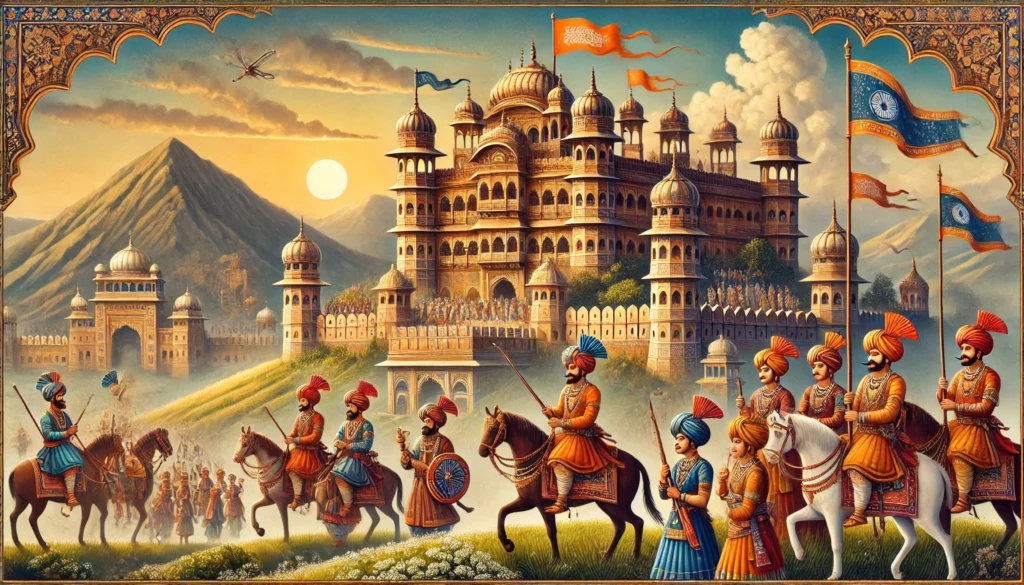
The Rajput period is an important era of Indian history, which is seen as a bridge between ancient and medieval India. This period extended from approximately the 7th to the 12th century. During this time, Rajput rulers controlled a large part of the Indian subcontinent and left a deep mark through their social, cultural, and military contributions. Let us understand this glorious era in detail.
1. Emergence of the Rajput Era
The word Rajput comes from “Rajputra”, which means “son of a king”. Rajputs emerged as a powerful group around the 7th century CE. Their origin is debated, but historians and traditions usually connect them to four major sources.
1.1 Main Traditions of Rajput Origin
Suryavanshi
Considered descendants of Lord Rama and linked to the solar lineage.
Chandravanshi
Associated with the lunar lineage, believed to be born from the Moon.
Agnivanshi
According to mythology, some Rajput clans were created from a sacred fire pit (Agnikund) to protect India.
Kshatriya Descendants
Many Rajput clans are viewed as successors of ancient Kshatriya lineages and warrior families.
2. Major Rajput Clans
Several significant Rajput dynasties emerged during the Rajput period. Through their administrative and military strength, they brought regional stability and cultural prosperity.
2.1 Important Rajput Dynasties
Pratihara Dynasty (Gurjara-Pratihara)
This dynasty established its power in northern India and played an important role in stopping the early Arab invaders in western India.
Chauhan Dynasty
The Chauhans ruled over regions like Ajmer and Delhi. Prithviraj Chauhan was the most famous ruler of this dynasty.
Chalukya / Solanki Dynasty
This dynasty ruled mainly in Gujarat and parts of Rajasthan, contributing to trade and temple architecture.
Parmar Dynasty
A major dynasty that ruled the Malwa region and promoted art, literature, and learning.
Rathore Dynasty
The Rathores ruled over Marwar (Jodhpur) and are known for their brave resistance and desert forts.
Sisodia Dynasty
Rulers of Mewar, with Maharana Pratap as the most famous king, remembered for his resistance against the Mughals.
4. Military Power
The military strength of the Rajputs was their identity. These warriors were known for their bravery, courage, and battlefield strategies.
4.1 Main Features of Rajput Military Power
Cavalry and Swordsmanship
Rajput warriors were skilled in horse-riding, archery, and swordsmanship. Their personal valour in open battles became legendary.
System of Forts
They established a strong network of forts in hills, deserts, and plains to protect their kingdoms and control trade routes.
Fight for Freedom and Honour
Rajputs often fought not only for territory but also to defend freedom, self-respect, and honour. This gave their battles a heroic and emotional dimension.
5. Major Conflicts of the Rajput Period
5.1 Arab Invasion
The Pratihara dynasty played an important role in stopping the Arab invaders in western India. Their resistance delayed the spread of Arab political power deep into the Indian subcontinent.
5.2 Turk Invasion
In the 12th century, Turkic invasions under leaders like Muhammad Ghori became a major challenge. The Battle of Tarain (1191–1192 CE) between Prithviraj Chauhan and Muhammad Ghori was one of the most significant conflicts of this period. These battles ultimately paved the way for the establishment of Turkish rule in North India.
6. Reasons for the Fall of Rajput Power
The decline of Rajput political dominance did not happen overnight. It was the result of several internal and external factors.
6.1 Internal Conflict
Continuous warfare among various Rajput clans weakened their unity. Instead of forming a single strong empire, many kingdoms competed with each other for power and prestige.
6.2 Invading Forces
The invasions of the Turks, Khiljis, and later the Mughal rulers gradually ended the political power of many Rajput states, although some continued to resist and retain semi-independent status.
6.3 Outdated War Strategies
Many Rajput rulers remained attached to traditional methods of warfare, personal heroism, and open-field battles. The invaders, on the other hand, used more organised armies, advanced technology, and better coordination, which gave them an advantage.
7. Heritage of the Rajput Period
- Architectural Legacy: Rajput forts, palaces, and temples are still an integral part of Indian culture and tourism.
- Stories of Bravery: Their stories of courage and sacrifice are immortalised in Indian folklore, ballads, and historical literature.
- Defence of Civilization: Rajputs played an important role in defending Indian society and culture during periods of foreign invasions.
The Rajput period is therefore remembered as a glorious chapter in Indian history. It enriched Indian culture and society, and left behind values of bravery, honour, self-respect, and cultural pride that continue to shape India’s identity.
8. Emergence of the Rajput Era: A Detailed Perspective
The emergence of the Rajput period is an important phase of Indian history, which took place approximately between the 7th and 12th centuries. This era followed the decline of the Gupta Empire and is often considered the beginning of medieval India. There are many historical and mythological narratives about the rise of the Rajputs.
8.1 Rise of Rajputs: Historical Perspective
After the Fall of the Gupta Empire
After the fall of the Gupta Empire in the 6th century, small regional states emerged across India. The struggle for power increased among these states, and in the midst of this competition, the Rajputs rose as powerful rulers. They successfully brought regional stability and organised local tribes into strong kingdoms.
Lineage of Rajputs
Rajputs are often divided into four main clans based on lineage:
- Suryavanshi: Descendants of Lord Rama and the solar dynasty.
- Chandravanshi: Associated with Lord Krishna and Yaduvanshi kings.
- Agnivanshi: Believed to have originated from the Agnikund (sacred fire).
- Nagavanshi: Linked with Naga tribes and snake worship traditions.
Connection with Kshatriya Tradition
Rajputs are considered successors of the ancient Kshatriya clan. Many Rajput families are also believed to be descendants of Guptas, Huns, and other rulers who gradually assimilated into Indian culture and adopted Rajput identities.
8.2 Mythology: Origin from the Fire Pit
According to a popular mythological belief, some Rajput clans originated from a yagya called “Agnikund” at Mount Abu. Sage Vasishtha is said to have created four Rajput clans from the sacred fire to protect India:
- Chauhan
- Parmar
- Pratihar
- Solanki
8.3 Social and Political Organisation of the Rajputs
Kshatriya Dharma and Rajput Identity
The Rajputs associated themselves strongly with the Kshatriya varna. They considered bravery, courage, and warfare skills as part of their religious and social duty.
Organisation of Local Tribes
Rajput rulers consolidated power by organising local tribes and communities. By building forts in hilly regions, the Thar desert, and the plains of central India, they secured their territories and trade routes.

Centralisation of Political Power
Many small states were formed during this period. The rulers of these states strengthened their forts, military structures, and administrative systems, contributing to the spread of Rajput influence.
8.4 Reasons for the Emergence of Rajput Power
Political Vacuum after the Gupta Empire
After the decline of the Gupta Empire, a political vacuum was created in India. To fill this space, many regional powers emerged, among which the Rajputs became particularly prominent.
Hun and Saka Invasions
The influence of foreign groups like the Huns and Shakas gradually reduced. Their remaining descendants assimilated into Indian society and adopted Rajput identities in some regions.
Development of Local Autonomy
As central authority weakened, many local rulers became independent and established their own kingdoms. Several of these rulers identified themselves as Rajput powers.
Influence of Religion and Culture
The Rajputs adopted and preserved Hindu religion and culture. Temple construction, religious rituals, and established social structures helped increase their political influence and public support.
8.5 Geographical Background of Rajput Emergence
Rajput states emerged mainly in regions such as Rajasthan, Gujarat, Madhya Pradesh, Uttar Pradesh, and Haryana. Rajasthan is considered the core centre of Rajput power, from where they expanded their rule to other parts of India.
8.6 Importance of Rajputs in Indian History
The emergence of the Rajputs was not merely a political event. It was a phase that brought stability and prosperity to Indian society and culture. Through their valour, cultural patronage, and architectural achievements, Rajputs made significant contributions to Indian civilisation.
The emergence of the Rajputs is a chapter of Indian history that gave a new direction to medieval India and kept the spirit of bravery and self-respect alive in Indian society.
Conclusion: The Enduring Legacy of the Rajput Era
The Rajput era stands as a powerful symbol of courage, honour, and cultural pride in Indian history. From their heroic battles to their magnificent forts and temples, the Rajputs shaped not only the political landscape of medieval India but also its cultural and moral imagination.
Even today, the stories of Rajput bravery inspire people to value self-respect, duty, and resilience. Their legacy lives on in India’s traditions, festivals, literature, and historical memory, reminding us that courage and culture can outlast even the greatest challenges.
FAQ – Rajput Era and Its Emergence
Q1. What is meant by the Rajput Era in Indian history?
The Rajput Era refers to the period from roughly the 7th to the 12th century CE, when various Rajput dynasties ruled large parts of North and Western India and played a major role in shaping medieval Indian politics, society, and culture.
Q2. How did the Rajputs emerge after the fall of the Gupta Empire?
After the fall of the Gupta Empire, a political vacuum emerged and many small regional powers rose to prominence. Rajput rulers organised local tribes, strengthened forts, and established stable kingdoms, becoming a dominant force in North and Western India.
Q3. What are the main clans of the Rajputs?
Traditionally, Rajputs are associated with four main lineages: Suryavanshi (solar lineage), Chandravanshi (lunar lineage), Agnivanshi (origin from a sacred fire), and Nagavanshi (associated with Naga tribes and snake worship).
Q4. Which Rajput dynasties were the most important?
Some of the most important Rajput dynasties include the Pratihara (Gurjara-Pratihara), Chauhan, Chalukya/Solanki, Parmar, Rathore, and Sisodia dynasties. Each played a major role in regional politics, culture, and defence.
Q5. Why did the Rajput powers decline?
Rajput powers declined due to internal conflicts between clans, repeated invasions by Turks, Khiljis, and Mughals, and the continued use of traditional war strategies against more organised and technologically advanced armies.
Q6. What is the legacy of the Rajput Era in modern India?
The Rajput Era left behind a rich legacy of forts, palaces, temples, heroic literature, and cultural values. It continues to inspire ideals of bravery, honour, and cultural pride in modern India and contributes significantly to tourism, heritage, and national identity.
Major Rajput Clans and Social-Cultural Characteristics of the Rajput Era
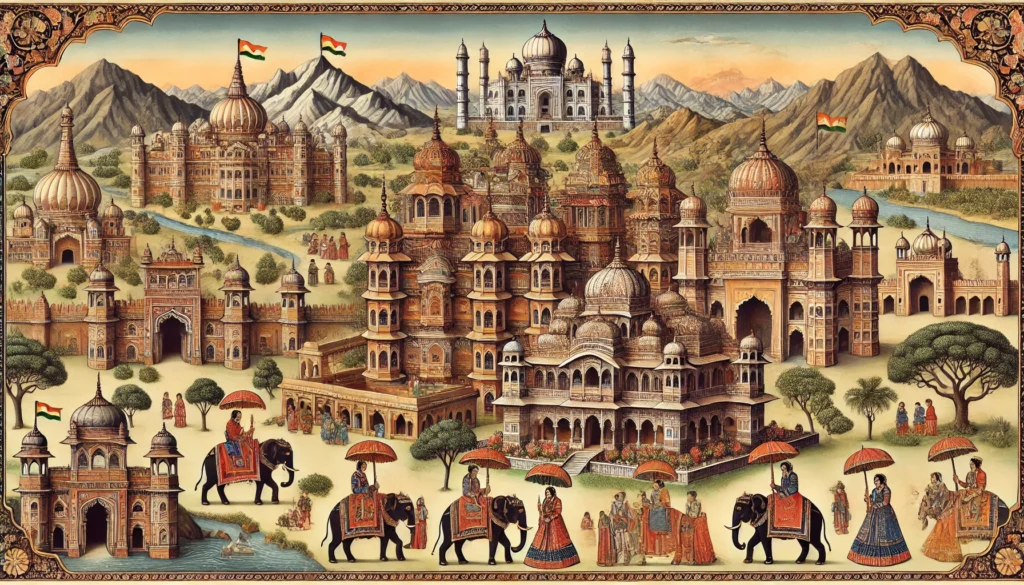
During the Rajput period, several major dynasties emerged that established their influence across different regions of India. These clans were not only centers of political power but also made remarkable contributions to art, culture, literature, and architecture. Below is a detailed overview of the major Rajput dynasties and the social-cultural life of Rajput society.
Major Rajput Clans
1. Gurjara–Pratihara Dynasty (6th – 11th Century)
- Center: Kannauj
- Important Rulers: Nagabhatta I, Nagabhatta II, Mihir Bhoj
- Heritage:
- Played a major role in stopping Arab invasions.
- Participated in the Kannauj Triangular Struggle against Rashtrakutas and Palas.
- Patronised Sanskrit literature and architecture.
- Mihir Bhoj is remembered for military and cultural achievements.
2. Chauhan Dynasty (7th – 12th Century)
- Center: Ajmer and Delhi
- Important Ruler: Prithviraj Chauhan
- Heritage:
- Developed Ajmer as a major centre of power.
- Defeated Muhammad Ghori in the First Battle of Tarain (1191 CE).
- Was defeated in the Second Battle of Tarain (1192 CE).
- Gave rise to famous literature such as Prithviraj Raso.
3. Parmar Dynasty (9th – 14th Century)
- Center: Malwa (Dhar, Madhya Pradesh)
- Important Ruler: Raja Bhoj
- Heritage:
- Raja Bhoj promoted education, art, and literature.
- Established Bhojshala and Saraswati Mandir as educational centers.
- Contributed to architecture and water management innovations in Malwa.
4. Solanki (Chalukya) Dynasty (10th – 13th Century)
- Center: Gujarat
- Important Rulers: Bhimdev I, Siddharaj Jaisingh
- Heritage:
- Reconstructed the Somnath Temple.
- Built architectural marvels like Rani ki Vav (Patan).
- Encouraged trade and cultural growth in Gujarat.
5. Sisodia Dynasty (8th Century Onwards)
- Center: Mewar (Chittor and Udaipur)
- Important Rulers: Rana Kumbha, Maharana Pratap
- Heritage:
- Rana Kumbha built Kumbhalgarh Fort.
- Maharana Pratap displayed unmatched valour in the Battle of Haldighati (1576 CE).
- Symbol of independence, pride, and Rajput honour.
6. Rathore Dynasty (13th Century Onwards)
- Center: Marwar (Jodhpur)
- Important Ruler: Rao Jodha
- Heritage:
- Founded the city of Jodhpur.
- Promoted art, culture, and trade in Marwar.

7. Gehlot Dynasty
- Center: Mewar (Earlier name of Sisodia dynasty)
- Heritage:
- Strengthened Rajput traditions and culture.
- Later evolved into the Sisodia dynasty.
8. Kachwaha Dynasty (11th Century Onwards)
- Center: Amer and Jaipur
- Important Ruler: Raja Man Singh I
- Heritage:
- Maintained strong political relations with the Mughals.
- Constructed Amer Fort and Jaigarh Fort.
9. Tomar Dynasty (9th – 12th Century)
- Center: Gwalior and Delhi
- Important Ruler: Anangpal Tomar
- Heritage:
- Founded Delhi and built the Lal Kot Fort.
- Developed architecture and art in Gwalior.
10. Bhati Dynasty
- Center: Jaisalmer
- Important Ruler: Rawal Jaisal
- Heritage:
- Established Jaisalmer Fort.
- Controlled desert trade routes.
General Characteristics of Rajput Clans
- Strategic Strength: Protected borders with strong forts and military strategies.
- Culture and Arts: Patronised temples, architecture, and literature.
- Self-Respect and Independence: Fought constantly to protect honour and freedom.
- Religious Patronage: Promoted Hinduism and temple construction.
Rajput clans remain a glorious part of Indian history. Their bravery, art, and cultural contributions enriched India’s heritage.
Social and Cultural Characteristics of the Rajput Era
The Rajput period was not only politically dynamic but also culturally vibrant. This era witnessed significant evolution in social structure, traditions, architecture, art, and literature. Below are the key social and cultural traits of Rajput society.
Social Characteristics
1. Varna System
- Rajput society followed a strict caste structure.
- Rajputs considered themselves followers of Kshatriya Dharma.
- Social mobility was limited due to rigidity in caste rules.
2. Status of Women
- Women were respected and honoured in society.
- Jauhar and Sati traditions were practised during wars and crises.
- The purdah system was common.
- Some queens participated in politics and warfare, such as Rani Padmini and Rani Karnavati.
3. Marriage Customs
- Marriage held high importance socially and politically.
- Polygamy existed among the royals; common people followed monogamy.
- Marriages were often arranged to secure political alliances.
4. Caste and Sub-Castes
- Rajputs had various sub-clans like Chauhan, Sisodia, Rathore, Parmar, etc.
- Each clan maintained its own customs, traditions, and identity.
5. Society of Valour and Bravery
- Warrior training, horse riding, and weapon skills were compulsory.
- Heroic songs and poetry celebrated bravery and sacrifice.
Cultural Characteristics
1. Religion and Religious Tolerance
- Rajputs were staunch followers of Hinduism.
- Promoted Shaivism and Vaishnavism.
- Jainism also received royal patronage.
- Built numerous temples across their kingdoms.
2. Art and Architecture
- Built magnificent forts, palaces, and temples.
- Famous forts: Chittorgarh, Kumbhalgarh, Amer Fort.
- Architectural masterpieces: Dilwara Jain Temple, Rani ki Vav.
- Murals, carvings, and intricate designs were common.
3. Literature and Language
- Developed Sanskrit, Prakrit, Rajasthani, and Braj literature.
- Epic works like Prithviraj Raso highlighted Rajput valour.
- Bhakti movement literature flourished.
4. Music and Dance
- Music and dance thrived in royal courts.
- Folk forms like Ghoomar and Ger became popular.
5. Festivals and Celebrations
- Dussehra, Holi, and Diwali were celebrated with grandeur.
- Festivals celebrating bravery were also common.
6. Outfits and Jewellery
- Men wore angarkhas, turbans, and waistbands.
- Women wore ghaghra, odhani, and traditional jewellery.
- Kundan and Meenakari jewellery flourished.
Characteristics of Rajput Society & Culture
- Bravery and Self-Respect: Warfare and valour were supreme values.
- Religion and Traditions: Deep adherence to rituals and Hindu culture.
- Patronage of Art and Culture: Encouraged literature, music, and architecture.
- Strong Social Organisation: Based on caste, clan, and family hierarchy.
The social and cultural characteristics of the Rajput era shaped every aspect of their life and contributed immensely to the richness of Indian civilization.
Rajput Era Military Power and Major Conflicts of the Rajput Period
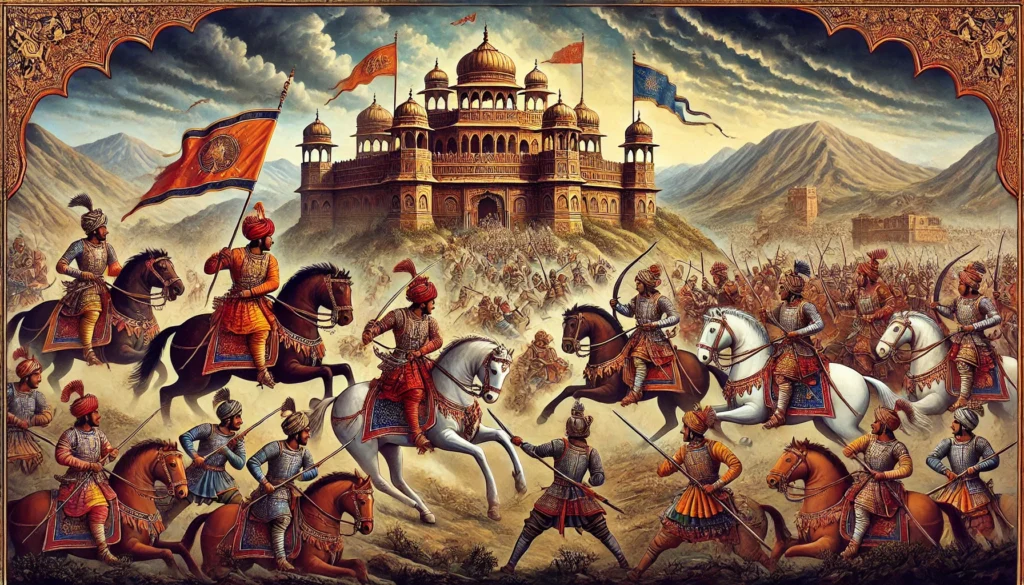
Rajput military power was one of the strongest pillars of their identity. From the 10th century onwards, the Rajputs adopted principles of warfare, valour, discipline, and sacrifice, making their military system organised, effective, and feared. Their strategy, weapons, forts, and ethics of war played a major role in shaping medieval Indian history.
Rajput Era Military Power
1. Military Organization
The Rajput army was divided into four major units:
- Padati (Infantry): The largest segment of the army.
- Cavalry: The strongest and fastest force; Rajput horsemen were renowned for mobility and precision.
- Gaja Sena (Elephant Army): Symbol of strength and intimidation in battle.
- Chariot Army: Though less significant by this period, it was used in certain regions.
2. Forts and Fortifications
The Rajputs constructed grand, strategic, and naturally protected forts across India.
- Famous Forts: Chittorgarh, Kumbhalgarh, Amer, Jalore, Jaisalmer.
- Built on hills, deserts, cliffs, and riverbanks for natural defence.
- Forts were not just military bases but symbols of culture, architecture, and royal authority.
3. War Skills and Strategies
- Open Battlefield: Rajputs were renowned for direct, face-to-face combat with unmatched bravery.
- Siege Warfare: Surrounded enemy forts and cut off supplies.
- Guerrilla Warfare: Rarely used, but adopted in mountainous or forest regions.
- Skilled use of horses and war elephants.
4. Weapons and Armour
- Weapons:
- Rajput swords (the identity of a warrior)
- Spears, maces
- Bow and arrow
- Daggers, shields
- Armour: Iron and leather armour used for battlefield protection.
5. Ethics and Morality in War
- War was considered a sacred duty.
- Rajputs prioritised honour, bravery, and fairness.
- Practices like Jauhar (women's self-immolation) and Shaka (men's final suicidal charge) symbolised extreme sacrifice.
6. Horse Riding and Horses
- Horse riding was a primary skill for every Rajput warrior.
- Famous breeds like the Marwari horses were known for loyalty, strength, and speed.
- Horses provided mobility, quick attacks, and battlefield advantage.
7. Strategic Alliances
- Rajputana was divided into several states but united during foreign invasions.
- Matrimonial alliances were formed to ensure political stability.
- Several Rajput rulers forged strategic military relations with the Mughals.
8. Major Displays of Rajput Military Strength
- Battle of Tarain (1191): Prithviraj Chauhan defeated Muhammad Ghori.
- Battle of Tarain (1192): Ghori returned and defeated Prithviraj Chauhan.
- Battle of Haldighati (1576): Maharana Pratap fought heroically against the Mughal Empire.
- Battle of Khanwa (1527): Rana Sanga fought with great valour against Babur.
9. Decline of Rajput Military Power
- Internal Conflicts: Rivalries among Rajput states weakened unity.
- Arrival of Turks & Mughals: Superior technologies, cannons, and firearms.
- Traditional Warfare: Rajputs relied on old techniques while invaders used gunpowder weapons.
10. Importance of Rajput Military Strength
- A symbol of bravery, sacrifice, and dignity.
- Contributed significantly to Indian military and architectural traditions.
- Inspired generations with values of courage and honour.
Major Conflicts of the Rajput Period
The Rajput period witnessed several major conflicts that shaped Indian history. These battles highlight Rajput determination, self-respect, and their commitment to independence.
1. Struggle Against Arab Invasion (8th Century)
- Major Ruler: Nagabhatta I (Gurjara–Pratihara)
- Description: Arabs attempted expansion after conquering Sindh. Nagabhatta I successfully halted their advance and secured western India.
2. Kannauj Triangular Struggle (8th – 10th Century)
- Dynasties: Gurjara–Pratiharas, Palas, Rashtrakutas
- Description: A long struggle for control over Kannauj. Finally, the Pratiharas succeeded in establishing dominance.
3. Invasion of Mahmud of Ghazni (11th Century)
- Major Rajput Rulers: Kings of Gwalior, Kalinjar
- Mahmud attacked Somnath and other regions; local Rajput rulers resisted but Ghazni succeeded due to rapid, repeated invasions.
4. Battles of Tarain (1191 & 1192)
- Dynasty: Chauhan
- Ruler: Prithviraj Chauhan
- 1191: Prithviraj defeated Muhammad Ghori.
- 1192: Ghori returned and captured Delhi after defeating Prithviraj.
5. Battle of Khanwa (1527)
- Dynasty: Sisodia
- Major Ruler: Rana Sanga
- Description: Rana Sanga led a large Rajput coalition against Babur, but was defeated due to Babur’s artillery and new war techniques.
6. Battle of Haldighati (1576)
- Dynasty: Sisodia
- Ruler: Maharana Pratap
- Description: Maharana Pratap fought bravely against the Mughal army. Though he retreated, he continued resistance using guerrilla warfare.
7. Rajput–Maratha Conflicts (18th Century)
- Major States: Jaipur, Jodhpur, Udaipur
- Description: Marathas intervened in Rajput territories; the Rajputs fought to preserve independence but internal disunity was evident.
8. British–Rajput Conflicts (19th Century)
- Description: British East India Company aimed to dominate Rajput states. Many states eventually signed subsidiary treaties to retain cultural autonomy.
Main Causes of These Conflicts
- Protection of independence and honour.
- Territorial disputes among Rajput states.
- Foreign invasions by Turks, Afghans, Mughals, and later British.
- Preservation of cultural and religious identity.
Significance of Rajput Conflicts
- Symbol of bravery, sacrifice, and unwavering self-respect.
- Enriched India’s military and architectural heritage.
- Demonstrated resilience despite lack of unity and external challenges.
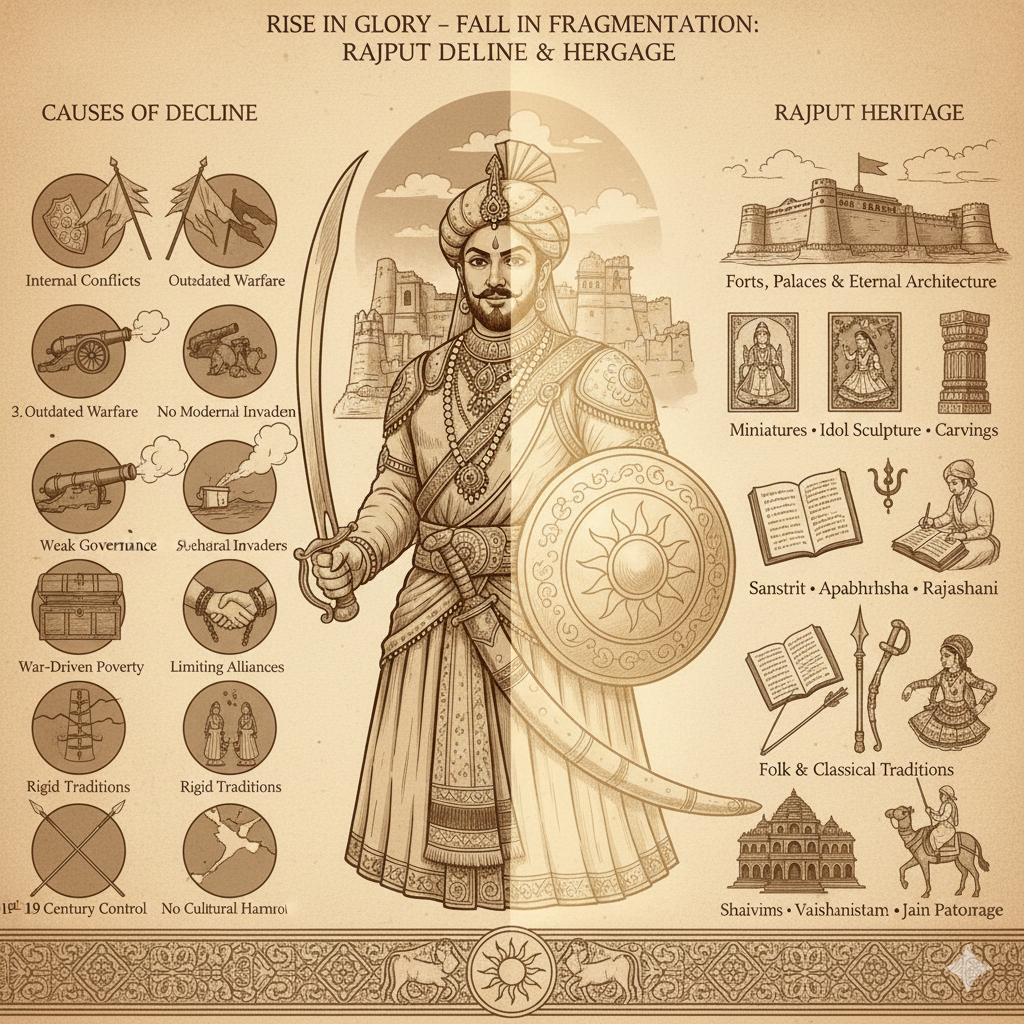
Causes of the Collapse and Heritage of the Rajput Era
The decline of the Rajput era was a complex process influenced by internal weaknesses, external invasions, economic challenges, and social rigidities. Despite their bravery, valour, and cultural achievements, certain structural limitations contributed to the weakening of Rajput power. At the same time, the Rajput era left behind an immense heritage that continues to inspire Indian culture.
Causes of the Collapse of the Rajput Era
1. Internal Strife and Lack of Unity
- Rajput states often engaged in mutual conflict and rivalry.
- Lack of unity among major clans such as Chauhans, Parmars, and Sisodias weakened collective strength.
- The constant struggle for power, prestige, and regional dominance diluted their ability to resist foreign invasions.
2. Strategic and Military Weakness
- Rajputs continued using traditional weapons like swords and spears.
- Foreign invaders used advanced technologies such as cannons, artillery, and gunpowder.
- Heavy reliance on forts proved ineffective during long sieges.
3. Ignoring Modern Warfare Techniques
- Rajputs did not adapt to new warfare tactics involving gunpowder and firearms.
- Their emphasis on open battle and individual heroism proved ineffective.
- Organised armies with coordinated formations and artillery outmatched them.
4. Pressure from Foreign Invaders
- Arabs, Turks, Ghazni, and Ghori launched repeated invasions.
- Rajputs were left divided and individually confronted strong forces like the Delhi Sultanate and the Mughals.
- Key defeats in the Battles of Tarain (1192) and Khanwa (1527) weakened Rajput influence severely.
5. Political and Administrative Weaknesses
- Rajput states remained decentralised and fragmented.
- Lack of central authority limited administrative efficiency.
- Little innovation in governance or administrative systems.
6. Limitations of Matrimonial and Political Alliances
- Marriages with the Mughals and other powers often weakened political independence.
- Many Rajput rulers allied with Akbar, reducing collective resistance.
- Such alliances provided short-term stability but long-term dependency.
7. Economic Weaknesses
- Prolonged wars drained financial resources.
- Forts required heavy expenditure for defence and maintenance.
- Limited focus on agriculture and trade weakened economic foundations.
8. Social and Cultural Rigidity
- Rigid caste system hindered social flexibility and progress.
- Practices like Jauhar and Sati reflected extreme social responses to crises.
- Lack of openness to reform slowed societal development.
9. Religious Intolerance and Cultural Rigidity
- Strong adherence to orthodox traditions prevented broader societal integration.
- Failure to build alliances across religious groups sometimes weakened internal unity.
- Foreign invaders used religious divisions to their advantage.
10. Maratha and British Intervention
- Marathas exerted pressure on Rajput states during the 18th century.
- British East India Company gradually subdued Rajput kingdoms.
- Subsidiary Alliances ended political autonomy of Rajput states.
Effects of the Decline
- Loss of Independence: Rajput states came under foreign rule.
- Preservation of Culture: Despite political decline, Rajputs preserved architecture, art, and tradition.
- Social Transition: Rajput society adapted slowly to changing political realities.
The collapse of the Rajput era was shaped by a combination of internal tensions, external invasions, and socio-economic limitations. Yet their cultural legacy remains immortal in Indian history.
Heritage of the Rajput Era
The Rajput era stands as a symbol of valour, honour, and aesthetic grandeur. Their heritage survives in the form of majestic forts, temples, art, literature, music, and deep-rooted cultural traditions.
1. Architecture
a) Forts
- Built on mountains, deserts, and riverbanks for natural defence.
- Features included reservoirs, tunnels, layered walls, and watchtowers.
- Major Forts:
- Chittorgarh Fort – Largest fort in India.
- Kumbhalgarh Fort – Famous for the “Great Wall of India”.
- Jaisalmer Fort – Golden desert fort.
- Amer Fort – Example of Rajput architecture and art.
b) Palaces
- City Palace (Udaipur): Surrounded by picturesque lakes.
- Hawa Mahal (Jaipur): Known for its iconic latticed windows.
- Mehrangarh Fort Palace (Jodhpur): Majestic hilltop structure.
- Umaid Bhawan Palace: Blend of modern and Rajput design.
c) Temples
- Carved pillars, intricate sculptures, and harmonious designs.
- Major Temples:
- Dilwara Jain Temples – World famous marble carvings.
- Ranakpur Sun Temple – Detailed stone carvings.
- Eklingji Temple – Important Shiva temple in Udaipur.
2. Art and Sculpture
- Stone and metal sculptures depicting gods, kings, and war scenes.
- Artistic carvings in Chittorgarh and Kumbhalgarh forts.
- Jain Tirthankara statues showing fine craftsmanship.
3. Painting
Main painting schools:
- Rajasthan School: Jaipur, Mewar, Marwar styles.
- Pahari Style: Originated in Kangra and Basohli.
- Kishangarh Style: Known for Radha-Krishna themes.
Features include natural scenery, mythological themes, and vibrant colours.
4. Literature and Language
- Sanskrit and Apabhramsha were dominant.
- Development of Rajasthani and Braj languages.
- Important Works:
- Prithviraj Raso – Epic of Rajput courage.
- Religious texts of Jain and Hindu traditions.
- Bhakti movement literature composed by saint-poets.
5. Social Conventions
- Jauhar and Shaka: Acts of extreme sacrifice for honour.
- Hospitality: “Atithi Devo Bhava” was deeply followed.
- Outfits and Jewellery:
- Men: Angrakha, dhoti, turbans.
- Women: Ghaghra, odhani, heavy jewellery.
- Kundan and Meenakari work became renowned.
6. Music and Dance
- Folk dances such as Ghoomar, Kalbelia, and Gauri dance flourished.
- Heroic ballads and devotional songs were widespread.
- Courtly classical music and instruments developed under royal patronage.
7. Military Heritage
- Use of swords, spears, bows, and armour.
- Forts protected by reservoirs, secret routes, and elevated locations.
- Warrior culture influenced festivals, art, and customs.
8. Religion and Traditions
- Rajputs were followers of Shaivism and Vaishnavism.
- Jainism also received strong patronage in several regions.
- Temples and religious art reflect their deep spiritual heritage.
The Rajput heritage remains a vital part of India’s identity. Their forts, temples, traditions, and stories of valour continue to inspire millions and remind the world of India’s rich cultural history.
References
- “A History of Rajasthan” – Rima Hooja
- “The History and Culture of the Indian People” – R.C. Majumdar
- “Medieval India: From Sultanate to the Mughals” – Satish Chandra
- “Rajput Architecture and Heritage” – Government of Rajasthan Publications
- Archaeological Survey of India (ASI) – Reports on Rajput Forts and Temples
- National Museum, New Delhi – Medieval India Collection
- Rajasthan State Archives – Documents on Rajput Dynasties
- Primary inscriptions, temple records, and regional chronicles from Mewar, Marwar, and Amber.
3. Social and Cultural Characteristics
3.1 Society
Kshatriya Dharma
Rajput society followed the ideals of Kshatriya Dharma. War, bravery, honour, and sacrifice were considered the highest values.
Status of Women
Women in Rajput society were respected and honoured. At the same time, practices like the purdah system and jauhar were also prevalent in certain periods and regions.
Caste System
The varna system was important in Rajput society. Social roles and responsibilities were often defined according to caste and lineage.
3.2 Culture
Art and Architecture
Rajput rulers built magnificent forts, palaces, and temples. Forts like Chittaurgarh, Kumbhalgarh, and Amer are powerful examples of the rich architecture of this era.
Literature
Sanskrit and Prakrit literature developed during this time. Famous works like Prithviraj Raso reflect the heroic traditions and values of Rajput culture.
Religion
Rajputs were primarily followers of Hinduism, but Jainism and Buddhism also received royal patronage in various regions.