

Rajput Empire — A Glorious Chapter of Medieval India
The Rajput era (roughly 7th–12th century) stands out in Indian history for its warrior spirit, distinct lineages, remarkable architecture, and enduring cultural legacy. This article presents the history, social structure, and achievements of the Rajput kingdoms in an inspiring and informative narrative.
Emergence of the Rajputs
After the decline of large pan-Indian powers such as the Gupta Empire, regional polities emerged across north and west India. During the 7th to 12th centuries, the Rajputs rose as a dominant warrior class in many of these regions, organizing themselves into clans and establishing independent states.
The Term and Its Meaning
The word “Rajput” derives from the Sanskrit rajaputra, literally meaning “son of a king.” The name reflects royal and Kshatriya roots and became associated with a group of clans celebrated for martial skill, honour, and rulership.
Lineage and Origins
Rajput identity is traditionally linked to three principal lineages. These lineages shaped family identity, social status, and cultural traditions.
Major Lineages
- Suryavansh — Descendants of the Sun. Many clans (for example Kachchhwaha, Sisodia, Gehlot) claim solar descent and trace their mythic ancestry to figures such as Lord Rama.
- Chandravansh — Descendants of the Moon. These lineages are associated with lunar dynasties referred to in epic literature; clans like the Yadavas or Somvanshis are often placed here.
- Agnivansh — Born from fire. According to popular legends, certain clans (including Chauhans, Parmars, Solankis, and Pratiharas) trace mystical origins to an Agnikund near Mount Abu.
Importance of Lineage
Lineage influenced marriage alliances, social status, the choice of family deities (kuldevta), and collective pride. Myths of divine origin reinforced a sense of dignity, honour, and cultural continuity.
Political Structure and Major States
The Rajput political world was largely feudal. Multiple clans ruled independent states; at times they cooperated, and at other times they were rivals. The lack of a single centralized authority was both a feature and a vulnerability.
Notable Rajput Dynasties
- Pratihara (Pratihara Empire) — Ruled large areas of Rajasthan, Gujarat, and parts of central India; noted for resisting early Arab incursions into the subcontinent.
- Chauhan Dynasty — Based in Ajmer and Delhi. Figures like Prithviraj Chauhan are celebrated for their valour and resistance against invaders such as Muhammad Ghori.
- Solanki (Chalukya of Gujarat) — Promoted trade and grand temple architecture (e.g., the Sun Temple of Modhera).
- Parmar Dynasty — Rulers of Malwa, with kings like Raja Bhoj known as patrons of learning, literature, and the arts.
- Sisodia Dynasty (Mewar) — The Sisodias of Mewar, centered at Chittorgarh, became a symbol of bravery and independence.

Top Rated Amazon Product
Premium quality and highly rated product with excellent performance and durability — ideal for everyday use and value for money.
👉 Buy Now on AmazonMilitary Prowess
Rajput warriors were renowned for cavalry skills, archery, fortification expertise, and personal bravery. Although internal conflicts sometimes reduced collective strength, many Rajput battles and feats of courage became part of regional lore.
Art, Architecture, and Cultural Achievements
Rajput art and architecture display grandeur and refined craftsmanship. Forts, palaces, temples, and a rich painting tradition (Rajasthani and Pahari schools) are part of their lasting cultural footprint.
Chittorgarh Fort
One of the most important Rajput forts and a symbol of resistance and courage.
Kumbhalgarh Fort
Famous for its massive defensive wall — often called the "Great Wall of India".
Dilwara Temples
Jain temples near Mount Abu noted for exquisite marble workmanship.
City Palace, Udaipur
An elegant fusion of Rajput and Mughal architectural elements.
Social and Cultural Structure
Social Values and Traditions
Rajput society emphasized honour, loyalty, and martial virtue. Rituals like jauhar and saka (sacrificial acts associated with honour in desperate wartime circumstances) figure prominently in historical narratives about their code of honour and sacrifice.
Religion and Patronage
Most Rajputs followed Hinduism and worshipped deities such as Shiva, Vishnu and Durga. Many Rajput rulers also patronised Jainism and supported Jain temples and institutions.
Festivals, Dress, and Identity
Festivals like Holi, Diwali, and Dussehra were celebrated with splendour. Traditional dress, jewellery, and weapons were important markers of Rajput identity and status.
Challenges and Downfalls
- Internal conflicts: Constant warfare among clans weakened collective resistance.
- Foreign invasions: Campaigns by dynasties such as the Ghorids and later the Delhi Sultanate put immense pressure on Rajput states.
- Lack of centralisation: The feudal and fragmented political structure made it difficult to mount unified defence.
Despite these challenges, Rajputs preserved a distinct identity and cultural legacy that continued to influence the subcontinent for centuries.
Legacy of the Rajput Era
The Rajput period left an indelible mark on Indian history. Their traditions of honour, architectural achievements, regional literature, and stories of valour continue to inspire. The forts, palaces, temples, and paintings of the Rajput kingdoms remain treasured parts of India’s cultural heritage.
Conclusion
The lineage, culture, and spirit of the Rajputs formed a foundation for medieval regional identities in north and west India. Whether through the heroic tales of battle, the patronage of arts and learning, or the monumental architecture they left behind, the Rajputs occupy a unique and respected place in the history of the subcontinent.
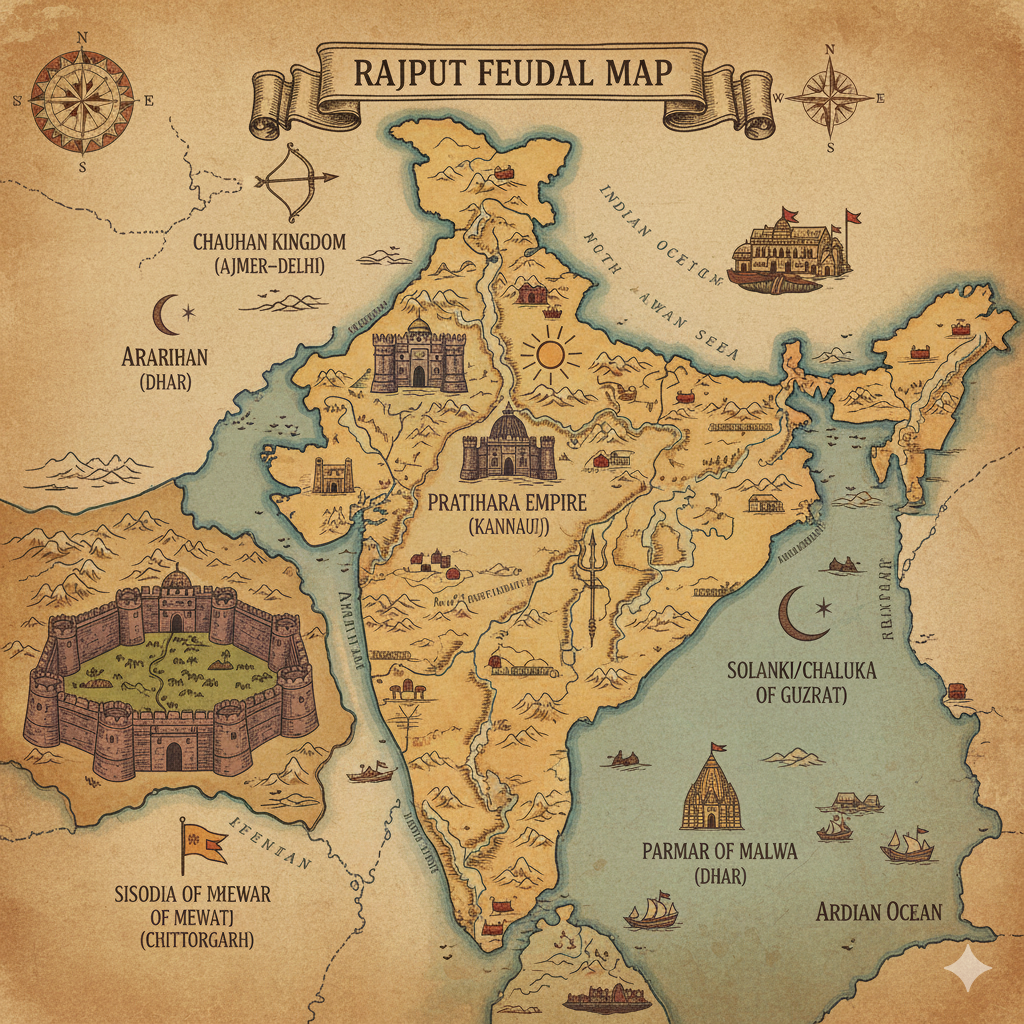
Political Structure and State of Rajputs
The Rajput period (7th to 12th centuries) was a significant era in Indian history marked by the absence of a strong central empire. As a result, several regional powers emerged, and Rajput rulers established their own political systems, forming independent and feudal states across India. Their administrative systems, warfare strategies, and feudal governance greatly shaped Rajput politics.
Characteristics of the Political Structure
1. Feudal System
The political structure of the Rajputs was primarily based on a feudal model:
- Each state had vassals under the king who provided military and revenue support.
- Feudal lords were granted land, known as “Jagir”, based on their service and loyalty.
- These lords ruled their territories independently but were obligated to assist the king during emergencies.
This system showed weak central authority but strengthened local administration.
2. Regional Autonomy
Each Rajput ruler exercised full authority over his territory. These states often maintained friendly or hostile relations with each other. However, lack of unity made them vulnerable to foreign invasions.
3. Succession Policy
- Succession in Rajput states was hereditary.
- The eldest son usually inherited the throne.
- Absence of an heir often led to internal disputes and power struggles.
4. Rule Based on Military Power
Rajput kingdoms relied heavily on military strength:
- States maintained cavalry, infantry, and elephant units.
- Feudal lords supplied troops during wartime.
- Honour and bravery were central to Rajput martial culture.
State Formation and Expansion
1. Pratihara Empire
The Pratihara dynasty ruled large parts of North India between the 8th and 11th centuries, covering Rajasthan, Gujarat, and central India. Their greatest achievement was resisting Arab invasions and safeguarding the Indian subcontinent.
2. Chauhan Dynasty
The Chauhans ruled mainly in Ajmer and Delhi. Their most renowned king, Prithviraj Chauhan, displayed great bravery in the Battles of Tarain. The dynasty played a crucial role in resisting foreign invasions in northern India.
3. Solanki (Chalukya) Dynasty
The Solanki rulers of Gujarat made the region culturally and economically prosperous. Architectural marvels such as the Sun Temple of Modhera were built during their reign.
4. Parmar Dynasty
The Parmars ruled the Malwa region. Their famous ruler, Raja Bhoj, was a patron of education, literature, and the arts. Under the Parmars, Malwa became a major cultural centre.
5. Sisodia Dynasty
The Sisodias ruled Mewar and became symbols of freedom and courage. Their capital, Chittorgarh, stood as a testament to Rajput bravery and sacrifice. The Sisodias consistently fought to maintain their independence.
Administrative System
1. Central Government
- The king was the supreme authority.
- He was expected to rule under the ideal of “Dharamrajya”.
- State decisions were based on scriptures and traditions.
2. Feudal Administration
Feudal lords were responsible for:
- Administering their territories.
- Maintaining law and order.
- Paying taxes and providing military support.

Top Amazon Product
Premium quality product with excellent performance and durability — ideal for everyday use and strong value for money.
👉 Buy Now on Amazon3. Forts and Capitals
Rajput administration revolved around forts and capital cities, which were the centres of governance and security.
- Chittorgarh Fort (Mewar)
- Ajmer Fort (Chauhan Kingdom)
4. Justice System
- The king acted as the supreme judicial authority.
- Disputes were resolved through scriptures and customs.
- A Panchayat system functioned at the village level.
Political Weaknesses
- Internal conflicts: Frequent power struggles and territorial disputes weakened Rajput unity.
- Lack of centralisation: Independent states could not organise a unified defence against invasions.
- Foreign invasions: The decentralised system allowed Ghazni, Ghori, and the Delhi Sultanate to penetrate India easily.
Conclusion
The political structure of the Rajputs, their love for independence, and their feudal governance shaped medieval India in many ways. Although internal conflicts and decentralisation contributed to their downfall, their courage, military skill, and cultural achievements form an immortal chapter in Indian history.
Pratihara Empire
The Pratihara Empire was a major medieval dynasty that ruled North India from the 8th to the 11th centuries. It became a powerful symbol of cultural richness, military strength, and architectural advancement.
Origin and Naming of the Pratihara Dynasty
1. Mythological Background
The Pratiharas are believed to be descendants of the Agnivanshi Rajputs, emerging from the legendary Agnikund ritual at Mount Abu. The name “Pratihara” means “protector.” It is said that their ancestor Laxman, brother of Lord Rama, served as a pratihar (gatekeeper), inspiring the clan name.
2. Historical Background
The dynasty originated in the 7th century. The earliest notable ruler was Nagabhatta I, who laid its foundation.
Expansion of the Pratihara Empire
Nagabhatta I (730–756 CE)
- Organised regions of Gujarat and Rajasthan.
- Defeated Arab invaders and secured western India.
- Extended control over Malwa, Rajasthan, and Gujarat.
Vatsaraja (775–800 CE)
- Strengthened the empire after Nagabhatta I.
- Engaged in the triangular conflict with the Palas and Rashtrakutas.
Mihir Bhoja (836–885 CE)
The Pratihara Empire reached its peak under Mihir Bhoja:
- Expanded influence across North, West, and Central India.
- Known by the title “Adivarah”.
- Defeated Arab forces and preserved Indian territories.
Mahendrapala I (885–910 CE)
- Continued the empire’s expansion.
- Promoted art, literature, and education.
- Maintained dominance despite conflicts with Palas and Rashtrakutas.
Political Structure of the Empire
1. Capital
- The first capital was Avantika (Ujjain).
- Later, the capital shifted to Kannauj, one of the most important political centres of medieval India.
2. Feudal Governance
The empire followed a feudal administrative structure:
- Local lords ruled various regions.
- They provided taxes and military service to the king.
3. Military Power
- The army relied heavily on cavalry and elephants.
- Successfully resisted Arab invasions.
Cultural Achievements
1. Architecture and Art
The Pratiharas contributed greatly to temple architecture. Notable examples include temples at Osian and Khajuraho.
2. Religion and Literature
The dynasty supported Hinduism, especially Vaishnavism. Rulers like Mihir Bhoja encouraged Sanskrit literature.
3. Education and Knowledge
Several scholars flourished under Pratihara patronage, and educational institutions prospered.
Decline of the Pratihara Empire
1. External Attacks
Turkish invasions, including those by Mahmud Ghazni, severely weakened the empire.
2. Internal Problems
Feudal disputes and succession conflicts weakened central authority.
3. Final Collapse
By the 11th century, the empire fragmented into smaller states.
Historical Importance of the Pratiharas
- Resisting Arab invasions: Saved India from early Islamic expansion.
- Kannauj conflict: Demonstrated strong influence in medieval politics.
- Cultural patronage: Supported art, architecture, and literature.
Conclusion
The Pratihara Empire remains a glorious and influential chapter in Indian history. Their military strength, cultural patronage, and architectural legacy continue to inspire generations.

Chauhan Dynasty
The Chauhan Dynasty, also known as the Chahamana Dynasty, was one of the major Rajput clans of India. They ruled over Rajasthan, Delhi, and parts of western India. The rulers of this dynasty were renowned for their valour, military strength, and cultural patronage. The period from the 7th to the 12th century marked the rise of the Chauhans as symbols of independence and national pride.
Origin and Establishment of the Chauhan Dynasty
1. Beginning of the Dynasty
- The Chauhan dynasty is linked to the Agnikund legend, making them part of the Agnivanshi Rajputs.
- The early Chauhan rulers governed the region of Sapadalaksha (modern Nagaur and surrounding areas in Rajasthan).
2. Initial Capital
The initial capital of the Chauhans was Ajmer, which they developed into a major cultural and administrative centre. Architectural structures such as the Taragarh Fort were built during their rule.
3. Meaning of the Name
The word “Chauhan” is said to mean “four-times-born,” reflecting beliefs in divine origin and rebirth.
Important Rulers of the Chauhan Dynasty
1. Ajayraj Chauhan
- Founded the city of Ajmer.
- Built the Ajaymeru (Taragarh) Fort.
- Made the region a prosperous and powerful state.
2. Vigraharaja IV
- A great patron of literature, learning, and arts.
- Promoted Sanskrit education and commissioned literary works such as Harikeli Nataka.
- Established a major centre of learning in Ajmer.
3. Prithviraj Chauhan
The most famous ruler of the Chauhan dynasty, Prithviraj Chauhan governed Ajmer and Delhi in the 12th century.
First Battle of Tarain (1191 CE)
Prithviraj Chauhan defeated Muhammad Ghori, achieving a historic victory.
Second Battle of Tarain (1192 CE)
Prithviraj Chauhan was defeated by Muhammad Ghori, leading to the rise of Turkish power in North India.
His defeat paved the way for the establishment of Muslim rule in Delhi.
Political Structure and Governance
1. Central Government
The Chauhan administration was centralized, with the king as the supreme authority.
2. Feudal System
- Feudal lords guarded the borders and assisted in governance.
- They provided military forces and taxes to the king.
3. Military Strength
- Strong cavalry, infantry, and elephant units.
- Construction of forts strengthened military security.
4. Justice System
- Based on religious scriptures and Rajput traditions.
- Village-level disputes were resolved by Panchayats or the king.
Cultural and Religious Contributions
1. Architecture
The Chauhans contributed significantly to temple and fort architecture in Ajmer, Delhi, and neighbouring regions.
- Taragarh Fort
- Temples and early Rajput structures in Ajmer
2. Religion
The Chauhan rulers mainly followed Hinduism and patronised Vaishnavism, Shaivism, and Jainism. Numerous Jain temples were built in and around Ajmer.
3. Patronage of Literature
Scholars and poets flourished under rulers like Vigraharaja IV.
Fall of the Chauhan Dynasty
1. Battles of Tarain
The Second Battle of Tarain (1192 CE) was the major turning point that led to the fall of the Chauhans.
2. Turkish Influence
Following Ghori’s victory, the Turks gained control of Delhi, diminishing Chauhan authority.
3. Internal Conflicts
Feudal rebellions and internal disputes weakened the dynasty.
Importance of the Chauhan Dynasty
- Symbol of Valour: They stood bravely against foreign invasion.
- Pride of Rajasthan: Strengthened cultural and military heritage.
- Contribution to Indian History: Protected Indian civilization and fought for independence.
Conclusion
The Chauhan dynasty remains a celebrated chapter of Indian history. Their contributions to governance, culture, religion, and literature shaped the medieval landscape. The bravery of kings like Prithviraj Chauhan continues to inspire generations.
Featured Amazon Product
Premium quality and reliable performance with strong customer satisfaction — perfect choice for everyday use and value for money.
👉 Buy Now on AmazonSolanki Dynasty
The Solanki Dynasty, also known as the Chalukya Dynasty of Gujarat, was one of the major Rajput clans that ruled western India from the 10th to the 13th centuries. They were known for administrative excellence, architectural brilliance, and religious patronage.
Origin and History of the Solanki Dynasty
1. Origin
- The Solankis were a branch of the Chalukya dynasty.
- They belonged to the Agnivanshi lineage of Rajputs.
- Their rule began in the 10th century with Gujarat as the main centre.
2. Initial Capital
Their capital was Anahilwara (modern Patan), which became an important political and cultural hub.
3. Naming
The name “Solanki” was commonly used in Gujarat, though historical texts identify them as Chalukyas.
Important Solanki Rulers and Their Contributions
1. Mularaja I (960–995 CE)
- Founder of the Solanki Dynasty.
- Established rule over Gujarat.
- Strengthened Anahilwara as the kingdom’s capital.
2. Bhimdev I (1022–1064 CE)
- Reconstructed the Somnath Temple.
- Faced Mahmud of Ghazni’s invasion in 1025 CE.
- Expanded Gujarat’s power and prosperity.
3. Siddharaja Jaisingh (1094–1143 CE)
One of the most influential Solanki kings.
- Developed Anahilwara into a major cultural centre.
- Constructed several architectural monuments.
- Built Rudra Mahalaya at Siddhpur.
4. Kumarapala (1143–1173 CE)
- His reign is considered the golden age of the Solanki Empire.
- A devout follower of Jainism who promoted non-violence.
- Encouraged innovative architecture and temple construction.
5. Ajaypal (1173–1176 CE)
The reign of Ajaypal saw the beginning of the dynasty’s decline due to invasions and internal issues.
Political Structure and Governance
1. Central Government
The Solanki government was centralized. The king held supreme authority.
2. Feudal System
- Local lords managed territories under the king.
- They provided taxes and military support.
3. Military Strength
- Consisted of infantry, cavalry, and elephant units.
- Forts were built to defend the kingdom.
Cultural Achievements of the Solanki Dynasty
1. Architecture
The Solankis gave Gujarat some of its finest architectural masterpieces.
- Rani ki Vav (Patan): A UNESCO World Heritage site and an extraordinary stepwell.
- Rudra Mahalaya (Siddhpur): A blend of water conservation and temple architecture.
2. Religious Patronage
The Solankis supported both Hinduism and Jainism. They built and preserved major temples including the Somnath Temple.
3. Literature and Education
- Growth of Sanskrit and Prakrit literature.
- Jain scriptures flourished under their rule.
Fall of the Solanki Dynasty
1. External Invasions
During the 13th century, the Delhi Sultanate and Turkic rulers invaded Gujarat, weakening Solanki authority.
2. Internal Conflicts
Clan disputes and feudal rebellions contributed to the decline.
3. Final Decline
The Solanki dynasty ended in the 13th century when it was replaced by the Vaghela dynasty.
Importance of the Solanki Dynasty
- Architectural Development: They elevated Indian temple architecture to new heights.
- Religious and Cultural Patronage: Supported Hinduism, Jainism, and classical learning.
- Administrative Strength: Established Gujarat as a powerful and prosperous state.
Conclusion
The Solanki dynasty played a crucial role in shaping Gujarat’s political, cultural, and architectural identity. Their temples, stepwells, and scholarly traditions stand as lasting symbols of their glory.
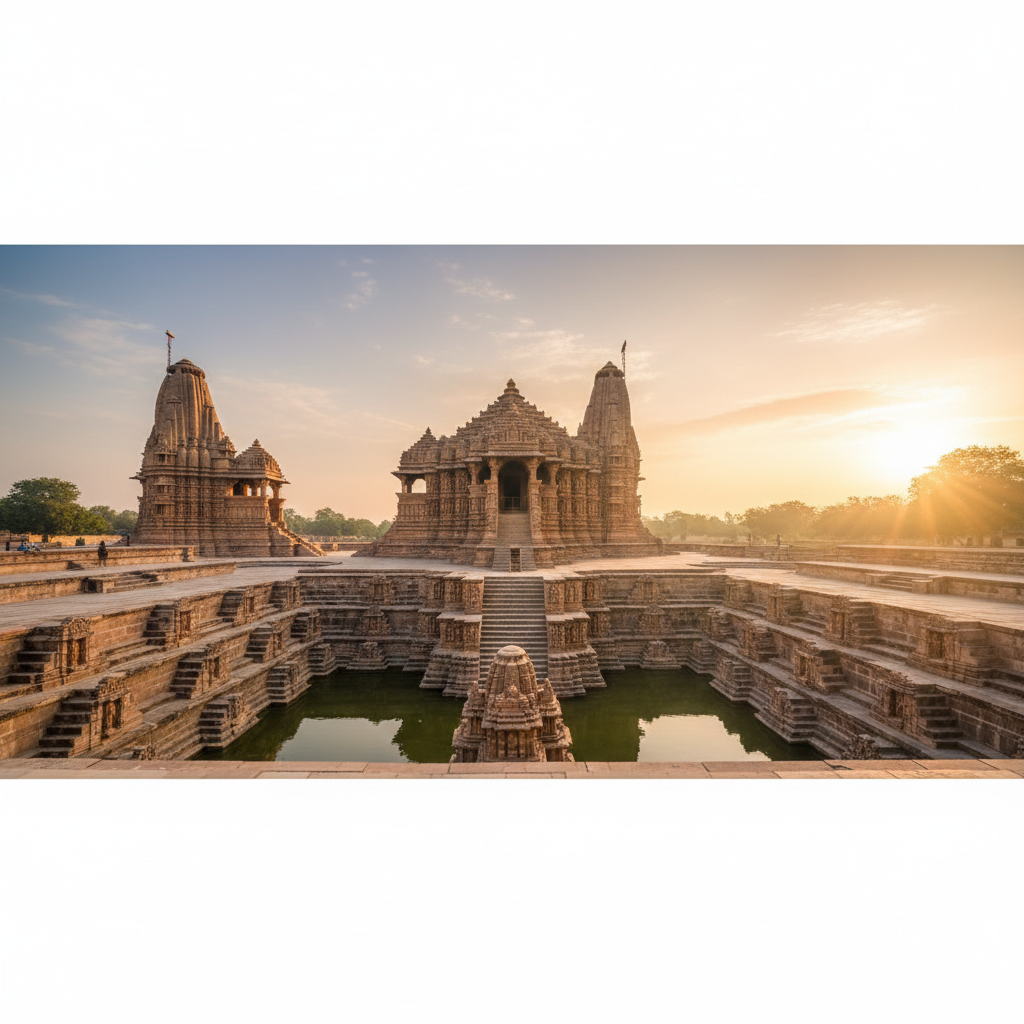
Sun Temple of Modhera
The Sun Temple of Modhera, located in the Mehsana district of Gujarat, is a remarkable example of ancient Indian temple architecture. Dedicated to Lord Surya Narayana, it was built in the 11th century by King Bhimdev I (1026 CE) of the Solanki Dynasty.
History of the Temple
1. Period of Construction
- The temple reflects the architectural brilliance and religious devotion of the Solanki rulers.
- The Solanki kings were devoted followers of sun worship, which played a major role in their cultural identity.
2. Invasion of Mahmud Ghazni
- Mahmud of Ghazni invaded Gujarat in 1025 CE and damaged several temples, including Modhera and Somnath.
- Despite destruction, the grandeur and craftsmanship of Modhera’s Sun Temple still stand strong.
Architecture and Structure
The temple complex is divided into three primary sections:
1. Garbhagriha (Sanctum)
- The sanctum once housed the idol of Lord Surya.
- The architecture is designed so that the first rays of the rising sun directly illuminate the deity.
- The walls and pillars feature intricate carvings of gods, apsaras, and scenes from everyday life.
2. Sabha Mandap (Assembly Hall)
- A grand pillared hall used for cultural and religious gatherings.
- It has 52 beautifully carved pillars, symbolizing the 52 weeks of the year.
- The pillars showcase mythological stories and artistic carvings.
3. Surya Kund (Ram Kund)
- A large stepwell located in front of the temple, known as Surya Kund or Ram Kund.
- There are 108 small shrines constructed around the kund.
- The structure represents a perfect blend of water management and sacred architecture.
Key Features of the Temple
1. Astronomical Precision
The temple is engineered so that sunlight illuminates the sanctum at specific times of the year, showing the advanced astronomical knowledge of ancient architects.
2. Architectural Mastery
The temple features exquisite carvings depicting mythology, nature, dancers, gods, and human life. The figures appear almost lifelike due to fine detailing.
3. Cultural and Educational Centre
In ancient times, the temple was also a hub of cultural, musical, and educational activities.
Religious Significance
- Dedicated to Lord Surya, the deity of energy, vitality, and prosperity.
- Rituals and sun worship were performed regularly in ancient times.
- Although worship is no longer performed now, the temple is preserved as a protected monument.
Current Importance
1. World Heritage Significance
- The temple is maintained by the Archaeological Survey of India (ASI).
- It holds importance along with other Sun Temples like Konark (Odisha) and Martand (Jammu & Kashmir).
2. Tourism
The temple attracts thousands of visitors every year due to its artistic beauty and historical depth.
3. Modhera Dance Festival
The famous Modhera Dance Festival is held annually in January, showcasing the cultural heritage of the region.
Top Amazon Product
Premium quality product with reliable performance and strong customer reviews — great for everyday use and excellent value for money.
👉 Buy Now on AmazonConclusion
The Sun Temple of Modhera stands as a remarkable blend of architecture, culture, astronomy, and devotion. It showcases the artistic excellence of the Solanki dynasty and the scientific advancement of ancient India. Despite invasions and the passage of time, the temple continues to inspire awe and preserve India’s glorious heritage.
Parmar Dynasty
The Parmar Dynasty, also known as the Panwar Dynasty, was an ancient Rajput clan that ruled parts of Malwa, central India, and western India from the 9th to the 14th centuries. The rulers of this dynasty are remembered for their immense contribution to culture, literature, and architecture.
Origin of the Parmar Dynasty
1. Agnikund Tradition
- The Parmars are associated with the Agnikund tradition of Mount Abu.
- They are considered one of the four major Agnivanshi Rajput clans (Chauhan, Solanki, Parmar, Pratihara).
- The word “Parmar” means “defeater of enemies.”
2. Historical Background
- The dynasty emerged in the 9th century in the Malwa region.
- The Parmar influence expanded into Central India, Gujarat, and Rajasthan.
Major Rulers of the Parmar Dynasty
1. Upendra (Vikramarka) Parmar
- The founder of the Parmar dynasty.
- Captured and established rule over Malwa.
2. Munjraj (King Munja)
- A celebrated scholar and warrior king.
- Patron of literature, art, and learning.
- Known as “Kavi Raja” for his scholarly skills.
3. Bhojraj (Raja Bhoj)
- The most famous and influential Parmar ruler.
- Founded the city Bhojpal, known today as Bhopal.
- Contributed to education, literature, science, architecture, and water management.
- Constructed monuments such as the Sun Temple, Raja Bhoj’s Sarovar, and structures in Dhar.
- Authored works like Saraswati Kanthabharanam.
4. Parmar Rulers of Ujjain
The Parmaras made Ujjain a cultural and religious centre. The Mahakaleshwar Temple was reconstructed under their patronage.
Political Structure of the Parmar Dynasty
1. Centralized Administration
The king was the supreme authority and managed the kingdom’s governance.
2. Military Organization
- Maintained a strong military for defense and territorial expansion.
- Protected their borders against external invasions.
3. Conflicts with Neighbouring States
The Parmaras frequently engaged in conflicts with the Cholas, Chalukyas, Solankis, and Chauhans. Their struggles with the Solankis of Gujarat were especially significant.
Cultural and Literary Contributions
1. Architecture
- Remarkable temples and forts were built under the Parmaras.
- The Mahakaleshwar Temple (Ujjain), forts of Dhar, and the unfinished Bhojpur Temple are notable examples.
2. Literature and Education
- Raja Bhoj promoted Sanskrit scholarship.
- Invited renowned scholars to his court.
- Fields like astronomy, architecture, and Vedic studies advanced significantly.
3. Patronage of Jainism
The Parmars supported Jainism and built many Jain pilgrimage centres.
Fall of the Parmar Dynasty
1. Internal Conflicts
Power struggles and rivalry among rulers weakened the dynasty.
2. External Invasions
The Parmars faced repeated attacks from Turkic rulers and the Delhi Sultanate. By the 14th century, the Parmar kingdom came under Delhi’s control.
Importance of the Parmar Dynasty
- Cultural Flourishing: Exceptional contributions to Indian art, architecture, and literature.
- Religious Harmony: Promoted both Hinduism and Jainism.
- Architectural Heritage: Their monuments still stand as treasures of Indian history.
Conclusion
The Parmar Dynasty is an illustrious part of Indian history. Their contributions in literature, architecture, and religion created a rich legacy. Rulers like Raja Bhoj elevated the dynasty to great heights, and their heritage continues to inspire pride in India’s cultural past.
Sisodia Dynasty
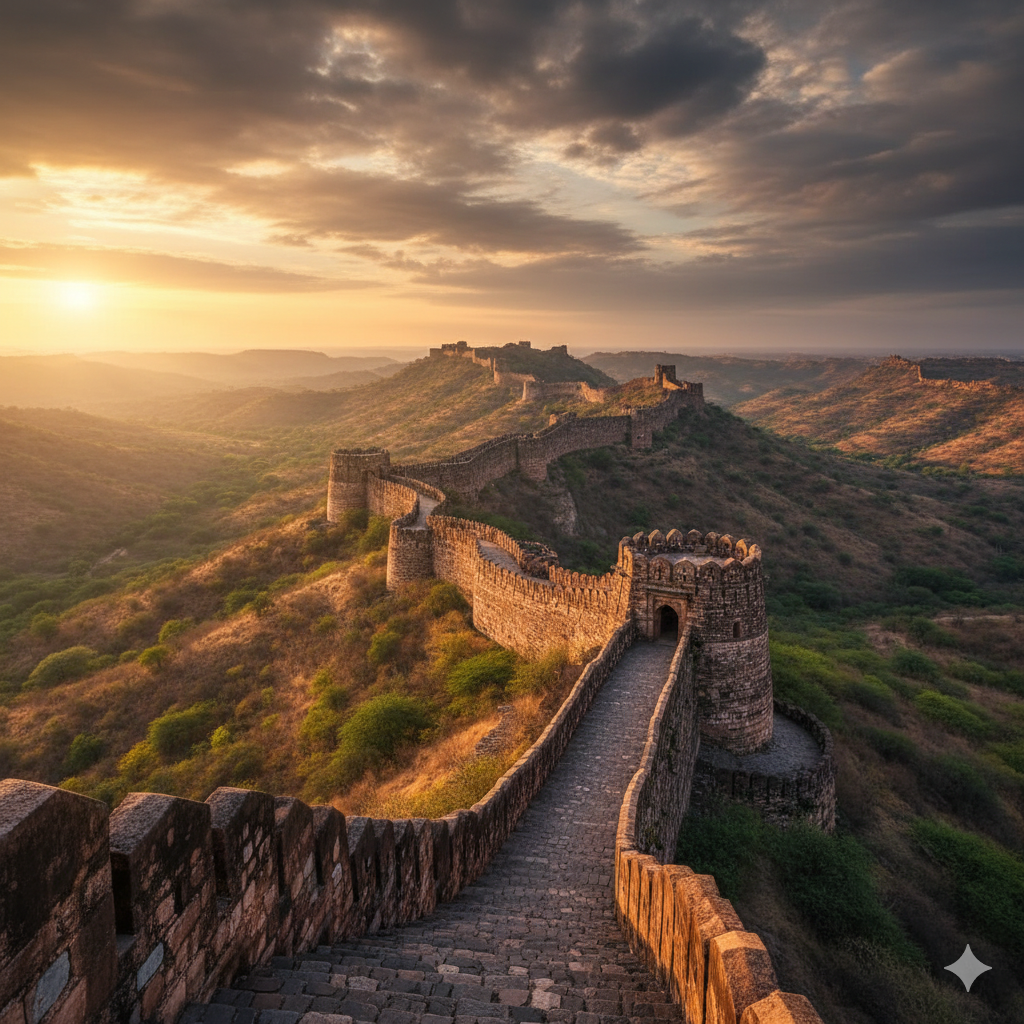
The Sisodia Dynasty is one of the most prominent Rajput dynasties in Indian history. Associated with the kingdom of Mewar, the dynasty is known for its bravery, culture, and unyielding spirit of independence. Rulers like Rana Kumbha and Rana Pratap made the Sisodia lineage an everlasting symbol of valour and patriotism.
Origin and History of the Sisodia Dynasty
1. Origin
- The Sisodias are considered one of the 36 premier Rajput clans of India.
- The dynasty originated from the Guhil (Guhila) Dynasty, the early rulers of Mewar.
- The term “Sisodia” refers to “the achiever,” symbolising the clan’s legacy of success and bravery.
- The rulers governed from Udaipur, which remained the political and cultural heart of Mewar.
2. Major Rulers and Their Contributions
Rana Kumbha (1433–1468)
- A celebrated ruler who fortified Mewar’s defence system.
- Constructed several forts including the magnificent Kumbhalgarh Fort.
- Promoted music, art, and cultural activities in his court.
- Strengthened Rajput identity and heritage through architecture and military power.
Rana Pratap (1540–1597)
- The most renowned Sisodia ruler, known for his unbreakable spirit.
- Refused to submit to Mughal emperor Akbar.
- Fought the famous Battle of Haldighati (1576 CE), symbolising Rajput resistance.
- His loyal horse Chetak became a legend of bravery.
- Dedicated his entire life to preserving the independence of Mewar.
3. Golden Age of the Sisodia Dynasty
After Rana Pratap, the Sisodias continued to strengthen Mewar in art, literature, and religious traditions. The dynasty brought Rajput culture to new heights, influencing architecture, painting, and temple construction.
Political and Military Organisation
1. Centralised Governance
- The administration was centralised under the Rana.
- The ruler held supreme authority in political, judicial, and military affairs.
2. Military Structure
- The Sisodia military was known for its discipline and bravery.
- Included cavalry, infantry, and war elephants.
- Soldiers were trained for independence and loyalty to their state.
3. Conflicts with Neighbouring States
- The Sisodias frequently clashed with the Mughal Empire and regional Rajput states.
- Rana Pratap’s resistance against Akbar made the Sisodia name legendary.
Cultural Heritage of the Sisodia Dynasty
1. Architecture
- Constructed magnificent forts and palaces including:
- Kumbhalgarh Fort — known as the “Great Wall of India.”
- Chittorgarh Fort — a symbol of Rajput pride and sacrifice.
2. Literature and Art
- The court of Rana Kumbha was a centre of learning.
- Music, dance, and poetry flourished.
- Created a strong foundation for Rajput painting and literature.
3. Religious Patronage
- The Sisodia rulers were devout followers of Hinduism.
- Worshipped Shiva, Vishnu, and Krishna.
- Constructed temples in Chittorgarh and Udaipur.
Decline of the Sisodia Dynasty
- The decline began with growing Mughal influence and internal disputes.
- Akbar captured Chittorgarh Fort in 1568 CE.
- After Rana Udai Singh’s death, the dynasty weakened politically.
- Rana Pratap’s efforts kept the spirit of the Sisodias alive, but expansion slowed.
Conclusion
The Sisodia Dynasty remains a shining example of sacrifice, courage, and cultural richness. Rulers like Rana Pratap are celebrated as national heroes. The forts, temples, and traditions they established continue to inspire pride in Indian heritage and Rajput identity.

Top Amazon Product
Premium quality product with excellent performance and customer satisfaction — a reliable choice with great value for the price.
👉 Buy Now on AmazonMilitary Prowess of Rajputs
Military prowess has always been an essential component of Indian history. Among the greatest contributors to Indian warfare were the Rajputs, known for their courage, discipline, and mastery of war strategies. From ancient texts like the Mahabharata to medieval battles, Indian military traditions evolved through skill, diplomacy, and innovation.
History and Development of Military Skills
1. Ancient Indian Warfare
- The Vedas, Upanishads, Mahabharata, and other texts describe advanced warfare techniques.
- Krishna’s guidance to Arjuna represents one of the earliest works on war strategy.
- Indian warriors studied Shastras (rules of warfare) and Tantras (battle methods).
2. Medieval Indian Warfare
- The Rajputs refined warfare strategies, weaponry, and army structure.
- Used cavalry, elephants, infantry, and chariots in battle.
- Their fortifications and defence systems reflected advanced military engineering.
Characteristics of Rajput Military Excellence
1. Strategy and War Tactics
- Rajputs adopted guerrilla warfare techniques.
- Exchanged strategies with other civilisations, improving their methods.
- Focused on bravery, alertness, and diplomacy.
2. Cavalry
- The Rajput cavalry was fast, powerful, and considered the most effective military unit.
- Warriors used high-quality horses for speed and endurance.
- Used weapons like bows, spears, swords, and lances while riding.
3. War Elephants
- War elephants played a crucial role in Rajput armies.
- Used for crushing formations, breaking enemy lines, and defence.
- Elephant-mounted soldiers carried heavy weapons.
4. Forts and Fortifications
- Forts formed the backbone of Rajput defence.
- Built with strong walls, water systems, escape tunnels, and high vantage points.
- Designed to withstand long-lasting sieges.
Military Training and Army Organisation
1. Military Training
- Training included mastery of weapons, horse riding, and war strategy.
- Warriors learned courage, endurance, and tactical thinking.
2. Army Structure
- The Rajput army followed a hierarchical command system.
- Included generals, commanders, soldiers, guards, and scouts.
Weapons and Equipment
1. Bow and Arrow
A primary weapon in ancient and medieval Indian warfare, practiced extensively in Rajput armies.
2. Swords and Spears
The most commonly used weapons in Rajput battles, ideal for close combat and long-range attacks.
3. Shields and Armour
Shields and armour protected soldiers from enemy strikes and were essential parts of Rajput battle gear.
Conclusion
The military prowess of the Rajputs forms a vital chapter in Indian history. Their strategies, battlefield skills, fortifications, and heroic traditions continue to be celebrated as examples of courage and excellence in Indian warfare.
Strategy and Might
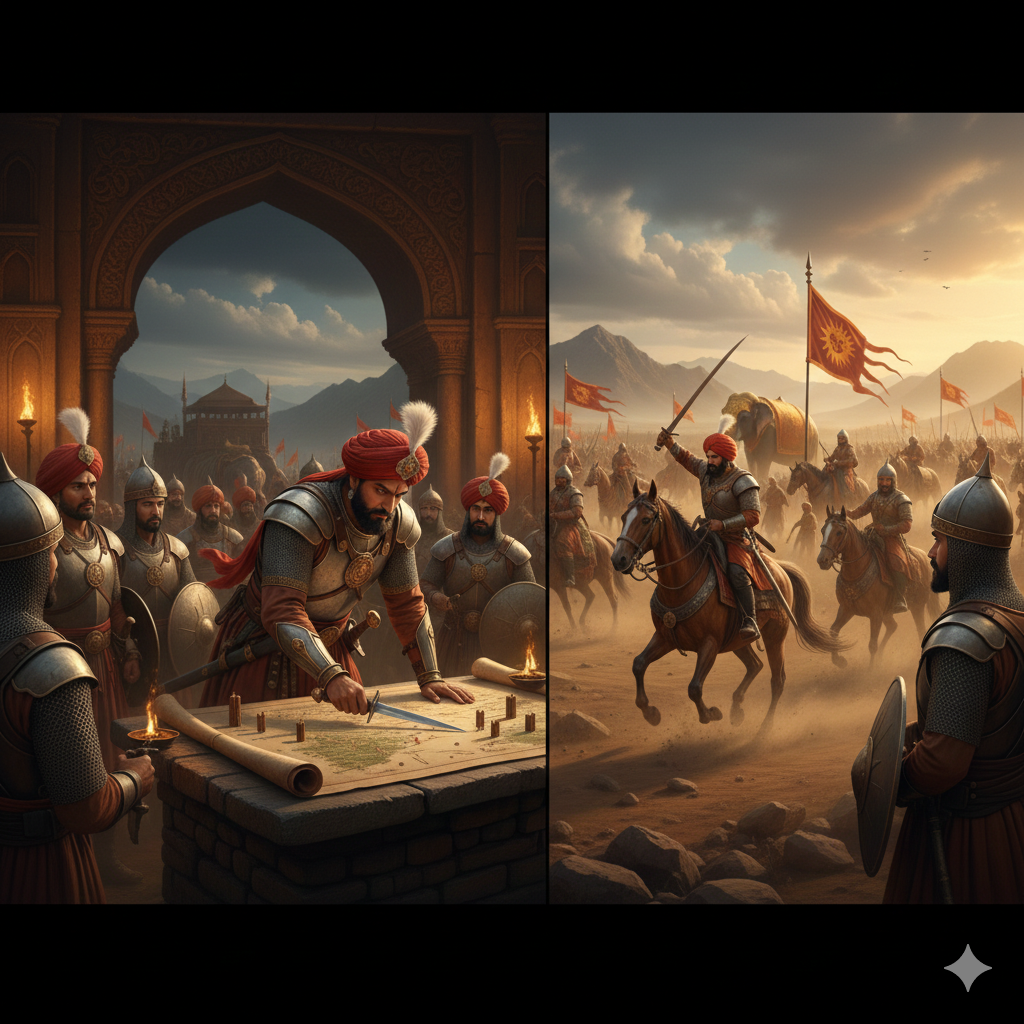
Strategy and valor are two essential pillars for achieving success in any war, conflict, or military mission. From ancient battles like the Mahabharata to the Rajput wars of medieval India, these two elements played a crucial role in determining victory on the battlefield. This article explains the importance of strategy and valor in Indian military history.
Strategy: The Foundation of Victory
Strategy refers to planning and executing a well-thought-out plan to achieve the desired outcome. In warfare, strategic thinking ensures optimal use of manpower, resources, terrain, and timing.
1. Preparation for War
- Proper assessment of the enemy’s strength, geographical position, and possible tactics.
- Leaders prepare multiple backup plans to handle unexpected situations.
2. Selection of the Battlefield
- A suitable battlefield greatly influences the outcome of a war.
- High ground advantage helps armies attack before the enemy reacts.
- Natural barriers like rivers and mountains serve as strategic defences.
3. Deception and Diplomacy
- Armies often used diversionary tactics and false routes to confuse enemy forces.
- This method, known as bluffing, was used often by Rajput warriors.
4. Attack Strategies
- The timing and precision of attack determine the success of a battle.
- Rajput cavalry was known for swift and powerful offensive strikes.
Valor: Symbol of Courage and Sacrifice
Valor reflects the inner courage, confidence, and determination of a warrior. Without valor, even the best strategy fails to achieve victory.
1. Bravery in Battle
Examples include:
- Rana Pratap at the Battle of Haldighati, who fought bravely against the Mughal army.
2. Self-Sacrifice
- Valor also involves selfless dedication and willingness to sacrifice life for duty.
- Queen Durgavati is a powerful example, choosing death over surrender to protect her kingdom.
3. Defence of Forts
- Defending forts was considered a mark of honour in Rajput tradition.
- During the defence of Chittorgarh, Rani Padmini and Rajput soldiers displayed unmatched bravery.
Combined Effect of Strategy and Valor
When effective strategy is reinforced with bravery, even the strongest enemy can be defeated. Strategy weakens the enemy’s power, while valor motivates soldiers to fight beyond their limits.
Conclusion
Strategy and valor are the two essential pillars of warfare. Strategy provides direction and planning, while valor turns plans into reality. These principles shaped many victories in Indian history and remain timeless qualities of great warriors.
Art and Architecture
Indian art and architecture form a unique and invaluable heritage that has inspired the world for thousands of years. From cave paintings to giant temples, from classical dances to Mughal monuments, India’s cultural expressions reflect deep religious, social, and historical significance.
Indian Art: A Medium of Creativity
1. Painting
- Ancient cave paintings in Ajanta, Ellora, and Kanchi depict religious stories and daily life in beautiful detail.
- Miniature paintings, especially from Rajasthan and Gujarat, represent intricate Indian artistry.
Premium Amazon Product
High-quality, durable product with excellent performance — perfect for everyday use and value-for-money.
👉 Buy Now on Amazon2. Sculpture
- Indian sculpture is rich in spiritual and cultural symbolism.
- Temples like Khajuraho, Bodhgaya, and Somnath contain exquisite statues of gods, goddesses, and historical figures.
- During the Gupta period, Indian sculpture reached artistic perfection.
3. Dance and Music
- Indian classical dance forms such as Bharatanatyam, Kathak, Odissi, and Kathakali evolved through centuries.
- Hindustani and Carnatic music developed rich musical structures like ragas, taans, and talas.
Indian Architecture: A Fusion of Culture and Engineering
1. Hindu Temple Architecture
- Built according to ancient Vastu Shastra principles.
- Famous temples include Kashi Vishwanath, Somnath, and Kedarnath.
- Temples were designed with elaborate sanctums, entrances, and mandapas.
2. Buddhist Stupas and Monasteries
- Buddhist architecture reflects simplicity, spirituality, and symbolism.
- Examples include the Sanchi Stupa and the Mahabodhi Temple.
- Caves and Viharas were centres for meditation, learning, and monastic life.
3. Muslim and Mughal Architecture
- Developed as a blend of Indian and Islamic styles.
- Famous monuments include the Taj Mahal, Qutb Minar, and Agra Fort.
- Features include domes, arches, marble decorations, charbagh gardens, and geometrical patterns.
4. Rajput Forts and Palaces
- Symbolised power, wealth, and military engineering.
- Examples include City Palace (Udaipur), Jaisalmer Fort, and Amer Fort (Jaipur).
- Forts had thick walls, water storage systems, tunnels, and intricately painted interiors.
Conclusion
Indian art and architecture are timeless treasures that reflect the creativity, spirituality, and technical skill of Indian civilization. These traditions have shaped India’s cultural identity and continue to inspire the world. Preserving this heritage is essential to maintaining the richness of Indian culture.

Chittaurgarh Fort
Chittaurgarh Fort, located in the Chittorgarh district of Rajasthan, is a magnificent example of Rajput history and architecture. It is considered the pride of Rajasthan and a symbol of Rajput bravery, sacrifice, and honour. The tales of Rani Padmini, Rana Kumbha, and other Rajput heroes make this fort a landmark of valor and cultural heritage.
History and Importance of the Fort
The origins of Chittaurgarh Fort date back to the 7th century. It became a major political, military, and cultural centre during the medieval period. Although the foundation was ancient, the most significant expansion and architectural development took place under Rana Kumbha in the 15th century.
- The fort is built on a hilltop around 20 km from the main city.
- Covers an area of approximately 700 acres.
- Surrounded by deep trenches and strong walls for protection.
- At one time, the fort could accommodate nearly 1 lakh soldiers.
Architecture and Structure
The fort is an outstanding example of Rajput architecture, symbolising both strength and artistic excellence. Important structures inside the fort include:
1. Vijay Stambh
- Built by Rana Kumbha in 1448 to celebrate his victory in battles.
- 150 feet tall and adorned with intricate carvings of Hindu deities.
- Located at one of the highest points of the fort.
2. Rani Padmini Mahal
- Dedicated to the legendary queen Rani Padmini.
- Associated with the tragic tale of Jauhar and Rajput honour.
- One of the most visited and photographed structures inside the fort.
3. Kirti Stambh
- An ancient tower dedicated to Lord Adinath.
- Decorated with detailed sculptures and images related to Jain tradition.
4. Fort Gates
- The fort has seven major gates.
- Padmini Pol and Ram Pol are the most famous.
- These gates played a crucial role in the fort’s defence system.
Stories of Valor Associated with the Fort
1. Rani Padmini and Alauddin Khilji
In 1303, Alauddin Khilji invaded Chittaurgarh. To protect her honour and the dignity of Mewar, Rani Padmini performed Jauhar along with thousands of Rajput women. This event stands as one of the greatest examples of Rajput honour and sacrifice.
2. Bravery of Rana Kumbha
During Rana Kumbha’s reign, Chittorgarh became a symbol of Rajput strength. He won several battles and further strengthened the fort’s architecture. His leadership made Mewar a formidable power.
3. Rana Pratap and the Spirit of Chittorgarh
Although Rana Pratap later shifted his capital, Chittaurgarh remained the source of his inspiration. His struggle against the Mughal Empire reflects the pride and bravery associated with the fort.
Present-Day Significance
Chittaurgarh Fort is now a major tourist attraction and a UNESCO World Heritage Site. Visitors come to witness its historical monuments, majestic walls, temples, and the tales of valor etched into its stones. It remains one of India’s finest symbols of bravery, sacrifice, and architectural genius.
Conclusion
Chittaurgarh Fort stands as an immortal symbol of Rajput pride, strength, and bravery. Its architecture, historical events, and cultural importance give it a unique place in the heritage of India.
Kumbhalgarh Fort
Kumbhalgarh Fort, located in the Rajsamand district of Rajasthan, is one of the strongest and most strategically important forts of the Rajput era. Built in the 15th century by Rana Kumbha, it symbolizes the architectural and military genius of the Mewar rulers.
History and Construction
- Construction began in 1443 under the rule of Rana Kumbha.
- The fort served as a major military stronghold of the Mewar kingdom.
- Located at a great altitude, making it easily defensible and strategically superior.
- Well connected with key Mewar centres like Udaipur and Chittorgarh.
Architecture and Special Features
1. Massive Fort Walls
- The fort is surrounded by a massive 36 km long wall.
- This wall is considered the second longest in the world after the Great Wall of China.
- Height varies from 15 to 25 feet, making it extremely strong and impenetrable.
2. Vijay Pol (Main Gate)
- The main entrance to the fort.
- Architecturally magnificent and part of the fort’s primary defence system.
3. Palaces and Structures Inside the Fort
- Includes palaces, chambers, and administrative rooms.
- The Rana Kumbha Palace is the most famous residential building inside the fort.
- Served as the residence of Mewar’s royal family.
4. Temples within the Fort
- The fort houses over 300 temples.
- Important temples include the Ganesh Temple, Shyam Temple, and Kalika Mata Temple.
Military and Strategic Importance
Top Amazon Product
Premium quality and reliable performance with excellent customer reviews — ideal for everyday use and great value for money.
👉 Buy Now on Amazon1. Defence System
- Surrounded by deep trenches and rugged terrain.
- Fortified walls provided strong protection against enemy forces.
- Weapon stores, soldier camps, and watchtowers were positioned strategically.
2. Role in Wars
- Kumbhalgarh played a crucial role during the battles between the Rajputs and Mughals.
- It served as a refuge and base for Rana Pratap during his struggle for independence.
Historical Significance
1. Rana Kumbha
Rana Kumbha not only constructed the fort but also designed it as a masterpiece of military engineering. His strategic vision ensured the fort remained unconquered for centuries.
2. Struggles of Rana Pratap
Rana Pratap used Kumbhalgarh as a stronghold to plan his resistance against the Mughal Empire. The fort remains a symbol of his courage and determination.
Kumbhalgarh Fort as a Tourist Destination
Today, Kumbhalgarh Fort is a UNESCO World Heritage Site and one of Rajasthan’s most popular tourist attractions. Visitors admire its gigantic walls, temples, palaces, and breathtaking views.
Conclusion
Kumbhalgarh Fort stands as a testament to the military brilliance and cultural legacy of the Rajputs. Its massive fortifications, strategic architecture, and rich history make it one of India’s most iconic heritage sites.
Dilwara Temple
Dilwara Temple, located in Mount Abu (Rajasthan), is one of the most renowned Jain temples in India. Dedicated primarily to Lord Mahavira and other Jain Tirthankaras, the temple symbolizes spiritual purity, artistic excellence, and centuries-old Jain craftsmanship. Its marble architecture is considered one of the finest in the world.
History and Construction
The Dilwara Temples were constructed between the 11th and 13th centuries. They were commissioned by Jain devotees and wealthy patrons, including King Vimal Shah and later ministers like Tejpal and Vastupal. The temples were built to promote Jain teachings and serve as a spiritual centre for pilgrims.
The temple complex consists of five major temples collectively known as Panchayatana Temples. The most famous among them are the Vimal Vasahi and Luna Vasahi temples.
Temple Architecture
Dilwara Temple is an extraordinary masterpiece of Jain marble architecture. The white marble used throughout the complex provides a serene, divine atmosphere. Every pillar, wall, ceiling, and doorway is adorned with ultra-fine carvings, sculptures, and ornamental patterns.
1. Vimal Vasahi Temple
- Built in 1031 AD by King Vimal Shah.
- Dedicated to the first Jain Tirthankara, Adinath.
- Known for intricately carved ceilings, domes, and pillars.
- Features sculptural depictions of Jain legends and celestial beings.
2. Luna Vasahi Temple
- Built in 1230 AD by Tejpal and Vastupal.
- Dedicated to the 22nd Tirthankara, Neminath.
- Famous for its exquisite marble ceiling and detailed carvings.
- The decorative work showcases master-level artistry and perfect symmetry.
3. Other Temples in the Complex
- Pittha Temple
- Parshavanath Temple
- Mahavir Swami Temple
Each of these temples contributes to the sacredness and artistic richness of the Dilwara complex.
Religious Importance
- Dilwara Temple is a major pilgrimage site for Jains.
- Daily rituals include Archana, Tapasya, Prayers, and Meditation.
- Special ceremonies like Panch Kalyanak Puja are performed with great devotion.
Cultural and Tourist Importance
The tranquil surroundings and artistic grandeur attract thousands of domestic and international tourists every year. Its proximity to Mount Abu’s attractions—Nakki Lake, Toad Rock, and Guru Shikhar—makes it an essential part of Rajasthan tourism.
Conclusion
Dilwara Temple is a stunning example of Jain spirituality and architectural brilliance. Its marble carvings and divine atmosphere make it one of the most treasured cultural and religious monuments of India.
City Palace of Udaipur
The City Palace of Udaipur, located on the banks of Lake Pichola, is one of the most iconic palaces of Rajasthan. Built in traditional Mewar style, it showcases the grandeur of Rajput royalty and the cultural heritage of Udaipur. It served as the residence of the royal family of Mewar.
History and Construction
The construction of the City Palace began under Maharana Udai Singh II in 1559 AD when he established Udaipur as the new capital of Mewar. Over the centuries, successive rulers expanded the palace, resulting in a majestic complex that blends Rajput and Mughal architectural elements.
Architecture of the Palace
The palace is built with marble, granite, glass, and precious stones. It features intricately carved walls, decorated balconies, courtyards, gateways, and royal chambers.
1. Jagdish Temple
- Located within the palace complex.
- Dedicated to Lord Vishnu.
- Famous for its magnificent carvings and Indo-Aryan architecture.

Top Amazon Product
High-quality product with reliable performance and great customer satisfaction — ideal for everyday use and excellent value for money.
👉 Buy Now on Amazon2. Krishna Vilas
- A grand palace adorned with beautiful paintings and murals.
- Showcases royal lifestyle and artistic traditions of the Mewar dynasty.
3. Suraj Gokhda (Suraj Ghat Palace)
- A serene and divine section of the palace.
- Offers scenic views of Lake Pichola.
Palace Museum and Art Heritage
The City Palace Museum holds an extensive collection of royal artefacts such as:
- Rajput and Mughal paintings
- Royal attire and jewellery
- Historical weapons—swords, shields, bows, arrows, daggers
- Sculptures and religious idols
Cultural and Tourist Importance
1. Cultural Events and Festivals
- Traditional dance performances
- Musical concerts
- Rajasthani festivals and rituals
2. Scenic Views
From the top of the palace, visitors can enjoy breathtaking views of:
- Lake Pichola
- Fateh Sagar Lake
- Udaipur cityscape
Conclusion
The City Palace of Udaipur stands as a majestic symbol of Mewar’s royal legacy. Its architecture, vibrant art, museums, and panoramic views make it one of the most enchanting heritage sites of India.
Rajasthani and Pahari Architectural Style
Indian architecture presents diverse regional styles, among which the Rajasthani and Pahari styles hold an important place. Both styles reflect different geographical, cultural, and climatic influences, yet share the same goal—creating beauty, utility, and protection.
Rajasthani Style
Rajasthani architecture reflects royalty, grandeur, and the rich cultural traditions of the Rajput kingdoms. It is most prominent in the forts, palaces, and temples of Rajasthan.
Main Features of Rajasthani Style
- Forts and Palaces: Examples include Chittorgarh Fort, Amer Fort, and City Palace Udaipur.
- Use of Marble and Sandstone: Intricate carvings and frescoes adorn the walls and ceilings.
- Jaalis and Windows: Designed for ventilation and aesthetics. Seen in Hawa Mahal and City Palace.
- Gardens and Water Features: Includes scenic gardens, ponds, and water channels like those in Sajjangarh Palace.
Pahari Style
Pahari architecture evolved in the hilly regions of India such as Himachal Pradesh, Uttarakhand, and Jammu & Kashmir. Designed to withstand harsh weather and seismic activity, this style emphasizes simplicity, stability, and harmony with nature.
Main Features of Pahari Style
- Use of Wood and Stone: Provides insulation against cold temperatures.
- Small, Compact Structures: Helps maintain warmth and structural strength.
- Round Roofs & Walls: Improves earthquake resistance.
- Courtyards and Small Gardens: Adapted to limited flat land in the hills.
Similarities and Differences
Similarities:
- Both styles adapt to their geography and climate.
- Both integrate nature with architecture.
Differences:
- Rajasthani style represents grandeur; Pahari style focuses on natural simplicity.
- Rajasthani architecture uses marble and sandstone; Pahari uses wood and stone.
- Rajasthani structures are large and elaborate; Pahari structures are small and functional.
Conclusion
The Rajasthani and Pahari architectural styles highlight India’s cultural diversity. Rajasthani architecture is a symbol of royal heritage, while Pahari architecture represents natural harmony and resilience. Together, they enrich India’s architectural legacy.
References
Trending Amazon Product
Premium quality product with excellent performance and strong customer satisfaction — ideal for everyday use and great value for money.
👉 Buy Now on Amazon- “Rajput History and Culture” – Rajasthan State Archives
- “Medieval Indian Kingdoms and Dynasties” – National Museum of India Publications
- “Architecture of Rajasthan: Forts & Palaces” – Archaeological Survey of India (ASI)
- “Jain Art and Temples of India” – Jain Cultural Research Society
- “The Forts of Mewar: Chittorgarh & Kumbhalgarh” – Department of Tourism, Government of Rajasthan
- “Indian Art and Architectural Heritage” – Indira Gandhi National Centre for the Arts (IGNCA)
- “Historical Accounts of the Rajput Dynasties” – Various Indian History Journals & Academic Publications