
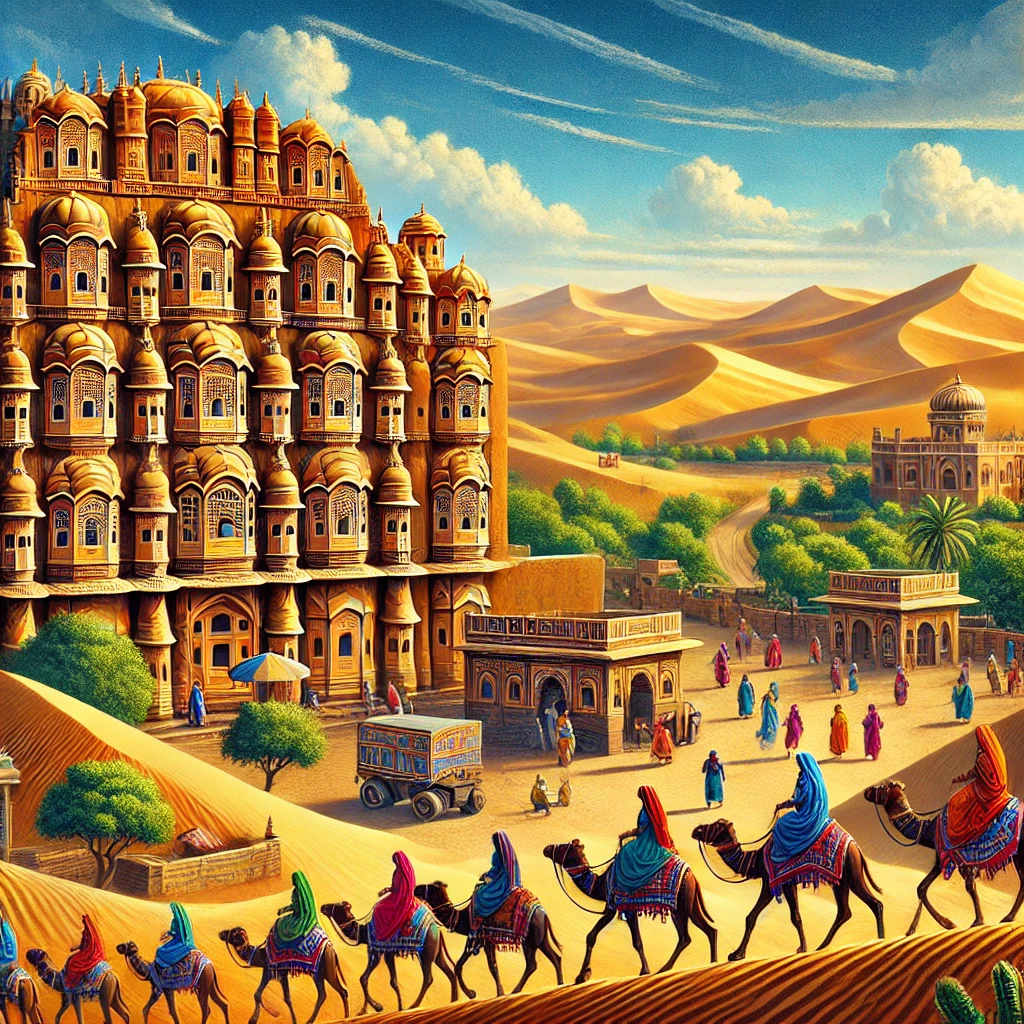
Rajasthan — History, Culture, Geography and the Pink City
Rajasthan, the largest state of India, is famous for its historical, cultural and geographical diversity. Much of the area is covered by the Thar Desert and the Aravalli mountain range. The capital, Jaipur — known as the “Pink City” — and the many forts and palaces tell stories of Rajput empires, bravery and rich heritage.
Main Characteristics
Historical Places
- Amer Fort (Jaipur)
- Mehrangarh Fort (Jodhpur)
- Chittaurgarh Fort
- City Palace (Udaipur)
Natural Beauty
- Thar Desert
- Mount Abu (the only hill station in the state)
- Sambhar Lake (India’s largest salt water lake)
Folk Culture
- Rajasthan’s folk dance and music, such as Ghoomar and Kalbelia, are world famous.
- Bandhej, Lahariya and blue pottery are part of Rajasthan's cultural identity.
Festivals and Fairs
- Pushkar Fair
- Desert Festival (Jaisalmer)
- Traditional festivals like Teej and Gangaur
Cooking
- Garlic Bati Churma
- Vegetable curry
- Ker – Sangri and Mirchi Bada
Economy
Rajasthan’s economy is mainly based on tourism, agriculture and handicrafts. It is also known for marble, granite and other mineral resources.
If you need information about any particular aspect of Rajasthan, let us know.
Pink City — Jaipur
The Pink City, also known as Jaipur, is the capital of Rajasthan and one of the most beautiful historical cities in India. The city is famous for its architecture, culture and colorful traditions. Jaipur was painted pink during the visit of the Prince of Wales in 1876; pink is considered a symbol of hospitality and welcome. Since then it has been known as the “Pink City.”
History of Jaipur
Jaipur was founded in 1727 by King Sawai Jai Singh II of the Kachwaha dynasty. It is the first planned city of India and was built on the principles of Vastu Shastra and Shilpa Shastra. The city plan was prepared by the Bengali architect Vidyadhar Bhattacharya.
Main Attractions
Hawa Mahal
Built by Maharaja Sawai Pratap Singh in 1799, Hawa Mahal is called the “Palace of Winds” because it has 953 windows that help bring in the cool breeze.
Amer Fort
Located about 11 km from Jaipur, Amer Fort is a symbol of Rajasthan’s royal heritage. Notable sections include the Sheesh Mahal, Diwan-e-Aam and Diwan-e-Khas.
Jantar Mantar
This astronomical observatory, included in a UNESCO World Heritage Site, was built by Raja Sawai Jai Singh II in 1734.
City Palace
Located in the center of Jaipur, the City Palace remains the residence of the royal family. It includes a museum, gardens and a grand Durbar Hall.
Jal Mahal
Situated in the middle of Man Sagar Lake, Jal Mahal is an example of refined architectural art.
Cultural and Folk Life
Jaipur’s markets are colorful and vibrant — Johri Bazaar, Bapu Bazaar and Chandpole Bazaar are well known. Handicrafts such as Bandhej, Kundan jewellery and blue pottery are famous. Traditional dances like Ghoomar and Kalbelia are performed often in the city.
Major Festivals
- Jaipur Literature Festival: One of the world’s largest literary festivals.
- Gangaur and Teej: Festivals especially important to women.
- Desert Festival and Kite Festival: Events that showcase local culture and traditions.
Food of Jaipur
- Dal Baati Churma
- Vegetable curry and Ker – Sangari
- Onion Kachori, Mirchi Bada and Ghevar are popular snacks.
Why go to Jaipur?
The pink-decorated markets and buildings are unique. Jaipur offers a blend of history, architecture and modernity, and its hospitality and culture provide a memorable experience.
If you want to know more about Jaipur or are planning a trip, let us know.
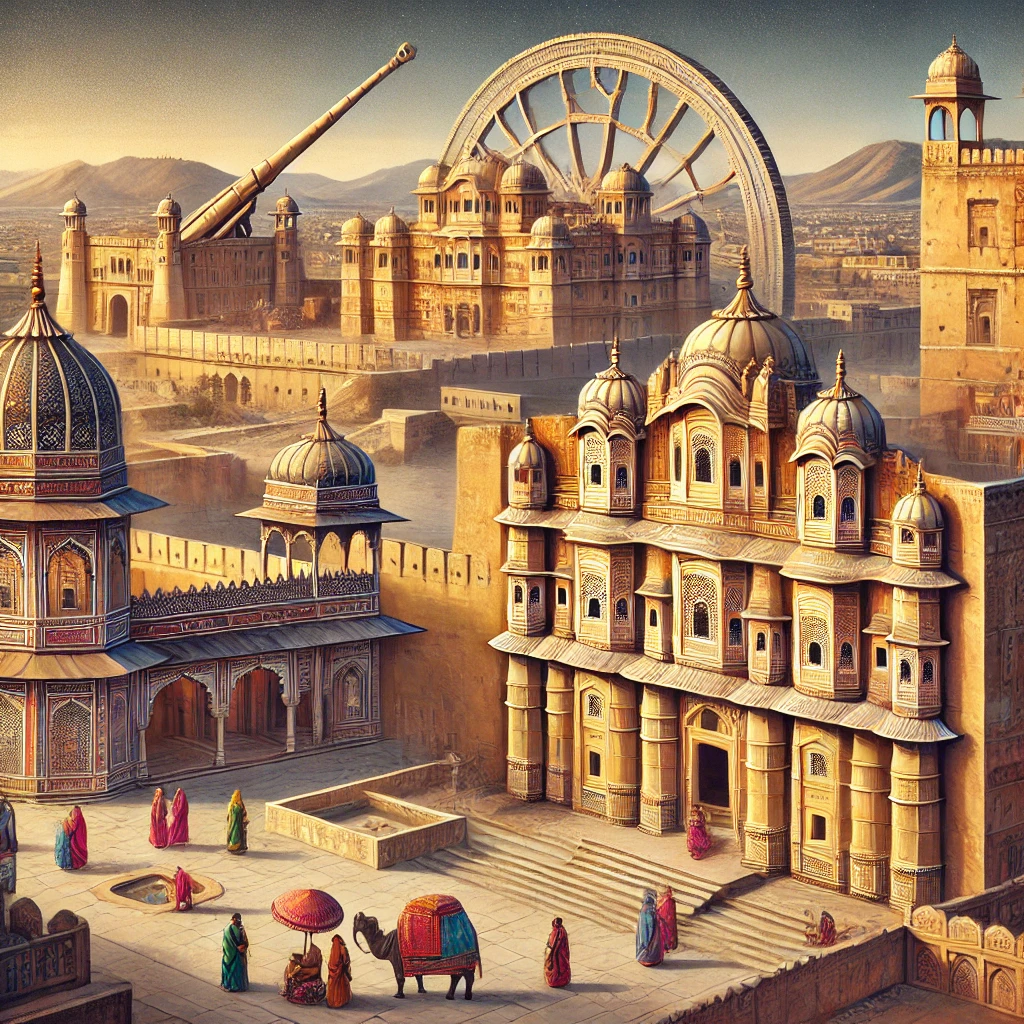
Historical Places of Rajasthan
Rajasthan is full of historical and cultural heritage. These sites reflect the valor and glorious history of the Rajput rulers and present wonderful examples of architecture and art.
1. Chittaurgarh Fort
Location:
Chittaurgarh
Feature:
It is among the largest forts in India and a UNESCO World Heritage Site.
Fame & History:
The story of Queen Padmini and her jauhar; major monuments include Vijay Stambh, Kirti Stambh, Rana Kumbha Palace and Meera Bai temple. It is associated with the pride of Mewar and has ancient origins.
2. Amer Fort
Location:
Jaipur
Feature:
Known for majestic architecture and the Sheesh Mahal.
Fame & Construction:
Diwan-e-Aam and Diwan-e-Khas, elephant rides and a light-and-sound show. It was built by Raja Man Singh in 1592.
3. Mehrangarh Fort
Location:
Jodhpur
Feature & Fame:
One of the largest forts in India; offers a view of the “Blue City” and houses royal arms, palanquins and costumes. Built by Rao Jodha in 1459.
4. Kumbhalgarh Fort
Location:
Rajsamand
Feature & Fame:
Famous for its 36 km long wall, the second longest wall after the Great Wall of China. Birthplace of Maharana Pratap; contains more than 360 temples. Built by Maharana Kumbha in the 15th century.
5. Ranthambore Fort
Location:
Sawai Madhopur
Feature & Fame:
Located within Ranthambore National Park; historically used as a hunting ground and home to an important Ganesha temple. Built in 944 AD by Chauhan rulers.
6. Jaisalmer Fort (Sonar Quila)
Location:
Jaisalmer
Specialty & Fame:
Called “Sonar Qila” because it is made of yellow sandstone and shines like gold in sunlight. Contains residential areas and markets, Patwon’s Haveli and Nathmal’s Haveli. Built by Rawal Jaisal in 1156 AD.
7. Gagron Fort
Location:
Jhalawar
Feature & Fame:
Known as the Water Fort because it is surrounded by water on three sides. Included in the UNESCO World Heritage List; associated with the tomb of musician Pipaji. Built by Parmar kings in the 12th century.
8. Jaigarh Fort
Location:
Jaipur (near Amer Fort)
Specialty & Fame:
Houses the world’s largest cannon called “Jaiwan”; notable for the royal treasury and water management system. Built by Maharaja Sawai Jai Singh II in 1726.
9. Nagaur Fort
Location:
Nagaur
Feature & Fame:
Considered one of the most impressive desert forts in India. Notable for unique murals and architecture. Constructed by the Nagavanshi dynasty in the 2nd century.
10. Bala Quila of Alwar
Location:
Alwar
Specialty & Fame:
Located on the Aravalli hills; known for antiquity and royal history. Built by Hasan Khan Mewati in the 15th century.
11. Bundi Fort (Taragarh Fort)
Location:
Bundi
Feature & Fame:
Famous for paintings and murals, with an art gallery and Queen’s palace. Built by Rao Barsal in the 14th century.
Why are the forts of Rajasthan special?
The architecture is a mixture of Rajput, Mughal and various local styles. Each fort carries stories of bravery, sacrifice and valor. These forts are living symbols of Rajasthan’s cultural heritage.
If you need more information about any of these places or help planning your trip, let us know.
Udaipur City Palace, Natural Beauty of Rajasthan, Mount Abu & Thar Desert — Complete Guide
This guide covers Udaipur’s City Palace, the natural beauty of Rajasthan, Mount Abu and the Thar Desert — presenting history, architecture, heritage and nature in one structured resource.
Udaipur City Palace — From History to Present
History of the City Palace
Establishment
The City Palace of Udaipur was founded in 1553 by Maharana Udai Singh II of Mewar. Its construction began with the formation of Udaipur when the Maharana shifted his capital from Chittorgarh.
Construction Period
The palace took nearly 400 years to complete and was expanded by successive Mewar rulers to reflect their royal culture and valor.
Political Importance
Being the capital of Mewar, the palace served as the seat of administrative, political and cultural activities. Maharana Pratap — who fought the Battle of Haldighati against the Mughals — belonged to this dynasty.
Architecture of the Palace
Style
The City Palace is a blend of Rajput, Mughal and European architectural styles, made primarily of white marble and granite.
Structure
The complex consists of 11 palaces, courtyards, corridors and gardens. Major areas include Moti Mahal, Sheesh Mahal, Krishna Vilas, Bhupal Vilas and Shiv Niwas.
Main Parts
- Toran Pol & Tripolia Gate: Main entrance.
- Mor Chowk: Famous for colorful peacock mosaics.
- Darbar Hall: Built by Maharana Sajjan Singh for royal gatherings.
- Jhulata Bagh: A garden with magnificent swings.
Modern Form of the City Palace
Museum
A large portion is now a museum displaying weapons, royal paintings, artifacts and costumes of the Mewar dynasty.
Heritage Hotels
Some sections have been converted into heritage hotels such as Fateh Prakash Palace and Shiv Niwas Palace.
Tourism
The City Palace is among the most visited tourist places in Udaipur, attracting millions annually.
Film Shooting
It has been used in films including the James Bond movie Octopussy.
Modern Usage
Part of the palace still houses the current Maharana, Arvind Singh Mewar, and the Mewar Trust manages its preservation.
Features and Highlights
View of Pichola Lake
The palace offers stunning views of Pichola Lake, including the Lake Palace and Jag Mandir.
Mor Chowk
One of the most beautiful examples of Rajasthani mosaic art.
Light & Sound Show
A memorable attraction depicting the history of Mewar.
Visitor Information
- Location: Banks of Pichola Lake, Udaipur
- Museum Timings: 9:30 AM – 5:30 PM
- Light & Sound Show: 7 PM (timings may vary)
- Entry Fee: ₹300–₹400 (Indians), additional for cameras
Conclusion
The City Palace is a majestic symbol of Mewar’s rich heritage and artistry. Anyone visiting Rajasthan must explore this grand palace.
Natural Beauty of Rajasthan
Beyond its historical heritage, Rajasthan is equally rich in natural beauty — from deserts and mountains to lakes, forests and wildlife sanctuaries.
1. Thar Desert
Location: Western Rajasthan
The Thar Desert, also called the Great Indian Desert, is India’s largest desert. Its golden dunes offer breathtaking sunset views.
Major Attractions
- Jaisalmer — Gateway to the Desert
- Sam Sand Dunes — Camel rides & camping
- Desert Festival
2. Aravalli Mountain Range
One of the oldest mountain ranges in the world, dividing Rajasthan's desert and green regions.
Major Attractions
- Mount Abu — The only hill station
- Nakki Lake, Dilwara Temples & Guru Shikhar
- Kumbhalgarh Wildlife Sanctuary
3. Lakes of Rajasthan
Udaipur — The City of Lakes
- Pichola Lake — Home to Jag Mandir & Lake Palace
- Fateh Sagar Lake — Boating & scenic beauty
- Rajsamand Lake
Sambhar Lake
India's largest saltwater lake and home to migratory flamingos.
4. Wildlife Sanctuaries & National Parks
- Ranthambore National Park: Famous for tigers
- Sariska Tiger Reserve: Rich wildlife
- Keoladeo National Park: UNESCO World Heritage
- Desert National Park: Fossils & desert species
5. Forest Regions
- Kumbhalgarh Wildlife Sanctuary — Leopards & birds
- Menal — Natural springs & dense forests
- Sajjangarh Forest (Bundi)
6. Oasis & Desert Villages
- Khejadli Village — Natural oasis
- Barmer & Jaisalmer Oasis Villages
7. Waterfalls & Rivers
- Chulia Falls — Chambal River
- Menal Falls
- Rivers: Banas, Chambal
8. Habitat for Migratory Birds
- Khichan — Demoiselle Cranes
- Tal Chhapar Sanctuary — Blackbuck & birds
9. Rural Natural Beauty
Regions like Shekhawati and Marwar feature traditional farming, palm groves and desert culture.
Summary
Rajasthan’s natural landscape is among the most diverse in India, offering deserts, mountains, forests, lakes and rich wildlife — each region telling a unique story.

Mount Abu — The Only Hill Station of Rajasthan
History of Mount Abu
Ancient Period
Known as “Arbudanchal,” Mount Abu is associated with sages and mythological stories.
Rajput Era
A region influenced by the Chauhan and Solanki dynasties.
British Period
Developed as a summer retreat and cantonment for British officers.
Geographical Features
- Altitude: 1,220 meters
- Climate: Cool summers; winters may drop to 0°C
- Landscape: Green forests, waterfalls and lakes
Major Attractions
1. Nakki Lake
The heart of Mount Abu — known for boating and hill views.
2. Dilwara Jain Temples
Renowned for marble carvings and architecture (11th–13th century).
3. Guru Shikhar
Highest point of Aravalli; panoramic views and Dattatreya Temple.
4. Achalgarh Fort & Temple
5. Sunset Point
6. Mount Abu Wildlife Sanctuary
7. Peace Park
Religious Importance
- Jainism: Dilwara Temples
- Hinduism: Achleshwar Mahadev & Dattatreya Temple
Activities
- Boating
- Trekking & Nature Walks
- Photography
- Local Shopping
Weather
- Summer: 20–30°C
- Monsoon: July–Sept
- Winter: 5–15°C
How to Reach
- Nearest Airport: Udaipur (170 km)
- Nearest Railway: Abu Road (28 km)
- Well-connected by road
Conclusion
Mount Abu is ideal for nature lovers, history enthusiasts and spiritual travelers. Its cool climate and scenic beauty make it a must-visit destination.
The Thar Desert — India’s Golden Desert
Geographical Features
Location & Extent
Located in western Rajasthan, bordered by Pakistan, the Aravallis and the Rann of Kutch.
Size
Spreads over 200,000 sq. km.
Climate
Summer: up to 50°C
Winter: near 0°C
Rainfall: 100–150 mm
Landforms
Sand dunes, dry riverbeds, saline lakes and sparse vegetation.
History of the Thar Desert
- Geological origin: millions of years old
- Linked with Indus Valley Civilization
- Ghaggar–Hakra river once flowed here
Natural Features
Golden Sand Dunes
Oasis
Found in places like Pokhran & Kishangarh.
Flora & Fauna
- Khejari trees, cactus, acacia
- Desert fox, reptiles, birds like Bustard & Vultures
Cultural Significance
- Bhil, Bishnoi & Rajput tribes
- Folk music & traditional lifestyle
- Jaisalmer Fort & desert havelis
Major Tourist Places
- Jaisalmer: Fort, Gadisar Lake, Sam Dunes
- Bikaner: Junagarh Fort, Karni Mata Temple
- Barmer: Handicrafts
- Pokhran: Fort & nuclear test site
- Desert National Park
Economic & Ecological Role
- Agriculture — millet, dates
- Camels & goats
- Minerals — gypsum, limestone, petroleum
- Endangered species habitat
Challenges
- Water scarcity
- Soil erosion
- Climate change
Conclusion
The Thar Desert is a symbol of Rajasthan’s natural and cultural pride. Its landscapes, heritage and adventure experiences make it one of India’s most unforgettable destinations.

Rajasthan Complete Guide: History, Culture, Nature, Cities & Cuisine
1. Udaipur City Palace — From History to Present
History of the City Palace
Establishment
The City Palace of Udaipur was founded in 1553 by Maharana Udai Singh II of Mewar. The palace emerged with the founding of Udaipur when the Maharana moved his capital from Chittorgarh.
Construction Period
Construction and expansion continued for nearly 400 years. Successive rulers added new wings and ornate features to reflect Mewar’s royal culture.
Political Importance
As the capital seat of Mewar, the palace was central to administration and culture. The Mewar dynasty, including Maharana Pratap—famous for the Battle of Haldighati—ruled from this region.
Architecture of the Palace
Style
The City Palace blends Rajput, Mughal and European architectural elements, built largely with white marble and granite.
Structure
The complex includes eleven palaces, multiple courtyards, gardens and corridors. Prominent sections are Moti Mahal, Sheesh Mahal, Krishna Vilas, Bhupal Vilas and Shiv Niwas.
Main Parts
- Toran Pol & Tripolia Gate: Main entrances to the complex.
- Mor Chowk: Known for intricate peacock mosaics and colored glass work.
- Darbar Hall: Built by Maharana Sajjan Singh for royal assemblies.
- Jhulata Bagh: Gardens with historic swings.
Modern Form and Usage
Museum
Large parts of the palace function as a museum displaying weapons, paintings, textiles and royal artifacts of the Mewar dynasty.
Heritage Hotels
Sections like Fateh Prakash Palace and Shiv Niwas Palace are now heritage hotels offering luxury accommodation.
Tourism & Film
The City Palace is a top tourist attraction and has been used as a filming location for movies such as the James Bond film Octopussy.
Preservation
Part of the palace still houses the Mewar royal family; the Mewar Trust manages conservation and visitor services.
Highlights & Visitor Info
- View: Panoramic views of Lake Pichola, Jag Mandir and Lake Palace.
- Mor Chowk: Finest examples of Rajasthani mosaic art.
- Light & Sound Show: Evening show narrating Mewar history (timings may vary).
- Location: On the banks of Pichola Lake, Udaipur.
- Museum Timings: Generally 9:30 AM to 5:30 PM.
- Entry Fee: Typically ₹300–₹400 for Indian tourists; camera fees extra (confirm current rates locally).
Conclusion: The City Palace stands as an enduring symbol of Mewar’s royal culture, artistry and history. It is a must-visit for anyone traveling to Rajasthan.
2. Natural Beauty of Rajasthan
Rajasthan's landscape ranges from the golden dunes of the Thar to the Aravalli hills, lakes, forests and rich wildlife sanctuaries. The state's natural diversity complements its cultural heritage.
1. Thar Desert
The Thar (Great Indian Desert) is Rajasthan’s defining landscape—famous for sweeping dunes, desert wildlife and vibrant desert culture.
- Attractions: Jaisalmer, Sam Sand Dunes, Desert Festival
- Experiences: Camel safaris, desert camps, sunset vistas
2. Aravalli Mountain Range
One of the world’s oldest ranges, Aravallis influence the climate and ecology of Rajasthan and host scenic hill stations and wildlife sanctuaries.
- Key spot: Mount Abu — the state’s only hill station
- Wildlife: Kumbhalgarh Wildlife Sanctuary
3. Lakes
Rajasthan’s lakes, especially around Udaipur, add a unique aquatic charm to an otherwise arid state.
- Udaipur: Lake Pichola (Lake Palace, Jag Mandir), Fateh Sagar Lake
- Sambhar Lake: India’s largest saltwater lake and a habitat for migratory birds
4. Wildlife Sanctuaries & Parks
- Ranthambore National Park — famous for tigers
- Sariska Tiger Reserve
- Keoladeo National Park (Bharatpur) — UNESCO World Heritage site for birds
- Desert National Park — unique desert biodiversity
5. Forests, Waterfalls & Rivers
- Kumbhalgarh Wildlife Sanctuary — leopards and diverse birdlife
- Menal & Chulia Falls — seasonal waterfalls
- Rivers: Banas, Chambal — important lifelines in the region
Summary: For nature lovers, Rajasthan offers deserts, lakes, forests and wildlife — each region with a distinct natural story.
3. Mount Abu — The Only Hill Station of Rajasthan
History & Significance
Known in ancient times as Arbudanchal, Mount Abu has mythological and historical importance. It served as a Rajput retreat and later a British summer cantonment.
Geography & Climate
- Altitude: ~1,220 m above sea level
- Climate: Pleasant summers (20–30°C), cool winters (can drop to 0°C)
Major Attractions
Nakki Lake
The heart of Mount Abu, ideal for boating and scenic walks.
Dilwara Jain Temples
Exquisite marble carvings dating from the 11th–13th centuries; a major pilgrimage site.
Guru Shikhar
Highest point in the Aravallis, offering panoramic views and the Dattatreya temple.
Achalgarh Fort & Sunset Point
Historical fort and famed sunset viewpoints.

Wildlife Sanctuary & Peace Park
Forests and protected areas supporting diverse flora and fauna; Peace Park is ideal for meditation and relaxation.
Activities & Practicalities
- Boating at Nakki Lake
- Trekking to Guru Shikhar
- Photography, shopping for handicrafts
How to reach
- Nearest Airport: Udaipur (~170 km)
- Nearest Rail: Abu Road (~28 km)
- Good road connectivity from major cities
Conclusion: Mount Abu’s cool climate, temples and natural beauty make it an essential stop on any Rajasthan itinerary.
4. Thar Desert — India’s Golden Desert
Overview
The Thar Desert is mainly in western Rajasthan and is famed for its dunes, desert culture and resilient ecology.
Geography & Climate
- Area: ~200,000 sq km (partly extends into Pakistan)
- Climate extremes: summer up to ~50°C; winters near 0°C
- Average rainfall: 100–150 mm annually
Natural Features
- Sand dunes, saline lakes, dry riverbeds
- Vegetation: Khejari, cactus, acacia
- Fauna: desert fox, reptiles, birds including the Great Indian Bustard
Cultural & Historical Significance
Desert communities preserve rich traditions—folk music, dance, crafts and distinctive architecture such as havelis and forts (e.g., Jaisalmer).
Major Desert Destinations
- Jaisalmer — Sam Sand Dunes, Jaisalmer Fort
- Bikaner — Junagarh Fort, Karni Mata Temple
- Barmer — renowned crafts
- Pokhran — historical fort and test site
- Desert National Park — protected desert biodiversity
Economy & Ecology
The Thar supports pastoral livelihoods, mineral extraction and unique tourism. Challenges include water scarcity, soil erosion and climate vulnerability.
Conclusion: The Thar Desert is central to Rajasthan’s identity—offering adventure, culture and ecological value.
5. Folk Culture of Rajasthan — A Confluence of Tradition, Art & Heritage
Rajasthan’s folk culture is world-renowned—expressed through music, dance, crafts, costumes and festivals that are woven into daily life.
1. Folk Music & Dance
Folk Music
Rajasthani music narrates life, love, bravery and nature. Traditional instruments include:
- Ravanhatta — one of the oldest string instruments
- Sarangi, Kamaicha, Morchang, Pakhavaj
Types of songs: Veer Ras (heroic ballads), devotional songs (e.g., Mirabai bhajans), and seasonal/nature songs.
Folk Dance
- Ghoomar — graceful women’s dance for weddings and festivals
- Kalbelia — snake-charming tribe’s dance, listed by UNESCO
- Kachchi Mare — a male dance with horse-shaped costumes
- Chari Dance — balancing burning lamps on the head
2. Folk Arts & Crafts
Art & Painting
- Phad painting — long scrolls depicting heroic tales
- Pichwai — devotional paintings for Shrinathji
- Meenakari & glasswork — jewelry and decorative arts
- Block printing — Bagru & Sanganer prints are world-famous
Handicrafts
Leather goods, marble and stone carving, embroidery and zari work are signature crafts of Jaipur, Jodhpur and Udaipur.
3. Traditional Costumes
Men
- Safa / Pagri (turban) — regional identity and style
- Angrakha, dhoti, mojri (traditional footwear)
Women
- Ghagra–choli with heavy embroidery and Gota–Patti work
- Odhni (veil) — covers head and shoulders
- Traditional jewelry — nose rings, bangles, armlets
4. Fairs & Festivals (linked to folk traditions)
Major folk events such as the Pushkar Fair, Desert Festival and regional fairs showcase music, dance, contests and crafts (more details in the Festivals & Fairs section).
5. Traditions & Beliefs
Rajasthani life is steeped in hospitality and community values—“Padhaaro Mharo Desh” (Welcome to my land) reflects local warmth and openness.
6. Tribes & Their Culture
- Bhil: Ancient tribe with distinct customs
- Gurjar: Livestock-rearing and farming communities
- Kalbelia: Nomadic tribe known for dance and snake-charming heritage
- Bishnoi: Noted for environmental protection traditions
Conclusion: Rajasthan’s folk culture is its living identity—preserved, celebrated and central to the state’s pride.
6. Festivals & Fairs of Rajasthan — A Confluence of Tradition & Joy
Rajasthan’s festivals and fairs are elaborate expressions of faith, art and community life. They attract domestic and international visitors and play a major role in cultural preservation and the local economy.
Major Festivals
Teej
Celebrated in the month of Sawan; a festival primarily for women, featuring swings, songs and Ghoomar dances. Jaipur hosts a notable Teej procession.
Gangaur
Observed for about 16 days beginning after Holi; women worship Goddess Gauri for marital harmony. Large processions and cultural displays occur in Jaipur, Udaipur and Bikaner.
Holi
Celebrated on Phalguna Purnima with colors, bhang, music and local nuances (notably in Pushkar and surrounding traditions).
Diwali
Festival of lights—temples and markets glitter with lamps and decorations (especially scenic in Jaipur).
Makar Sankranti
14 January; kite-flying and seasonal celebrations—Jaipur hosts vibrant kite events.
Dussehra
Victory of good over evil; large-scale Ramlila performances and effigy burnings take place in many towns.
Famous Fairs
Pushkar Fair
Held on Kartik Purnima in Pushkar (Ajmer) — world’s largest camel fair with trading, cultural events and competitions.
Desert Festival (Maru Mahotsav)
Jaisalmer’s February festival celebrates desert culture with camel races, Kalbelia dances and folk performances.
Nagaur Fair
Animal trading and cultural festivities in Nagaur, traditionally important for livestock trade.
Kartik Mela & Ajmer Urs
Religious and cultural gatherings in Ajmer; Ajmer Sharif Urs symbolizes religious unity with qawwali and Sufi traditions.
Regional Festivals
- Shekhawati Festival — mansion decor and heritage walk in Shekhawati
- Baneshwar Fair — Dungarpur’s tribal festival
Features & Importance
- Festivals promote social integration and community bonding
- They boost tourism and the local economy
- Provide a platform to showcase folk arts and handicrafts
Conclusion: Rajasthan’s festivals and fairs are a living encyclopedia of its cultural life—participation offers an immersive and memorable experience.
7. Rajasthani Cooking & Cuisine — A Confluence of Taste & Culture
Rajasthani cuisine developed in response to geography, climate and traditional lifestyles. It is rich in spices, ghee and inventive techniques to manage scarcity.
Major Dishes
Dal Baati Churma
Signature dish: spiced dal, baked wheat baati (served with ghee) and sweet churma. Central to festive and everyday meals.
Gatta ki Sabzi
Gram-flour (besan) dumplings cooked in a tangy curd-based gravy—common in arid areas.
Ker–Sangri
Desert specialty made from Ker (wild berry) and Sangri (dried beans), spiced and preserved—iconic of Marwari cuisine.
Bajra Roti & Garlic Chutney
Bajra (pearl millet) rotis paired with pungent garlic chutney are staple rustic fare.
Pitod ki Sabzi & Mohan Thal
Other regional preparations and sweets served at special occasions.
Sweets & Snacks
- Ghevar — special during Sawan and Teej (types: malai, kesar)
- Pheni — layered fried sweet
- Malpua & Mawa Kachori — festive desserts
- Churma Laddu — sweet made from roasted flour, ghee and jaggery
- Onion Kachori, Mirchi Bada, Lentil Kachori — popular street snacks
Drinks
- Buttermilk — cooling and served with meals
- Saffron milk — warming winter drink
- Masala chai — ubiquitous spiced tea
Rajasthani Thali
A traditional thali balances flavors and texture—dal, baati, churma, gatta, bajra roti, chutney and a sweet.
Food Characteristics
- Generous use of ghee and spices
- Prevalence of dry and preserved foods due to arid climate
- Predominantly vegetarian cuisine
- Use of millets and gram flour to adapt to water scarcity
Conclusion: Rajasthani cuisine is both practical and celebratory—rooted in tradition, rich in flavor and essential to experiencing the state's culture.
References
- Government of Rajasthan —
- Rajasthan Tourism —
- Incredible India —
- Archaeological Survey of India (ASI) —
- UNESCO — Hill Forts of Rajasthan —
- Rima Hooja, A History of Rajasthan
- James Tod, Annals and Antiquities of Rajasthan
- Encyclopaedia Britannica — Rajasthan & Jaipur entries
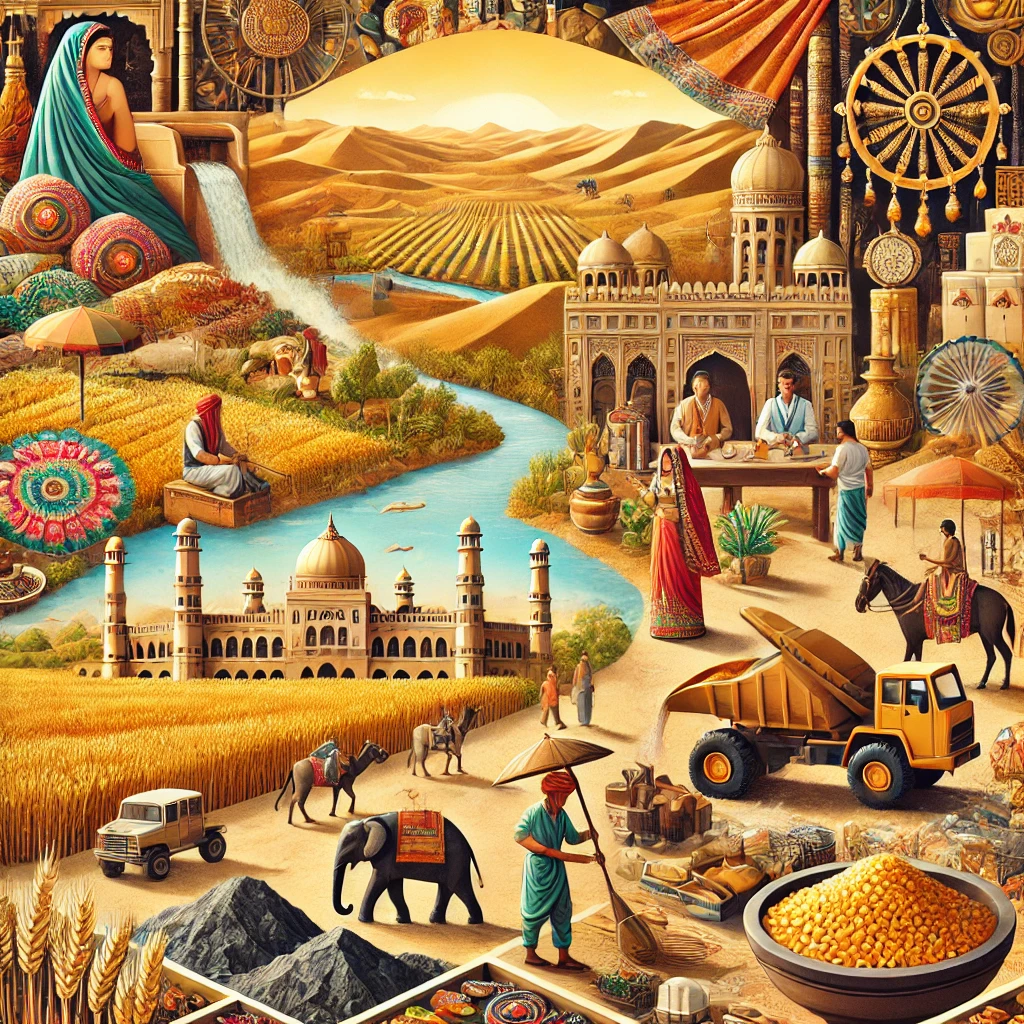
Economy, Education, Tourism & Mineral Industry of Rajasthan
A complete guide covering the economic structure, educational development, tourism growth and mineral resources of Rajasthan.
Economy of Rajasthan — Features, Sectors & Challenges
Rajasthan’s economy is diverse and supported by agriculture, industry, tourism, minerals and services. While the state has strong economic resources, it also faces challenges such as water scarcity and unemployment.
1. Agriculture & Farming
Agriculture is a major part of the state economy even though Rajasthan is largely arid.
Main Agricultural Products
- Maize
- Wheat
- Millet (Bajra)
- Pulses
- Groundnut
- Vegetables like watermelon, peppers and tomatoes
Rajasthan is India’s largest millet producer and an important maize and pulse producer.
Water Resources & Irrigation
Due to water scarcity, irrigation depends on dams, lakes and river systems (e.g., Gandhi Sagar). Modern irrigation schemes and water-saving methods are being adopted.
2. Industry & Manufacturing Sector
Main Industries
- Mineral Industry: Rajasthan produces limestone, silica, zinc, mercury and marble.
- Textile Industry: Jaipur, Bikaner and Udaipur are major textile hubs.
- Marble & Stone Industry: Rajasthan marble is world famous.
- Sawmill & Resin Industry
3. Tourism Industry
Tourism is a major contributor to the state economy, supported by forts, palaces, temples and deserts.
Major Tourist Cities
- Jaipur (Pink City)
- Udaipur (City of Lakes)
- Jodhpur (Blue City)
- Jaisalmer (Golden Fort)
- Mount Abu
- Ranthambore National Park
4. Service Sector
Banking, education, healthcare, IT and outsourcing sectors are rapidly growing in Jaipur, Jodhpur and Udaipur.
5. Minerals & Natural Resources
- Marble
- Limestone
- Zinc
- Salt (Sambhar Lake)
- Granite
6. Challenges & Opportunities
Challenges
- Severe water scarcity
- Unemployment in rural regions
- Low market access for farmers
Opportunities
- Solar energy development
- Heritage & cultural tourism
- Modern agriculture & irrigation
Conclusion
The economy of Rajasthan is a blend of tradition and modern growth. Despite challenges, ongoing reforms point toward a strong economic future.
Education in Rajasthan — Status, Challenges & Development
1. Overview of the Education System
Primary & Secondary Education
- 51,000+ government schools
- Mid-Day Meal Scheme & RTE implemented
- Rajasthan Board conducts Class 10 & 12 exams
- Large growth of private CBSE/ICSE schools
Higher Education
Rajasthan has multiple universities offering courses in arts, science, commerce, law, engineering and medicine.
- University of Rajasthan (Jaipur)
- MDS University (Ajmer)
- Rajasthan Technical University
- AIIMS (Jodhpur)
2. Major Government Initiatives
Right to Education (RTE)
Ensures free and compulsory education for children aged 6–14.
Mid-Day Meal Scheme
Improves attendance and nutrition among school children.
Smart Classes & Digital Education
Smart classrooms and e-learning have been introduced in many schools.
CM Child Welfare Scheme
Offers financial assistance to students from weaker sections.
3. Challenges
- Rural-urban educational gap
- Shortage of qualified teachers
- Gender inequality in some regions
- Concerns over quality of education
4. Future Directions
- Expansion of technical & vocational education
- Promoting women’s education
- Research & innovation centers
- International collaborations
Conclusion
Rajasthan’s education system is progressing rapidly but still faces major challenges. Continued efforts can significantly improve the state’s educational future.
Tourism Industry of Rajasthan — A Global Attraction
1. Major Tourist Destinations
Jaipur (Pink City)
- Amber Fort
- City Palace
- Hawa Mahal
- Jantar Mantar
- Jal Mahal

Udaipur (City of Lakes)
- City Palace
- Pichola Lake
- Bagore ki Haveli
- Monsoon Palace
Jodhpur (Blue City)
- Mehrangarh Fort
- Jaswant Thada
- Umaid Bhawan Palace
Jaisalmer (Golden Fort)
- Jaisalmer Fort
- Patwon ki Haveli
- Sam Sand Dunes
Mount Abu
- Dilwara Temples
- Nakki Lake
- Guru Shikhar
Wildlife Tourism
- Ranthambore National Park
- Sariska Tiger Reserve
2. Contribution of Tourism
Financial Contribution
Tourism adds significantly to Rajasthan’s revenue and boosts heritage tourism.
Employment Generation
- Hotels
- Transport
- Guides
- Craft markets
Cultural Promotion
Tourism helps preserve traditional arts, crafts, music and cuisine.
3. Tourism Development Measures
- Infrastructure development
- International marketing campaigns
- Eco-tourism & adventure tourism
- Digital promotion & tourism apps
4. Challenges
- Environmental stress
- Crowding at popular sites
Conclusion
The tourism industry strengthens Rajasthan’s economy and heritage. With sustainable development, it can continue to grow globally.
Mineral Industry of Rajasthan — Backbone of the Economy
1. Major Mineral Resources
1.1 Marble
Rajasthan is the world’s largest marble producer. Key districts: Rajsamand, Udaipur, Pali and Chittorgarh.
1.2 Zinc
Rajasthan leads India in zinc production (Udaipur, Bhilwara).
1.3 Iron Ore
Found in Bhilwara, Alwar and Rajsamand.
1.4 Silica
Used in cement, glass and construction materials.
1.5 Salt
Large production from Sambhar, Pali and Bundi.
1.6 Stone, Granite & Slate
1.7 Graphite & Sulphur
2. Economic Importance
Contribution to State Revenue
Mineral royalty and exports add major income to the state.
Employment
Mining provides direct and indirect employment to millions.
Exports
Marble, graphite and zinc are exported worldwide.
3. Challenges
- Environmental degradation
- Resource depletion
- Worker safety issues
- Illegal mining
4. Government Initiatives
- Rajasthan Mineral Policy
- Eco-friendly mining rules
- Worker safety programs
- Crackdown on illegal mining
Conclusion
Rajasthan’s mineral industry is critical for state development. With sustainable mining practices and strict regulation, the sector can thrive for decades.
References
- Government of Rajasthan – rajasthan.gov.in
- Rajasthan Tourism – tourism.rajasthan.gov.in
- Incredible India – incredibleindia.org
- Archaeological Survey of India – asi.nic.in
- UNESCO – Hill Forts of Rajasthan
- Rima Hooja — A History of Rajasthan
- James Tod — Annals & Antiquities of Rajasthan
- Encyclopaedia Britannica — Rajasthan Entry