
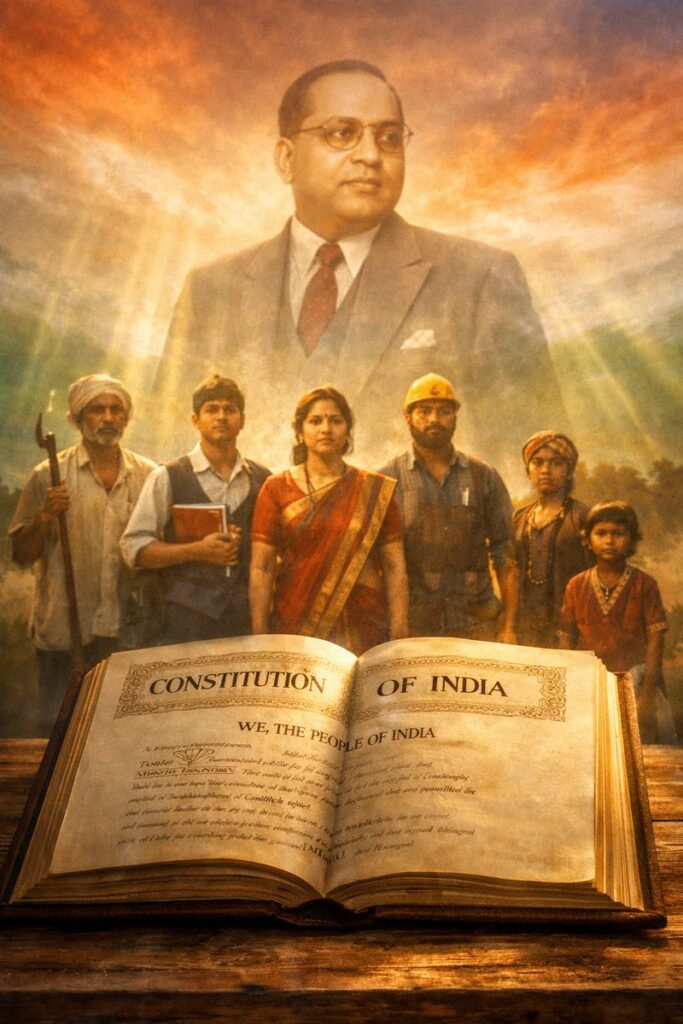
What Is a Constitution and Why Is It Necessary?
The Indian Constitution is the supreme legal and moral foundation of the nation. A constitution is not merely a collection of laws, but a living document that defines the identity, values, and direction of a country. Through the constitution, a nation decides how it will be governed, how power will be distributed, and how the rights of its citizens will be protected.
In simple terms, the constitution is the backbone of a state. Without it, governance would become arbitrary, unstable, and unjust. It provides clarity, discipline, and balance to the political and social system of a nation.
For a diverse country like India, the Indian Constitution is especially essential because it unites people of different religions, languages, cultures, and traditions under a single framework of equality and justice.
The Role of the Constitution in Democracy
Democracy is not only about elections; it is about participation, accountability, and protection of rights. The constitution gives democracy its true meaning. It ensures that no individual, institution, or government is above the law.
The constitution defines the powers and limits of the legislature, executive, and judiciary. By maintaining a balance among these institutions, it prevents dictatorship and protects democratic values.
Without a constitution, democracy would be nothing more than a slogan. It is the constitution that transforms democratic ideals into practical reality.
The Relationship Between the Constitution and Ordinary Citizens
The constitution is not written only for politicians, judges, or administrators. It is written for every ordinary citizen. The freedom we enjoy, the equality we demand, and the justice we seek all flow directly from the constitution.
Whenever a citizen raises a voice against injustice, the strength behind that voice is the constitution. It empowers the weak, protects the marginalized, and gives dignity to every human being.
Thus, the constitution is not distant from daily life; it silently guides and safeguards it.
The Constitution Is Not Just Law, but a Social Contract
If we see the constitution only as a legal book, we fail to understand its true soul. In reality, the constitution is a social contract — an agreement made by the people of a nation to live together with mutual respect, equality, and harmony.
It reflects a collective decision about what kind of society we wish to build. It is based on values such as liberty, equality, fraternity, and justice.
Therefore, the constitution is not just an instrument of governance, but a guiding philosophy that transforms a group of people into a united nation.

Featured Amazon Product
Stylish design, reliable performance and excellent user satisfaction make this product a strong choice for everyday use.
👉 Buy on AmazonFormation of the Constituent Assembly
The formal journey of making the Indian Constitution began with the formation of the Constituent Assembly. This historic body was entrusted with the responsibility of designing the political, legal, and moral framework of independent India.
The Constituent Assembly was formed in 1946 under the Cabinet Mission Plan. At that time, India was still under British rule, but the dream of independence and self-governance had already taken deep roots in the hearts of the people.
Initially, the Assembly was to have 389 members, representing British Indian provinces and princely states. After the partition of India in 1947, the total number of members was reduced to 299.
The members of the Constituent Assembly were not elected directly by the public. Instead, they were elected by the provincial legislative assemblies using the system of proportional representation. This ensured that different political parties, communities, and regions received fair representation.
The goal of this election process was to make the Constitution truly inclusive, reflecting the diversity and unity of India.
Prominent Members of the Constituent Assembly
The Constituent Assembly included many visionary leaders who shaped the destiny of India through their ideas, debates, and sacrifices. Their contributions transformed the Constitution into a living and progressive document.
- Dr. B. R. Ambedkar – Chairman of the Drafting Committee and chief architect of the Constitution.
- Jawaharlal Nehru – Presenter of the Objectives Resolution and symbol of modern democratic vision.
- Dr. Rajendra Prasad – President of the Constituent Assembly and later the first President of India.
- Sardar Vallabhbhai Patel – Leader of national integration and pillar of administrative unity.
Each of these leaders contributed uniquely, ensuring that the Constitution balanced tradition with progress and authority with freedom.
Dr. B. R. Ambedkar: The Architect of the Constitution
Dr. Bhimrao Ramji Ambedkar is remembered as the chief architect of the Indian Constitution. Born into a marginalized community, he rose through education, determination, and courage to become one of India’s greatest jurists and social reformers.
He was appointed Chairman of the Drafting Committee, a role that placed immense responsibility on his shoulders. Dr. Ambedkar studied various constitutions of the world and carefully adapted their best features to suit India’s unique social and cultural conditions.
His primary mission was not merely to frame laws, but to eliminate social injustice, discrimination, and inequality. Through the Constitution, he ensured legal protection, dignity, and equal opportunities for the oppressed and marginalized sections of society.
Dr. Ambedkar firmly believed that political freedom without social and economic equality was meaningless. This philosophy deeply influenced the spirit of the Indian Constitution.
Therefore, Dr. Ambedkar is not only the maker of the Constitution but also the architect of India’s social transformation.
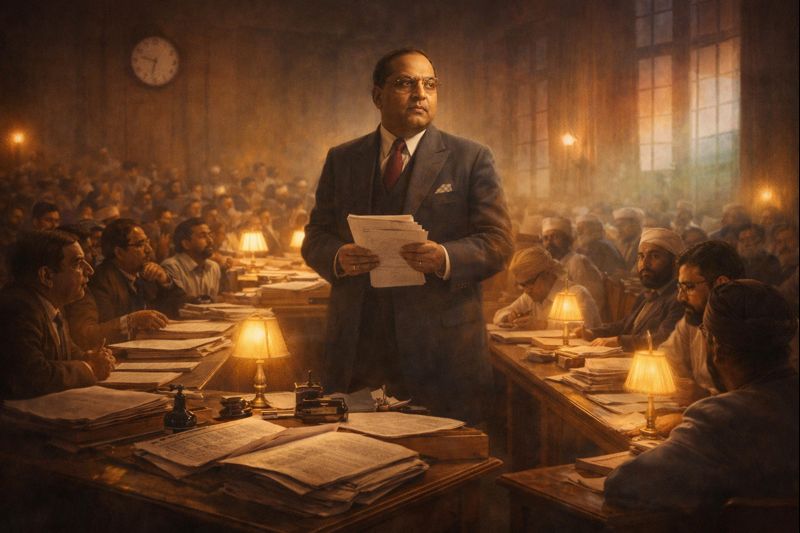
Process of Drafting the Indian Constitution
The drafting of the Indian Constitution was not a simple legal exercise. It was a historic journey of ideas, debates, disagreements, and collective wisdom. The members of the Constituent Assembly were not merely writing laws; they were shaping the destiny of a future nation.
This process formally began on 9 December 1946 and continued for nearly 2 years, 11 months, and 18 days. During this period, the Constituent Assembly held multiple sessions, where every article of the Constitution was discussed with seriousness, responsibility, and vision.
Each word of the Constitution was carefully chosen to ensure that it would remain relevant not only for that generation, but also for generations to come.
Formation of the Drafting Committee
To give the Constitution a clear and organized structure, the Drafting Committee was formed on 29 August 1947. The primary responsibility of this committee was to prepare the final draft of the Constitution based on the recommendations of various committees and debates of the Assembly.
Dr. B. R. Ambedkar was appointed as the Chairman of the Drafting Committee. Other members included K. M. Munshi, Alladi Krishnaswamy Ayyar, N. Gopalaswami Ayyangar, Syed Mohammad Saadullah, B. L. Mitter, and D. P. Khaitan.
The Drafting Committee carefully examined reports, amendments, and suggestions, and transformed them into a coherent constitutional document. Dr. Ambedkar’s legal brilliance, clarity of thought, and commitment to social justice played a crucial role in shaping the final draft.
The committee did not merely write articles; it preserved the spirit of equality, liberty, and justice within the constitutional framework.
Debates, Differences, and Resolutions
The Constituent Assembly represented diverse political views, social backgrounds, and ideological perspectives. Naturally, there were strong disagreements on many issues such as language, religion, federal structure, minority rights, and the distribution of powers between the Centre and the States.
At times, these disagreements appeared deep and difficult to resolve. However, the beauty of the Assembly lay in its commitment to dialogue rather than conflict. Every disagreement became an opportunity to refine and strengthen the Constitution.
These debates ensured that the Constitution was not the voice of a few, but the collective conscience of the nation. Compromise was not seen as weakness, but as wisdom.
The Assembly proved that differences, when guided by national interest, can become the foundation of unity.
Inspiration from Other Countries’ Constitutions
Although the Indian Constitution is original in spirit, its makers studied several foreign constitutions to adopt their best features according to Indian needs.
From the United States, India adopted Fundamental Rights and the system of judicial review. From the United Kingdom, it borrowed the parliamentary system of government and the principle of rule of law. From Ireland, it drew inspiration for the Directive Principles of State Policy. From Canada, it adopted the federal structure with a strong central government.
By blending these global ideas with Indian values and realities, the Constitution became both modern and deeply rooted in national traditions.
This thoughtful integration made the Indian Constitution the longest, most detailed, and one of the most progressive constitutions in the world.
Thus, the process of drafting the Constitution was not merely about writing legal provisions, but about designing a just, inclusive, and democratic future for India.

Best Value Amazon Product
Compact and reliable product with great performance, ideal for daily use and excellent user satisfaction.
👉 Buy on Amazon2 Years, 11 Months, and 18 Days: The Journey of Making the Constitution
The Constitution of India was not created in a single moment. It was the result of nearly three years of continuous dedication, debate, reflection, and responsibility. When the Constituent Assembly met for the first time on 9 December 1946, the members carried not only documents in their hands, but also the hopes of millions in their hearts.
Every session brought new challenges. Sometimes it was about language and identity, sometimes about religion and equality, sometimes about social justice, and sometimes about the balance of power between the Centre and the States. Yet, beyond all differences, one vision remained constant — to build a nation based on justice, liberty, and dignity.
The members of the Assembly were not merely drafting legal articles. They were shaping the future lives of generations. Each clause reflected careful thought, sacrifice, and moral responsibility.
Finally, on 26 November 1949, the Constitution was adopted, and on 26 January 1950, it came into force. This moment marked not only the birth of a legal document, but the awakening of India’s democratic soul.
These 2 years, 11 months, and 18 days proved that unity is possible even within diversity, and consensus can emerge even from disagreement.
Every Day Was a Struggle
Each day of constitution-making carried its own struggle. It was not a struggle of weapons, but of ideas. It was not a struggle for power, but for principles. It was not about personal ambition, but about national destiny.
Long debates continued late into the night. Fatigue was visible, disagreements were strong, yet commitment never weakened. The members knew that every word they wrote would shape the lives of millions.
For many, this was not just a political responsibility, but a deeply personal mission. Those who had experienced discrimination, injustice, and silence wanted the Constitution to become a voice for dignity and equality.
For leaders like Dr. Ambedkar, this struggle was a fight for social rebirth. He believed that a strong Constitution could heal centuries of injustice and open doors of opportunity for every Indian.
That is why the Indian Constitution was not merely written — it was lived, questioned, refined, and finally embraced by the collective conscience of a nation.
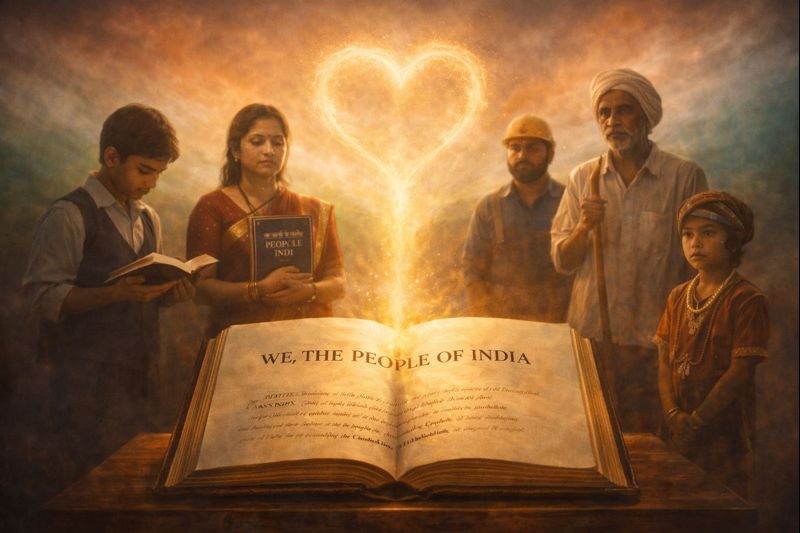
The Soul of the Constitution
The Constitution of a nation is not merely a collection of laws; it is the soul of that nation. It reflects the dreams, values, and moral direction of its people. The soul of the Indian Constitution is built upon the ideals of justice, liberty, equality, and fraternity. These principles transform India from a geographical territory into a living democracy.
The Constitution teaches us that power is not meant to dominate, but to serve. It reminds every citizen that rights and duties must walk together so that society can progress with balance and harmony.
What makes the Indian Constitution unique is its ability to evolve with time while preserving its core values. Circumstances may change, generations may change, but the soul of the Constitution continues to protect human dignity and democratic spirit.
Importance of the Preamble
The Preamble is the essence and guiding light of the Indian Constitution. It is the doorway through which we enter the spirit of the Constitution. It declares the objectives, philosophy, and vision upon which the Constitution is built.
The words “Sovereign, Socialist, Secular, Democratic Republic” are not just political terms; they represent India’s identity and collective commitment. They define the nature of the Indian state and the values it promises to uphold.
Justice, liberty, equality, and fraternity are the four pillars of Indian democracy, and the Preamble places them clearly at the heart of the constitutional framework.
We, the People of India…
“We, the People of India” is the most powerful and meaningful opening line of the Constitution. These words declare that the ultimate authority does not belong to rulers or institutions, but to the citizens of India.
This line reminds us that the Constitution is created by the people, for the people, and in the interest of the people. It transforms every citizen into a guardian of constitutional values.
“We, the People of India” is not merely a sentence; it is a shared identity, a collective responsibility, and a national promise. It tells us that democracy is not only a system of governance, but a continuous participation of citizens in shaping their nation.
Whenever we read these words, we do not just see history — we see our present duty and our future hope.

Must-Have Amazon Product
Compact, reliable and highly rated — a quality product perfect for daily use with excellent value for money.
👉 Buy on AmazonFundamental Rights and Duties
The Indian Constitution grants Fundamental Rights to every citizen so that they can live with dignity, freedom, and equality. These rights are not privileges given to a few, but guarantees provided to all, without discrimination.
Fundamental Rights protect citizens from injustice, exploitation, and inequality. They ensure freedom of speech, equality before law, freedom of religion, and protection of life and personal liberty. Together, these rights form the backbone of a democratic society.
However, the Constitution does not stop at granting rights. It also reminds citizens of their Fundamental Duties, because a democracy can survive only when citizens act responsibly.
Rights give us power, but duties give us direction. Without duties, rights can lose their true meaning.
Rights Are Incomplete Without Duties
If citizens focus only on their rights and ignore their duties, society becomes imbalanced. Rights provide freedom, but duties teach responsibility.
It is the duty of every citizen to respect the Constitution, the national flag, and the national anthem, to protect public property, to promote harmony, and to preserve the unity and integrity of the nation.
When we perform our duties sincerely, our rights automatically become stronger and more meaningful. Duties create discipline, while rights create confidence.
The Constitution wisely connects rights with duties, reminding us that freedom without responsibility can never lead to true democracy.
Therefore, Fundamental Rights teach us how to live freely, and Fundamental Duties teach us how to live rightly.
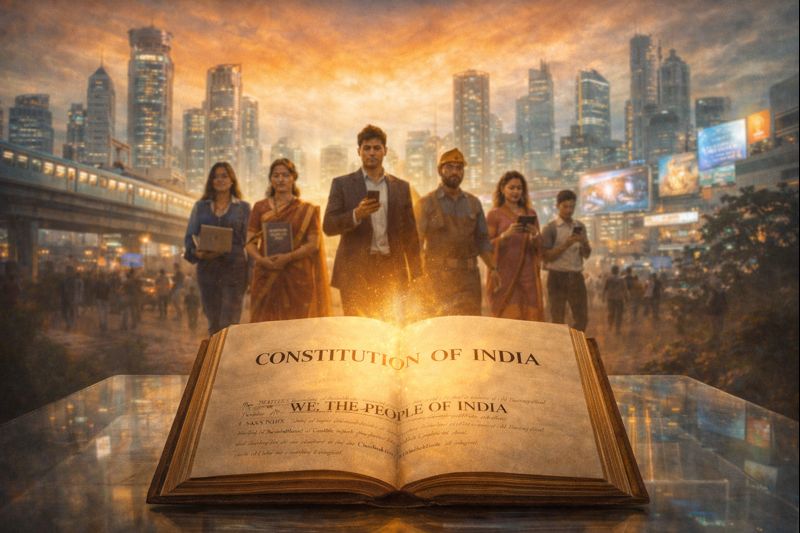
Relevance of the Constitution in Modern India
Modern India is progressing rapidly in the fields of technology, economy, and global influence. Yet, the true direction of this progress is guided by the Constitution. It reminds us that development is not only about infrastructure and wealth, but also about protecting human values and democratic principles.
As society evolves, new challenges, new ideas, and new expectations emerge. Even in this changing world, the Constitution remains as relevant today as it was at the time of independence, because its foundation is built on justice, equality, and liberty.
The Constitution teaches us that every transformation must remain within the boundaries of democracy and human dignity.
Do We Truly Understand the Constitution?
This question is not meant only for students, lawyers, or politicians, but for every citizen. Do we really understand what the Constitution gives us and what it expects from us?
Often, we hear about the Constitution only during political debates, court cases, or controversies. But we forget its presence in our daily lives.
The Constitution gives us freedom of expression, but it also teaches us to use this freedom with responsibility.
It gives us equality, but it also reminds us to treat others with equal respect.
If we consider the Constitution only as a legal document, we can never understand its true spirit. To understand the Constitution means to practice its values in our thoughts, actions, and behavior.
When citizens do not just read the Constitution but begin to live by it, democracy becomes truly strong.

Premium Amazon Product
Stylish design, reliable durability and excellent performance make this product a great choice for everyday use.
👉 Buy on AmazonInspiration from the Making of the Constitution
The making of the Indian Constitution was not just a historical event, but a powerful lesson in patience, dialogue, and collective responsibility. It teaches us that meaningful change is never easy, but it becomes possible when guided by vision, courage, and commitment.
The members of the Constituent Assembly placed the future of the nation above their personal differences. Their dedication proved that true patriotism is not only emotional, but also practical and responsible.
The process of constitution-making inspires us to believe that unity can be built even within diversity, and agreement can be achieved even after disagreement.
From Struggle to Solution
The entire journey of drafting the Constitution was a movement from struggle to solution. Different opinions, ideologies, and perspectives often clashed, but the ultimate goal remained the same — to create a just and democratic India.
When conflicts arose, dialogue became the bridge. When solutions seemed distant, patience became the guide. And when decisions were finally made, they were meant not only for that generation, but for generations yet to come.
This journey teaches us that struggle is not a weakness, but the first step toward transformation. Solutions are born when struggle is faced with wisdom and sensitivity.
Even today, whenever we face social or personal challenges, the story of the Constitution reminds us that every problem carries within it the seed of a solution.
Thus, the making of the Constitution is not only history — it is a timeless source of inspiration for every citizen.
Conclusion
The Indian Constitution is not merely a collection of laws, but the soul, identity, and guiding light of the nation. It teaches us that democracy is not just a system of governance, but a way of life based on equality, justice, and human dignity.
In a country as diverse as India, the Constitution acts as a unifying force that connects different languages, religions, cultures, and regions into a shared national spirit.
When we look at the Constitution today, we do not see only history — we see responsibility for the present and hope for the future.
The Constitution Is Not Just a Document, but a Living Idea
The Constitution is a living idea that evolves with time while remaining faithful to its core values. It adapts to changing circumstances, yet never compromises on justice, liberty, and equality.
Every generation receives the responsibility to understand the Constitution more deeply and to strengthen it through awareness, respect, and responsible citizenship.
When we respect the Constitution, we do not merely honor a legal text — we honor our rights, our duties, and our collective identity.
Therefore, reading the Constitution is an act of knowledge, but living by its values is an act of true patriotism.
Frequently Asked Questions (FAQ)
When did the Constitution of India come into force?
The Constitution of India came into force on 26 January 1950, marking the birth of India as a sovereign democratic republic.
Who is known as the architect of the Indian Constitution?
Dr. B. R. Ambedkar is known as the chief architect of the Indian Constitution and was the Chairman of the Drafting Committee.
When was the Constituent Assembly formed?
The Constituent Assembly was formed in 1946 under the Cabinet Mission Plan.
How long did it take to draft the Indian Constitution?
It took 2 years, 11 months, and 18 days to complete the drafting of the Indian Constitution.
Why is the Indian Constitution considered unique?
The Indian Constitution is the longest written constitution in the world and is admired for its democratic, secular, and inclusive nature.
What is the importance of the Preamble?
The Preamble reflects the philosophy, values, and objectives of the Constitution and is considered its guiding spirit.
Why are Fundamental Rights important?
Fundamental Rights protect citizens from injustice, discrimination, and exploitation, ensuring dignity and freedom.
What is the role of Fundamental Duties?
Fundamental Duties remind citizens of their responsibilities towards the nation, society, and the Constitution.
Can the Indian Constitution be amended?
Yes, the Constitution can be amended to meet changing needs, while preserving its basic structure.
Why is the Constitution still relevant today?
The Constitution continues to protect democracy, human rights, and social justice, making it highly relevant in modern India.
Top Value Amazon Product
Sleek build, dependable performance, and excellent user feedback make this product a smart choice for everyday use.
👉 Buy on AmazonReferences
- The Constitution of India – Government of India Publications
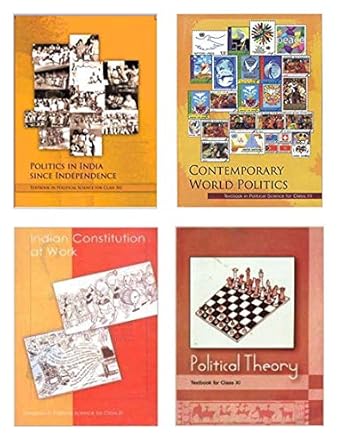
- NCERT Political Science Textbooks (Class 11 & 12)
- Constituent Assembly Debates – Official Records
- Dr. B. R. Ambedkar: Life and Works – Various Biographical Sources
- Indian Polity by M. Laxmikanth
- Our Constitution by Subhash C. Kashyap
- Indian Freedom Movement and Constitution Making – Historical Research Articles
- National Archives of India and Official Government Websites
The information in this article has been carefully compiled and presented in a simple and educational manner based on the above authentic and reliable sources, so that readers can clearly understand the process of making the Indian Constitution.