
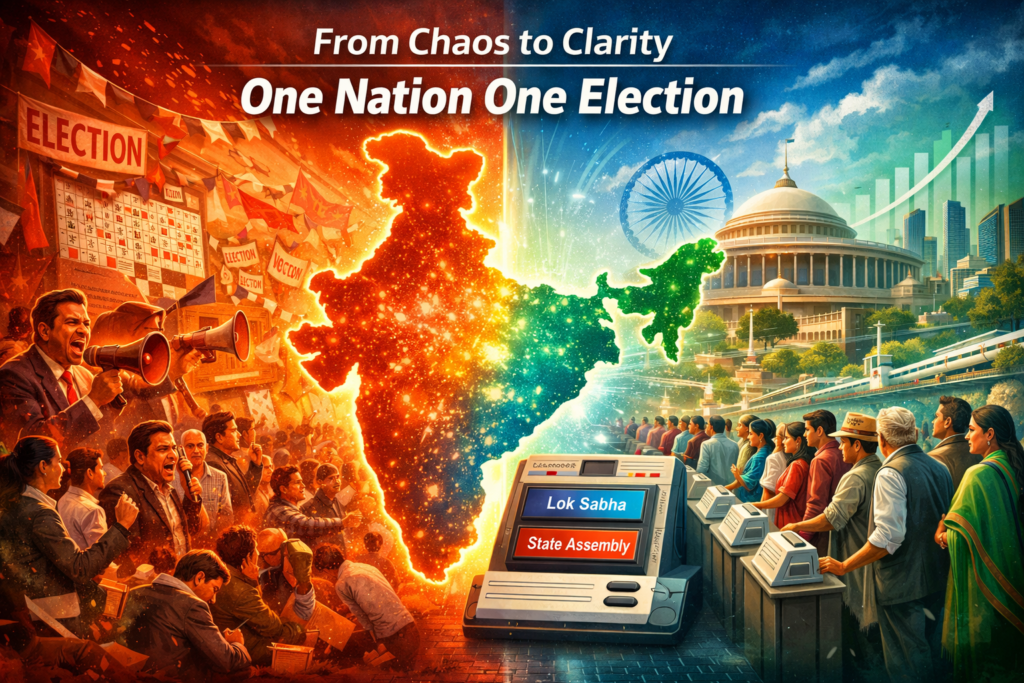
Detailed Analysis of One Nation One Election
In a vast democracy like India, elections are not just a political process—they are the backbone of governance and public participation. However, when elections occur frequently across different states, they begin to impact not only politics but also the economy, administration, and daily life of citizens.
This is where the concept of One Nation One Election emerges as a major reform idea. It aims to make India’s electoral system more efficient, structured, and cost-effective.
🔍 Related Article
Artificial Intelligence is rapidly transforming global politics, elections, and democratic systems. From data-driven campaigning to AI-powered misinformation, its impact is growing every year.
Read Full Article: AI in Politics 2026 Impact →1. What is One Nation One Election?
Definition and Core Concept
One Nation One Election refers to a proposed system where elections for the Lok Sabha (central government) and all State Legislative Assemblies are conducted at the same time.
Currently, elections in India are held at different times in different states. As a result, elections take place almost every year somewhere in the country. Under this proposed system, all voters would cast their votes simultaneously—one for the central government and one for their respective state government.
This approach aims to create a fixed electoral cycle, where major elections are held once every five years across the entire nation.
The core objectives of this concept include:
- Streamlining the electoral process
- Reducing the frequency of elections
- Ensuring continuity in governance
- Optimizing the use of national resources
To understand this with a simple analogy, imagine a school where exams are conducted multiple times throughout the year for different classes, causing constant disruption. Now compare that with a system where all exams are conducted at one fixed time—this reduces stress, saves time, and improves efficiency.
Although the idea appears simple and practical, implementing One Nation One Election is complex. It involves constitutional amendments, political consensus, and careful consideration of India’s federal structure.
Therefore, this concept is not just an electoral reform—it represents a significant transformation in the way democracy functions in India.
2. History of Elections in India
The history of elections in India reflects the evolution of the world’s largest democracy. The current electoral system did not develop overnight—it has gone through several phases of change and adaptation over time.
Simultaneous Elections from 1951 to 1967
India conducted its first general elections in 1951-52, which were considered the largest democratic exercise in the world at that time. During this period, a unique system was followed where elections for the Lok Sabha and all State Legislative Assemblies were held simultaneously.
Under this system:
- Voting took place across the country at the same time
- Both central and state governments were elected together
- The electoral process was more streamlined and efficient
This system continued successfully until 1967. It ensured a fixed electoral cycle and provided administrative and financial stability.
Changes in the Election System After 1967
After 1967, the election system in India began to change significantly. Political instability increased in several states, and many governments could not complete their full terms.
The major reasons behind this shift included:
- Premature dissolution of state governments
- Unstable political alliances
- Differing political situations between the center and states
- Frequent imposition of President’s Rule
As a result, the synchronized election cycle broke down, and elections for the Lok Sabha and State Assemblies started being held at different times.
Today, India experiences elections almost every year in different states, leading to a continuous election cycle across the country.
This is why the concept of One Nation One Election is being revisited—to potentially restore a more coordinated and efficient electoral system similar to the earlier model.
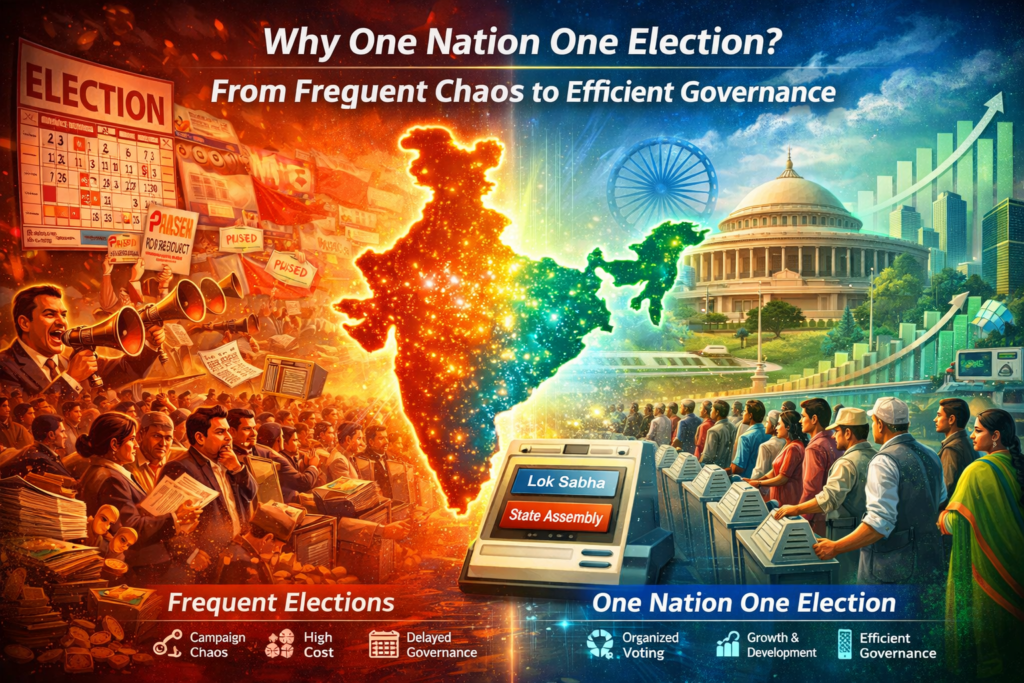
3. Why is One Nation One Election Needed?
In a vast and diverse country like India, elections are a vital part of democracy. However, when elections are conducted frequently throughout the year, their impact extends beyond politics and begins to affect governance, the economy, and the daily lives of citizens.
This is why the concept of One Nation One Election is gaining attention—as a potential solution to make the electoral system more efficient and balanced.
Impact of Frequent Elections
Under the current system, elections are held at different times in different states. As a result, the country remains in a constant election mode almost throughout the year.
This leads to several challenges:
- Frequent disruption of government policies and development projects
- Implementation of the Model Code of Conduct delays decision-making
- Political parties remain engaged in continuous campaigning
- Long-term governance and planning are affected
For example, when elections are announced in a state, government officials are often assigned election duties, which slows down administrative work and public services.
Administrative and Economic Burden
Conducting elections repeatedly places a heavy burden on both administration and the economy.
Key issues include:
- Massive expenditure—elections cost thousands of crores of rupees
- Repeated deployment of security forces and government staff
- Frequent use of schools and public infrastructure as polling centers
- Significant diversion of administrative machinery toward election duties
Additionally, frequent elections can create uncertainty in policy decisions, which affects businesses, investors, and overall economic stability.
Considering these factors, One Nation One Election is seen as a potential reform that could optimize resource utilization, reduce costs, and ensure smoother governance across the country.
4. Advantages of One Nation One Election
One Nation One Election is considered a major reform in India’s electoral system. It offers several benefits that can positively impact governance, the economy, administration, and citizens.
Cost Reduction
Conducting elections in India is an expensive process. Each election involves significant spending by the government, the Election Commission, and political parties.
If Lok Sabha and State Assembly elections are held simultaneously:
- The overall cost of conducting elections can be significantly reduced
- Expenditure on security arrangements will decrease
- Political parties will spend less on repeated campaigns
This can lead to better utilization of national resources, allowing funds to be redirected toward development activities.
Better Governance and Policy Making
Frequent elections lead to repeated enforcement of the Model Code of Conduct, which slows down decision-making and policy implementation.
With simultaneous elections:
- Governments can function without frequent interruptions
- Long-term policies can be implemented more effectively
- Decision-making becomes more stable and consistent
This ensures continuity in governance and accelerates development across sectors.
Increase in Voter Participation
Frequent elections can lead to voter fatigue, where people lose interest in participating repeatedly.
However, if elections are held together:
- Voters may be more motivated to participate in a single, significant event
- Voter turnout is likely to increase
- Both rural and urban participation may improve
Additionally, citizens will not need to visit polling stations multiple times, saving both time and effort.
Considering these advantages, One Nation One Election has the potential to strengthen India’s democratic system and make it more efficient and citizen-friendly.
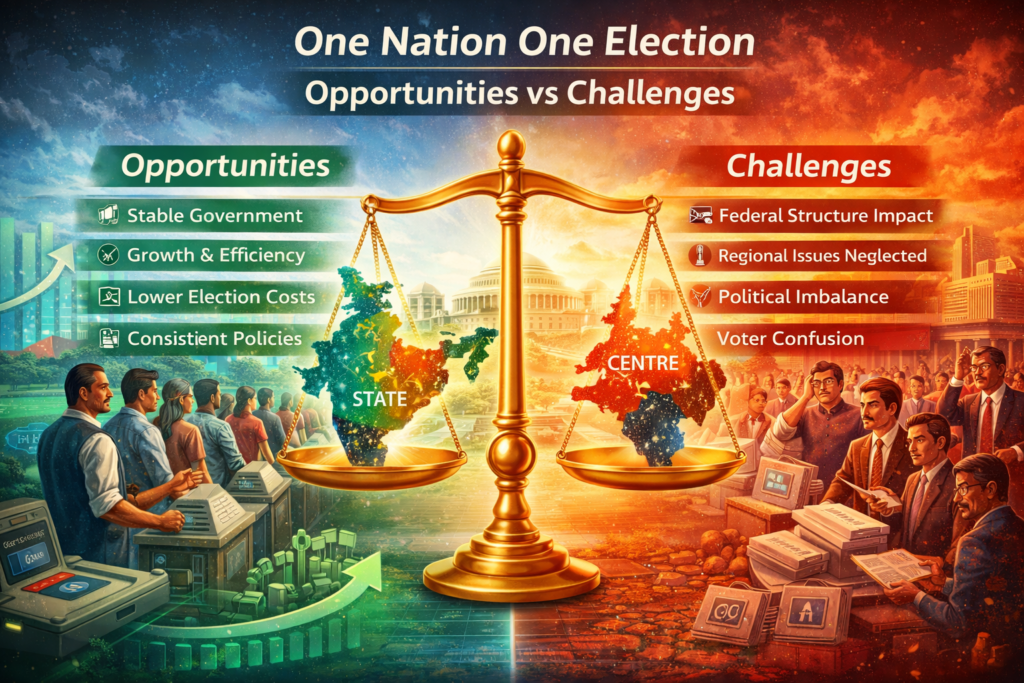
5. Challenges of One Nation One Election
While One Nation One Election offers several advantages, it also comes with significant challenges. Implementing this reform is not just an administrative decision—it involves complex constitutional, political, and practical issues.
Understanding these challenges is essential to evaluate whether this system can be successfully implemented in India.
Need for Constitutional Amendments
To implement One Nation One Election, major amendments to the Indian Constitution would be required.
Currently, various constitutional provisions govern the tenure and dissolution of the Lok Sabha and State Legislative Assemblies.
- The terms of central and state governments end at different times
- Governments can fall before completing their full term
- Elections may be delayed in extraordinary situations
Aligning all these timelines into a single election cycle is complex and would require broad political consensus and legal changes.
Impact on Federal Structure
India follows a federal system, where both the central and state governments have their own powers and responsibilities.
Critics argue that implementing One Nation One Election may:
- Reduce the political autonomy of states
- Allow national issues to overshadow regional concerns
- Increase the influence of the central government
This could weaken the voice of states and affect the balance of power in India’s federal structure.
Situation of Government Collapse
One of the biggest practical challenges is handling situations where a government falls before completing its term.
This raises several important questions:
- Should fresh elections be conducted immediately?
- Should an interim government be formed?
- Should President’s Rule be imposed?
Frequent government collapses can disrupt the synchronization of elections, making it difficult to maintain a fixed electoral cycle.
Therefore, a clear and sustainable mechanism must be developed to address such scenarios effectively.
Considering all these factors, it is evident that One Nation One Election is not just a simple reform—it is a complex transformation that requires careful planning, legal restructuring, and strong political consensus.
6. Impact on Democracy and Federal System
The concept of One Nation One Election goes beyond just electoral reforms. It has the potential to significantly influence India’s democratic framework and its federal structure. Like any major reform, it comes with both positive and negative implications.
Positive Impact
If implemented effectively, One Nation One Election can bring several benefits to democracy:
- Stable Governments: Simultaneous elections can ensure that governments complete their full term, leading to greater political stability.
- Continuity in Policies: Frequent elections disrupt policy implementation. A fixed cycle allows long-term planning and execution.
- Reduced Election Expenditure: Lower costs can free up resources for development and welfare programs.
- Administrative Efficiency: Government machinery will not be repeatedly engaged in election duties, improving governance.
These factors can strengthen the overall functioning of democracy and improve governance outcomes.
Negative Impact
Despite its advantages, there are potential drawbacks that need careful consideration:
- Neglect of Regional Issues: National-level debates may overshadow local and state-specific concerns.
- Impact on Federal Structure: It may reduce the autonomy of states and tilt the balance toward the central government.
- Political Imbalance: Larger political parties may gain an advantage, potentially weakening smaller regional parties.
- Voter Confusion: Casting votes for multiple levels of government at once may confuse some voters.
Therefore, while One Nation One Election has the potential to improve efficiency, it must be implemented with caution to preserve the balance between national unity and regional representation.
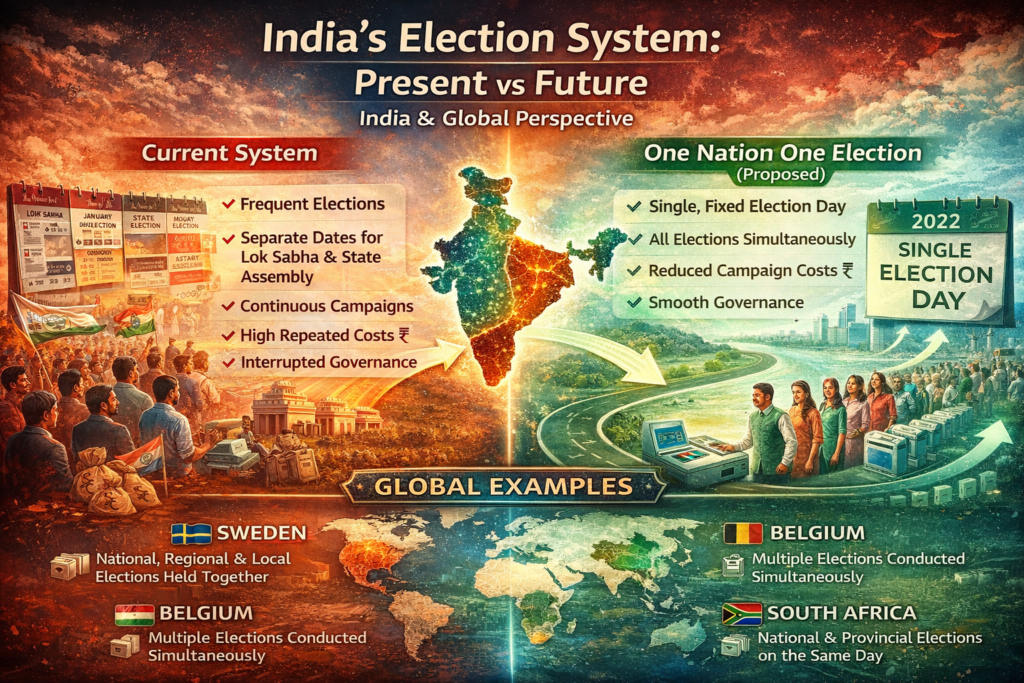
7. Current vs Proposed Election System
India’s electoral system has evolved over time. Currently, elections are held at different times across states, while the concept of One Nation One Election proposes a unified system where all elections are conducted simultaneously.
Understanding the difference between these two systems is essential to evaluate which approach is more effective and suitable for the country.
Current Election System
In the existing system, elections for the Lok Sabha and State Legislative Assemblies are conducted at different times. As a result, elections take place throughout the year in various parts of the country.
Key features of the current system:
- Lok Sabha and State Assembly elections are held separately
- The country remains in a continuous election mode
- Government policies often face interruptions
- Frequent elections lead to repeated financial expenditure
While this system allows states to function independently, it also creates administrative challenges and economic pressure.
📌 Important Current Affairs Update
Stay updated with the latest national and international developments for competitive exams. This article covers important topics from economy, defence, science, and global events in a concise format.
Read Current Affairs – 27 March 2026 →Simultaneous Election System
Under the proposed One Nation One Election system, elections for the Lok Sabha and all State Assemblies would be conducted at the same time.
Key features of the proposed system:
- A fixed election cycle across the entire country
- Voters cast their votes once for both central and state governments
- Reduction in election-related costs
- Governments get a full term to function without interruptions
This system is considered more organized and efficient from an administrative perspective. However, it requires careful planning and resolution of legal and political challenges before implementation.
This comparison clearly shows that both systems have their own advantages and limitations, and a balanced approach is necessary to determine the best path forward.
8. Examples from Other Countries
The concept of One Nation One Election is not unique to India. Several countries around the world follow systems where national and regional elections are conducted simultaneously or within a fixed cycle.
Studying these countries helps us understand how such a system works in practice, along with its benefits and limitations.
Sweden, South Africa, Belgium
Sweden: In Sweden, elections for the national parliament (Riksdag), regional councils, and local municipalities are held simultaneously every four years. This ensures a streamlined electoral process and reduces administrative costs while maintaining efficiency.
South Africa: South Africa conducts national and provincial elections at the same time. Although local elections are held separately, simultaneous national and provincial elections help maintain political stability and reduce election-related expenses.
Belgium: Belgium, a federal country like India, also conducts several elections in a coordinated manner. Despite having a complex political structure, it manages to maintain administrative efficiency through synchronized elections.
These examples show that simultaneous election systems can work effectively in different political environments. However, each country has its own unique structure, so direct comparison with India must be done carefully.
Therefore, before implementing One Nation One Election, India needs to carefully study global experiences and adapt the model according to its own constitutional and political framework.
9. Future and Possibilities in India
One Nation One Election is considered a significant step toward electoral reform in India. Although it has not yet been fully implemented, there is growing discussion among policymakers, experts, and political leaders about its future and feasibility.
If implemented effectively, this system has the potential to make India’s democratic process more stable, efficient, and streamlined.
Government Initiatives and Plans
The Government of India has taken several steps to explore the idea of One Nation One Election. Various committees and policy discussions have been initiated to study its feasibility and implications.
Key initiatives include:
- Discussions and recommendations by policy think tanks
- Formation of expert committees to examine legal and constitutional aspects
- Efforts to build consensus among political parties
The objective is to ensure that any implementation is well-planned, legally sound, and widely accepted.
Possible Implementation Strategy
Implementing One Nation One Election across the entire country at once may be challenging. Therefore, a phased or gradual approach is being considered.
Possible strategies include:
- Aligning elections in certain states as a first step
- Synchronizing Lok Sabha elections with selected State Assemblies
- Gradually establishing a uniform election cycle across the country
Additionally, advancements in technology such as digital voting systems and improved election management can support the implementation process.
Considering all these factors, the future of One Nation One Election in India appears promising. However, its success will depend on careful planning, strong political consensus, and necessary legal reforms.
10. Conclusion
One Nation One Election has the potential to become a transformative reform in India’s electoral system. It can reduce the frequency of elections, improve administrative efficiency, and ensure better utilization of economic resources.
However, it also comes with significant challenges, including the need for constitutional amendments, concerns about the federal structure, and handling situations where governments fall before completing their term.
Therefore, it is not just a simple reform but a complex process that requires careful planning, legal adjustments, and broad political consensus.
📌 Latest Current Affairs
Stay updated with the most important national and international events for exam preparation. Our latest current affairs cover defence, economy, science, and global developments in a simple and exam-focused format.
Read Current Affairs – 29 March 2026 →Is One Nation One Election Right for India?
This question continues to be widely debated. Some experts believe it is essential for improving governance and stability, while others argue that it may pose risks to democracy and the autonomy of states.
If implemented thoughtfully and with proper safeguards, it could be a game-changer for India. However, rushing into it without full preparation and agreement could create new challenges.
Ultimately, the success of One Nation One Election will depend on collective decision-making involving policymakers, political parties, experts, and informed citizens.
As responsible citizens, it is important for us to understand this concept, evaluate its pros and cons, and actively participate in discussions about the future of India’s democracy.
FAQs (Frequently Asked Questions)
1. What is One Nation One Election?
One Nation One Election is a system where elections for the Lok Sabha and all State Legislative Assemblies are conducted at the same time.
2. Why is One Nation One Election important?
It reduces the frequency of elections, lowers costs, and allows governments to function without frequent interruptions.
3. Were simultaneous elections held in India before?
Yes, from 1951 to 1967, India conducted Lok Sabha and State Assembly elections simultaneously.
4. What are the main advantages of One Nation One Election?
It helps reduce election expenses, improves governance stability, and ensures better use of administrative resources.
5. What are the major challenges of this system?
The biggest challenges include constitutional amendments, political consensus, and managing situations where governments fall before completing their term.
6. Will it affect democracy?
It can improve efficiency, but there are concerns that it may impact regional representation and federal balance.
7. Can this system be implemented in India?
Yes, but it requires legal reforms, careful planning, and agreement among political stakeholders.
References
- Election Commission of India – https://eci.gov.in/
- NITI Aayog Report – https://www.niti.gov.in/
- PRS Legislative Research – https://prsindia.org/
- Wikipedia – Simultaneous Elections in India – https://en.wikipedia.org/wiki/Simultaneous_elections_in_India
- Government of India Official Portal – https://www.india.gov.in/
The above sources are reliable and provide valuable information to understand the concept of One Nation One Election in detail.