

Definition of Newspaper & News Agencies
A newspaper is a printed or digital publication, which is published at regular intervals (daily, weekly, or monthly). Its main purpose is to provide news, information, views, and information about events. Newspapers publish news and articles related to politics, economy, sports, society, science, culture, entertainment, and other topics.
Definition of newspaper: “Newspaper is a medium through which information, views, and analysis of important events and topics of society, country and world are delivered to the readers.”
It is an important means of disseminating information and increasing public awareness.
News Agencies are the organizations that do the work of news collection and broadcasting. These agencies provide fresh and authentic news content to newspapers, radio, television and online media. There are many major news agencies in India and the world.
What Is the History of Newspaper Agencies?
Early History
1. Early News and Information
In ancient times, only mouth-to-mouth and letters were used to convey news to each other. People also exchanged news through tea addresses, pieces of paper, and royal orders. In the medieval period, the use of paper messages increased between royalty and merchants to exchange information related to trade and war.
2. Formation of the First News Agency
Agence Havas, established in France in 1835, is considered to be the world’s first news agency. Its purpose was to disseminate business news. Havas was nationalized by the French government in 1940 and later became known as “Agency France-Presse (AFP)”.
Expansion of News Agencies in the 19th Century
1. Reuters
In 1851, British journalist Charles Louis Reuters started a news agency named “Reuters”. The specialty of Reuters was that it started exchanging news through wires, which caused the news to spread very fast. The main objective of Reuters was to disseminate financial and business news.
2. Associated Press (AP)
Associated Press (AP) was established in America in 1846. This was also a joint effort involving major newspapers of America. It was started specifically to get news about American war and national events. After this, this agency became a pioneer in the dissemination of international news.
3. Growth and Global Expansion
By the end of the 19th century, these news agencies established their correspondent offices in different parts of the world and the dissemination of news increased rapidly. These agencies introduced high standards of journalism and started collecting news for media houses around the world.
Evolution of News Agencies in the 20th Century
1. New Technological Advancements
In the early 20th century news agencies started using radio, television and later the internet. This technological development helped news agencies not only to disseminate news but also made them part of a vast global network.
2. New Agencies
Press Trust of India (PTI): PTI was established in India after independence in 1947. It became India’s leading news agency, compiling and distributing Indian news.
Reuters: Britain’s Reuters news agency increased its influence globally in the mid-20th century and became a major source of global business news.
3. Specialized Scope
By the mid-20th century news agencies were not limited to general news but also focused on specialized subjects such as war, international political events, sports, science and technology news.
Development of News Agencies in Current Times
1. Impact of Digital Media
The development of the Internet and digital technologies has completely changed the way news agencies work. Now these agencies have new opportunities to provide information through live reporting, social media and digital platforms.
2. News Agencies and Social Media
In the 21st century, news agencies are using social media, which allows them to distribute news faster and reach people around the world.
3. Global Network
Today’s major news agencies such as AP, Reuters, AFP, and Bloomberg have established global networks and have correspondent teams everywhere. These agencies compile news from around the world and supply these news to major media channels.
Conclusion
News agencies have evolved over time and now they do not just collect news, but have become an influential platform for exchanging global information. Their impact is profound on society, politics and economy. News agencies have set many new standards in the field of journalism, and they will continue to evolve.
Explain the Concept of Newspaper Agencies
News agencies are organisations that collect, disseminate and distribute news. The main function of these agencies is to collect fresh and accurate news from around the world and provide it to various media institutions such as newspapers, radio, television channels, and internet platforms.
Key Aspects of the Concept of News Agencies
1. Collection and Distribution of News
News agencies collect news from various sources such as correspondents, reporters, government press releases, and open sources. They then distribute the news to various media platforms. For example, a news agency reports an important political event and sends it to media houses around the world.
2. Equality and Impartiality
News agencies work on impartiality and neutrality. Their aim is to provide news without bias or ideology, ensuring people receive accurate and fair information.
3. Optimum Utilization of Resources
They use a wide global network of correspondents and advanced technologies such as the Internet, mobile, and satellite networks to deliver fast and accurate news.
4. Characteristics and Types
General News: Political, social, economic, sports, cultural, and science-related news.
Analytical Reports: In-depth reports such as global economic crises or war analysis.
Photo & Video Reporting: Agencies also provide multimedia content to enhance news presentation.
5. Credibility of News
News agencies maintain strong standards for accuracy, objectivity, and freshness, making their content highly reliable.
6. Economic Model
They primarily use subscription-based systems where media houses pay to receive news content. Some earn through advertising and special services.
7. Major News Agencies
- Reuters (UK)
- Associated Press (AP) (USA)
- AFP (France)
- PTI (India)
- Bloomberg (USA – business news)
Role of News Agencies
1. Dissemination of Information
They deliver the latest news and events to the public quickly and efficiently.
2. Reliability and Objectivity
They maintain high credibility and provide unbiased news.
3. Global Network
Agencies have correspondents worldwide who cover important events and crises.
Conclusion
News agencies play a significant role in journalism by providing quick, accurate, and unbiased information. They ensure public awareness and help society stay connected with global events. Their contribution sets journalism standards and supports the flow of information in the world.

Explain the Concept of Newspaper Agencies
News Agencies are organizations that collect, disseminate, and distribute news. The main function of these agencies is to collect fresh and accurate news from around the world and provide it to various media organizations such as newspapers, radio, television channels, and internet platforms. The aim of these agencies is to disseminate information quickly and reliably.
Key Aspects of the Concept of News Agencies
Collection and Distribution of News
News agencies collect news from various sources, such as correspondents, reporters, government press releases, and other open sources. These then distribute the news to various media platforms for dissemination. For example, a news agency reports an important political event and sends it to media houses around the world.
Equality and Impartiality
News agencies work on the policy of impartiality and neutrality. They aim to provide news without any personal or institutional ideology, avoiding any kind of biased stance. This ensures that people from all sections and regions can get accurate and unbiased information.
Optimum Utilization of Resources
News agencies use an extensive network of correspondents who are located in various places across the world. Through these correspondents, agencies provide prompt reporting of events and issues. In addition, these agencies use the latest technological resources such as the Internet, mobile, and satellite technology, so that they can deliver news more quickly and accurately.
Characteristics and Types
General News
These include political, social, economic, sports, cultural, and science-related news.
Analytical Reports
News agencies also do in-depth and detailed reporting, such as reports on the global economic crisis or analysis on war situations.
Photo and Video Reporting
News agencies provide photo and video content in addition to journalism, which further enhances the impact of the news.
Credibility of News
The information provided by news agencies is trusted because they set standards to ensure accuracy, freshness, and objectivity. Their information is used by media houses, governments, business institutions, and international organizations.
Economic Model
News agencies usually work on a subscription-based model, where media houses and other clients buy news content from them. Apart from this, some news agencies also earn income through advertising and other services.
Major News Agencies
Reuters
It is a major UK-based news agency, which provides economic, business and general news.
Associated Press
It is a major US news agency, which is known for its impartiality.
AFP (Agence France-Presse)
It is a major international news agency of France.
Press Trust of India (PTI)
It is India’s leading news agency, which compiles Indian news.
Bloomberg
It is an American news agency, which specializes in business and financial news.
Role of News Agencies
Dissemination of Information
News agencies make the society aware of the latest news, events and issues. They have become an important source for conveying information about events to the people.
Credibility and Objectivity
News agencies provide accurate and unbiased news, thereby setting a standard for other forms of media.
Global Network
These agencies have a vast network of correspondents who collect news from all over the world and deliver it to every place.
Conclusion
News agencies play an important role in the field of dissemination of information and journalism. They influence journalism through quick, accurate, and unbiased distribution of information across the world and provide correct and important information to the society. Their job is not only to collect and distribute news but also to spread awareness in the society.

Definition of Newspaper Agencies
News agencies are organizations or institutions that collect news from various sources and disseminate it to various media houses, newspapers, radio, television channels, and other platforms. Their main purpose is to disseminate information, provide fresh news, and report unbiased and accurate updates. News agencies usually report events and issues through a network of correspondents spread across the world.
In simple terms, newspaper agencies are organizations that distribute collected news to various media organizations, so that news can be disseminated quickly and effectively.
Key Elements
1. News Gathering
Agencies collect news from various sources such as reporters, government press releases, and other open sources.
2. Accuracy and Objectivity
The main purpose of these agencies is to disseminate news in an accurate and unbiased manner.
3. Distribution
News agencies send the same news to different media houses and platforms.
4. Global Coverage
News agencies collect fresh news from all over the world and disseminate it instantly.
Newspaper agencies are an important part of the media, contributing to the rapid dissemination of information and spreading awareness in society.
Explain the Importance of Newspaper Agencies
News agencies play a central role in the world of journalism and information dissemination. These agencies not only compile and distribute news but are also important for making the exchange of information in society quick, reliable, and unbiased. Their importance can be understood from several aspects:
1. Immediate Information Dissemination
News agencies do quick reporting of events and disseminate that information immediately across the world. As soon as an event occurs, agencies cover it instantly and send it to various media organizations. This ensures that the news reaches readers, viewers, and listeners quickly.
2. Credibility and Impartiality
Major news agencies such as Associated Press, Reuters, and AFP are known for credibility and impartiality. These agencies disseminate news in an unbiased and accurate manner, due to which media organizations trust their content.
3. Uniform News Distribution
News agencies distribute the same news across multiple media platforms such as newspapers, radio, TV channels, and online mediums. This ensures that society receives consistent and uniform information.
4. Global Network and Reporting
News agencies report global events through a network of correspondents spread across the world. They collect and disseminate news about important events and crises, such as wars, natural disasters, and political situations.
5. Focus on Specific Areas
They provide expert reporting on topics such as politics, business, sports, science, society, environment, and health. This helps media organizations access in-depth and accurate information.
6. Resources for Press and Media Organizations
News agencies serve as a major resource for journalism. Newspapers, TV channels, and online portals rely heavily on news agency content to save time and publish comprehensive stories.
7. Documenting Monumental Events
News agencies document major events such as wars, global summits, natural disasters, and political changes. These reports serve as historical records for future reference.
8. Spreading Awareness to Society
They highlight pressing social issues such as human rights, environment, health, and education. This helps shape public awareness and encourages positive societal change.
9. Emergency Information Dissemination
During crises or natural disasters, news agencies quickly collect and disseminate information. This helps guide rescue operations and provides reliable updates to affected populations.
10. Economic and Business News
News agencies are major providers of financial and business information. They report on stock markets, corporate profits, global economy, and other financial indicators, helping investors and policymakers make informed decisions.
Conclusion
News agencies are of immense importance as they serve as a means of quick and reliable dissemination of information. They ensure accuracy, impartiality, and credibility while enabling the exchange of information among societies and communities. By focusing on global events and emerging issues, they help create awareness and set high standards in the field of journalism.
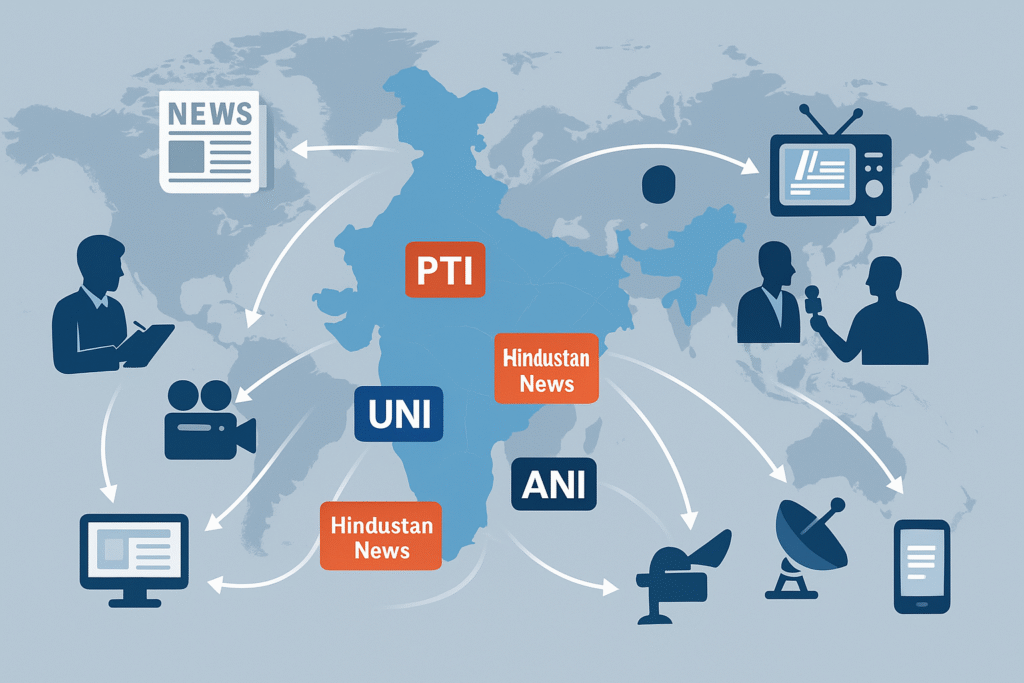
Major News Agencies of India
1. Press Trust of India (PTI)
India’s largest and oldest news agency.
Established: 1947
It provides news in English and other Indian languages.
2. United News of India (UNI)
Established: 1961
It provides news services in Hindi and English.
3. Hindustan News
Established: 1948
It is a multilingual news agency, providing news in various Indian languages.
4. Asian News International (ANI)
It is India’s leading multimedia news agency.
Specialty: Video news and broadcasting.
5. Indian National News Agency (INS)
It serves as the government news agency.
Produces news for radio and television.
These agencies play a major role in news collection and distribution and provide accurate information to the media at the national and international levels.
Press Trust of India (PTI)
Main Features
1. Establishment
Press Trust of India was established on 27 August 1947. It was established soon after independence so that India would have an independent news agency.
2. Headquarters
New Delhi.
3. Scope
PTI provides national and international news. It provides news on politics, economy, sports, science, technology, and cultural topics.
4. Languages
It provides news mainly in English, but its services are also available in regional languages.
5. Clients
Newspapers, TV channels, radio stations, government institutions, and digital media are its major clients.
6. Independence and Impartiality
PTI is known for its impartiality and credibility.
Importance
PTI is the largest source of fresh and authentic news for the Indian media. It is recognized as a credible news agency even outside India. PTI plays an important role in maintaining the flow of information in Indian democracy.
United News of India (UNI)
Key Features
1. Establishment
United News of India was established on 19 December 1961.
2. Headquarters
New Delhi.
3. Scope
UNI collects news from India and abroad. It provides news in various fields including politics, business, sports, science, health, and entertainment.
4. Languages
UNI mainly provides news services in Hindi and English. Hindi language news is provided through UNI-Varta.
5. Clients
Newspapers, television channels, radio stations, government institutions, and digital platforms.
6. Special Services
UNI Photo, UNI Cyber, UNI Finance.
Importance
It is a leading source of independent and unbiased news in India. UNI focuses on regional news, making it influential at the local and national level. It is known for its credibility in Indian journalism.
Hindustan News
“Hindustan News” is India’s first multilingual news agency. It is known for providing news in different languages across the country.
1. Establishment
Hindusthan News was established in 1948. It was founded keeping India’s linguistic diversity in mind.
2. Headquarters
New Delhi.
3. Scope of Work
It collects news at national and regional levels. Focuses on politics, business, sports, culture, social issues and international topics.
4. Languages
Provides news in more than 14 Indian languages including Hindi, Bengali, Marathi, Gujarati, Tamil, Telugu, Kannada and others.
5. Clients
Newspapers, radio channels, TV networks, and digital media platforms.
6. Features
Represents India’s cultural and linguistic diversity. Strong focus on local news.
Importance
It helps bring rural and regional voices to the mainstream. A reliable source for authentic news in regional languages. Strengthened the structure of Indian news agencies after independence.
Indian National Newsletter (INS)
Indian National Newsletter (INS) is a premier news agency of the Government of India, also known as the news department of “All India Radio”.
1. Establishment
INS was established to disseminate government news and information to the public.
2. Headquarters
New Delhi.
3. Scope
Provides news related to government policies, schemes, and announcements. Focuses on social, economic, and cultural events.
4. Languages
Provides news in Hindi, English, and other regional languages.
5. Affiliation
Works under the Ministry of Information and Broadcasting. Associated with All India Radio (AIR) and Doordarshan.
6. Special Services
Prepares special reports on development programmes, government schemes, and national events. Provides quick information during emergencies.
Importance
The most reliable source of government information. Helps increase awareness about government schemes across India. Provides accurate and prompt updates.
ANI (Asian News International)
Asian News International (ANI) is a leading multimedia news agency in India, primarily known for video news broadcasts and multimedia content.
1. Establishment
ANI was established in 1971. It is India’s first multimedia news agency.
2. Headquarters
New Delhi.
3. Scope
Works on national and international news. Covers politics, business, sports, entertainment, health, technology and international events.
4. Special Services
Video News: ANI’s specialty. Photo and text news. Live event coverage.
5. Clientele
Indian and international news channels, government departments, corporate entities, and digital media platforms.
6. Languages
Provides content primarily in English. Recently expanded services in Hindi and regional languages.
Importance
One of India’s most trusted and influential news agencies. Pioneer in video news content. Partners with international agencies for global news exchange. Plays a major role in digital media transformation.

The World’s Leading News Agency
The world’s leading news agency can vary depending on the metric used—such as global reach, influence, or volume of content produced. However, a few agencies are widely regarded as the most prominent and influential:
Associated Press (AP)
Founded in 1846, AP is a not-for-profit cooperative based in the United States. It serves thousands of newspapers, broadcasters, and online outlets worldwide. Its unbiased and extensive coverage makes it one of the most trusted names in news.
Reuters
A British news agency founded in 1851, Reuters is renowned for its financial and business reporting, in addition to general news. It is part of the Thomson Reuters Corporation, listed on the London Stock Exchange.
Agence France-Presse (AFP)
Based in Paris and founded in 1835, AFP is one of the oldest global news agencies. It provides coverage in multiple languages and has a strong presence in Europe, Africa, and the Middle East.
Bloomberg News
Primarily known for its financial reporting, Bloomberg delivers high-quality journalism on global markets, business, and politics. It has become a leader in financial news over the past few decades.
Xinhua News Agency
China’s state news agency is one of the largest in the world by staffing and global reach. Xinhua provides extensive coverage in Chinese and many foreign languages.
Each agency has strengths in different areas, making them leaders in the global news industry.
Reuters
1. Establishment
Reuters was founded in 1851 by Paul Julius Reuter. It was initially created for stock market and financial news.
2. Headquarters
London, United Kingdom.
3. Scope
Reuters provides news on politics, economy, sports, science, business, technology, and international issues. Its services are the leading source for global media houses, financial institutions, and digital platforms.
4. Special Services
- Financial news and data analysis
- Live news reporting
- Photos, videos, and multimedia content
5. Languages
Reuters publishes news in major languages around the world.
6. Clients
Television channels, newspapers, radio stations, websites, and financial institutions.
Importance
Reuters is one of the most trusted and neutral news agencies in the world. It focuses on accurate and unbiased news delivery.
Influence of Reuters
- It sets the standard for global journalism.
- Used by almost every major news organization.
- Impactful on international politics and financial markets.
- Innovator in journalism—from homing pigeons to the digital age.
AFP (Agence France-Presse)
1. Establishment
AFP was founded in 1835 by Charles-Louis Havas. It is recognized as the world's oldest news agency.
2. Headquarters
Paris, France.
3. Scope
AFP covers politics, economy, sports, culture, science, health, and environmental topics. It provides comprehensive coverage of global events.
4. Languages
AFP publishes news in English, French, Spanish, Arabic, Portuguese, and German.
5. Clients
Major TV channels, radio stations, newspapers, digital media, and government bodies.
6. Special Services
- Photo and video content
- Live news coverage
- Special reports and data-driven journalism
Importance
AFP is known for neutral and credible news. It is a leading source for media houses worldwide.
Impact
- Renowned for accuracy and impartiality
- Provides fast coverage of world events
- Strong in political, cultural, and social reporting
- Historic credibility gives it a unique global position
Associated Press (AP)
1. Establishment
AP was founded in 1846 in New York City by six major American newspapers.
2. Headquarters
New York, USA.
3. Scope
AP reports on politics, business, sports, science, entertainment, health, and global issues. It is known for breaking news and in-depth multimedia reporting.
4. Languages
Mainly English, with some content in Spanish and other languages.
5. Customers
Newspapers, TV channels, radio stations, digital platforms, governments, and corporations.
6. Special Services
- Photo and video journalism
- Live event coverage
- Data journalism and special reports
Importance
AP is one of the world’s most trusted and unbiased news agencies.
Impact
- Raised global journalism standards
- Known for accurate and comprehensive international coverage
- Global recognition for breaking news reporting
Bloomberg
1. Establishment
Bloomberg was founded in 1981 by Michael Bloomberg. It began with the goal of providing financial services and business information.
2. Headquarters
New York, USA.
3. Scope
Bloomberg specializes in financial news, market data, business reports, and analysis on stocks, bonds, commodities, foreign exchange, and global markets.
4. Languages
Mainly English, with services in other languages due to global operations.
5. Customers
Investors, financial institutions, corporate companies, and media houses.
6. Special Services
- Bloomberg Terminal: Instant financial data and analytics
- Bloomberg News: Global business and financial reporting
- Bloomberg TV: 24-hour financial news channel
Importance
Bloomberg is one of the most trusted sources of financial and economic information. Its reporting influences financial markets worldwide.
Bloomberg’s Influence
- Major source for investors and financial analysts
- Data and analysis influence global decisions
- Set new standards in data-driven journalism
IPS (Inter Press Service)
Inter Press Service (IPS) is an international news agency focusing on development, social justice, human rights, and environment. It amplifies the voices of developing nations (Global South).
1. Establishment
IPS was founded in 1964 in Rome, Italy. It aimed to bring the perspectives of developing countries to global media.
2. Headquarters
Rome, Italy.
3. Scope
IPS reports extensively on global social, economic, and environmental issues, focusing on the Global South. It highlights women’s rights, environment, conflict, human rights, and development challenges.
4. Languages
Mainly English, Spanish, and Arabic.
5. Clients
Media organizations, NGOs, public institutions, and global development bodies.
6. Special Services
- News reporting
- Feature stories
- Analytical reports
- Focus on environment, development, and social justice
Importance
IPS aims to highlight issues neglected in mainstream media and uplift the voices of developing nations.
Impact of IPS
- Brings Global South issues to mainstream media
- Focuses on justice, equality, and human rights
- Acts as a voice for marginalized societies
- Promotes social and political awareness
Conclusion
News agencies are a fundamental source of information for modern society. They act as a bridge to connect the global community as well as promote social, political, and economic development. However, it is very important to maintain their impartiality and credibility so that the information is not misused.
The presence of news agencies in the country and the world presents many important conclusions and effects. News agencies work to collect, authenticate and widely disseminate information at the global and local level. The following conclusions are drawn from this:
1. Dissemination and Access of Information
News agencies play an important role in disseminating information to every section of society. This gives citizens information about national and international events, which broadens their perspective.
2. Promotion of Democracy and Transparency
News agencies keep an eye on governments and administration and convey information about their policies and actions to the public. This helps in strengthening democracy, as transparency and accountability are ensured.
3. Global Connectivity
News agencies connect events of different countries. This allows people living in different parts of the world to understand each other’s culture, problems, and achievements.
4. Diversification of Information
Different types of news—political, economic, social, cultural—are available through news agencies. This allows people to get information based on their interests and needs.
5. Challenge of Fake News and Misinformation
While news agencies claim to provide true and authentic information, the spread of misinformation is a growing concern. Therefore, the responsibility of verifying information and maintaining impartiality becomes even more important.
6. Economic and Political Influence
News agencies influence global and local markets, politics, and social movements. The information they provide often helps in decision-making processes.
7. Symbol of Communication and Technological Progress
News agencies disseminate information quickly and effectively using modern technological tools. This technological progress has become even more important in the digital age.
References
- Associated Press (AP) – Official Website & Historical Archives
- Reuters News Agency – Thomson Reuters Corporation Publications
- Agence France-Presse (AFP) – Global News Reports & Media Resources
- Bloomberg News – Financial Market Reports & Business Journalism
- Xinhua News Agency – China Global Information Network Reports
- Press Trust of India (PTI) – Official News Releases & Bulletins
- United News of India (UNI) – UNI-Varta & UNI News Services
- Hindustan News Agency – Multilingual News Services (India)
- Asian News International (ANI) – Video & Multimedia News Broadcasts
- Indian National News Agency (INS) – AIR & Doordarshan Government Bulletins
- Inter Press Service (IPS) – Global South Development & Human Rights Reports
- Global Journalism Research Publications – Media Studies & Communication Sources
- Official Government of India – Ministry of Information & Broadcasting Resources
Newspaper hi vyakti ke azadi Ko abhivyakt Karta hai tatha vyakti ki swatantrata ko vyakt karte hain tatha duniya mein hone wali gatividhiyon se avgat karaoke