
📖 Nature of the Indian Constitution Introduction
The Constitution of India is one of the longest and most comprehensive written constitutions in the world. It came into force on 26 January 1950 and established India as a Sovereign, Socialist, Secular, Democratic Republic. The framers of the Constitution faced the enormous challenge of designing a system of government for a vast, diverse, multilingual, and multicultural nation while maintaining national unity and ensuring adequate powers for the states.
In this context, an important constitutional question arises: Is the Indian Constitution Federal or Unitary in nature? This topic has remained a significant subject of constitutional and political debate. Constitutional experts, legal scholars, and the judiciary have expressed different viewpoints regarding the true nature of India's constitutional framework.
The Indian Constitution incorporates features of both federal and unitary systems. Therefore, it cannot be classified as purely federal or purely unitary. Considering India's unique socio-political conditions, the Constitution establishes a system commonly described as a Quasi-Federal System with a strong central government and elements of Cooperative Federalism.
- Meaning of Federal Government
- Meaning of Unitary Government
- Federal Features of the Indian Constitution
- Unitary Features of the Indian Constitution
- Why India is Called a Quasi-Federal State
- Views of the Constituent Assembly and Supreme Court
- Important Facts for UPSC, SSC, State PCS & Other Competitive Exams
📖 Also Read: Preamble of the Indian Constitution
Before understanding whether the Indian Constitution is federal or unitary, it is important to understand the Preamble of the Indian Constitution, which reflects the philosophy, objectives, and fundamental values of the Constitution. The Preamble declares India as a Sovereign, Socialist, Secular, Democratic Republic and serves as the guiding spirit of constitutional governance.
👉 Read Complete Article on the Preamble of the Indian Constitution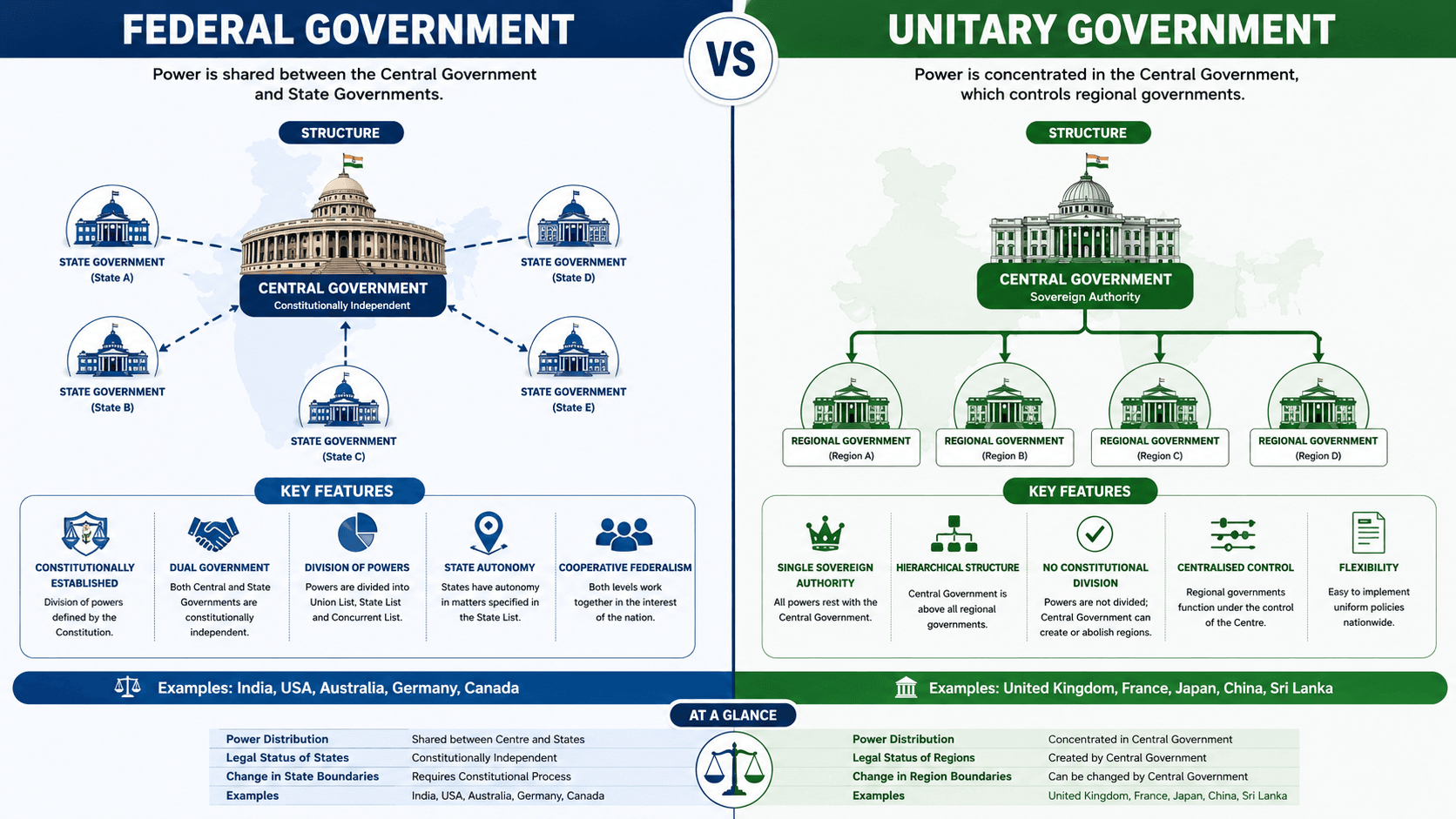
Nature of the Indian Constitution Meaning of Federal Government
A Federal Government is a system of governance in which powers are constitutionally divided between the central government and regional governments, such as states or provinces. Both levels of government derive their authority from the Constitution and operate independently within their respective jurisdictions.
The primary objective of a federal system is to maintain national unity while providing regional autonomy. Under this arrangement, the central government deals with matters of national importance, whereas state governments manage local and regional affairs.
Several countries, including the United States, Canada, Australia, and Switzerland, have adopted federal systems of government. In these countries, the Constitution clearly defines the powers and responsibilities of both the federal and state governments.
- Written Constitution
- Supremacy of the Constitution
- Division of Powers between the Centre and States
- Independent Judiciary
- Dual Government System
- Rigid Constitution and Special Amendment Procedure
Meaning of Unitary Government
A Unitary Government is a system in which all governing powers are concentrated in the hands of a central authority. Local or regional governments function under powers delegated by the central government and do not possess constitutionally guaranteed autonomy.
In a unitary system, the central government holds supreme authority and may alter the powers and functions of local bodies whenever necessary. This form of government promotes administrative uniformity and centralized decision-making.
The United Kingdom (UK) is one of the most notable examples of a unitary system, where Parliament remains the supreme authority and local governments operate under its control.
- Centralization of Powers
- Single Supreme Government
- Limited Regional Autonomy
- Flexible Constitutional Amendment Process
- Uniform Administration Across the Country
Federal Features of the Indian Constitution
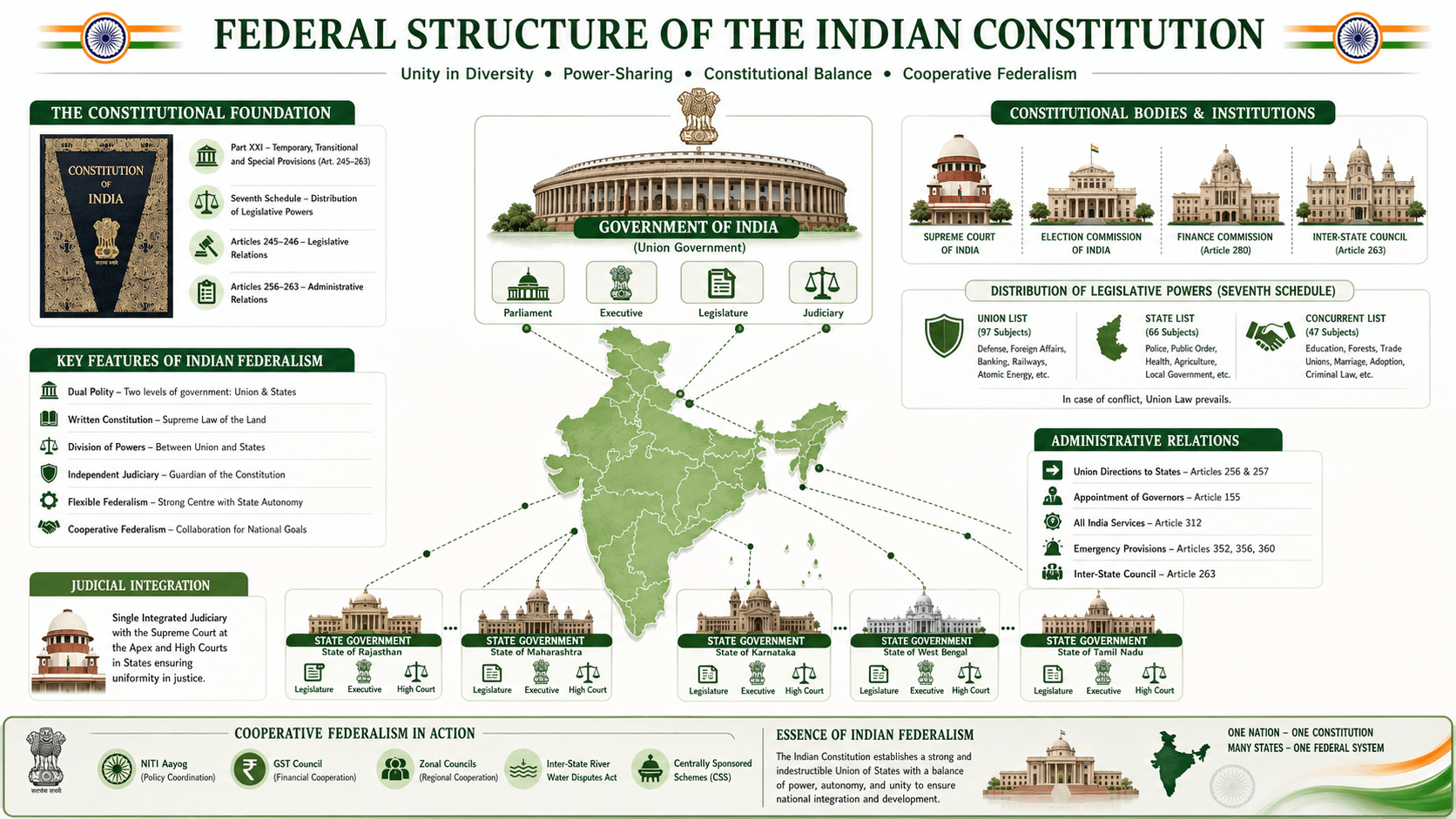
The Constitution of India contains several features that reflect its federal character. The framers of the Constitution established a system in which powers are distributed between the Union Government and the State Governments, ensuring a balance between national unity and regional autonomy.
1. Dual Polity
India has a dual system of government consisting of:
- Union Government
- State Governments
Both levels of government are created by the Constitution and operate independently within their respective spheres of authority. This dual structure is one of the most important characteristics of a federal system.
2. Constitutional Division of Powers
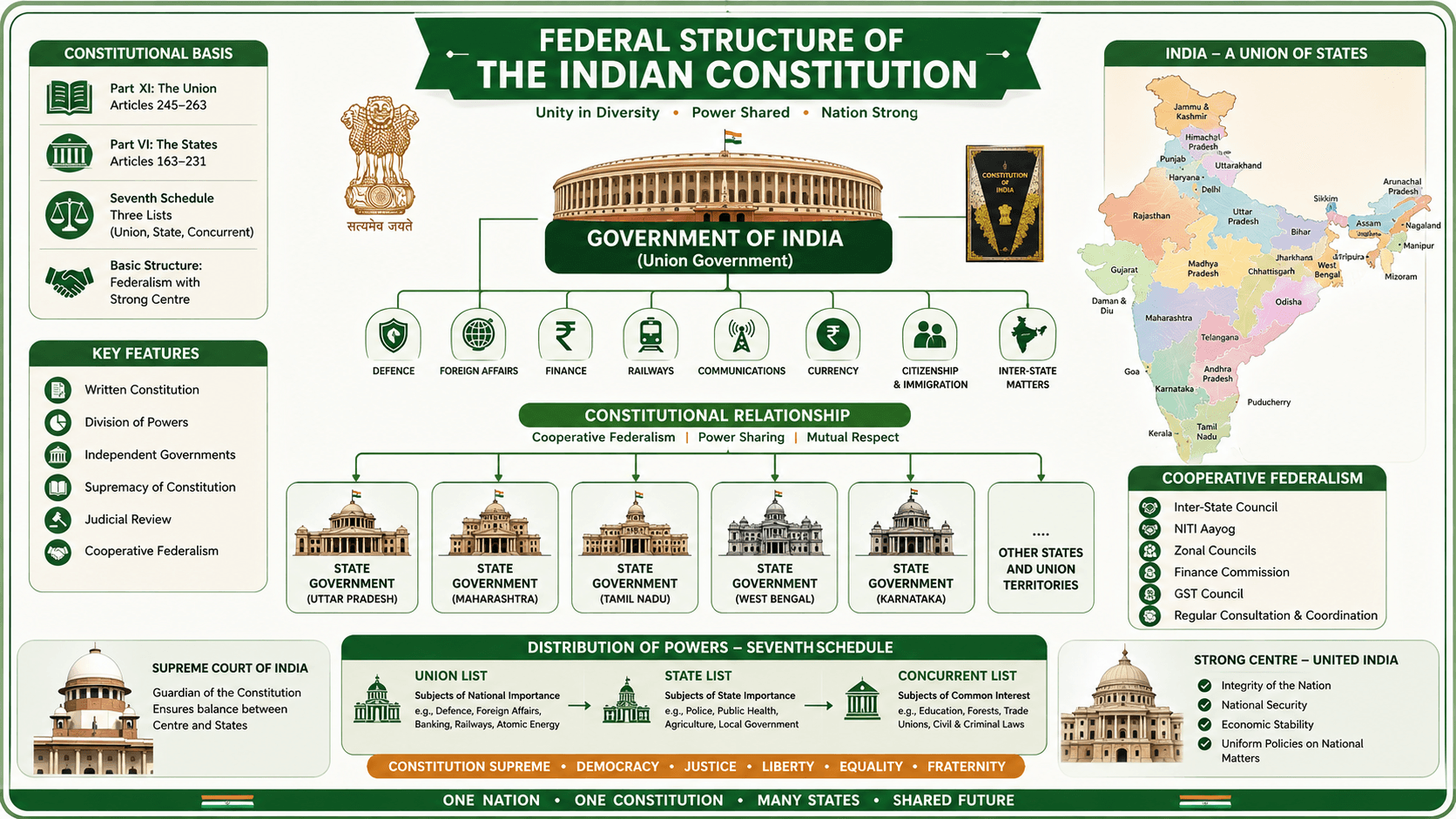
The Seventh Schedule of the Indian Constitution clearly divides powers between the Union and the States. These powers are categorized into three lists:
- Union List
- State List
- Concurrent List
This constitutional distribution of powers is a fundamental feature of federalism because it clearly defines the authority and responsibilities of each level of government.
⭐ Related Article: Features of the Indian Constitution
Understanding whether the Indian Constitution is Federal or Unitary becomes easier when you first understand its fundamental characteristics. Explore the detailed guide on the Features of the Indian Constitution to learn about constitutional supremacy, fundamental rights, federalism, parliamentary democracy, independent judiciary, and other key pillars of Indian governance.
- Key Features of the Indian Constitution
- Federal and Unitary Characteristics
- Parliamentary System of Government
- Independent Judiciary and Fundamental Rights
- Constitutional Supremacy and Democratic Values
1. Nature of the Indian Constitution Strong Centre
One of the most significant unitary features of the Indian Constitution is the existence of a strong central government. The framers of the Constitution granted greater powers to the Union Government in order to maintain national unity, security, and administrative efficiency.
Although powers are divided between the Union and the States through the Seventh Schedule, most matters of national importance are included in the Union List. Subjects such as defense, foreign affairs, currency, communications, and railways fall exclusively under the jurisdiction of the Union Government.
Furthermore, the Constitution grants residuary powers to the Union Government. This means that any subject not mentioned in the Union List, State List, or Concurrent List falls under the authority of Parliament.
In countries like the United States, residuary powers belong to the states, whereas in India they are vested in the Union Government.
2. Nature of the Indian Constitution Single Citizenship
India follows the principle of single citizenship. Every citizen is recognized solely as a citizen of India and not as a citizen of any particular state.
In contrast, countries such as the United States provide dual citizenship, where individuals are citizens of both the federal government and their respective states.
Single citizenship promotes national unity, equality, and integration, making it an important unitary feature of the Indian constitutional system.
3. Integrated Judiciary
India has established a unified judicial system. The Supreme Court stands at the apex of the judiciary, and all courts in the country function within a single integrated structure.
Unlike some federal countries that maintain separate federal and state court systems, India follows a unified judicial framework. This ensures consistency in the interpretation and application of laws throughout the country.
The integrated judiciary strengthens legal uniformity and reinforces the unity of the nation.
4. Nature of the Indian Constitution Appointment of Governors
According to the Constitution, the Governor of a State is appointed by the President of India. The Governor serves as the constitutional head of the state and acts as an important link between the Union and State Governments.
Since Governors are appointed by the Union Government rather than elected by the people of the state, this arrangement is often regarded as a unitary feature of the Indian Constitution.
5. Emergency Provisions
The Constitution of India contains special emergency provisions to deal with extraordinary situations. During an emergency, the powers of the Union Government expand significantly, and the autonomy of the states may be reduced.
These provisions are intended to safeguard national security, constitutional governance, and financial stability during times of crisis.
National Emergency (Article 352)
A National Emergency may be proclaimed in the event of war, external aggression, or armed rebellion. During such a period, the Union Government gains extensive control over state affairs.
President’s Rule (Article 356)
If the constitutional machinery of a state fails, President’s Rule may be imposed. In such circumstances, the administration of the state comes under the direct control of the Union Government.
Financial Emergency (Article 360)
A Financial Emergency may be declared if the financial stability or credit of India is threatened.
National Emergency has been proclaimed three times in India: in 1962, 1971, and 1975.
6. All India Services
India has certain administrative services that serve both the Union and State Governments. These are known as the All India Services.
- Indian Administrative Service (IAS)
- Indian Police Service (IPS)
- Indian Forest Service (IFS)
Officers of these services are recruited through the Union Public Service Commission (UPSC) and serve in both central and state administrations. This system promotes administrative uniformity and national integration.
7. Financial Dependence of States
Although states have the authority to levy certain taxes and generate revenue, they remain significantly dependent on the Union Government for financial resources.
Through mechanisms such as the Finance Commission, grants-in-aid, and centrally sponsored schemes, the Union Government provides financial assistance to states. This arrangement strengthens the position of the Centre within the federal framework.
Why is India Called a Quasi-Federal State?
The Indian Constitution incorporates both federal and unitary features. On the one hand, characteristics such as the division of powers, an independent judiciary, constitutional supremacy, and dual polity reflect a federal structure. On the other hand, provisions such as a strong Centre, single citizenship, emergency powers, and the appointment of Governors reveal unitary tendencies.
Because of this unique combination, the renowned constitutional scholar K.C. Wheare described the Indian Constitution as a “Quasi-Federal Constitution.”
According to Wheare, India is neither a purely federal state nor a purely unitary state. Instead, it represents a balanced blend of both systems, designed to meet the unique political, social, and geographical requirements of the country.
Nature of the Indian Constitution Views of the Constituent Assembly
To understand the nature of the Indian Constitution, it is essential to examine the debates and discussions held in the Constituent Assembly. During the framing of the Constitution, one of the most important questions was whether India should adopt a federal system or a unitary system of government.
The framers of the Constitution carefully considered India's vast geographical size, cultural diversity, linguistic differences, and the political challenges that existed at the time of independence. As a result, they adopted a system that balanced national unity with regional autonomy.
Dr. B. R. Ambedkar, the Chairman of the Drafting Committee, clearly stated that the Indian Constitution would function as a federal system under normal circumstances but could assume a unitary character during emergencies.
"The Constitution is federal in normal times, but it is designed to work as a unitary system during emergencies when the situation demands national unity and centralized authority."
This is one of the reasons why Article 1 of the Constitution describes India as a "Union of States" rather than a "Federation of States." The term reflects the intention of the framers to preserve the unity and integrity of the nation above all else.
Judicial Perspective
The Indian judiciary has also played a significant role in defining the nature of the Constitution. Through several landmark judgments, the Supreme Court has recognized federalism as an essential feature of the Indian constitutional framework.
1. Kesavananda Bharati v. State of Kerala (1973)
This landmark case is regarded as one of the most important decisions in Indian constitutional history. In this case, the Supreme Court established the Basic Structure Doctrine.
The Court held that while Parliament has the power to amend the Constitution, it cannot alter or destroy its basic structure. Federalism was recognized as one of the core elements of this basic structure.
2. S. R. Bommai v. Union of India (1994)
In this significant judgment, the Supreme Court explicitly stated that federalism is one of the fundamental features of the Indian Constitution.
The Court also emphasized that Article 356 cannot be used arbitrarily and that elected state governments enjoy constitutional protection within the federal framework.
According to the Supreme Court, federalism forms an integral part of the Basic Structure of the Constitution and cannot be abolished through constitutional amendments.
Cooperative Federalism
In modern India, federalism extends beyond the mere division of powers between the Union and the States. The concept of Cooperative Federalism emphasizes coordination, collaboration, and partnership between different levels of government.
Cooperative Federalism aims to ensure that the Union and State Governments work together to achieve national development goals, improve governance, and address common challenges.
Major Examples of Cooperative Federalism
- GST Council
- NITI Aayog
- Inter-State Council
- Finance Commission
Through these institutions, the Centre and the States coordinate policy-making, financial planning, and developmental initiatives, thereby strengthening the federal structure of the country.
Comparison Between Federal and Unitary Features
| Federal Features | Unitary Features |
|---|---|
| Dual Polity | Strong Central Government |
| Division of Powers | Residuary Powers with the Centre |
| Written Constitution | Single Citizenship |
| Supremacy of the Constitution | Integrated Judiciary |
| Independent Judiciary | Appointment of Governors by the Centre |
| Role of States in Constitutional Amendments | Emergency Provisions |
| Representation of States in Rajya Sabha | All India Services |
Conclusion
The nature of the Indian Constitution cannot be described as purely federal or purely unitary. It contains all the essential features of a federal system, including the division of powers, an independent judiciary, constitutional supremacy, and a dual system of government.
At the same time, the Constitution grants significant powers to the Union Government in order to preserve national unity, administrative efficiency, and political stability. Features such as single citizenship, emergency provisions, the appointment of Governors, and All India Services reflect its unitary tendencies.
For this reason, India is commonly described as a “Quasi-Federal State” or a “Union based on Cooperative Federalism.”
In conclusion, the Indian Constitution is fundamentally federal in structure but incorporates several unitary features to meet the unique requirements of a diverse and developing nation. This balanced approach has played a crucial role in maintaining India's unity, integrity, and democratic governance.
📜 Historical Foundation: Adoption of the Indian Constitution (26 November 1949)
Before understanding whether the Indian Constitution is Federal or Unitary, it is essential to know how and when the Constitution was officially adopted. The historic adoption of the Constitution on 26 November 1949 marked a turning point in India's democratic journey and laid the foundation for the constitutional system that governs the nation today.
- Why 26 November 1949 is a historic date
- Role of the Constituent Assembly
- Constitution drafting process
- Adoption vs Enforcement of the Constitution
- Importance of Constitution Day (Samvidhan Diwas)
- Impact on Indian democracy and governance
Frequently Asked Questions (FAQs)
1. What is the nature of the Indian Constitution?
The Indian Constitution has a mixed character. It incorporates both federal and unitary features. Therefore, it is commonly described as a Quasi-Federal Constitution.
2. Why is India called a Quasi-Federal State?
India possesses federal features such as the division of powers, an independent judiciary, and a dual system of government. At the same time, it has unitary features like a strong Centre, single citizenship, and emergency provisions. Hence, India is referred to as a Quasi-Federal State.
3. What are the major federal features of the Indian Constitution?
The major federal features of the Indian Constitution include dual polity, division of powers, a written Constitution, constitutional supremacy, an independent judiciary, and representation of states in the Rajya Sabha.
4. What are the major unitary features of the Indian Constitution?
The major unitary features include a strong central government, single citizenship, an integrated judiciary, appointment of Governors by the Centre, emergency provisions, and All India Services.
5. How does the Constitution describe India?
Article 1 of the Constitution describes India as a "Union of States". This expression highlights the indestructible unity of the nation while recognizing the existence of states.
6. Who described the Indian Constitution as Quasi-Federal?
The constitutional scholar K.C. Wheare described the Indian Constitution as a Quasi-Federal Constitution because it combines both federal and unitary characteristics.
7. Which Supreme Court case recognized federalism as part of the Basic Structure?
The Supreme Court recognized federalism as a part of the Basic Structure of the Constitution in the landmark case of Kesavananda Bharati v. State of Kerala (1973).
8. What is Cooperative Federalism?
Cooperative Federalism refers to a system in which the Union and State Governments work together through consultation, coordination, and partnership to achieve national development goals and improve governance.
9. Why is the Rajya Sabha important in a federal system?
The Rajya Sabha represents the states at the national level and enables them to participate in the legislative process. It serves as an important institution for protecting the interests of the states within the federal framework.
10. Is the Indian Constitution federal or unitary?
The Indian Constitution is neither completely federal nor completely unitary. It is fundamentally federal in structure but contains several unitary features to ensure national unity, stability, and effective governance.
Key Takeaways
- India follows a unique blend of federal and unitary principles.
- The Constitution establishes a dual polity with powers divided between the Union and the States.
- A strong Centre, single citizenship, and emergency provisions reflect unitary tendencies.
- Federalism is part of the Basic Structure of the Constitution.
- India is commonly described as a Quasi-Federal State with a strong central government.
- Cooperative Federalism strengthens coordination between the Union and State Governments.
🏛️ Recommended Reading: Process of Making the Indian Constitution
To understand why the Indian Constitution contains both Federal and Unitary features, it is important to explore how the Constitution was actually created. The constitution-making process involved extensive debates, committee discussions, constitutional research, and nearly three years of deliberation by the Constituent Assembly. Understanding this historic journey provides deeper insight into the constitutional framework of modern India.
- Formation of the Constituent Assembly
- Role of the Cabinet Mission Plan (1946)
- Drafting Committee and Dr. B. R. Ambedkar
- Major Stages of Constitution Making
- Timeline: 1946–1950
- Adoption and Enforcement of the Constitution
Nature of the Indian Constitution Conclusion
The nature of the Indian Constitution cannot be described as purely federal or purely unitary. It incorporates all the essential characteristics of a federal system, including the division of powers, a written Constitution, constitutional supremacy, an independent judiciary, and a dual system of government consisting of the Union and State Governments.
At the same time, the framers of the Constitution granted significant powers to the Union Government in order to preserve national unity, administrative stability, and the integrity of the country. Features such as single citizenship, a strong Centre, emergency provisions, the appointment of Governors, and All India Services clearly reflect its unitary tendencies.
The debates of the Constituent Assembly, the views of Dr. B. R. Ambedkar, and several landmark judgments of the Supreme Court demonstrate that the Indian Constitution represents a unique constitutional framework that successfully combines both federal and unitary principles.
For this reason, the renowned constitutional scholar K.C. Wheare described the Indian Constitution as a “Quasi-Federal Constitution.” In recent decades, the concepts of Cooperative Federalism and Competitive Federalism have further strengthened this constitutional arrangement by encouraging collaboration and healthy competition among governments.
In conclusion, the Indian Constitution is fundamentally federal in structure but incorporates several unitary features to meet the unique requirements of a diverse and complex nation. This balanced approach has played a crucial role in maintaining India's unity, democratic governance, political stability, and administrative efficiency.
References
- The Constitution of India, Government of India.
- M. Laxmikanth, Indian Polity, McGraw Hill Education.
- D. D. Basu, Introduction to the Constitution of India.
- Subhash C. Kashyap, Our Constitution.
- Constituent Assembly Debates, Government of India Archives.
- Dr. B. R. Ambedkar’s Speeches in the Constituent Assembly.
- Kesavananda Bharati v. State of Kerala, Supreme Court of India (1973).
- S. R. Bommai v. Union of India, Supreme Court of India (1994).
- NCERT, Democratic Politics and Indian Constitution.
- Ministry of Law and Justice, Government of India.
The Indian Constitution is generally described as a Quasi-Federal Constitution with a strong unitary bias. Federalism is recognized as a part of the Basic Structure of the Constitution and therefore cannot be abolished through constitutional amendments.
📜 Explore More: History and Evolution of the Indian Constitution
The federal and unitary features of the Indian Constitution did not emerge overnight. They are the result of a long historical journey shaped by colonial laws, constitutional reforms, freedom movements, and the vision of the Constituent Assembly. Understanding the History and Evolution of the Indian Constitution helps readers discover how India developed one of the world's most comprehensive constitutional frameworks.
- Historical Evolution of Constitutional Development in India
- British Acts and Constitutional Reforms
- Role of the Freedom Movement
- Constituent Assembly and Constitution Making
- Major Constitutional Milestones
- Growth of Indian Democracy and Governance
📚 Continue Learning Indian Constitution
Understanding the Nature of the Indian Constitution is only one step toward mastering Indian Polity. Explore our complete Constitution Series to learn about its history, drafting process, preamble, key features, and constitutional development.
✔ India is a Quasi-Federal State.
✔ Federalism is part of the Basic Structure.
✔ Constitution contains both Federal and Unitary Features.
✔ Strong Centre ensures national unity and governance.
© GS Study Hub | Indian Constitution Notes for UPSC, SSC, RAS, REET & Competitive Exams