
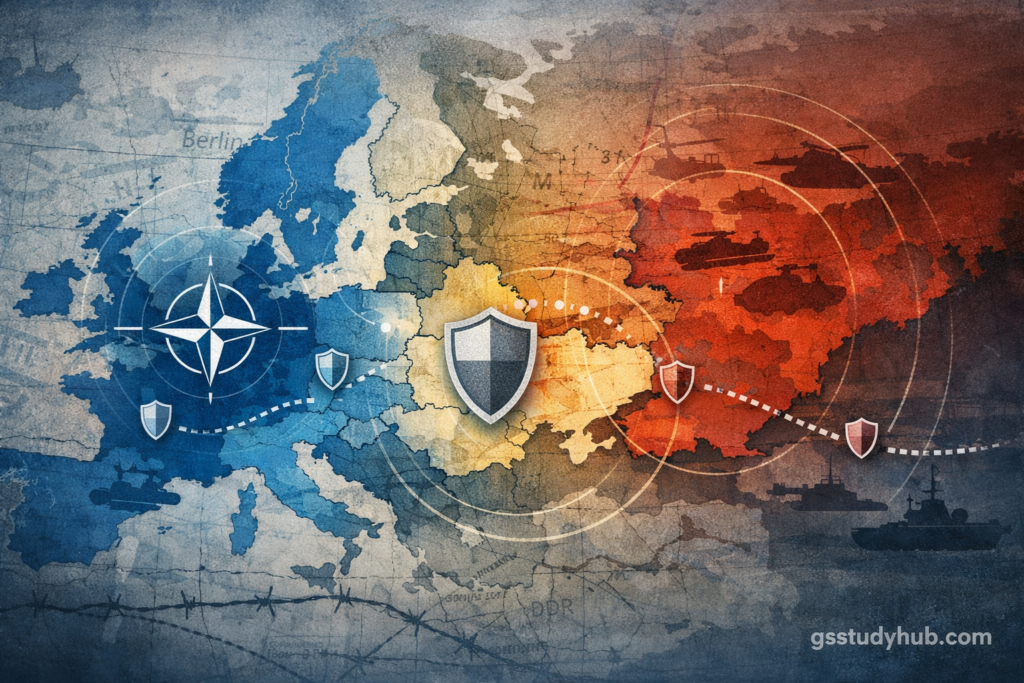
Understanding NATO Strategy in Eastern Europe : My First Encounter with Global Power Politics
When I first began to seriously explore international relations, the name NATO kept appearing in almost every major global conflict and security debate. Initially, it felt like just another military alliance. However, as I followed world events more closely, I realized that NATO represents a complex system of power, security, and strategic decision-making that shapes global politics.
NATO strategy in Eastern Europe has become one of the most debated topics in global geopolitics.
This article explains the hidden logic behind NATO strategy in Eastern Europe and its broader geopolitical implications.
What NATO Really Stands For
At its core, NATO is built on the principle of collective security. This means that an attack on one member state is considered an attack on all. Beyond military strength, NATO symbolizes political cooperation, strategic coordination, and mutual trust among its member nations.
A Lesson I Learned from Studying Military Alliances
While studying military alliances, I learned that power in global politics does not come from weapons alone. It emerges from unity, shared interests, and timely decision-making. NATO taught me that preparation and cooperation are the strongest forms of security—both for nations and for individuals navigating uncertainty.

Premium High-Performance Everyday Product
- Durable & long-lasting build quality
- Designed for daily, hassle-free use
- Excellent value for money
- Trusted by thousands of buyers
Why NATO Strategy in Eastern Europe Matters for Regional Security
Eastern Europe occupies a central place in NATO strategy in Eastern Europe because of its unique combination of geography, historical experience, and power dynamics. This region lies at the intersection of Western Europe and Russia, making it a natural buffer zone as well as a potential flashpoint. Control, influence, or instability in Eastern Europe directly affects the overall security architecture of the European continent.
From NATO’s perspective, Eastern Europe is not merely a group of member states; it is a strategic frontier where deterrence, reassurance, and balance of power must work simultaneously. Decisions taken in this region shape the evolution of NATO strategy in Eastern Europe, its credibility, and its ability to respond to emerging threats.
Historical Background Shaping NATO Strategy in Eastern Europe
The security concerns of Eastern Europe are deeply rooted in history. During the Cold War, much of the region remained under Soviet influence, with limited sovereignty and externally controlled security policies. Political repression, military domination, and repeated interventions created long-lasting fears about national survival and independence.
After the collapse of the Soviet Union, Eastern European countries faced a new strategic dilemma: how to protect their newly regained sovereignty in an uncertain international environment. The expansion of NATO became a crucial part of NATO strategy in Eastern Europe, aimed at strengthening deterrence and ensuring long-term stability.
My Realization While Studying European History
While studying European history, I realized that national security decisions are rarely driven by ambition alone; they are shaped by memory, trauma, and experience. Eastern Europe’s support for NATO becomes far more understandable when viewed through the lens of past invasions, occupations, and external control.
Understanding this historical context makes NATO strategy in Eastern Europe appear less confrontational and more rooted in survival, deterrence, and precaution.

NATO Expansion in Eastern Europe: Strategy Explained Simply
NATO expansion in Eastern Europe is often described as complex and controversial, but the core logic behind NATO strategy in Eastern Europe can be explained in simple terms. The strategy is not designed to provoke conflict, but to prevent it. By expanding its presence eastward, NATO aims to strengthen regional stability, reassure its member states, and reduce the risk of sudden aggression.
Within the broader framework of NATO strategy in Eastern Europe, expansion represents a forward-looking security approach—addressing potential threats before they turn into active crises and maintaining a balance of power in a historically unstable region.
Military Presence and Deterrence Policy
The most visible element of NATO strategy in Eastern Europe is its military presence. This includes the deployment of limited numbers of troops, the establishment of military bases, and regular joint exercises with member states. These measures are carefully calibrated and defensive in nature.
At the heart of this approach lies the concept of deterrence. Deterrence works on a simple principle: if a potential adversary believes that the cost of aggression will outweigh any possible gains, it is less likely to take hostile action. In this sense, military strength is used not to fight wars, but to prevent them from happening in the first place.
Political Messaging and Psychological Strategy
Beyond military deployments, NATO strategy in Eastern Europe also relies heavily on political messaging and psychological signalling. Through high-level summits, joint statements, and coordinated diplomacy, NATO communicates unity and resolve to both allies and potential adversaries.
This form of power signalling reassures smaller and more vulnerable member states that they are not alone, while simultaneously sending a clear message that collective defence commitments are credible and enforceable. In many cases, perception and confidence matter as much as physical military capabilities.
What This Taught Me About Power and Fear
While studying NATO expansion, I learned that power in international politics is not always about instilling fear—it is often about managing it. When exercised with restraint, clarity, and purpose, strategic actions under NATO strategy in Eastern Europe can reduce uncertainty rather than escalate tensions.
This insight also applies beyond geopolitics. In personal life, preparedness and clear communication often prevent conflict more effectively than confrontation. Whether among nations or individuals, well-defined boundaries and mutual understanding can turn fear into stability and chaos into order.
- Strong & durable build
- Perfect for daily use
- High customer satisfaction
- Great value for money
Russia Factor and the Eastern Europe Security Dilemma
The security situation in Eastern Europe is deeply shaped by the growing mistrust between Russia and NATO. This tension is not simply about military confrontation; it reflects a classic security dilemma, where actions taken by one side to increase its security are perceived as threats by the other, leading to mutual suspicion and escalation. This dynamic directly influences NATO strategy in Eastern Europe and the broader regional balance of power.
Why Russia Feels Threatened by NATO Strategy in Eastern Europe
From Russia’s perspective, NATO strategy in Eastern Europe challenges its traditional security buffer zones. After the Cold War, Russia expected that the regions along its borders would remain free from hostile military alliances. The steady movement of NATO infrastructure, troops, and military cooperation closer to Russian borders has therefore been interpreted as strategic encirclement.
Russian policymakers often argue that foreign military bases and advanced weapons systems near their territory reduce strategic depth and limit freedom of action. Seen through this lens, Russia’s reactions are driven not only by ambition, but also by historical memory, insecurity, and the desire to prevent vulnerability along its frontiers.
How NATO Strategy in Eastern Europe Is Viewed as Protection
In contrast, many Eastern European countries view NATO strategy in Eastern Europe as a vital shield for their security and sovereignty. Their historical experiences include repeated invasions, external domination, and political pressure from larger powers. As a result, security is closely tied to national survival rather than abstract strategic theory.
For these nations, NATO membership represents collective defence and the right to make independent political choices. In this context, NATO strategy in Eastern Europe is not perceived as aggression, but as a mechanism that allows sovereignty to exist without constant fear of external coercion.
A Personal Reflection on Conflict and Survival
While studying this security dilemma, I came to realize that international conflicts are rarely simple stories of right and wrong. More often, they are shaped by fear, memory, and the instinct to survive. The evolution of NATO strategy in Eastern Europe reflects this complex interplay of security concerns on all sides.
This understanding offered a broader human lesson: whether at the level of nations or individual lives, perceived threats strongly influence behaviour. Sustainable peace does not emerge from power alone, but from recognizing and addressing the insecurities that drive conflict in the first place.

Impact of NATO Strategy in Eastern Europe on Global Politics
NATO strategy in Eastern Europe has consequences far beyond the European continent. It reshapes alliances, influences threat perceptions, and alters the balance of power in a world that is increasingly interconnected. Decisions taken in one region now ripple across global politics, affecting how states cooperate, compete, and prepare for uncertainty.
Effect on Asia and the Emerging World Order
The evolution of NATO strategy in Eastern Europe has drawn close attention in Asia, where major powers are carefully observing how Western alliances respond to security challenges. For China, NATO’s cohesion and military coordination are often interpreted as signals of a broader Western strategic posture beyond Europe.
At the same time, India approaches these developments with strategic caution. As a country that values strategic autonomy, India views changes linked to NATO strategy in Eastern Europe as both an opportunity and a challenge. A stronger alliance-based system may contribute to a multipolar world, but it can also intensify geopolitical competition.
Future of NATO Strategy in Eastern Europe
Looking ahead, NATO strategy in Eastern Europe is likely to become more adaptive and technology-driven. Rather than focusing solely on permanent troop deployments, future planning may emphasize cyber security, intelligence sharing, rapid response forces, and flexible military coordination.
The primary objective will remain deterrence and stability, not escalation. The future of NATO strategy in Eastern Europe is expected to focus on preventing conflict through preparedness, credibility, and cooperation, while avoiding actions that could trigger uncontrolled confrontation.
What the Future Taught Me About Adaptability
Studying the evolution of NATO strategy in Eastern Europe taught me that survival—whether for institutions, nations, or individuals—depends on adaptability. Rigid thinking becomes a weakness in a rapidly changing world, while the ability to learn and adjust becomes a source of strength.
This realization offered a broader lesson: true power lies not in resisting change, but in understanding it and responding wisely. Those who adapt with clarity and purpose are best equipped to navigate uncertainty and shape a stable future.
For deeper strategic analysis, see the Belfer Center study on Russia–NATO scenarios in Europe .

- Strong & durable build
- Perfect for daily use
- High customer satisfaction
- Great value for money
Lessons for Ordinary People from NATO Strategy in Eastern Europe
Although strategy and alliances are often associated only with nations and militaries, the principles behind NATO strategy in Eastern Europe offer valuable lessons for everyday life. Planning ahead, building reliable support systems, and understanding risks can make individuals more resilient in times of uncertainty.
Whether in global politics or personal life, those who anticipate challenges and prepare for them tend to respond more calmly and effectively when difficulties arise. The evolution of NATO strategy in Eastern Europe highlights the importance of foresight over reaction.
For related geopolitical updates, read our Daily Current Affairs – 07 February 2026 .
Why Strategy Matters Even in Personal Life
Geopolitics teaches us that decisions made without a clear strategy often lead to instability and vulnerability. The strategic thinking reflected in NATO strategy in Eastern Europe demonstrates how preparation reduces uncertainty and builds confidence.
Just as NATO relies on alliances, individuals also benefit from strong personal networks—family, friends, skills, and knowledge. The broader logic behind NATO strategy in Eastern Europe reminds us that security and success rarely come from acting alone; they emerge from preparation, cooperation, and the ability to think ahead rather than merely reacting to circumstances.

- Strong & durable build
- Perfect for daily use
- High customer satisfaction
- Great value for money
Conclusion: What My Journey Taught Me About Power, Strategy, and Peace
Studying the strategy of NATO in Eastern Europe has been more than an exercise in understanding military alliances or global power politics. It has been a journey into how history, fear, cooperation, and preparation shape decisions at every level—from nations to individuals.
The future of NATO strategy in Eastern Europe will shape global security dynamics.
NATO’s approach in Eastern Europe reveals a central truth of geopolitics: security is rarely absolute, and strategy is often about managing uncertainty rather than eliminating it. What may appear aggressive from one perspective can feel defensive and necessary from another. Recognizing this complexity is essential for understanding modern global conflicts.
On a personal level, this exploration reshaped how I think about power and peace. True strength does not lie only in force, but in foresight, alliances, adaptability, and the willingness to learn from history. The same principles that guide nations through instability can help individuals navigate uncertainty in their own lives.
Ultimately, the lesson is clear: lasting stability—whether in global politics or personal growth—comes not from confrontation, but from preparation, cooperation, and a deep awareness of the past. In a rapidly changing world, those who understand strategy are better equipped not just to survive, but to shape a more balanced and peaceful future.
Frequently Asked Questions (FAQs)
What is NATO and why is it important?
NATO is a military and political alliance formed to ensure collective security among its member states. It is important because it aims to prevent conflict through cooperation, deterrence, and shared defence commitments rather than unilateral military action.
Why does NATO focus so much on Eastern Europe?
Eastern Europe holds strategic importance due to its geographical position between Western Europe and Russia. Historical instability, past invasions, and security concerns make the region central to NATO’s strategy of deterrence and regional stability.
Is NATO expansion in Eastern Europe aggressive?
NATO describes its expansion as defensive, not aggressive. From NATO’s perspective, expansion is driven by the voluntary choice of Eastern European countries seeking security guarantees. However, perceptions differ, especially from Russia’s viewpoint, which sees expansion as a potential threat.
Why does Russia oppose NATO’s presence in Eastern Europe?
Russia argues that NATO’s military infrastructure near its borders reduces its strategic security and creates a sense of encirclement. These concerns are influenced by historical experiences, geopolitical rivalry, and fears of losing influence in neighboring regions.
How do Eastern European countries benefit from NATO membership?
For many Eastern European nations, NATO membership provides collective defence, political reassurance, and protection of sovereignty. It also strengthens their international standing and reduces the risk of external coercion or military pressure.
Does NATO’s strategy affect regions outside Europe?
Yes. NATO’s actions influence global geopolitics, including Asia and the emerging world order. Major powers such as China closely observe NATO’s cohesion, while countries like India assess its impact on global balance, multipolarity, and strategic autonomy.
What can ordinary people learn from NATO’s strategy?
At a personal level, NATO’s strategy highlights the value of preparation, alliances, and long-term thinking. Just as nations rely on cooperation and foresight, individuals also benefit from planning ahead, building support networks, and adapting to change.
Is NATO likely to remain active in Eastern Europe in the future?
Yes, but its approach is expected to evolve. Future strategies may focus more on cyber security, intelligence sharing, rapid response, and flexibility rather than permanent large-scale military deployments.
References
- NATO (North Atlantic Treaty Organization). Official Website and Policy Documents. Strategic concepts, official statements, and policy papers related to Eastern Europe.
- United Nations. Reports on International Security and Regional Stability. Background material on global security dilemmas and regional conflicts.
- Council on Foreign Relations (CFR). Articles and Briefings on NATO Expansion and Russia–Europe Relations.
- Brookings Institution. Research Papers on European Security and Global Power Shifts.
- European Union. Policy Papers on European Defence and Regional Cooperation.
- Mearsheimer, John J. The Tragedy of Great Power Politics. University of Chicago Press — for theoretical insights into power politics.
- Gaddis, John Lewis. The Cold War: A New History. Penguin Books — for historical context of East–West security dynamics.
- Author’s personal study, analysis, and interpretation based on international relations literature, historical records, and contemporary geopolitical developments.