

Nagaland – A Land of Heritage, Nature, and Inspiring Cultural Diversity
Introduction: My Experience and Learnings
Nagaland, located in the northeastern corner of India, has always inspired me with its breathtaking landscapes, vibrant tribal culture, and warm hospitality of its people. Whenever I explored or read about Nagaland, its mountains, valleys, colorful festivals, and unique traditions formed a vivid picture in my mind. My experiences and learnings helped me understand that Nagaland is not just a geographical region—it is a symbol of deep cultural legacy, courage, community bonding, and harmony with nature. In this article, I share insights about Nagaland that are informative, inspiring, and reflect the essence of this beautiful state.
1. Geographical Location
Understanding the Geography of Nagaland
Nagaland is known for its scenic landscapes, lush greenery, and serene mountains.
Key Highlights:
- Location: Situated in Northeast India; bordered by Arunachal Pradesh (north), Assam (west), Manipur (south), and Myanmar (east).
- Capital: Kohima
- Area: Approximately 16,579 square kilometers
- Major Mountains: Japfu Peak and Dzukou Valley
2. History
A Glimpse into Nagaland’s Past
- Nagaland’s history is deeply rooted in tribal customs, traditions, and community living.
- The region came under British rule in the 19th century.
- After India’s independence, Nagaland became the 16th state of India on 1 December 1963.
3. Tribes and Culture
Rich Tribal Traditions and Cultural Heritage
Nagaland is known as the “State of 16 Tribes,” each with its own identity, language, customs, and artistic traditions.
Major Tribes:
- Ao
- Angami
- Chaksen
- Sema
- Konyak
- Limha
- Phom
Popular Festival:
The Hornbill Festival, celebrated every December, is the most famous cultural event of Nagaland. It is known as the “Festival of Festivals” and showcases the state’s rich tribal heritage.
4. Language
Languages Spoken in Nagaland
- Official Language: English
- Other Languages: Nagamese, Tensidim, and local tribal languages
5. Economy
Nagaland’s Economic Structure
The economy of Nagaland is primarily driven by agriculture and traditional industries.
Major Crops:
- Rice
- Maize
- Sugarcane
- Potatoes
Handicrafts, bamboo-based industries, and woodcraft cottage industries also play an essential role in the state’s economy.
6. Tourism
Tourist Attractions in Nagaland
The state’s natural beauty, tribal traditions, and peaceful ambiance make it a popular tourist destination.
Major Tourist Places:
- Kohima War Memorial
- Dzukou Valley
- Mokokchung City
- Tuensang
- Intanki National Park

Featured Amazon Product
यह प्रोडक्ट excellent quality, reliable build और dependable performance के लिए जाना जाता है। रोज़मर्रा के उपयोग और gifting दोनों के लिए एक बेहतरीन विकल्प है।
Buy on Amazon7. Religion
Faith and Spiritual Beliefs
Nagaland is predominantly Christian and is known as India’s largest Christian-majority state. Traditional tribal belief systems are still followed in some regions.
8. Natural Beauty
Nature’s Splendour in Nagaland
Nagaland is often referred to as the “Switzerland of the East” because of its lush greenery, tranquil mountains, and refreshing climate.
9. Features
Unique Characteristics of Nagaland
- Naga Bamboo Dance, traditional handloom, and indigenous music are key cultural highlights.
- The state’s handicrafts are well-known in national and international markets.
Nagaland is one of India’s most unique states, defined by its vibrant tribal lifestyle, cultural diversity, and mesmerizing natural beauty. It stands as a perfect blend of heritage, history, and nature.
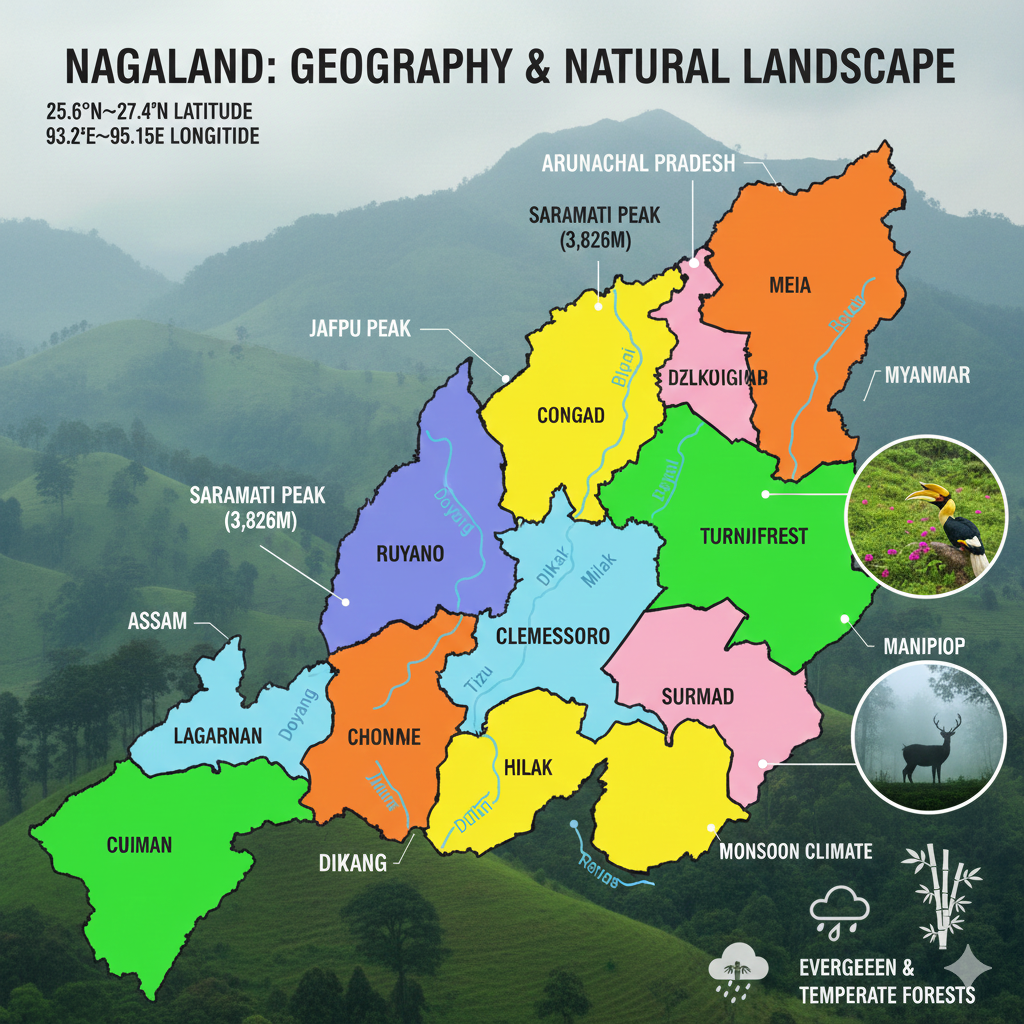
Nagaland – Geography, Natural Beauty, Capital City, and Major Mountains
Geographical Location of Nagaland
To understand Nagaland’s geographical setting, it is important to explore its location, climate, mountains, rivers, forests, biodiversity, and other landforms. Nagaland’s geography plays a key role in shaping its culture, environment, and lifestyle.
1. Location and Boundaries
- Region: Located in the northeastern part of India.
- Boundaries:
- North: Arunachal Pradesh
- West: Assam
- South: Manipur
- East: Myanmar (Burma)
- Geographical Coordinates: Between 25.6° N to 27.4° N latitude and 93.2° E to 95.15° E longitude.
- Area: 16,579 sq km (one of the smaller states in India).
2. Topography
Nagaland is primarily a mountainous state. The region is dominated by high and low valleys, rolling hills, and elevated landscapes.
- Highest Peak: Saramati Peak (3,826 m), located near the Myanmar border.
- Other Important Mountains:
- Japfu Peak (in Kohima district)
- Dzukou Valley – known for greenery and natural beauty
3. Rivers
The rivers of Nagaland play a vital role in agriculture, daily life, and local ecosystems.
- Dikhu River: Flows in the northeastern region.
- Dangki River: Located in the central region.
- Tenganga River: Flows toward Myanmar.
- Other Rivers: Juluki and Milak rivers.
These rivers support agriculture, irrigation, and fish farming in the state.
4. Climate
Nagaland experiences a Tropical Monsoon climate.
- Summer Temperature: 21°C to 40°C
- Winter Temperature: 4°C to 24°C
- Rainfall: 1500 mm to 2000 mm annually
- Monsoon Season: June/July to September
The weather is generally cool, pleasant, and refreshing.
5. Forests and Biodiversity
- Forest Cover: Over 70% of Nagaland is covered with dense forests.
- Types of Forests: Evergreen forests and temperate forests.
- Major Trees: Sal, bamboo, mahogany, pine.
- Biodiversity: Home to rare plant and animal species.
Notable wildlife:
Bird: Great Hornbill
Animals: Elephants, wild buffaloes, deer species
6. Geological Structure
Nagaland lies at the junction of the Indian Plate and the Myanmar Plate, making it a geologically active region. Mild earthquakes are occasionally felt here.
7. Natural Beauty and Environment
- Most of the state is covered with forests and mountains.
- Dzukou Valley is called the “Paradise of the East.”
- Shilloi Lake is one of the major natural attractions.
Featured Amazon Product
यह प्रोडक्ट premium quality, practical design, और reliable performance के लिए जाना जाता है। रोज़मर्रा के उपयोग और gifting दोनों के लिए एक बढ़िया विकल्प है।
Buy on AmazonGeographical Importance
Nagaland holds strategic significance due to its international border with Myanmar. Its geographical conditions support agriculture, forest products, eco-tourism, and biodiversity conservation.
Kohima – The Capital of Nagaland
Kohima, the capital city of Nagaland, is known for its natural beauty, historical importance, and cultural richness.
1. Geographical Location
- Elevation: 1,444 metres (4,738 ft) above sea level.
- Located in the southern part of Nagaland.
- Surrounded by hills and lush greenery.
- Has a pleasant climate throughout the year.
2. Historical Importance
Kohima is historically significant for its role in World War II.
- In 1944, the Battle of Kohima took place here.
- This battle was crucial in stopping the Japanese advance into India.
- The Kohima War Cemetery commemorates the soldiers who died during the battle.
3. Cultural and Religious Significance
Kohima is largely influenced by the Angami Naga Tribe. The city reflects the cultural diversity of Nagaland, where tribes follow their unique festivals, customs, and traditions.
4. Major Attractions
- Dzukou Valley: Known for its green landscapes and seasonal flowers. Ideal for trekking.
- Japfu Peak: The second-highest peak of Nagaland, offering breathtaking sunrise views.
- Kohima Museum: Displays the culture and history of the 16 Naga tribes.
5. Hornbill Festival
Nagaland’s most famous cultural event, the Hornbill Festival, is held every December in Kohima. It showcases traditional dance, music, crafts, and lifestyle of the Naga tribes.
6. Transportation and Connectivity
- Kohima is well-connected by road to various parts of Nagaland.
- The nearest airport and railway station are located in Dimapur.
- Dimapur is around 74 km from Kohima.
Summary: Kohima is not only the administrative capital but also a symbol of Nagaland’s history, culture, and natural charm.
Major Mountains of Nagaland
Nagaland’s major mountain ranges and natural sites—especially Japfu Peak and Dzukou Valley—are world-famous for their beauty and adventure opportunities.
1. Japfu Peak
Geographical Features
- Second-highest peak in Nagaland.
- Height: 3,048 metres (10,000 ft).
- Located in Kohima district within Angami tribal territory.
- Surrounded by dense forests and diverse vegetation.
Natural Attractions
- Giant Rhododendron Trees: Japfu Peak is home to some of the world’s tallest rhododendron trees (up to 20 meters).
- Sunrise Views: Offers spectacular sunrise views and panoramic scenery.
Adventure Activities
- Popular for trekking and mountaineering.
- The trail is challenging but rewarding with stunning natural beauty.
2. Dzukou Valley
Geographical Features
- Located on the Nagaland–Manipur border.
- Elevation: 2,452 metres (8,000 ft).
- Often called the “Paradise of the Northeast.”
Natural Beauty
- Known for its lush green meadows.
- Rich in seasonal wildflowers, especially after the monsoon.
- Contains streams, small waterfalls, and natural ponds.
Adventure Activities
- Trekking: One of the most popular treks in Nagaland.
- Camping: Designated camping areas provide a thrilling overnight experience.
Cultural Significance
The valley holds cultural and religious significance for local tribes, especially the Angami Naga community.
Connection Between Japfu Peak and Dzukou Valley
Both Japfu Peak and Dzukou Valley are located close to each other and are ideal for combined trekking trips. The valley view from Japfu Peak is exceptionally beautiful.
Tourism Importance
- Both locations attract a large number of Indian and international tourists every year.
- The Nagaland government is improving infrastructure to promote tourism.
Summary: Japfu Peak and Dzukou Valley represent the finest natural beauty of Nagaland. While Japfu Peak offers thrilling adventure and stunning landscapes, Dzukou Valley is known for its colorful flowers and peaceful environment.

History of Nagaland, Tribal Culture & Hornbill Festival
History of Nagaland
The history of Nagaland is rich, diverse, and deeply rooted in its tribal societies. From ancient times to modern India, Nagaland’s past reflects a story of cultural identity, colonial influence, and a long journey toward peace and integration. Let us understand it in detail.
1. Ancient Times
- Nagaland has been home to various tribes since ancient times.
- Tribes such as Angami, Ao, Sema, Konyak, and others lived with distinct languages, traditions, and customs.
- Naga tribes traditionally relied on agriculture and lived a communal lifestyle.
- Much of ancient Naga history is known through oral traditions rather than written records.
2. Medieval Period
- Nagaland was not part of any major empire due to its difficult mountainous terrain and isolated tribal lifestyle.
- The region was known for tribal conflicts and self-reliant village communities.
- Despite inter-tribal battles, the Naga people strongly preserved their customs and traditions.
3. Colonial Period (19th Century)
- British rule began in the 19th century.
- After the Treaty of Yandaboo (1826), the British took control of Assam and later expanded into Nagaland.
- British officers launched military campaigns to control Naga tribes and bring the region under administration.
- In 1879, the Battle of Kohima marked a major resistance by Naga tribes.
Changes during British Rule:
- Spread of Christianity: Missionaries arrived in the late 19th century, converting a large population to Christianity.
- Education and Social Change: Missionaries promoted education, literacy, and social awareness.
4. Freedom Struggle and Naga Movement
- Nagaland remained relatively peaceful during India’s freedom movement.
- After independence, Naga leaders demanded autonomy and recognition of their distinct identity.
- In 1946, the Naga National Council (NNC) was formed, demanding independence.
- Angami Zapu Phizo became the main leader of the Naga movement.
- In 1951, the NNC organized an unrecognized referendum demanding independence.
5. Accession of Nagaland into the Indian Union
- The Government of India made efforts to resolve conflicts and integrate Nagaland.
- In 1957, the Naga Hills became a Special Administrative Region.
- In 1960, an agreement was signed between Naga leaders and the Indian government.
- On 1 December 1963, Nagaland became the 16th state of India.
6. Naga Insurgency and Peace Process
- Insurgency continued even after statehood, with groups demanding complete independence.
- In 1980, the National Socialist Council of Nagaland (NSCN) was formed.
Major Factions:
- NSCN (IM): Participates in peace talks.
- NSCN (K): Known for violent activities.
In 1997, a ceasefire agreement was signed between the Government of India and NSCN (IM). Peace negotiations are ongoing regarding autonomy and cultural rights.
7. Modern Nagaland
- Nagaland is now an integral part of India.
- The people proudly preserve their tribal identity and traditions.
- Peace talks continue to ensure development and stability in the region.
Importance of Nagaland’s History
The history of Nagaland reflects courage, identity, and cultural heritage. It is a powerful example of how tribal traditions and modernity can coexist.
Tribes and Culture of Nagaland
Nagaland’s tribes and culture are the defining features of the state. The region is a treasure of diversity, traditions, and ethnic heritage.
1. Tribes of Nagaland
Nagaland is known as the “State of 16 Tribes.” Each tribe has its own language, customs, attire, and social system.
Major Tribes:
- Angami
- Ao
- Chang
- Konyak
- Phom
- Lotha
- Sema (Sumy)
- Zeliang
- Cachari
- Yimchunger
- Rengma
- Khiamniungan
- Chakhesang
- Sangtam
- Pochury
Several smaller tribes also contribute to the cultural richness of Nagaland.
2. Cultural Diversity
a. Language and Dialects
- Each tribe has its own mother tongue.
- More than 20 dialects and languages are spoken.
- Official Language: English
b. Traditional Attire
- Known for handwoven fabrics with bright colors and intricate patterns.
- Jewelry includes beads, shells, and metal ornaments.
c. Dance and Music
- Dance and music are central to Naga culture.
- Angami Dance: War dance.
- Sema Dance: Post-harvest celebration dance.
- Phom Dance: Symbolizes peace and joy.
Traditional music includes drums, flutes, and folk instruments.
3. Festivals and Celebrations
Nagaland is known as the “Land of Festivals.”
Major Festivals:
- Hornbill Festival: The largest festival, held every December.
- Sekrenyi (Angami Tribe): Harvest festival.
- Moatsu (Ao Tribe): Celebration marking the end of agricultural work.
- Tuluni (Sema Tribe): Paddy harvest festival.
- Oling (Chang Tribe): Autumn festival.
4. Traditions and Customs
a. Social Structure
- Each village is autonomous and follows traditional governance.
- Morung (Community Hall): Used for meetings, cultural events, and education.
b. Weapons and Hunting
- Tribes traditionally used spears, bows, arrows, and knives.
- Hunting was once important but has reduced over time.
c. Marriage and Family
- Marriage is considered sacred.
- Traditions differ from tribe to tribe.
- Family systems are collective and community-centered.

Premium Amazon Product
यह प्रोडक्ट excellent quality, durable design और reliable performance के लिए जाना जाता है। दैनिक उपयोग और gifting दोनों के लिए एक शानदार विकल्प है।
Buy on Amazon5. Religion
- Most Nagas are Christians.
- Christianity spread widely in the 19th century.
- Traditional belief: Animism (worship of nature).
6. Handicrafts and Art
- Famous for bamboo and cane crafts.
- Major handicrafts include wood carvings, bamboo furniture, jewelry, and handwoven shawls.
7. Food and Cuisine
- Staple foods: Rice, meat, fish, bamboo shoots, and herbs.
- Popular dishes: Smoked meat, bamboo pickle (fermented bamboo), aromatic soups.
8. Naga Culture in Modern Times
Modern Nagaland blends tradition and modernity. Events like the Hornbill Festival have brought global recognition to Naga culture.
Hornbill Festival – The Pride of Nagaland
The Hornbill Festival is the most important and celebrated cultural event in Nagaland. It is known as the “Festival of Festivals,” showcasing the state’s rich traditions, dances, music, and tribal lifestyle.
Important Information
- Dates: 1st to 10th December every year
- Venue: Kisama Heritage Village, 12 km from Kohima
- Organizers: Government of Nagaland (Departments of Tourism & Art & Culture)
- Named After: The Great Indian Hornbill bird, a cultural and ecological symbol of Nagaland.
Main Objectives
- To preserve and promote the culture of all 16 Naga tribes.
- To promote tourism and showcase Nagaland globally.
- To create harmony between tradition and modernity.
Main Attractions
1. Cultural Performances
- Traditional dances, songs, and music by all tribes.
- Colorful costumes and ornaments enhance the visual appeal.
2. Warrior Drills
- Demonstration of traditional war skills and martial arts of Naga tribes.
- Symbolizes bravery and historical courage.
3. Handicrafts & Cuisine
- Bamboo and cane crafts, wood carvings, and traditional tools.
- Traditional food: Pork with bamboo shoots, smoked meat, and local rice beer "Zü".
4. Music & Dance Festival
- Rock music competitions and concerts.
- Participation from artists across India and abroad.
5. Adventure Sports
- Cycling, trekking, motor rallies.
- Traditional games such as archery and Naga wrestling.
6. Literature & Film
- Literary festivals and film screenings.
- Promotion of art, literature, and cinema of Nagaland and Northeast India.
Cultural Significance
The Hornbill Festival celebrates tribal unity and cultural heritage. It inspires communities to preserve their traditions and presents Nagaland’s social, spiritual, and artistic diversity to the world.
Impact on Tourism
- Attracts thousands of Indian and international tourists every year.
- Boosts the economy and tourism industry of Nagaland.
- Makes other tourist attractions like Dzukou Valley and Japfu Peak even more popular.
Summary:
The Hornbill Festival is the cultural pride of Nagaland.
It preserves tribal traditions, promotes unity, and presents Nagaland’s identity to the global audience.
For visitors, the festival offers an unforgettable cultural experience.

Language and Economy of Nagaland
Language of Nagaland
The languages of Nagaland are extremely rich and diverse. This northeastern state is home to several tribes, each with its own unique language and dialect. These languages are deeply connected to the cultural identity, traditions, and heritage of the Naga people.
1. Variety of Languages
- More than 20 languages and dialects are spoken across Nagaland.
- Most languages belong to the Tibeto–Burman branch of the Sino-Tibetan language family.
- Each tribe has its own language used in traditional songs, folklore, and daily communication.
Languages of Major Tribes:
- Angami Tribe: Angami language
- Ao Tribe: Ao language
- Konyak Tribe: Konyak language
- Sema (Sumi) Tribe: Sema language
- Chang Tribe: Chang language
- Lotha Tribe: Lotha language
- Rengma Tribe: Rengma language
- Phom Tribe: Phom language
2. Linguistic Families
Most Naga languages fall under the Tibeto–Burman linguistic group. These languages are tonal, meaning the tone of pronunciation changes the meaning of words.
- Simple grammatical structure
- High phonetic complexity
- Rich sound patterns and tones
3. Contact and Official Language
- Official Language: English (used in administration, education, and official work).
- Nagamese: A contact language (lingua franca) used for communication between tribes.
Nagamese is a simplified mixture of Assamese and Naga tribal languages. It is widely spoken in markets, social interactions, and trade.
4. Writing System
- Traditionally, Naga languages were oral and had no script.
- Christian missionaries introduced the Roman script for writing.
- Today, most Naga languages are written in the Roman alphabet.
5. Preservation and Development of Languages
- Efforts to preserve folk songs, oral stories, and tribal literature.
- Local languages being introduced in schools and colleges.
- Cultural festivals helping to revive endangered languages.
- Some languages are at risk due to the rise of English and Nagamese.
6. Cultural Importance of Languages
Naga languages carry the identity, history, and indigenous knowledge of their tribes. Traditional rituals and customs are preserved through these languages.
7. Linguistic Challenges
- Diversity of languages makes communication difficult—hence the need for Nagamese.
- Some traditional languages are declining due to lesser usage among youth.
- Urbanization and English education reduce the use of tribal mother tongues.
8. Languages in the Modern Context
- English and Nagamese are widely used in modern Nagaland.
- Digital platforms are helping promote and teach tribal languages.
- Events like the Hornbill Festival create awareness of linguistic diversity.
Summary:
The languages of Nagaland reflect the state’s cultural richness and tribal identity.
Despite the challenges of modernization, strong efforts are being made to preserve and revive these traditional languages.
Economy of Nagaland
Nagaland’s economy is primarily agricultural, but trade, industry, handicrafts, and tourism have grown significantly in recent years. The state’s unique geography and cultural strength heavily influence its economic structure.
1. Basis of the Economy
a. Agriculture
- Main livelihood for more than 70% of the population.
- Shifting cultivation (Jhum cultivation) is widely practiced.
- This method affects soil fertility but remains culturally significant.
Main Crops:
- Rice (staple)
- Maize
- Millets
- Pulses
- Ginger, chilli, sugarcane (cash crops)
b. Horticulture & Organic Farming
- Nagaland has ideal conditions for horticulture.
- Pineapple, oranges, lemon, and jackfruit are widely grown.
- Organic farming is rising under the Nagaland Organic Mission.

Premium Amazon Product
यह प्रोडक्ट premium quality, stylish design और dependable performance के लिए जाना जाता है। रोज़मर्रा के उपयोग और gifting दोनों के लिए एक शानदार विकल्प है।
Buy on Amazon2. Industries
a. Handicrafts & Cottage Industries
- Bamboo and cane products
- Wood carving
- Handloom textiles
- Major source of employment
b. Bamboo Industry
- Nagaland is known as the “Bamboo Hub of India.”
- Bamboo is used for furniture, constructed items, and paper.
- The Nagaland Bamboo Development Agency promotes this sector.
c. Minerals & Natural Resources
- Coal, petroleum, limestone, and marble are found here.
- Mining is underdeveloped due to terrain and environmental limits.
3. Animal Husbandry & Fisheries
- The second-largest contributor to the economy after agriculture.
- Cattle, pigs, goats, and poultry are reared for food and trade.
- Fisheries use natural ponds and streams and are growing fast.
4. Tourism
- A major contributor due to natural beauty and cultural heritage.
- Hornbill Festival attracts international tourists.
- Important destinations: Kohima, Dimapur, Mokokchung, Dzukou Valley, Shilloi Lake.
5. Trade & Commerce
- Main items: agricultural produce, handicrafts, bamboo products, and forest goods.
- Dimapur is the state’s largest commercial center.
- Border trade with Myanmar offers economic potential.
6. Power & Energy
- Hydroelectric power is the primary source.
- State imports electricity from neighboring states.
- Solar and wind energy projects are being explored.
7. Transport & Infrastructure
- Road transport is the main mode but challenging due to mountainous terrain.
- Dimapur has the only airport and railway station.
- Government is improving connectivity under multiple central schemes.
8. Banking & Finance
- Banking services are expanding steadily.
- Government schemes support farmers, small industries, and startups.
- Digital banking is growing in rural areas.
9. Government Efforts and Schemes
- Modern farming assistance (seeds, fertilizers, irrigation).
- PMGSY for rural road connectivity.
- Bamboo Mission to promote bamboo-based industries.
10. Challenges
a. Economic Challenges
- Soil fertility decline due to shifting cultivation.
- Poor infrastructure in remote areas.
- Limited industrial development.
- Lack of widespread employment opportunities.
b. Political & Social Challenges
- Long-standing insurgency affects investment.
- Border trade disputes.
11. Future Prospects
- Tourism: Huge potential due to nature and culture.
- Organic Farming: High demand in international markets.
- Bamboo & Handicrafts: Strong export possibilities.
- IT & Education: Growing focus on digital hubs and institutions.
Summary:
The economy of Nagaland is rooted in agriculture, handicrafts, and tourism.
Despite challenges, government initiatives, natural resources, and strong cultural heritage offer a promising future for economic growth.
References

Featured Amazon Product
यह प्रोडक्ट premium quality, smart design और dependable performance के लिए जाना जाता है। रोज़मर्रा के उपयोग और gifting दोनों के लिए एक शानदार विकल्प है।
Buy on Amazon- Government of Nagaland – Official Portal
- Ministry of Development of North Eastern Region (DoNER) – Reports
- India Census Data – Linguistic and Demographic Reports
- Nagaland Tourism Department – Cultural and Tourism Information
- Historical Records from Archaeological Survey of India (ASI)
- Research Publications on Naga Tribes and Culture
- North East India Studies and Academic Journals