
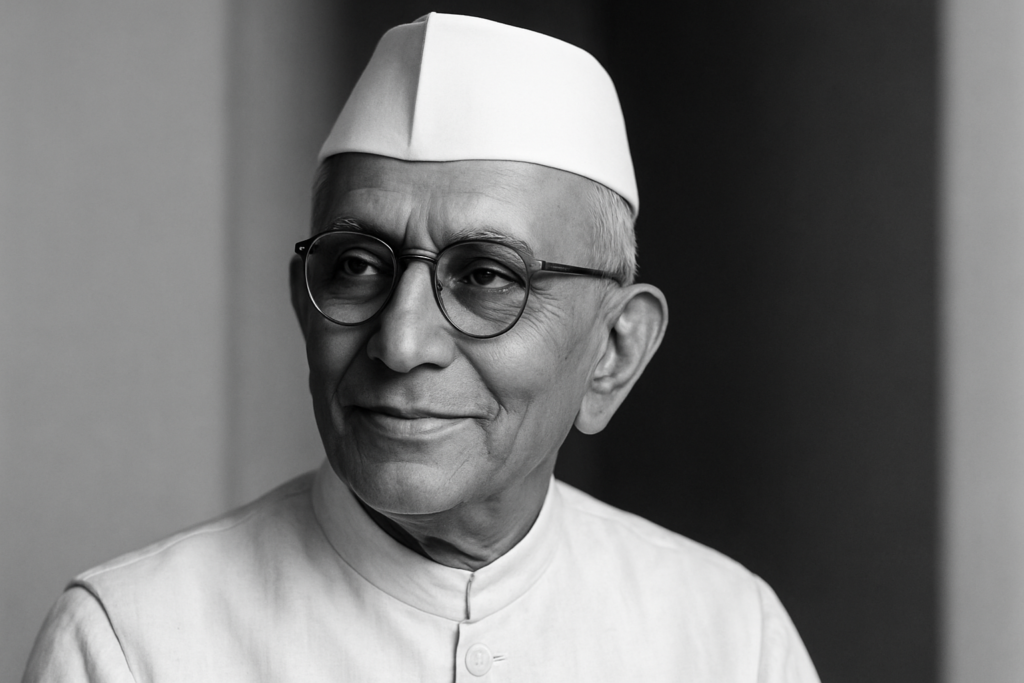
Biography of Shri Morarji Desai
Shri Morarji Desai was an Indian freedom fighter, a principled politician and the sixth Prime Minister of India. He is remembered as a simple, disciplined and honest leader in Indian politics. He also holds the distinction of being the first non-Congress Prime Minister of India. Let us understand his life journey, early education, political career and legacy in detail.
Early Life and Education (Overview)
- Full Name: Morarji Ranchhodji Desai
- Date of Birth: 29 February 1896
- Birthplace: Bhadeli village, Bulsar district (now Valsad), Gujarat
- Father: Ranchhodji Desai (a school teacher)
- School Education: St. Basil’s High School, Bombay
- College Education: Bachelor’s degree from Wilson College, Bombay
Morarji Desai began his professional life as a government employee. For some time, he served as a Deputy Collector in the Bombay Presidency. However, he became dissatisfied with the exploitative policies and unjust system of British rule. Guided by his conscience and love for the nation, he resigned from his post and plunged into the freedom movement.
Role in the Indian Freedom Movement
In the 1930s, Morarji Desai actively participated in the Salt Satyagraha. Later, he also took an active role in the Quit India Movement in 1942. Because of his commitment and strong stand against British rule, the British government imprisoned him several times. He was deeply influenced by the thoughts and principles of Mahatma Gandhi and Sardar Patel, and he followed the path of truth, non-violence and discipline throughout his public life.
Political Career After Independence
Chief Minister, Finance Minister and Deputy Prime Minister
After India gained independence, Morarji Desai continued to play an important role in public life:
- In 1952, he became the Chief Minister of the Bombay State and served in this role till 1956.
- Later, he served as the Finance Minister of India from 1958 to 1963.
- He also held the position of Deputy Prime Minister of India.
Separation from the Congress and Rise of the Janata Party
Over time, differences started increasing within the Congress party, especially under the leadership of Indira Gandhi. In 1969, the Congress split, and Morarji Desai chose to remain with the Congress (Organisation) group. In 1975, when Indira Gandhi imposed the Emergency, he strongly opposed it and became one of the most vocal critics of authoritarian policies. After the Emergency was lifted in 1977, several opposition parties came together to form the Janata Party. The Janata Party contested the elections and came to power by defeating Indira Gandhi’s Congress.
Prime Ministerial Tenure (1977–1979)
In 1977, Morarji Desai became the first non-Congress Prime Minister of India. His government was formed under the banner of the Janata Party. During his tenure:
- He ordered several commissions of inquiry to investigate corruption and excesses during the Emergency.
- He tried to improve India’s relations with neighbouring countries like Pakistan and China.
- He promoted transparency in India’s nuclear policy and strongly advocated the peaceful use of nuclear energy.
Key Features of His Leadership Style
- He led a very simple and disciplined life, with high moral standards.
- He did not misuse government facilities, power or privileges for personal gain.
- He believed in self-respect and self-reliance in both personal and public life.
- He also remained in the news for his support of urine therapy, which he considered part of natural healing along with yoga and naturopathy.
Resignation from the Post of Prime Minister and Later Life
In 1979, due to internal conflicts and differences within the Janata Party, Morarji Desai resigned from the post of Prime Minister. After his resignation, he gradually withdrew from active politics, though he continued to be respected as an elder statesman and a symbol of principled public life.
Death
Morarji Desai passed away on 10 April 1995 in Mumbai. He lived to the age of 99 and is counted among the oldest serving Prime Ministers in the world and one of the oldest Prime Ministers of India. His long life was a reflection of his disciplined lifestyle, simple food habits and dedication to yoga, naturopathy and self-restraint.
Honours and Legacy
- He was awarded India’s highest civilian honour, the Bharat Ratna, in 1991.
- He is the only Indian to have received both the Bharat Ratna and Pakistan’s highest civilian award, Nishan-e-Pakistan, highlighting his role in promoting peace and better relations between the two countries.
Morarji Desai was one of the few leaders in Indian politics who consistently practiced politics based on principles and honesty. His life was a symbol of truth, non-violence and simplicity. He is remembered as a strict yet fair administrator, a disciplined leader and a moral example for future generations.
Conclusion
The life of Shri Morarji Desai proves that politics can be guided by principles, integrity and national interest rather than personal power. From leaving a prestigious government job for the freedom struggle to leading the country as Prime Minister, he always placed moral values above convenience. His truthfulness, discipline, simplicity and commitment to public service continue to inspire citizens and leaders even today.
Early Life and Education of Morarji Desai in Detail
The life of Morarji Desai, a brave fighter of India’s freedom struggle and the sixth Prime Minister of the country, was a symbol of sacrifice, simplicity, discipline and moral values. He was one of those rare leaders of Indian politics who never ignored principles, no matter how difficult the political situation became. The foundation of his personality and work was laid in his early life and education.
Birth and Family Background
Morarji Desai was born on 29 February 1896 in Bhadeli village in Bulsar district (now Valsad) of Gujarat. He was born on a special day that comes once every four years, in a leap year, which made his actual birthday appear only once in four years.
His father, Ranchhodji Desai, was a school teacher. Ranchhodji was a very disciplined, religious and honest person, and his personality had a deep impact on young Morarji. The family was middle class and not very affluent, but it was rich in moral values. The atmosphere at home was disciplined and traditional, where children were taught the values of simple living, truth, honesty and self-reliance from an early age.
Childhood and Social Environment
Morarji Desai’s childhood was spent in a rural environment. His village was peaceful and culturally rich, though economically modest. While there was a lack of modern facilities, people were aware of the importance of education and culture.
Morarji grew up in this simple environment of his village and family. His father’s discipline and religious lifestyle influenced him from the very beginning. He was a highly disciplined boy, who liked to be punctual, focus on his studies and live a simple life. He believed in always speaking the truth, and this quality remained a constant feature of his character throughout his life.
Elementary Schooling
Morarji Desai’s early education began in a local school in his village, Bhadeli. For his secondary education, he later moved to Bombay (now Mumbai) and took admission in St. Basil’s High School in 1910. At that time, Bombay was a major centre of education, and going there for studies was considered a significant achievement.
During his school years in Bombay, he established himself as a hardworking, intelligent and disciplined student. He was good at studies, but even more than academic performance, his focus was on moral values and self-control. He had a deep interest in religious texts, especially the Bhagavad Gita. The teachings of the Gita influenced his thinking and lifestyle from an early age, and concepts like duty, self-discipline and detachment became central to his approach to life.
College Education and Personal Struggles
For his graduation, Morarji Desai took admission in Wilson College, Bombay. There he showed a special interest in mathematics and science subjects. At that time, Indian students had to study under the British education system, which often tried to promote British ideology. However, Morarji Desai never gave up Indian traditions and values and remained proud of his cultural roots.
His college life was not easy. The financial condition of his family was not very strong, yet he completed his education with determination. He had to work part-time along with his studies to support himself. These struggles taught him self-reliance, hard work and the art of living a tough and disciplined life.
During his college days, his nature and thinking gradually began to connect with nationalist and social concerns. He had not yet met Mahatma Gandhi personally, but he was increasingly influenced by Gandhian ideas. He started studying about the Swadeshi movement, Indianisation of education and social reforms. These ideas slowly prepared him for a larger role in the country’s political and social life.
Entry into Government Service
After obtaining his graduation degree, Morarji Desai joined the British administration in the Bombay Presidency and started working as a Deputy Collector. It was considered a prestigious government post at that time. This phase gave him valuable administrative experience and a close view of how the colonial system functioned.
However, it did not take long for him to realise that British policies were unjust and discriminatory towards Indians. He saw that many decisions of the administration violated the principles of justice and fairness that he believed in. Even while in government service, he tried to maintain morality and impartiality in his work. When he felt that he was being forced to act against his conscience and support policies he considered unjust, he took the difficult and courageous decision to resign from his job.
This decision shows that Morarji Desai was not ready to compromise with his ideals at any cost. He believed that if one has to sacrifice personal comfort or position for the sake of truth and justice, then that sacrifice gives true greatness to a person’s life.
Pillars of Personality Development: Education and Discipline
In Morarji Desai’s life, education was not just a means to obtain a degree or a job; for him, the ultimate aim of education was character-building. He famously believed:
“Without character, education is incomplete.”
According to him, an educated person without moral values could become a danger to society. Therefore, in his own education and lifestyle, he gave great importance to morality, honesty, self-restraint, celibacy and national service.
His life was based on the principles of celibacy, self-discipline, yoga and naturopathy. These habits had become a part of his routine since childhood. He adopted simple food, a disciplined daily schedule and strict punctuality throughout his life. These practices not only kept him physically healthy and mentally alert but also made his personality strong and balanced.
Core Values That Shaped His Character
- Serving others and thinking beyond self-interest
- Following strict discipline in personal and public life
- Facing difficult situations without fear
- Standing firmly for truth and justice
- Practicing his ideology in real life, not just in speeches
Motivational Experiences and the Foundation of His Ideology
The experiences of Morarji Desai’s early life made him a moral warrior and a principled leader. This period of his life was not limited to schooling and employment; it was like a living school where he learnt the most valuable lessons of life:
- The value of serving others and the nation
- The importance of discipline and self-control
- The courage to oppose injustice, even at personal cost
- The power of truth, simplicity and honest living
- The need to align one’s actions with one’s beliefs
Final Thoughts on His Early Life
Morarji Desai’s early life and education formed the strong foundation of his entire personality. Born as the son of a school teacher, the values he received at home and in school stayed with him till he became the Prime Minister of India. He proved that real education is not just bookish knowledge, but a way to become a better, responsible and moral human being.
His simplicity, discipline, truthfulness and high thinking were ideal not only for his own era, but they remain a powerful source of inspiration even today. His journey from a small village in Gujarat to the highest office in the country shows how strong values, courage and character can shape both a person’s life and the destiny of a nation.
Role of Morarji Desai in the Freedom Movement
🛒 Buy Now on AmazonIndia’s freedom struggle was a long movement full of sacrifice and self-denial, in which thousands of patriots gave up their lives, comforts and careers. Among the committed and principled personalities who played an important role in this movement, Morarji Desai stands out. He may not have attained the same fame as Gandhi, Nehru or Sardar Patel, but his role in the freedom struggle was powerful, moral and of lasting impact.
1. Background of His Entry into the Freedom Movement
Resignation from Government Job
After completing his education, Morarji Desai started his government service as a Deputy Collector in the Bombay Presidency under British rule. This was a prestigious position, especially for someone from a middle-class background.
However, Morarji Desai’s conscience did not allow him to serve an unjust and discriminatory colonial system. He was troubled by the oppressive policies and humiliating treatment of Indians by the British.
A turning point came when he was ordered to take strict punitive action against an innocent Indian farmer. This incident deeply disturbed him and he felt that continuing in the British system meant supporting injustice.
After this moral struggle, Desai resigned from his job in the early 1930s and dedicated himself completely to the service of the nation. It was a bold and rare decision at a time when government jobs were highly valued.
2. Active Participation in the Indian National Congress
Joining the Congress
After resigning, Morarji Desai joined the Indian National Congress, which was then the main force leading India’s freedom struggle. Leaders like Mahatma Gandhi, Pandit Nehru and Sardar Patel guided the movement.
Being from Gujarat, Morarji Desai was greatly influenced by Mahatma Gandhi and Sardar Patel. He embraced Gandhi’s principles of truth, non-violence, self-reliance and Swadeshi.
3. Salt Satyagraha (1930)
In 1930, when Mahatma Gandhi launched the historic Salt Satyagraha (Dandi March), the movement spread strongly across Gujarat. Morarji Desai actively participated in it. He encouraged people to stand up against the British, boycott foreign goods and adopt indigenous products.
He also participated in the violation of the salt law along with other satyagrahis. As a result, he was arrested for the first time and sent to jail.
4. Civil Disobedience Movement (1932) and Imprisonment
When the Civil Disobedience Movement was revived in 1932, Morarji Desai played a significant role in mobilising people to defy unjust British laws. His efforts once again led to his imprisonment.
Even in jail, he remained disciplined and committed to truth, spending time on meditation, yoga and introspection.
5. Quit India Movement (1942)
The Most Decisive Role
The Quit India Movement of 1942 became the most crucial chapter of Morarji Desai’s patriotic life. When Gandhiji gave the call of “Do or Die” on 8 August 1942, the entire nation erupted with revolutionary fervour.
Desai played a central role in organising the movement in Gujarat. He delivered powerful speeches against the British, held public meetings and encouraged people to boycott government institutions.
Due to his influence, he was arrested immediately and imprisoned for nearly three years. Despite health issues during imprisonment, he never compromised with his principles.
6. Life in Prison and Ideological Determination
Even in jail, Morarji Desai maintained his core life values:
- Practice of celibacy and self-discipline
- Daily routine of yoga and pranayama
- Regular study of religious texts, especially the Bhagavad Gita
- Deep introspection, self-control and mental strength
Jail became a form of spiritual penance for him. This period strengthened his moral and political ideology even further.
7. Administrative Role Before Independence
In the final years of British rule, when limited provincial self-rule was introduced, Morarji Desai became a member of the Legislative Council of the Bombay Province.
Even while handling administrative responsibilities, he continued supporting the freedom movement. He raised public concerns strongly and opposed unjust actions by British officials.
8. A Principled Revolutionary
Morarji Desai was a revolutionary, but his path was based not on violence, but on moral strength, discipline and truth. He remained firmly committed to Gandhian principles.
He believed that to build an independent India, its leaders must embody morality and honesty. According to him, “Self-rule (Swaraj) must begin with self-discipline.”
9. Inspiring Women and Youth
Morarji Desai emphasised the involvement of women and youth in the freedom struggle. He encouraged them not only to raise slogans, but also to lead by character and conduct.
He promoted Swadeshi education, handicrafts and self-reliance, believing that India must become economically independent.
10. Role at the Time of Independence
By 1947, Morarji Desai had earned recognition as an efficient, principled and honest leader. After independence, he became the Home Minister of Bombay State and later served as its Chief Minister.
Conclusion: The Ideal Life of a Warrior
Morarji Desai’s role in the freedom struggle was not limited to participating in movements. Through his character, discipline and moral strength, he laid the foundation of a new kind of politics. His aim was not just to remove British rule, but to build a moral, disciplined and self-reliant India.
His contribution serves as an inspiration for future generations and remains an important part of India’s journey to independence.
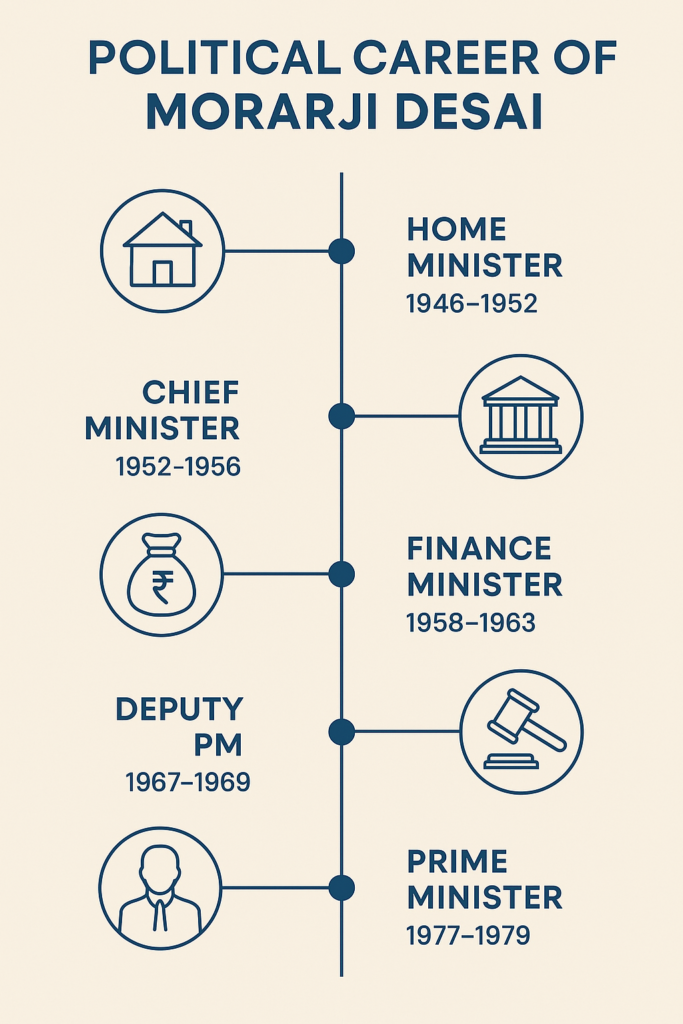
Political Career of Shri Morarji Desai
Morarji Desai was a leader who not only participated in the freedom struggle but also played a major role in shaping the governance of independent India. Known for his discipline, honesty and strict principles, his political career spanned nearly five decades—during which he served as Chief Minister, Union Minister, Deputy Prime Minister and ultimately India’s first non-Congress Prime Minister.
1. Entry into Independent India (After 1947)
Recognition of Administrative Ability
After independence, Morarji Desai was given an important role in the administration of Bombay State (now Maharashtra and Gujarat). His leadership skills made him one of the senior leaders of the Congress.
Home Minister of Bombay Province (1946–1952)
Even before independence, he was appointed as Home Minister of Bombay Province in 1946. He became known for his discipline and strict administrative style. He took significant steps to ensure transparency and honesty in governance.
2. Chief Minister of Bombay State (1952–1956)
Tenure as Chief Minister
During his tenure, he focused on:
- Taking strict measures against corruption
- Improving education and rural development
- Strengthening government machinery
- Reforming police and judicial systems
Differences on the Division of Bombay State
In 1956, when the proposal to divide Bombay State into Gujarat and Maharashtra was made, Morarji Desai opposed the linguistic division. Due to this disagreement, he resigned from the post of Chief Minister—reflecting his principled approach.
3. Entry into Central Politics (After 1956)
As a Union Minister
In 1956, Jawaharlal Nehru included him in the Union Cabinet.
Finance Minister (1958–1963)
- Took bold and strict economic decisions
- Brought transparency in taxation
- Became known as a “tough minister”
Tension with Indira Gandhi
Ideological conflicts began developing between Morarji Desai and Indira Gandhi. Desai believed in fiscal discipline and freedom to the private sector, while Indira Gandhi leaned towards socialist policies.
4. Split in Congress and Resignation (1966–1969)
Prime Ministerial Contests
After Nehru’s death in 1964, Morarji Desai was a strong contender for the post of Prime Minister. But Lal Bahadur Shastri was chosen. After Shastri’s death, Desai again appeared in the race, but Indira Gandhi was selected by Congress leadership.
Deputy Prime Minister & Finance Minister (1967–1969)
Desai served as Deputy PM and Finance Minister in Indira Gandhi’s cabinet, but ideological differences continued to grow.
Resignation (1969)
In 1969, due to differences with Indira Gandhi, Morarji Desai resigned and joined Congress (Organisation).
5. Leader of Opposition and the Emergency (1975–1977)
Opposition to the Emergency
When Indira Gandhi imposed the Emergency in 1975, Morarji Desai was among the few leaders who strongly opposed it. He was arrested and spent about 19 months in jail.
6. Formation of Janata Party & Becoming Prime Minister (1977)
In 1977, opposition parties united and formed the Janata Party. In the historic elections that followed, the Congress was defeated for the first time and Morarji Desai became India’s first non-Congress Prime Minister.
7. Tenure as Prime Minister (1977–1979)
Key Achievements
- Ended the Emergency environment and restored fundamental rights
- Removed press censorship
- Reversed several unconstitutional amendments
- Promoted transparency in administration
- Improved relations with Pakistan and China
Challenges
Internal differences within the Janata Party weakened the government. Ideological divisions and leadership conflicts eventually led to instability.
Resignation (1979)
Under pressure from party factions, Morarji Desai resigned in 1979, marking the end of the Janata government.
8. Retirement and Later Life
After leaving office, he retired from politics and devoted his time to yoga, meditation and spiritual discipline. He was awarded the Bharat Ratna in 1991.
Conclusion
The political life of Morarji Desai is an important chapter in Indian democracy. His journey remains a symbol of truth, discipline, honesty and unwavering principles. He treated politics as a path of service and moral responsibility, leaving behind a legacy that continues to inspire the nation.
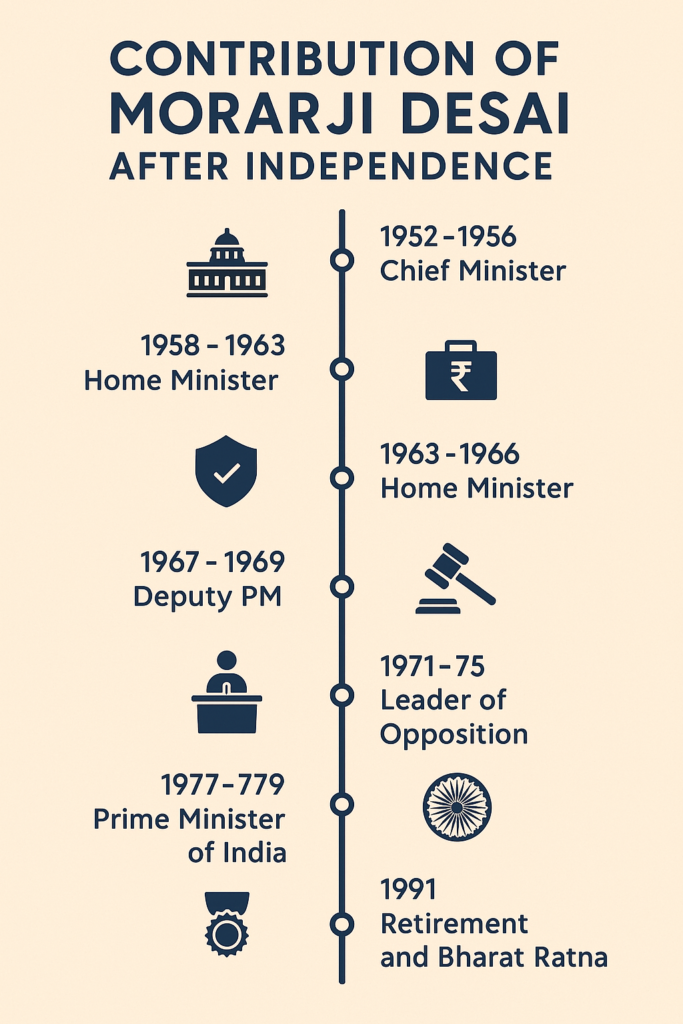
Contribution of Morarji Desai After Independence
After independence, Morarji Desai emerged as a symbol of disciplined, ethical and visionary leadership. His contributions significantly shaped the political and administrative direction of modern India. Below is a detailed account of his political life after 1947, covering his roles before and after becoming Prime Minister.
🛒 Buy Now on Amazon1. Initial Role in Independent India (1947–1952)
Benefits of Administrative Experience
After independence, Morarji Desai’s administrative skills and his reputation from the freedom movement earned him a major role in the administration of the Bombay Province (now Maharashtra and Gujarat). His experience made him one of the most trusted leaders of Congress in the region.
Home Minister of Bombay State (1946–1952)
Morarji Desai was appointed Home Minister of Bombay State just before independence and continued in this role afterwards. He adopted a strict approach toward law and order, implemented administrative reforms, and took significant steps to curb corruption.
2. Chief Minister of Bombay State (1952–1956)
Holding the Chief Ministerial Post
In the first general elections of independent India (1952), Congress won convincingly, and Morarji Desai became the Chief Minister of Bombay State.
Major Contributions as Chief Minister
- Focused on education, irrigation and agricultural reforms
- Introduced discipline and transparency in administration
- Promoted prohibition, Swadeshi and civic discipline
Linguistic Dispute and Resignation
With rising demands for separate Marathi and Gujarati states, the Centre decided to divide Bombay State. Morarji Desai opposed the reorganisation and ultimately resigned from the post on moral grounds.
3. Role as Union Minister (1956–1969)
Entry into Central Politics
In 1956, Prime Minister Jawaharlal Nehru brought Morarji Desai into the Union Cabinet, entrusting him with key ministries such as Finance, Home and Industry.
Finance Minister of India (1958–1963)
- Prioritised fiscal discipline
- Introduced strict budgetary policies
- Strengthened taxation reforms
- Focused on planned expenditure control
- Worked to reduce dependence on foreign loans
Contribution as Home Minister (1963–1966)
As Home Minister, Morarji Desai strengthened internal security, improved law and order and initiated police reforms by increasing coordination with the states.
4. Race for Prime Minister and Differences within Congress (1966–1969)
After the Death of Lal Bahadur Shastri
Following Shastri’s death in 1966, Morarji Desai was a prime contender for the post of Prime Minister. However, Indira Gandhi was chosen by the Congress leadership.
Deputy Prime Minister & Finance Minister (1967–1969)
Desai served as Deputy Prime Minister and Finance Minister under Indira Gandhi, but ideological conflicts soon intensified. While Desai believed in fiscal discipline and encouraging private-sector growth, Indira Gandhi leaned towards socialist policies and poverty alleviation schemes.
Resignation and Split in Congress
In 1969, Desai resigned from his posts. With the formal split in Congress, he became the leader of Congress (Organisation), also known as Congress (O).
5. Leader of the Opposition (1971–1975)
Strengthening Opposition Democracy
As leader of Congress (O), Morarji Desai organised opposition forces across the country. He became a vocal defender of democracy, transparency and constitutional values.
Opposition to the Emergency
When Indira Gandhi declared Emergency in 1975, Morarji Desai emerged as its strongest critic. He was arrested and spent 19 months in jail. His courage and steadfastness increased his stature nationwide.
6. Formation of Janata Party and Becoming Prime Minister (1977–1979)
Creation of the Janata Party
In response to the Emergency, all major opposition parties united to form the Janata Party. Congress (O), Jan Sangh, Bharatiya Lok Dal, Socialist Party and others merged into one national force.
Historic Election Victory of 1977
In the March 1977 elections, the Janata Party defeated Congress for the first time in history. Morarji Desai, the seniormost leader, was unanimously chosen to be India's first non-Congress Prime Minister.
7. Tenure as Prime Minister (1977–1979)
Key Achievements
- Ended the Emergency atmosphere
- Restored fundamental rights
- Lifted press censorship
- Took strict action against corruption
- Reduced the excessive powers of RAW
- Improved diplomatic relations with Pakistan and China
- Formed the Shah Commission to investigate Emergency excesses
Challenges and Internal Conflicts
The Janata Party was a coalition of ideologically diverse groups. Conflicts between Jan Sangh and Socialist members, along with power struggles involving Charan Singh, ultimately destabilised the government.
Resignation in 1979
After Charan Singh withdrew support, Morarji Desai resigned in July 1979. This marked the end of the Janata Party government.
8. Retirement and Final Years
After resigning, Morarji Desai retired from active politics. He devoted his time to yoga, naturopathy and spiritual practices. In 1991, he was awarded the Bharat Ratna. He passed away on 10 April 1995 at the age of 99.
Conclusion
Morarji Desai’s political life is a model of ethics, discipline and transparency in public service. His contributions went far beyond the freedom struggle—he sought to build an India guided by honesty, accountability and democratic values. His legacy remains a powerful inspiration in Indian politics.
Separation from Congress and Joining the Janata Party
Morarji Desai’s separation from Congress and his role in forming the Janata Party marked a turning point in Indian democratic history. It paved the way for the first non-Congress government at the Centre and reshaped India’s political landscape.
1. Background: Beginning of Differences in Congress
Ideological Conflict with Indira Gandhi
During the 1960s, Morarji Desai was a senior and influential Congress leader who held important ministries. But after Lal Bahadur Shastri’s death, when Indira Gandhi was selected as Prime Minister instead of Desai, the seeds of conflict were sown.
2. Congress Split of 1969: Congress (O) vs Congress (R)
Presidential Election as the Trigger
The 1969 presidential election became the turning point. While Morarji Desai and senior Congress leaders supported Neelam Sanjiva Reddy, Indira Gandhi supported V.V. Giri, defying party discipline.
The Split
After internal conflict intensified, Indira Gandhi expelled Morarji Desai and other senior leaders. Congress formally split into two factions:
- Congress (O): Led by Morarji Desai, Nijalingappa and others
- Congress (R): Led by Indira Gandhi
3. 1971 Elections and Defeat of Congress (O)
In the 1971 elections, Indira Gandhi’s “Garibi Hatao” slogan gained massive support. Congress (O) suffered a severe defeat.
4. Emergency and Opposition Unity (1975–1977)
Imposition of Emergency
In 1975, after the Allahabad High Court invalidated Indira Gandhi’s election, she declared a national Emergency.
Suppression of Opposition
Morarji Desai, along with Jayaprakash Narayan, Vajpayee, Advani and others, was arrested. Press censorship and restrictions on fundamental rights created unprecedented political turmoil.
Unity Among Opposition Leaders
Jail time strengthened the resolve for unity among opposition leaders, and Morarji Desai emerged as a disciplined and experienced leader of the movement.
5. Formation of Janata Party (1977)
Merger of Opposition Forces
Once the Emergency was lifted in January 1977, various parties united and formed the Janata Party. It included Congress (O), Jan Sangh, Bharatiya Lok Dal, Socialist Party and several smaller groups.
6. Historic Victory of 1977
The Janata Party won a historic victory, ending Congress dominance for the first time. Morarji Desai, due to his seniority and clean public image, was elected Prime Minister.
7. Morarji Desai’s Prime Ministership (1977–1979)
Governance Priorities
- Restoration of democratic institutions
- Freedom of the press
- Transparency in administration
- Investigating excesses during the Emergency
- Peaceful diplomacy with Pakistan and China
Internal Conflicts
Ideological differences between former Jan Sangh members and Socialists caused tension. Charan Singh challenged Desai’s leadership, eventually withdrawing support.
8. Dissolution of Government and Resignation (1979)
After Charan Singh’s rebellion, Morarji Desai resigned from the post of Prime Minister on 15 July 1979, bringing an end to the Janata Party government.
Conclusion
Morarji Desai’s departure from Congress and his leadership in forming the Janata Party reshaped Indian politics. He proved that democracy thrives on alternatives and that power is not the monopoly of any single party. His efforts laid the foundation for the multiparty system and future political developments in India.
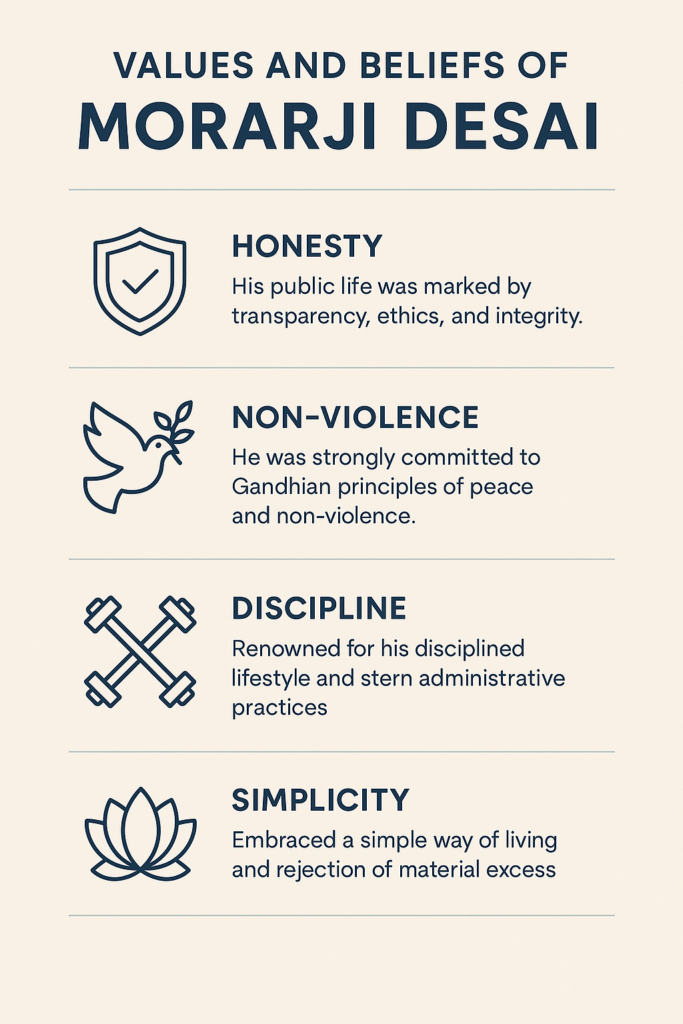
Morarji Desai’s Prime Minister Tenure (1977–1979)
Morarji Desai’s tenure as Prime Minister was a unique and transformative period in Indian political history. He became the first non-Congress Prime Minister of India, marking a major shift in India’s democratic landscape. His government focused on restoring democracy after the Emergency, promoting ethical governance and establishing accountability in public institutions. The following is a detailed description of his tenure from 1977 to 1979.
🛒 Buy Now on Amazon1. Background: Janata Party’s Historic Victory
Post-Emergency Elections
On 25 June 1975, Indira Gandhi imposed the Emergency, suspending fundamental rights, arresting opposition leaders and enforcing strict censorship on the press. This period created widespread public resentment.
When the Emergency was lifted in January 1977 and elections were announced, a massive anti-Congress wave emerged across the country.
Formation of the Janata Party
Opposition parties – Congress (O), Jan Sangh, Lok Dal, the Socialist Party and others – came together to form the Janata Party. The objective was clear: to restore democracy and challenge authoritarian governance.
Morarji Desai, being the most senior, experienced and respected leader, became the natural choice to lead the alliance.
Historic Election Results
In March 1977, the Janata Party achieved a historic victory by defeating the Congress for the first time since independence. On 24 March 1977, Morarji Desai took oath as the first non-Congress Prime Minister of India.
2. Governance Priorities and Policies
Restoration of Democracy
One of his first priorities was to reverse the authoritarian actions taken during the Emergency. Repressive orders, press censorship and interference with the judiciary were reviewed.
A Shah Commission was established to investigate the abuses and excesses committed during the Emergency.
Restoration of Fundamental Rights
Amendments were introduced to ensure that no future government could suspend fundamental rights so easily. Freedom of expression, press freedom and judicial independence were fully restored.
Administrative Reforms
Morarji Desai emphasised clean governance. He adopted a strict stance against corruption, misuse of power and administrative inefficiency. His personal lifestyle—simple, disciplined and honest—became a model for public life.
Economic Policy
Desai did not support excessive socialism. Instead, he promoted frugality, self-reliance and reduced dependence on foreign loans.
He encouraged prohibition, adoption of indigenous products and a modest lifestyle as symbols of national discipline.
3. Contribution to Foreign Policy
Relations with Pakistan
After years of hostility, Morarji Desai adopted a peaceful engagement approach. He initiated communication with Pakistan’s President Zia-ul-Haq and attempted to rebuild mutual trust.
Efforts with China
Since the 1962 war, India-China relations had remained strained. Desai attempted to renew diplomatic dialogue and improve relations.
Nuclear Policy
Morarji Desai strongly opposed nuclear weapons. He slowed down India’s nuclear programme, prioritising peaceful applications. Although some criticised him for this, it reflected his deep commitment to non-violence.
4. Discord Within the Janata Party
Ideological Differences
The Janata Party was a coalition of diverse political groups – Jan Sangh, Congress (O), Lok Dal, Socialists and Gandhian followers. Massive ideological gaps existed among them.
The Socialist groups were uncomfortable with the Jan Sangh members’ ties to the RSS. This “dual membership” issue became a major source of tension.
Leadership Struggle
Leaders like Charan Singh, Jagjivan Ram and Atal Bihari Vajpayee were influential, leading to frequent clashes over leadership. While Desai was respected, his firm decision-making style often increased internal dissatisfaction.
5. Charan Singh Conflict and Fall of Government
Charan Singh’s Rebellion
Deputy Prime Minister Charan Singh accused Desai of being stubborn, autocratic and unwilling to listen to coalition partners. He objected to the influence of Jan Sangh and its RSS links.
Resignation of Morarji Desai
When Charan Singh withdrew support from the government, the Janata Party lost its majority. Unable to prove numbers in Parliament, Morarji Desai resigned on 15 July 1979.
6. Achievements and Criticisms
Major Achievements
- Restoration of democracy: India’s democratic values were revived after the Emergency.
- Honest administration: He curbed corruption and encouraged integrity in public life.
- Ethical leadership: He lived an exemplary personal life, avoiding misuse of government facilities.
- International goodwill: He promoted peaceful diplomacy.
Criticisms
- Weakness of alliance: The Janata Party lacked ideological unity, causing instability.
- Rigid decision-making: Desai’s inflexibility sometimes alienated coalition partners.
- Slow nuclear development: His stance on nuclear weapons was criticised as impractical.
7. After His Tenure
After resigning, Morarji Desai retired from active politics. He never contested elections again and spent the rest of his life practicing yoga, naturopathy and meditation.
Conclusion
Morarji Desai’s tenure as Prime Minister symbolised the resilience of Indian democracy. Despite political instability, his leadership reaffirmed that power is not the monopoly of any one party. His work strengthened democratic institutions and upheld the values of ethical governance.
Resignation as Prime Minister and Later Life
Morarji Desai’s resignation and his life afterwards represent a quiet yet deeply inspirational chapter in Indian political history. His journey reflects how an idealistic leader continues serving society through simplicity, discipline and integrity—even after leaving power.
1. Background of Resignation
Internal Conflicts of Janata Party
The Janata Party government was a coalition of Congress (O), Jan Sangh, Lok Dal, Socialists and several smaller groups. From the beginning, ideological differences existed—especially between Jan Sangh members and the Socialist factions.
Charan Singh’s Rebellion
By 1979, Charan Singh openly opposed Morarji Desai’s leadership, calling him rigid and authoritarian. The conflict over RSS links intensified the crisis. Finally, Charan Singh withdrew support.
Failure to Prove Majority
Without enough support, Morarji Desai could not prove majority in Parliament. On 15 July 1979, he resigned as Prime Minister.
2. Political Situation After Resignation
Charan Singh’s Short-Lived Government
President Neelam Sanjiva Reddy appointed Charan Singh as Prime Minister. However, due to lack of support from Indira Gandhi, he could not prove majority and resigned within 23 days.
Indira Gandhi’s Return (1980)
Disillusionment with the Janata Party and its instability helped Indira Gandhi return to power with a huge majority in 1980.
3. Retirement from Politics
A Graceful Exit
After resigning, Morarji Desai officially announced his retirement from politics. He did not accept any post, nor did he interfere in party affairs. He never criticised his successors, displaying dignity and emotional balance.
4. Later Life: Simplicity, Yoga and Spiritual Practice
Simple Living, High Thinking
Desai lived a disciplined life marked by vegetarian food, daily yoga, strict routine and abstinence from alcohol and tobacco. His adherence to natural lifestyle principles remained unchanged.
Promotion of Health and Naturopathy
He famously advocated urine therapy, which attracted both interest and criticism. He believed longevity comes from self-control, mental stability and discipline.
5. Social Contributions
Public Lectures
Desai occasionally delivered public speeches emphasising honesty, moral values, discipline and patriotism. He continued guiding the youth through his words.
Writings and Memoirs
His writings and autobiography provide insights into his ideology, political experiences and personal philosophy.
6. International Honours and Recognition
Nishan-e-Pakistan Award
In 1990, Pakistan conferred upon him the “Nishan-e-Pakistan,” its highest civilian honour. He became the first Indian to receive it, acknowledging his efforts for Indo-Pak peace.
While some criticised him for accepting the honour, Desai saw it as a gesture of humanity and goodwill.
7. Final Years and Demise
Morarji Desai lived almost a century. Born on 29 February 1896, he passed away on 10 April 1995 at the age of 99. His long life is often attributed to his disciplined lifestyle and strict self-control.
Conclusion
Morarji Desai’s resignation and later life illustrate that politics is not merely a pursuit of power, but a path of principles, service and restraint. He left office with dignity, avoided bitterness and upheld the highest standards of democratic ethics. His simple lifestyle, moral courage and commitment to honesty continue to inspire generations.
Morarji Desai: Honours and Legacy
Morarji Desai was among the rare Indian political leaders who not only participated in the freedom struggle but also strengthened the democratic and ethical foundations of independent India. His greatest strengths were honesty, unwavering commitment to principles and personal discipline. Whether in power or after stepping down, he never resorted to populism or compromised on values. His contributions to Indian politics, administration and moral standards remain invaluable. Below is a detailed analysis of the honours he received and his lasting legacy.
1. Major National Honours
Bharat Ratna (1991)
In 1991, Morarji Desai was awarded the Bharat Ratna, India’s highest civilian honour. This honour recognised his long public life, his contribution to democracy and his integrity in policy-making. It symbolised national recognition of his moral leadership and statesmanship.
Freedom Fighter Recognition
For his active role in the freedom struggle, he received various honours, including prestigious state recognitions such as the "Abhinandan Samman." Many states named institutions, schools and roads after him as a tribute to his service.
2. International Honour
Nishan-e-Pakistan (1990)
In 1990, the Pakistan government awarded Morarji Desai the “Nishan-e-Pakistan,” the country’s highest civilian award. He became the first and only Indian to receive this honour.
The award acknowledged his efforts in improving Indo-Pak relations and advocating peaceful diplomacy. Despite criticisms from some quarters, Desai considered the honour a recognition of humanity, peace and goodwill.
3. His Political Legacy
Legitimising Non-Congress Politics
As India’s first non-Congress Prime Minister, Morarji Desai proved that stable, ethical governance was possible beyond Congress. His leadership strengthened democratic maturity and legitimised the concept of political alternatives.
Foundation of Coalition Politics
The Janata Party government was India’s first national coalition government. It laid the foundation for today’s era of multiparty alliances, federal bargaining and coalition governance.
A Graceful Exit from Power
After resigning as Prime Minister, he retired completely from politics—rare for Indian leaders. He neither sought power nor criticised successors, marking a dignified and principled withdrawal.
4. An Example of Morality and Discipline
Anti-Corruption Approach
Throughout his public life, no corruption allegation was ever proven against Morarji Desai. His simple living, strict discipline and personal integrity became benchmarks for ethical political conduct.
Alcohol Prohibition and Social Reform
He strongly advocated prohibition and influenced similar policies in states like Gujarat. He also promoted yoga, naturopathy and public health through disciplined living.
Promotion of Urine Therapy
Morarji Desai supported “urine therapy” as a natural healing practice, which generated worldwide discussion. Though controversial, his exceptional health and longevity attracted global curiosity about this method.
5. Contribution to Protecting Democracy
Restoration of Democracy After the Emergency
As Prime Minister, he undertook the vital work of reversing the authoritarian actions of the Emergency. He established the Shah Commission to investigate repression, censorship and misuse of power during that period.
Constitutional Safeguards
His government introduced amendments to ensure that future Prime Ministers could not misuse Emergency provisions. Press freedom and judicial independence were firmly reinstated.
6. Contribution to Education and Institutions
Institutions Named After Him
Many institutions, schools, roads and public facilities across India are named in his honour. Examples include:
- Morarji Desai National Institute of Yoga (New Delhi)
- Morarji Desai Residential Schools (in Karnataka, Gujarat, Maharashtra and other states)
Educational Inspiration
His life of hard work, self-discipline and honesty remains a powerful motivation for students and youth.
7. Longevity and Personal Life Inspiration
Living Almost a Hundred Years
Morarji Desai lived for 99 years and 41 days, making him India’s first centenarian political leader. His disciplined lifestyle, yoga practices, controlled diet and positive thinking contributed to his long life.
Personal Simplicity
Even as Prime Minister, he lived modestly and used minimal government facilities. He believed in direct interaction with the public and personally responded to letters.
Conclusion: A Rare Legacy
Morarji Desai’s legacy extends far beyond his political positions. He proved through his life that politics can be a medium of honesty, service and moral responsibility. He stands among the few leaders who neither compromised for power nor abandoned principles.
His life remains a mirror for Indian politics, reminding us how a nation can be served with restraint, ethics and dedication. His memory continues to inspire future generations as a symbol of honest, disciplined and principled public life.
Conclusion: Life and Contribution of Morarji Desai
Morarji Desai belongs to the class of great Indian leaders who reshaped public life through personal ethics, disciplined conduct and unwavering principle. His journey—from a freedom fighter to Chief Minister, Deputy Prime Minister and ultimately the first non-Congress Prime Minister—reflects dedication to both administrative integrity and moral governance.
His identity was rooted in honesty, simplicity and self-discipline. For him, power was not an instrument of personal gain but a tool of service. Even after resigning as Prime Minister, he retired completely from politics, demonstrating that his commitment to principles mattered more than position.
His longevity, yogic lifestyle and belief in natural health made him a unique personality in Indian leadership. His international recognition—including Bharat Ratna and Pakistan’s Nishan-e-Pakistan—reflects his wide acceptance as a statesman of peace and diplomacy.
Today, Morarji Desai’s life inspires India to believe that honest politics is not only possible but essential. His legacy teaches that simplicity, integrity and dedication to duty are the finest qualities of leadership.
References
- Government of India – Bharat Ratna Awardees, Ministry of Home Affairs
- Morarji Desai National Institute of Yoga, Government of India
- Parliament of India – Lok Sabha Debates and Records
- Shah Commission Report on Emergency (1977–1978)
- Biography: “The Story of My Life” – Morarji Desai
- Historical Records: National Archives of India
- Newspaper Archives – The Hindu, Times of India, Indian Express
- Political History Journals – Studies on Indian Democracy and Janata Party Era
- Pakistan Government Archives – Nishan-e-Pakistan Award Records