
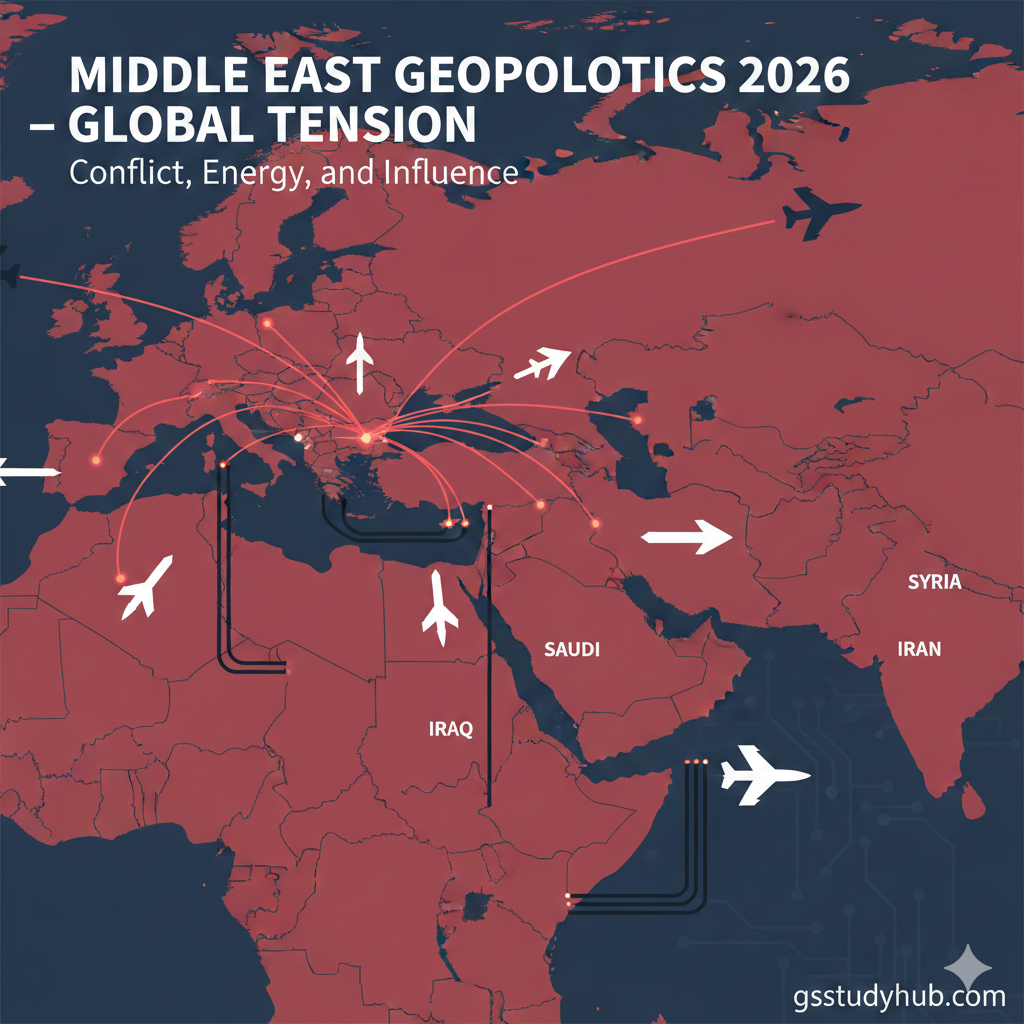
🌍 Middle East Geopolitics 2026 – Rising Tensions, Strategic Rivalries & Global Energy Shock
Middle East Geopolitics 2026 is rapidly becoming one of the most important geopolitical developments shaping global energy markets and international politics.In 2026, the Middle East has once again emerged as the epicenter of global geopolitics. A region historically shaped by power struggles, ideological rivalries, and vast energy resources is now witnessing a new phase of intense strategic competition. The escalating confrontation between Israel and Iran, the expanding military posture of the United States, and the calculated diplomatic maneuvering of Russia have together created a complex geopolitical chessboard that is influencing not only regional security but the entire global order.
Recent military strikes, covert operations, and rising naval deployments have sharply intensified tensions across the region. These developments have drawn global attention toward one of the world’s most strategically vital maritime corridors — the Strait of Hormuz. Though narrow in geography, this critical sea passage acts as the lifeline of global energy supply. Nearly 20% of the world's oil trade passes through this route every day, making it one of the most sensitive chokepoints in international commerce.
Any disruption in this corridor immediately sends shockwaves through the global economy. Oil markets react instantly with sharp volatility, shipping insurance costs rise, and energy-importing nations begin preparing for supply uncertainty. As tensions rise around the strait, analysts and policymakers across the world are closely watching every strategic move unfolding in the Gulf region.
The growing instability has already triggered noticeable fluctuations in global oil prices. Energy experts warn that if the conflict between regional powers escalates further, the world could witness a severe energy price surge. Such a scenario would not only strain global markets but also affect inflation, industrial production, and economic stability in major economies.
This is precisely why Middle East Geopolitics 2026 is no longer just a regional security issue. It has evolved into a matter of global energy security, strategic trade stability, and international economic balance.
Behind the visible military tension lies a deeper struggle for influence and power. Israel seeks to preserve its technological and military superiority in the region, while Iran aims to expand its geopolitical reach through alliances, regional proxies, and strategic deterrence.
At the same time, the United States continues to maintain a strong military presence in the Persian Gulf to protect its allies and secure global energy routes. Meanwhile, Russia is carefully strengthening its diplomatic and strategic role, seeking to increase its influence in a region where global power politics intersect.
Together, these competing ambitions have transformed the Middle East into a high-stakes geopolitical arena where every move carries global consequences. A single military strike, naval blockade, or diplomatic breakdown could reshape energy markets, international alliances, and economic stability worldwide.
Therefore, understanding Middle East Geopolitics 2026 is essential for analyzing the future of global power dynamics. What happens in this volatile yet strategically crucial region will not only determine the balance of power in West Asia but will also influence the trajectory of the world economy in the years ahead.
Gaza–Israel Conflict Explained
The current tensions in the Middle East are closely linked to the Gaza–Israel conflict, which continues to influence regional security, global diplomacy, and energy politics.
Read the full analysis here → Israel–Palestine Conflict in Gaza
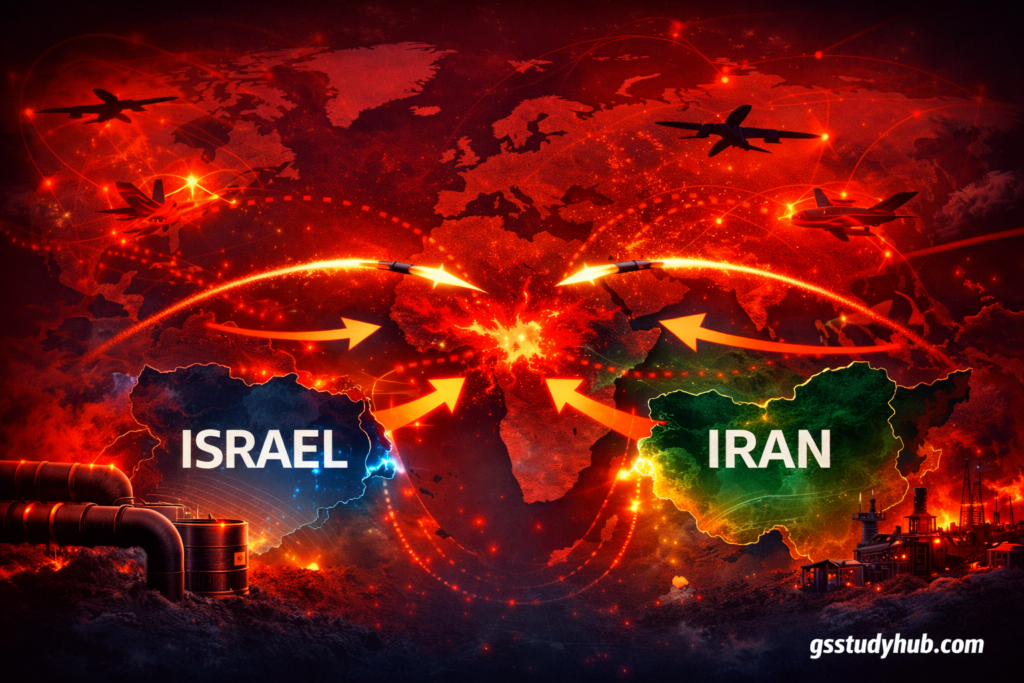
⚔ Background: Israel–Iran Conflict and Regional Escalation
At the beginning of 2026, tensions in the Middle East dramatically escalated after a series of military strikes carried out by the United States and Israel against strategic targets in Iran. These attacks, reportedly aimed at Iranian military facilities and suspected nuclear infrastructure, triggered one of the most dangerous geopolitical crises the region has witnessed in recent years.
The strikes were justified by Washington and Tel Aviv as preventive security measures designed to stop Iran from strengthening its military capabilities and advancing its nuclear ambitions. However, Tehran interpreted the attacks as a direct act of aggression and responded swiftly with a powerful display of retaliation.
Within days, Iran launched multiple missile and drone strikes targeting strategic military bases and allied infrastructure across the region. These retaliatory actions intensified regional tensions and pushed the Middle East toward a dangerous phase of strategic confrontation.
At the same time, Iran issued stern warnings to international shipping companies and naval forces operating in the Strait of Hormuz. Iranian officials announced that if the military pressure continued, they would consider restricting or blocking maritime traffic through this vital sea corridor.
The Strait of Hormuz is one of the most important maritime chokepoints in the global energy network. Every day, a massive flow of oil tankers and cargo ships passes through this narrow passage connecting the Persian Gulf to the Arabian Sea. Nearly one-fifth of the world's oil supply travels through this route, making it a crucial artery of global trade and energy security.
As tensions grew, insurance costs for commercial vessels skyrocketed, and several major shipping companies temporarily halted operations in the region. This disruption created serious concerns about the stability of global energy markets and international trade flows.
The conflict between Israel and Iran did not emerge suddenly in 2026. Instead, it is the result of a long-standing geopolitical rivalry rooted in ideological differences, strategic competition, and security concerns that have been developing for decades.
🔎 Three Major Causes of the Crisis
Experts believe that the current escalation is driven by three major underlying factors that have shaped the strategic rivalry between Iran, Israel, and Western powers.
1️⃣ Iran’s Nuclear Program
The first and most controversial issue is Iran’s nuclear program. For years, Iran has insisted that its nuclear activities are meant for peaceful purposes such as energy generation and scientific research. However, Israel and several Western countries suspect that Tehran may eventually develop nuclear weapons capability.
This suspicion has led to years of diplomatic negotiations, economic sanctions, and international monitoring efforts. Despite these measures, tensions have remained high, especially as Iran continues to advance its nuclear technology and uranium enrichment capabilities.
For Israel, the possibility of a nuclear-armed Iran represents an existential security threat. Israeli leaders have repeatedly stated that they will not allow Iran to acquire nuclear weapons under any circumstances.
2️⃣ Israel’s Security Concerns
The second major driver of the conflict is Israel’s deep-rooted concern for its national security. Israel views Iran as its most dangerous regional adversary due to Tehran’s military capabilities and its support for several armed groups across the Middle East.
Iran maintains strategic relationships with organizations and militias operating in countries such as Lebanon, Syria, and Iraq. From Israel’s perspective, these alliances create a network of potential threats along its borders.
As a result, Israel has adopted a proactive military strategy aimed at preventing Iran from strengthening its regional influence or establishing advanced weapons systems close to Israeli territory.
3️⃣ Strategic Involvement of the United States and Western Powers
The third major factor behind the escalating crisis is the involvement of the United States and several Western allies. For decades, the United States has maintained strong strategic and military partnerships with Israel while simultaneously attempting to contain Iran’s regional influence.
Washington’s presence in the Persian Gulf — including naval fleets, military bases, and security alliances — plays a crucial role in shaping the balance of power in the region. Whenever tensions rise between Israel and Iran, the United States often becomes directly or indirectly involved in the situation.
This external involvement adds another layer of complexity to the conflict, turning what might otherwise be a bilateral rivalry into a multi-dimensional geopolitical crisis.
🌍 Regional Instability and Global Impact
The escalating confrontation between Israel and Iran has significantly increased instability across the entire Middle East. Neighboring countries are now closely monitoring the situation, fearing that the conflict could expand into a broader regional war.
Moreover, disruptions in maritime traffic through the Strait of Hormuz have raised serious concerns about the safety of global trade routes. If tensions continue to escalate, the world could face rising oil prices, supply chain disruptions, and economic instability.
For many analysts, the events unfolding in 2026 represent a critical moment in modern geopolitics. The evolving conflict between Israel, Iran, and their international partners is not only reshaping the strategic landscape of the Middle East but also influencing the future of global energy security and economic stability.
To understand the deeper geopolitical roots of regional tensions, explore our detailed analysis on the major reasons behind the Israel–Middle East conflict , including historical disputes, territorial claims, and religious significance shaping the region.
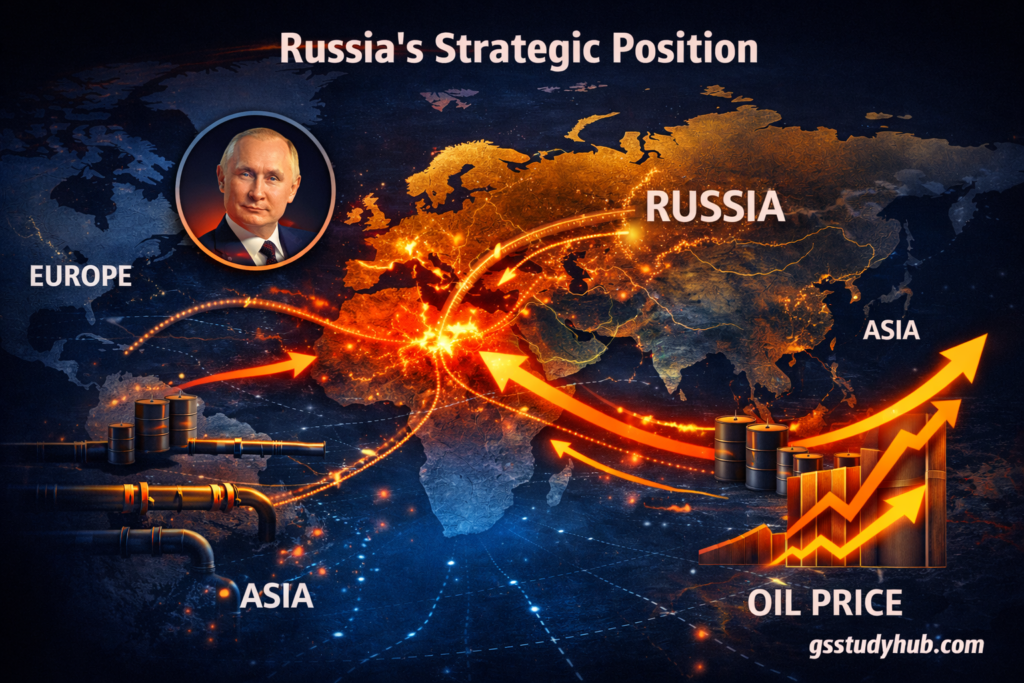
🌍 Russia’s Strategic Position in the Conflict
The escalating tensions in the Middle East during 2026 have created a complex geopolitical landscape where several global powers are carefully assessing their strategic interests. While the primary confrontation appears to be between Israel, the United States, and Iran, another powerful actor is quietly observing and strategically positioning itself in the background — Russia.
Interestingly, Russia is not directly involved in the military confrontation. Unlike the United States or regional actors, Moscow has not deployed troops or launched military operations in this crisis. However, that does not mean Russia is unaffected. In fact, many geopolitical analysts believe that Russia could become one of the most significant strategic beneficiaries of the unfolding situation.
Russia’s position in this conflict reflects a classic example of strategic opportunism in international politics. Rather than entering the battlefield directly, Moscow may benefit economically and politically from the instability in the Middle East.
🔎 Why the Crisis Could Benefit Russia
Several factors explain why Russia may gain indirect advantages from the growing Middle East tensions. These factors are largely related to the global energy market, geopolitical influence, and shifting international alliances.
1️⃣ Rising Oil Prices – A Major Advantage for Russia
One of the most immediate effects of geopolitical instability in the Middle East is the sharp fluctuation in global oil prices. Whenever tensions threaten the supply of crude oil — especially in critical routes like the Strait of Hormuz — global markets react with fear and uncertainty.
This fear often pushes oil prices upward. For oil-exporting countries, higher oil prices can translate into massive revenue gains. Russia, being one of the world’s largest energy exporters, stands to benefit significantly from such price increases.
Russian crude oil and natural gas exports form a major pillar of its national economy. If the Middle East conflict disrupts oil supply or raises energy prices globally, Russia could experience a surge in its energy income. Higher revenues would help Moscow strengthen its economic position and compensate for financial pressures created by international sanctions.
2️⃣ Europe’s Energy Security Could Become Weaker
Another strategic factor lies in Europe’s fragile energy security. For decades, Europe has relied heavily on imported energy, including oil and natural gas from external suppliers. In recent years, many European countries have attempted to reduce their dependence on Russian energy sources.
However, if Middle Eastern oil supplies become unstable due to conflict, Europe may find itself facing a serious energy shortage. In such a scenario, Russia could regain strategic leverage as an alternative supplier.
Even if Europe does not directly increase its purchases from Russia, global energy shortages could still raise prices across markets. This would indirectly strengthen Russia’s economic position and give Moscow greater influence in global energy negotiations.
3️⃣ Increased Energy Demand from Asia
The Middle East crisis could also reshape energy trade patterns across Asia. Major energy-consuming countries such as China and India rely heavily on imported oil and gas to support their rapidly growing economies.
If oil shipments from the Persian Gulf become uncertain or disrupted, these countries may look for alternative suppliers to secure their energy needs. Russia, with its vast reserves of oil and natural gas, could become an increasingly important supplier for Asian markets.
In recent years, Moscow has already strengthened its energy partnerships with Asian countries through pipeline projects, long-term supply agreements, and strategic trade deals. A Middle East crisis could accelerate this trend and deepen Russia’s economic relationships with emerging Asian economies.
📊 Economic Impact and Strategic Gains
Geopolitical analysts suggest that prolonged instability in the Middle East could significantly boost Russia’s energy revenues. Higher oil and gas prices would increase government income, improve fiscal stability, and provide additional financial resources for strategic investments.
This economic advantage could help Russia reduce the impact of Western sanctions and strengthen its domestic economy. Increased revenues may also allow Moscow to expand investments in infrastructure, military modernization, and technological development.
Furthermore, Russia’s diplomatic role could also grow during the crisis. Moscow often presents itself as a mediating power capable of maintaining dialogue with multiple sides in regional conflicts. This diplomatic flexibility may enhance Russia’s reputation as a key geopolitical actor.
🌐 Russia as an Indirect Beneficiary
Taken together, these factors explain why many analysts describe Russia as a potential “indirect beneficiary” of the Middle East crisis. Although Moscow is not directly involved in the military confrontation, the geopolitical consequences of the conflict could work in its favor.
Rising energy prices, shifting trade patterns, and weakened energy security in competing regions may all create opportunities for Russia to strengthen its economic and strategic position.
In the complex world of international geopolitics, influence is not always gained through direct military engagement. Sometimes, the most powerful advantages emerge quietly — through economic shifts, strategic alliances, and global market dynamics.
As the Middle East crisis continues to evolve, Russia will likely continue to monitor developments closely while carefully positioning itself to benefit from the changing global energy landscape.
The global race for semiconductor dominance has intensified geopolitical competition between major powers. To understand how advanced chips are shaping technology, military power, and economic security, read our detailed analysis on the Semiconductor War 2026 – Global Chip Power Struggle .
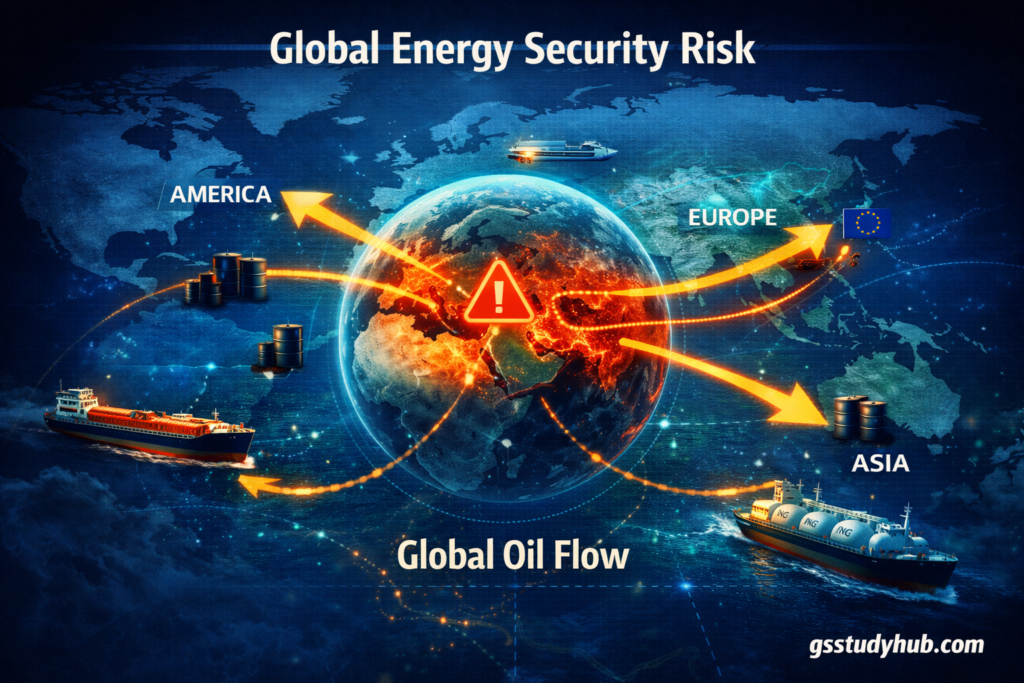
⚡ Global Energy Security at Risk
The Middle East has long been considered the energy heart of the world. Vast oil fields, massive natural gas reserves, and strategically important shipping routes make this region one of the most critical pillars of the global energy system. However, when geopolitical tensions or military conflicts erupt in this region, the consequences are felt almost instantly across international energy markets.
In 2026, the escalating confrontation between Israel, Iran, and the involvement of major global powers has created serious concerns about the stability of global energy supply. The ongoing crisis has placed the entire framework of global energy security under immense pressure.
Energy security refers to the reliable and uninterrupted supply of energy resources such as oil and natural gas at stable prices. When conflicts threaten production facilities, pipelines, or maritime trade routes, the delicate balance of the global energy system can quickly collapse.
🌍 Why the Middle East is Critical for Global Energy
The Middle East accounts for a significant share of the world’s proven oil and gas reserves. Countries such as Saudi Arabia, Iran, Iraq, Qatar, and United Arab Emirates play a vital role in supplying energy to global markets.
These nations collectively produce millions of barrels of oil every day and export large quantities of natural gas to Europe, Asia, and other regions. Any disruption in their production or transportation systems can create immediate shocks in the global economy.
The most crucial artery of this energy system is the Strait of Hormuz. This narrow yet extremely strategic maritime corridor connects the Persian Gulf to the Arabian Sea and serves as a gateway for energy exports from the Middle East to the rest of the world.
📊 Key Energy Facts About the Strait of Hormuz
Energy experts often describe the Strait of Hormuz as one of the world’s most critical energy chokepoints. Several important statistics highlight its significance in the global energy network:
- Approximately 20 million barrels of oil pass through the Strait of Hormuz every single day.
- A large portion of the world’s Liquefied Natural Gas (LNG) shipments also travel through this route.
- Major energy exporters in the Persian Gulf rely heavily on this passage to transport oil and gas to global markets.
Because of its strategic importance, even a minor disruption in the Strait of Hormuz can trigger dramatic changes in global energy prices and supply chains.
⚠ Impact of the Current Conflict
The ongoing conflict in the Middle East has already begun to disrupt the region’s energy infrastructure and shipping activity. Several incidents involving attacks on oil tankers, commercial vessels, and energy facilities have raised serious concerns about the safety of energy transport routes.
Insurance costs for tankers operating in the region have surged dramatically. Some shipping companies have temporarily reduced their operations due to security risks, further tightening global energy supply.
These developments have created a wave of uncertainty across international energy markets. Traders, investors, and policymakers are closely monitoring every military and political move in the region.
📈 Rising Oil and Gas Prices
One of the most visible consequences of the conflict has been the sharp rise in global energy prices. Benchmark crude oil prices, particularly Brent crude, have surged as markets react to fears of supply disruptions.
At the same time, natural gas markets have also experienced significant volatility. Countries across Europe and Asia have seen a substantial increase in gas prices as energy companies scramble to secure alternative supplies.
The rise in energy prices has broader economic implications. Higher oil and gas costs often translate into increased transportation expenses, rising electricity prices, and higher inflation across global economies.
🌐 Increasing Volatility in Energy Markets
Energy markets thrive on stability and predictability. However, geopolitical conflicts introduce uncertainty that can rapidly destabilize these markets. The Middle East crisis has created an environment where prices fluctuate sharply in response to political statements, military developments, and diplomatic negotiations.
Investors and governments are increasingly concerned that prolonged instability could trigger a broader global energy shock.
💰 Could Oil Prices Reach $100–$200 per Barrel?
Some energy analysts believe that if the conflict intensifies or continues for an extended period, oil prices could rise dramatically. In extreme scenarios involving large-scale disruptions to Middle Eastern exports, crude oil prices could potentially reach $100 to $200 per barrel.
Such a dramatic price surge would have far-reaching consequences for the global economy. Energy-importing countries could face severe financial pressure, while industries heavily dependent on fuel — including transportation, aviation, and manufacturing — might experience significant cost increases.
Developing economies, which rely heavily on affordable energy for growth, could be particularly vulnerable to such shocks.
🔮 Future Implications for Global Energy Security
The current crisis highlights the fragile nature of global energy systems. It also underscores the urgent need for countries to diversify their energy sources, invest in renewable energy technologies, and develop more resilient energy supply chains.
While the Middle East will continue to remain a central hub of global energy production, many nations are now reconsidering their long-term energy strategies to reduce vulnerability to geopolitical conflicts.
As the geopolitical situation continues to evolve, the world is watching closely. The future of global energy security may depend on how effectively international diplomacy can stabilize the Middle East and protect the critical energy routes that power the modern world.
Global geopolitics is increasingly shaped by the clash between renewable energy expansion and traditional fossil-fuel power politics. For a deeper analysis of how climate policies, oil markets, and strategic alliances are reshaping global energy power, read our detailed guide on Energy Transition vs Oil Politics 2026 .
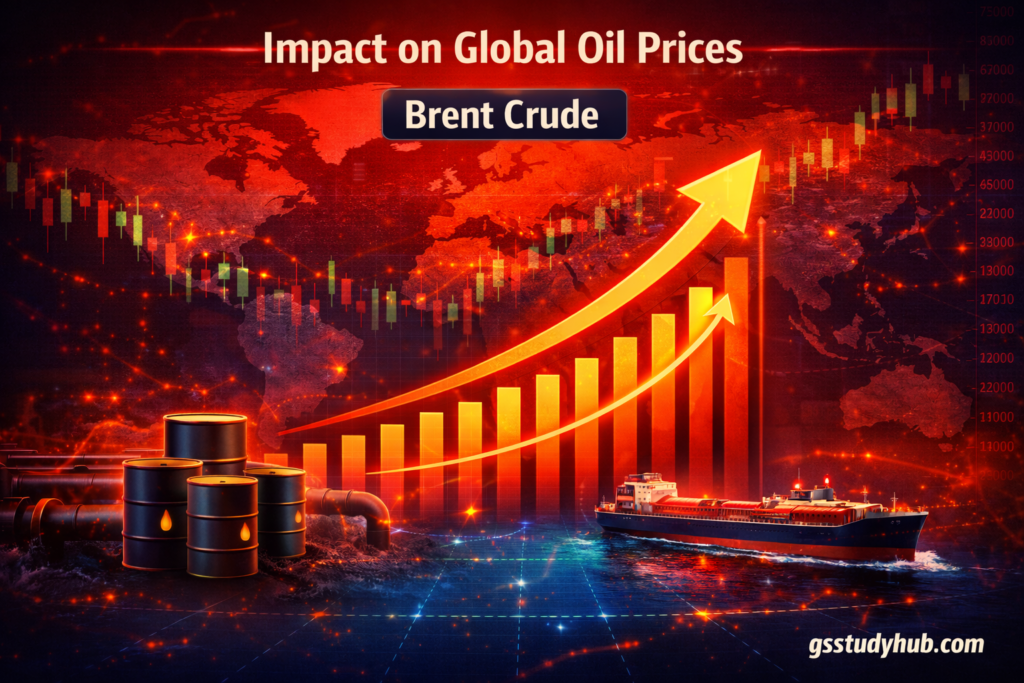
📈 Impact on Global Oil Prices
The rapidly evolving Middle East Geopolitics in 2026 has triggered significant turbulence across global energy markets. Among the most immediate and visible consequences of the regional conflict has been the sharp movement in global oil prices. Because the Middle East serves as one of the world’s most important energy hubs, any political instability or military confrontation in this region can quickly ripple through international commodity markets.
Energy traders, governments, and investors closely monitor developments in the Middle East because the region produces a substantial portion of the world’s crude oil and natural gas supply. When tensions rise, markets often react immediately due to fears of potential supply disruptions. The current Israel–Iran escalation, combined with growing military activity in the Persian Gulf, has created an atmosphere of uncertainty that is pushing oil and gas prices upward.
In global energy markets, even the possibility of supply disruption can trigger price volatility. This is exactly what has occurred during the recent geopolitical crisis. Traders have responded to the risk of conflict by increasing speculative buying, which has amplified fluctuations in oil prices worldwide.
⚡ Recent Market Reactions
Following the escalation of tensions in the Middle East, international energy markets experienced a strong and immediate reaction. Oil and gas benchmarks surged as concerns over supply stability grew. Several important developments have been observed in the market:
- Brent crude oil prices increased by approximately 10–13% in a short period of time.
- Global LNG (Liquefied Natural Gas) prices surged by nearly 30–40% due to concerns over supply availability.
- Rising energy costs have increased fears of global inflation, which could affect economic stability in both developed and developing countries.
These price increases highlight how sensitive global energy markets are to geopolitical shocks. When instability threatens energy infrastructure or transportation routes, the effects quickly spread across international economies.
🌍 Major Causes Behind Rising Oil Prices
Energy analysts point to several major factors that are contributing to the surge in oil and gas prices. These causes are closely connected to the ongoing conflict and security concerns in the Middle East.
1️⃣ Attacks on Energy Infrastructure
One of the key drivers of rising oil prices has been the reported attacks on energy infrastructure. Several incidents involving strikes on oil storage facilities, gas processing plants, and pipeline networks have raised serious concerns about the reliability of energy production in the region.
When production facilities or storage sites come under threat, markets immediately anticipate potential supply shortages. This anticipation pushes oil traders to purchase crude at higher prices, driving overall market prices upward.
Even minor damage to energy facilities can create psychological pressure in global markets because energy supply chains are highly interconnected.
2️⃣ Disruption of Maritime Trade Routes
Another crucial factor affecting oil prices is the vulnerability of maritime energy transportation routes. A significant portion of the world’s oil exports travel through the Strait of Hormuz, one of the most strategically important shipping corridors in the world.
If tensions escalate around this route or shipping traffic slows down, global markets fear that oil shipments could be delayed or reduced. Even the possibility of a blockade or military confrontation near the strait can trigger sharp increases in energy prices.
This strategic chokepoint therefore plays a decisive role in determining short-term oil price movements during geopolitical crises.
3️⃣ Reduced Shipping Activity
During periods of conflict, commercial shipping companies often reduce their operations in high-risk areas. This has been evident during the current Middle East crisis, where some vessels have temporarily avoided certain routes due to security concerns.
Additionally, maritime insurance costs for oil tankers have increased sharply. Higher insurance premiums raise transportation costs, which ultimately translate into higher prices for crude oil and natural gas.
Reduced shipping capacity can also slow the delivery of energy supplies to major importing regions such as Asia and Europe.
🌐 Wider Impact on the Global Economy
Rising oil prices have far-reaching consequences beyond the energy sector. Energy costs influence nearly every part of the global economy, including transportation, manufacturing, and electricity generation.
When oil prices increase sharply, businesses face higher operational costs. These increased expenses are often passed on to consumers in the form of higher product prices, contributing to inflation.
Countries that rely heavily on imported energy—such as India, Japan, and South Korea— may experience stronger economic pressure during such periods.
📊 Continued Volatility in Energy Markets
At present, global energy markets remain highly volatile. Oil prices are reacting to every new military development, diplomatic announcement, and geopolitical signal emerging from the Middle East.
Investors and policymakers are closely monitoring the situation because prolonged instability could trigger further price spikes and deeper economic challenges.
🔮 Future Outlook
Many analysts believe that if the conflict intensifies or continues for an extended period, oil prices could climb even higher. A prolonged disruption of Middle Eastern energy exports could potentially push global oil markets into a period of sustained price inflation.
The events of 2026 clearly demonstrate that global oil prices are not influenced only by supply and demand. They are also deeply shaped by geopolitical tensions, strategic trade routes, and the broader dynamics of international security.
As the Middle East crisis continues to evolve, the stability of global energy markets will remain closely tied to the region’s political and military developments.
India has emerged as a key strategic player in the Indo-Pacific region due to its geographic location, naval capabilities, and growing diplomatic partnerships. To explore how New Delhi is shaping regional security, maritime cooperation, and economic connectivity, read our detailed analysis on India’s Role in the Indo-Pacific Strategy .
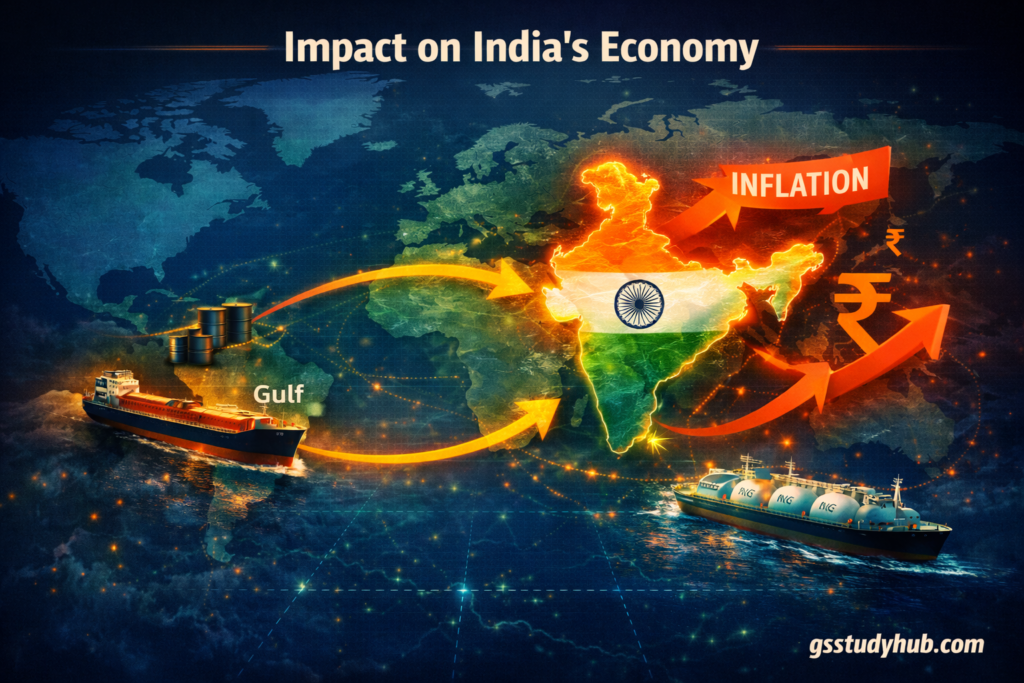
🇮🇳 Impact on India’s Economy and Energy Security
The escalating Middle East geopolitical crisis in 2026 is not only a regional security concern but also a serious economic challenge for many countries around the world. Among the nations most vulnerable to this crisis is India, one of the fastest-growing major economies and one of the world’s largest energy consumers.
India’s economic growth, industrial expansion, and transportation system rely heavily on imported energy resources. Because domestic oil production is limited, the country depends significantly on imports from energy-rich regions—especially the Middle East.
Currently, India imports more than 80% of its crude oil requirements from foreign suppliers. A substantial portion of this supply comes from Middle Eastern countries such as Saudi Arabia, Iraq, UAE, and Kuwait.
Because of this strong dependence, any instability in the Middle East—whether political, military, or economic—can quickly impact India’s energy security and broader economic stability.
The ongoing conflict involving regional powers, potential disruptions in maritime routes, and rising global oil prices have raised serious concerns among Indian policymakers and economic analysts.
⚡ Why India is Highly Vulnerable
India’s vulnerability to Middle East tensions arises from several structural realities of its energy system.
- India imports more than 80% of its oil consumption.
- The Middle East remains the largest supplier of crude oil to India.
- A significant portion of these energy shipments travel through the Strait of Hormuz.
If geopolitical tensions disrupt shipping routes or reduce production in the region, India could face higher energy costs and supply uncertainties.
⛽ 1️⃣ Rising Petrol and Diesel Prices
One of the most immediate consequences of rising global oil prices is the increase in domestic fuel prices. When crude oil becomes more expensive in international markets, the cost of refining and distributing fuel also rises.
As a result, petrol and diesel prices in India may increase significantly.
Higher fuel prices directly affect millions of households and businesses across the country. Transportation costs increase, logistics become more expensive, and industries that rely on fuel-intensive operations face rising operational expenses.
This creates pressure not only on consumers but also on government policies related to fuel taxation and subsidies.
📊 2️⃣ Rising Inflation
Energy prices are closely connected to the overall inflation rate of an economy. When fuel costs rise, transportation becomes more expensive, which increases the cost of moving goods across the country.
Industries such as manufacturing, agriculture, and logistics depend heavily on energy. Therefore, rising oil prices can push up the cost of production.
Eventually, these higher costs are passed on to consumers in the form of higher prices for goods and services.
This process contributes to inflationary pressure, which can reduce consumer purchasing power and slow economic growth.
💱 3️⃣ Pressure on the Indian Rupee
Another major consequence of rising oil prices is the impact on India’s currency. Because India imports a large amount of crude oil, higher prices mean the country must spend more foreign currency—primarily U.S. dollars—to pay for energy imports.
This leads to an increase in the national import bill.
When the import bill rises significantly, it can create pressure on the Indian rupee, causing it to weaken against the U.S. dollar.
A weaker currency can make imports even more expensive, creating a cycle that further increases inflation and economic stress.
🚢 4️⃣ Impact on Trade and Supply Chains
The Middle East is not only a major energy supplier but also a crucial hub for global shipping routes. Many international trade corridors connecting Asia, Europe, and Africa pass through the region.
If maritime traffic through strategic passages such as the Strait of Hormuz becomes restricted due to conflict, shipping times and costs could increase significantly.
For India, this could disrupt both imports and exports.
Export-oriented sectors such as manufacturing, chemicals, and textiles may face delays in receiving raw materials or delivering finished products to international markets.
In addition, higher shipping costs and insurance premiums for vessels operating in conflict zones could further increase trade expenses.
🌐 Strategic Implications for India
The Middle East crisis highlights the importance of strengthening India’s energy security strategy. Over the past decade, India has already taken steps to diversify its energy sources by importing oil from regions such as Russia, the United States, and Africa.
India has also been expanding its strategic petroleum reserves to prepare for potential supply disruptions.
In the long term, policymakers are increasingly focusing on renewable energy, electric mobility, and energy diversification to reduce dependence on imported fossil fuels.
🔮 Future Outlook
If the Middle East conflict continues or intensifies, India may face prolonged economic challenges related to energy prices, inflation, and trade disruptions.
However, the crisis also serves as a reminder of the importance of building a more resilient energy system that can withstand geopolitical shocks.
By diversifying energy imports, expanding renewable capacity, and strengthening strategic energy reserves, India can gradually reduce its vulnerability to external energy crises and secure a more stable economic future.
Rapid climate change and melting Arctic ice are transforming the region into a new arena of global power competition. To understand how oil reserves, shipping routes, and military rivalry are shaping the future of global energy politics, read our in-depth analysis on Arctic Geopolitics and the Emerging Energy War .
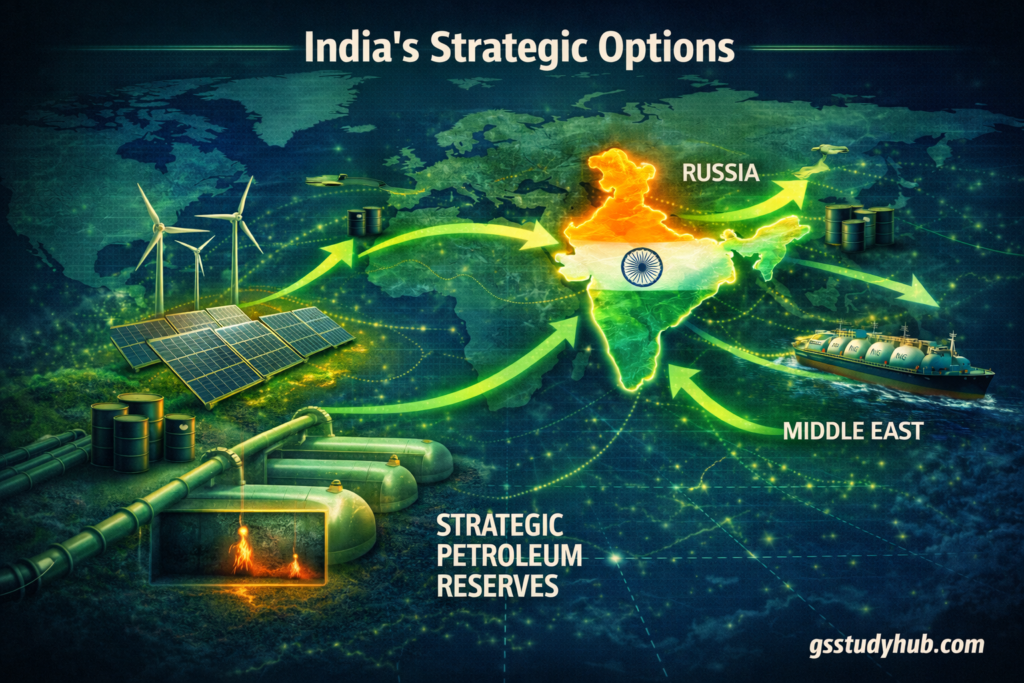
🇮🇳 Strategic Options for India in the Middle East Crisis
The rising geopolitical tensions in the Middle East in 2026 have created serious concerns for global energy markets and international trade routes. For a rapidly developing economy like India, these tensions pose both economic challenges and strategic opportunities.
India’s strong dependence on imported energy, particularly crude oil from the Middle East, means that any disruption in regional stability could significantly affect the country’s energy security and economic growth. However, India is not without options. Through a combination of strategic planning, energy diversification, and diplomatic engagement, the country can mitigate the risks arising from the crisis.
Experts believe that India must adopt a multi-dimensional strategy that balances energy resilience, economic stability, and geopolitical diplomacy.
⚡ Key Strategic Options for India
To navigate the uncertainties of the current geopolitical environment, India can pursue several important strategies that strengthen its long-term energy security and economic stability.
1️⃣ Diversification of Energy Sources
One of the most effective ways to reduce vulnerability to Middle East conflicts is through energy diversification. When a country relies too heavily on a single region for its energy supplies, geopolitical conflicts in that region can create severe economic shocks.
India has already begun expanding its network of oil suppliers in recent years. Apart from Middle Eastern producers, India is increasingly importing crude oil from Russia, the United States, and African countries.
This diversification strategy helps reduce dependence on a single geographic source and provides greater flexibility in times of geopolitical instability. If disruptions occur in the Persian Gulf, India can partially compensate by increasing imports from alternative suppliers.
Such diversification also strengthens India’s bargaining power in global energy markets, allowing the country to negotiate more competitive prices and secure stable supply contracts.
2️⃣ Strengthening Strategic Petroleum Reserves
Another important strategy is the expansion and effective utilization of Strategic Petroleum Reserves (SPR). These reserves function as emergency oil stockpiles that countries maintain to manage temporary disruptions in energy supply.
India has already established strategic petroleum storage facilities in locations such as Visakhapatnam, Mangaluru, and Padur.
These underground reserves allow India to store millions of barrels of crude oil, which can be released into the domestic market during supply shortages or sudden price spikes.
Expanding these reserves further would strengthen India’s energy security buffer. In the event of major disruptions in Middle Eastern oil supplies, strategic reserves could help stabilize fuel availability and prevent panic in domestic markets.
3️⃣ Accelerating Renewable Energy Development
Perhaps the most sustainable long-term solution to energy vulnerability is the expansion of renewable energy. India has already emerged as one of the world’s fastest-growing renewable energy markets.
Large-scale investments in solar power and wind energy are gradually reducing India’s dependence on imported fossil fuels.
Government initiatives such as the National Solar Mission and ambitious renewable capacity targets aim to transform India into a global leader in clean energy.
Increasing the share of renewable energy in the national energy mix can help protect the economy from volatile global oil prices and geopolitical disruptions.
In addition, renewable energy investments contribute to environmental sustainability and support India’s commitment to reducing carbon emissions under global climate agreements.
4️⃣ Maintaining Balanced Diplomatic Relations
Diplomacy remains one of the most critical tools for navigating geopolitical crises. India has traditionally pursued a balanced and pragmatic foreign policy in the Middle East.
The country maintains strong strategic partnerships with multiple regional actors, including Israel, Iran, and several Arab nations.
This balanced diplomatic approach allows India to protect its economic interests while avoiding alignment with any single geopolitical bloc.
For example, India cooperates with Israel in areas such as defense technology and agricultural innovation, while also maintaining energy partnerships with Gulf countries and cultural ties with Iran.
By maintaining constructive relationships with all major regional actors, India can ensure continued access to energy supplies and protect its trade routes during periods of geopolitical tension.
🌍 Building Long-Term Energy Resilience
The current Middle East crisis highlights the importance of developing a resilient energy strategy capable of withstanding global shocks. India’s long-term energy security will depend on its ability to combine multiple policy approaches, including diversification, strategic reserves, renewable expansion, and diplomatic engagement.
A forward-looking energy policy will not only safeguard India’s economy from external disruptions but also strengthen its position as a major global economic power.
🔮 Future Outlook
As geopolitical tensions continue to reshape global energy markets, India’s strategic choices will play a crucial role in determining its economic resilience.
By pursuing diversified energy partnerships, expanding renewable capacity, strengthening emergency reserves, and maintaining balanced diplomacy, India can effectively navigate the uncertainties of global geopolitics and secure a more stable energy future.
The ongoing instability in the Red Sea has become a major concern for global shipping and supply chains. This strategic maritime corridor connects the Suez Canal with the Indian Ocean and carries a significant share of global trade. To understand how attacks on commercial vessels, rerouted shipping lanes, and rising transport costs are affecting international commerce, read our in-depth analysis on Red Sea Crisis 2026 – Global Trade Impact .
🌍 Future Outlook: Middle East Geopolitics 2026
The evolving crisis in the Middle East during 2026 has become one of the most closely watched geopolitical developments in the world. Rising tensions between regional powers, strategic rivalries between global actors, and the increasing importance of energy routes have transformed this conflict into a global strategic concern.
What happens next in the Middle East will not only determine the future stability of the region but could also influence the trajectory of global energy markets, international trade, and world economic stability.
Geopolitical analysts and international policymakers are currently evaluating several possible scenarios that may shape the future of this crisis. While the exact outcome remains uncertain, three major possibilities are widely discussed by experts.
🔮 Possible Scenarios for the Future
The future of Middle East geopolitics may unfold in different directions depending on military developments, diplomatic negotiations, and the involvement of global powers such as the United States, Russia, and China.
⚔ 1️⃣ Limited Conflict
The first and perhaps the most likely scenario is a limited conflict. In this situation, tensions between key actors—particularly Israel and Iran—may continue for an extended period, but the conflict may not escalate into a full-scale war.
Under this scenario, military actions may remain relatively contained. There could be occasional missile strikes, cyber operations, naval confrontations, or proxy conflicts in neighboring regions.
Such a situation would keep the region in a state of strategic tension, while avoiding a direct and large-scale military confrontation.
Even though a limited conflict may prevent catastrophic escalation, it could still create significant uncertainty in global markets. Energy prices may remain volatile, and investors could continue to react to each new development with caution.
🔥 2️⃣ Regional War
The second and more dangerous scenario involves the possibility of a regional war. If tensions escalate beyond control, several countries in the Middle East could become directly involved in the conflict.
A regional war could draw in multiple actors including regional allies, military coalitions, and powerful external nations.
Such a scenario would dramatically increase instability across the region and could disrupt major maritime routes such as the Strait of Hormuz.
Because this passage is responsible for transporting a large portion of the world's oil supply, any prolonged disruption could trigger a global energy shock.
A large-scale regional war could also create humanitarian crises, displace millions of people, and intensify political tensions among major global powers.
In such a scenario, global oil prices could rise dramatically, potentially reaching levels that could destabilize international economies and disrupt financial markets worldwide.
🕊 3️⃣ Diplomatic Resolution
The third and most hopeful scenario is a diplomatic resolution. In this outcome, international pressure and negotiations could bring rival parties to the negotiating table.
Global organizations such as the United Nations, along with major powers, may attempt to mediate discussions aimed at reducing tensions and restoring regional stability.
Diplomatic solutions may involve security agreements, nuclear monitoring frameworks, or confidence-building measures designed to prevent further escalation.
While diplomatic negotiations are often slow and complex, they remain the most effective long-term method of ensuring sustainable peace in volatile regions.
If successful, diplomatic engagement could help stabilize energy markets, restore confidence among investors, and reopen disrupted trade routes.
🌐 Global Implications of a Prolonged Conflict
If the Middle East conflict continues for a prolonged period, its impact will extend far beyond regional borders.
The consequences could reshape global geopolitics, energy supply chains, and international economic stability.
Energy-importing nations may face higher fuel costs, increased inflation, and pressure on national currencies. At the same time, global supply chains could experience delays and disruptions due to maritime security risks.
In addition, prolonged instability may encourage countries to accelerate their transition toward renewable energy and diversify their energy supply sources.
📊 Transformation of Global Geopolitics
The evolving crisis may also reshape alliances and geopolitical relationships. Countries may form new strategic partnerships to secure energy supplies and protect trade routes.
Major powers such as the United States, Russia, China, and the European Union may play increasingly important roles in determining the outcome of the crisis.
As these geopolitical dynamics evolve, the Middle East will likely remain a central arena where global power competition unfolds.
🔮 Conclusion: A Defining Moment for Global Stability
The year 2026 could become a defining moment in modern geopolitics. The future of Middle East stability will influence not only regional security but also the broader global economic order.
Whether the crisis moves toward limited confrontation, regional escalation, or diplomatic resolution will depend on the choices made by world leaders in the coming months.
For the global community, the key challenge will be balancing strategic interests with the urgent need for stability, cooperation, and peaceful dialogue.
The ongoing instability in the Red Sea has become a major concern for global shipping and supply chains. This strategic maritime corridor connects the Suez Canal with the Indian Ocean and carries a significant share of global trade. To understand how attacks on commercial vessels, rerouted shipping lanes, and rising transport costs are affecting international commerce, read our in-depth analysis on Red Sea Crisis 2026 – Global Trade Impact .
🌍 Conclusion: Middle East Geopolitics 2026 and the Emerging Global Order
The unfolding developments in Middle East Geopolitics 2026 are rapidly transforming into one of the most defining chapters of contemporary international politics. What initially appeared as a regional confrontation has gradually evolved into a complex geopolitical situation with far-reaching global implications.
The growing tensions between Israel and Iran, the strategic involvement of global powers, and the fragile stability of energy supply routes have collectively pushed the world toward a new era of geopolitical uncertainty.
In today’s interconnected world, regional conflicts rarely remain confined within geographical boundaries. The crisis unfolding in the Middle East is a clear reminder that global politics, energy markets, and economic stability are deeply interconnected.
Every missile strike, naval movement, or diplomatic announcement in the region has the potential to influence global oil prices, international trade routes, and strategic alliances among major world powers.
⚔ Israel–Iran Rivalry and Its Strategic Consequences
The ongoing rivalry between Israel and Iran remains one of the central drivers of instability in the Middle East. Both nations view each other as major strategic threats, which has created a cycle of confrontation, deterrence, and geopolitical competition.
Israel’s focus on maintaining its national security and military superiority has led to proactive actions against perceived threats. Meanwhile, Iran seeks to expand its regional influence through strategic alliances, political partnerships, and military capabilities.
This rivalry has turned the Middle East into a highly sensitive geopolitical arena where regional conflicts can quickly escalate into broader international tensions.
🌐 Russia’s Strategic Position
Another critical dimension of the crisis is the strategic role played by Russia. Although Russia is not directly engaged in the military conflict, the changing dynamics of global energy markets and geopolitical alignments may indirectly benefit Moscow.
Higher oil prices, shifting trade patterns, and growing demand for alternative energy suppliers could strengthen Russia’s position in global energy markets.
By carefully navigating the diplomatic landscape, Russia may be able to expand its influence while positioning itself as a strategic player in both energy politics and international negotiations.
⚡ Volatility in Global Energy Markets
One of the most immediate consequences of the Middle East crisis has been the instability in global energy markets.
Oil prices, particularly Brent crude, have already experienced sharp fluctuations as investors respond to potential supply disruptions and maritime security risks.
The strategic importance of the Strait of Hormuz further amplifies these concerns, as a significant portion of the world’s oil supply passes through this critical maritime corridor.
Any prolonged disruption in this region could trigger a broader global energy shock, affecting industries, transportation systems, and economic growth across multiple continents.
🇮🇳 India: A Challenge and an Opportunity
For India, the evolving Middle East crisis presents both a serious challenge and a strategic opportunity.
As one of the world’s largest energy importers, India remains vulnerable to fluctuations in global oil prices and disruptions in energy supply routes.
At the same time, the crisis encourages India to strengthen its energy security strategy, diversify its import sources, and accelerate the development of renewable energy.
India’s balanced diplomatic relationships with countries across the Middle East—such as Israel, Iran, and the Gulf states—also provide an opportunity to play a constructive role in maintaining regional stability.
By carefully navigating these geopolitical complexities, India can protect its economic interests while enhancing its position as a responsible global power.
🔮 A New Era of Geopolitical Transformation
The developments of 2026 suggest that the world may be entering a new phase of geopolitical transformation. Energy security, strategic alliances, and regional stability are becoming increasingly interconnected in shaping the global balance of power.
Countries are now recognizing the importance of diversifying energy sources, securing critical trade routes, and strengthening diplomatic engagement to navigate a rapidly changing international environment.
📊 Final Perspective
Ultimately, the trajectory of Middle East Geopolitics 2026 will play a decisive role in shaping the future of global politics.
Whether the crisis leads to prolonged confrontation, diplomatic compromise, or a broader regional realignment will depend on the strategic decisions made by world leaders in the coming months.
For nations around the world—including India—the key challenge will be maintaining economic resilience, energy security, and balanced diplomacy in an increasingly uncertain geopolitical landscape.
As the world watches the unfolding developments in the Middle East, one thing is clear: the geopolitical events of 2026 may reshape the global order for years to come.
India’s western coastline forms a narrow coastal plain stretching between the Arabian Sea and the Western Ghats. This region plays a crucial role in India’s climate, biodiversity, maritime trade, and cultural geography. To explore the physical features, coastal divisions, and strategic importance of this region, read our detailed guide on Geography of the Western Coast of India .
❓ FAQ – Middle East Tensions: Israel–Iran–Russia Axis (2026)
The geopolitical crisis unfolding in the Middle East in 2026 has raised numerous questions among policymakers, analysts, students, and global observers. The confrontation involving Israel, Iran, and the strategic positioning of Russia has created a complex web of military tensions, energy concerns, and global diplomatic debates.
Below are some of the most frequently asked questions (FAQs) that help explain the Israel–Iran–Russia geopolitical dynamics and their global implications in 2026.
1️⃣ What triggered the Israel–Iran conflict in 2026?
The escalation began after a series of coordinated military strikes conducted by Israel and the United States against Iranian military and nuclear-related facilities in February 2026. The operation, known as “Operation Lion’s Roar”, targeted strategic locations across Iran in what Israel described as a pre-emptive action against potential nuclear threats. :contentReference[oaicite:0]{index=0}
Iran responded with missile and drone attacks targeting Israeli territory and U.S. military installations across the region, escalating the conflict into a broader regional security crisis.
2️⃣ Why is Russia involved in this geopolitical equation?
Although Russia is not directly fighting in the conflict, it plays a crucial strategic and diplomatic role. Moscow maintains strong political and military ties with Iran and has condemned the U.S.–Israel strikes as destabilizing actions that threaten international security. :contentReference[oaicite:1]{index=1}
Russia's involvement is also linked to broader geopolitical competition with Western powers. By supporting Iran diplomatically and expanding energy partnerships with countries in Asia, Russia may gain greater influence in the global energy market and international diplomacy.
3️⃣ Why is the Strait of Hormuz so important in this conflict?
The Strait of Hormuz is one of the most critical maritime chokepoints in the world. Nearly 20% of global oil supply passes through this narrow waterway every day.
Following the military strikes on Iran, tensions in the region caused severe disruptions to shipping traffic in the strait, with tanker movements dropping dramatically as vessels avoided the conflict zone. :contentReference[oaicite:2]{index=2}
Because so much of the world’s oil flows through this route, any disruption can lead to significant increases in global energy prices and economic uncertainty.
4️⃣ How has the conflict affected global oil prices?
The geopolitical crisis triggered immediate reactions in global energy markets. Oil prices surged due to fears of supply disruptions, with benchmark Brent crude rising significantly after the escalation of tensions.
Analysts warn that prolonged instability in the Middle East could push oil prices even higher if shipping routes remain disrupted or if production facilities are damaged. :contentReference[oaicite:3]{index=3}
Rising oil prices have ripple effects across the global economy, increasing transportation costs, fueling inflation, and affecting financial markets worldwide.
5️⃣ Could this conflict turn into a larger regional war?
Yes, many analysts believe there is a possibility that the conflict could expand into a broader regional war. This could involve multiple actors such as Hezbollah in Lebanon, militias in Iraq, and other regional alliances aligned with Iran.
Recent clashes between Israeli forces and Iran-backed groups in neighboring countries indicate that the crisis already has the potential to spread beyond direct Israel–Iran confrontation. :contentReference[oaicite:4]{index=4}
If the conflict widens, it could significantly destabilize the Middle East and affect global economic and security systems.
6️⃣ What role do global powers like the United States and China play?
The United States remains Israel’s primary security partner and has played a major role in supporting military operations against Iranian strategic targets.
Meanwhile, China has called for diplomatic negotiations and stability in the region, primarily because China depends heavily on Middle Eastern oil imports.
The involvement of global powers makes the crisis more complex, as geopolitical rivalries between major nations intersect with regional conflicts.
7️⃣ How does this conflict impact the global economy?
The economic consequences of the Middle East crisis are far-reaching. Financial markets have already experienced volatility due to rising oil prices, trade disruptions, and geopolitical uncertainty.
Airspace closures in several Gulf countries and disruptions in maritime trade have also affected aviation, shipping, and tourism industries worldwide. :contentReference[oaicite:5]{index=5}
If the conflict continues for a prolonged period, the global economy could face increased inflation, slower economic growth, and supply chain disruptions.
8️⃣ What does this crisis mean for the future of global geopolitics?
The events of 2026 may mark a turning point in global geopolitics. The Middle East remains one of the most strategically important regions due to its energy resources and geographic location.
The evolving Israel–Iran confrontation, combined with Russia’s strategic positioning and global power rivalries, suggests that the world may be entering a new phase of multipolar geopolitical competition.
Countries around the world are now rethinking their energy strategies, diplomatic alliances, and security policies in response to these developments.
📌 Final Thought
The Israel–Iran–Russia geopolitical axis in 2026 illustrates how regional conflicts can quickly evolve into global strategic challenges. Energy security, military alliances, and economic stability are now deeply interconnected in the modern world.
Understanding the dynamics behind these tensions is essential for analyzing the future of global politics and international security in the years ahead.