
Prologue – When the Mountains Called Me
Major Mountain Ranges of the World: A Personal Beginning
The major mountain ranges of the world have always fascinated me since childhood. From the snowy peaks of Asia to the rugged mountains of the Americas, these natural formations sparked my curiosity about how the Earth was shaped.
I felt as if these were not just lines on paper, but the veins of the Earth, keeping life flowing through its body. Studying the major mountain ranges of the world helped me understand how geography influences climate, rivers, and civilizations.
When my teacher once said, "The Himalayas are the Earth's highest mountain range," a new question arose in my mind about how such massive structures were formed and how they compare with other major mountain systems.
Through my study and experience, I will introduce you to the major mountain ranges of the world — from the towering Himalayas to the vast Andes, Rockies, and Alps.
Himalayas – In the Lap of the Land of the Gods
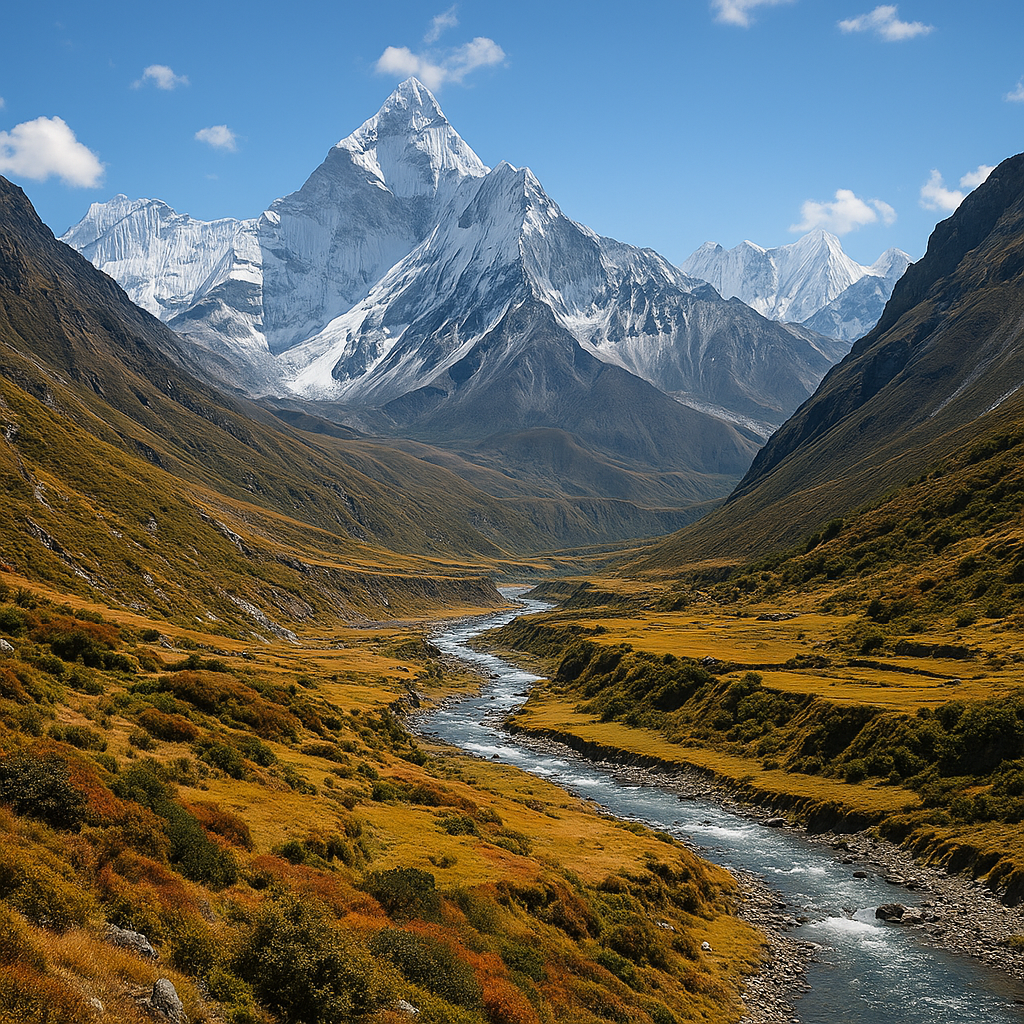
Among the major mountain ranges of the world, the Himalayas stand as the highest and one of the most magnificent natural formations on Earth. The word “Himalaya” means “abode of snow” or “house of snow,” reflecting its eternal white peaks.
Geological Structure of the Himalayas
Stretching approximately 2,400 kilometers, the Himalayas extend across India, Nepal, Bhutan, Pakistan, and China.
- The Himadri (Greater Himalaya): Home to Mount Everest (8,848 m), Kanchenjunga, and Nanda Devi.
- The Himachal (Middle Himalaya): Known for valleys, forests, and waterfalls.
- The Shivalik (Outer Himalaya): The southernmost and relatively lower range.
India’s major rivers — the Ganga, Yamuna, Brahmaputra, and Indus — originate from these mountains and have supported civilization for thousands of years.
As one of the major mountain ranges of the world, the Himalayas have shaped India’s climate, culture, and history.
My Experience – First Meeting with the Himalayas
My first trip to the Himalayas was during my student days.
It was an educational trip, but it became a spiritual experience for me.
When I first saw the snow-capped peaks from the bus window,
I felt as if the earth had donned a white crown.
The cool breeze touched my face,
and somewhere in the distance, bells were ringing—perhaps from a small temple.
At that moment, I realized that mountains neither speak nor move,
yet they are “alive.”
As a teacher, that experience taught me a new lesson—
“Stillness is also power.”
Mountains don’t shout, they simply stand—
yet they have inspired and guided humanity for centuries.
I felt that this is what life should be like—
without noise, standing firm in one’s place.
Cultural and Educational Importance of the Himalayas
The Himalayas are called the Land of the Gods in Indian culture.
It is not only a geographical structure, but also a center of faith, spirituality, and learning.
Sages and saints meditated in its caves,
and the philosophy of life emerged from its valleys.
Geographically, the Himalayas are the world’s youngest mountain range—
still forming today as tectonic plates continue to move.
This scientific fact taught me that even things that appear static are dynamic within.
Culturally, the Himalayas bind India and South Asia together in a spiritual thread.
From the valleys of Nepal to the plateaus of Tibet,
its influence is visible everywhere—in folk songs, paintings, and human devotion.
It is a sensitive region environmentally.
The glaciers here are the foundation of Asia’s rivers,
and their melting could affect the lives of millions of people.
Therefore, as a student, I always felt—
the Himalayas are not just a subject, but a responsibility.
Lessons Learned From Education
• Geography teaches us not just maps, but vision—
to see the soul of the earth in the mountains.
• The Himalayas tell us that to reach heights, it is necessary to stay connected to our roots.
• And also that the one who appears the highest is the most humble—
because even after touching the sky, he does not forget the earth.
The Andes Mountains — The Backbone of South America
Geography and Extent
If there is anything that truly marks the heart of South America, it is the Andes.
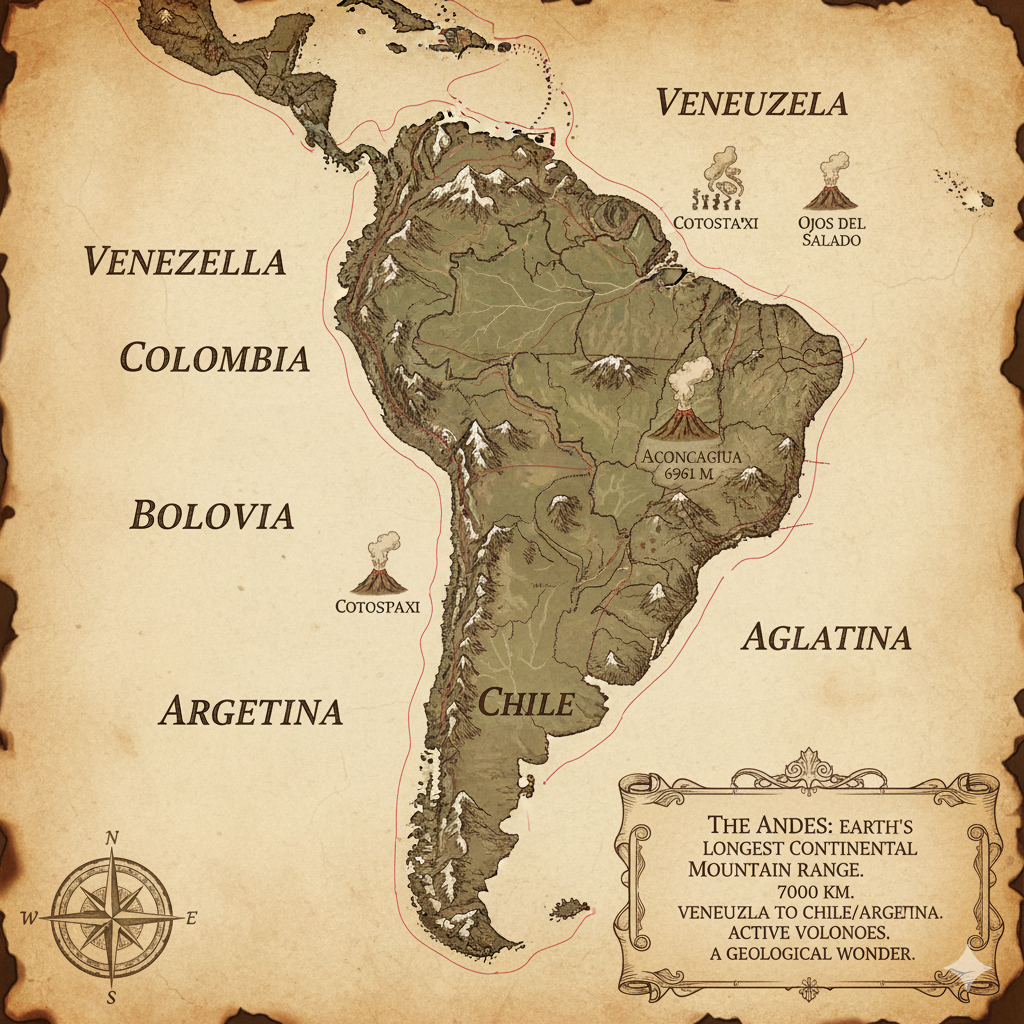
It is the Earth’s longest continental mountain range, stretching for nearly 7,000 kilometers.
The Andes stretch from Venezuela in the north to Chile and Argentina in the south.
Its expanse is so vast that it connects seven countries—
Venezuela, Colombia, Ecuador, Peru, Bolivia, Chile, and Argentina.
The highest peak here is Aconcagua,
which rises approximately 6,961 meters above sea level—
the highest mountain peak outside of Asia.
Many volcanoes are active within the Andes,
such as Cotopaxi and Ojos del Salado.
This range is not only a symbol of mountain beauty,
but also a living laboratory of the Earth’s tectonic movements.
The Andes From An Education Perspective
While studying the Andes, I realized that geography isn’t just a description of landmarks—it’s a living science. The Andes teach us that the Earth is constantly changing, and we are a part of that change.
While studying, I learned that the Andes, like the Himalayas, were formed by plate tectonics.
When the Nazca Plate sank beneath the South American Plate,
the Earth lifted itself up—
and this great mountain range was born.
This geological process in the Andes was like a living classroom for me.
I felt like every peak here was a teacher—
saying, “Height is born of struggle.”
The climatic zones found in this mountain range are also remarkable.
The temperature decreases as we go higher above sea level,
and each altitude offers a new biodiversity—
somewhere tropical forests, somewhere cold barren regions, somewhere snow-capped peaks.
Experience – A Fantasy Journey Through The Andes
I’ve never seen the Andes in person,
but when I first saw photographs and documentaries about them,
I felt as if I were walking in those heights myself—
where earth and sky converse with each other.
I remember once telling my students, “Imagine standing on a peak in the Andes.
Below you is a sea of clouds, and all around you is silence.”
The thought of that moment touched me deeply.
The people of the Andes—the Inca civilization—also considered these mountains to be gods.
They believed that every mountain possessed a spirit (Apu).
I deeply understood this idea—
that communion with nature is true education.
Books give us information,
but mountains give us “feelings.”
Lessons Learned From Education
• The Andes teach that struggle and stability can coexist.
• Heights are sustained only when the foundation is deep—
like the Nazca Plate, which, even as it sinks, lifts the earth.
• And the greatest lesson of all—change is not scary, it is creative.
The Rocky Mountains—North America's Great Wall
Geographical Structure
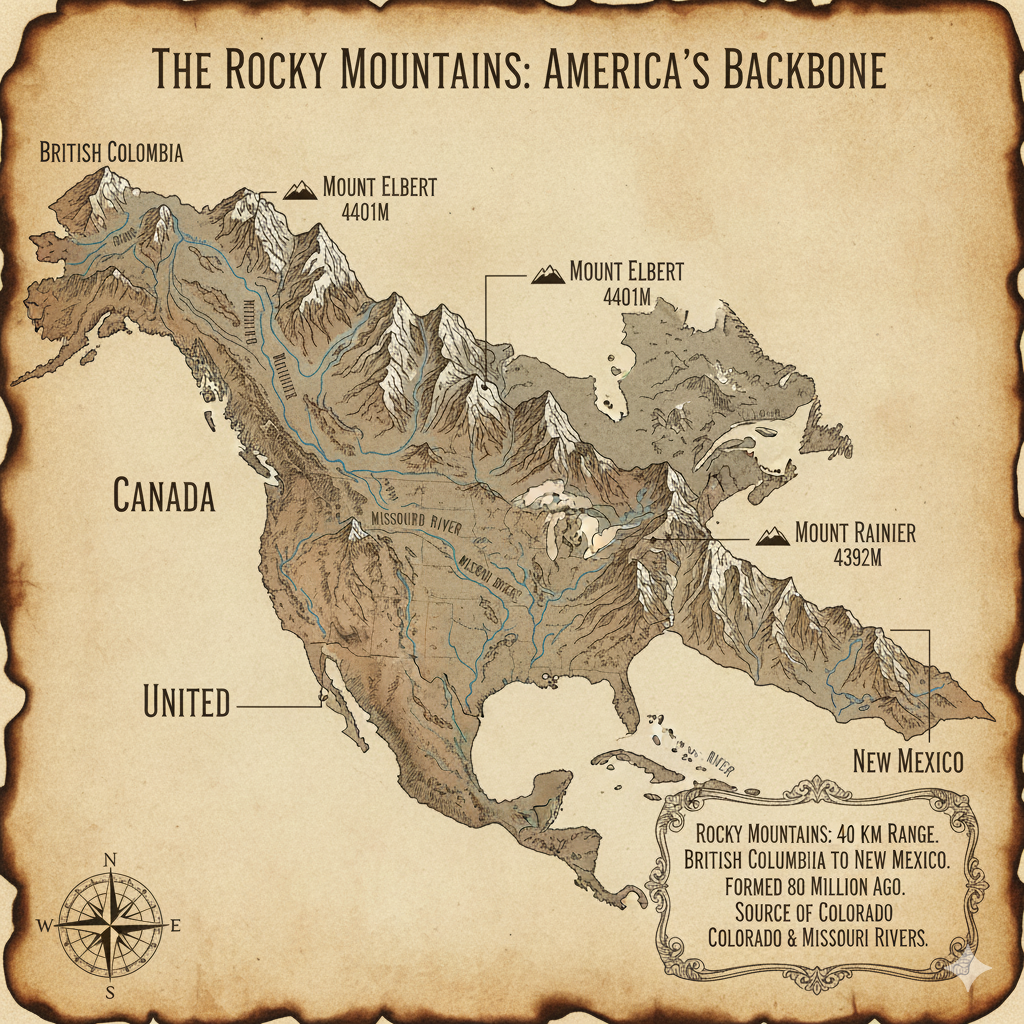
The Rocky Mountains are called the “backbone” of America.
This range stretches approximately 4,800 kilometers, starting in British Columbia, Canada, and ending in New Mexico, United States.
These mountains were formed approximately 80 million years ago during a geological process called the Laramide Orogeny.
The Rocky Mountains’ major peaks are:
Mount Elbert—4,401 meters,
and Mount Rainier—4,392 meters.
This range continues to shape America’s climate and environment today—
Its glaciers and lakes are the source of numerous rivers,
such as the Colorado and Missouri Rivers.
Experience and Learning
I remember the first time I saw a map of the United States,
the wavy line of the Rocky Mountains fascinated me.
This range seemed to me like the “spine” of the Earth—
giving balance to the entire continent.
While studying geography, I learned
that these mountains are extremely environmentally sensitive.
The glaciers here are melting, the ecosystem is changing.
Then I realized that stability does not mean inertia.
The Rocky Mountains stand, but they are constantly changing within—
just as we should be in life—stable yet alert.
The Balance of Modernity and Nature
The cities surrounding the Rocky Mountains demonstrate a wonderful balance between man and nature.
Cities like Denver are technologically and economically advanced while remaining close to nature.
As I read about them, I realized that
civilization is great when it moves in step with nature.
This lesson resonated deeply with me—
because modernity often distances us from nature.
But the people of the Rocky Mountains say that
“Progress doesn’t mean distance from nature, it means communion with it.”
Lessons Learned From Education
• Stability and adaptation—the Rocky Mountains symbolize both.
• Heights in life are meaningful when we don’t forget our “ground.”
• The balance of nature and technology is the true direction of the future.
Closing Thoughts
Both the Andes and Rocky Mountains
bear witness to human civilization and the evolution of the Earth.
One gave birth to the culture of South America,
the other stabilized the environment of North America.
What I realized from studying them is that—
every mountain offers us a new dimension to understanding ourselves.
Sometimes of conflict, some of balance, some of stability.
And this is the true purpose of education—
“To know oneself by knowing the world.”
The Alps – The Crown of Beauty of Europe
Geography and Extent of the Alps
The Alps stretch across central Europe—
France, Switzerland, Italy, Germany, Austria, Slovenia, and Liechtenstein.
The range is approximately 1,200 kilometers long.
Its highest peak—
Mont Blanc—is approximately 4,808 meters high.
The Alps are often called the “Crown of Europe,”
because their snow-capped peaks, lush valleys,
and crystal-clear lakes are the source of the climate and rivers of all of Europe.
Rivers like the Danube, Rhine, and Po originate here,
giving life to European civilization.
The Role of The Alps in Culture and Lifestyle
The Alps are not only a natural beauty, but also a center of European culture and art.
From the traditional music of Switzerland to the literature of Austria,
the mountains echo in every creation.
Europeans love their mountains—
their protection, cleanliness, and ecological awareness teach us
that development and conservation can go hand in hand.
During my education, when I studied European environmental policy,
the Alps were often cited as an example.
There is tourism, there is industry, but nature is treated like a “mother.”
Both the governments and citizens there embody this philosophy—
“Success is what works with the Earth, not against it.”
My Experience – The Alps Imagine and Inspire
I’ve never seen the Alps in person,
but when I saw photographs of Switzerland—
it felt as if a painter had brought nature to life.
Behind every snowy peak, there’s a sense of discipline.
Reflected in every lake—a philosophy of balance.
As a student, this was a profound lesson for me—
that “beauty is lasting only when it is accompanied by order and respect.”
Europe embraced this idea,
and perhaps that’s why nature and civilization there are companions.
Lessons Learned From Education
• The Alps teach that the discipline of nature is the future of humanity.
• Cleanliness and order are not just rules, they are a culture.
• Beauty is not just something to be seen, it is also something to be cherished.
Karakoram Mountains – A Confluence of Height and Ruggedness
Geography of Karakoram
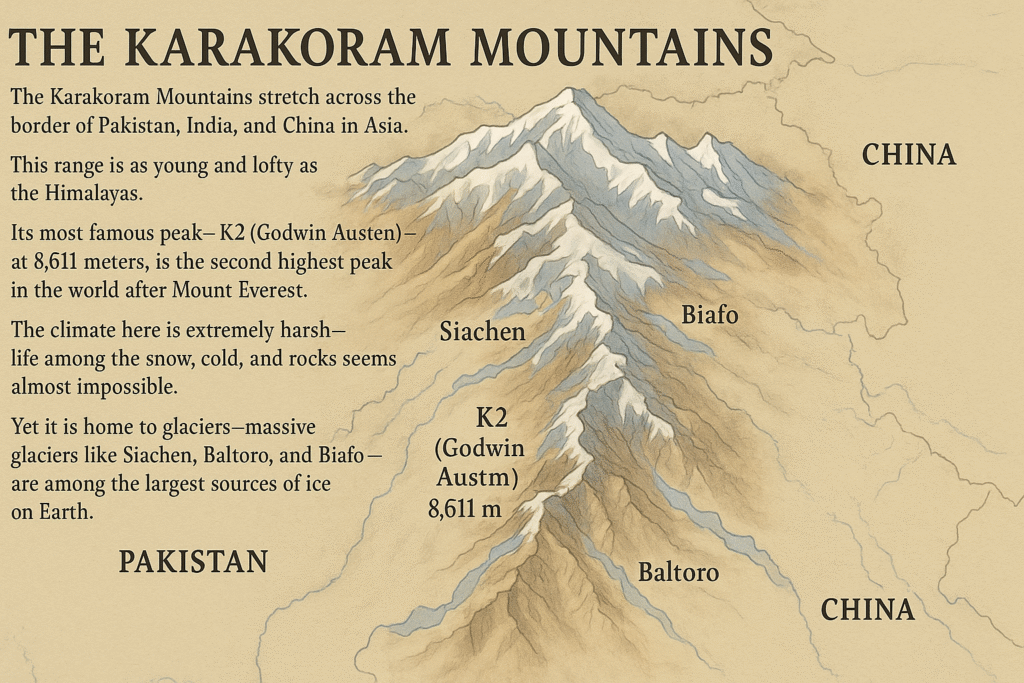
The Karakoram Mountains stretch across the border of Pakistan, India, and China in Asia.
This range is as young and lofty as the Himalayas.
Its most famous peak—
K2 (Godwin Austin)—at 8,611 meters,
is the second highest peak in the world after Mount Everest.
The climate here is extremely harsh—
life among the snow, cold, and rocks seems almost impossible.
Yet it is home to glaciers—
massive glaciers like Siachen, Baltoro, and Biafo—
are among the largest sources of ice on Earth.
Experience – Learning from Struggle
When I read about the Karakoram,
I realized that nature here is harsh yet instructive.
This mountain range is like a “teacher” who says, “Those who seek the highest heights must traverse the most difficult paths.”
The environment here is not soft, but truthful.
And this truth is essential for life.
The Karakoram teaches us that perseverance means accepting hardship.
Lessons Learned from Education
• The value of heights is understood only when the path is difficult.
• True education lies not in running away from struggle, but in embracing it.
• There is beauty even in hardship—all you need is vision.
Atlas Mountains – The Pride of Africa
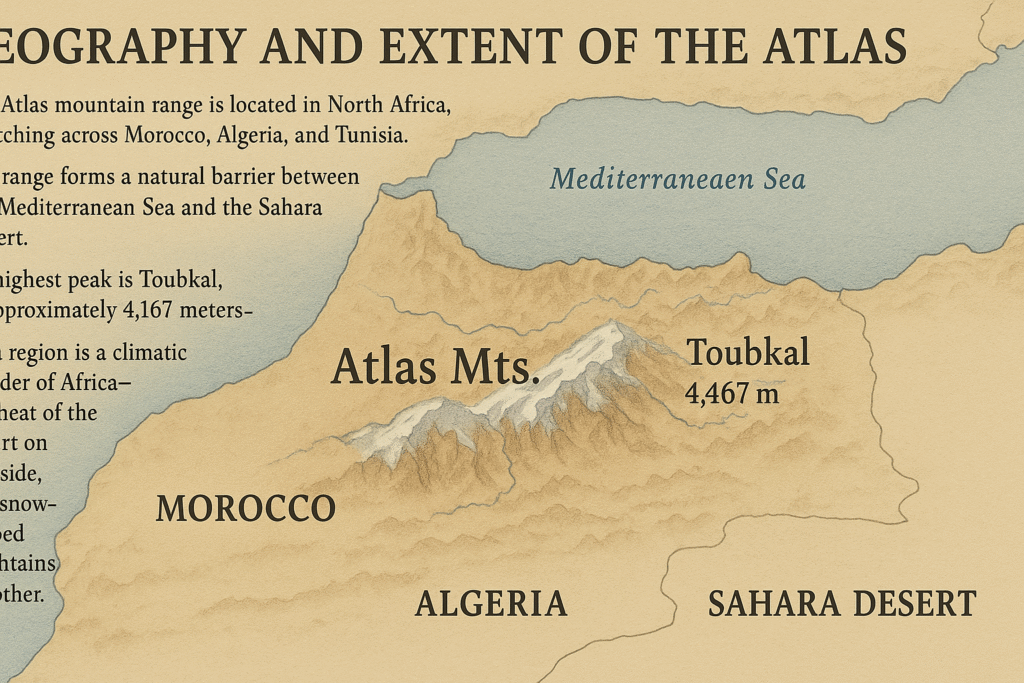
Geography and Extent of the Atlas
The Atlas Mountains are located in North Africa,
stretching across Morocco, Algeria, and Tunisia.
This range forms a natural barrier between the Mediterranean Sea and the Sahara Desert.
Its highest peak is Toubkal, at approximately 4,167 meters.
This region is a climatic wonder of Africa—
the heat of the desert on one side, and snow-capped mountains on the other.
Culture and Human Life
Berber tribes live around the Atlas Mountains,
whose lives are based on nature.
They believe that the mountains are the home of the gods—
where there is no wall between God and man.
I found this thought profound—
because it shows that no matter what civilization,
the reverence for the mountains is the same within every human being.
Lessons Learned From Education
• Balance in diversity is the secret of life.
• Even harsh terrain can become a breeding ground for creativity.
• Harmony with nature is the true form of culture.
Ural Mountains – The Border Between Asia and Europe
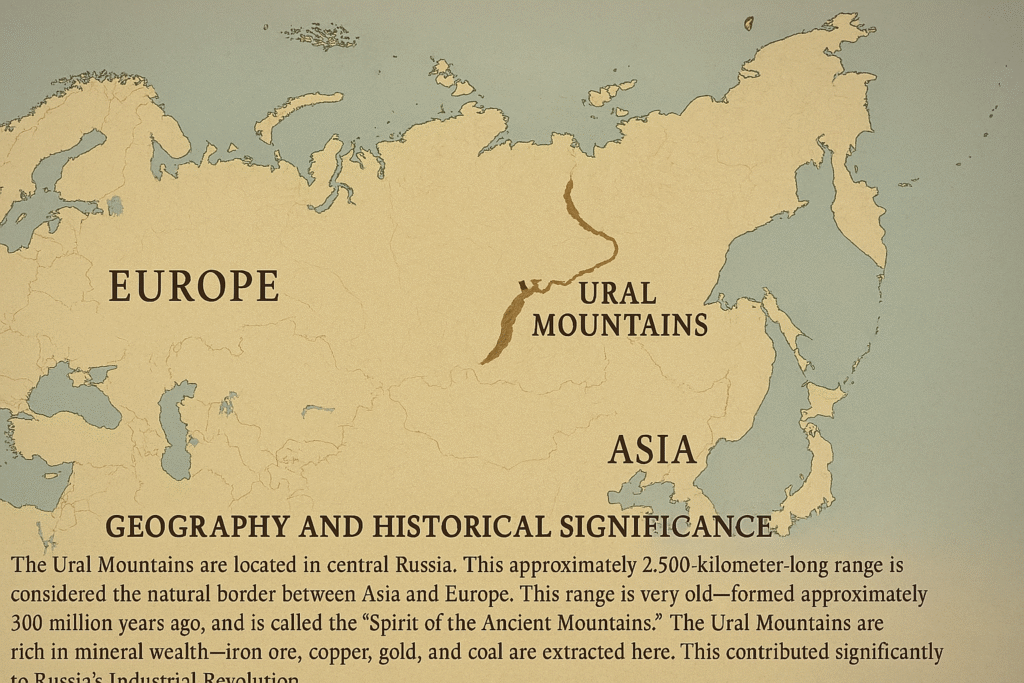
Geography and Historical Significance
The Ural Mountains are located in central Russia.
This approximately 2,500-kilometer-long range is considered the natural border between Asia and Europe.
This range is very old—
formed about 300 million years ago,
and is called the “Spirit of the Ancient Mountains.”
The Ural Mountains are rich in mineral wealth—
iron ore, copper, gold, and coal are extracted here.
This contributed significantly to Russia’s Industrial Revolution.
Experiences—From History to Geographic Education
When I first heard the name “Ural Mountains,”
I thought they were just a geographical line.
But as I studied history,
I learned that these lines connect civilizations, not divide them.
The Urals teach us that the Earth’s boundaries
are not man-made political walls,
but natural lines that teach balance.
Lessons Learned From Education
• Geography and history complement each other.
• Borders do not divide, they provide identity.
• Balance is the root of civilization.
Closing Thoughts
The beauty of the Alps taught us that discipline is beauty.
The harshness of the Karakoram showed us that heights are achieved through struggle.
The diversity of the Atlas explained that culture is born from nature,
and the Urals reminded us that even borders can speak the language of unity.
Conclusion – Lessons Learned from The Mountains
Mountains – Nature's Silent Teachers
When I began this journey—
Mountains were merely geographical subjects for me:
height, length, climate, and landforms.
But when I learned to “feel” them,
I discovered that every mountain is a living teacher.
They don’t speak, but they teach much—
patience, stability, balance, and the power in silence.
The Himalayas taught—
“Height means humility.”
The Andes revealed—
“Creation also happens in struggle.”
The Rockies explained—
“Be steady, but keep changing.”
The Alps showed—
“Discipline is beauty.”
The Karakoram shocked—
“Difficulties shape character.”
The Atlas and the Urals reminded—
“Diversity and balance are the foundation of civilization.”
The Meaning of Height Is Not Only Geographical But Also Spiritual
When we talk about climbing a mountain,
we consider height a symbol of victory.
But in reality, mountains teach us
that height is not a victory, but a practice.
Even after reaching the peak, one has to return to earth.
Therefore, height does not mean arrogance, but humility.
The higher the mountain, the more peaceful it is—
because it has seen and heard everything, and then chosen silence.
This reminds me of the principle of education—
that the purpose of knowledge is not to “appear superior,”
but to “become superior.”
The Balance of Stability and Change in Life
Mountains are stable, but they are not inert.
They change—with the winds, with the climate, with time.
Therein lies their balance.
Life is the same—
if we become too rigid, we break,
and if we become too lax, we disintegrate.
Stability and flexibility are both essential.
The stability of the Himalayas and the dynamism of the Rockies,
the purity of the Alps and the diversity of the Andes—
these are all chapters of life,
where every mountain becomes a subject,
and we the students.
Responsibility Towards Nature
Today, as the world faces a climate crisis,
glaciers are melting, rivers are drying up,
it’s crucial to understand that protecting mountains isn’t just an “environmental duty,”
it’s humanity’s duty.
The melting glaciers of the Himalayas
are not just a loss to the Himalayas—
they are weakening the foundations of our civilization.
Mountains give us clean air, water, minerals, and balanced weather,
but in return, they demand only respect and sensitivity.
If we treat nature only as a commodity,
then future generations
will have stories about mountains, but not mountains themselves.
Final Lesson Learned From Education
• Geography isn’t just about maps; it guides life.
• To understand mountains is to understand oneself.
• The union of success, balance, and humility is true height.
• Read the earth; it writes a new chapter on every page.
Final Message – Live Like the Mountains
This journey through the mountains hasn’t ended,
because every journey doesn’t have an end, but a meaning.
I learned that—
“Mountains don’t teach us to climb,
they teach us to fall and get up again.”
They tell us that reaching heights in life isn’t always easy,
but if the steps are steady and the intentions are clear,
then the destination itself becomes the path.
Today, when I mention the name “Himalayas” while teaching geography to a child,
I recall not just a mountain, but an inspiration—
that height isn’t just a measurement,
it’s a value—of patience, faith, and dedication.
The Last Sentence in The Language of The Mountains
“When you get tired,
look to the mountains—
they will remind you
that stillness is also a journey.”