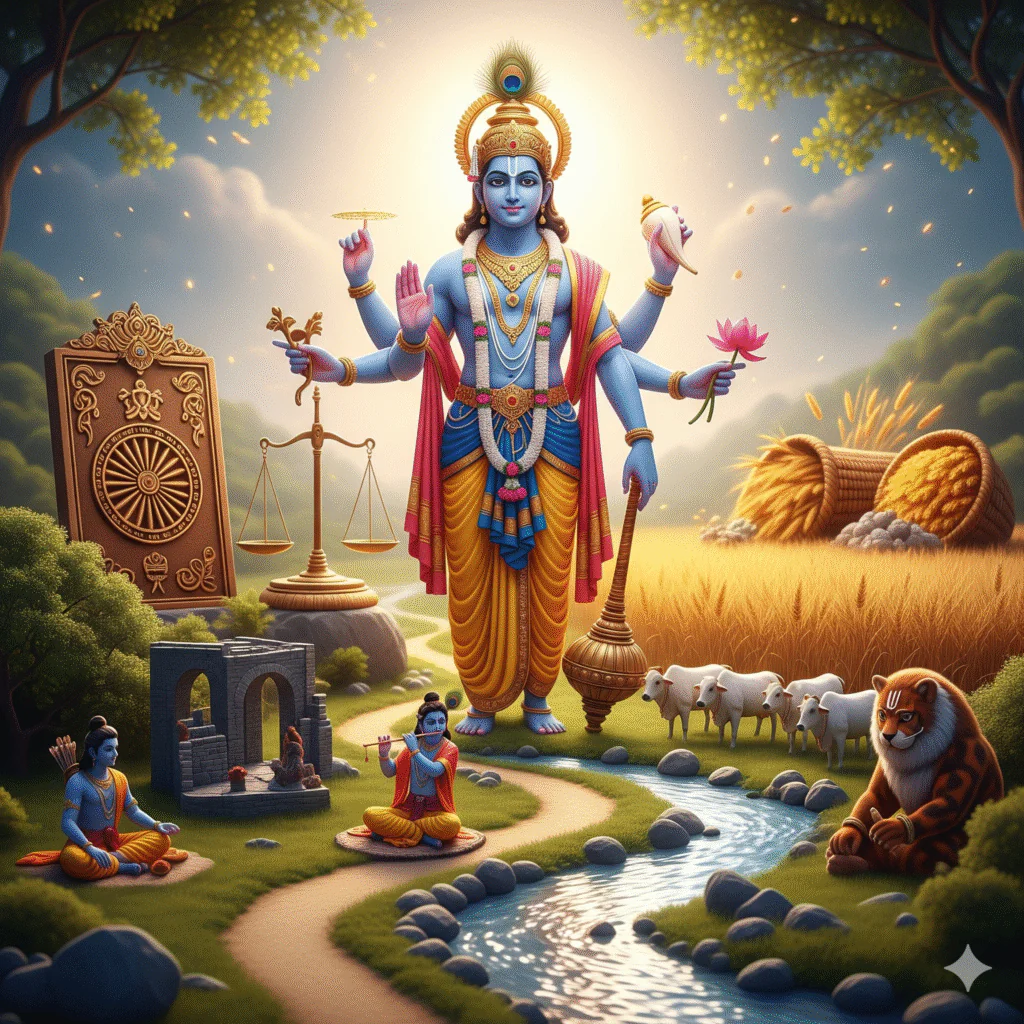
Lord Vishnu

Lord Vishnu: Preserver of the Universe and Protector of Dharma

Lord Vishnu: Preserver of the Universe and Protector of Dharma

Bhagwan Vishnu is one of the principal deities among the sacred trinity of Hinduism. He is regarded as the preserver of the universe. While Lord Shiva is known as the destroyer and Lord Brahma as the creator, Lord Vishnu’s divine role is to sustain creation and maintain cosmic balance. He is worshipped as the symbol of peace, compassion, and the restoration of righteousness (Dharma).


Divine Form and Symbolism of Lord Vishnu

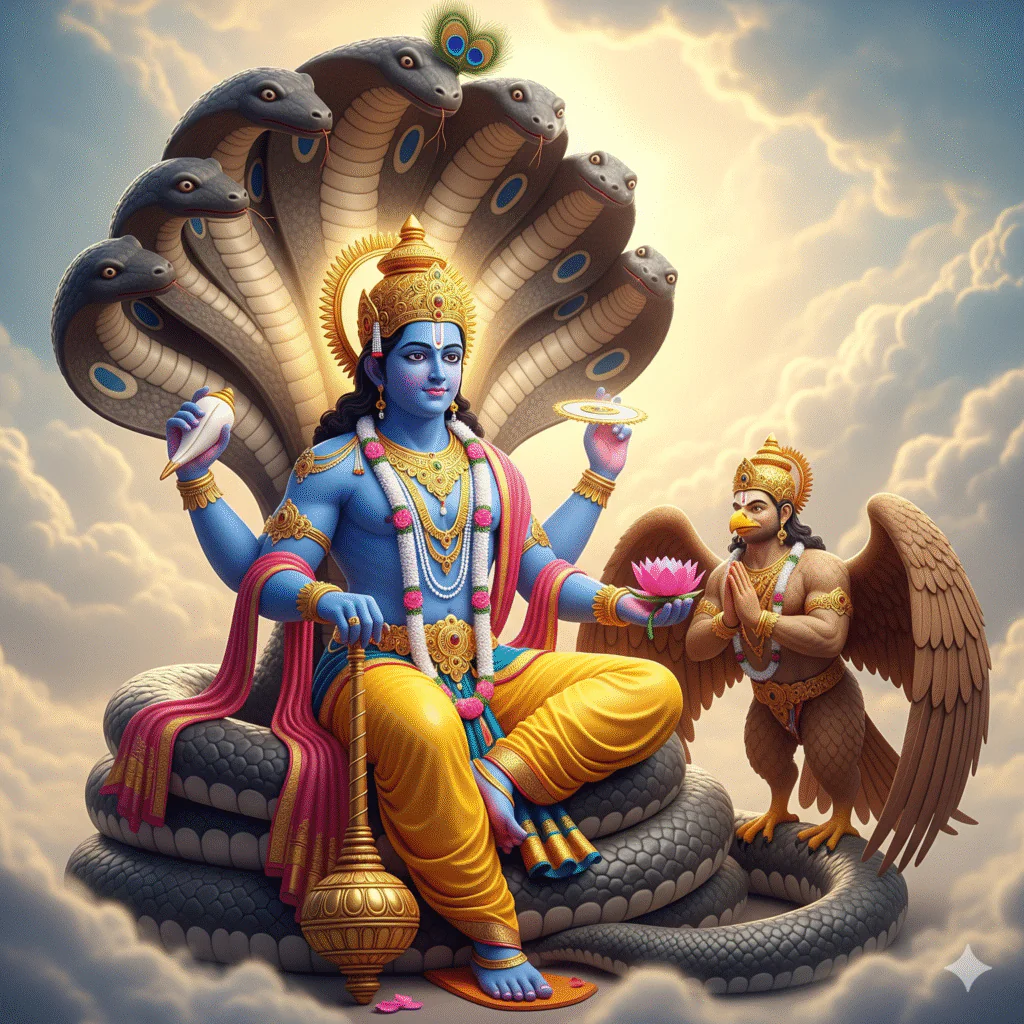
The divine appearance of Lord Vishnu is extremely captivating and powerful.

  • His body color is described as deep blue, similar to the vast ocean.
  • He holds four objects in his four hands:
    • Shankh (Panchajanya)
    • Chakra (Sudarshan Chakra)
    • Gada (Kaumodaki)
    • Padma (Lotus)
  • His vehicle is Garuda, and Sheshanaga serves as his divine resting companion.

The Ten Incarnations of Lord Vishnu (Dashavatar)

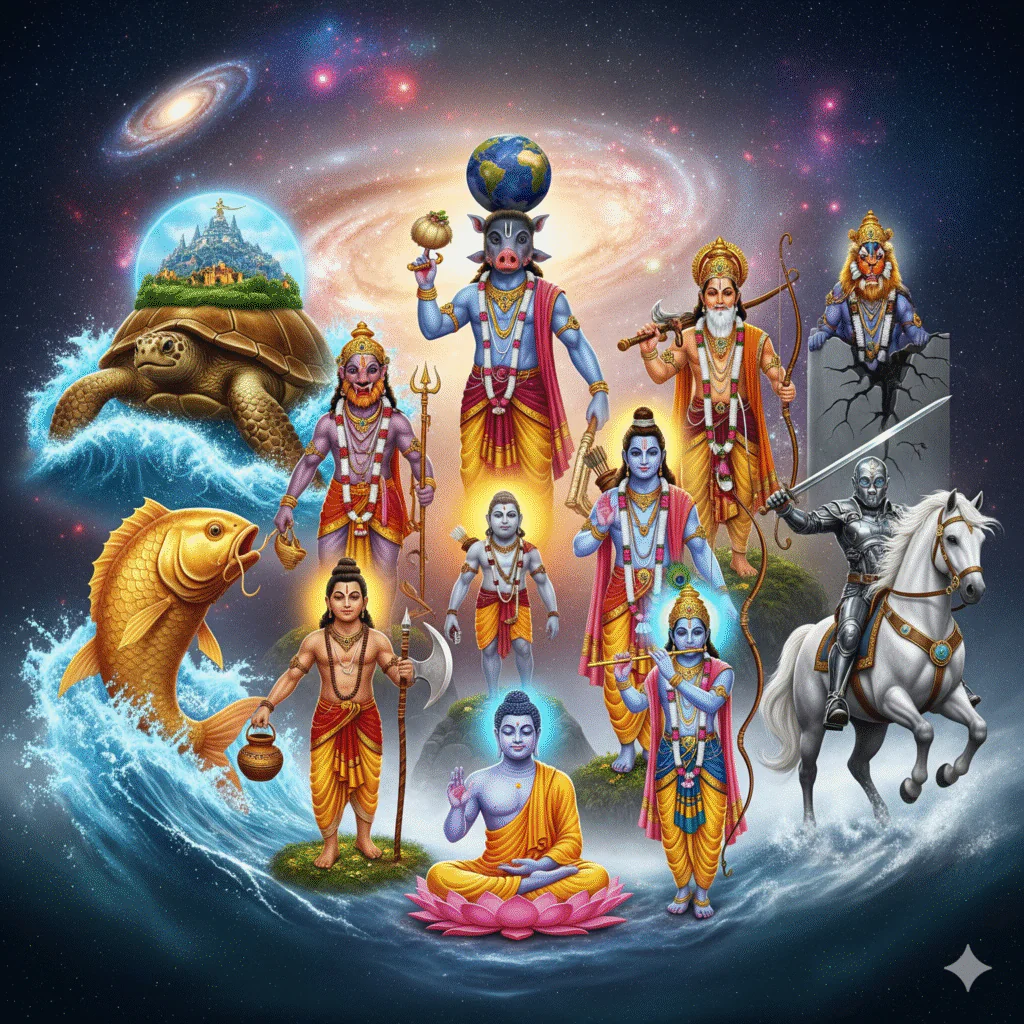
To protect Dharma and destroy the forces of Adharma, Lord Vishnu incarnates on Earth from time to time. These incarnations are collectively known as the Dashavatar.

1. Matsya Avatar

He took the form of a fish to save creation from the great deluge.

2. Kurma Avatar

He incarnated as a tortoise to support Mount Mandarachal during the Samudra Manthan.

3. Varaha Avatar

He took the form of a boar to rescue Earth from the demon Hiranyaksha.

4. Narasimha Avatar

A half-lion, half-man form taken to protect devotee Prahlad from Hiranyakashipu.

5. Vamana Avatar

He appeared as a dwarf Brahmin to restore Earth from King Bali.

6. Parashurama Avatar

Born to destroy the tyrannical Kshatriyas.

7. Lord Rama

Appeared in Treta Yuga to defeat Ravana and establish the ideals of righteousness.

8. Lord Krishna

Born in Dwapara Yuga to destroy Kansa and guide humanity in the Mahabharata.

9. Buddha Avatar

Appeared to spread the message of non-violence and compassion.

10. Kalki Avatar

He will appear at the end of Kali Yuga to destroy evil and reestablish Dharma.


Worship and Significance of Lord Vishnu

Worship Method

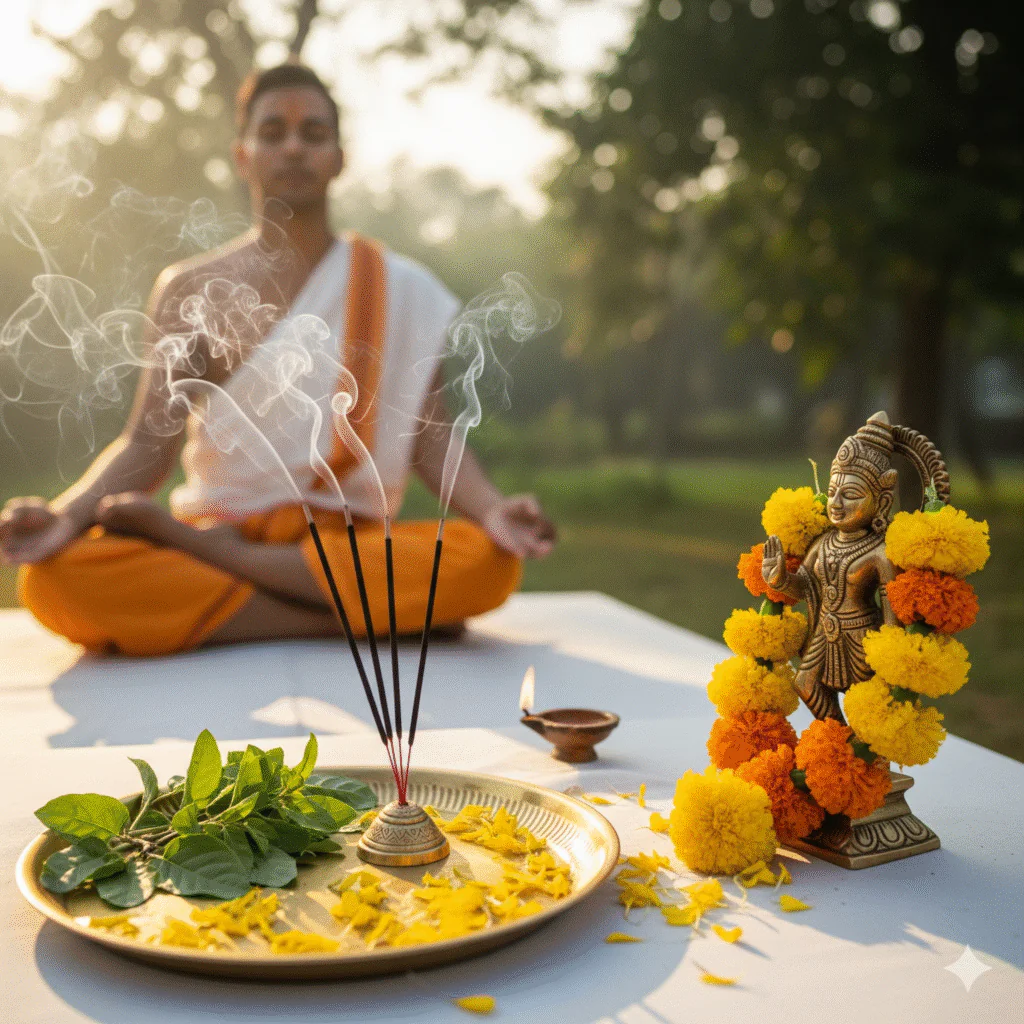
  • Begin the morning with a pure mind and meditate upon Lord Vishnu.
  • Offer Tulsi leaves, yellow flowers, incense, and light a lamp.
  • Chant the mantra: “Om Namo Bhagavate Vasudevaya”

Significance of Lord Vishnu

  • He blesses devotees with peace and prosperity.
  • He inspires one to follow Dharma, truth, and balance in life.
  • His incarnations provide guidance on living a righteous and meaningful life.

Conclusion

Lord Vishnu is not only the protector of Dharma but also the embodiment of devotion, compassion, and peace. His avatars remind us that whenever Adharma rises on Earth, the Divine will manifest to restore balance and protect humanity.

Introduction to Lord Vishnu – The Preserver and Protector in Hinduism

Introduction to Lord Vishnu

Lord Vishnu is one of the three supreme deities (Brahma, Vishnu, and Mahesh) in Hinduism. His divine role is to preserve, nourish, and protect the universe. While Brahma creates the world and Shiva brings transformation or dissolution, Lord Vishnu maintains balance in the cosmos.

He is worshipped as the preserver, the protector of Dharma, and the ocean of compassion. Lord Vishnu is also known by many sacred names such as Narayana, Hari, Janardana, Vasudeva, Padmanabha, and Jagannath.

Importance of Lord Vishnu

  • He incarnates whenever required to destroy evil and re-establish Dharma.
  • He symbolizes peace, prosperity, and divine protection for devotees.
  • Chanting His holy name is believed to remove sins and guide the soul toward liberation (Moksha).

Lord Vishnu in Ancient Scriptures

Descriptions of Lord Vishnu are found in the Rigveda, Mahabharata, Bhagavata Purana, and Vishnu Purana. These texts describe Him as eternal, all-pervading, and the supreme preserver of the universe.


Inspiring Reflection

As I explore these ancient scriptures, I find that Lord Vishnu’s presence is more than just divine worship — it is a timeless lesson. His role teaches us that the universe thrives on balance, compassion, and righteousness. Whenever darkness rises, the light of Dharma returns through His wisdom and protection.

Spiritual Insight

Understanding Lord Vishnu feels like discovering a deeper rhythm of the universe — one that safeguards every soul, nurtures life, and leads us gently toward peace, purpose, and liberation.

Symbol of lord Vishnu
Form and Symbols of Lord Vishnu

Form and Symbols of Lord Vishnu

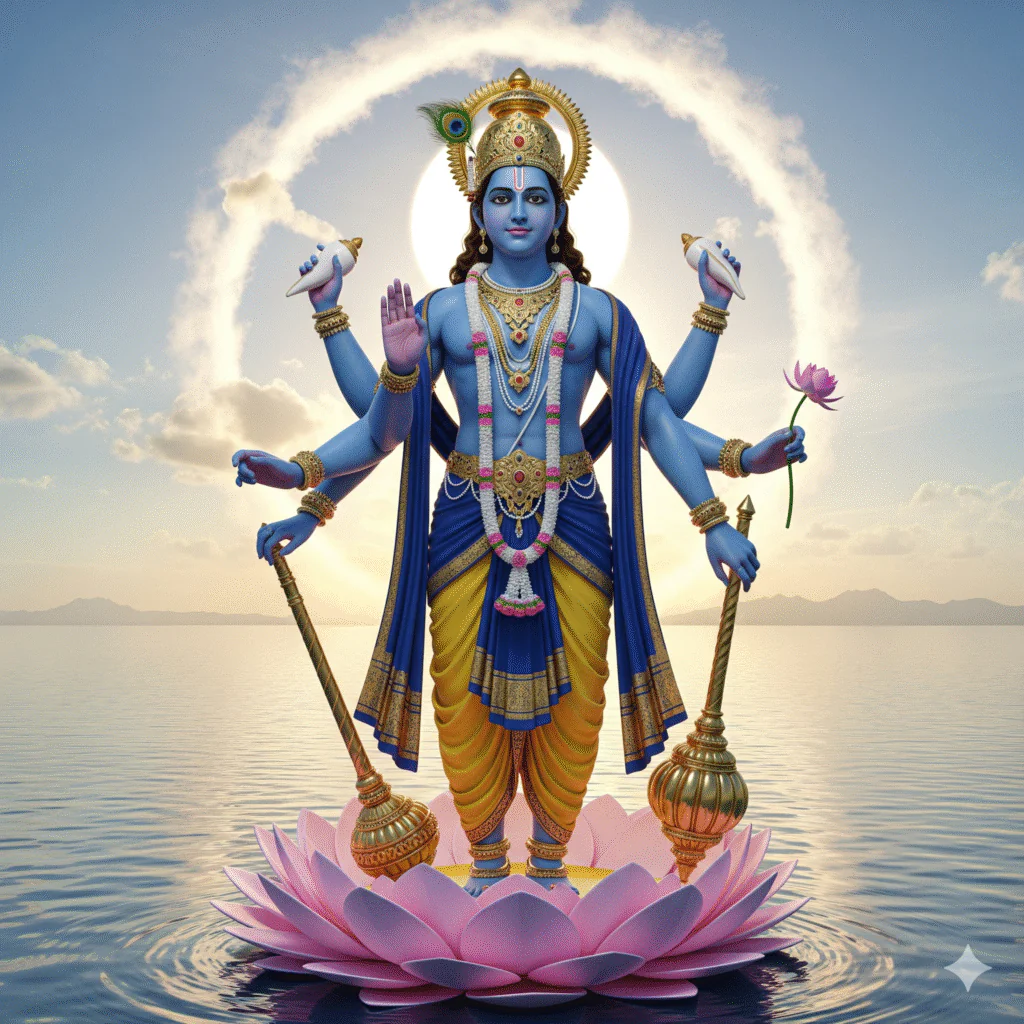
The form of Lord Vishnu is extremely divine, peaceful, and filled with compassion. Scriptures describe Him as having a deep blue complexion, symbolizing the infinite expanse of the sky and the ocean.


The Four Hands of Lord Vishnu

Lord Vishnu has four hands, and in each of them He holds sacred symbols and divine weapons:

  1. Shankha (Panchajanya) – Symbol of Dharma and purity.
  2. Sudarshan Chakra – Symbol of the destruction of evil and the defeat of demons.
  3. Gada (Kaumodaki) – Symbol of strength, authority, and justice.
  4. Padma (Lotus) – Symbol of purity, knowledge, and creation.

Vehicle and Divine Seat of Lord Vishnu

  • Garuda, the divine bird, is the vehicle of Lord Vishnu. It represents courage, speed, and protection.
  • He is often depicted resting upon Sheshnag, the celestial serpent, which symbolizes eternal time and cosmic stability.

Other Sacred Symbols

  • He wears the precious gem Kaustubha Mani around His neck.
  • His garments are yellow in color, representing peace, purity, and devotion.
  • Goddess Lakshmi, His divine consort, resides on His chest in the sacred mark known as Shrivatsa.

Inspiring Reflection

The divine symbols of Lord Vishnu are not merely ornaments—they carry deep spiritual messages. Each symbol inspires purity, strength, righteousness, and inner balance, reminding us that the universe is protected by compassion and guided by Dharma.

Spiritual Insight

Understanding the sacred form of Lord Vishnu helps us connect with higher wisdom. These symbols teach that true strength lies in justice, true purity lies in knowledge, and true divinity lies in compassion and balance.

Vishnu ji ke Avtar
Ten Incarnations of Lord Vishnu (Dashavatar)

The Ten Incarnations of Lord Vishnu (Dashavatar)

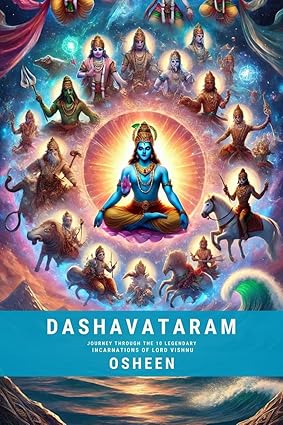
According to Hindu tradition, whenever unrighteousness (Adharma) rises and Dharma is endangered, Lord Vishnu incarnates on Earth to restore balance. These manifestations are known as the Dashavatar — the ten divine incarnations of Lord Vishnu.


1. Matsya Avatar

During the great deluge, Lord Vishnu incarnated as a fish. He saved Manu and the Saptarishis by guiding them to a safe place and protected the sacred Vedas from destruction.

Story of Matsya Avatar

The first incarnation of Lord Vishnu is known as the Matsya Avatar. In this form, He appeared as a giant fish.

As mentioned in Hindu scriptures, when a great flood submerged Earth, King Manu found a tiny fish that asked for protection. Manu kept it safe, but the fish kept growing larger and larger. Realizing that this was no ordinary fish, Manu understood it was Lord Vishnu Himself.

In His Matsya form, Lord Vishnu rescued Manu and the Saptarishis by placing them on a boat and guiding them to safety. He also saved the sacred Vedas so that divine knowledge would not perish.

Message of Matsya Avatar

This avatar teaches that whenever there is danger, the divine always protects true devotees.


2. Kurma Avatar

Lord Vishnu’s second incarnation was the Kurma Avatar, where He took the form of a tortoise.

Story of Kurma Avatar

During the great churning of the ocean (Samudra Manthan), the Mandarachal mountain was used as the churning rod. However, the mountain began to sink into the ocean. To stabilize it, Lord Vishnu incarnated as a giant tortoise and supported the mountain on His back.

Because of this, the churning was successful, and many divine treasures emerged — including Amrit, Goddess Lakshmi, the Kaustubha gem, and Airavata the elephant.

Message of Kurma Avatar

This avatar teaches that patience and stability can help accomplish even the most difficult tasks.


3. Varaha Avatar

Lord Vishnu’s third incarnation was the Varaha Avatar, where He took the form of a colossal boar.

Story of Varaha Avatar

The demon Hiranyaksha had submerged Earth deep into the cosmic ocean. To save the Earth, Lord Vishnu appeared as Varaha.

With a mighty roar, He entered the ocean, lifted Earth on His tusks, and restored it to its rightful place. He then fought a fierce battle and destroyed Hiranyaksha.

Significance of Varaha Avatar

  • This avatar symbolizes the protection of Earth.
  • It teaches that whenever evil threatens the world, the divine intervenes to restore balance.

4. Narasimha Avatar

Lord Vishnu’s fourth incarnation was Narasimha — half lion and half human.

Story of Narasimha Avatar

The demon king Hiranyakashipu received a boon that he could not be killed by man or animal, day or night, inside or outside, with a weapon or without one. Misusing this power, he terrorized the three worlds.

His son Prahlad, however, was a devoted follower of Lord Vishnu. Unable to tolerate this devotion, Hiranyakashipu tried harming Prahlad.

To protect His devotee, Lord Vishnu emerged at twilight (neither day nor night), at the palace threshold (neither inside nor outside), took the Narasimha form (neither man nor animal), placed Hiranyakashipu on His thigh, and tore him apart with His claws (neither weapon nor tool).

Message of Narasimha Avatar

This avatar signifies protection of true devotees and destruction of evil.


5. Vamana Avatar

Lord Vishnu’s fifth incarnation is the Vamana Avatar, in which He appeared as a dwarf Brahmin.

Story of Vamana Avatar

The mighty king Bali had taken control of the three worlds. To restore balance, Lord Vishnu approached him as a humble dwarf and asked for three steps of land.

When Bali agreed, the Lord expanded into His massive Trivikrama form:

  • With one step He covered Earth,
  • With the second step He covered Heaven.

No space was left for the third step, so Bali offered his own head. Vishnu then placed His foot on Bali’s head, sending him to the underworld but blessing him for his devotion.

Message of Vamana Avatar

This avatar teaches humility and the downfall of ego.


6. Parashurama Avatar

The sixth incarnation of Lord Vishnu is Parashurama, a fierce warrior-sage.

Story of Parashurama Avatar

In Treta Yuga, when many Kshatriya kings became unjust and misused their power, Lord Vishnu incarnated as Parashurama to restore Dharma.

Armed with His divine axe (Parashu), He defeated corrupt rulers 21 times and freed Earth from tyranny.

Message of Parashurama Avatar

This avatar teaches that justice always prevails over oppression.


7. Rama Avatar

The seventh incarnation of Lord Vishnu is Lord Rama, the ideal king and embodiment of righteousness.

Story of Rama Avatar

Born in Ayodhya to King Dasharatha and Queen Kaushalya, Lord Rama lived a life of virtue and duty.

  • He defeated demons with Sage Vishwamitra.
  • Married Sita by breaking Lord Shiva’s bow.
  • Spent 14 years in exile with Sita and Lakshman.
  • Destroyed Ravana and restored Dharma.

Message of Rama Avatar

This avatar teaches that truth and righteousness always lead to victory.


8. Krishna Avatar

The eighth incarnation of Lord Vishnu is Lord Krishna — the embodiment of wisdom, love, and divine play.

Story of Krishna Avatar

  • Killed demons like Putana, Trinavarta, and Aghasura in childhood.
  • Lifted Govardhan Mountain to protect the people of Braj.
  • Destroyed King Kansa.
  • Delivered the Bhagavad Gita to Arjuna during the Mahabharata war.

Message of Krishna Avatar

This avatar teaches devotion, righteousness, and the importance of performing one’s duty.


9. Buddha Avatar

The ninth incarnation of Lord Vishnu is Lord Buddha.

Story of Buddha Avatar

Born as Prince Siddhartha in Lumbini, he renounced worldly pleasures after witnessing suffering in the world. Through deep meditation, he attained enlightenment under a Bodhi tree and became Gautama Buddha.

Purpose of Buddha Avatar

  • To spread the message of non-violence and compassion.
  • To inspire truth, kindness, and peace.
  • To turn humanity away from violence and ignorance.

Message of Buddha Avatar

This avatar teaches that true Dharma lies in compassion, truth, and non-violence.


10. Kalki Avatar

The final avatar of Lord Vishnu, yet to appear, is the Kalki Avatar.

Story and Prophecy of Kalki Avatar

Scriptures state that at the end of Kali Yuga, when evil, injustice, and sin reach their peak, Vishnu will descend as Kalki.

He will ride a white horse and wield a blazing sword, destroying the wicked and restoring Dharma.

Message of Kalki Avatar

This avatar symbolizes the complete end of evil and the beginning of a new era of truth — Satya Yuga.

Worship method of Lord Vishnu
Worship and Significance of Lord Vishnu

Worship and Significance of Lord Vishnu

Worship Method of Lord Vishnu

The worship of Lord Vishnu is performed with simplicity, devotion, and a pure heart.

  • After a morning bath, one should wear clean clothes and light a lamp before the idol or image of Lord Vishnu.
  • Offering yellow flowers, Tulsi leaves, sandalwood paste, and incense is considered highly auspicious.
  • Reciting Vishnu Sahasranama, Vishnu Stuti, Narayana Kavach, or verses from the Bhagavad Gita is extremely beneficial.
  • Thursday is considered a special day for the worship of Lord Vishnu.

Importance of Vishnu Worship

  • As the preserver of the universe, the worship of Lord Vishnu brings prosperity, peace, and contentment.
  • His blessings bring harmony, love, and happiness within the family.
  • Devotees facing planetary issues or family difficulties experience relief through Vishnu worship.
  • Offering Tulsi destroys sins and leads the soul toward liberation.

Spiritual Importance

The worship of Lord Vishnu teaches that the universe functions through Dharma and balance. His message encourages:

  • Maintaining patience and balance in life.
  • Realizing that even if Adharma becomes powerful, Dharma ultimately wins.
  • Understanding that devotion to Vishnu purifies the soul and leads toward Moksha.

Overall Insight

Thus, worshipping Lord Vishnu not only brings worldly happiness and prosperity but also grants spiritual peace and knowledge.


Detailed Method of Worshipping Lord Vishnu

Ideal Time and Place for Worship

  • The best time to worship Lord Vishnu is during early morning or evening.
  • The worship place should be clean, peaceful, and filled with positive energy.
  • The idol or image of Lord Vishnu should be placed in the northeast direction (Ishan Kon).

Required Items

  • Clean water and Ganga water
  • Yellow or white flowers
  • Tulsi leaves (offered directly without touching)
  • Sandalwood paste and rice grains (Akshat)
  • Oil lamp and incense sticks
  • Yellow fruits and prasad (bananas, laddus, etc.)

Step-by-Step Worship Process

  1. Take a bath in the morning and wear clean yellow clothes.
  2. Light a lamp and incense at the place of worship.
  3. Sprinkle Ganga water on the idol or image of Lord Vishnu.
  4. Offer sandalwood paste, Akshat, flowers, and Tulsi leaves.
  5. Chant Vishnu Sahasranama, Narayana Stuti, or the mantra “Om Namo Bhagavate Vasudevaya.”
  6. Conclude by offering fruits, sweets, and performing Aarti.

Importance of Worship

  • Worshipping Lord Vishnu brings wealth, happiness, and peace into the home.
  • Offering Tulsi destroys sins and creates positive karma.
  • Planetary issues, family conflicts, and financial problems get resolved.
  • His blessings bring prosperity and guide the soul toward liberation.

Overall Insight

Thus, the method of worshipping Lord Vishnu is simple yet extremely powerful. Regular worship removes obstacles and opens the path to prosperity and spiritual success.


Significance of Lord Vishnu

Preserver of the Universe

Lord Vishnu is considered the preserver. He maintains the functioning of creation and protects all living beings. While Brahma creates and Shiva dissolves, Vishnu sustains and nurtures the universe.

Protector of Dharma

Whenever Adharma increases on Earth, Lord Vishnu incarnates in the form of His Dashavatar to restore Dharma, truth, and justice.

Bringer of Prosperity and Happiness

Worshipping Lord Vishnu brings wealth, joy, and tranquility. His blessings make the home harmonious and prosperous.

Giver of Liberation (Moksha)

Remembering the lotus feet of Lord Vishnu liberates the soul from the cycle of birth and death. He grants salvation and improves the spiritual journey of the devotee.

Symbol of Balance and Compassion

The form of Lord Vishnu symbolizes compassion, love, and balance. He teaches that true peace and stability come only by walking on the path of Dharma.

Conclusion and References – Lord Vishnu

Conclusion

Lord Vishnu is regarded in Hinduism as the preserver of creation and the protector of Dharma. His ten incarnations clearly show that He manifests on Earth whenever needed to destroy unrighteousness and restore righteousness.

The worship of Lord Vishnu brings peace, prosperity, happiness, and ultimately liberation. He is the symbol of compassion and balance, teaching us that true life is the one lived on the path of Dharma, truth, and goodness.

Overall Insight

Thus, the worship of Lord Vishnu is not merely a religious duty— it is also a path to spiritual elevation and a meaningful, successful life.


References

  1. Rigveda, Yajurveda, and Samaveda – Descriptions of the form and qualities of Lord Vishnu.
  2. Bhagavad Gita – Teachings on Dharma and Karma Yoga delivered by Lord Vishnu in the form of Krishna.
  3. Shrimad Bhagavata Purana – Detailed narration of the ten incarnations and divine acts of Lord Vishnu.
  4. Ramayana – The story of the Rama incarnation of Lord Vishnu.
  5. Mahabharata – The role and teachings of Lord Vishnu in the form of Krishna.
  6. Vishnu Purana – Detailed descriptions of the worship, significance, and divine nature of Lord Vishnu.
  7. Acharya Ramchandra Shukla – Essays on Hindu scriptures and philosophy.
  8. Dr. Satyavrat Shastri – Works on Indian religion, culture, and spiritual heritage.

Leave a Comment

Your email address will not be published. Required fields are marked *

Scroll to Top