

Lord Krishna: Life, Leelas and Timeless Teachings of Lord Krishna
Lord Krishna is one of the most revered deities in Hinduism and the eighth incarnation of Vishnu. The life of Lord Krishna — from his miraculous birth in Mathura to his profound guidance in the Bhagavad Gita — continues to inspire millions across the world. The teachings of Lord Krishna emphasize dharma, karma, love, devotion and righteousness, making Lord Krishna eternally relevant in modern life.
Birth of Lord Krishna and Divine Childhood in Gokul
Kansa’s Tyranny and the Divine Prophecy
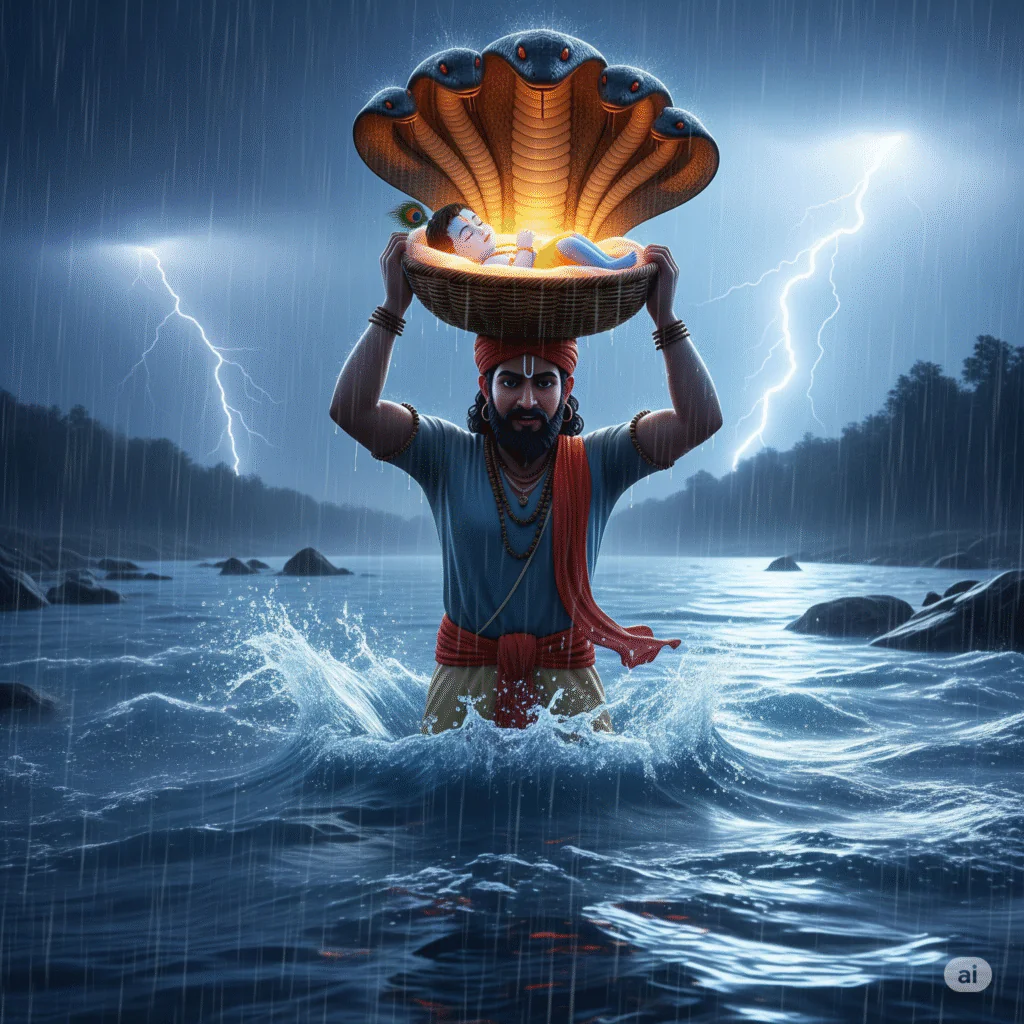
Mathura was ruled by the cruel king Kansa. A divine prophecy declared that the eighth son of Devaki would end his tyranny. Fearing death, he imprisoned Devaki and Vasudeva. When Lord Krishna was born at midnight, Vasudeva carried Lord Krishna across the Yamuna River to Gokul, where Nanda and Yashoda lovingly raised Lord Krishna in safety.
Childhood Leelas of Lord Krishna in Vrindavan
In Gokul and Vrindavan, Lord Krishna became famous for playful childhood leelas. Lord Krishna stole butter, played with cowherds, enchanted everyone with his flute, and performed Raasleela with the gopis. These divine acts of Lord Krishna symbolized pure love and spiritual bliss.
Victory of Lord Krishna Over Evil Forces
Killing of Putana
The demoness Putana attempted to poison the infant Lord Krishna by offering milk. Instead of being harmed, Lord Krishna liberated her soul, symbolizing the triumph of purity over evil.
Subduing Kaliya Naag
When the serpent Kaliya poisoned the Yamuna River, Lord Krishna courageously danced upon its hood and restored purity to the waters, protecting the people of Vrindavan.
Govardhan Parvat and Indra’s Pride
To protect villagers from torrential rains sent by Indra, Lord Krishna lifted Govardhan Parvat on his little finger for seven days. This powerful act established Lord Krishna as Govardhandhari and emphasized devotion over ritualistic pride.
Youth of Lord Krishna and Role in the Mahabharata
End of Kansa’s Rule
Returning to Mathura in his youth, Lord Krishna defeated Kansa and freed his parents, restoring justice and dharma through righteous action.
Establishment of Dwarka
Due to political instability, Lord Krishna established the fortified city of Dwarka on the western coast, ensuring safety and prosperity for his people.
Lord Krishna and the Bhagavad Gita at Kurukshetra
During the Mahabharata war, Lord Krishna served as Arjuna’s charioteer on the battlefield of Kurukshetra. When Arjuna hesitated to fight, Lord Krishna delivered the sacred Bhagavad Gita — a timeless scripture explaining karma (action), dharma (duty), bhakti (devotion), and jnana (wisdom).
- Lord Krishna teaches performing duty without attachment to results.
- Lord Krishna emphasizes standing firmly on the path of righteousness.
- The message of Lord Krishna shows that devotion and selfless action lead to liberation.

Lord Krishna as Symbol of Love, Devotion and Dharma
Divine Love of Radha and Lord Krishna
The eternal bond between Radha and Lord Krishna represents unconditional love and spiritual union between the soul and the divine.
Lord Krishna as Protector and True Friend
By protecting Draupadi and guiding the Pandavas, Lord Krishna demonstrated that true leadership is rooted in compassion, wisdom, and righteousness.
Conclusion: Timeless Relevance of Lord Krishna
The life and teachings of Lord Krishna are not merely mythological narratives but a profound philosophy of life. The flute of Lord Krishna symbolizes harmony, the actions of Lord Krishna symbolize courage, and the wisdom of Lord Krishna continues to guide humanity toward truth and duty.
Lord Shri Krishna’s Birth and Childhood Stories
Child Krishna in the Basket of Vasudev Ji
Kansa’s Terror and Birth of Shri Krishna
King Kansa of Mathura city was cruel and ruthless. He used to torture his subjects and did not tolerate anyone’s opposition. One day when Kansa’s sister Devaki got married to Vasudev ji, then a voice from the sky came –
“O Kansa! You will die at the hands of your sister Devaki’s eighth child.”
On hearing this, Kansa became angry and immediately tried to kill his sister. But Vasudev ji explained –
“O Kansa! Do not kill your sister, I promise that I will hand over all her children to you.”

Kans imprisoned Devaki and Vasudev in prison. Time passed and one by one, Devaki’s seven children were killed by Kansa as soon as they were born.
Divine Birth of Shri Krishna
When the time for the eighth child came, Lord Vishnu himself appeared before Devaki and Vasudev at midnight in the prison. He said –
“I have come as your son. Now Vasudev, take me across the Yamuna to Gokul and leave me at Nand-Yashoda’s house.”
That night a miracle happened –
- The prison doors opened automatically.
- The guards fell into a deep sleep.
- The Yamuna river started giving way.
Vasudev ji reached Gokul with the child Krishna in a basket and handed him over to Nand-Yashoda. In return, he brought the newborn girl (Yogmaya) from there to the prison.
In the morning, when Kansa tried to kill that girl, she got free from his hand and went into the sky and said –
“O Kansa! The one who will kill you has been born and he is safe.”
Naughty Childhood Pranks
Sri Krishna started growing up in the courtyard of Yashoda-Nanda in Gokul.
- Sometimes he would steal butter and distribute it among the cowherds,
- Sometimes he would enchant everyone with the tune of his flute,
- And sometimes he would show miracles while playing with the milkmaids.
This is where his mischievous acts began, which made him famous as Nandlal and Makhanchor.
Lord Shri Krishna’s Battle With Superpowers
Putana Vadh
Kamsa sent many demons to Gokul to kill Krishna. The first among them was Putana, who was a demoness. She came to Gokul in the guise of a beautiful woman and took little Krishna in her lap and started feeding him poison.
But Krishna sucked out her life force while drinking milk from her breast. Putana fell on the ground and died there.
The people of Gokul were frightened, but everyone saw that the child Krishna was safe. This incident convinced everyone that this was not an ordinary child, but a divine power.
Shaktasur Vadh
Once a big bullock cart like chariot was standing in Nand Baba’s courtyard. A demon named Shaktasur was hiding in it. As soon as he got the opportunity, he tried to attack the child Krishna.
But Krishna kicked the cart with his small feet and the demon was destroyed in no time.
Destruction of Trinavarta
Kansa sent another demon – Trinavarta, who took the form of a storm and took the child Krishna to the sky. But Krishna held him tightly by the throat.
Trinavarta suffocated and fell from the sky and died. After this incident, the people of Gokul understood that this child was the master of some extraordinary power.
Suppression of Kaliya Naag
A poisonous snake named Kaliya lived in the Yamuna river, due to which the water had become poisonous. No one could go into the river.
One day the ball of the cowherd boys fell into the Yamuna. Krishna jumped into the river and fought with Kaliya Naag. He danced on its hood and defeated it.
Krishna promised him – “Go Kaliya! Now you leave Yamuna and go far away and never trouble the people of Gokul.”
This incident convinced the people of Gokul that their little Shyam is their protector.
The Leela of Govardhan Mountain
The people of Gokul used to worship Lord Indra every year. Once Krishna explained to everyone that the real worship should be done of the Govardhan Mountain and nature, because it gives us water, food and shelter.
When Lord Indra got angry and rained heavily on Gokul, Krishna lifted the Govardhan Mountain on his little finger.
The people of Gokul remained safe under it for seven days. Finally, Lord Indra accepted defeat and Krishna got the name Govardhandhari.

Putana Killed by Lord Krishna
Kansa’s Plan
King Kansa of Mathura was always worried that Devaki’s eighth son would kill him. When he came to know that a divine child was born to Nanda in Gokul, he started sending demons one by one.
First he sent a demoness named Putana, who was an expert in killing children.
Putana’s Arrival in Gokul
Putana assumed the form of a beautiful woman and entered Gokul. Seeing her beauty, no one could recognize that she was a demoness.
She went straight to Nanda Baba’s house and picked up the sleeping baby Krishna in her lap.
Attempt to Drink Poison
Putana’s breasts were filled with deadly poison. She thought that as soon as she breastfed this child, he would die and Kansa’s plan would be successful.
But this child was no ordinary baby – he was the incarnation of Lord Vishnu himself.
Killing by Shri Krishna
As soon as Putana breastfed Krishna, Shri Krishna started sucking out her life force along with the milk.
Putana started writhing in pain, her true form was revealed and she became a giant demoness. Eventually, she breathed her last and fell to the ground.
Joy and Fear in Gokul
When the people of Gokul saw this scene, they became frightened, but immediately understood that the child Krishna was no ordinary child.
Mata Yashoda found Krishna safe due to her care and everyone expressed their gratitude to the Lord.
Significance of Killing Putana
- This story shows that God always protects his devotees.
- Even an evil demoness like Putana was given salvation by Krishna, which teaches that God is kind to everyone.
- This incident is proof that Shri Krishna was born with divine power.
Suppression of Kaliya Snake by Lord Shri Krishna
Kaliya’s Terror in Yamuna River
A poisonous snake named Kaliya lived in the sacred Yamuna river of Gokul. The water of the river had become black and poisonous due to its poison.
The people of Gokul were afraid to go near Yamuna because the atmosphere there was full of poisonous gases.
The Ball of the Cowherd Boys Fell in Yamuna
One day, while playing, the cowherd boys threw their ball in Yamuna. All the children got scared, but the naughty Nandlal fearlessly said –
“Don’t be afraid! I will bring our ball out of Yamuna.”
Krishna jumped into the river and reached directly to Kaliya snake.
The Battle Between Kaliya and Shri Krishna
Kaliya snake grabbed Krishna with his huge hoods. The whole Gokul got scared.
Then Shri Krishna showed his divine power and came out of the hoods and jumped on the snake.
- Krishna started dancing vigorously on Kaliya’s hoods.
- The poison of the snake started getting neutralized due to the blow of his feet.
- Gradually his strength diminished and he fell down helplessly.
Prayer of the Snake Wives
When Kaliya’s wives, the snake wives, saw this scene, they fell crying at the feet of Shri Krishna and said –
“O Lord! Forgive our husband. He had started tormenting the innocent due to his arrogance.”
Shri Krishna showed compassion and gave life to Kaliya and ordered –
“Now you leave Yamuna and go to the sea. Never return here.”
Happiness of the People of Gokul
When Krishna came out of Yamuna after defeating Kaliya snake, the entire Gokul became happy. Everyone hailed their Nandlal.
Importance of Kaliya Snake Suppression
- This story tells that true religion always wins over unrighteousness.
- Shri Krishna showed us that any poison can be destroyed with courage and devotion.
- He gave the message of compassion by forgiving even a wicked person like Kaliya.
Govardhan Puja
Tradition of Worshiping Indra Dev
Every year in Gokul, after the rainy season, the villagers used to worship Indra Dev. They believed that it is only by the grace of Indra that it rains and crops are produced in the fields. Therefore, they used to celebrate Indra Utsav with great pomp.
Teaching of Shri Krishna
Little Krishna asked the people of Gokul –
“Why do you people worship Indra? The real life-giver is Govardhan mountain, which gives us water, food, fodder and shelter. In fact, we should worship nature, because it is she who nourishes us.”
Influenced by Krishna’s words, the people of Gokul decided to worship Govardhan mountain instead of Indra.
Indra’s Anger and Torrential Rain
When Indra Dev came to know that the people of Gokul have stopped worshipping him, he became angry.
With a feeling of revenge, he started pouring torrential rain on Gokul continuously.
Waterlogging occurred everywhere, animals, birds and humans all got frightened and reached the shelter of Shri Krishna.
Govardhan Parvat Held by Shri Krishna
Then little Krishna lifted the entire Govardhan Parvat on his little finger.
The Gokulvasis, animals and birds all came under the mountain and became safe.
Krishna held the mountain for seven days and seven nights. Finally, Indra Dev realized his mistake and stopped the rain.
Indra’s Surrender
Indra Dev apologized to the Gokulvasis and accepted the divinity of Shri Krishna.
He understood that this is not an ordinary child, but the incarnation of God himself.
Importance of Govardhan Puja
- This story teaches that respecting nature and environment is the true worship.
- This incident tells that God always protects his devotees.
- That is why even today, the festival of Govardhan Puja is celebrated every year on Shukla Pratipada of Kartik month.
Youth of Lord Shri Krishna and Role of Mahabharata
Return to Mathura and Killing of Kansa
When Shri Krishna grew up, he along with his brother Balram left for Mathura. There King Kansa organized a religious assembly and a martial competition to welcome him.
Krishna and Balram displayed their bravery in the assembly. Finally, Shri Krishna killed the tyrant Kansa and freed his parents Devaki and Vasudev from prison.
Thus Mathura was freed from the terror of Kansa.
Establishment of Dwarka City
After the killing of Kansa, Mathura was repeatedly attacked. Magadh king Jarasandh attacked Mathura several times.
To protect his subjects, Shri Krishna established a new city on the seashore, which was named Dwarka. This city became famous as a strong and prosperous state and Shri Krishna was established as the king there.
Abduction of Rukmini
In his youth, Shri Krishna was married to Rukmini, the princess of Vidarbha. Rukmini’s marriage was forcibly fixed with Shishupal, but Rukmini secretly wanted Krishna as her husband.
Shri Krishna abducted Rukmini from Swayamvar and their marriage was celebrated with great pomp.
Role in Mahabharata War
Friend of Pandavas
Shri Krishna was the most dear friend and guide of Pandavas. He showed his compassion and religious devotion by saving Draupadi’s honour and supporting Pandavas in difficult times.
Became Arjuna’s Charioteer
When Pandavas and Kauravas came face to face in Kurukshetra, both sides asked for help from Shri Krishna.
Kauravas chose their army, while Arjuna himself asked Shri Krishna as charioteer.
In this way, Shri Krishna did the great work of establishing religion by driving Arjuna’s chariot in the war.
Preaching of Gita
Before the war started, Arjuna became disappointed and started giving up his weapons. Then Shri Krishna preached the Bhagavad Gita to him.
“O Arjun, do your duty, do not worry about the result.”
“Protection of Dharma and justice is the ultimate duty of life.”
“Devotion, knowledge and action, all three paths lead to salvation.”
Message of Shri Krishna
From youth to Mahabharata, Shri Krishna showed throughout his life that his goal was to establish Dharma and destroy Adharma. His policies are still relevant in all three fields of politics, society and spirituality.
Lord Krishna Kills Kansa in Mathura
Kansa’s Atrocities
King Kansa of Mathura was notorious for his cruelty and atrocities. Hearing the prophecy that his sister Devaki’s eighth son would kill him, Kansa imprisoned Devaki and Vasudev and brutally killed their children.
But at the time of Shri Krishna’s birth, he was miraculously transported to Gokul, where Nanda and Yashoda brought him up.
Kansa’s Invitation
Krishna and Balarama grew up and became famous in Gokul for their valour and miracles.
When this news reached Kansa, he called them to Mathura to participate in an archery competition.
In reality, this competition was a conspiracy so that he could kill both the brothers.
Kansa’s Plan Failed
- They first killed Kansa’s elephant Kuvalayapeed.
- After this, they broke the huge bow in the archery competition.
- As soon as he entered the arena, he defeated the wrestlers Chanur and Mushtik sent by Kansa.
Killing of Kansa
When all the plans failed, Shri Krishna himself pulled Kansa from his throne and threw him in the arena and killed him.
Thus that prophecy proved true and Mathura was freed from the terror of Kansa.
Happiness of the People
As soon as Kansa died, the people of Mathura welcomed Shri Krishna and Balram with joy.
Devaki and Vasudev were released from prison and they got the good fortune of meeting their sons.
Learning
- The end of tyranny and unrighteousness is certain.
- Truth and religion always triumph.
- Lord Shri Krishna himself incarnated to protect religion.
Lord Shri Krishna Established The City of Dwarka
Repeated Attacks on Mathura
After killing Kansa, Shri Krishna started living in Mathura with his parents and Yaduvanshi family.
But Kansa’s maternal uncle Jarasandh, who was the powerful king of Magadha, started repeatedly attacking Mathura.
Jarasandh attacked Mathura 17 times, every time Shri Krishna and Balram defeated him.
Still, the people of Mathura were troubled by continuous wars and destruction.
Consideration of Safety of the People
Shri Krishna knew that repeated confrontations with kings like Jarasandh and Shishupal would disturb the peace of Mathura.
So he decided that it was necessary to settle the Yaduvanshi family and the people of Mathura in a safe place.
Construction of a New City on the Seashore
Shri Krishna received a land as a boon from the sea god, which was located on the coast of today’s Gujarat.
There he established a new and grand city, which was named – Dwarka.
This city was equipped with seven gates, strong forts and beautiful palaces.
It is said that it was designed by Vishwakarma himself.
Importance of Dwarka
Dwarka not only became a place of safety for the Yaduvanshi people, but it also became the political and religious capital of Shri Krishna.
From here he conducted important works like establishment of religion, protection of people and Mahabharata.
Beliefs Related to Dwarka
- Dwarka is still one of the four dhams of India.
- It is also called “Moksha Nagari”, where sins are destroyed by mere darshan.
- There are stories of the remains of Dwarka city being found inside the sea even today.
Education
- The duty of a leader is not only to fight a war, but also to protect the people.
- Welfare of the society is possible with new system and foresight.
- Shri Krishna was not only a warrior in the true sense but also a visionary politician.

Geeta Sermon by Lord Shri Krishna To Arjun
Start of Mahabharata War
The battle of Kurukshetra was about to begin. On one side were the Kauravas and on the other were the Pandavas. When Arjuna’s chariot was brought to the centre of the battlefield, he saw his own Guru, Dronacharya; Grandfather Bhishma; and his own relatives in front of him.
Arjuna’s Attachment and Doubt
Arjuna’s heart melted on seeing this scene. He put down his bow and said –
“O Madhava! How can I shoot an arrow at my own relatives?
In this war, my own family will be destroyed.
I do not want kingdom, victory and happiness.”
Arjuna was filled with attachment and sorrow. Forgetting his duty, he started thinking of leaving the war.

Sri Krishna’s Sermon Begins
Sri Krishna smiled and said seeing Arjun’s condition –
“O Parth! This is not appropriate for you.
A brave man neither fears death nor is bound by attachment.
Whatever happened, what is happening and what will happen, all is my wish and the law of Brahma.”
The Essence of Gita
The Soul is Immortal
Sri Krishna explained that the soul neither takes birth nor dies. The body is destructible, but the soul is eternal.
The Message of Karmayoga
He said –
“Your duty is to do work, do not worry about the result.
Work itself is Dharma.
Do not have a right over the result, because the result is received by the will of God.”
Devotion and Surrender
Sri Krishna told Arjun that if he leaves his ego and remembers only God with complete surrender, then he will get salvation and ultimate peace.
Arjun’s Doubts Are Removed
The preaching of Gita removed attachment and doubt from Arjun’s heart. He raised his bow and said –
“O Keshav! I will fight under your protection.
You are not only my charioteer, but also my guide.”
Importance of Gita
- Gita is not just a sermon for the battlefield, it is a guide for life.
- It teaches us that we should never back down from our duty.
- The confluence of all three paths of karma, bhakti and knowledge is in Gita.
Education
- Whatever be the circumstances in life, patience and dedication should be maintained.
- Duty is the greatest religion.
- Every crisis can be overcome with faith in God and belief in one’s own actions.
Importance of Lord Krishna
Lord Krishna is the most prominent and beloved deity of Indian culture, philosophy and religion. His life is not just a mythological story, but the art of living and inspiration. The importance of Shri Krishna is not only in his miracles and leelas, but in the ideals and teachings given by him.
Religious Significance
Incarnation of Vishnu
Shri Krishna is considered to be the eighth incarnation of Lord Vishnu. He descended on earth to destroy evil and establish righteousness.
“Yada yada hi dharmasya glanirbhavati bharat…”
This statement explains the reason for the incarnation of Shri Krishna.
Basis of Devotion
- Krishna devotion is a major basis of Hinduism.
- Radha-Krishna’s leelas are considered to be the highest expression of love and devotion.
- Chanting and singing the name of Shri Krishna provides mental peace and spiritual strength to the devotees.
Cultural Significance
Krishna in Art and Literature
The leelas of Shri Krishna have been the main subject of Indian music, dance, drama and painting. Rasleela and Murlidhar Krishna are the symbol of beauty and love in the art world.
Festivals and Traditions
Festivals like Janmashtami, Holi and Rasleela are associated with Shri Krishna. These festivals spread joy, unity and enthusiasm in the society.
Philosophical Significance
Preaching of Gita
The Gita preaching given to Arjun in Kurukshetra is considered to be the greatest teaching of human life. Gita shows us the path of Karmayoga, Gyanyoga and Bhaktiyoga.
Art of Living
The message of Shri Krishna is –
Whatever the circumstances, maintain patience and discretion.
Do not back down from duty.
Keeping balance in life is the key to success.
Social Importance
- Shri Krishna gave the message of equality and brotherhood.
- He taught the society that everyone is equal in the eyes of God.
- Through Govardhan Puja, he told the importance of protecting nature and environment.
Conclusion
The importance of Lord Shri Krishna is not limited to religious faith only. He is the god of devotion, the symbol of love, the skilled strategist of politics, and the supreme guide of life. His life teaches us that love, religion, devotion and following duty is the true life.
Symbol of Love and Devotion – Lord Krishna
Lord Krishna is not only a preacher of religion and ethics, but also the supreme symbol of love and devotion. His life teaches that true love is selfless and devotion connects us to God.
The divine love story of Radha-Krishna and his affection for the gopis is a perfect example of eternal devotion.
The Divine Love of Radha-Krishna
Importance of Radha
The names of Radha and Krishna are incomplete without each other. Radha’s love was not worldly but spiritual and soulful love. Her devotion teaches that true love is not in union, but in surrender.
Rasleela and Rasotsav
The Rasleelas of Vrindavan are the culmination of devotion and love. The gopis join Krishna in the divine Raas and symbolize the union of the soul and the Supreme Being.
Devotion of the Gopis
The gopis’ love for Krishna was not just attraction. It was the perfect form of selfless devotion. They considered only Krishna as their everything without caring about the world.
This love of theirs is considered to be the highest expression of Bhaktiyoga.
Murli and the Message of Love
The music of Shri Krishna’s flute was not just a sound, but it was a call of love. Every creature was drawn towards him after hearing the sound of the flute.
This symbolizes that when the soul hears the call of God, it forgets the worldly bonds and gets attracted towards the Lord.
The Originator of Bhaktiyoga
Lord Krishna showed the path of Bhaktiyoga. He said in the Gita – “Bhaktya Maambhijanati” i.e. only through devotion can God be known.
His life tells that love and devotion are the easiest way to reach God.
Love and Devotion from a Social Point of View
Shri Krishna’s love was not limited only to Radha and the gopis. He showed compassion towards friends (Sudama), mother (Yashoda), devotees and even enemies.
His life teaches that true love should not be limited to one person, but should be for the whole world.
Conclusion
Lord Krishna is the eternal symbol of love and devotion. His pastimes teach us that true love lies in sacrifice and surrender, and devotion takes us to the proximity of God. Therefore, Krishna bhakti is not just a religious tradition, but the basis of spiritual life.
Guidance of Ethics and Religion – Lord Krishna
Lord Krishna was not only a divine incarnation, but he was also a great guide of ethics and religion.
Through the Mahabharata and the Gita, he gave such teachings for human life, which are as relevant today as they were in that era.
His policies were not limited to the battlefield, but were meant to teach the art of living.
The timeless philosophy of Lord Krishna continues to inspire humanity with principles of dharma, leadership, compassion, and righteous action.
Ethics and Religion in the Gita

Importance of Religion
“Swadharme nidhanam shreyah, paradharmo bhayavaah”
Every person should follow his own duty (dharma) with sincerity and courage.
Preaching of Selfless Action
Perform your work without attachment to results. This teaching encourages balance beyond success and failure.
Practical Policies for Life
Friendship and Duty
The friendship with Sudama reflects honesty, loyalty, and emotional support beyond material wealth.
Ethics in Politics
During the Mahabharata war, diplomacy and righteousness were balanced carefully to protect dharma.
The True Form of Religion
Not Just Worship
Religion is not limited to rituals. It represents truth, justice, compassion, and responsibility toward society.
Religion and War
When injustice crosses limits, protecting righteousness sometimes requires strong action.
People’s Leader and True Friend
Protector of Society
- Ended tyranny and injustice.
- Protected innocent people from oppression.
- Established justice and moral order.
Ideal Friendship
The bond with Sudama and guidance to Arjuna show the meaning of selfless friendship.
Life Lessons from Leadership and Dharma
- Stand firmly against injustice.
- Remain truthful even in difficulty.
- Perform duties with devotion.
- Practice compassion in every action.
Final Conclusion
The life and teachings presented through the Mahabharata and Gita provide a complete philosophy of life.
They teach leadership, courage, friendship, devotion, and righteousness in every aspect of human existence.
Even today, the guidance of Lord Krishna remains a universal blueprint for ethical living, strong leadership, and spiritual growth.
References
- Bhagavata Purana
- Mahabharata – Bhishma Parva
- Vishnu Purana
- Harivansh Purana
- Geeta Press Publications
Bhagwan Shri Krishna ji dwapar Yug mein Vishnu ke Avatar