
Brahmo Samaj and Its Expansion
Introduction
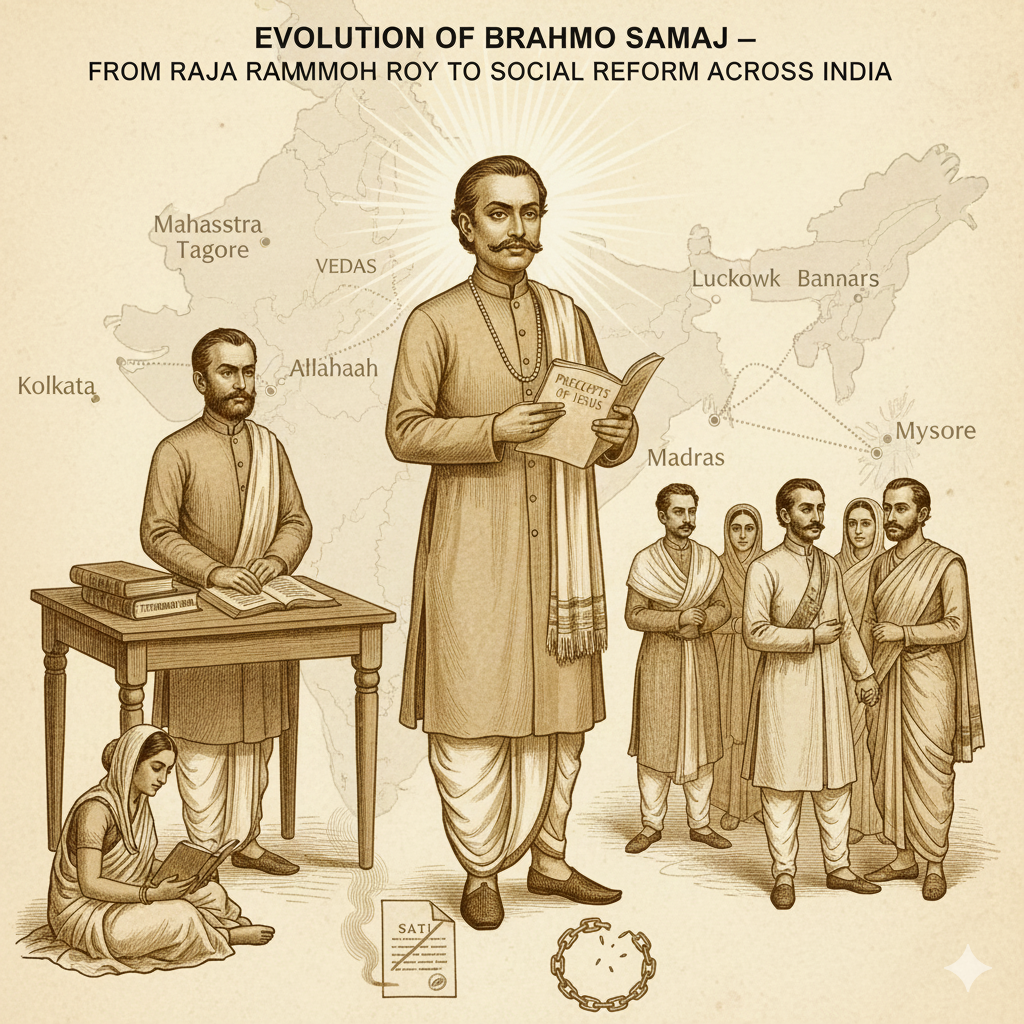
Brahmo Samaj was a major social and religious reform movement of 19th-century India, founded by Raja Rammohan Roy in 1828. Its main objective was to remove the evil practices prevalent in Hindu society and to promote unity, rationalism and spirituality. Through this movement, a powerful social and religious renaissance began, which inspired many later reform movements.
1. Establishment and Objectives of Brahmo Samaj
1.1 Establishment (1828)
In 1828, Raja Rammohan Roy initially started an organisation called “Brahma Sabha”, which later came to be known as the Brahmo Samaj. Its headquarters were established in Kolkata (Calcutta). The aim was to reform Hinduism from within and make it more rational, progressive and compatible with modern values.
1.2 Main Objectives
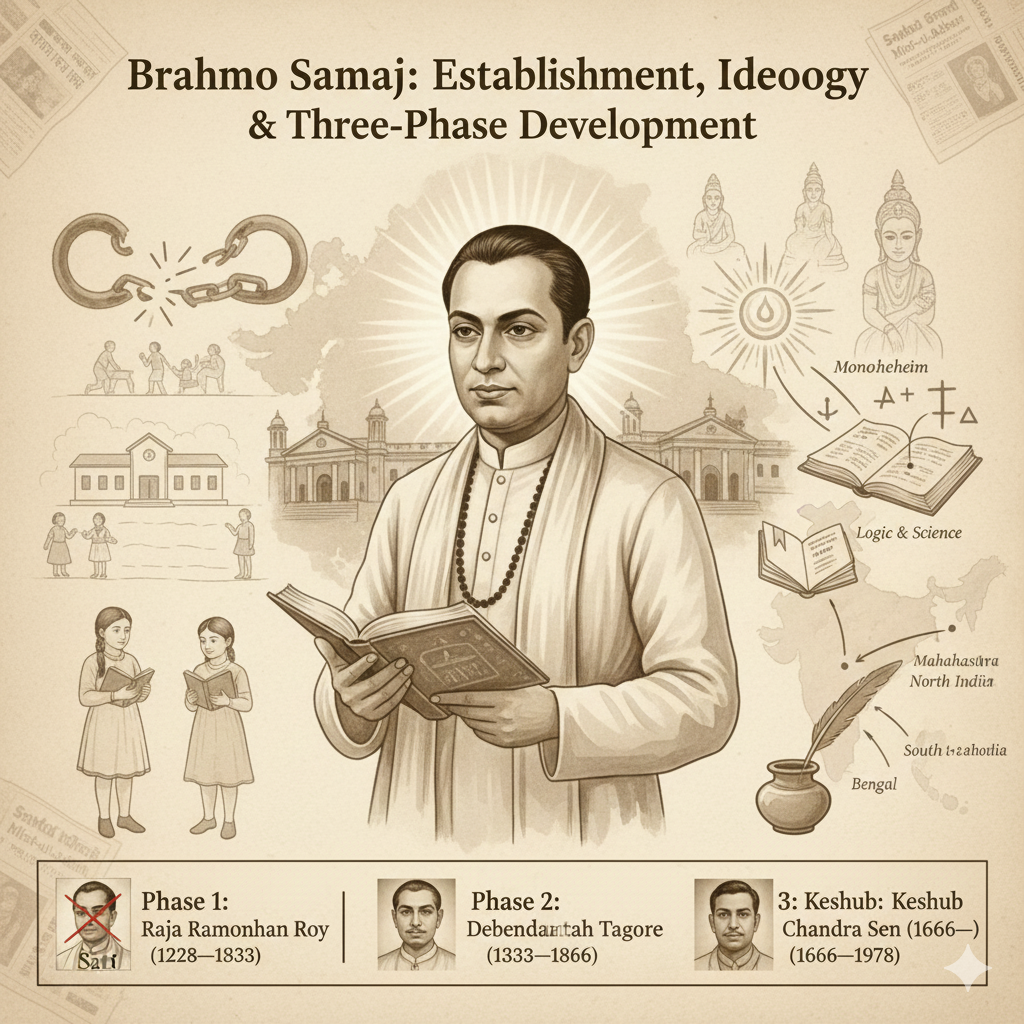
- To promote monotheism (worship of only one God).
- To oppose idol worship, superstition and meaningless rituals.
- To eradicate social evils like the caste system, Sati system and child marriage.
- To encourage women’s education and widow remarriage.
- To understand religion on the basis of logic and scientific thinking.
2. Major Phases and Development of Brahmo Samaj
The development of the Brahmo Samaj can be seen in three major phases, associated with three important leaders.
2.1 First Phase – Era of Raja Rammohan Roy (1828–1833)
Raja Rammohan Roy founded the Brahmo Samaj as a religious and social reform movement. He promoted western education and opposed many social evils, especially the cruel practice of Sati.
- He played a crucial role in the abolition of the Sati tradition.
- In 1829, due to his efforts, Lord William Bentinck declared Sati illegal.
- He was in favour of adopting the good principles of Christianity, Islam and Zoroastrianism into Hindu thought.
- He connected religion with morality and social justice.
- He passed away in England in 1833, but his ideas continued to inspire the movement.
2.2 Second Phase – Era of Debendranath Tagore (1833–1866)
After the death of Raja Rammohan Roy, Debendranath Tagore took over the leadership of the Brahmo Samaj and gave it a more organised structure.
- In 1843, he established the Tatvabodhini Sabha, which strengthened and systematised the Brahmo movement.
- In 1850, he developed the Brahmo Samaj as an independent religious organisation, distinct from orthodox Hinduism.
- He rejected the teachings of Christianity as a religious base and adopted monotheism based on the Vedas.
- During his time, the Brahmo Samaj began to spread to other provinces beyond Bengal.
2.3 Third Phase – Era of Keshub Chandra Sen (1866–1878)
In the third phase, Keshub Chandra Sen expanded the reach of Brahmo Samaj and gave it a more progressive and dynamic form.
- He took the Brahmo Samaj to a new level and spread it throughout India.
- He promoted women’s education, inter-caste marriage and wide-ranging social reforms.
- He established branches of the Brahmo Samaj in Maharashtra, North India and South India.
- In 1878, the Brahmo Samaj split into two parts:
2.3.1 Adi Brahmo Samaj
- Followers of Debendranath Tagore.
- Closer to traditional ideas and more conservative in approach.
2.3.2 New / Neo Brahmo Samaj
- Followers of Keshub Chandra Sen.
- More progressive and strongly focused on social reform and change.
3. Geographical Expansion of Brahmo Samaj
Although the Brahmo Samaj began in Bengal, its ideas gradually spread to different regions of India and influenced many local reform movements.

✔ Easy & comfortable for everyday use
✔ Excellent performance at this price
✔ Popular choice among Amazon buyers
3.1 Expansion in Bengal
- The headquarters of the Brahmo Samaj was in Kolkata.
- From here it spread throughout Bengal and was adopted mainly by the educated and intellectual class.
- Inspired by its ideas, many Bengali social reformers carried forward the work of religious and social transformation.
3.2 Expansion in Maharashtra
- In Maharashtra, social reformers like Mahadev Govind Ranade and others spread the ideas of the Brahmo Samaj.
- Here, a similar movement came to be known as the “Prayer Society” (Prarthana Samaj).
- It worked actively for women’s education and the abolition of the caste system.
3.3 Expansion in North India
- Through the efforts of Keshub Chandra Sen, Brahmo Samaj spread to many cities in North India.
- Branches were established in Allahabad, Lucknow, Banaras and Delhi.
- In North India, it was especially adopted by the urban educated class.
3.4 Expansion in South India
- Branches of the Brahmo Samaj were also set up in Madras (Chennai) and Mysore.
- Reformers in these regions adopted its principles and carried forward religious and social reform activities.
4. Influence and Contribution of Brahmo Samaj
4.1 Social Reforms
- Abolition of the practice of Sati: Due to the persistent efforts of Raja Rammohan Roy, Lord William Bentinck declared Sati illegal in 1829.
- Women’s Education: The tradition of educating women was strongly encouraged.
- Widow Remarriage: The movement supported granting widows the right to remarry.
- Opposition to Casteism: The Brahmo Samaj advocated equal rights for all castes and opposed rigid caste-based discrimination.
4.2 Religious Reforms
- Promoted monotheism and a rational ideology within Hinduism.
- Opposed idol worship, empty rituals and superstition.
- Linked religion with morality, social justice and responsible living.
- Gave Hinduism a new, progressive and ethical perspective.
4.3 Political and Educational Influence
- Advocated the adoption of a modern education system and the spread of English education.
- Inspired many social reformers associated with the Indian freedom struggle.
- Its ideas influenced leaders and thinkers like Mahatma Gandhi, Swami Vivekananda and several other reformers.
5. Limitations and Decline of Brahmo Samaj
5.1 Limitations
- The influence of the Brahmo Samaj largely remained limited to urban educated Hindus.
- It mainly attracted the middle-class Bengali Hindu community in its early stages.
- The deep-rooted traditions of Hinduism made it difficult for the movement to have a widespread impact on the entire society.
- It did not make a very strong impact in rural areas and many parts of North India.
5.2 Reasons for Decline
- In 1878, the split into the Adi Brahmo Samaj and the Neo Brahmo Samaj weakened its organisational strength.
- The rise of other powerful reform movements, such as those led by Swami Vivekananda and the Arya Samaj, reduced its independent influence.
- Gradually, many of its ideas were absorbed into newer social and religious reform movements, and its separate identity became less prominent.
6. Conclusion
The Brahmo Samaj played an important role in awakening Indian society during the 19th and 20th centuries. It worked to reform Hinduism, to agitate against social evils and to promote women’s education. The movement laid the foundation of modern social and religious reforms in India and gave Hinduism a new, rational and ethical outlook.
Although the influence of the Brahmo Samaj gradually weakened over time, its ideas and principles continued to inspire Indian society. It encouraged critical thinking, moral responsibility and social justice. The Brahmo Samaj not only contributed to religious reform but also inspired the Indian freedom struggle and many later social reform movements.
“Brahmo Samaj was not merely a religious reform movement; it became the pioneer of awareness and progressivism in Indian society.”
Establishment and Objectives of Brahmo Samaj
1. Establishment of Brahmo Samaj
(a) Background and Reasons
In the 18th and 19th centuries, many social and religious evils were prevalent in Indian society. Practices such as Sati, child marriage, the caste system, superstition, idol worship, rituals, and neglect of women’s education created deep social problems. With the advent of British rule, modern education and Western ideas began influencing Indian thinkers.
Enlightened reformers like Raja Rammohan Roy began working towards eradicating these evils and promoting religious and social reforms. As part of these efforts, the Brahmo Samaj was born.
(b) Year of Establishment and Founder
- The Brahmo Samaj was founded on 20 August 1828 by Raja Rammohan Roy.
- It began as the “Brahma Sabha”, later renamed the Brahmo Samaj.
- The headquarters were established in Kolkata (Calcutta).
- It soon became a major movement for reforming Hinduism and creating social awareness.
(c) Ideology of Brahmo Samaj
- Believed in monotheism based on the Vedas and Upanishads.
- Opposed idol worship, yajnas, sacrifices, and superstition.
- Accepted good teachings from all religions.
- Encouraged women's education, widow remarriage, and abolition of caste discrimination.
- Promoted logic, science, and modern education.
2. Objectives of Brahmo Samaj
The objectives of the Brahmo Samaj can be divided into three major categories: religious, social, and educational reforms.
(a) Religious Objectives
Propagation of Monotheism
- The Brahmo Samaj believed in the worship of one God.
- It strongly opposed idol worship and meaningless rituals.
- Raja Rammohan Roy believed true religion meant worship of God and following moral values.
Opposition to Idol Worship and Rituals
- Rejected idol worship, pilgrimages, yajnas, sacrifices, and mantras.
- Promoted understanding religion through reason and scientific thinking.
Respect for All Religions
- Accepted good teachings from Islam, Christianity, Zoroastrianism, and Hinduism.
- Rammohan Roy studied the Bible and the Quran.
Opposition to Priesthood
- Opposed superstition spread by priests and religious gurus.
- Promoted religious freedom for every individual.
(b) Social Objectives
Abolition of Sati
In 1829, with the efforts of Raja Rammohan Roy and support from Lord William Bentinck, the British government declared the practice of Sati illegal.
Opposition to Child Marriage and Polygamy
- The Brahmo Samaj worked to prevent child marriage.
- They considered polygamy illegal and unjust.
Promotion of Widow Remarriage
The movement strongly advocated widow remarriage and helped widows regain social acceptance.
✔ Comfortable & easy to use
✔ Great performance & value
✔ Popular choice among customers
Women's Education and Equality
- Supported education for women.
- Demanded property rights and equal opportunities for women.
Opposition to Caste System and Untouchability
- Condemned the caste system as inhuman.
- Promoted equality and dignity for all individuals.
(c) Educational Objectives
- Promoted modern education in English, mathematics, and science.
- Supported the establishment of Hindu College (now Presidency College, Kolkata).
- Emphasized girls' education and opened schools for women.
- Used newspapers and journals to spread awareness—such as Sambad Kaumudi and Mirat-ul-Akhbar.
3. Conclusion
The Brahmo Samaj marked the beginning of a new social and religious era in India. Under the leadership of Raja Rammohan Roy, it raised a strong voice against superstition, casteism, child marriage, and the oppression of women. It was not merely a religious reform movement but an attempt to bring awareness, progressivism, and equality in Indian society.
The principles of Brahmo Samaj later inspired movements like the Arya Samaj, Prarthana Samaj, and even the Indian freedom struggle.
Major Phases and Development of Brahmo Samaj
Introduction
The Brahmo Samaj, founded by Raja Rammohan Roy in 1828, gradually evolved into an important religious and social reform movement. Its development can be understood through three major phases.
1. First Phase (1828–1833) – Era of Raja Rammohan Roy
(a) Characteristics of This Phase
- Initial formation of Brahmo Samaj and establishment of basic ideology.
- Opposition to idol worship, rituals, and superstition.
- Acceptance of good principles of all religions.
(b) Major Contributions
Establishment of Brahmo Sabha (1828)
Raja Rammohan Roy founded the “Brahmo Sabha,” later renamed the “Brahmo Samaj,” to promote monotheism within Hinduism.
Abolition of Sati (1829)
His persistent efforts led Lord William Bentinck to abolish the Sati system legally in 1829.
Religious Tolerance
He supported adopting the good teachings of Islam, Christianity, and Zoroastrianism.
Educational Reforms
Encouraged modern education and helped establish Hindu College (now Presidency College).
(c) End of This Phase
The phase ended with Raja Rammohan Roy's death in England in 1833, which slowed the movement temporarily.
2. Second Phase (1833–1866) – Era of Debendranath Tagore
(a) Characteristics
After Rammohan Roy’s death, the movement became inactive, but in 1843, Debendranath Tagore revived it and gave it strong organizational structure.
(b) Major Contributions
Establishment of Tattvabodhini Sabha (1843)
Debendranath Tagore formed this Sabha to promote study of the Vedas and Upanishads and revive the Brahmo Samaj.
Organizational Expansion
He gave Brahmo Samaj a structured religious identity and a clear code of conduct.
Separation from Christianity
He based the Brahmo doctrine entirely on Vedanta and reduced Christian influence.
Social and Educational Reforms
Supported women's education, abolition of casteism, and widow remarriage. Opened schools across Bengal.
(c) End of This Phase
In 1866, Debendranath Tagore stepped down from leadership, paving the way for Keshub Chandra Sen's rise.
3. Third Phase (1866–1878) – Era of Keshub Chandra Sen and Partition
(a) Characteristics
Keshub Chandra Sen transformed the Brahmo Samaj into a national movement and expanded it across India. This was the period of rapid growth and eventual division.
(b) Major Contributions
All-India Expansion
Branches were established in Maharashtra, North India, and South India, taking the movement beyond Bengal.
Social Reforms
Promoted women’s education, inter-caste marriage, widow remarriage, and fought against child marriage.
Support from British Administration
Worked with the British government to implement social reforms.
(c) Split of Brahmo Samaj (1878)
Adi Brahmo Samaj
- Followers of Debendranath Tagore.
- More traditional and conservative.
Neo Brahmo Samaj
- Followers of Keshub Chandra Sen.
- More progressive; supported women’s freedom and inter-caste marriages.
(d) End of This Phase
After the split, the influence of the Brahmo Samaj gradually declined. Later reforms such as Arya Samaj, Prarthana Samaj, and the Indian National Movement became more prominent.
4. Conclusion
The Brahmo Samaj evolved through three major stages—Rammohan Roy founded it, Debendranath Tagore strengthened it, and Keshub Chandra Sen expanded it across India. Although its influence declined by the late 19th century, the reforms it introduced—women's education, abolition of caste system, widow remarriage, and rational religious principles—left a permanent mark on Indian society.
“Brahmo Samaj was not merely a religious reform movement, but a revolutionary step that laid the foundation for the social awakening of India.”
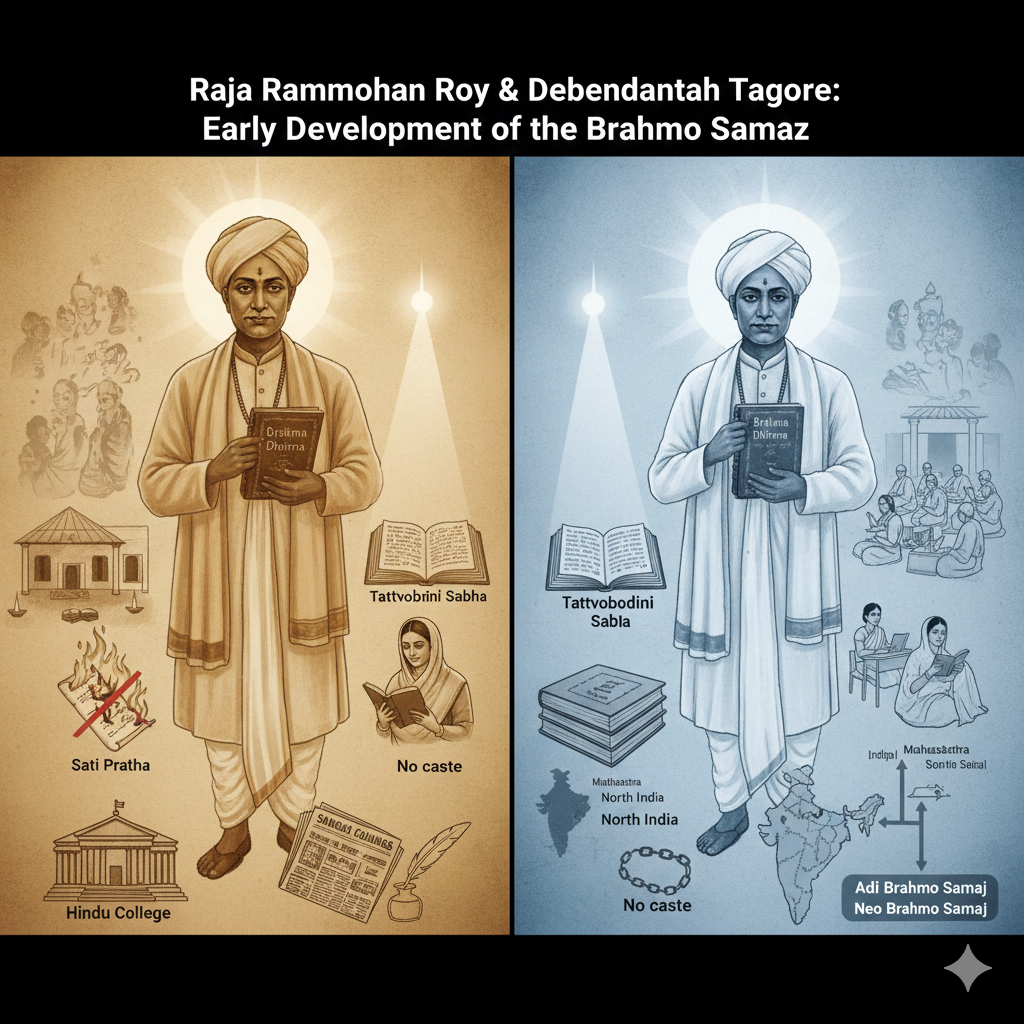
First Phase: The Era of Raja Rammohan Roy (1828–1833)
The first phase of the Brahmo Samaj lasted from 1828 to 1833, when its founder Raja Rammohan Roy led the movement. This phase focused on religious reforms, social reforms, and the spread of modern education. During this time, the Brahmo Samaj began fighting against superstition, idol worship, and social evils prevalent in Hindu society.
1. Raja Rammohan Roy: A Brief Introduction
- Born: 22 May 1772, Radhanagar (Bengal)
- Died: 27 September 1833, England
- He is considered a scholar, social reformer, and the father of the Indian Renaissance.
- He had deep knowledge of Persian, Arabic, Sanskrit, English, Hindi, and Bengali.
- He supported monotheism (worship of one God) and opposed idol worship and superstition.
2. Establishment of Brahmo Samaj (1828)
(a) Objectives of Establishment
In 1828, Raja Rammohan Roy founded the “Brahma Sabha,” later renamed the “Brahmo Samaj.” Its objectives included:
- Propagation of Monotheism: Promoting the worship of one God in Hinduism.
- Opposition to Idol Worship: Ending idol worship, yajnas, sacrifices, and superstition.
- Religious Tolerance: Accepting good principles from all religions.
- Social Reform: Opposing Sati, caste system, child marriage, and exploitation of women.
- Promotion of Modern Education: Encouraging awareness and scientific thinking.
(b) Meetings and Functioning of the Brahmo Samaj
- Regular meetings were held where only the worship of one God was practiced.
- No idols, idol worship, ritual chanting, or Vedic recitations were allowed.
- Verses from the Upanishads and other religious texts were recited.
- All members were treated equally regardless of caste, religion, or gender.
3. Major Social Reforms
(a) Abolition of the Practice of Sati (1829)
Sati was a cruel practice where a widow was burned on her husband's funeral pyre. Raja Rammohan Roy fought a long battle against this custom and urged the British government to abolish it. In 1829, Lord William Bentinck declared Sati illegal.
(b) Opposition to Caste System and Untouchability
- He rejected caste distinctions and advocated equality of all human beings.
- He challenged the dominance of Brahmins and opposed social discrimination.
(c) Women’s Education and Rights
- Encouraged the education of women.
- Supported property rights and social equality for women.
(d) Opposition to Child Marriage and Polygamy
- Spoke against the harmful practice of child marriage.
- Condemned polygamy and promoted monogamy.
(e) Support for Widow Remarriage
He advocated granting widows the right to remarry.
4. Spread of Education and Modern Thinking
✔ Easy & comfortable for everyday use
✔ Great value for the price
✔ Popular choice among Amazon buyers
(a) Promotion of Modern Education
- Supported modern, scientific education over the traditional Gurukul system.
- Emphasized learning English, science, mathematics, history, and modern subjects.
(b) Establishment of Premier Educational Institutions
- Hindu College (1817): Later became Presidency College.
- Anglo-Hindu School (1822): Taught English and modern subjects.
- Encouraged Indians to adopt scientific thinking and Western education.
(c) Development of Journalism and Press
- Sambad Kaumudi (Bengali, 1821) – focused on social reform and education.
- Mirat-ul-Akhbar (Persian, 1822) – published articles on political and social issues.
5. Religious Reforms and Monotheism
- Supported monotheism based on the Vedas and Upanishads.
- Opposed idol worship, rituals, and superstition.
- Advocated accepting good teachings from all religions.
6. Visit to England and Death (1833)
In 1831, Raja Rammohan Roy traveled to England to advocate for Indian rights and request reforms from the British government. He passed away there on 27 September 1833.
7. Conclusion
Founded by Raja Rammohan Roy, the Brahmo Samaj became the foundation of the Indian Renaissance. Through his efforts, Sati was abolished, casteism was challenged, women’s education was promoted, and modern education began in India. Although the movement weakened after his death, it was later revived and strengthened by Debendranath Tagore and Keshub Chandra Sen.
“Raja Rammohan Roy was not only a social reformer but also the pioneer of modern India.”
Second Phase: The Era of Debendranath Tagore (1833–1866)
The second phase of the Brahmo Samaj lasted from 1833 to 1866 under the leadership of Debendranath Tagore. During this period, the Brahmo Samaj was reorganized, its rules were formalized, and it evolved into a permanent religious and social reform movement.
1. Debendranath Tagore: Introduction
- Born: 15 May 1817, Calcutta (Bengal)
- Died: 19 January 1905
- Father of renowned poet Rabindranath Tagore.
- A theologian, scholar, and social reformer.
- Revived the Brahmo Samaj and transformed it into a strong organization.
2. Salient Features of This Phase
- The Brahmo Samaj became more organized and disciplined.
- Both religious and social reforms were expanded.
- Rules for the movement were formalized under “Brahma Dharma.”
- The influence of the Brahmo Samaj spread beyond Bengal.
- Tattvabodhini Sabha and Tattvabodhini Patrika were established.
- Opposition to idol worship, casteism, and religious hypocrisy continued.
3. Revival of Brahmo Samaj and Organizational Reform
(a) Revival of Brahmo Samaj
After 1833, the Brahmo Samaj became inactive for some time. In 1843, Debendranath Tagore revived it and transformed it into a systematic religious reform movement. He strengthened it as an organization rather than just an ideology.
(b) Establishment of “Brahmo Dharma” (1848)
- In 1848, Debendranath Tagore formalized the principles called Brahmo Dharma.
- Worship of one God was the central doctrine.
- He prepared a “New Testament” for Brahmo followers, outlining religious and moral duties.
- Rejected idol worship, sacrifices, rituals, and polytheism.
4. Establishment of Tattvabodhini Sabha and Magazine (1843)
(a) Tattvabodhini Sabha
Established in 1843, the Sabha spread Brahmo ideas and promoted the study of the Vedas and Upanishads. It aimed to bring about social and religious reform.
(b) Tattvabodhini Magazine
Also founded in 1843, this magazine propagated the reformist ideas of the Brahmo Samaj and helped expand social reform movements across Bengal and India.
5. Religious Reforms and Return to the Vedas
While Rammohan Roy accepted good principles from Christianity and Islam, Debendranath Tagore based the Brahmo Samaj firmly on Vedantic philosophy. He studied the Vedas deeply and strengthened Brahmo ideology, rejecting rituals and sacrifices.
6. Expansion of Brahmo Samaj and Separation from Hinduism
Debendranath Tagore expanded the Brahmo Samaj beyond Bengal into Maharashtra, North India, and South India. Gradually, the Brahmo Samaj distanced itself from traditional Hindu beliefs and became a separate reformist identity.
7. Major Social Reforms
(a) Opposition to Casteism and Untouchability
He rejected caste distinctions and advocated equality for all.
(b) Women’s Education and Rights
Promoted women’s education and supported the establishment of schools for women.
(c) Support for Widow Remarriage
Encouraged social acceptance of widow remarriage.
8. Split of Brahmo Samaj (1866)
Differences between Debendranath Tagore and Keshub Chandra Sen led to a split in 1866.
Adi Brahmo Samaj
- Led by Debendranath Tagore.
- Maintained traditional Vedantic and Hindu values.
Neo Brahmo Samaj
- Led by Keshub Chandra Sen.
- More progressive and focused on social reforms.
9. Conclusion
Debendranath Tagore revived, organized, and expanded the Brahmo Samaj into a lasting reform movement. Through the Tattvabodhini Sabha and magazine, he promoted education and social reforms. The movement’s contributions—abolition of casteism, promotion of women’s education, and support for widow remarriage— left a deep impact on Indian society.
“Debendranath Tagore transformed the Brahmo Samaj from an ideology into a powerful movement that shaped modern India.”
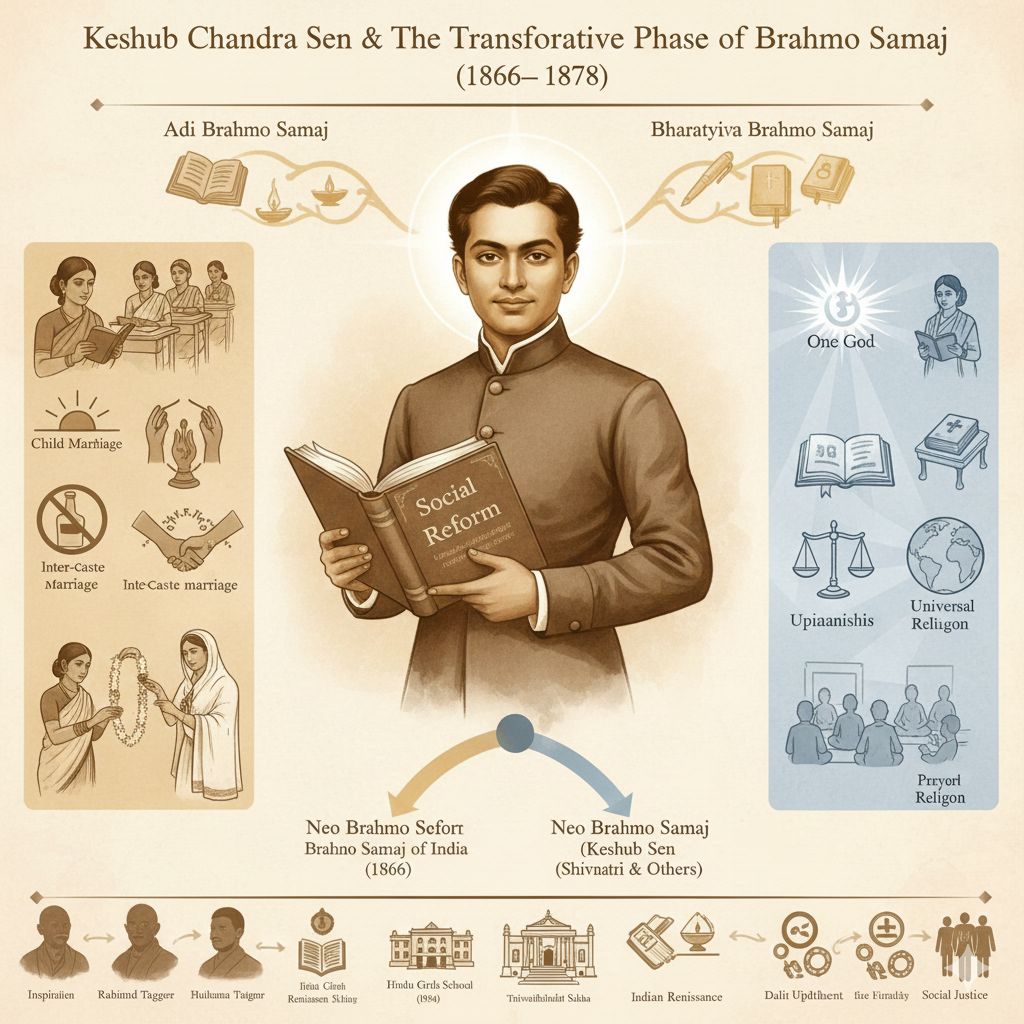
Third Phase: The Era of Keshub Chandra Sen (1866–1878)
The third phase of the Brahmo Samaj lasted from 1866 to 1878 under the leadership of Keshub Chandra Sen. This period witnessed major reforms, but it was also marked by disagreements and divisions within the movement.
1. Keshub Chandra Sen: Introduction
- Born: 19 November 1838, Kolkata (Bengal)
- Died: 8 January 1884
- He was an eloquent speaker, social reformer, and religious thinker.
- Joined the Brahmo Samaj in 1857 and soon became a leading figure.
- Youthful, radical, and heavily influenced by Western education.
2. Split of Brahmo Samaj (1866)
Differences arose between Debendranath Tagore and Keshub Chandra Sen. While Debendranath Tagore preferred staying close to traditional Vedanta, Keshub Chandra Sen leaned toward progressive ideas and social reforms.
Due to these differences, the Brahmo Samaj split into two parts in 1866:
- Adi Brahmo Samaj (led by Debendranath Tagore) – more traditional, Vedanta-based.
- Bharatvarsiya Brahmo Samaj (led by Keshub Chandra Sen) – more liberal, modern, and reform-oriented.
3. Brahmo Samaj of India (1866)
In 1866, Keshub Chandra Sen founded the Brahmo Samaj of India. He attempted to separate it completely from traditional Hinduism. The organisation focused on women’s education, widow remarriage, inter-caste marriage, and prohibition.
4. Major Social Reforms
(a) Support for Women’s Education and Rights
- Strong promoter of women's education.
- Worked to improve the status of widows and support their remarriage.
- Supported equal rights for women.
(b) Opposition to Child Marriage & Support for Inter-Caste Marriage
- Opposed child marriage and demanded raising the minimum age for marriage.
- Promoted inter-caste marriages — a revolutionary step in society.
- However, his decision to marry his 13-year-old daughter to the Maharaja of Cooch Behar in 1871 sparked controversy.
(c) Social Equality and Opposition to Casteism
- Completely rejected caste distinctions and untouchability.
- Allowed people from all castes and classes to participate in Brahmo Samaj meetings.
(d) Prohibition of Liquor and Moral Reform
- Opposed alcoholism and other addictions.
- Promoted moral discipline, integrity, and philanthropy.
5. Religious Reforms and Influence of Christianity
Keshub Chandra Sen was influenced by Western thought and Christianity. He incorporated teachings from the Bible and Jesus Christ into Brahmo ideology. He aimed to create a global religion that accepted good teachings from Hinduism, Islam, Christianity, and other faiths.
However, his inclination towards Christianity caused disagreements within the Brahmo Samaj.
6. Second Split of Brahmo Samaj (1878)
The marriage of Keshub Chandra Sen’s 13-year-old daughter in contradiction to his stance on child marriage created widespread anger among followers. His credibility was questioned.
As a result, in 1878, the Brahmo Samaj split again:
- Neo Brahmo Samaj (led by Keshub Chandra Sen)
- Sadharan Brahmo Samaj (led by Shivnath Shastri and Anand Mohan Bose) – more democratic and liberal.
7. Conclusion
Keshub Chandra Sen introduced strong social reforms, but his personal decisions and differing views caused divisions within the Brahmo Samaj. Despite the splits, his advocacy of women’s education, widow remarriage, inter-caste marriage, and anti-casteism left a lasting impact on Indian society.
“Keshub Chandra Sen transformed the Brahmo Samaj into a wider social reform movement and brought revolutionary changes in the fields of casteism, child marriage, and women’s education.”
Influence and Contribution of Brahmo Samaj
The Brahmo Samaj had a profound impact on Indian society and culture. It became a powerful force for religious, social, political, and educational reforms, laying the foundation of modern India.
1. Contribution in Religious Reforms
(a) Propagation of Monotheism
- Opposed polytheism and idol worship in Hinduism.
- Promoted the worship of one formless, infinite, omnipotent God.
- Based this idea on the Vedas and Upanishads, presenting it in a logical and scientific way.
(b) Opposition to Idol Worship and Rituals
- Rejected idol worship, yajnas, sacrifices, and ritual chanting.
- Condemned superstition and meaningless rituals.
- Promoted prayer, meditation, morality, and ethics as true devotion.
(c) Tolerance Towards All Religions
- Accepted good teachings from Christianity, Islam, Buddhism, and Zoroastrianism.
- Promoted inter-religious respect and dialogue.
- Became the foundation of India’s future belief in religious tolerance.
(d) Challenge to the Power of the Priesthood
- Asserted that individuals can connect with God directly—without priests.
- This reduced superstition and increased religious freedom.

✔ Easy & convenient for everyday use
✔ Great value for money
✔ Popular choice among customers
2. Contribution in Social Reforms
(a) Opposition to Casteism and Untouchability
- Declared the caste system inhuman and promoted the equality of all people.
- Allowed participation of all castes in Brahmo Samaj meetings.
- Inspired later Dalit upliftment movements.
(b) Women’s Education and Empowerment
- Promoted women’s education and opened schools for women.
- Supported women’s rights, property rights, and independent identity.
(c) Opposition to Sati & Support for Widow Remarriage
- Efforts of Raja Rammohan Roy led to the abolition of Sati in 1829.
- Encouraged widow remarriage and worked to improve their social status.
(d) Opposition to Child Marriage & Support for Inter-Caste Marriage
- Opposed child marriage and sought increasing the marriage age.
- Encouraged inter-caste marriages to break caste-based divisions.
(e) Prohibition of Liquor and Moral Reform
- Opposed alcohol consumption and other addictive habits.
- Promoted moral discipline and social responsibility.
3. Contribution in the Field of Education
(a) Promotion of Modern Education
- Supported Western-style modern education.
- Encouraged scientific and logical thinking.
(b) Girls’ Education
Opened many schools for girls, ensuring access to modern learning.
(c) Establishment of Schools and Colleges
- Tattvabodhini Sabha and Magazine promoted educational awareness.
- Reformers like Vidyasagar expanded the network of schools and colleges.
4. Impact on Indian Nationalism and Freedom Struggle
(a) Inspiration for the Indian Renaissance
The Brahmo Samaj awakened self-respect, awareness, and modern thinking. It sparked the beginning of the Indian Renaissance.
(b) Contribution to the Freedom Struggle
Its ideas deeply influenced the Indian Independence movement. Reformers like Rammohan Roy, Debendranath Tagore, and Keshub Chandra Sen inspired Indians towards self-reliance. Leaders like Rabindranath Tagore, Mahatma Gandhi, and Subhas Chandra Bose were influenced by Brahmo philosophy.
5. Lasting Impact on Indian Society
(a) Foundation of Modern Indian Society
The Brahmo Samaj helped free society from superstition and orthodox rituals, promoting a modern outlook.
(b) Inspiration to Other Reform Movements
Movements like Arya Samaj, Prarthana Samaj, and Ramakrishna Mission were influenced by Brahmo ideals and continued social reforms in India.
(c) Improvement in the Condition of Women and Dalits
Advocated equality, justice, and rights for women and Dalits, strengthening the foundation of social reform.
Conclusion
The Brahmo Samaj was one of the most influential reform movements in Indian history. It initiated revolutionary changes in religious, social, and educational spheres. Its ideas helped transform Indian society into a more progressive, scientific, and modern nation.
“Brahmo Samaj was not just a religious movement, but a revolutionary reform movement that gave a new direction to Indian society.”
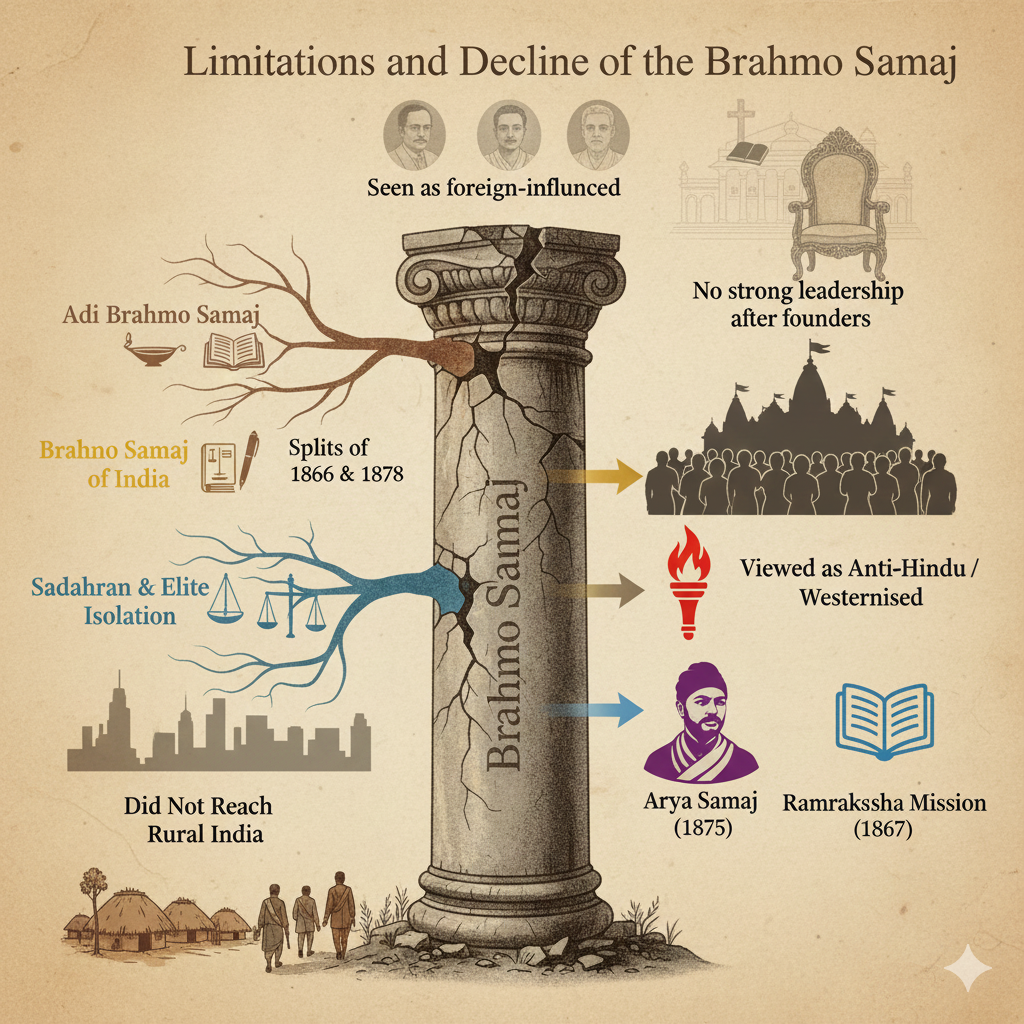
Limitations and Decline of Brahmo Samaj
The Brahmo Samaj contributed significantly to religious, social, and educational reforms in India, but its influence gradually declined. Several factors—such as internal differences, limited public outreach, external opposition, and inability to adapt to changing social realities—led to its downfall.
1. Limitations of Brahmo Samaj
(a) Lack of Public Relations and Popularity
- The Brahmo Samaj mainly remained confined to the urban educated class.
- Its reach in rural areas was minimal.
- Its meetings and teachings were mostly limited to Bengal and a few cities.
- It remained disconnected from the language, beliefs, and religious traditions of common people.
(b) Alienation from Hindu Society
- The Brahmo Samaj opposed idol worship, rituals, and traditional Hindu customs.
- Many orthodox Hindus began to see it as an anti-Hindu movement.
- Its ideas were often viewed as being influenced by Western and Christian thought, reducing its acceptance.
(c) Internal Differences and Divisions
- Leadership conflicts created long-term instability.
- In 1866, ideological differences between Debendranath Tagore and Keshub Chandra Sen caused the first major split:
Two Groups Formed in 1866:
- Adi Brahmo Samaj (led by Debendranath Tagore)
- Brahmo Samaj of India (led by Keshub Chandra Sen)
In 1878, controversy over Keshub Chandra Sen’s daughter's early marriage led to another split, creating the Sadharan Brahmo Samaj. Frequent divisions weakened the unity and power of the movement.
(d) Limited Impact of Social Reforms
- The Brahmo Samaj advocated widow remarriage, women’s education, abolition of casteism, and ending child marriage.
- However, these reforms remained limited to a small group of educated people.
- Deep-rooted traditions in Indian society made widespread acceptance difficult.
(e) Competition from Other Reform Movements
- The rise of the Arya Samaj (1875) provided a more acceptable reform model rooted in the Vedas.
- Prarthana Samaj (1867) and Ramakrishna Mission (1897) gained wider popularity among Hindus.
- These movements overshadowed the Brahmo Samaj and reduced its influence.
(f) Excessive Idealism
- The Brahmo Samaj attempted to accept good teachings from all religions, making it appealing intellectually—but not to the masses.
- Its ideals were difficult to apply in practical life.
- As a result, it remained limited to a small intellectual class.
(g) Lack of Political Consciousness
- The Brahmo Samaj focused mainly on religious and social reforms.
- It lacked any major political programme.
- Thus, it did not play a significant role in the Indian freedom movement.

✔ Easy & convenient for daily use
✔ Great performance & value
✔ Popular choice among customers
2. Decline of Brahmo Samaj
(a) Death of Prominent Leaders
- The passing of major leaders such as Raja Rammohan Roy (1833), Debendranath Tagore (1905), and Keshub Chandra Sen (1884) created a leadership vacuum.
- No strong leaders emerged afterward to keep the movement united and relevant.
- This weakened the movement significantly.
(b) Inclination Towards Christianity
- Some leaders adopted elements of Christianity.
- Hindu society began seeing the Brahmo Samaj as a foreign-influenced organisation.
- In contrast, Arya Samaj and Ramakrishna Mission reformed Hinduism while maintaining traditional roots, making them more popular.
(c) Changing Social Circumstances
- Late 19th and early 20th century India saw rising nationalism and the freedom struggle.
- Movements like the Indian National Congress (1885) and the Swadeshi Movement gained public focus.
- The reformist approach of the Brahmo Samaj became less relevant in this context.
(d) Lack of Interest Among Youth
- By the early 20th century, young people viewed the Brahmo Samaj as outdated.
- No new energetic leaders emerged to revive it.
- Its branches slowly closed down, and its influence decreased.
3. Conclusion
The Brahmo Samaj played a major role in social and religious reforms in India. However, due to limited mass reach, internal conflicts, competition from other reform movements, and changing social conditions, it gradually declined in influence and relevance.
Summary of Main Reasons for Decline
- Limited public contact – did not reach rural masses.
- Isolation from Hindu society – opposition to traditional customs reduced acceptance.
- Constant divisions – leadership disputes weakened unity.
- Competition from new reform movements – Arya Samaj, Ramakrishna Mission, etc.
- Lack of leadership – no strong leaders after Rammohan Roy, Debendranath, and Sen.
Despite its decline, the Brahmo Samaj played a crucial role in promoting women’s education, abolishing casteism, and encouraging religious tolerance. It laid the foundation for the Indian social reform movement and inspired many reformers in later generations.
“Even though the Brahmo Samaj weakened as an organisation, its ideas continue to live on in Indian society.”
References

✔ Easy and comfortable to use daily
✔ Great performance & value
✔ Popular choice among Amazon customers
- Roy, Raja Rammohan. Selected Works of Raja Rammohan Roy. Calcutta Oriental Press.
- Sastri, Sivanath. History of the Brahmo Samaj. Brahmo Mission Press.
- Tagore, Debendranath. Brahmo Dharma. Tattvabodhini Press.
- Sen, Keshub Chandra. The Life and Teachings of Keshub Chandra Sen. Indian Reform Society.
- Majumdar, R.C. History of the Freedom Movement in India. Firma KLM.
- Chatterjee, S. Indian Renaissance and Reform Movements. Modern India Publications.
- NCERT – Modern Indian History (Class 8, 10, 12) – Chapters on Social and Religious Reform Movements.
- Encyclopaedia Britannica – Entry on “Brahmo Samaj”.
- Government of India, Ministry of Culture – Articles on Social Reformers.