
To understand the deeper geopolitical dynamics shaping the Middle East, read our full analysis: Middle East Geopolitics 2026: Power Struggle, Oil Politics and Global Power Game
Iran–Israel Conflict Expands, Strait of Hormuz & USA: What Next for India?
Iran Israel Conflict is rapidly becoming one of the most serious geopolitical crises in the Middle East, especially due to tensions around the Strait of Hormuz.
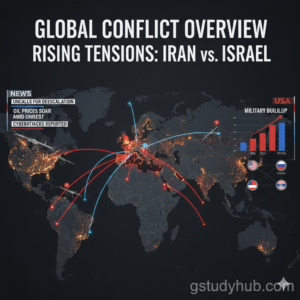
The Middle East has once again become the center of global geopolitics. Rising tensions between Iran and Israel are no longer just a regional dispute. Instead, the situation is gradually transforming into a potential global crisis that could reshape the balance of power in international politics.
Over the past few months, the world has witnessed missile strikes, drone attacks, cyber warfare, and rising military mobilization between the two nations. These developments have significantly increased fears that the conflict could escalate into a wider regional war involving several powerful countries.
The situation becomes even more complex when the role of the United States is considered. For decades, the United States has been a strong strategic ally of Israel and has repeatedly expressed concerns about Iran’s nuclear program. Meanwhile, Iran has been attempting to expand its regional influence through alliances and strategic partnerships across the Middle East.
Because of these competing ambitions, the Iran–Israel confrontation is no longer just about two nations. It is increasingly becoming a struggle for geopolitical dominance in one of the world’s most strategically important regions.
However, one critical factor makes this conflict even more dangerous — the presence of the Strait of Hormuz. This narrow waterway is considered one of the most important maritime chokepoints in the world.
Located between Iran and Oman, the Strait of Hormuz connects the Persian Gulf with the Arabian Sea. This strategic route allows oil-rich Gulf nations such as Saudi Arabia, Iraq, Kuwait, Qatar, and the United Arab Emirates to export their energy resources to global markets.
According to global energy reports, nearly 20% of the world’s total oil supply passes through this narrow waterway every single day. In numerical terms, this equals roughly 17–20 million barrels of oil per day.
Because of this massive energy flow, the Strait of Hormuz is often described as the “lifeline of global energy trade.” Any disruption in this region — whether due to military confrontation, naval blockades, or geopolitical tension — could immediately impact global oil prices and energy security.
If the Strait of Hormuz were to be blocked or heavily militarized, analysts believe that global oil prices could skyrocket to $150–$200 per barrel. Such a sudden shock would trigger inflation, supply chain disruptions, and a potential global economic slowdown.
Countries across Asia and Europe would face severe consequences, but the impact could be particularly significant for India. India is one of the largest energy-importing countries in the world and depends heavily on oil shipments from the Middle East.
Currently, India imports nearly 80% of its crude oil requirements. A major portion of this oil travels through the Strait of Hormuz. Any disruption in this critical maritime route could directly affect India’s energy security, fuel prices, and economic stability.
Beyond energy, India also has strong economic and human connections with the Middle East. More than 8 million Indians live and work in Gulf countries, sending billions of dollars in remittances back home each year.
If tensions escalate into a large-scale regional conflict, the safety of these expatriates and the stability of remittance flows could also come under threat.
Therefore, the expanding Iran–Israel conflict is not merely a bilateral dispute. It has the potential to reshape global energy markets, international trade routes, geopolitical alliances, and economic stability.
In this article, we will explore in detail why the Iran–Israel conflict is escalating, the strategic role of the United States, why the Strait of Hormuz is so critical, and most importantly, what this evolving crisis means for India’s economy, energy security, and foreign policy.
Analysis Source: gsstudyhub.com
Want to understand the internal political crisis shaping Iran today? Read our full analysis here → The Current Movement in Iran: Causes, History, Religious, Political and Global Implications
Strait of Hormuz – The World’s Most Important Oil Route
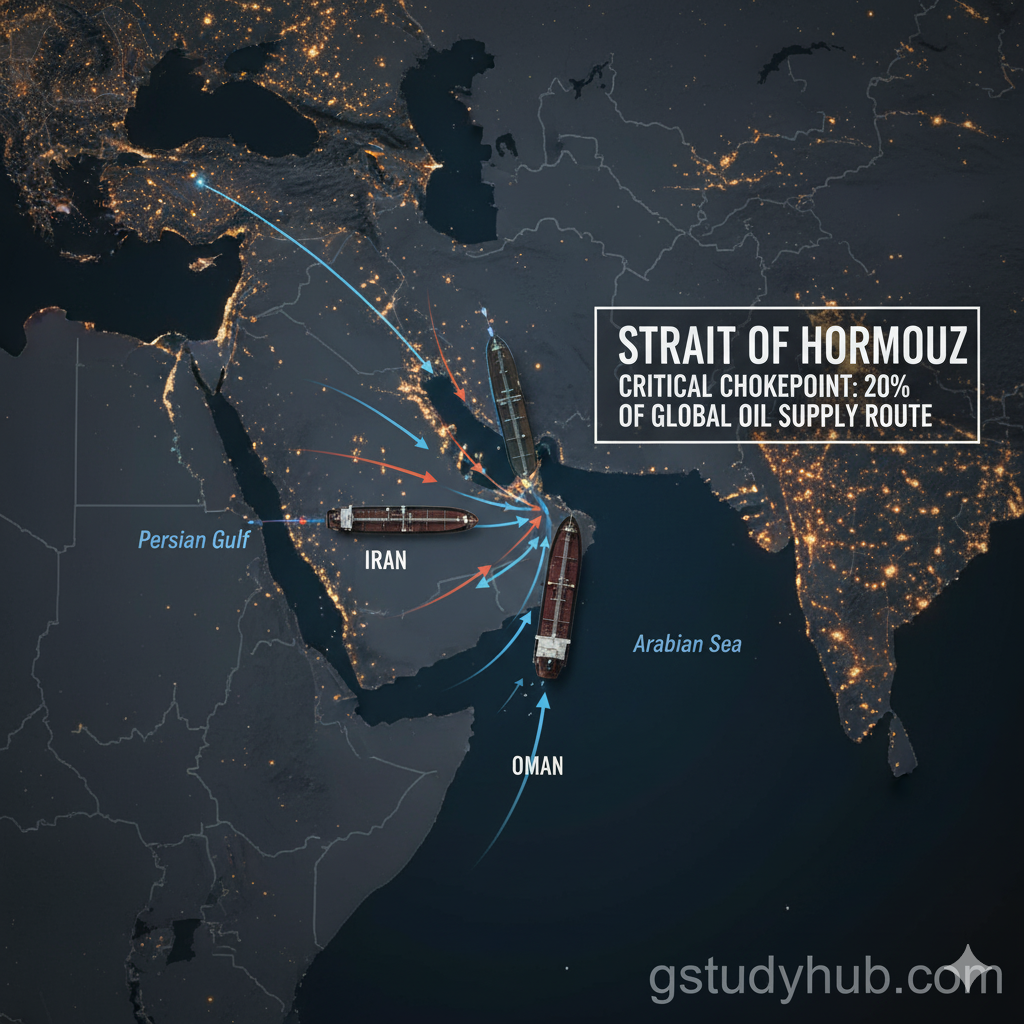
Amid rising tensions in the Middle East, one strategic location is receiving global attention — the Strait of Hormuz. Although this narrow waterway may appear small on the map, it is considered the most important oil chokepoint in the world and plays a critical role in global energy security.
The Strait of Hormuz is located between Iran and Oman. It connects the Persian Gulf with the Arabian Sea. Through this strategic passage, major oil-producing nations such as Saudi Arabia, Iraq, Kuwait, Qatar, and the United Arab Emirates export their oil and liquefied natural gas (LNG) to international markets.
According to global energy estimates, nearly 20% of the world’s total oil supply passes through this narrow maritime route every day. In numerical terms, around 17–20 million barrels of oil are transported daily by massive oil tankers through the Strait of Hormuz.
Because of this massive volume of energy trade, the Strait of Hormuz is often described as the “Global Oil Lifeline.” Any disruption here—whether caused by military conflict, naval blockades, or geopolitical tensions— could immediately impact global oil markets and energy supply chains.
What Happens if the Strait of Hormuz Is Blocked?
Experts warn that if the Strait of Hormuz were to be blocked or severely disrupted, the consequences could be extremely serious for the global economy.
- Severe global oil shortages could occur.
- Petrol and diesel prices could surge worldwide.
- Global inflation may rise sharply.
- International shipping and trade routes could face major disruptions.
- A potential global economic crisis could emerge.
History has shown that whenever tensions increase in the Middle East, global oil prices react almost immediately. If the Strait of Hormuz were completely blocked, analysts estimate that oil prices could rise to $150–$200 per barrel, creating a shockwave across the global economy.
Why Is It Important for India?
For countries like India, the Strait of Hormuz holds enormous strategic importance. India imports nearly 80% of its crude oil, and a significant portion of this energy supply travels through the Strait of Hormuz.
If this maritime route becomes unstable, it could lead to higher fuel prices, rising inflation, and economic pressure within India. This is why policymakers and energy analysts closely monitor developments in the region.
In simple terms, the Strait of Hormuz is not just a narrow sea passage. It is the heartbeat of global energy trade. Any conflict or disruption here could influence oil markets, international trade, and economic stability across the world.
Analysis Source: gsstudyhub.com
Want to understand Iran’s geography, political system, economy, and its role in global geopolitics? Read our complete country guide → Iran: Geography, Politics, Economy and Global Influence
Iran’s Biggest Geopolitical Weapon – The Strait of Hormuz Strategy
According to strategic analysis discussed in the video, Iran does not possess the same level of conventional military power as the United States. Direct large-scale warfare with a global superpower like the United States would be extremely difficult. However, Iran holds a powerful strategic advantage that could significantly disrupt the global system.
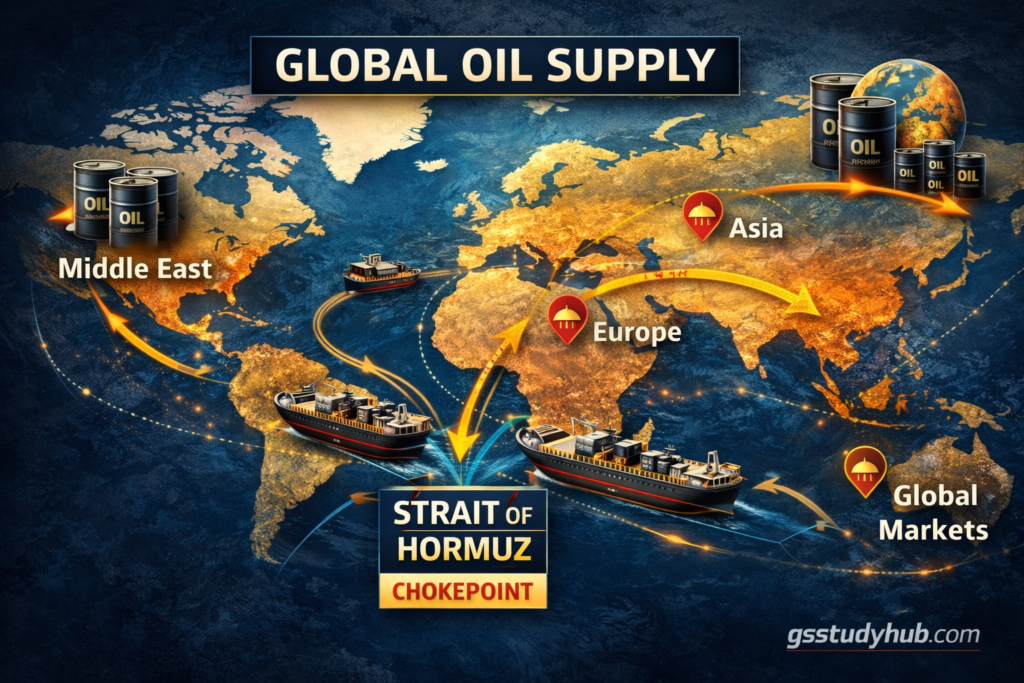
That advantage is the ability to threaten or temporarily block the Strait of Hormuz, one of the most critical maritime chokepoints in the world. Since nearly 20% of global oil supply moves through this narrow waterway, any disruption here could trigger a major global energy shock.
Because of this strategic location, the Strait of Hormuz is often described as Iran’s most powerful geopolitical leverage. Even without matching the military strength of larger powers, Iran can influence global energy markets, shipping routes, and international politics.
How Could Iran Block the Strait of Hormuz?
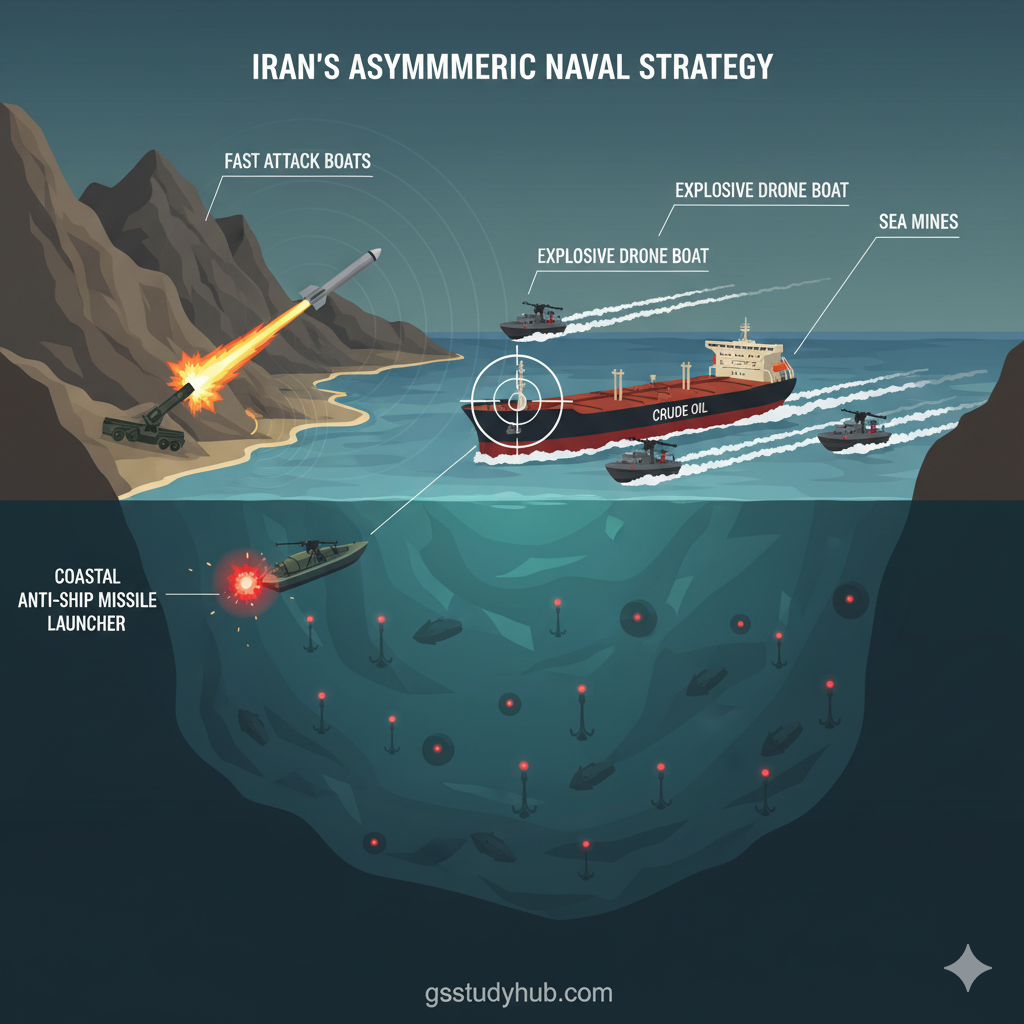
Military analysts believe that Iran could attempt to disrupt shipping in the region using several low-cost but highly effective naval strategies. Instead of conventional naval battles, Iran relies on tactics designed to create maximum disruption with limited resources.
- Sea Mines – Iran could deploy underwater naval mines that can damage or sink large oil tankers passing through the narrow strait.
- Drone Boats – Unmanned explosive boats could be used to attack commercial ships or military vessels operating in the region.
- Anti-Ship Missiles – Iran has developed missile systems capable of targeting ships from coastal launch platforms.
- Fast Attack Boats – Small, high-speed naval vessels can swarm large ships and create serious challenges for traditional naval defense systems.
What Is Asymmetric Naval Warfare?
This strategy is commonly known as Asymmetric Naval Warfare. It refers to a military approach where a relatively weaker power uses unconventional tactics and cost-effective weapons to challenge a stronger opponent.
Instead of fighting large naval fleets directly, Iran focuses on disruption, surprise attacks, and maritime chokepoint control. These tactics are specifically designed to make it extremely risky for large commercial vessels or military ships to operate safely in the region.
Even a limited disruption in the Strait of Hormuz could lead to massive spikes in oil prices, shipping delays, and increased insurance costs for international cargo routes. This is why global powers closely monitor any military activity in the area.
In geopolitical terms, the Strait of Hormuz gives Iran a strategic bargaining chip. While it may not match the military capabilities of larger powers, its control over a critical energy chokepoint allows it to exert significant influence on global politics and energy markets.
Strategic Analysis: gsstudyhub.com
Space is becoming the next strategic battlefield in global geopolitics. Read the full analysis → Space Militarization 2026: The New Arms Race Beyond Earth
How Serious Is the Situation Right Now?
The current situation in the Strait of Hormuz is becoming increasingly concerning for the global community. According to recent strategic and shipping reports, the level of tension in this critical maritime corridor has risen significantly. What was once a theoretical geopolitical risk is now beginning to show real-world disruptions in global shipping activity.
The Strait of Hormuz is widely recognized as the most important oil chokepoint in the world. Every day, millions of barrels of crude oil and liquefied natural gas pass through this narrow sea route from the Persian Gulf to global markets. However, recent developments indicate that shipping traffic through the strait has slowed dramatically.
Reports suggest that several commercial vessels and oil tankers have either delayed their journeys or temporarily suspended operations in the region. Some shipping companies are now reconsidering their logistics strategies due to increasing security risks and rising insurance costs.
Key Developments Reported in the Region
Recent intelligence and shipping industry updates highlight several alarming developments that indicate the seriousness of the situation.
- Shipping traffic through the Strait of Hormuz has significantly slowed down, as many vessels are waiting for security clearance before entering the region.
- Several ships have reportedly faced attacks or threats, raising fears about the safety of international cargo vessels.
- Major shipping companies have temporarily suspended or rerouted operations to avoid potential conflict zones.
- Insurance premiums for ships traveling through the region have surged, making the route significantly more expensive for global trade.
Potential Impact on Global Energy Supply
If this situation continues or escalates further, the consequences for the global economy could be extremely serious. Since nearly 20% of the world's oil supply passes through the Strait of Hormuz, even a temporary disruption can trigger instability in international energy markets.
Energy analysts warn that prolonged disruption could lead to sharp increases in oil prices, fuel shortages, and inflation across many economies. Countries heavily dependent on imported oil, particularly in Asia and Europe, may face the greatest challenges.
Because of these risks, global governments, energy markets, and military forces are closely monitoring developments in the region. The stability of the Strait of Hormuz is not just a regional issue — it is a critical factor in maintaining global energy security and economic stability.
Strategic Analysis: gsstudyhub.com
Semiconductors are becoming the most strategic resource of the digital age. Read the full analysis → Semiconductor War 2026: Global Chip Power Struggle
Impact on the Global Economy
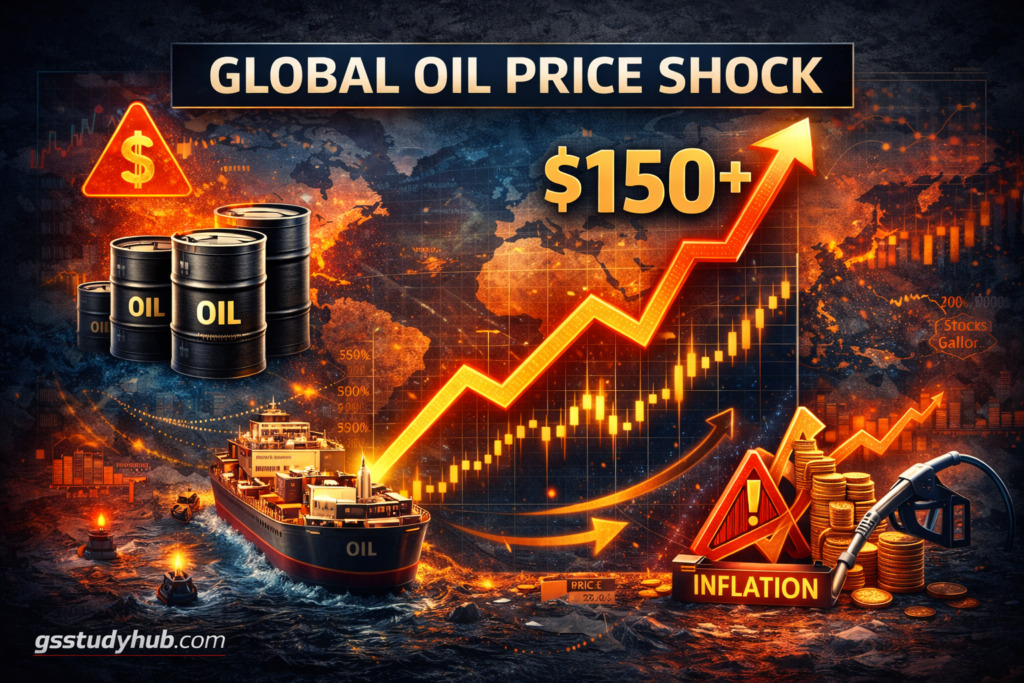
The Iran Israel conflict is already influencing global oil markets and energy security.The growing tension around the Strait of Hormuz is not just a regional security issue. It has the potential to affect the entire global economic system. Energy experts and international analysts warn that disruptions in this narrow maritime corridor could trigger serious instability in global energy markets and international trade.
Every single day, nearly 20 million barrels of crude oil pass through the Strait of Hormuz. This massive flow of energy supplies fuels industries, transportation systems, and economies across Asia, Europe, and other parts of the world.
Because such a large share of global oil trade depends on this route, even a temporary disruption could cause significant volatility in global oil markets. Energy traders closely monitor any tension in the region because the Strait of Hormuz acts as a lifeline for global oil supply.
Why This Route Is So Critical for the World Economy
The importance of the Strait of Hormuz lies in its role as a major energy transportation corridor. Oil produced in Gulf countries must pass through this narrow waterway before reaching major global markets.
- Nearly 20 million barrels of oil move through the strait daily.
- A disruption could immediately push global oil prices higher.
- Energy-importing nations may face supply shortages.
- Global trade and shipping costs could increase sharply.
Experts Warn of Potential Global Economic Risks
Many international economists and energy analysts are warning that a prolonged disruption in the Strait of Hormuz could lead to a wider global economic impact. Higher fuel prices would increase transportation costs, which could eventually affect food prices, manufacturing costs, and global inflation.
If the situation escalates further, financial markets could also experience volatility and investor uncertainty. Energy-importing economies would face greater pressure, and global economic growth could slow down.
For this reason, stability in the Strait of Hormuz is considered essential for maintaining global economic balance and energy security. Any major disruption here can send shockwaves across the entire world economy.
Economic Analysis: gsstudyhub.com
Conflicts in the 21st century are increasingly fought through cyber attacks, information warfare, and hybrid strategies. Read the full analysis → Cyber and Hybrid Warfare in the 21st Century
What Could Happen Next? Scenario 1 – Limited War
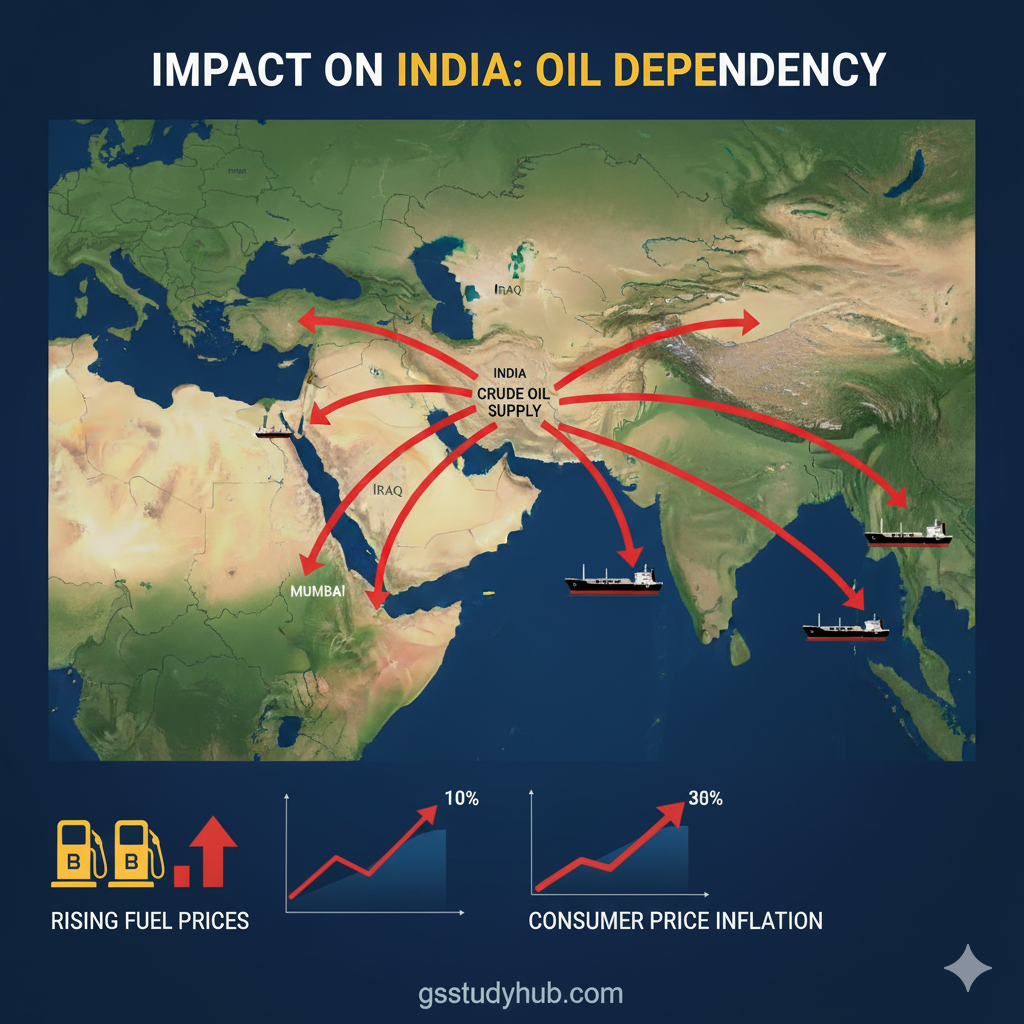
For India, the Iran Israel conflict could increase oil prices and inflation.As tensions continue to rise in the Middle East, many strategic analysts believe that the most likely short-term outcome could be a limited military confrontation rather than a full-scale war. In this scenario, clashes may occur between Iran and the United States or between Iran and regional allies of the U.S., but the conflict would remain relatively controlled.
A limited war generally means that both sides engage in targeted military actions such as airstrikes, naval confrontations, cyber attacks, or limited missile strikes, without escalating into a full regional war. The objective in such conflicts is usually to send strategic signals or weaken the opponent without triggering uncontrollable escalation.
Possible Characteristics of a Limited Conflict
- Localized military strikes against strategic targets.
- Naval tensions in the Persian Gulf and the Strait of Hormuz.
- Cyber warfare and intelligence operations between opposing sides.
- Diplomatic pressure and sanctions used alongside military actions.
Impact on Global Oil Markets
Even a limited conflict could create uncertainty in global energy markets. Since the Strait of Hormuz is a vital oil transport route, any military activity in the region would increase risk for shipping companies and oil traders.
In this scenario, global oil prices would likely rise significantly due to geopolitical risk, but the overall supply of oil would probably continue flowing. Energy markets often react strongly to uncertainty, which could push prices upward even if the physical supply of oil is not completely disrupted.
For countries dependent on imported energy, including India, this would mean higher fuel prices and increased inflationary pressure, although global energy trade would still continue.
In summary, a limited war scenario would create temporary economic stress and higher oil prices, but it would likely avoid the catastrophic consequences of a full-scale regional conflict.
Strategic Analysis: gsstudyhub.com
The balance of global power is gradually shifting from the traditional Western powers toward emerging Global South nations. Read the full analysis → Global South vs West: The New Cold War 2026
What Could Happen Next? Scenario 2 – Strait of Hormuz Blocked
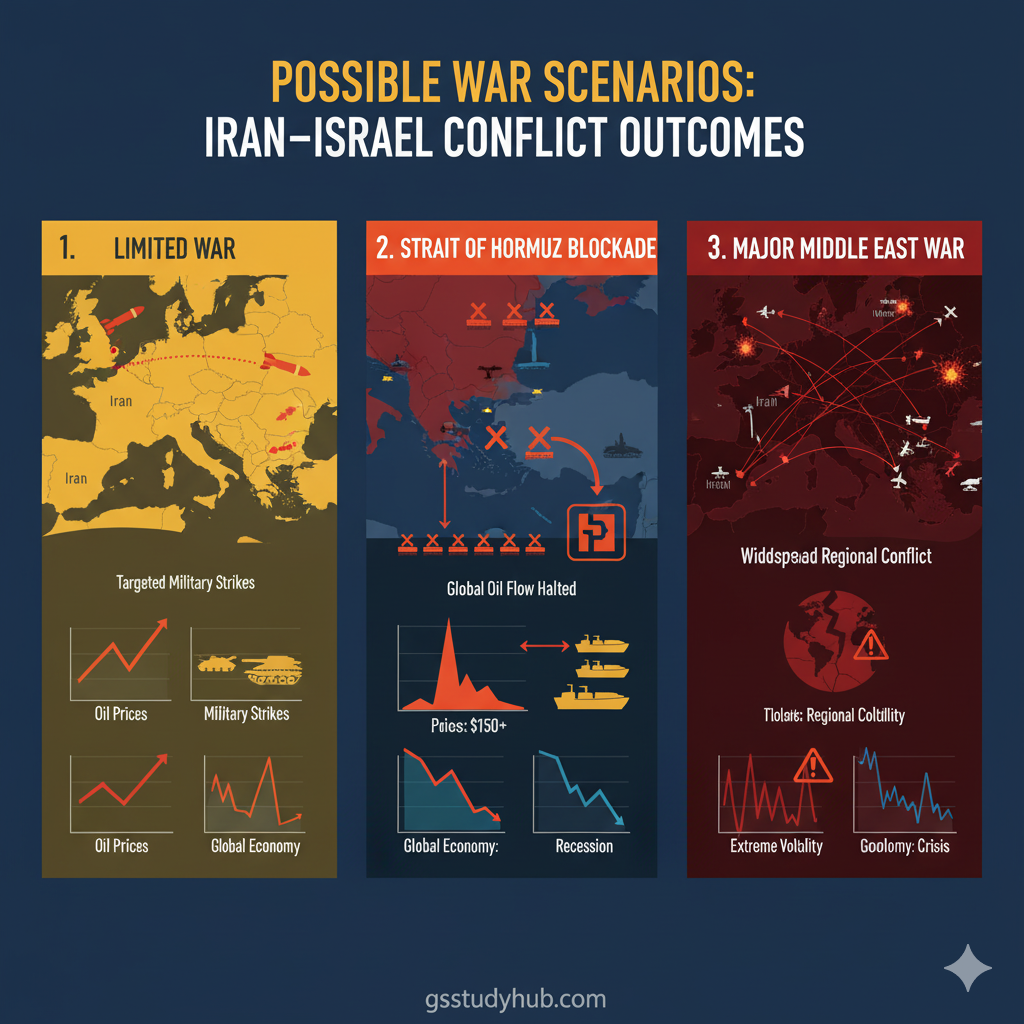
One of the most dangerous scenarios discussed by geopolitical analysts is the possibility that the Strait of Hormuz could be partially or fully blocked. Since this narrow waterway carries a massive portion of the world’s energy supply, any disruption here would have immediate and far-reaching consequences for the global economy and energy markets.
The Strait of Hormuz is often described as the most critical oil chokepoint in the world. Nearly 20% of global oil supply moves through this strategic passage every day. If military tensions escalate to the point where ships cannot safely travel through the strait, global oil transportation could be severely disrupted.
Possible Immediate Effects
- Global oil prices could surge above $150 per barrel due to sudden supply fears.
- Energy-importing nations may face fuel shortages as shipping routes become unsafe.
- Shipping insurance costs and transportation expenses would increase dramatically.
- Financial markets could become highly volatile as investors react to geopolitical uncertainty.
Risk of a Global Economic Crisis
A prolonged disruption in the Strait of Hormuz could potentially trigger a global economic crisis. Oil is the backbone of modern industrial economies, and a sudden spike in fuel prices would raise transportation costs, manufacturing expenses, and the price of essential goods worldwide.
Higher energy prices could also accelerate global inflation, slow down economic growth, and create financial instability in both developed and emerging economies.
Countries heavily dependent on imported oil, including India, could face severe economic pressure. Higher fuel costs would affect transportation, agriculture, industry, and household spending.
For this reason, governments, energy markets, and international security organizations closely monitor developments around the Strait of Hormuz. The stability of this single maritime corridor has the potential to influence the entire global economic system.
Global Energy Analysis: gsstudyhub.com
The Taiwan Strait is emerging as one of the most dangerous geopolitical hotspots in the world. Read the full analysis → Taiwan Strait Crisis 2026: The Next Ukraine?
What Could Happen Next? Scenario 3 – A Major Middle East War
The most dangerous and unpredictable scenario discussed by geopolitical analysts is the possibility of a large-scale war across the Middle East. If the conflict between Iran and Israel escalates further, multiple regional and global powers could become involved, turning a regional crisis into a major international conflict.
In such a situation, the conflict may no longer remain limited to a few military strikes. Instead, it could expand across several countries and involve powerful alliances, creating a complex multi-front war in the Middle East.
Countries That Could Become Involved
If tensions spiral out of control, several countries and regional actors could become directly or indirectly involved in the conflict.
- Iran – A key regional power with strong military capabilities and strategic alliances.
- Israel – One of the most technologically advanced militaries in the region.
- United States – A major global power and strategic ally of Israel.
- Lebanon and regional armed groups – Particularly groups aligned with Iran that could open new fronts in the conflict.
- Gulf countries – Nations in the Persian Gulf region could become involved due to security alliances and regional stability concerns.
Risk of a Wider Global Conflict
If multiple countries become involved simultaneously, the situation could begin to resemble a global-scale geopolitical crisis. Major powers may increase military deployments, naval forces could gather in strategic waters, and international alliances may become more active.
Such a conflict could disrupt global trade routes, energy supply chains, and financial markets. Since the Middle East controls a significant share of the world’s oil reserves, a major war in the region could lead to extreme volatility in energy prices and global markets.
For countries around the world, including India, this would create serious economic and security challenges. Governments would need to prepare for energy shortages, rising inflation, and geopolitical instability.
In summary, a full-scale Middle East war would represent the most severe and dangerous outcome. While many global powers prefer to avoid such a scenario, rising tensions mean that the possibility cannot be completely ruled out.
Geopolitical Analysis: gsstudyhub.com
Rising geopolitical tensions are not limited to the Middle East. Another potential global flashpoint is emerging in the Indo-Pacific region. To understand why experts warn that the Taiwan Strait could become the next major geopolitical crisis, read our detailed analysis: Taiwan Strait Crisis 2026: Could It Become the Next Ukraine?
Simple Conclusion
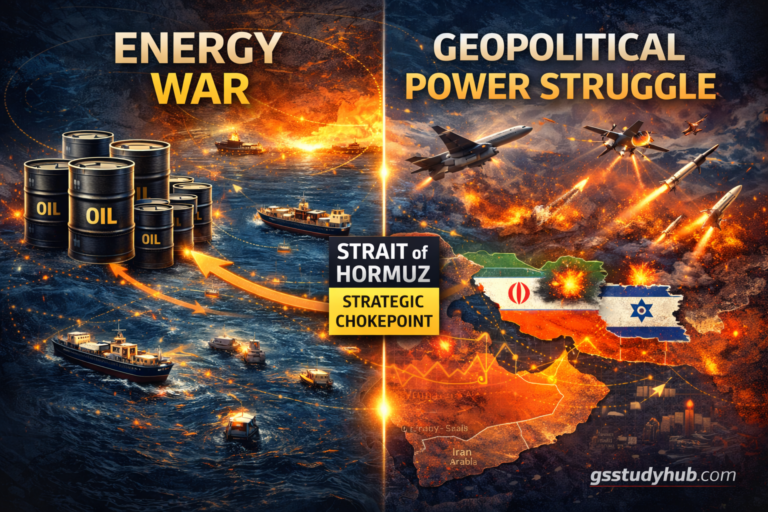
The Iran Israel conflict shows how energy routes like the Strait of Hormuz shape global geopolitics.The rising tension between Iran and Israel is not just a traditional military confrontation. Instead, it represents a complex struggle involving energy security, global trade routes, and geopolitical influence.
At the center of this crisis lies the Strait of Hormuz, one of the most strategically important maritime chokepoints in the world. Because nearly 20% of the world’s oil supply passes through this narrow waterway, control over this route provides enormous geopolitical leverage.
For this reason, the current crisis is increasingly being viewed as both an Energy War and a Geopolitical Power Struggle. Even without a full-scale military confrontation, the ability to threaten global energy supply gives regional actors a powerful strategic advantage.
In simple terms, the conflict between Iran and Israel goes far beyond military operations. It is part of a larger geopolitical contest where energy routes, global markets, and strategic maritime chokepoints play a decisive role. Among them, the Strait of Hormuz has emerged as the most powerful strategic weapon in the crisis.
Conclusion Analysis: gsstudyhub.com
To understand the deeper geopolitical dynamics shaping the Middle East, read our full analysis: Middle East Geopolitics 2026: Power Struggle, Oil Politics and Global Power Game