
Introduction to the Geography of India: My Story and India’s Landscape
The Geography of India is not just about maps, mountains, and rivers — it is a living story written across deserts, plains, and monsoon skies. I was born and raised in the dry yet soulful landscapes of Jhunjhunu, Rajasthan — a region where the earth meets the sky in a golden horizon of sand and wind. The smell of rain on parched soil and the sound of desert winds whispering through the khejri trees were my first lessons in the Geography of India long before I ever opened a textbook. For me, geography was not merely an academic subject; it was an experience shaped by nature itself.
A Rainy Morning and the Living Geography of India
I still remember that monsoon morning vividly. The sky was heavy with clouds, and the air carried the scent of relief after months of desert heat. As the first drops of rain touched the sand, tiny ripples formed in the village pond. In that simple transformation, I witnessed the power of the Geography of India — how climate patterns, seasonal winds, and landforms shape everyday life. The barren fields slowly turned alive, proving that geography is not only about physical features but also about survival, resilience, and renewal.
Educational Journey into the Physical Geography of India
As my academic journey progressed, my interest in the Geography of India deepened. I began studying the Thar Desert ecosystem, rainfall distribution, soil types, and environmental sustainability. The physical geography of India — from the Himalayas to the coastal plains — revealed how interconnected natural systems influence agriculture, economy, and settlement patterns. Rivers sustain civilizations, mountains protect borders, and the monsoon drives food security. Through field observations and classroom learning, I understood that the Geography of India forms the backbone of our social and economic structure.
Purpose of This Introduction to the Geography of India
This article presents an Introduction to the Geography of India not merely as factual information, but as a meaningful narrative. Readers will explore India’s physical divisions, river systems, monsoon mechanism, biodiversity, and the economic significance of geographical features. The goal is to help students and aspirants preparing for competitive exams understand the Geography of India conceptually and emotionally — as a dynamic force that shapes culture, livelihoods, and national development.
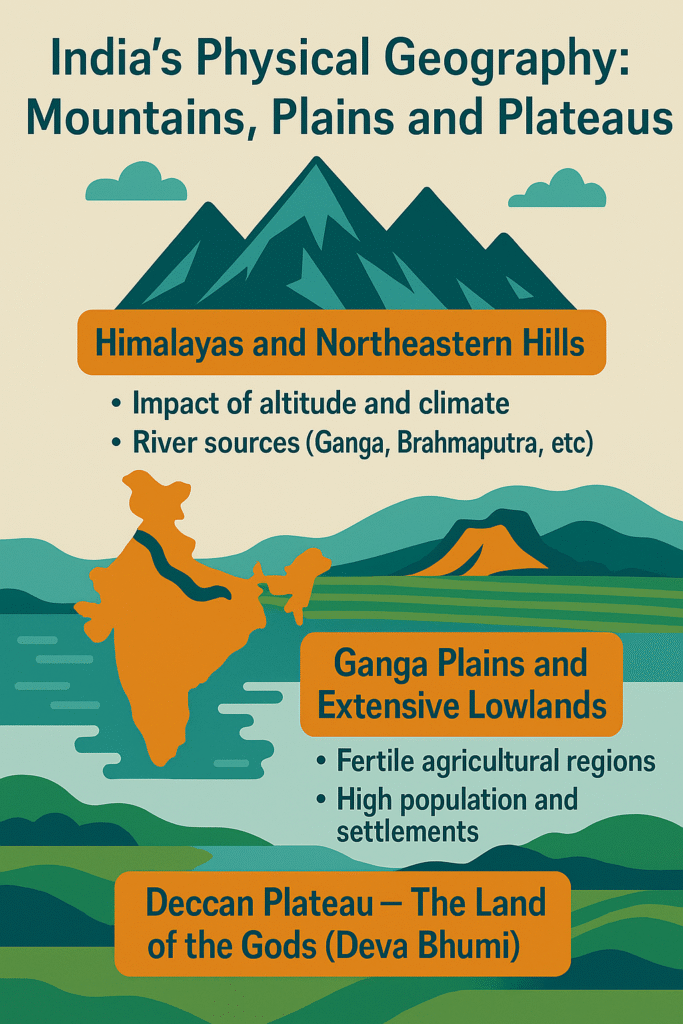
Physical Geography of India: Mountains, Plains, and Plateaus Explained
The Geography of India becomes truly meaningful when we explore its physical divisions. India is not a single stretch of uniform land; it is a diverse combination of mountains, plains, plateaus, deserts, and coastal regions. From the snow-covered Himalayas in the north to the ancient Deccan Plateau in the south, the physical geography of India shapes climate, agriculture, economy, and settlement patterns.
The Himalayas in the Geography of India
The Himalayas form the northern boundary of the Geography of India and stretch over 2,400 kilometers. These young fold mountains act as a natural barrier, protecting the Indian subcontinent from cold Central Asian winds and influencing the monsoon system. Major rivers like the Ganga, Yamuna, and Brahmaputra originate from the Himalayan glaciers, making this region the backbone of India’s river system.
The Himalayas are not only significant geographically but also strategically and environmentally important. They regulate climate, support biodiversity, and influence rainfall patterns across northern India.
Key Features of the Himalayan Region
- Three parallel ranges — Himadri (Greater Himalayas), Himachal (Lesser Himalayas), and Shiwalik (Outer Himalayas).
- Source of major perennial rivers — Ganga, Indus, Brahmaputra.
- Extensive glacial systems affecting monsoon and water supply.
- Rich biodiversity and forest cover.
The Northern Plains and Their Role in the Geography of India
The Northern Plains are among the most fertile regions in the Geography of India. Formed by the alluvial deposits of the Indus, Ganga, and Brahmaputra rivers, these plains stretch across Punjab, Haryana, Uttar Pradesh, Bihar, and West Bengal. This region supports intensive agriculture and is one of the most densely populated areas in the world.
The Indo-Gangetic Plains are often referred to as the cradle of Indian civilization because ancient settlements flourished along these riverbanks. The flat terrain, fertile soil, and irrigation facilities make this region the agricultural heartland of India.
Major Characteristics of the Northern Plains
- Extremely fertile alluvial soil.
- High population density and urban development.
- Strong irrigation and transportation networks.
- Major contributor to India’s food grain production.
The Peninsular Plateau in the Physical Geography of India
The Peninsular Plateau represents the oldest landmass in the Geography of India. Composed mainly of igneous and metamorphic rocks, this triangular plateau covers central and southern India. It includes the Deccan Plateau, Malwa Plateau, and Chotanagpur Plateau.
This region is extremely rich in mineral resources such as iron ore, coal, manganese, and bauxite, making it crucial for India’s industrial development. Rivers like the Godavari, Krishna, Narmada, and Tapi flow across this plateau, contributing to irrigation and hydroelectric power generation.
Distinctive Features of the Peninsular Plateau
- Ancient geological structure with stable landmass.
- Divided into Central Highlands and Deccan Plateau.
- Rich mineral deposits supporting industries.
- Seasonal rivers with significant hydroelectric potential.
Physical Unity in the Geography of India
The physical geography of India shows remarkable unity in diversity. The Himalayas provide water resources, the Northern Plains sustain agriculture, and the Peninsular Plateau supplies minerals and energy. Together, these regions create an interconnected system that defines India’s environmental balance and economic stability. Understanding the Geography of India is therefore essential for students preparing for UPSC, State PSC, and other competitive examinations.
Rivers, Climate, and Monsoon: The Lifelines of India
The rivers of India are not merely streams of water — they are the lifelines of civilization, the veins through which the nation breathes. They nurture the soil, sustain agriculture, and inspire countless traditions. Growing up in the arid landscapes of Jhunjhunu, Rajasthan, I often imagined rivers as distant miracles — symbols of abundance in a world of scarcity. To me, water was not just an element, it was hope flowing through the veins of the earth.
Major Rivers of India: The Journey of Water
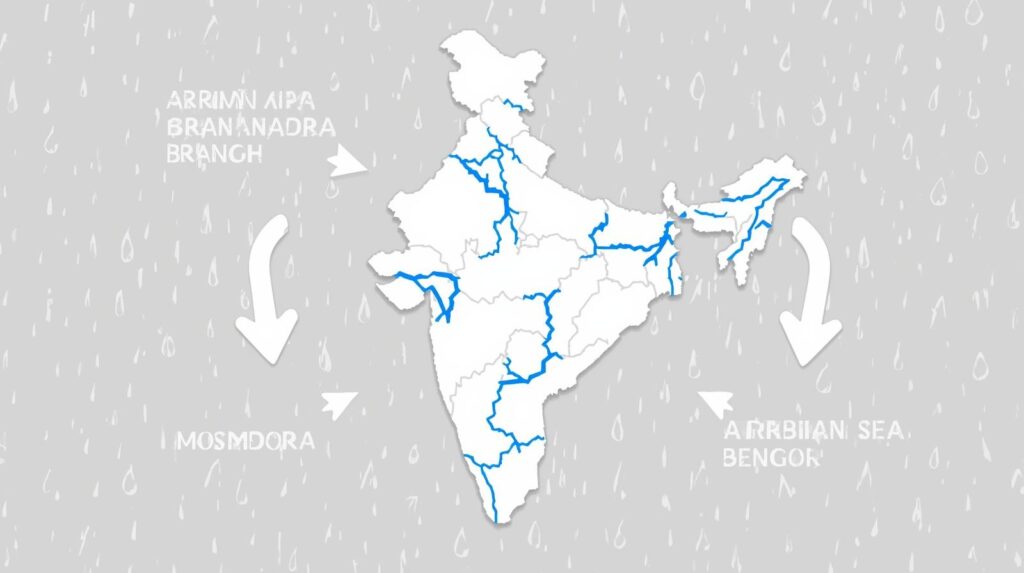
India is rightly called the “Land of Rivers.” Every direction — north to south, east to west — tells a different story of flowing water. In the north, mighty rivers such as the Ganga, Yamuna, Indus, and Brahmaputra originate from the Himalayas. In the south, rivers like the Godavari, Krishna, Narmada, and Kaveri breathe life into the Deccan Plateau and the coastal plains.
The Ganga River is not only a geographical wonder but also a spiritual symbol of purity and continuity. When I visited the ghats of Varanasi, I realized that the river is more than a waterway — it is the very soul of India, carrying stories, prayers, and livelihoods on its timeless waves.
Major River Systems and Their Features
- Ganga-Yamuna System: The heart of northern India, providing fertile plains and supporting dense agriculture.
- Indus System: The ancient cradle of the Indus Valley Civilization, still vital for the northwestern states.
- Brahmaputra System: The powerful river of the northeast, rich in water flow and biodiversity.
- Southern Rivers: Godavari, Krishna, Narmada, and Kaveri — essential for irrigation and hydropower in peninsular India.
India’s Climate: Unity in Diversity
India’s climate is as diverse as its geography. From the scorching heat of the Thar Desert to the icy winds of the Himalayas, every region tells a different weather story. When I used to watch the shimmering mirage over Jhunjhunu’s dunes, it was hard to imagine that at the same moment, snow might be falling in Himachal. This contrast is what makes India’s climate so fascinating — one nation, many seasons.
Broadly, India experiences four main seasons — summer, monsoon, autumn, and winter — each influencing not only the environment but also agriculture, economy, and cultural rhythms. This dynamic climate system defines India’s natural identity and its human resilience.
Major Climatic Zones
- Tropical Monsoon Climate: Found in southern and central India, characterized by distinct wet and dry seasons.
- Temperate Climate: Found in northern mountain regions.
- Arid and Semi-Arid Climate: Covers western India including Rajasthan and Gujarat.
- Humid Climate: Dominates coastal and northeastern regions.
The Indian Monsoon: The Pulse of the Nation
If one word could define India’s geography, it would be “Monsoon.” The monsoon is not just a weather phenomenon — it is the heartbeat of India. Farmers wait for it, rivers depend on it, and entire communities celebrate its arrival. Its rhythm dictates the nation’s agricultural cycle and, in many ways, the nation’s happiness itself.
I still remember my childhood in Jhunjhunu when the first raindrops of the season fell on the dry ground. The earthy fragrance filled the air, and children sang songs of joy, dancing in the rain. Back then, I didn’t know it was the result of winds traveling thousands of kilometers from the Arabian Sea — but I understood its magic. That moment taught me that the monsoon is not just science, it is emotion.
Types and Impact of Monsoon
- South-West Monsoon: Blows from June to September, bringing rain to most parts of India.
- North-East Monsoon: Occurs from October to December, mainly affecting Tamil Nadu and southeastern coasts.
- Impact: Determines crop success, water availability, hydropower generation, and the overall economy.
Climate Change and Emerging Challenges
Today, climate change is altering the patterns of rainfall, temperature, and river flow across India. Droughts are becoming longer, floods more frequent, and seasons increasingly unpredictable. As someone who has witnessed both extremes — drought in Rajasthan and floods in eastern India — I realize how urgent it is to balance progress with preservation.
The Need for Balance
Rivers, monsoon, and climate together form the ecological foundation of India. If any one of these falls out of balance, the entire system suffers. It is our collective responsibility to protect this equilibrium through sustainable water management, afforestation, and respect for traditional wisdom.
Ecology and Natural Resources: The Lifeforce of India
India’s geography is not just about mountains, plains, and rivers — it is a living web of ecosystems, species, and natural resources. Forests, wildlife, coastal habitats, and minerals form the foundation of this vibrant land. Growing up in the semi-arid lands of Jhunjhunu, Rajasthan, I learned how even limited rainfall could nurture life when nature and people worked in balance. That observation shaped my understanding of India’s ecological strength.
Forests and Biodiversity: The Living Library of India
India is one of the world’s biodiversity hotspots. From the evergreen forests of the Western Ghats to the tropical jungles of the northeast and the dry scrublands of Rajasthan, every region tells a unique ecological story. When I walked through the misty forests of the Western Ghats, I felt that each breath carried a lesson — about interdependence, patience, and resilience. Local communities here live in harmony with nature, protecting it as a sacred responsibility.
Major Ecological Regions
- Mountain Forest Zones: The Himalayas and their valleys, rich in coniferous forests and wildlife habitats.
- Tropical Rainforests: Found in the Western Ghats and Northeastern India, home to countless endemic species.
- Arid and Semi-Arid Regions: The Thar Desert and western India, where vegetation has adapted to extreme dryness.
- Coastal and Lagoon Systems: The mangroves, deltas, and estuaries — crucial for fisheries and coastal protection.
Natural Resources: Minerals, Soil, and Water
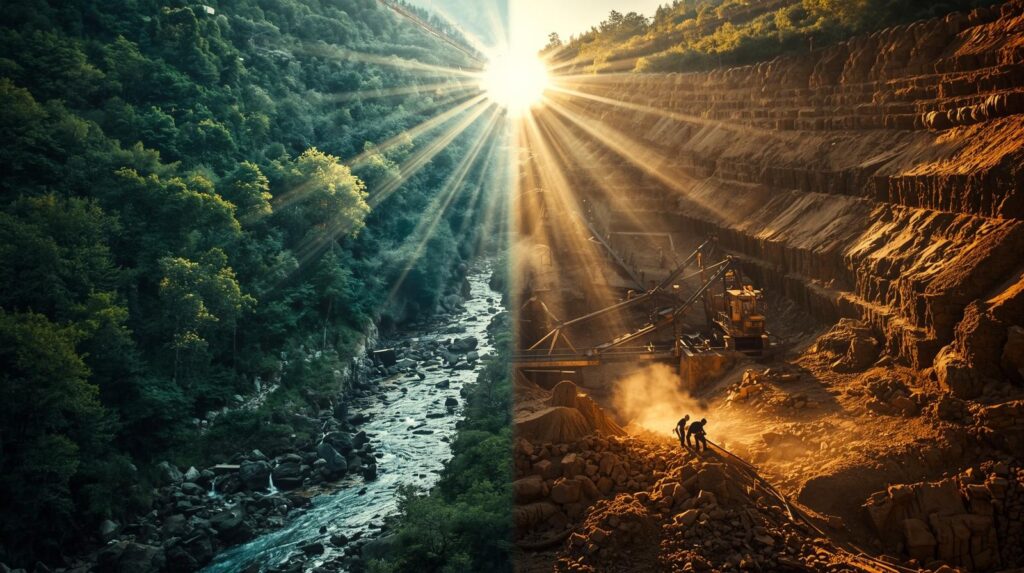
The Deccan Plateau is India’s geological treasure chest — rich in iron, coal, bauxite, and other minerals. When I visited a mining area in central India, I saw how resources can create both prosperity and responsibility. Extraction must go hand in hand with conservation and rehabilitation. The type of soil, the depth of groundwater, and the availability of surface water directly determine agricultural productivity and the livelihoods of millions.
Socio-Economic Dimensions of Resources
- Mining creates jobs and fuels industry, but also demands strict environmental regulation.
- Water resources — rivers, canals, ponds, and groundwater — sustain rural and urban life alike.
- Soil fertility and traditional farming practices promote sustainable use of land.
Traditional Wisdom and Local Conservation Practices
During my travels, I encountered numerous examples of community-based conservation — ancient wells, step ponds, and traditional seed storage systems. These practices, passed down through generations, show that sustainability is not a modern invention; it is deeply rooted in India’s heritage. When modern science collaborates with this wisdom, it creates lasting solutions.
Best Practices I Observed
- Rainwater harvesting and small check dams for sustainable agriculture.
- Crop rotation and mixed farming to prevent soil degradation.
- Community-led forest management where locals make conservation decisions collectively.
Conservation Efforts and Challenges
India’s conservation journey is inspiring yet complex. National parks, biosphere reserves, and wildlife sanctuaries protect vast ecosystems, but threats still loom large — deforestation, falling groundwater levels, and climate change. In some drought-prone villages I visited, water scarcity had reshaped entire ways of life, forcing communities to migrate or adapt new methods of survival.
Key Environmental Challenges
- Deforestation and habitat loss due to unplanned urban expansion.
- Overuse of groundwater and declining water tables.
- Pollution and ecological damage from mining and industrial activities.
The Road Ahead: Sustainable Use and Community Participation
The future lies in empowering local communities, integrating traditional knowledge with modern science, and ensuring equitable use of natural resources. I have seen how villages that manage their forests and water collectively achieve both ecological balance and economic security. Sustainable growth is not about control — it is about cooperation between humanity and nature.
Practical Recommendations
- Implement localized water management — rainwater harvesting and restoration of small water bodies.
- Promote community forest rights and local monitoring systems.
- Enforce stricter environmental standards for mining and industrial projects.
- Educate and engage citizens through environmental awareness in schools and institutions.
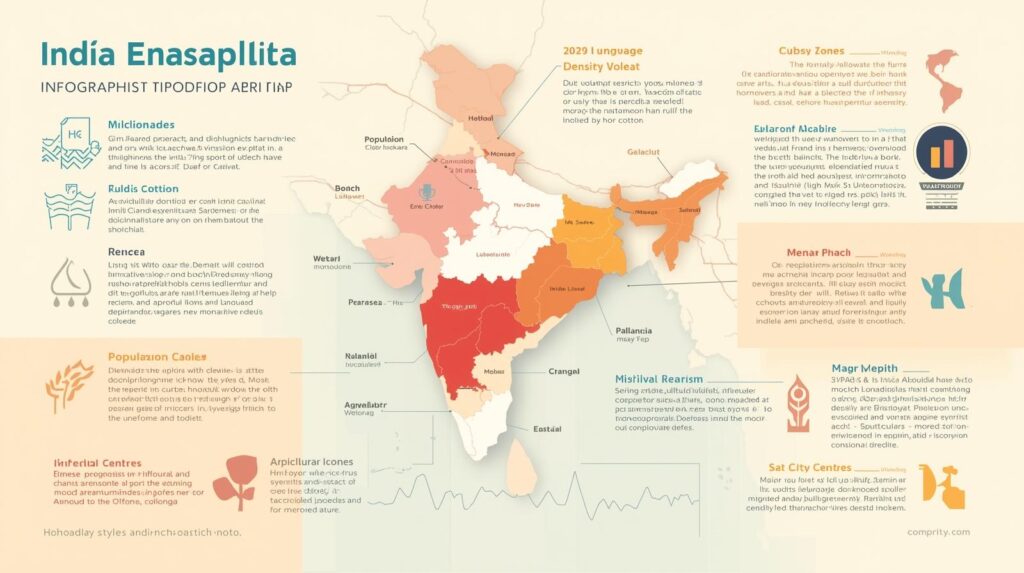
Human Geography: Population, Language, Agriculture, and Economic Impact
India’s geography is not limited to mountains, rivers, and plains — it is the story of people and their relationship with nature. Human geography acts as a bridge that connects the physical environment with society, culture, and the economy. Growing up in the rural landscapes of Jhunjhunu, I witnessed how farmers survived harsh droughts and still managed to rebuild their lives. That resilience showed me how deeply humans are connected with the land they live on.
Population: Unity in Diversity
India is the world’s second-most populous country, home to more than 1.4 billion people. Yet, the real beauty of this population lies in its diversity. From north to south and east to west, every region speaks a different language, follows unique customs, and practices distinct traditions — and together, they form the heart of India’s unity in diversity.
The distribution of population is uneven. Northern and coastal regions are densely populated, while deserts of Rajasthan, the Himalayas, and certain northeastern areas remain sparsely inhabited. This variation is directly linked to geography — where water, fertile soil, and resources are abundant, human settlements flourish.
Key Features of India’s Population
- Uneven population density — the Ganga Plains are the most densely populated.
- High proportion of youth — a potential demographic advantage.
- Predominantly rural population — about 65% still live in villages.
- Rapid urbanization — especially in metropolitan cities.
Language and Culture: The Soul of Geography
Languages in India are like rivers — each flowing in its own direction, yet all nourished by the same soil. The country officially recognizes 22 major languages and hundreds of dialects. Hindi is widely spoken in the north, Punjabi in Punjab, Tamil and Telugu in the south, and Assamese and Manipuri in the northeast.
Geography has deeply influenced these linguistic and cultural patterns — mountain regions developed isolated dialects, coastal areas evolved sea-linked lifestyles, and plains nurtured a blend of multiple traditions. This diversity forms the essence of India’s cultural identity — “Unity in Diversity.”
Geographical Influence on Culture
- Mountain regions preserve folk music, woolen clothing, and local traditions.
- Plains celebrate agricultural festivals such as Makar Sankranti and Baisakhi.
- Coastal zones emphasize fishing, boat-making, and maritime culture.
- Desert regions foster folk dances, puppet art, and colorful attire.
Agriculture: The Backbone of Life and Economy
About 60% of India’s population still depends on agriculture for livelihood. Farming here is not just an occupation — it is a way of life. Every season, crop, and festival has a direct connection with geography. In semi-arid regions like Jhunjhunu, I observed how farmers use innovation to survive water scarcity — through drip irrigation, rainwater harvesting, and crop diversification.
India’s agriculture is as diverse as its terrain. Wheat, rice, and maize dominate the northern and eastern regions, while cash crops such as cotton, sugarcane, and spices thrive in the west and south. This diversity is shaped by climate, soil type, and local resources.
Major Agricultural Regions
- North India: Wheat, sugarcane, pulses.
- East India: Rice and jute.
- South India: Rice, coffee, spices, and coconut.
- West India: Cotton, groundnut, and oilseeds.
Economy and Industrial Impact
Geography plays a vital role in shaping India’s economy. Mineral-rich states like Jharkhand, Odisha, and Chhattisgarh have become industrial hubs, while coastal states such as Maharashtra, Gujarat, and Tamil Nadu thrive in trade and shipping. The link between physical geography and economic activity is undeniable.
Rural regions rely on agriculture and agro-based industries, while cities focus on technology, manufacturing, and services. Geography influences not only where people live but also how they earn and evolve economically.
Geographical Aspects of Economic Development
- Industrial growth in resource-rich regions.
- Coastal zones drive export, import, and maritime trade.
- Mountainous regions promote tourism and hydropower generation.
- Desert and arid regions explore solar and wind energy potential.
Balancing Humanity and Geography
Human geography teaches us that true development is sustainable only when it aligns with nature. Rapid urbanization, industrialization, and population pressure have created challenges that require balance. Every time I return to my village and see farmers working the soil, I am reminded that the land is not just an economic asset — it is a living mother that sustains us all.
Suggestions for Sustainable Development
- Plan regional development based on local resources and geography.
- Encourage balance between modern technology and traditional farming methods.
- Ensure green zones and efficient water drainage in expanding urban areas.
- Promote awareness about human geography and environmental harmony through education.
Challenges and Conservation in the Geography of India: A Sustainable Vision
The Geography of India is vast, diverse, and dynamic. However, this diversity also brings significant environmental and geographical challenges. From the fragile Himalayan ecosystem to the drought-prone regions of Rajasthan, and from densely populated urban centers to shrinking forests, the Geography of India today faces critical pressures that demand urgent attention.
Major Environmental Challenges in the Geography of India
While studying and traveling across different regions, I realized that the Geography of India is deeply interconnected with climate, water resources, and human activity. The melting Himalayan glaciers signal climate change, irregular monsoon patterns disrupt agriculture, and groundwater depletion threatens rural livelihoods. These challenges are not isolated — they directly impact India’s economy, food security, and social stability.
Key Geographical Challenges of India
- Climate Change: Increasing irregular rainfall, extreme droughts, floods, and rising temperatures.
- Deforestation: Rapid urbanization and industrial growth reducing forest cover and biodiversity.
- Soil Degradation: Overexploitation, erosion, and excessive chemical usage harming agricultural productivity.
- Water Crisis: Declining groundwater levels and drying rivers, lakes, and reservoirs.
- Pollution: Growing air, water, and soil pollution in major cities and industrial regions.
Conservation Efforts Strengthening the Geography of India
To protect the Geography of India, several national and community-driven initiatives have been launched. Programs such as Swachh Bharat Abhiyan, Namami Gange Mission, and the National Forest Policy aim to restore ecological balance and promote sustainable development. Environmental education and local participation are increasingly becoming central to conservation strategies.
Inspirational Conservation Examples
- Oran Sacred Forests of Rajasthan: Community-protected forests preserving biodiversity for generations.
- Kerala’s Community Water Management: Restoration of ponds and canals through local participation.
- The Chipko Movement (Uttarakhand): A historic environmental movement protecting forests through peaceful resistance.
- Biodiversity Parks in Northeast India: Integrating conservation with education and eco-tourism.
The Future of the Geography of India: Sustainable Development
The future of the Geography of India depends on sustainable planning and responsible citizenship. Development must balance economic growth with environmental protection. Renewable energy adoption, water conservation, afforestation, and scientific land-use planning are essential to preserve India’s geographical stability.
I witnessed this transformation firsthand when a rainwater harvesting initiative was introduced in my village. Over time, groundwater levels improved, agriculture revived, and the community regained confidence. That experience proved that protecting the Geography of India begins with small, determined local actions.
Three Essential Actions for Every Citizen
- Conserve Natural Resources: Practice rainwater harvesting, reduce waste, and promote renewable energy.
- Participate in Environmental Programs: Join plantation drives and local conservation initiatives.
- Spread Awareness: Educate students and communities about the importance of the Geography of India and sustainability.
Inspirational Conclusion on the Geography of India
The Geography of India is not just a physical framework of mountains, rivers, and plains — it is the foundation of our civilization, economy, and identity. If we respect and protect this land, it will continue to nurture future generations. Understanding the Geography of India is therefore not only essential for academic success in UPSC and competitive exams, but also for responsible citizenship.
“Nature gives us life, and true progress comes only when we preserve it.” This timeless principle reflects the real lesson of the Geography of India.
Call to Action: Protect the Geography of India
If you are reading this, take a meaningful step today. Plant a tree, conserve water, reduce pollution, or spread environmental awareness. Every small effort contributes to protecting the Geography of India and securing a sustainable future.
Because lasting change begins with one responsible individual — and that individual can be you.