
Introduction
In the long timeline of human civilization, there are a few chapters that never lose their brilliance — one such remarkable chapter is the Indus Valley Civilization. It stands as a shining testimony to the intelligence, creativity, and organization of humankind thousands of years ago.
Flourishing roughly between 3300 BCE and 1300 BCE, this civilization spread across regions of present-day Pakistan and northwestern India. Its major cities — Harappa, Mohenjo-Daro, Lothal, and Dholavira — demonstrate remarkable examples of urban planning, advanced drainage systems, and well-structured governance, making it one of the most sophisticated societies of the ancient world.
I still remember the first time I learned about the Indus Valley Civilization during a school exhibition. The sight of ancient pottery and seals sparked a deep question within me — “How could people thousands of years ago build such advanced cities?” That moment planted the seed of curiosity about history in my mind, which later grew through my university studies in archaeology and culture.
The purpose of this article is not merely to restate historical facts, but to feel the spirit of that civilization — to explore the lives, thoughts, and values of its people. The Indus Valley Civilization is not just a chapter from the past; it is a foundation stone of modern human development and social organization.
Historical Background
The Indus Valley Civilization is one of the earliest known urban civilizations in the world. It originated around 3300 BCE and reached its mature phase between 2600 and 1900 BCE, flourishing across large parts of present-day Pakistan and northwestern India.
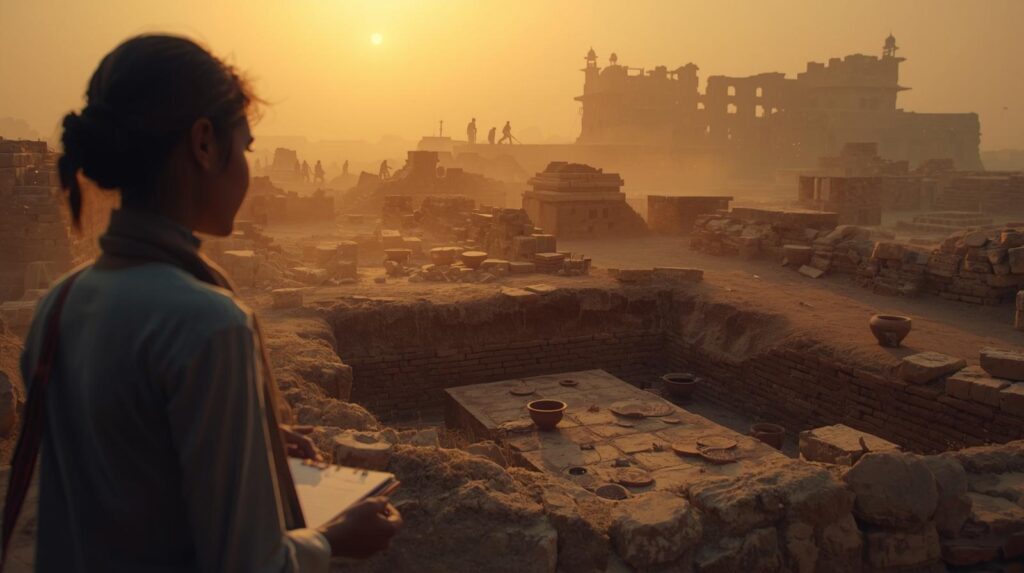
The civilization was first discovered in the 1920s when archaeologists such as R.D. Banerjee and Sir John Marshall excavated sites like Mohenjo-Daro and Harappa. These discoveries proved that an advanced and well-organized urban culture existed in the Indian subcontinent long before many other ancient societies.
Historians categorize the civilization into three major phases — the Early Harappan, Mature Harappan, and Late Harappan periods. Through these stages, one can trace the rise, development, and eventual decline of the civilization.
The meticulous town planning, uniform brick sizes, and advanced drainage systems of Harappa and Mohenjo-Daro reflect a strong administrative control and a deep understanding of urban engineering. The Indus Valley Civilization thus laid the foundation for organized human settlement, trade, and technological progress.
Urban Planning and City Structure
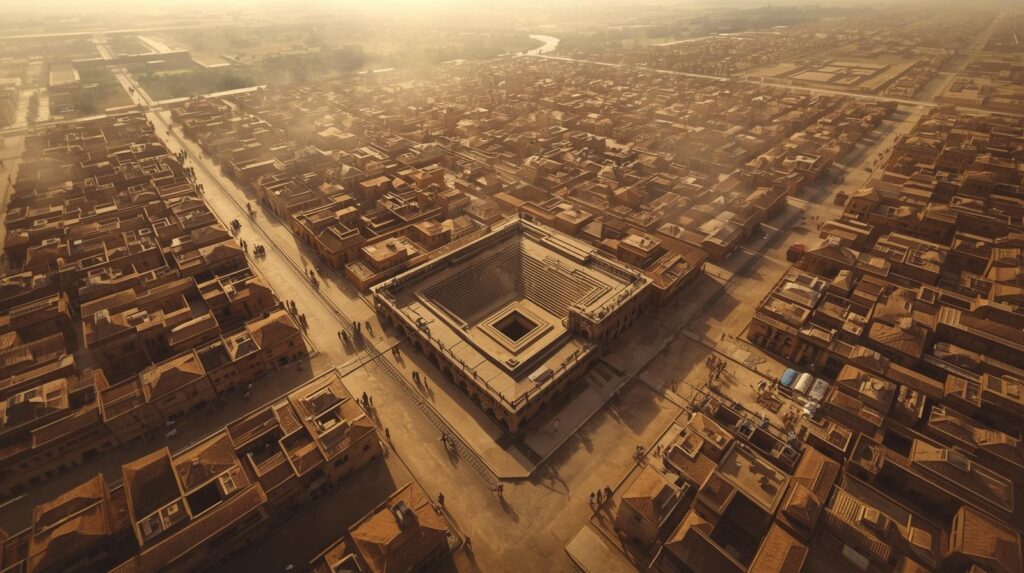
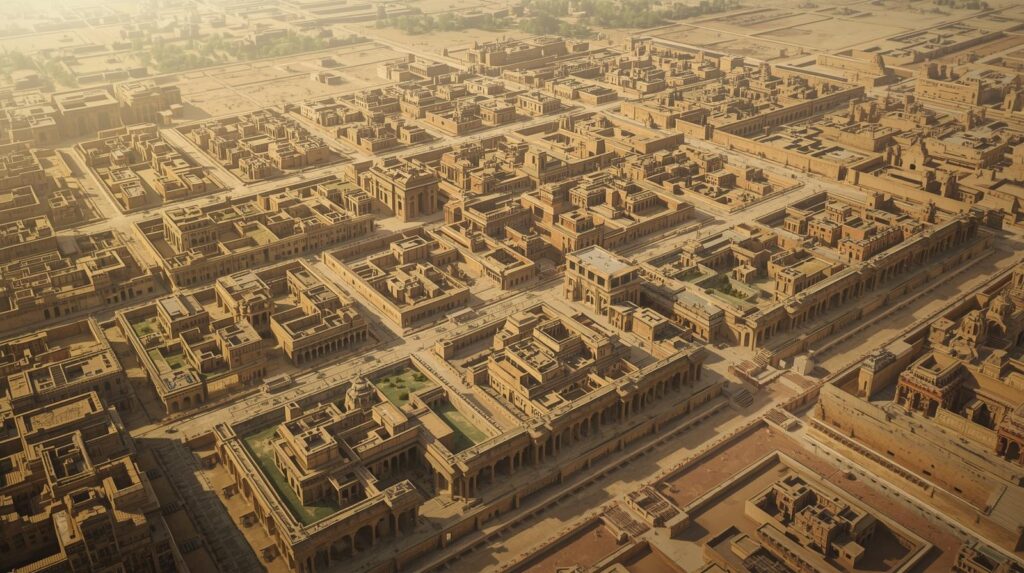
One of the most remarkable aspects of the Indus Valley Civilization was its advanced urban planning. Nearly five thousand years ago, the people of this civilization built cities that rival the design and organization of modern urban centers.
Cities like Harappa and Mohenjo-Daro were laid out on a grid pattern — streets intersected each other at right angles, forming well-structured blocks. Main roads were as wide as 30 feet, lined with systematically built houses. The houses were made from uniformly sized baked bricks, ensuring both strength and aesthetic consistency.
Each household was connected to an underground drainage system, which linked to the main city drains. This system was so advanced that rainwater and household waste were channelled separately — a sign of the people’s scientific understanding and concern for sanitation.
The cities also had public baths, granaries, and market areas built in a planned manner. This indicates the presence of a central administrative authority or an urban governing body responsible for maintaining order and infrastructure.
Society and Economy
The people of the Indus Valley Civilization lived a highly organized and practical life. Their society functioned smoothly, where every individual contributed — whether as a farmer, craftsman, or trader. The cities were not just places of residence but active centers of economic production and exchange.
Agriculture formed the backbone of the Indus economy. Crops such as barley, wheat, cotton, and gram were cultivated using irrigation from canals and wells. This reflects their advanced understanding of agricultural engineering. Animal husbandry was equally significant — they domesticated cattle, bulls, sheep, goats, and camels.
The craftsmanship of the Indus people was exceptional. They produced pottery, metal tools, seals, and ornaments with great skill. Artifacts made of copper, bronze, and gold indicate a high level of metallurgical expertise.
The Indus Valley Civilization was largely self-sufficient but also engaged in external trade. Archaeological findings show commercial relations with Mesopotamia, evident from seals and ship depictions. Commodities such as textiles, metals, grains, and beads were traded extensively.
Interestingly, no clear evidence of social inequality or conflict has been found. This suggests that the Indus society was based on equality, cooperation, and shared responsibility — perhaps one of the key reasons behind its long-lasting stability.
Religion and Script
The religious beliefs of the Indus Valley Civilization were closely connected to nature and fertility. Rather than being centered on a single god or scripture, their faith appears to have revolved around natural forces and symbols of life and growth.
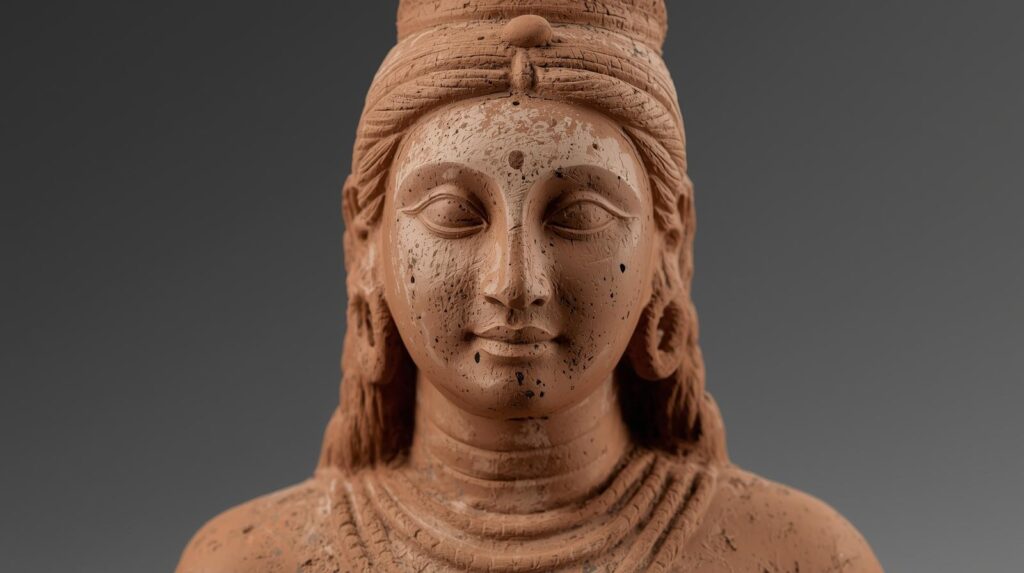
Excavations have revealed numerous terracotta figurines and seals that suggest the worship of a Mother Goddess or fertility deity. Female figurines with prominent features reflect the concept of the “Mother Earth” — the giver of life. Animal motifs, particularly bulls and the unicorn-like creature, were likely used as sacred symbols.
The Great Bath of Mohenjo-Daro is considered a religious or ritualistic structure. It is believed that it was used for ritual purification or community bathing, symbolizing both social harmony and spiritual cleanliness.
The Indus Script remains one of the world’s most intriguing undeciphered writings. Comprising more than 400 unique symbols, the script was inscribed on seals, pottery, and tablets. Scholars believe it may contain records related to trade, administration, and religious rituals.
These inscriptions reveal that the Indus people possessed a structured system of writing — not merely a communication tool but also an identity marker and a means of documentation in economic life.
Trade, Technology & Craftsmanship
The Indus Valley Civilization was remarkably advanced in trade, technology, and craftsmanship. It was not only self-sufficient but also maintained active trade relations with distant regions. Artifacts unearthed from excavation sites confirm a wide network of commercial exchange.
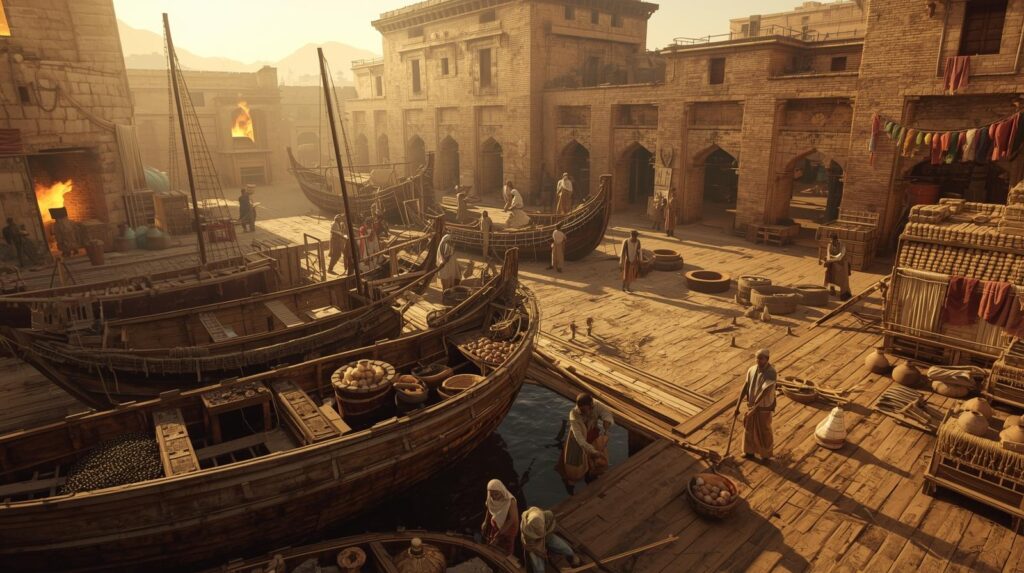
There is strong evidence of trade with Mesopotamia through both land and sea routes. Cities like Lothal served as major port towns, featuring dockyards and warehouse structures that illustrate advanced knowledge of navigation and maritime trade. Commodities such as beads, metals, precious stones, cotton textiles, and grains were exported from these regions.
Technologically, the civilization was far ahead of its time. The use of standardized baked bricks, well-planned drainage systems, and expertise in metal casting demonstrate their engineering brilliance. They were skilled in alloying copper, bronze, lead, and tin to create tools, figurines, and ornaments.
In the realm of craftsmanship, the Indus people were true artisans. Their pottery, seals, and terracotta figurines reflect artistic expression and aesthetic sensibility. The animal motifs and symbols engraved on their seals served not only as trade identifiers but also as cultural icons.
The craftsmen and technologists of the Indus Valley proved that human creativity knows no bounds. Their work continues to inspire us to this day, emphasizing that organization, innovation, and beauty together define a civilization’s greatness.
Decline and Theories
The decline of the Indus Valley Civilization remains one of history’s greatest mysteries. This civilization thrived for nearly seven centuries, yet its downfall was sudden and widespread. Scholars have proposed multiple theories to explain this decline.
1. Climate Change and Shifting River Courses
One of the most accepted theories attributes the decline to climate change and the drying or shifting of major rivers such as the Saraswati and Ghaggar-Hakra. Reduced rainfall and prolonged droughts led to the collapse of agriculture and forced people to abandon urban centers in favor of smaller rural settlements.
2. Natural Disasters
Archaeological evidence suggests that earthquakes and floods may have played a major role in the destruction of Indus cities. The remains at Mohenjo-Daro, for instance, indicate sudden flooding that might have devastated the settlement.
3. Economic Decline
The disruption of trade routes and depletion of resources gradually weakened the economy. Commercial activity slowed down, leading to the decline of industrial centers and urban prosperity.
4. The Aryan Invasion Theory
Early historians once believed that the Aryan invasion might have destroyed the civilization. However, modern research largely rejects this idea, suggesting instead that the decline was gradual, driven by environmental and social factors rather than violent conquest.
The fall of the Indus Valley Civilization was therefore not the result of a single catastrophe but a combination of natural, economic, and environmental challenges. Yet, its cultural and technological heritage continued to influence later civilizations in the Indian subcontinent.
Legacy and Modern Significance
The Indus Valley Civilization continues to influence the cultural, social, and scientific fabric of South Asia even today. Its legacy extends far beyond the ruins — shaping how we think, build, and live in the modern world.
The most remarkable contribution of the Indus Civilization was its urban planning. The ideas of straight streets, drainage systems, and public spaces laid the foundation for modern city planning. Many ancient and even contemporary Indian towns still reflect the same organizational principles.
The traditions of metallurgy, pottery, and craftsmanship that began in the Indus era continue to thrive in Indian art and culture. The jewelry, beads, and earthenware of Harappa still resonate with Indian aesthetics and creativity.
The civilization also emphasized cleanliness, equality, and organization — values that remain central to modern India. The concern for sanitation visible in Indus cities finds a modern echo in initiatives like the Swachh Bharat Mission.
Ultimately, the Indus Valley Civilization taught humanity that a balance of science, culture, and cooperation leads to true progress. Its spirit lives on — not merely in archaeological remains, but in our architecture, ethics, and imagination.
Personal Experiences & Lessons
Replace the bullet points below with your real memories — I will weave them into a narrative:
- First encounter with a Harappan seal at a school exhibition — [year/place]
- College project on pottery or urban drainage — [brief detail]
- Visit to an archaeology museum that left an impression — [museum name]
- Local stories or oral histories heard from elders — [example]
- Workshop or seminar where you learned a craft or method — [detail]
- A defining moment when history changed your perspective — [short note]
My first real connection with history began at a small school exhibition where I first saw a Harappan seal. The engraved animal on that tiny piece caught my attention — it made me wonder about identity and symbolism thousands of years ago. From that day I started treating artifacts not as 'old things' but as stories waiting to be read.
Later, a college research project on the drainage systems of Mohenjo-Daro gave me hands-on insight. Observing ancient drains and public baths convinced me that cleanliness and communal planning were integral values of that society — lessons that still resonate.
While standing in an archaeology museum, facing rows of pottery and seals, I felt a deep urge to connect the dots between objects and lives. Listening to elders recount local legends about ancient settlements further reinforced the continuity of culture and knowledge.
In a practical workshop where I tried making a clay seal myself, the process of shaping and imprinting taught me the patience and skill that the old craftsmen must have possessed. These personal moments remind me that history is meant to be experienced, not only studied.
Conclusion — Lessons for the Future
The Indus Valley Civilization is not merely a chapter of history but a living testament to human creativity, harmony, and collective wisdom. Its achievements in planning, art, technology, and social balance remind us that civilization is not measured by material wealth alone, but also by human values and cooperation.
When we imagine the streets of Harappa or Mohenjo-Daro, we do not just see bricks and structures — we witness human determination, discipline, and empathy. These ancient people, even without modern tools, built cities that were clean, sustainable, and well-organized — setting examples that modern societies still strive to achieve.
Through my own studies and reflections, I have realized that history becomes meaningful only when we attempt to learn from it. The story of the Indus Civilization reminds us that balance with nature, social harmony, and technological innovation are the three essential pillars of lasting progress.
In today’s world of rapid urbanization and environmental challenges, the lessons of this civilization are more relevant than ever. If we embrace their philosophy — “stability lies in balance” — we too can build a sustainable future, just as they did thousands of years ago.
In conclusion, the Indus Valley Civilization teaches us that while time changes, the power of values endures. Its true importance lies not only in the past but in how it continues to inspire our present and shape our future. It is not merely the story of a civilization — it is the story of the timeless triumph of the human spirit.
References and Further Reading
The following books, research papers, and online resources are considered essential for understanding the Indus Valley Civilization. They provide valuable insights into its history, culture, and discoveries.
- “The Indus Civilization” — Sir John Marshall, Archaeological Survey of India Reports.
- “The Archaeology of the Indus Valley” — Mortimer Wheeler, Cambridge University Press.
- “Ancient India: From the Earliest Times” — R.S. Sharma, National Book Trust of India.
- “The Lost River: On the Trail of the Saraswati” — Michel Danino, Penguin Books.
- Online Source: Harappa.com — Detailed studies, maps, and photo archives on the Indus Civilization.
- Online Source: Archaeological Survey of India (ASI) — Official excavation reports and heritage documentation.
These sources not only provide factual information but also inspire curiosity and a deeper appreciation for one of the world’s earliest urban cultures. Students, researchers, and enthusiasts are encouraged to explore these materials for further understanding.