

Introduction — My First Encounter with the Indian Constitution History
The First Glance: A Child's Curiosity
The Indian Constitution history is not just a legal timeline but a living journey that connects citizens to the foundations of democracy. My own engagement with the Indian Constitution history began in a small town where school bells, local festivals, and neighborhood conversations shaped everyday life. One of my earliest civic memories is hearing the opening lines of the Preamble — "We, the people of India..." — recited in assembly.
At first, those words felt ceremonial, almost ornamental. Yet they stirred a quiet curiosity: what did these ideals mean for someone like me, living daily life far from the halls of power? As a child, the Constitution seemed like a distant text — an official document discussed by teachers and elders. Only later did I begin to sense that it was more than paper; it was a guide to citizenship and collective responsibility.
A teacher's provocation
I still remember a schoolteacher asking our class: "Do these words change your life, or do you change their meaning through your actions?" Her question lingered in my mind. It pushed me to look beyond textbook definitions and ask how constitutional ideals could translate into daily choices — how a pledge on paper might become a lived practice in neighborhoods, markets, and classrooms.
For a more detailed explanation of structural elements such as federalism, parliamentary system, and fundamental rights, you can read our comprehensive guide on Features of the Indian Constitution .
From Textbook to Thought: Learning in College
In college, when I enrolled in political science and history courses, the Constitution moved from being a quoted preface to a living subject of study. Lectures on the Preamble, fundamental rights, and directive principles revealed how law functions as a social instrument. Through this deeper study, I began to appreciate how the Indian Constitution history reflects debates, compromises, and aspirations that shaped modern India.
Reading excerpts from constituent assembly debates made the drafting process feel less abstract and more human. Each clause carried both legal precision and moral intent, reflecting the framers' attempt to balance diversity with unity.
A formative classroom incident
During one seminar, our professor challenged us to translate constitutional clauses into plain language. The exercise produced surprisingly relatable sentences. A fellow student asked, "If ordinary people read this, will they truly understand their rights?" That moment convinced me that accessibility is central to constitutional effectiveness.
Constitution as a Moral Map
Over time, I came to see the Constitution as a moral map rather than merely a set of rules. The principles outlined in the Preamble — justice, liberty, equality, and fraternity — are not decorative phrases; they are commitments that guide governance and civic expectations.
This perspective shaped how I engaged with local civic life. Whether resolving community disputes or encouraging participation in Gram Sabha meetings, constitutional values provided a framework for fairness, dignity, and equal opportunity.
Bringing Constitutional Values to the Community
Motivated by this conviction, I worked on a college project to simplify constitutional provisions for local citizens. We created a short leaflet explaining key articles in simple language and distributed it at a village meeting. The questions people asked revealed a gap between constitutional text and everyday awareness — a gap that civic education can help bridge.
Awakening to Rights and Duties
The more I reflected, the clearer it became that rights and duties are interconnected. Rights empower individuals, but duties sustain the civic fabric that protects those rights. Observing community life reinforced the idea that constitutional principles must be practiced, not merely quoted.
These experiences shaped my understanding that the Indian Constitution history gains meaning only when citizens actively engage with its values. From childhood curiosity to community involvement, the journey revealed that constitutional ideals thrive through participation and awareness.
Summary — The Beginning of a Constitutional Journey
My early encounters with constitutional ideas laid the foundation for deeper exploration. In the next section, we will examine how colonial governance and political movements contributed to the broader narrative of the Indian Constitution history.

The Constituent Assembly and the Constitution-making Process
Formation of the Constituent Assembly (1946)
The Constituent Assembly was the crucible in which modern India's constitutional identity was forged. Elected in 1946 under the Cabinet Mission Plan, the Assembly brought together a remarkable range of voices — lawyers, social reformers, political leaders, and representatives of diverse regions and communities. Although not a product of a direct adult franchise, it nevertheless reflected the varied aspirations of a country on the brink of unprecedented change.
The first time I read the list of Assembly members, I felt a deep sense of awe. Names like Dr. B.R. Ambedkar, Jawaharlal Nehru, Sardar Patel, and Rajendra Prasad stood out, but so did lesser-known figures whose local knowledge and moral courage shaped vital debates. It was this mixture of national vision and local insight that, in my view, gave the Assembly its unique strength.
Key committees and working methods
The Assembly worked through committees — among them the Drafting Committee, the Union Powers Committee, and the Advisory Committee. The Drafting Committee, chaired by Dr. B.R. Ambedkar, played an especially pivotal role in translating philosophical ideals into workable legal text. The methodical, almost craftsman-like approach of these committees contrasted with the urgency of the times, but that balance between careful drafting and urgent action defined the process.
Major debates and difficult choices
The Constituent Assembly's sessions were not mere formalities; they were arenas of intense debate. Issues such as the nature of the federal structure, the balance between fundamental rights and directive principles, the role of religion in public life, and the language policy provoked passionate arguments. The trauma of Partition loomed large and influenced many of these debates, making the task of forging unity out of diversity both urgent and delicate.
Personally, when I read the recorded debates years later, I was struck by the dignity and patience with which leaders engaged one another. Even in disagreement, there was a persistent commitment to dialogue. This taught me a valuable lesson: constitution-making is as much about negotiating relationships and trust as about drafting clauses.
The role of minority rights and social justice
Social justice emerged as a central preoccupation. The Assembly confronted questions about caste disabilities, untouchability, and the socio-economic backwardness of many communities. Dr. Ambedkar's interventions, rooted in both moral conviction and legal scholarship, steered the Assembly towards provisions that sought to protect the marginalized and promote equality. The inclusion of fundamental rights and later the framing of reservation policies were direct outcomes of such sustained moral engagement.
Drafting the text: from ideals to clauses
Transforming lofty ideals into precise legal provisions required exceptional care. The Drafting Committee studied constitutions from around the world — borrowing elements from the Government of India Act, the British parliamentary model, the American Bill of Rights, and constitutions of several other countries. Yet the aim was not imitation; it was adaptation. The text had to resonate with India's social realities and administrative needs.
I remember participating in a seminar where a senior teacher explained how every phrase in the final draft had been weighed for its long-term implications. That insight stayed with me: words in a constitution do not merely regulate; they shape future expectations and institutional practices.
Public engagement and communication
While much of the drafting was a deliberative, inside-the-room process, public engagement mattered too. Debates and summaries were reported in newspapers; activists and community leaders brought local concerns to the attention of Assembly members. In later years, I took inspiration from that practice and tried to communicate constitutional ideas to students and local groups in plain language. Making the Constitution accessible was, for me, a continuation of the Assembly's democratic spirit.
Adoption, signatures, and the emotional moment
On 26th November 1949, the Assembly adopted the final text of the Constitution. The ceremonial signing by its members was more than a constitutional formality — it was an emotional affirmation of collective resolve. Rajendra Prasad, as President of the Assembly, presided over the occasion; K.M. Munshi read the Preamble aloud. The sense of a new political birth was palpable.
Reading firsthand accounts of that day, I often imagined the mixed feelings in the room: relief at the conclusion of a long labor, sorrow over partition's scars, and hope for a shared future. That complex emotional landscape reminds us that constitutions are born out of both reason and feeling.
summary — craft, contest, and consensus
The Constituent Assembly combined meticulous drafting with spirited debates to produce a text that sought to balance ideals and practical governance. The process was not without tension, but the commitment to deliberation, protection of rights, and inclusion of marginalized voices marked it as a foundational democratic exercise. In the next section, we will reflect on the role of key individuals — especially Dr. B.R. Ambedkar — and the philosophical underpinnings that shaped the Constitution's character.
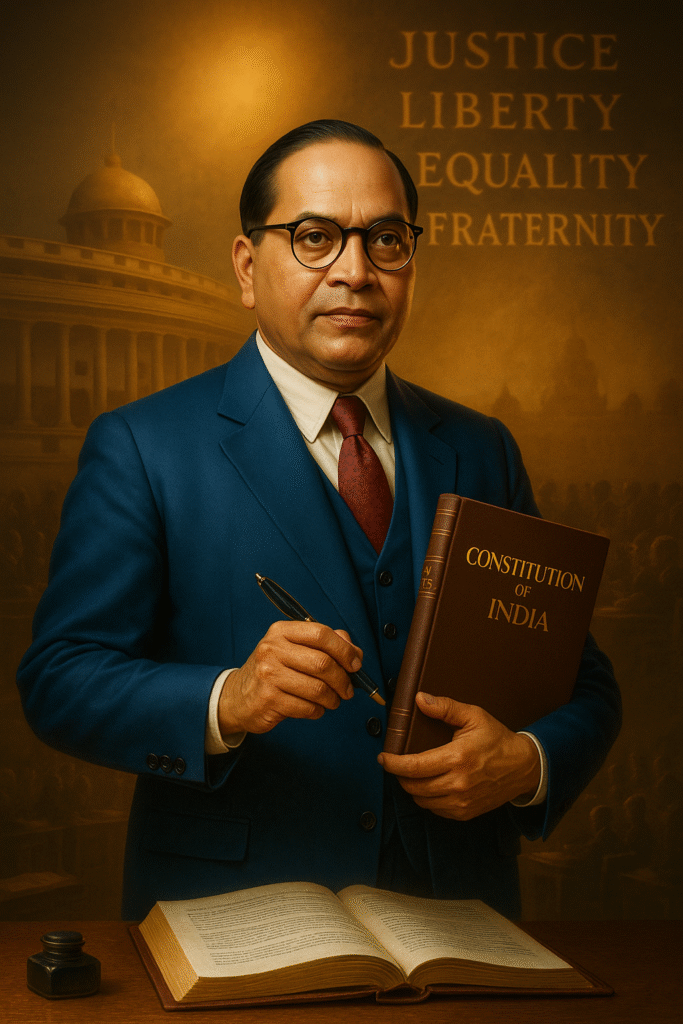
Dr. B.R. Ambedkar — The Architect of the Constitution
From Struggle to Resolve: Ambedkar's Life
Dr. Bhimrao Ramji Ambedkar's life was not merely a personal journey; it was a social revolution in motion. Born into a society riddled with exclusion, he transformed adversity into academic excellence and public service. His education abroad and his perseverance back home demonstrated how rigorous thought and relentless effort can challenge entrenched inequalities.
When I first read Ambedkar's biography, I was struck by the way his individual struggle became a collective aspiration. He did not limit himself to critique; he fashioned legal and institutional tools to dismantle social barriers. For me, Ambedkar embodies the conviction that law can be an instrument of social transformation.
A formative encounter
A college mentor once remarked, "Ambedkar did not simply draft laws; he converted the language of law into a weapon for social justice." That insight shaped my understanding of constitutionalism as inherently moral as well as technical.
Shaping the Text: From Principles to Provisions
As chair of the Drafting Committee, Ambedkar played a pivotal role in converting political ideals into precise constitutional clauses. He championed provisions that aimed at abolishing untouchability, guaranteeing fundamental rights, and fostering equality of opportunity. His priority was clear: the Constitution must protect the most vulnerable.
Many clauses that seek to correct historical injustices and ensure affirmative action bear his intellectual imprint. Ambedkar insisted that constitutional language should not only enshrine rights but also pave the path for substantive social change.
Technical mastery and moral conviction
What made Ambedkar extraordinary was his ability to combine rigorous legal scholarship with deep moral purpose. He extensively studied other constitutions and legal traditions, selecting and adapting elements appropriate to India's social realities. This combination of comparative insight and contextual sensitivity was central to his craft.
Speech and Philosophy: Justice, Liberty, and Equality
Ambedkar's speeches reveal a persistent commitment to social justice. He repeatedly emphasized that rights without access and opportunities are hollow. His rhetoric was grounded in legal reasoning, but it was always animated by human empathy and a demand for dignity.
Reading his recorded interventions in the Assembly, I felt the moral urgency in his words. He appealed not merely to legal logic but to the nation's conscience — a quality that continues to anchor constitutional debates today.
Precision in language
Ambedkar's drafting style was marked by precision and clarity. He weighed words carefully, aware that constitutional phrasing would shape institutions and expectations for generations. That attention to linguistic detail helped the Constitution endure and remain effective in practice.
Personal Impact: What Ambedkar Means to Me
To me, Ambedkar is not only a historical hero but an intellectual companion. His insistence on equal dignity and structural remedies informs my reflections whenever constitutional questions arise. I have organized discussions in my community around his ideas, and each conversation reaffirms his continuing relevance.
His life teaches that legal reform must be accompanied by social mobilization, education, and persistent advocacy. Ambedkar's blend of scholarship and activism remains a model for those who seek justice through institutional change.
An enduring imprint
If one were to name the moral spine of the Indian Constitution, Ambedkar's influence would stand at its center. He shaped the document not merely as a charter of governance but as a manifesto for social transformation. His legacy persists in constitutional principles, judicial reasoning, and public movements for equality.
Summary — Thinker, Craftsperson, and Guide
This section traced how Dr. B.R. Ambedkar combined personal struggle, academic rigor, and moral resolve to shape India's constitutional framework. He was a thinker who translated ideals into institutional design, a craftsperson who honed legal text with care, and a guide whose vision continues to inform India's pursuit of justice. In the next part, we will examine the formal enactment of the Constitution and the significance of January 26, 1950 — the day the document came into force.
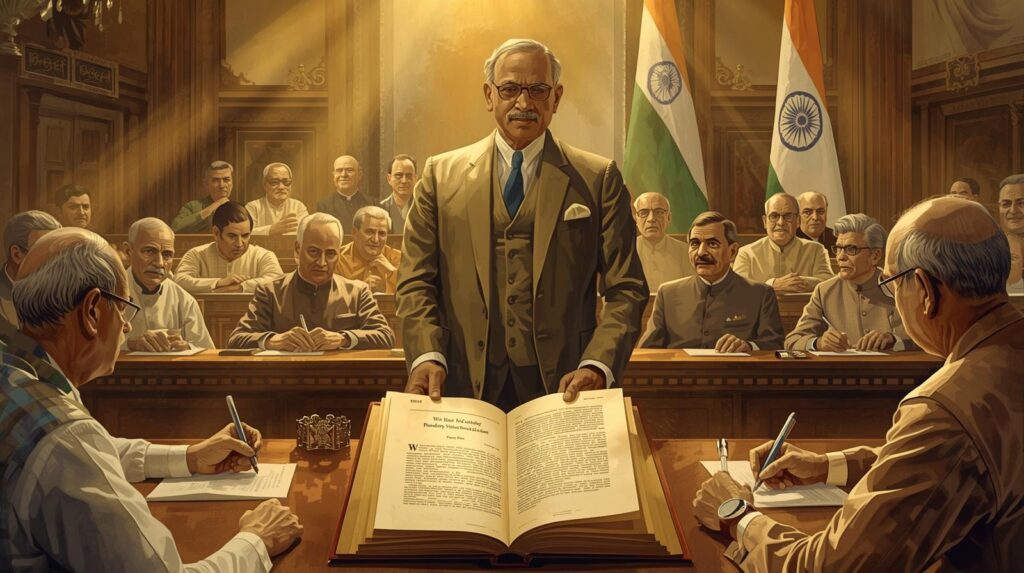
Adoption of the Constitution — The Birth of a New India
The Historic Day of Adoption — 26 November 1949
The Constituent Assembly adopted the final text of the Constitution on 26 November 1949. After years of deliberation, drafting, and debate, the adoption marked a formal pledge by representatives of India to a set of principles that would guide the nation. The act of adoption was not merely the passing of a document; it was a collective vow to uphold justice, liberty, equality, and fraternity.
The atmosphere in the Assembly
Contemporary accounts describe the Assembly on that day as tense and solemn, a room full of relief and resolve. The shadow of Partition still lingered, but for the members present, adoption signified a chance for reconstruction and collective renewal. Leaders like Jawaharlal Nehru, Dr. Rajendra Prasad, and many others spoke with a mix of gravity and hope, acknowledging the enormous task ahead.
The Preamble Read Aloud — Symbolism and Substance
The Preamble was read in the Assembly as the summarizing statement of the Constitution's purpose — “We, the people of India...” These opening words enshrined the ideals the nation sought to realize: justice, liberty, equality and fraternity. The Preamble served as both a moral compass and a symbolic assertion of a new democratic identity for India.
What the Preamble meant to ordinary citizens
For many, the Preamble distilled complex legal language into a set of shared values. It offered a vision that citizens could relate to — a promise that governance would aim to secure rights and opportunities for all. For me, reading the Preamble for the first time felt like encountering a civic creed that demanded not only rights but also responsibilities.
26 January 1950 — The Constitution Comes into Force
The Constitution became effective on 26 January 1950, a date chosen to honor the declaration of Purna Swaraj (complete independence) in 1930. January 26 thus became Republic Day — the day India began to function under its own supreme law. Institutions of governance — legislature, executive and judiciary — assumed their constitutional roles with new legitimacy and structure.
Practical changes and institutional beginnings
With enactment, citizens received formal guarantees of fundamental rights, and the framework for governance shifted to constitutional processes. Administrative machinery had to be reoriented, courts adapted to interpret new rights, and legislators began the work of making laws consistent with constitutional principles. These were not instantaneous fixes; they required training, legal reform, and public education.
Early challenges and the work of implementation
Adoption and enactment were the beginning — implementation posed profound challenges. The immediate post-adoption years confronted India with refugee resettlement, economic rebuilding, and the task of integrating princely states. Translating constitutional commitments into social and economic reality required state capacity, public awareness, and sustained political will.
A local perspective — democracy taking root
At a local level, I observed gradual changes: village councils becoming more structured, schools and clinics opening under new programs, and ordinary people learning to frame grievances in rights-language. These small, incremental shifts illustrated how a constitutional order grows from the grassroots upward, not only from statutes downward.
The cultural and moral impact of adoption
The Constitution changed more than law — it challenged social norms. Provisions against untouchability, recognition of women's rights, and emphasis on equality and education began to reshape aspirations. The adoption signaled a moral reorientation; law became a tool for social change, not merely a mechanism for order.
My takeaway: adoption as a long-term commitment
The most enduring lesson from adoption is that constitutions require guardianship. A written charter produces its fruits only when institutions, citizens, and civil society continuously nurture its promises. Adoption is the seed; implementation, interpretation, and civic engagement are the ongoing cultivation.
Summary — Promise, Promise-keeping, and Practice
The emotional and institutional significance of adopting and enacting the Constitution — moments of national promise that launched a long endeavor of democratic practice. The adoption (26 November 1949) and coming into force (26 January 1950) remain founding milestones that continue to guide India's constitutional journey.
In the next section we will examine the Constitution's key features — federal structure, fundamental rights, directive principles, and the parliamentary system — and reflect on how these features were designed to meet India's unique needs.

Key Features of the Constitution in the Indian Constitution History
Size and Uniqueness of the Indian Constitution
The Indian Constitution is often described as one of the longest written constitutions in the world. Its breadth — reflected in numerous Articles, Parts and Schedules — responds to India's vast diversity and complex social-economic challenges. Within the broader narrative of the Indian Constitution history, this structural detail reflects careful planning and sensitivity to national needs. The document is not only a framework for governance but also an expression of national aspirations.
A personal perspective
When I first studied the structure of the Constitution, I was struck by its systematic design. It felt like an engineered construct that also carried the warmth of social sensitivity — a balance that makes it remarkable.
Federal Structure and Centre-State Relations
The Constitution adopts a quasi-federal model with a strong unitary bias. Powers are distributed between the Union and the States through three lists — Union, State and Concurrent — which define legislative competence. The design seeks to balance regional autonomy with national unity.
Practical insight
From my experience, federalism becomes effective when the Centre and States work with mutual respect and continuous dialogue. Legal provisions alone cannot sustain cooperative federalism without political will and administrative coordination.
Parliamentary System and Responsible Government
India follows a parliamentary form of government where the executive is accountable to the legislature. The Prime Minister and Council of Ministers must retain the confidence of the elected House, ensuring that the government remains answerable to representatives of the people.
The democratic spirit
The parliamentary system underscores the importance of debate, dissent and accountability. It demonstrates how representative institutions can channel public aspirations into policies and laws.
Fundamental Rights
The Constitution guarantees fundamental rights to citizens — including equality before law, freedom of speech and expression, protection from exploitation, religious freedom, and access to legal remedies. These rights function as safeguards against arbitrary state action.
Judicial support
Fundamental rights are meaningful only when citizens are aware of them and courts are accessible to enforce them. Judicial interpretation has played a vital role in expanding and protecting these liberties.
Directive Principles of State Policy
Directive Principles guide the State toward establishing a welfare-oriented polity. Though not justiciable in courts, these principles influence legislation and policy on education, public health, social welfare and economic justice.
Guidance versus enforceability
While fundamental rights are enforceable, Directive Principles provide moral and policy direction. Their real impact emerges when governments translate these guidelines into concrete programs.
Secularism and Social Inclusion
The Constitution enshrines secularism as a foundational principle — the State does not favor or endorse any religion and aims to treat all faiths impartially. At the same time, the document provides measures for social inclusion, such as affirmative action for historically disadvantaged groups.
Signs of social change
Secularism is more than legal neutrality; it requires active respect for diversity and equal opportunity in daily life.
Independent Judiciary and Judicial Review
The judiciary, headed by the Supreme Court, serves as the guardian of the Constitution. Judicial review allows courts to examine the constitutionality of laws and governmental actions, thereby protecting fundamental rights and resolving federal disputes.
Trust in justice
Where judicial remedies function effectively and communities trust courts, constitutional governance deepens and public confidence strengthens.
Single Citizenship and National Integration
The Constitution provides for single citizenship across the Republic, reinforcing legal unity and uniform rights for all citizens regardless of state boundaries.
Unity in diversity
Single citizenship helps maintain a shared political identity amidst linguistic and cultural differences, which is central to national unity.
Emergency Provisions
The Constitution contains emergency provisions that allow the Union to assume special powers in times of war, external aggression, or breakdown of constitutional machinery in a state. These provisions are designed to protect the nation but require safeguards against misuse.
A call for vigilance
Emergency powers should be invoked only as a last resort and with robust accountability to prevent erosion of democratic rights.
Amendment Procedure
The Constitution provides mechanisms for amendment, enabling necessary change over time. The amendment process balances flexibility with stability — some provisions can be amended by simple parliamentary majorities, while others require special procedures or ratification by states.
Flexibility and continuity
Amendment mechanisms allow adaptation to new realities while preserving core constitutional values. The doctrine of the 'basic structure' later articulated by the judiciary further protects essential features from being altered.
Schedules, Language Policy and Administrative Design
Numerous Schedules and language-related provisions help manage administrative complexity and respect cultural plurality. These structural details enable practical governance across diverse regions.
The importance of local context
Constitutional principles take root most effectively when implemented in ways that respect local languages, traditions, and administrative realities.
Summary — Principle and Practice in Balance
This section has outlined how the Indian Constitution integrates federalism, parliamentary democracy, fundamental rights, directive principles, and an independent judiciary into a coherent whole. In the wider context of the Indian Constitution history, these features demonstrate how institutional design and democratic values evolved together to sustain governance in a diverse society.

Amendments and the Evolution of the Constitution
Why Amend? The Need for Change
A living constitution must balance stability with adaptability. Societies change — political priorities shift, technologies emerge, and social expectations evolve. Amendments allow a constitution to respond to new realities while preserving its foundational principles. In India, Parliament has used the amendment power to refine governance, enhance social justice, and address administrative needs.
A personal note
In my view, amendments are most valuable when they are grounded in broad public interest and respect the core values of constitutional democracy. Changes driven purely by short-term political gains risk weakening the institutional fabric that the Constitution seeks to protect.
Milestone Amendments and Their Effects
Throughout its history, the Constitution has been amended many times. Some amendments have been transformative, reshaping institutional balances or expanding rights; others were corrective responses to political circumstances. Notable examples include the 42nd Amendment, the 44th Amendment, and the 73rd & 74th Amendments that formalized local self-government.
The 42nd Amendment (1976)
Enacted during the Emergency, the 42nd Amendment is one of the most controversial changes in constitutional history. It expanded Parliament's powers, altered various provisions, and attempted to strengthen the role of the state in social and economic matters. Critics argued that it disturbed the balance between branches of government and curtailed judicial review.
The 44th Amendment (1978)
The 44th Amendment rolled back several provisions of the 42nd Amendment and sought to restore civil liberties and safeguards against arbitrary executive power. It reaffirmed the protection of fundamental rights and introduced safeguards around proclamations of Emergency.
The 73rd & 74th Amendments (1992)
These amendments gave constitutional status to Panchayati Raj institutions and urban local bodies, respectively. By decentralizing governance, they aimed to enhance grassroots democracy and local accountability — reforms that have had tangible impacts in many regions.
Judiciary and the 'Basic Structure' Doctrine
While the Constitution allows amendments, the judiciary has acted as a guardian of its essential character. In the landmark Kesavananda Bharati case (1973), the Supreme Court advanced the doctrine of the 'basic structure', holding that Parliament could not alter the Constitution's fundamental framework. This doctrine preserves certain core features — such as democracy, rule of law, and fundamental rights — from being abrogated through amendments.
The balance of power
The 'basic structure' doctrine underscores the tension and balance between legislative supremacy and constitutional continuity. It reflects the judiciary's role in protecting constitutional identity while allowing democratic institutions to enact reforms.
Socio-Political Developments and Constitutional Adaptation
Over decades, economic liberalization, social movements, and technological change have posed new questions for constitutional governance. Issues such as environmental protection, information rights, privacy, and digital governance required either legislative action, executive policy, judicial interpretation, or constitutional amendment to align constitutional norms with contemporary realities.
Examples of evolving constitutional practice
The emergence of the Right to Information, the expansion of environmental jurisprudence, and judicial recognition of privacy as a fundamental right demonstrate how courts and institutions interpret constitutional norms to meet new challenges. These developments illustrate constitutional dynamism beyond formal amendments.
Risks and Responsibilities in Amending the Constitution
Amendments can strengthen the constitutional order, but they can also create risks if used without deliberation. Responsible amendment practices include public debate, legislative scrutiny, and respect for judicial review. Broad consensus and transparency help maintain legitimacy and prevent erosions of fundamental rights or institutional checks.
A civic perspective
From my experience engaging with students and local communities, I have found that informed public participation is vital. When citizens understand constitutional stakes, amendments become opportunities for deepening democracy rather than instruments of short-term politics.
Looking Forward: Continuity and Change
The story of constitutional amendments in India is a testament to both continuity and change. The document has evolved through a combination of parliamentary action, judicial interpretation, and civic advocacy. Going forward, preserving the Constitution's core values while enabling thoughtful adaptation will remain the central constitutional challenge.
Summary — Wisdom in Change
The Constitution adapts: through amendments, judicial safeguards, and evolving practices. The key lesson is prudence — change is necessary, but it must be pursued with respect for the constitutional ethos that sustains democratic life.
Relevance of the Constitution in Modern India
Constitutional Questions in the Digital Age
The rapid digitization of public life has raised fresh constitutional questions. Issues of privacy, data protection, digital expression and algorithmic governance now intersect with fundamental rights. Courts and lawmakers are required to interpret age-old principles in light of new technologies — ensuring that freedom of speech, equality and liberty retain real meaning online as well as offline.
Practical concerns
From e-governance platforms to mobile financial services, access to digital tools has expanded citizen participation. Yet, protecting personal data and preventing surveillance misuse are central constitutional concerns that require robust law and civic awareness.
Environmental Justice and Constitutional Duty
Environmental challenges — air and water pollution, deforestation and climate change — have become constitutional questions about the right to life and future generations' welfare. Courts have increasingly read environmental protection into fundamental duties and directive principles, making ecological stewardship part of constitutional governance.
Local impact
When environmental norms are translated into local policy, communities experience tangible benefits: cleaner water sources, improved health outcomes, and sustainable livelihoods. The Constitution's guidance supports these long-term public goods.
Transparency, Accountability and the Right to Information
Instruments like the Right to Information (RTI) exemplify how constitutional values of accountability and participatory democracy can be operationalized. RTI empowers citizens to seek information, hold officials to account, and strengthen public faith in institutions.
Civic practice
The effectiveness of transparency measures depends on active civic use and responsive institutions. In places where citizens regularly use information tools, governance tends to be more responsive and corruption risks diminish.
Judicial Interpretation and Dynamic Constitutionalism
The judiciary plays a pivotal role in keeping the Constitution relevant. Through interpretation, courts have extended constitutional protections to areas like privacy, environmental rights, and digital speech. This dynamic jurisprudence helps constitutional norms adapt without frequent formal amendment.
Maintaining balance
Judicial intervention must be balanced with respect for legislative policy-making. Healthy constitutional practice involves constructive interaction among courts, legislatures and the executive.
Youth, Education and Constitutional Awareness
The Constitution's future depends on civic education and youth engagement. Schools, universities and civil society that teach constitutional values — rights, duties, pluralism and critical thinking — empower the next generation to uphold democratic norms.
Emerging leadership
Young people, digitally connected and socially aware, can renew constitutional culture by translating ideals into action: community service, public interest litigation, and informed political participation.
Social Media, Free Expression and Misinformation
Social media platforms amplify voices but also spread misinformation and polarize communities. Constitutional protections for speech must be balanced with safeguards for public order, dignity and truth. Law, platform governance and media literacy together shape a healthy public sphere.
A civic responsibility
Citizens and educators alike have a role in promoting media literacy so constitutional freedoms do not become tools for harm or division.
Economic Change, Labour Rights and Social Security
Economic reforms, gig work and globalization pose questions about workers' rights, social security and equal opportunity. Directive Principles and constitutional commitments to social welfare provide a normative framework for policies that protect vulnerable workers and foster inclusive growth.
Policy implications
Constitutional values guide policies on minimum standards, employment protection and social safety nets — ensuring economic progress is compatible with dignity and fairness.
Public Health, Pandemics and Constitutional Governance
Recent health crises have tested state capacities and constitutional balances between public safety and individual freedoms. Emergency responses must be proportionate, time-bound and legally accountable to preserve constitutional values even under stress.
Resilience and law
Strengthening public health infrastructure and embedding legal safeguards for emergencies are constitutional priorities to protect life and liberty.
Federal Relations and Cooperative Governance
Contemporary challenges — disaster response, health, environment and economic coordination — underscore the need for cooperative federalism. Constitutional design encourages both unity and regional autonomy; practical cooperation among centre and states is essential to implement large-scale reforms.
Collaborative solutions
Strong intergovernmental institutions and dialogue sustain the federal compact and translate constitutional commitments into effective public programs.
Summary — Living Principles, Lived Practice
The Constitution remains relevant in modern India because it supplies principles that guide law and policy even as circumstances change. From digital rights to environmental justice, from labour protection to public health, constitutional values offer a durable framework. Yet relevance depends on active institutions, vigilant courts, responsive governments and engaged citizens who continually translate text into practice.
Conclusion — Lessons from the Indian Constitution History
The Constitution: A Commitment Beyond Words
Reflecting on the Indian Constitution history, I have come to see that the Constitution is more than a legal text; it is a moral and civic commitment that every citizen must internalize. The ideals of justice, liberty, equality and fraternity become transformative only when they guide everyday decisions and public conduct.
Lessons from personal experience
Local experiences taught me that constitutional change takes root when it becomes part of school lessons, village meetings and family conversations. Small civic acts — filing a grievance, supporting literacy drives, or organizing discussions on equality — are practical ways of translating constitutional principles into daily life.
Citizenship: Rights Coupled with Duties
The Constitution grants rights but also reminds us of duties. A vibrant democracy depends on active citizens — voting thoughtfully, raising concerns responsibly, and respecting the rights of others. Rights without civic responsibility remain fragile.
Inclusion and sensitivity
The vision of Dr. B.R. Ambedkar and other framers underscores that social inclusion requires sustained effort. Education, fair policies and empathetic behavior are essential to secure dignity and equal opportunity for all.
Keeping Constitutional Ideals Alive
The institutions of democracy — judiciary, legislature and executive — must function with accountability and balance. Yet the Indian Constitution history reminds us that institutions alone are not enough; citizens must actively participate in preserving democratic culture.
A message for the future
The younger generation, empowered by education and technology, can renew constitutional awareness. Democracy is not a one-time act of voting; it is a continuous practice rooted in dialogue, tolerance and civic engagement.
Final Inspirational Note
My humble appeal is simple: let us not only read about the Indian Constitution history but also live its values. When we embody the spirit of "We, the people of India," the Constitution remains a living force. Preserving it, practicing it, and passing it forward is our shared responsibility.
Summary — Learn, Live, and Carry Forward
This concluding reflection connects history, institutional design and personal inspiration. The Indian Constitution history teaches us that democracy survives through informed citizens who uphold its principles in everyday life.
For readers interested in the formal enactment and historical enforcement of India’s Constitution, check out Constitution of India enforced on 26 January 1950 .
Frequently Asked Questions (FAQs)
What is the significance of the Indian Constitution?
The Indian Constitution serves as the supreme law of the country. It defines the structure of government, distributes powers between institutions, guarantees fundamental rights, and establishes principles that guide democratic governance.
Why is the Indian Constitution considered unique?
The Indian Constitution is one of the longest written constitutions in the world. It combines federalism with a strong central authority, incorporates fundamental rights and directive principles, and adapts global constitutional ideas to Indian realities.
What are the key features of the Indian Constitution?
Key features include a parliamentary system, federal structure, fundamental rights, directive principles of state policy, an independent judiciary, secularism, single citizenship, and a detailed amendment procedure.
How does the Indian Constitution protect citizens' rights?
It guarantees fundamental rights such as equality, freedom of speech, protection from exploitation, religious freedom, and constitutional remedies. Courts can review laws and government actions to ensure these rights are protected.
Why is the Indian Constitution history important today?
The Indian Constitution history helps us understand how democratic institutions evolved through debates, reforms, and social movements. It provides insight into the values and compromises that shaped modern India's governance framework.
References
- Government of India. The Constitution of India. Ministry of Law and Justice, Government of India. Available at: https://legislative.gov.in/constitution-of-india/
- Constituent Assembly Debates (Official Report). Parliament of India Archives. Available at: Parliament Digital Library
- Basu, D.D. Introduction to the Constitution of India. LexisNexis.
- Austin, Granville. The Indian Constitution: Cornerstone of a Nation. Oxford University Press.
- Jain, M.P. Indian Constitutional Law. LexisNexis.
- Supreme Court of India. Landmark Constitutional Judgments. Available at: https://main.sci.gov.in/